


Mark 1:39
Bible text: King James Version (1769 Blayney text) · Public domain
Bible text: Berean Standard Bible · Public domain
Bible text: American Standard Version (1901) · Public domain
Bible text: World English Bible, Messianic edition · Public domain
Bible text: Geneva Bible (1599) · Public domain
Bible text: Young's Literal Translation · Public domain
- ΚαὶKaiAndG2532CONJConjunction
- ἦλθενēlthenHe was goingG2064V-2AAI-3SVerb 2nd Aorist Active Indicative 3rd Singular
- κηρύσσωνkērussōnpreachingG2784V-PAP-NSMVerb Present Active Participle Nominative Singular Masculine
- εἰςeisinG1519PREPPreposition
- τὰςtastheG3588T-APFDefinite article Accusative Plural Feminine
- συναγωγὰςsunagōgassynagoguesG4864N-APFNoun Accusative Plural Feminine
- αὐτῶνautōnof themG846P-GPMPersonal pronoun Genitive Plural Masculine
- εἰςeisinG1519PREPPreposition
- ὅληνholēnallG3650A-ASFAdjective Accusative Singular Feminine
- τὴνtēn<the>G3588T-ASFDefinite article Accusative Singular Feminine
- ΓαλιλαίανGalilaianGalileeG1056N-ASF-LNoun Accusative Singular Feminine Location
- καὶkaiandG2532CONJConjunction
- τὰta<the>G3588T-APNDefinite article Accusative Plural Neuter
- δαιμόνιαdaimoniademonsG1140N-APNNoun Accusative Plural Neuter
- ἐκβάλλωνekballōncasting outG1544V-PAP-NSMVerb Present Active Participle Nominative Singular Masculine
English is a literal word-by-word gloss of the Greek, not the KJV's wording. Why?
This is the original text the KJV's translators worked from — each Greek word with its own literal English meaning in this verse, prepared by scholars at Tyndale House, Cambridge. The KJV translates whole sentences, not word by word, so its wording differs: one Greek word can become several English words, and the KJV may choose “charity” where the gloss reads “love”. Both are faithful — they answer different questions. For the KJV's own rendering, switch to the KJV text.
Details
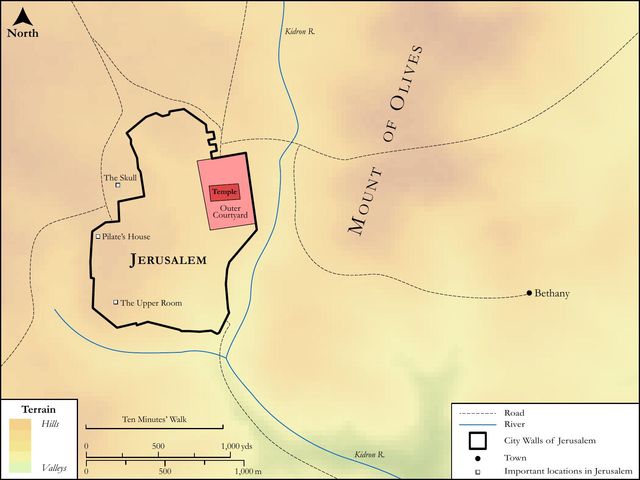
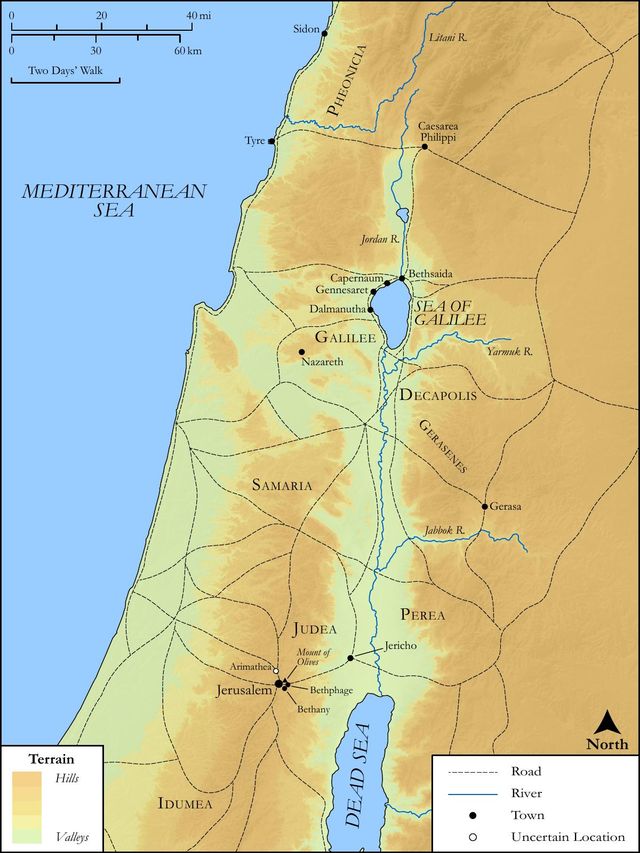
See on the biblical-era maps

Study this verse
Public-domain commentary
Matthew Henry
From his Commentary on the Whole Bible. Henry comments on passages, not single verses — this entry covers Mark 1:29–39. His three-level outline is real structure in the source text, so it is rendered as structure.
In these verses, we have,
I.A particular account of one miracle that Christ wrought, in the cure of Peter's wife's mother, who was ill of a fever. This passage we had before, in Matthew. Observe,
1.When Christ had done that which spread his fame throughout all parts, he did not then sit still, as some think that they may lie in bed when their name is up. No, he continued to do good, for that was it he aimed at, and not his own honour. Nay, those who are in reputation, had need be busy and careful to keep it up.
2.When he came out of the synagogue, where he had taught and healed with a divine authority, yet he conversed familiarly with the poor fishermen that attended him, and did not think it below him. Let the same mind, the same lowly mind, be in us, that was in him.
3.He went into Peter's house, probably invited thither to such entertainment as a poor fisherman could give him, and he accepted of it. The apostles left all for Christ; so far as that what they had should not hinder them from him, yet not so, but that they might use it for him.
4.He cured his mother-in-law, who was sick. Wherever Christ comes, he comes to do good, and will be sure to pay richly for his entertainment. Observe, How complete the cure was; when the fever left her, it did not, as usual, leave her weak, but the same hand that healed her, strengthened her, so that she was able to minister to them; the cure is in order to that, to fit for action, that we may minister to Christ, and to those that are his for his sake.
II.A general account of many cures he wrought - diseases healed, devils expelled.
It was on the evening of the sabbath, when the sun did set, or was set; perhaps many scrupled bringing their sick to him, till the sabbath was over, but their weakness therein was no prejudice to them in applying to Christ. Though he proved it lawful to heal on the sabbath days, yet, if any stumbled at it, they were welcome at another time. Now observe,
1.How numerous the patients were; All the city was gathered at the door, as beggars for a dole. That one cure in the synagogue occasioned this crowding after him. Others speeding well with Christ should quicken us in our enquiries after him. Now the Sun of righteousness rises with healing under his wings; to him shall the gathering of the people be. Observe, How Christ was flocked after in a private house, as well as in the synagogue; wherever he is, there let his servants, his patients, be. And in the evening of the sabbath, when the public worship is over, we must continue our attendance upon Jesus Christ; he healed, as Paul preached, publicly, and from house to house.
2.How powerful the Physician was; he healed all that were brought to him, though ever so many. Nor was it some one particular disease, that Christ set up for the cure of, but he healed those that were sick of divers diseases, for his word was a panpharmacon - a salve for every sore. And that miracle particularly which he wrought in the synagogue, he repeated in the house at night; for he cast out many devils, and suffered not the devils to speak, for he made them know who he was, and that silenced them. Or, He suffered them not to say that they knew him (so it may be read); he would not permit any more of them to say, as they did (Mar 1:24), I know thee, who thou art.
III.His retirement to his private devotion (Mar 1:35); He prayed, prayed alone; to set us an example of secret prayer.
Though as God he was prayed to, as man he prayed. Though he was glorifying God, and doing good, in his public work, yet he found time to be alone with his Father; and thus it became him to fulfil all righteousness. Now observe,
1.The time when Christ prayed.
(1.)It was in the morning, the morning after the sabbath day. Note, When a sabbath day is over and past, we must not think that we may intermit our devotion till the next sabbath: no, though we go not to the synagogue, we must go to the throne of grace, every day in the week; and the morning after the sabbath particularly, that we may preserve the good impressions of the day. This morning was the morning of the first day of the week, which afterward he sanctified, and made remarkable, by another sort of rising early.
(2.)It was early, a great while before day. When others were asleep in their beds, he was praying, as a genuine Son of David, who seeks God early, and directs his prayer in the morning; nay, and at midnight will rise to give thanks. It has been said, The morning is a friend to the Muses - Aurora Musis amica; and it is no less so to the Graces. When our spirits are most fresh and lively, then we should take time for devout exercises. He that is the first and best, ought to have the first and best.
2.The place where he prayed; He departed into a solitary place, either out of town, or some remote garden or out-building. Though he was in no danger of distraction, or of temptation to vain-glory, yet he retired, to set us an example to his own rule, When thou prayest enter into thy closet. Secret prayer must be made secretly. Those that have the most business in public, and of the best kind, must sometimes be alone with God; must retire into solitude, there to converse with God, and keep up communion with him.
IV.His return to his public work.
The disciples thought they were up early, but found their Master was up before them, and they enquired which way he went, followed him to his solitary place, and there found him at prayer, Mar 1:36, Mar 1:37. They told him that he was much wanted, that there were a great many patients waiting for him; All men seek for thee. They were proud that their Master was become so popular already, and would have him appear in public, yet more in that place, because it was their own city; and we are apt to be partial to the places we know and are interested in. "No," saith Christ, "Capernaum must not have the monopoly of the Messiah's preaching and miracles. Let us go into the next towns, the villages that lie about here, that I may preach there also, and work miracles there, for therefore came I forth, not to be constantly resident in one place, but to go about doing good." Even the inhabitants of the villages in Israel shall rehearse the righteous acts of the Lord, Jdg 5:11. Observe, Christ had still an eye to the end wherefore he came forth, and closely pursued that; nor will he be drawn by importunity, or the persuasions of his friends, to decline from that; for (Mar 1:39) he preached in their synagogues throughout all Galilee, and, to illustrate and confirm his doctrine, he cast out devils. Note, Christ's doctrine is Satan's destruction.
Historical interpretation
Seven Centuries of Reception
5 surviving comments on this verse. Each one is dated, so this reads as a timeline rather than a list.
Select a marker to jump to its quote. Markers stagger vertically where authors wrote within a few decades of each other.
But the door of the kingdom, morally, is repentance and faith, which works health for various diseases; for divers are the vices, with which the city of this world is sick.
(de Cons. Evan. ii. 19) But by this preaching, which, he says, He continued in all Galilee, is also meant the sermon of the Lord delivered on the mount, which Matthew mentions, and Mark has entirely passed over, without giving any thing like it, save that he has repeated some sentences not in continuous order, but in scattered places, spoken by the Lord at other times.
(Vict. Ant. e Cat. in Marc.) Not that He required prayer; for it was He who Himself received the prayers of men; but He did this by way of an economy, and became to us the model of good works.
(Vict. Ant. e Cat. in Marc.) Luke however says, that crowds came to Christ, and spoke what Mark here relates that the Apostles said, adding, And when they came to him, they said to him, All seek thee. (Luke 4:42) But they do not contradict each other; for Christ received after the Apostles the multitude, breathlessly anxious to embrace His feet. He received them willingly, but chose to dismiss them, that the rest also might be partakers of His doctrine, as He was not to remain long in the world. And therefore there follows: And he said, Let us go into the neighbouring villages and towns, that there also I may preach.
(Vict. Ant. e Cat. in Marc.) In which word, He manifests the mystery of His emptying himself, (Phil. 2:7) that is, of His incarnation, and the sovereignty of His divine nature, in that He here asserts, that He came willingly into the world. Luke however says, To this end was I sent, proclaiming the Dispensation, and the good pleasure of God the Father concerning the incarnation of the Son. There follows: And he continued preaching in their synagogues, in all Galilee.
(ubi sup.) Again mystically if by the setting of the sun, the death of the Saviour is intended, why should not His resurrection be intended by the returning dawn? For by its clear light, He went far into the wilderness of the Gentiles, and there continued praying in the person of His faithful disciples, for He aroused their hearts by the grace of the Holy Spirit to the virtue of prayer.
After that the Lord had cured the sick, He retired apart. Wherefore it is said, And rising very early in the morning, he went out and departed into a desert place. By which He taught us not to do any thing for the sake of appearance, but if we do any good, not to publish it openly. It goes on, and there prayed.
For He shows to us that we ought to attribute to God whatever we do well, and to say to Him, Every good gift cometh down from above, (James 1:17) from Thee. It continues: And Simon followed him, and they that were with him.
For He passes on to them as being more in need, since it was not right to shut up doctrine in one place, but to throw out his rays every where. It goes on: For therefore am I come.
He also mingled action with teaching, for whilst employed in preaching, He afterwards put to flight devils. For there follows: And casting out devils. For unless Christ showed forth miracles, His teaching would not be believed; so do thou also, after teaching, work, that thy word be not fruitless in thyself.
Continue studying Mark 1:39 across the web’s major study libraries — every link below opens this exact verse, chapter, or book on the destination site.
Read & Compare
 BibleGatewayThis verse in more than 200 translations and 70 languages.
 Bible.comThe YouVersion reader — hundreds of translations, reading plans, and highlights.
 ESV.orgCrossway's official English Standard Version reader.
 NET BibleThe NET translation with 60,000+ translators' notes on every rendering decision.
 STEP BibleTyndale House's free study tool — original text, vocabulary, and scholarly resources.
 BibliaLogos Bible Software's free web reader.
 USCCBThe New American Bible (Revised Edition) with the U.S. bishops' study notes.
Commentaries
 BibleHub CommentariesDozens of classic commentaries on this verse, gathered on one page.
 StudyLightMore than 100 commentary sets — the largest collection on the web.
 BibleRefPlain-English commentary on what this verse means, verse by verse.
 Enduring WordDavid Guzik's free commentary on this chapter, widely used by Bible teachers.
 Bible Study ToolsVerse commentary alongside Greek and Hebrew study aids.
Original Language & Research
- BibleHub InterlinearThe verse word by word — original language, transliteration, and English.
- BibleHub LexiconEvery word's original-language definition and Strong's entry.
 Blue Letter BibleDeep-study tools — Strong's numbers, concordance, and word studies.
 CNTR CollationThe earliest Greek manuscripts of this verse, collated letter by letter.
Sermons, Hymns & Audio


TrulyRandomVerse is not affiliated with these sites and doesn’t control their content. They’re linked because they’re genuinely useful.
Summary
Mark 1:39 provides a succinct yet profound summary of Jesus' early itinerant ministry, immediately following His call of the first disciples and initial miracles in Capernaum. This verse encapsulates the dual nature of His public work: the authoritative proclamation of God's Kingdom through preaching in Jewish synagogues across the entire region of Galilee, and the tangible demonstration of His divine power through the casting out of evil spirits. It highlights Jesus' comprehensive engagement with both the spiritual and physical needs of the people, establishing the pattern for His redemptive mission.
Context
ShowHideLiterary Context
Mark 1:39 concludes a significant section detailing the commencement of Jesus' public ministry. It follows His baptism and temptation (Mark 1:9-13), the calling of His first disciples (Mark 1:16-20), and a powerful day in Capernaum where He taught with authority in the synagogue, cast out an unclean spirit (Mark 1:21-28), and healed many, including Peter's mother-in-law (Mark 1:29-34). The preceding verse, Mark 1:38, explicitly states Jesus' purpose to "preach elsewhere" in the neighboring towns, setting the stage for the widespread evangelistic tour described in Mark 1:39. This verse acts as a bridge, summarizing the initial phase of His ministry before the narrative moves to other specific events.
Historical & Cultural Context
Galilee, a northern region of ancient Israel, was a diverse and populous area, often viewed by Judeans as less religiously pure due to its mixed population and close proximity to Gentile lands. This made it an ideal starting point for Jesus' ministry, as He sought to reach a broad audience beyond the religious elite of Jerusalem. Synagogues were central to Jewish community life in the first century, serving not only as places of worship and prayer but also as community centers, schools, and venues for public discourse and teaching. Unlike the Temple in Jerusalem, which was the sole center for sacrificial worship, synagogues were local and ubiquitous, providing accessible platforms for Jesus to disseminate His message and engage with the common people. His presence in these established religious institutions demonstrates His engagement with, yet ultimate transcendence of, the existing Jewish religious framework.
Key Themes
ShowHideThe verse significantly contributes to several key themes in Mark's Gospel. Firstly, it underscores the authority of Jesus as the Messiah, evident in both His teaching ("preached") and His power over spiritual forces ("cast out devils"). This authority is a recurring motif in Mark 1, particularly highlighted in Mark 1:22 where people were astonished by His teaching, and in Mark 1:27 where even unclean spirits obeyed Him. Secondly, it emphasizes the Kingdom of God as the central message of Jesus' ministry, a theme introduced in Mark 1:15. His preaching announced the arrival of God's reign, and His exorcisms were tangible manifestations of this Kingdom breaking into the world, confronting and defeating the powers of darkness. Lastly, the phrase "throughout all Galilee" highlights the expansive and itinerant nature of Jesus' mission, demonstrating His commitment to reaching as many people as possible with the good news, rather than confining Himself to one location.
Exposition and Analysis
ShowHideKey Word Analysis
ShowHideThis term signifies "to proclaim as a herald" or "to announce publicly and authoritatively." It is not merely teaching or discussing, but a formal, public declaration of significant news. In the context of Jesus, it refers to His authoritative proclamation of the Kingdom of God and the gospel message, much like a royal decree. This word emphasizes the public and official nature of His mission.
This verb means "to eject," "to drive out," or "to expel." It conveys a forceful and decisive action, indicating Jesus' absolute power and authority over the entities He was expelling. The use of this strong verb highlights the confrontational and victorious nature of Jesus' encounters with evil spirits, demonstrating His supremacy.
This term refers to "demonic beings" or "evil spirits." In the New Testament, these are understood as malevolent spiritual entities that oppose God and afflict humanity, often causing physical ailments, mental distress, or spiritual bondage. Jesus' ability to cast out these "devils" was a clear sign of His divine power and His mission to liberate humanity from the dominion of darkness.
Verse Breakdown
ShowHide"And he preached in their synagogues"
This clause describes the primary method and venue of Jesus' public ministry. "Preached" (kērýssō) signifies a public, authoritative proclamation, not just informal teaching. The "synagogues" were the local Jewish centers for worship, teaching, and community gatherings, providing an established platform for Jesus to deliver His message, signifying His engagement with the religious life of the people.
"throughout all Galilee"
This phrase emphasizes the extensive scope and itinerant nature of Jesus' ministry. He was not confined to one city or region but systematically traversed the entire area of Galilee, demonstrating a deliberate and widespread evangelistic effort to reach a broad populace with the message of the Kingdom of God.
"and cast out devils"
This final clause highlights the tangible demonstration of Jesus' divine power and authority. His ability to "cast out devils" (demons or evil spirits) served as powerful evidence of His identity as the Messiah and the inbreaking of God's Kingdom, directly confronting and overcoming the forces of spiritual darkness that held people captive.
Literary Devices
ShowHideMark's concise narrative style, often characterized by immediacy and action, is evident in Mark 1:39. The verse employs Parallelism by presenting two distinct but complementary actions of Jesus: "preached" and "cast out devils." This highlights the dual nature of His ministry – the proclamation of truth and the demonstration of power – which were inextricably linked. The phrase "throughout all Galilee" utilizes Hyperbole or Generalization to convey the extensive and comprehensive reach of Jesus' mission, implying a widespread and continuous effort rather than a literal visitation of every single synagogue. Furthermore, the actions described serve as Symbolism, where the casting out of devils symbolizes Jesus' ultimate victory over evil and the establishment of God's kingdom, which displaces the dominion of darkness.
Theological and Thematic Connections
ShowHideMark 1:39 profoundly illustrates the multifaceted nature of Jesus' redemptive work, which encompasses both the authoritative declaration of truth and the powerful demonstration of God's reign over all opposing forces. His ministry was not merely intellectual instruction but a dynamic confrontation with the spiritual realities of sin and evil. The combination of preaching and exorcism reveals that the gospel is not just a message to be heard, but a power to be experienced, bringing liberation from spiritual bondage and ushering in the transformative reality of God's Kingdom. This holistic approach to ministry—addressing both the spiritual and physical/demonic needs of humanity—is foundational to understanding Christ's mission and the ongoing work of His church.
Reflection and Application
ShowHideMark 1:39 offers a powerful blueprint for Christian life and ministry, reminding us that authentic faith involves both the proclamation of truth and the demonstration of God's power. Just as Jesus did not separate His teaching from His acts of deliverance, believers today are called to share the good news of the Kingdom of God not only through words but also through lives transformed by His power, bringing light into darkness and freedom to the oppressed. This might manifest as speaking truth in love, praying for healing, seeking justice, or engaging in spiritual warfare against the forces of evil in our own lives and communities. We are reminded that the spiritual battle is real, but Christ's authority is supreme. Our mission, empowered by the Holy Spirit, is to continue His work, bringing the liberating message and tangible presence of the Kingdom wherever we go.
Questions for Reflection
ShowHideFAQ
ShowHideWhy did Jesus primarily preach in synagogues?
ShowHideJesus primarily preached in synagogues because they were the established centers of Jewish community life, worship, and instruction in the first century. They provided a ready audience of people gathered to hear the Scriptures and discuss religious matters. This allowed Jesus to engage with the Jewish people within their existing religious framework, offering His new interpretation and fulfillment of the Law and Prophets. It also demonstrated His respect for the traditions, even as He brought a revolutionary message of the Kingdom of God.
What is the significance of Jesus casting out "devils" (demons)?
ShowHideThe casting out of "devils" (demons) was a profound demonstration of Jesus' divine authority and power, signifying the inbreaking of God's Kingdom into the world. In the Jewish worldview, demons were seen as agents of evil and darkness, often associated with sickness and spiritual oppression. Jesus' ability to effortlessly expel them proved His supremacy over the forces of evil and confirmed His identity as the Messiah, who had come to liberate humanity from the dominion of sin and Satan. It was a tangible sign that the strong man's house was being plundered by one stronger than him.
Christ-Centered Fulfillment
ShowHideMark 1:39, with its depiction of Jesus' widespread ministry of preaching and exorcism, finds its ultimate Christ-centered fulfillment in the comprehensive redemptive work of Jesus Christ. His "preaching" in the synagogues foreshadows the ultimate proclamation of the Gospel, where He Himself is the message, the good news of salvation and reconciliation with God. As the Word made flesh, Jesus embodies the divine truth He proclaimed, culminating in His death and resurrection, which became the central message of the early church (1 Corinthians 15:3-4). Furthermore, His act of "casting out devils" is a powerful prefigurement of His definitive victory over sin, death, and the devil on the cross. Through His crucifixion and resurrection, Jesus disarmed the powers and authorities, triumphing over them (Colossians 2:15). He became the ultimate deliverer, not just from individual demonic oppression, but from the spiritual bondage of sin that holds all humanity captive (Hebrews 2:14-15). Thus, Mark 1:39 is a snapshot of the Messiah initiating His mission, which finds its full and glorious accomplishment in His finished work, establishing His eternal reign and liberating His people.