


Mark 1:40
- ΚαὶKaiAndG2532CONJConjunction
- ἔρχεταιerchetaicomesG2064V-PNI-3SVerb Present Middle Or Passive Deponent Indicative 3rd Singular
- πρὸςprostoG4314PREPPreposition
- αὐτὸνautonHimG846P-ASMPersonal pronoun Accusative Singular Masculine
- λεπρὸςleprosa leperG3015A-NSMAdjective Nominative Singular Masculine
- παρακαλῶνparakalōnimploringG3870V-PAP-NSMVerb Present Active Participle Nominative Singular Masculine
- αὐτὸνautonHimG846P-ASMPersonal pronoun Accusative Singular Masculine
- καὶkaiandG2532CONJConjunction
- γονυπετῶνgonupetōnkneeling downG1120V-PAP-NSMVerb Present Active Participle Nominative Singular Masculine
- αὐτὸνautonto himG846P-ASMPersonal pronoun Accusative Singular Masculine
- καὶkaiandG2532CONJConjunction
- λέγωνlegōnsayingG3004V-PAP-NSMVerb Present Active Participle Nominative Singular Masculine
- αὐτῷautōto HimG846P-DSMPersonal pronoun Dative Singular Masculine
- ὅτιhotithatG3754CONJConjunction
- ἐὰνeanIfG1437CONDConjunction
- θέλῃςthelēsYou may be willingG2309V-PAS-2SVerb Present Active Subjunctive 2nd Singular
- δύνασαίdunasaiYou are ableG1410V-PNI-2SVerb Present Middle Or Passive Deponent Indicative 2nd Singular
- μεmemeG3165P-1ASPersonal pronoun Accusative 1st Singular
- καθαρίσαιkatharisaito cleanseG2511V-AANVerb Aorist Active Infinitive
English is a literal word-by-word gloss of the Greek, not the KJV's wording. Why?
This is the original text the KJV's translators worked from — each Greek word with its own literal English meaning in this verse, prepared by scholars at Tyndale House, Cambridge. The KJV translates whole sentences, not word by word, so its wording differs: one Greek word can become several English words, and the KJV may choose “charity” where the gloss reads “love”. Both are faithful — they answer different questions. For the KJV's own rendering, switch to the KJV text.
Details
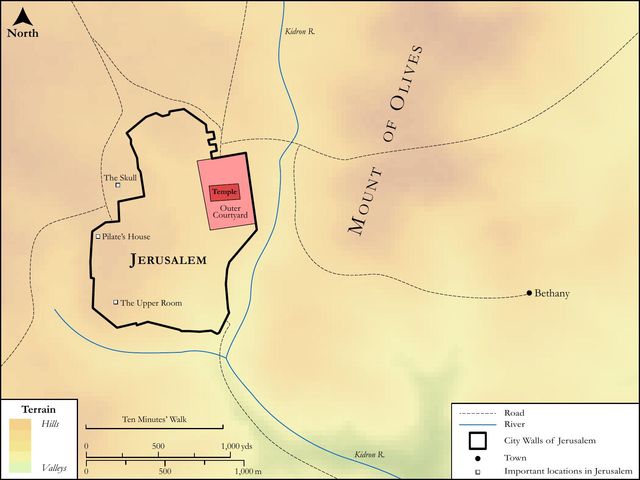
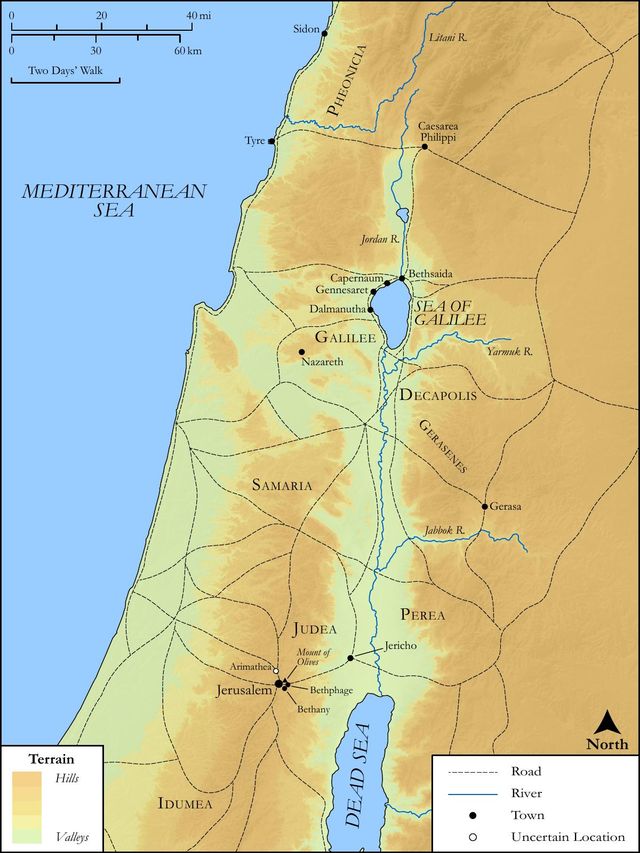
See on the biblical-era map
Study this verse
Public-domain commentary
Matthew Henry
From his Commentary on the Whole Bible. Henry comments on passages, not single verses — this entry covers Mark 1:40–45. His three-level outline is real structure in the source text, so it is rendered as structure.
We have here the story of Christ's cleansing a leper, which we had before, Mat 8:2-4. It teaches us,
1.How to apply ourselves to Christ; come as this leper did,
(1.)With great humility; this leper came beseeching him, and kneeling down to him (Mar 1:40); whether giving divine honour to him as God, or rather a less degree of respect as a great Prophet, it teaches us that those who would receive grace and mercy from Christ, must ascribe honour and glory to Christ, and approach to him with humility and reverence.
(2.)With a firm belief of his power; Thou canst make me clean. Though Christ's outward appearance was but mean, yet he had this faith in his power, which implies his belief that he was sent of God. He believes it with application, not only in general, Thou cast do every thing (as Joh 11:22), but, Thou cast make me clean. Note, What we believe of the power of Christ we must bring home to our particular case; Thou canst do this for me.
(3.)With submission to the will of Christ; Lord, if thou wilt. Not as if he had any doubt of Christ's readiness in general to help the distressed, but, with the modesty that became a poor petitioner, he refers his own particular case to him.
2.What to expect from Christ; that according to our faith it shall be to us. His address is not in the form of prayer, yet Christ answered it as a request. Note, Affectionate professions of faith in Christ, and resignations to him, are the most prevailing petitions for mercy from him, and shall speed accordingly.
(1.)Christ was moved with compassion. This is added here, in Mark, to show that Christ's power is employed by his pity for the relief of poor souls; that his reasons are fetched from within himself, and we have nothing in us to recommend us to his favour, but our misery makes us the objects of his mercy. And what he does for us he does with all possible tenderness.
(2.)He put forth his hand, and touched him. He exerted his power, and directed it to this creature. In healing souls, Christ toucheth them, Sa1 10:26. When the queen toucheth for the evil, she saith, I touch, God heals; but Christ toucheth and healeth too.
(3.)He said, I will, be thou clean. Christ's power was put forth in and by a word, to signify in what way Christ would ordinarily work spiritual cures; He sends his word and heals, Psa 107:20; Joh 15:3; Joh 17:17. The poor leper put an if upon the will of Christ; If thou wilt; but that doubt is soon put out of doubt; I will. Christ most readily wills favours to those that most readily refer themselves to his will. He was confident of Christ's power; Thou canst make me clean; and Christ will show how much his power is drawn out into act by the faith of his people, and therefore speaks the word as one having authority, Be thou clean. And power accompanied this word, and the cure was perfect in an instant; Immediately his leprosy vanished, and there remained no more sign of it, Mar 1:42.
3.What to do when we have received mercy from Christ. We must with his favours receive his commands. When Christ had cured him, he strictly charged him; the word here is very significant, embrimēsamenos - graviter interminatus - prohibiting with threats. I am apt to think that this refers not to the directions he gave him to conceal it (Mar 1:44), for those are mentioned by themselves; but that this was such a charge as he gave to the impotent man whom he cured, Joh 5:14, Sin no more, lest a worse thing come unto thee; for the leprosy was ordinarily the punishment of some particular sinners, as in Miriam's, Gehazi's, and Uzziah's, case; now, when Christ healed him, he warned him, he threatened him with the fatal consequence of it if he should return to sin again. He also appointed him,
(1.)To show himself to the priest, that the priest by his own judgment of this leper might be a witness for Christ, that he was the Messiah, Mat 11:5.
(2.)Till he had done that, not to say any thing of it to any man: this is an instance of the humility of Christ and his self-denial, that he did not seek his own honour, did not strive or cry, Isa 42:2. And it is an example to us, not to seek our own glory, Pro 25:27. He must not proclaim it, because that would much increase the crowd that followed Christ, which he thought was too great already; not as if he were unwilling to do good to all, to as many as came; but he would do it with as little noise as might be, would have no offence given to the government, no disturbance of the public peace, not any thing done that looked like ostentation, or an affecting of popular applause. What to think of the leper's publishing it, and blazing it abroad, I know not; the concealment of the good characters and good works of good men better become them than their friends; nor are we always bound by the modest commands of humble men. The leper ought to have observed his orders; yet, no doubt, it was with a good design that he proclaimed the cure, and it had no other ill effect than that it increased the multitudes which followed Christ, to that degree, that he could no more openly enter into the city; not upon the account of persecution (there was no danger of that yet,) but because the crowd was so great, that the streets would not hold them, which obliged him to go into desert places, to a mountain (Mar 3:13), to the sea-side, Mar 4:1. This shows how expedient it was for us, that Christ should go away, and send the Comforter, for his bodily presence could be but in one place at a time; and those that came to him from every quarter, could not get near him; but by his spiritual presence he is with his people wherever they are, and comes to them to every quarter.
Historical interpretation
Seven Centuries of Reception
7 surviving comments on this verse. Each one is dated, so this reads as a timeline rather than a list.
Select a marker to jump to its quote. Markers stagger vertically where authors wrote within a few decades of each other.
Mystically, our leprosy is the sin of the first man, which began from the head, when he desired the kingdoms of the world. For covetousness is the root of all evil; wherefore Gehazi, engaged in an avaritious pursuit, is covered with leprosy.
This leprosy is cleansed on offering an oblation to the true Priest after the order of Melchisedec; for He tells us, Give alms of such things as ye have, and, behold, all things are clean unto you. (Luke 11:41) But in that Jesus could not openly enter into the city, it is meant to be conveyed, that Jesus is not manifested to those, who are enslaved to the love of praise in the broad highway, and to their own wills, but to those who with Peter go into the desert, which the Lord chose for prayer, and for refreshing His people; that is, those who quit the pleasures of the world, and all that they possess, that they may say, The Lord is my portion. But the glory of the Lord is manifested to those, who meet together on all sides, that is, through smooth ways and steep, whom nothing can separate from the love of Christ. (Rom. 8:35)
(Hom. 25. in Matt) Further, the reason why He touches the leper, and did not confer health upon him by word alone, was, that it is said by Moses in the Law, that he who touches a leper, shall be unclean till the evening; that is, that he might show, that this uncleanness is a natural one, that the Law was not laid down for Him, but on account of mere men. Furthermore, He shows that He Himself is the Lord of the Law; and the reason why He touched the leper, though the touch was not necessary to the working of the cure, was to show that He gives health, not as a servant, but as the Lord.
(Hom. 25. in Matt) Moreover, by this, not only did He not take away the opinion of Him entertained by the leper, but He confirmed it; for He puts to flight the disease by a word, and what the leper had said in word, He filled up in deed; wherefore there follows, And when he had spoken, immediately, &c.
(Hom. 25) As if He said, It is not yet time that My works should be preached, I require not thy preaching. By which He teaches us not to seek worldly honour as a reward for our works. It goes on: But go thy way, show thyself to the chief of the priests. Our Saviour sent him to the priest for the trial of his cure, and that he might not be cast out of the temple, but still be numbered with the people in prayer. He sends him also, that he might fulfil all the parts of the Law, in order to stop the evil-speaking tongue of the Jews. He Himself indeed completed the work, leaving them to try it.
(non occ.) For the leper every where proclaimed his wonderful cure, so that all ran to see and to believe on the Healer; thus the Lord could not preach the Gospel, but walked in desert places; wherefore there follows, And they came together to him from all places.
It is not in one’s own power, however admirable and trustworthy may be the knowledge one has of the facts, to determine the order in which he will recall them to memory. For the way in which one thing comes into one’s mind before or after another proceeds not as we will, but simply as it occurs to us. It is reasonable enough to suppose that each of the Evangelists believed it to have been his duty to relate what he had to relate in that order in which it had pleased God to suggest it to his recollection.
(de Con. Evan. ii. 19) Mark puts together circumstances, from which one may infer that he is the same as that one whom Matthew (Matt. 8:2) relates to have been cleansed, when the Lord came down from the mount, after the sermon.
And there came to him a leper beseeching him, etc. Concerning this leper who was cleansed, it connects that he should be understood as the one whom Matthew mentions as being cleansed when the Lord came down from the mountain after that discourse. For thus Matthew says: When he had come down from the mountain, great crowds followed him (Matt. VIII). And behold, a leper came and worshipped him, saying: Lord, if you will, you can make me clean, etc. And because the Lord said: I have not come to destroy the law, but to fulfill it (Matt. V), he who was excluded by the law, presuming to be cleansed by the power of the Lord, judged that grace exists not from the law but above the law, which could wash away the stain of the leper. However, just as the authority of power is declared in the Lord, so in him is the constancy of faith. He fell on his face, which is an act of humility and shame, as everyone should be ashamed of the blemishes of his life; but shame did not suppress confession. He showed his wound, requested a remedy, and it is a confession full of religion and faith. If you will, he says, you can make me clean. He attributed the power to the will of the Lord. But concerning the will of the Lord, he did not doubt not as one incredulous in piety but as one conscious of his own foulness, he did not presume. However, Jesus, moved with compassion, stretched forth his hand and touched him, and said to him: I will, be clean. And when he had said it, immediately the leprosy departed from him, and he was cleansed. There is nothing intermediate between the work of God and the command, because the work is in the command. Finally, he spoke, and they were made (Ps. XXXII). You see, therefore, that it cannot be doubted that the will of God is power? Therefore, if his will is power, they who assert the unity of will, assuredly assert the unity of power. Therefore, as one who has the power of healing, and the authority of commanding, he does not avoid the testimony of working. For he says 'I will' because of Photinus, he commands because of Arius, he touches because of Manichaeus. And indeed the law prohibits touching lepers; but since the Lord is the lawgiver, he does not obey the law but makes the law. Therefore, he did not touch because he could not cleanse without touching, but to prove that he was not subject to the law. He did not fear contamination as humans do, but because he could not be defiled who was liberating others, the leprosy flees at the touch of the Lord, which used to contaminate the one touching. Together with this wonder, he healed in the same manner in which he had been entreated. If you will, you can make me clean. He says, I will, be clean. You have the will, you also have the effect of piety. Therefore, (contrary to what many Latins think) it should not be joined and read "I will to make you clean," but separated, so that first he says 'I will', then he commands, 'be clean.'
(ubi sup.) Again mystically if by the setting of the sun, the death of the Saviour is intended, why should not His resurrection be intended by the returning dawn? For by its clear light, He went far into the wilderness of the Gentiles, and there continued praying in the person of His faithful disciples, for He aroused their hearts by the grace of the Holy Spirit to the virtue of prayer.
(in Marc. i. 7) After that the serpent-tongue of the devils was shut up, and the woman, who was first seduced, cured of a fever, in the third place, the man, who listened to the evil counsels of the woman, is cleansed from his leprosy, that the order of restoration in the Lord might be the same as was the order of the fall in our first parents; whence it goes on: And there came a leper to him, beseeching him.
(in Marc. i. 9) And because the Lord said that He came not to destroy the Law but to fulfill, (Matt. 5:17) he who was excluded by the Law, inferring that he was cleansed by the power of the Lord, showed that that grace, which could wash away the stain of the leper, was not from the Law, but over the Law. And truly, as in the Lord authoritative power, so in him the constancy of faith is shewn; for there follows, Lord, if thou wilt, thou canst make me clean. He falls on his face, which is at once a gesture of lowliness and of shame, to show that every man should blush for the stains of his life. But his shame did not stifle confession; he showed his wound, and begged for medicine, and the confession is full of devotion and of faith, for he refers the power to the will of the Lord.
(ubi sup.) Moreover, he doubted of the will of the Lord, not as disbelieving His compassion, but, as conscious of his own filth, he did not presume. It goes on; But Jesus, moved with compassion, put forth his hand, and touched him, and saith unto him, I will, be thou clean. It is not, as many of the Latins think, to be taken to mean and read, I wish to cleanse thee, but that Christ should say separately, I will, and then command, be thou clean.
(ubi sup.) Another reason why He touched him, was to prove that He could not be defiled, who freed others from pollution. At the same time it is remarkable, that He healed in the way in which He had been begged to heal. If thou will, says the leper, thou canst make me clean. I will, He answered, behold, thou hast My will, be clean; now thou hast at once the effect of My compassion.
(ubi sup.) For there is no interval between the work of God and the command, because the work is in the command, for He commanded, and they were created. (Ps. 148:5) There follows: And he straitly charged him, and forthwith, &c. See thou tell no man.
(ubi sup.) This He did in order that the priest might understand that the leper was not healed by the Law, but by the grace of God above the Law. There follows: And offer for thy cleansing what. Moses, &c.
(ubi sup.) If any one wonders, how the Lord seems to approve of the Jewish sacrifice, which the Church rejects, let him remember, that He had not yet offered His own holocaust in His passion. And it was not right that significative sacrifices should be taken away, before that which they signified was confirmed by the witness of the Apostles in their preaching, and by the faith of the believing people.
(ubi sup. v. Greg. Moral. 19:22) Now it may well be asked, why our Lord ordered His action to be concealed, and yet it could not be kept hid for an hour? But it is to be observed, that the reason why, in doing a miracle, He ordered it to be kept secret, and yet for all that it was noised abroad, was, that His elect, following the example of His teaching, should wish indeed that in the great things which they do, they should remain concealed, but should nevertheless unwillingly be brought to light for the good of others. Not then that He wished any thing to be done, which He was not able to bring about, but, by the authority of His teaching, He gave an example of what His members ought to wish for, and of what should happen to them even against their will.
Further, this perfect cure of one man brought large multitudes to the Lord; wherefore it is added, So that he could not any more openly enter into the city, but could only be without in desert places.
(ubi sup.) But when the hand of the Saviour, that is, the Incarnate Word of God, is stretched out, and touches human nature, it is cleansed from the various parts of the old error.
(in Marc. i. 10) Even after working a miracle in that city, the Lord retires into the desert, to show that He loves best a quiet life, and one far removed from the cares of the world, and that it is on account of this desire, He applied Himself to the healing of the body.
For he said not, If thou wilt, pray unto God, but, If thou wilt, as thinking Him very God.
He ordered him to offer the gift which they who were healed were accustomed to offer, as if for a testimony, that He was not against the Law, but rather confirmed the Law, inasmuch as He Himself worked out the precepts of the Law.
But the leper, although the Lord forbade him, disclosed the benefit, wherefore it goes on: But he having gone out, began to publish and to blaze abroad the tale; for the person benefited ought to be grateful, and to return thanks, even though his benefactor requires it not.
Continue studying Mark 1:40 across the web’s major study libraries — every link below opens this exact verse, chapter, or book on the destination site.
Read & Compare
 BibleGatewayThis verse in more than 200 translations and 70 languages.
 Bible.comThe YouVersion reader — hundreds of translations, reading plans, and highlights.
 ESV.orgCrossway's official English Standard Version reader.
 NET BibleThe NET translation with 60,000+ translators' notes on every rendering decision.
 STEP BibleTyndale House's free study tool — original text, vocabulary, and scholarly resources.
 BibliaLogos Bible Software's free web reader.
 USCCBThe New American Bible (Revised Edition) with the U.S. bishops' study notes.
Commentaries
 BibleHub CommentariesDozens of classic commentaries on this verse, gathered on one page.
 StudyLightMore than 100 commentary sets — the largest collection on the web.
 BibleRefPlain-English commentary on what this verse means, verse by verse.
 Enduring WordDavid Guzik's free commentary on this chapter, widely used by Bible teachers.
 Bible Study ToolsVerse commentary alongside Greek and Hebrew study aids.
Original Language & Research
- BibleHub InterlinearThe verse word by word — original language, transliteration, and English.
- BibleHub LexiconEvery word's original-language definition and Strong's entry.
 Blue Letter BibleDeep-study tools — Strong's numbers, concordance, and word studies.
 CNTR CollationThe earliest Greek manuscripts of this verse, collated letter by letter.
Sermons, Hymns & Audio


TrulyRandomVerse is not affiliated with these sites and doesn’t control their content. They’re linked because they’re genuinely useful.
Summary
Mark 1:40 powerfully depicts a desperate leper's encounter with Jesus, highlighting his profound humility and unwavering faith. Despite the severe social and religious ostracization associated with his condition, the leper boldly approaches Jesus, kneeling in supplication, and declares his absolute conviction in Jesus' ability to heal him, appealing only to His willingness to do so. This poignant interaction sets the stage for a remarkable demonstration of Jesus' compassion and divine authority over disease and ceremonial uncleanness.
Context
ShowHideLiterary Context
This encounter with the leper occurs early in Jesus' Galilean ministry, immediately following a period of intense activity in Capernaum. Mark 1:21-39 details Jesus' authoritative teaching in the synagogue, His casting out of an unclean spirit, and the healing of Simon's mother-in-law, followed by a multitude of healings and exorcisms throughout the city. Jesus then withdraws to pray and subsequently announces His intention to preach in other towns, stating, "Let us go into the next towns, that I may preach there also: for therefore came I forth" (Mark 1:38). The leper's audacious approach interrupts this itinerant preaching, yet Jesus' response underscores His mission to bring holistic restoration, not just through words but through compassionate action, demonstrating His authority over the physical realm, social barriers, and ceremonial law.
Historical & Cultural Context
In ancient Israel, leprosy (Hebrew: tzara'at) was a devastating and highly stigmatized condition, encompassing a range of severe skin diseases, not limited to modern Hansen's disease. According to Mosaic Law, individuals afflicted with leprosy were considered ceremonially unclean and were legally compelled to live in isolation outside the community, crying out "Unclean! Unclean!" to warn others (Leviticus 13:45-46). They were forbidden from social interaction, temple worship, and even physical contact with others, rendering them spiritual and social pariahs. The leper's act of approaching Jesus, let alone kneeling before Him, was a profound and dangerous breach of these deeply ingrained societal and religious norms, driven by an extraordinary level of desperation and hope.
Key Themes
ShowHideMark 1:40 introduces several pivotal themes that resonate throughout the Gospel. First, the leper's plea, "If thou wilt, thou canst make me clean," highlights Profound Faith. He possesses an absolute conviction in Jesus' power ("thou canst") and appeals only to His compassionate will ("If thou wilt"), demonstrating a deep trust in Jesus' sovereignty. Second, the narrative underscores Jesus' Authority and Power not only over physical ailments but also over the ceremonial uncleanness that isolated the leper. This healing, further detailed in Mark 1:41-42, signifies Jesus' ability to restore individuals to physical health, social inclusion, and spiritual purity. Third, the leper's actions exemplify Desperation and Boldness, as he defies profound social stigma and religious prohibitions to seek help, illustrating that no one is too outcast or "unclean" for Jesus' attention and restorative power.
Exposition and Analysis
ShowHideKey Word Analysis
ShowHideFrom the same root as lépra (leprosy), this term refers to someone afflicted with a scaly skin disease, often identified with the biblical condition of leprosy. In the ancient world, this condition carried immense social and religious stigma, rendering the individual ceremonially unclean and outcast from society. The presence of a "leper" in this verse immediately sets a scene of profound human suffering and societal exclusion.
Derived from a compound word meaning "to fall on the knee," this verb describes the leper's posture of profound humility, reverence, and supplication. Kneeling was a common posture of prayer, worship, and earnest entreaty in the ancient world. For a leper, who was typically shunned, to kneel before Jesus signifies an extraordinary act of desperation, faith, and recognition of Jesus' unique authority and holiness.
This verb signifies the ability or possibility to do something, to "be able" or "be of power." The leper's declaration, "thou canst make me clean," is a powerful affirmation of his absolute conviction in Jesus' inherent power and capacity to perform the miracle. He does not doubt Jesus' ability; his only question pertains to Jesus' willingness.
From katharós (pure), this verb means "to cleanse" or "to purify," both literally and figuratively. For the leper, being made "clean" meant more than just physical healing; it implied restoration to ceremonial purity, allowing him to re-enter society, participate in religious life, and be free from the defilement associated with his disease. This word carries significant theological weight, foreshadowing Jesus' ultimate work of spiritual cleansing from sin.
Verse Breakdown
ShowHide"And there came a leper to him"
This opening phrase immediately establishes the extraordinary nature of the encounter. A leper, legally and socially compelled to remain isolated, actively seeks out Jesus. This act is one of immense courage and desperation, defying all conventional boundaries and highlighting the leper's profound hope.
"beseeching him, and kneeling down to him"
These actions underscore the leper's humility, earnestness, and reverence. "Beseeching" (Greek, parakaléō) conveys a strong sense of urgent appeal or imploration. "Kneeling down" (Greek, gonypetéō) is a posture of deep respect, submission, and desperate petition, indicating that the leper recognized Jesus' unique authority and power, approaching Him as one would approach a divine or royal figure.
"and saying unto him, If thou wilt, thou canst make me clean"
This is the heart of the leper's plea, revealing both his profound faith and his understanding of Jesus' sovereignty. He expresses absolute certainty in Jesus' ability ("thou canst," G1410 dýnamai), making it clear that his only question is concerning Jesus' willingness ("If thou wilt," G2309 thélō). The request to be made "clean" (G2511 katharízō) encompasses not just physical healing but also restoration to ceremonial purity, social acceptance, and spiritual wholeness, reflecting the comprehensive defilement associated with leprosy.
Literary Devices
ShowHideMark 1:40 employs several powerful literary devices. The scene is imbued with Pathos, evoking deep sympathy for the leper's plight—his physical suffering, social ostracism, and desperate hope. The very act of his approach, given his condition, creates a dramatic tension that immediately draws the reader in. Symbolism is also central, as leprosy in the biblical context often served as a powerful symbol of sin and its defiling, isolating effects. Thus, the leper's plea to be made "clean" carries a deeper spiritual resonance, foreshadowing Jesus' power to cleanse from spiritual impurity. Furthermore, there is a striking Contrast between the leper's "unclean" status and the holiness of Jesus, and between the societal mandate for isolation and the leper's bold, direct approach to the Lord. This contrast highlights Jesus' radical compassion and His willingness to transcend human-made barriers and ritualistic distinctions.
Theological and Thematic Connections
ShowHideThis encounter profoundly illustrates the nature of God's compassion and power in the person of Jesus. The leper's faith, expressed in his conviction of Jesus' ability, serves as a model for all who approach God with their deepest needs. Jesus' subsequent action (detailed in the following verses) demonstrates that His divine will is perfectly aligned with His divine power and compassion. He is not only able but also willing to restore those who are outcast, broken, and defiled, offering a holistic cleansing that transcends physical healing to encompass social and spiritual restoration. This miracle foreshadows the ultimate cleansing from sin that Jesus would accomplish through His atoning work, making the "unclean" clean and bringing the estranged back into fellowship with God.
Reflection and Application
ShowHideMark 1:40 offers profound encouragement and a powerful call to faith for believers today. Just as the leper, burdened by his physical and social "uncleanness," dared to approach Jesus, we are invited to come to Him with all our brokenness, shame, and perceived inadequacies. The leper's unwavering belief in Jesus' power, coupled with his humble appeal to Jesus' will, teaches us to trust not only in God's omnipotence but also in His boundless compassion and desire to heal and restore. No condition is too dire, no sin too great, no past too stained for Jesus' cleansing touch. This verse reminds us that true cleansing—physical, emotional, and spiritual—comes from an encounter with Christ, who is both able and willing to make us whole. It challenges us to shed our fears of rejection and boldly lay our needs before Him, confident in His loving response.
Questions for Reflection
ShowHideFAQ
ShowHideWhy was leprosy so significant in biblical times, and what did "clean" truly mean for the leper?
ShowHideIn biblical times, "leprosy" (Hebrew: tzara'at) referred to a variety of severe, often chronic, skin conditions. Its significance stemmed not only from its physical debilitation but primarily from its profound religious and social implications. According to Mosaic Law, a leper was deemed ceremonially "unclean" (Leviticus 13). This meant they were cut off from the community, unable to participate in temple worship, and forbidden from touching or being touched by others. To be made "clean" (Greek: katharízō) for the leper therefore implied a multifaceted restoration: physical healing from the disease, reinstatement of ceremonial purity, and, most crucially, reintegration into society and the religious life of Israel. It was a restoration of their entire personhood—body, soul, and social standing—a profound act of grace and healing.
What is the significance of the leper kneeling and saying, "If thou wilt, thou canst make me clean"?
ShowHideThe leper's act of kneeling (Greek: gonypetéō) is a posture of profound humility, reverence, and desperate supplication, acknowledging Jesus' superior authority and holiness. His specific phrasing, "If thou wilt, thou canst make me clean," is highly significant. It demonstrates an absolute, unwavering faith in Jesus' ability (Greek: dýnamai) to heal him. He has no doubt that Jesus possesses the power. His only question pertains to Jesus' willingness (Greek: thélō). This indicates a deep understanding of sovereignty, recognizing that while God is all-powerful, He also acts according to His perfect will. It's a humble yet bold request, trusting completely in Jesus' compassion and divine prerogative, rather than demanding a miracle.
Christ-Centered Fulfillment
ShowHideThe encounter with the leper in Mark 1:40 finds its ultimate fulfillment in the person and work of Jesus Christ. The leper's desperate plea for "cleansing" foreshadows humanity's universal need for spiritual purification from the defilement of sin. Just as leprosy rendered an individual outcast and ceremonially unclean, so too does sin separate humanity from a holy God (Isaiah 59:2). Jesus' willingness to allow the leper to approach, and His subsequent compassionate touch (as detailed in Mark 1:41), powerfully prefigures His identification with our brokenness and His ultimate sacrifice. On the cross, Jesus, the sinless Son of God, became "sin for us" (2 Corinthians 5:21), bearing our infirmities and taking upon Himself the "uncleanness" of our sin (Isaiah 53:4-5). Through His shed blood, He offers a complete and eternal cleansing, purifying not just our bodies but our consciences from dead works to serve the living God (Hebrews 9:14). The leper's restoration to community and worship points to Christ's work of reconciling us to God and to one another, making us part of His holy body, the Church, "that he might sanctify and cleanse it with the washing of water by the word" (Ephesians 5:26). Jesus is not only able but eternally willing to make us clean.