


Philippians 4:20
Bible text: King James Version (1769 Blayney text) · Public domain
Bible text: Berean Standard Bible · Public domain
Bible text: American Standard Version (1901) · Public domain
Bible text: World English Bible, Messianic edition · Public domain
Bible text: Geneva Bible (1599) · Public domain
Bible text: Young's Literal Translation · Public domain
- τῷtōTo theG3588T-DSMDefinite article Dative Singular Masculine
- δὲdenowG1161CONJConjunction
- θεῷtheōGodG2316N-DSM-TNoun Dative Singular Masculine Title
- καὶkaiandG2532CONJConjunction
- πατρὶpatriFatherG3962N-DSM-TNoun Dative Singular Masculine Title
- ἡμῶνhēmōnof us [is]G3165P-1GPPersonal pronoun Genitive 1st Plural
- ἡhē[be] theG3588T-NSFDefinite article Nominative Singular Feminine
- δόξαdoxagloryG1391N-NSFNoun Nominative Singular Feminine
- εἰςeistoG1519PREPPreposition
- τοὺςtoustheG3588T-APMDefinite article Accusative Plural Masculine
- αἰῶναςaiōnasagesG165N-APMNoun Accusative Plural Masculine
- τῶνtōnof theG3588T-GPMDefinite article Genitive Plural Masculine
- αἰώνωνaiōnōnagesG165N-GPMNoun Genitive Plural Masculine
- ἀμήνamēnAmenG281INJ-HEBInterjection
English is a literal word-by-word gloss of the Greek, not the KJV's wording. Why?
This is the original text the KJV's translators worked from — each Greek word with its own literal English meaning in this verse, prepared by scholars at Tyndale House, Cambridge. The KJV translates whole sentences, not word by word, so its wording differs: one Greek word can become several English words, and the KJV may choose “charity” where the gloss reads “love”. Both are faithful — they answer different questions. For the KJV's own rendering, switch to the KJV text.
Details
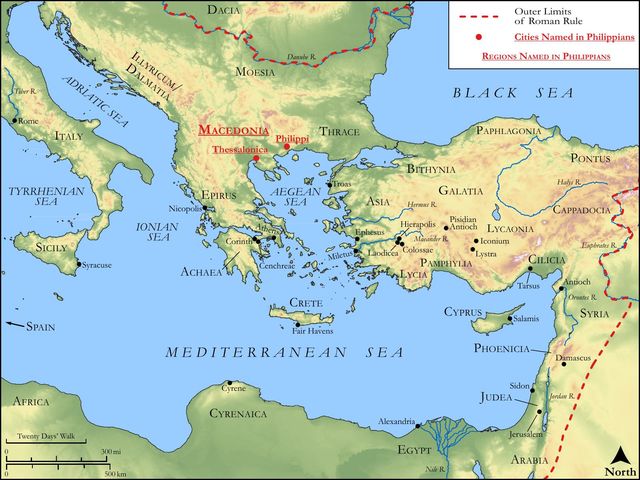
See on the biblical-era maps

Study this verse
Public-domain commentary
Matthew Henry
From his Commentary on the Whole Bible. Henry comments on passages, not single verses — this entry covers Philippians 4:20–23. His three-level outline is real structure in the source text, so it is rendered as structure.
The apostle concludes the epistle in these verses,
1.With praises to God: Now unto God and our Father be glory for ever and ever, Amen, Phi 4:20. Observe,
(1.)God is to be considered by us as our Father: Now unto God and our Father. It is a great condescension and favour in God to own the relation of Father to sinners, and allow us to say to him, Our Father; and it is a title peculiar to the gospel dispensation. It is also a great privilege and encouragement to us to consider him as our Father, as one so nearly related and who bears so tender an affection towards us. We should look upon God, under all our weaknesses and fears, not as a tyrant or an enemy, but as a Father, who is disposed to pity us and help us.
(2.)We must ascribe glory to God as a Father, the glory of his own excellence and of all his mercy unto us. We must thankfully own the receipt of all from him, and give the praise of all to him. And our praise must be constant and perpetual; it must be glory for ever and ever.
2.With salutations to his friends at Philippi: "Salute every saint in Christ Jesus (Phi 4:21); give my hearty love to all the Christians in your parts." He desires remembrances not only to the bishops and deacons, and the church in general, but to every particular saint. Paul had a kind affection to all good Christians.
3.He sends salutations from those who were at Rome: "The brethren who are with me salute you; the ministers, and all the saints here, send their affectionate remembrances to you. Chiefly those who are of Caesar's household; the Christian converts who belonged to the emperor's court." Observe,
(1.)There were saints in Caesar's household. Though Paul was imprisoned at Rome, for preaching the gospel, by the emperor's command, yet there were some Christians in his own family. The gospel early obtained among some of the rich and great. Perhaps the apostle fared the better, and received some favour, by means of his friends at court.
(2.)Chiefly those, etc. Observe, They, being bred at court, were more complaisant than the rest. See what an ornament to religion sanctified civility is.
4.The apostolical benediction, as usual: "The grace of our Lord Jesus Christ be with you all, Amen. The free favour and good will of Christ be your portion and happiness."
Historical interpretation
Historical reception
3 surviving comments on this verse. Each one is dated, so this reads as a timeline rather than a list.
Select a marker to jump to its quote. Markers stagger vertically where authors wrote within a few decades of each other.
Here he makes no distinction [as in 4:19] but prays to both our God and our Father. He calls upon God on account of awe. He calls upon the Father for the sake of honor and because every beginning is from him.
"Now unto our God and Father be the glory for ever and ever. Amen." For the glory of which he speaks belongs not only to the Son, but to the Father too, for when the Son is glorified, then is the Father also. For when he said, This is done to the glory of Christ, lest any one should suppose that it is to His glory alone, he continued, "Unto our God and Father be the glory," that glory which is paid to the Son.
Here he praises the Father alone, whereas elsewhere he praises the Son alone. … He does not divide the Son from the Father or the Father from the Son. He offers the hymn to the divine nature as a whole.
Continue studying Philippians 4:20 across the web’s major study libraries — every link below opens this exact verse, chapter, or book on the destination site.
Read & Compare
 BibleGatewayThis verse in more than 200 translations and 70 languages.
 Bible.comThe YouVersion reader — hundreds of translations, reading plans, and highlights.
 ESV.orgCrossway's official English Standard Version reader.
 NET BibleThe NET translation with 60,000+ translators' notes on every rendering decision.
 STEP BibleTyndale House's free study tool — original text, vocabulary, and scholarly resources.
 BibliaLogos Bible Software's free web reader.
 USCCBThe New American Bible (Revised Edition) with the U.S. bishops' study notes.
Commentaries
 BibleHub CommentariesDozens of classic commentaries on this verse, gathered on one page.
 StudyLightMore than 100 commentary sets — the largest collection on the web.
 BibleRefPlain-English commentary on what this verse means, verse by verse.
 Enduring WordDavid Guzik's free commentary on this chapter, widely used by Bible teachers.
 Bible Study ToolsVerse commentary alongside Greek and Hebrew study aids.
Original Language & Research
- BibleHub InterlinearThe verse word by word — original language, transliteration, and English.
- BibleHub LexiconEvery word's original-language definition and Strong's entry.
 Blue Letter BibleDeep-study tools — Strong's numbers, concordance, and word studies.
 CNTR CollationThe earliest Greek manuscripts of this verse, collated letter by letter.
Sermons, Hymns & Audio


TrulyRandomVerse is not affiliated with these sites and doesn’t control their content. They’re linked because they’re genuinely useful.
Summary
Philippians 4:20 is a profound doxology, a spontaneous and heartfelt outburst of praise from the Apostle Paul to God the Father. This verse serves as a fitting capstone to Paul's preceding discourse on contentment in all circumstances and his deep gratitude for the Philippian church's generous financial support. It encapsulates his theology of divine provision and faithfulness, culminating in an eternal declaration of glory to the one who is the ultimate source of all good things, affirming God's supreme worthiness of unending adoration.
Context
ShowHideLiterary Context
Philippians 4:20 immediately follows Paul's profound exposition on contentment and divine provision. In the preceding verses (Philippians 4:10-19), Paul expresses his overwhelming joy and gratitude for the Philippians' renewed care and financial support, which had reached him during his imprisonment. He clarifies that his contentment is not dependent on circumstances or material possessions, but on Christ who strengthens him (Philippians 4:11-13). He then acknowledges the Philippians' unique history of partnership in his ministry, specifically their repeated financial gifts, which he views not as a debt owed to him, but as "fruit that increases to your credit" (Philippians 4:17). The climax of this section is his confident declaration in Philippians 4:19, "But my God shall supply all your need according to his riches in glory by Christ Jesus." Verse 20, therefore, is not merely a concluding remark but a natural and fervent response of worship, a theological exclamation point to God's faithfulness and the Philippians' generosity, recognizing God as the ultimate provider and worthy of all praise.
Historical & Cultural Context
Paul wrote the letter to the Philippians likely from Roman imprisonment (c. AD 60-62), though some scholars suggest an earlier imprisonment in Ephesus or Caesarea. The Philippian church held a special place in Paul's heart; it was the first church he founded in Europe (Acts 16). Unlike many other churches, the Philippians consistently supported Paul financially, even when he was no longer with them (Philippians 4:15-16). Among the Greeks and Romans, patronage was a common social practice, where a patron provided support to a client, expecting loyalty or honor in return. While Paul appreciated the Philippians' gift, he reframed it not as a patron-client relationship, but as a spiritual partnership in the gospel, ultimately redounding to God's glory. Doxologies, like the one in Philippians 4:20, were common in both Jewish and early Christian worship, serving as formal expressions of praise and honor directed towards God, often concluding prayers or sections of teaching.
Key Themes
ShowHideThis verse powerfully encapsulates several key themes prevalent throughout Paul's letter and broader theology. Firstly, Doxology and Worship is central, as the verse itself is an act of direct praise, emphasizing God's inherent worthiness of all honor and adoration. It highlights that the ultimate response to God's character and provision is worship. Secondly, the theme of God's Sovereignty and Fatherhood is evident in the address "God and our Father," underscoring both His supreme authority over all creation and His intimate, loving, covenantal relationship with believers. This duality emphasizes His majesty and His tender care for His children. Thirdly, the phrase "for ever and ever" points to Eternal Glory, signifying the timeless, unending, and unchanging nature of God's glory. It teaches that God's praise is not bound by temporal circumstances but is an eternal reality, echoing the sentiment that all things ultimately exist for His glory. Finally, the concluding "Amen" signifies Affirmation and Certainty, serving as a powerful declaration of truth and sincerity, an emphatic "so be it" that seals the preceding declaration of praise with conviction and fervent desire for its eternal recognition.
Exposition and Analysis
ShowHideKey Word Analysis
ShowHideThis term signifies honor, renown, splendor, and majesty. When attributed to God, it refers to His inherent divine nature, His manifest presence, and the recognition of His supreme excellence and power. Paul's declaration means that all honor and praise should be ascribed to God, acknowledging His ultimate worth.
This is a powerful Greek idiom, literally meaning "unto the ages of ages." The preposition eis (G1519) indicates direction and purpose ("to" or "for"), while aiṓn (G165) denotes an age, a period of time, or by extension, perpetuity. The repetition of aiṓn in the plural is the strongest possible New Testament expression for eternity, boundless duration, and endless time. It emphasizes that the glory due to God is not temporary or circumstantial but is eternal and unending.
Of Hebrew origin, meaning "firm," "trustworthy," or "surely." As an interjection, it functions as an affirmation, meaning "so be it," "truly," or "let it be established." In this context, it serves as a solemn and fervent endorsement of the preceding doxology, expressing Paul's profound agreement and desire for God's eternal glory to be a perpetual reality.
Verse Breakdown
ShowHide"Now unto God and our Father"
The particle "Now" (dé, G1161) serves as a transition, linking this doxology to the preceding discussion of God's provision. The recipients of this praise are explicitly identified as "God" (theós, G2316), highlighting His divine nature and supreme authority, and "our Father" (patḗr, G3962), emphasizing His intimate, personal relationship with believers. This dual address underscores both His transcendence and His immanence.
"[be] glory"
The verb "be" is implied, making this a declarative statement of what is due to God. "Glory" (dóxa, G1391) is the central object of the ascription, signifying that all honor, praise, and recognition of supreme worth belong to God alone. It is a call for God's inherent majesty to be acknowledged and magnified.
"for ever and ever. Amen."
This phrase defines the duration and certainty of the glory ascribed. "For ever and ever" (eis aiṓnas aiṓnōn, G1519 G165 G165) is the strongest possible expression of eternity, indicating that God's glory is not limited by time but is perpetual and unending. The concluding "Amen" (amḗn, G281) serves as a powerful, solemn affirmation, signifying Paul's fervent agreement and desire that this eternal glory to God indeed be so.
Literary Devices
ShowHidePhilippians 4:20 is a prime example of a Doxology, a literary and theological device used to express praise and glory to God. It is a concise and formal statement of worship, often found at the conclusion of a letter or a section of teaching, as it is here. The phrase "for ever and ever" employs Hyperbole to emphasize the unending nature of God's glory, using an idiom that literally means "unto the ages of ages" to convey infinite duration. This rhetorical device underscores the boundless and timeless quality of divine majesty. Furthermore, the use of "Amen" at the conclusion functions as a powerful Affirmation, a direct and emphatic declaration of truth and fervent desire. It seals the doxology with a sense of finality and absolute conviction, inviting the reader to join in the solemn declaration.
Theological and Thematic Connections
ShowHideThis doxology is a powerful theological statement affirming God's ultimate sovereignty, self-sufficiency, and inherent worthiness of all praise. It teaches that true gratitude for divine provision and faithfulness culminates in the ascription of glory to God, not merely for what He does, but for who He is. The eternal nature of this glory underscores God's unchanging character and His position as the Alpha and Omega, the beginning and end of all things. It reminds believers that their ultimate purpose is to live lives that reflect and magnify this eternal glory, acknowledging that all blessings flow from Him and ultimately return to Him in praise. This perspective transforms human experience, shifting focus from earthly needs and circumstances to the transcendent reality of God's eternal majesty.
Reflection and Application
ShowHidePhilippians 4:20 serves as a profound call to cultivate a life of perpetual praise and thanksgiving, regardless of our circumstances. Paul, writing from prison, exemplifies how a heart fixed on God's character and faithfulness can overflow with doxology even amidst trials. This verse challenges us to shift our perspective from focusing on what we lack or what troubles us, to recognizing God's unchanging nature and His unfailing provision. It encourages us to make the giving of glory to God the ultimate purpose of our existence, allowing every blessing and every challenge to draw us into deeper worship. When we truly grasp that God is "our Father" and worthy of "glory for ever and ever," our worries diminish, our gratitude deepens, and our lives become a testament to His goodness, reflecting His light in a world that desperately needs to see His glory.
Questions for Reflection
ShowHideFAQ
ShowHideWhy does Paul offer this doxology specifically at this point in his letter?
ShowHidePaul's doxology in Philippians 4:20 is a direct and natural response to the Philippians' generous financial support and, more importantly, to God's faithful provision. In the preceding verses (Philippians 4:10-19), Paul expresses deep gratitude for their gift, not just for his own needs, but as "fruit that increases to your credit" (Philippians 4:17). He then declares with confidence, "my God shall supply all your need according to his riches in glory by Christ Jesus" (Philippians 4:19). This doxology is the theological culmination of that thought—a spontaneous outburst of praise to the ultimate source of all provision and blessing, acknowledging that all good things come from God and all glory belongs to Him.
What is the significance of the phrase "for ever and ever"?
ShowHideThe phrase "for ever and ever" (Greek: eis tous aiōnas tōn aiōnōn) is the strongest possible idiom in the Greek New Testament to express eternity and unending duration. It literally translates to "unto the ages of ages." Its significance in Philippians 4:20 is to emphasize that the glory due to God is not temporary, circumstantial, or limited by human time or understanding. It is an eternal, perpetual, and unchanging reality. This reinforces God's immutability and His supreme worthiness of worship throughout all time and beyond, highlighting that His glory is not contingent on human recognition but is an inherent aspect of His divine being.
What does the concluding "Amen" add to this doxology?
ShowHideThe word "Amen" (from Hebrew, meaning "firm," "trustworthy," or "so be it") serves as a powerful and solemn affirmation. In Philippians 4:20, it functions as Paul's emphatic endorsement of the preceding declaration of praise. It signifies his absolute conviction in the truth that God is indeed worthy of eternal glory and expresses a fervent desire that this be so. It invites the reader to join in this affirmation, making the doxology not just a personal expression of Paul's worship but a communal declaration of faith and adoration. It seals the statement with certainty and finality.
Christ-Centered Fulfillment
ShowHideWhile Philippians 4:20 directly ascribes glory to "God and our Father," its fulfillment is profoundly Christ-centered, as it is through Jesus Christ that we know the Father and are enabled to offer Him true glory. Jesus is the perfect revelation of the Father's glory, being "the radiance of the glory of God and the exact imprint of his nature" (Hebrews 1:3). It is through Christ that we, as believers, have access to the Father (Ephesians 2:18), and it is in His name that our prayers and praises are acceptable to God (Colossians 3:17). Furthermore, Christ Himself is worthy of eternal glory, as seen in the heavenly worship where "every creature in heaven and on earth and under the earth and in the sea, and all that is in them, saying, 'To him who sits on the throne and to the Lamb be blessing and honor and glory and might forever and ever!'" (Revelation 5:13). Thus, the eternal glory ascribed to God the Father in Philippians 4:20 is understood and experienced most fully within the context of God's redemptive plan, perfectly accomplished and revealed in Jesus Christ, who both mediates our worship and shares in the Father's unending glory.