


John 2:15
Bible text: King James Version (1769 Blayney text) · Public domain
Bible text: King James Version with Strong's numbers · Public domain
Bible text: Berean Standard Bible · Public domain
Bible text: American Standard Version (1901) · Public domain
Bible text: World English Bible, Messianic edition · Public domain
Bible text: Geneva Bible (1599) · Public domain
Bible text: Young's Literal Translation · Public domain
- καὶkaiAndG2532CONJConjunction
- ποιήσαςpoiēsashaving madeG4160V-AAP-NSMVerb Aorist Active Participle Nominative Singular Masculine
- φραγέλλιονphragelliona whipG5416N-ASNNoun Accusative Singular Neuter
- ἐκekofG1537PREPPreposition
- σχοινίωνschoiniōncordsG4979N-GPNNoun Genitive Plural Neuter
- πάνταςpantasallG3956A-APMAdjective Accusative Plural Masculine
- ἐξέβαλενexebalenHe drove outG1544V-2AAI-3SVerb 2nd Aorist Active Indicative 3rd Singular
- ἐκekfromG1537PREPPreposition
- τοῦtoutheG3588T-GSNDefinite article Genitive Singular Neuter
- ἱεροῦhi'eroutempleG2411N-GSNNoun Genitive Singular Neuter
- τάta<the>G3588T-APNDefinite article Accusative Plural Neuter
- τεtebothG5037CONJConjunction
- πρόβαταprobatathe sheepG4263N-APNNoun Accusative Plural Neuter
- καὶkaiandG2532CONJConjunction
- τοὺςtoustheG3588T-APMDefinite article Accusative Plural Masculine
- βόαςboasoxenG1016N-APMNoun Accusative Plural Masculine
- καὶkaiandG2532CONJConjunction
- τῶνtōnof theG3588T-GPMDefinite article Genitive Plural Masculine
- κολλυβιστῶνkollubistōnmoney changersG2855N-GPMNoun Genitive Plural Masculine
- ἐξέχεενexecheenHe poured outG1632V-AAI-3SVerb Aorist Active Indicative 3rd Singular
- τὸtotheG3588T-ASNDefinite article Accusative Singular Neuter
- κέρμαkermacoinG2772N-ASNNoun Accusative Singular Neuter
- καὶkaiandG2532CONJConjunction
- τὰςtastheG3588T-APFDefinite article Accusative Plural Feminine
- τραπέζαςtrapezastablesG5132N-APFNoun Accusative Plural Feminine
- ἀνέτρεψενanetrepsenHe overthrewG396V-AAI-3SVerb Aorist Active Indicative 3rd Singular
English is a literal word-by-word gloss of the Greek, not the KJV's wording. Why?
This is the original text the KJV's translators worked from — each Greek word with its own literal English meaning in this verse, prepared by scholars at Tyndale House, Cambridge. The KJV translates whole sentences, not word by word, so its wording differs: one Greek word can become several English words, and the KJV may choose “charity” where the gloss reads “love”. Both are faithful — they answer different questions. For the KJV's own rendering, switch to the KJV text.
Details
See on the biblical-era maps
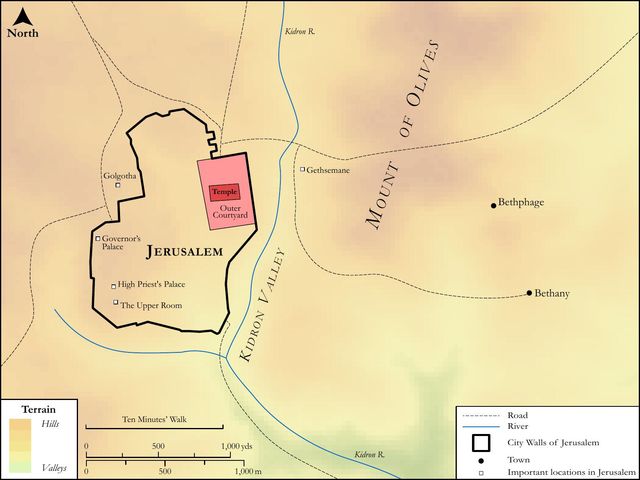
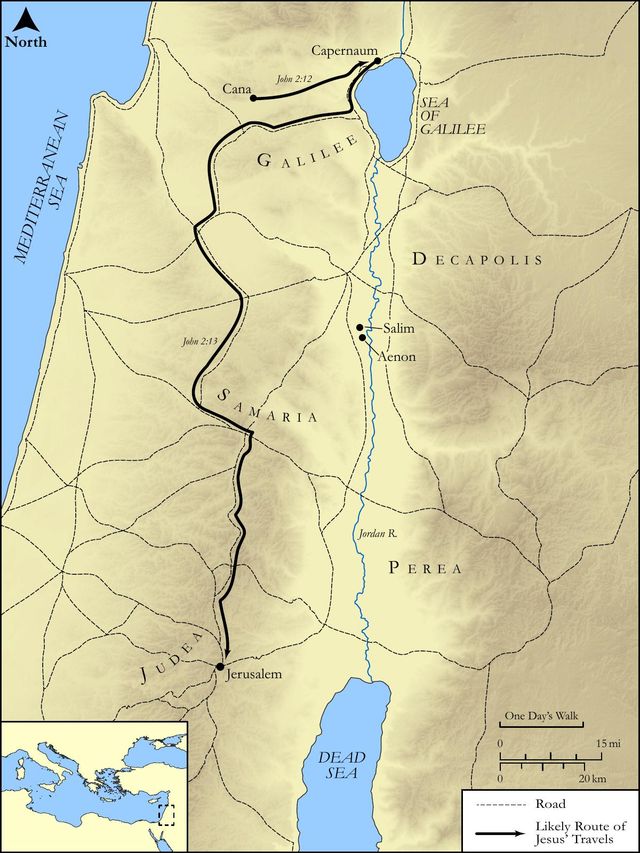
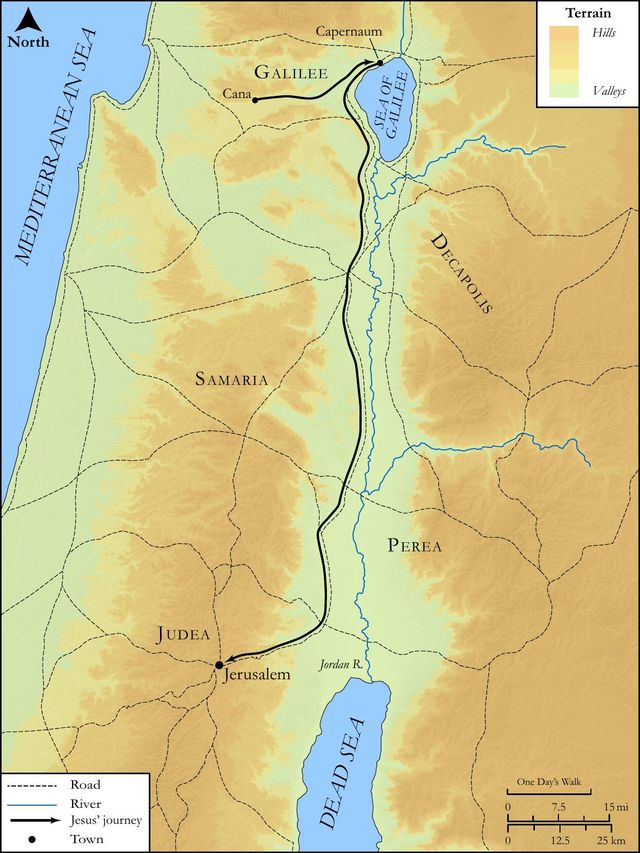
Study this verse
Public-domain commentary
Matthew Henry
From his Commentary on the Whole Bible. Henry comments on passages, not single verses — this entry covers John 2:12–22. His four-level outline is real structure in the source text, so it is rendered as structure.
Here we have,
I.The short visit Christ made to Capernaum, Joh 2:12.
It was a large and populous city, about a day's journey from Cana; it is called his own city (Mat 9:1), because he made it his head-quarters in Galilee, and what little rest he had was there. It was a place of concourse, and therefore Christ chose it, that the fame of his doctrine and miracles might thence spread the further. Observe,
1.The company that attended him thither: his mother, his brethren, and his disciples. Wherever Christ went,
(1.)He would not go alone, but would take those with him who had put themselves under his guidance, that he might instruct them, and that they might attest his miracles.
(2.)He could not go alone, but they would follow him, because they liked the sweetness either of his doctrine or of his wine, Joh 6:26. His mother, though he had lately given her to understand that in the works of his ministry he should pay no more respect to her than to any other person, yet followed him; not to intercede with him, but to learn of him. His brethren also and relations, who were at the marriage and were wrought upon by the miracle there, and his disciples, who attended him wherever he went. It should seem, people were more affected with Christ's miracles at first than they were afterwards, when custom made them seem less strange.
2.His continuance there, which was at this time not many days, designing now only to begin the acquaintance he would afterwards improve there. Christ was still upon the remove, would not confine his usefulness to one place, because many needed him. And he would teach his followers to look upon themselves but as sojourners in this world, and his ministers to follow their opportunities, and go where their work led them. We do not now find Christ in the synagogues, but he privately instructed his friends, and thus entered upon his work by degrees. It is good for young ministers to accustom themselves to pious and edifying discourse in private, that they may with the better preparation, and greater awe, approach their public work. He did not stay long at Capernaum, because the passover was at hand, and he must attend it at Jerusalem; for every thing is beautiful in its season. The less good must give way to the greater, and all the dwellings of Jacob must give place to the gates of Zion.
II.The passover he kept at Jerusalem; it is the first after his baptism, and the evangelist takes notice of all the passovers he kept henceforward, which were four in all, the fourth that at which he suffered (three years after this), and half a year was now past since his baptism. Christ, being made under the law, observed the passover at Jerusalem; see Exo 23:17. Thus he taught us by his example a strict observance of divine institutions, and a diligent attendance on religious assemblies. He went up to Jerusalem when the passover was at hand, that he might be there with the first. It is called the Jews' passover, because it was peculiar to them (Christ is our Passover); now shortly God will no longer own it for his. Christ kept the passover at Jerusalem yearly, ever since he was twelve years old, in obedience to the law; but now that he has entered upon his public ministry we may expect something more from him than before; and two things we are here told he did there: -
1.He purged the temple, Joh 2:14-17. Observe here,
(1.)The first place we find him in at Jerusalem was the temple, and, it should seem, he did not make any public appearance till he came thither; for his presence and preaching there were that glory of the latter house which was to exceed the glory of the former, Hag 2:9. It was foretold (Mal 3:1): I will send my messenger, John Baptist; he never preached in the temple, but the Lord, whom ye seek, he shall suddenly come to his temple, suddenly after the appearing of John Baptist; so that this was the time, and the temple the place, when, and where, the Messiah was to be expected.
(2.)The first work we find him at in the temple was the purging of it; for so it was foretold there (Mal 3:2, Mal 3:3): He shall sit as a refiner and purify the sons of Levi. Now was come the time of reformation. Christ came to be the great reformer; and, according to the method of the reforming kings of Judah, he first purged out what was amiss (and that used to be passover-work too, as in Hezekiah's time, Ch2 30:14, Ch2 30:15, and Josiah's, Kg2 23:4, etc.), and then taught them to do well. First purge out the old leaven, and then keep the feast. Christ's design in coming into the world was to reform the world; and he expects that all who come to him should reform their hearts and lives, Gen 35:2. And this he has taught us by purging the temple. See here,
[1.]What were the corruptions that were to be purged out. He found a market in one of the courts of the temple, that which was called the court of the Gentiles, within the mountain of that house. There, First, They sold oxen, and sheep, and doves, for sacrifice; we will suppose, not for common use, but for the convenience of those who came out of the country, and could not bring their sacrifices in kind along with them; see Deu 14:24-26. This market perhaps had been kept by the pool of Bethesda (Joh 5:2), but was admitted into the temple by the chief priests, for filthy lucre; for, no doubt, the rents for standing there, and fees for searching the beasts sold there, and certifying that they were without blemish, would be a considerable revenue to them. Great corruptions in the church owe their rise to the love of money, Ti1 6:5, Ti1 6:10. Secondly, They changed money, for the convenience of those that were to pay a half-shekel in specie every year, by way of poll, for the service of the tabernacle (Exo 30:12), and no doubt they got by it.
[2.]What course our Lord took to purge out those corruptions. He had seen these in the temple formerly, when he was in a private station; but never went about to drive them out till now, when he had taken upon him the public character of a prophet. He did not complain to the chief priests, for he knew they countenanced those corruptions. But he himself,
First, Drove out the sheep and oxen, and those that sold them, out of the temple. He never used force to drive any into the temple, but only to drive those out that profaned it. He did not seize the sheep and oxen for himself, did not distrain and impound them, though he found them damage faissant - actual trespassers upon his Father's ground; he only drove them out, and their owners with them. He made a scourge of small cords, which probably they had led their sheep and oxen with, and thrown them away upon the ground, whence Christ gathered them. Sinners prepare the scourges with which they themselves will be driven out from the temple of the Lord. He did not make a scourge to chastise the offenders (his punishments are of another nature), but only to drive out the cattle; he aimed no further than at reformation. See Rom 13:3, Rom 13:4; Co2 10:8.
Secondly, He poured out the changers' money, to kerma - the small money - the Nummorum Famulus. In pouring out the money, he showed his contempt of it; he threw it to the ground, to the earth as it was. In overthrowing the tables, he showed his displeasure against those that make religion a matter of worldly gain. Money-changers in the temple are the scandal of it. Note, In reformation, it is good to make thorough work; he drove them all out; and not only threw out the money, but, in overturning the tables, threw out the trade too.
Thirdly, He said to them that sold doves (sacrifices for the poor), Take these things hence. The doves, though they took up less room, and were a less nuisance than the oxen and sheep, yet must not be allowed there. The sparrows and swallows were welcome, that were left to God's providence (Psa 84:3), but not the doves, that were appropriated to man's profit. God's temple must not be made a pigeon-house. But see Christ's prudence in his zeal. When he drove out the sheep and oxen, the owners might follow them; when he poured out the money, they might gather it up again; but, if he had turned the doves flying, perhaps they could not have been retrieved; therefore to them that sold doves he said, Take these things hence. Note, Discretion must always guide and govern our zeal, that we do nothing unbecoming ourselves, or mischievous to others.
Fourthly, He gave them a good reason for what he did: Make not my Father's house a house of merchandise. Reason for conviction should accompany force for correction.
a.Here is a reason why they should not profane the temple, because it was the house of God, and not to be made a house of merchandise. Merchandise is a good thing in the exchange, but not in the temple. This was, (a.) to alienate that which was dedicated to the honour of God; it was sacrilege; it was robbing God. (b.) It was to debase that which was solemn and awful, and to make it mean. (c.) It was to disturb and distract those services in which men ought to be most solemn, serious, and intent. It was particularly an affront to the sons of the stranger in their worship to be forced to herd themselves with the sheep and oxen, and to be distracted in their worship by the noise of a market, for this market was kept in the court of the Gentiles. (d.) It was to make the business of religion subservient to a secular interest; for the holiness of the place must advance the market, and promote the sale of their commodities. Those make God's house a house of merchandise, [a.] Whose minds are filled with cares about worldly business when they are attending on religious exercises, as those, Amo 8:5; Eze 33:31. [b.] Who perform divine offices for filthy lucre, and sell the gifts of the Holy Ghost, Act 8:18.
b.Here is a reason why he was concerned to purge it, because it was his Father's house. And, (a.) Therefore he had authority to purge it, for he was faithful, as a Son over his own house. Heb 3:5, Heb 3:6. In calling God his Father, he intimates that he was the Messiah, of whom it was said, He shall build a house for my name, and I will be his Father, Sa2 7:13, Sa2 7:14. (b.) Therefore he had a zeal for the purging of it: "It is my Father's house, and therefore I cannot bear to see it profaned, and him dishonoured." Note, If God be our Father in heaven, and it be therefore our desire that his name may be sanctified, it cannot but be our grief to see it polluted. Christ's purging the temple thus may justly be reckoned among his wonderful works. Inter omnia signa quae fecit Dominus, hoc mihi videtur esse mirabilius - Of all Christ's wonderful works this appears to me the most wonderful. - Hieron. Considering, [a.] That he did it without the assistance of any of his friends; probably it had been no hard matter to have raised the mob, who had a great veneration for the temple, against these profaners of it; but Christ never countenanced any thing that was tumultuous or disorderly. There was one to uphold, but his own arm did it. [b.] That he did it without the resistance of any of his enemies, either the market-people themselves, or the chief priests that gave them their licences, and had the posse templi - temple force, at their command. But the corruption was too plain to be justified; sinners' own consciences are reformers' best friends; yet that was not all, there was a divine power put forth herein, a power over the spirits of men; and in this non-resistance of theirs that scripture was fulfilled (Mal 3:2, Mal 3:3), Who shall stand when he appeareth?
Fifthly, Here is the remark which his disciples made upon it (Joh 2:17): They remembered that it was written, The Zeal of thine house hath eaten me up. They were somewhat surprised at first to see him to whom they were directed as the Lamb of God in such a heat, and him whom they believed to be the King of Israel take so little state upon him as to do this himself; but one scripture came to their thoughts, which taught them to reconcile this action both with the meekness of the Lamb of God and with the majesty of the King of Israel; for David, speaking of the Messiah, takes notice of his zeal for God's house, as so great that it even ate him up, it made him forget himself, Psa 69:9. Observe, 1. The disciples came to understand the meaning of what Christ did, by remembering the scriptures: They remembered now that it was written. Note, The word of God and the works of God do mutually explain and illustrate each other. Dark scriptures are expounded by their accomplishment in providence, and difficult providences are made easy by comparing them with the scriptures. See of what great use it is to the disciples of Christ to be ready and mighty in the scriptures, and to have their memories well stored with scripture truths, by which they will be furnished for every good work, 2. The scripture they remembered was very apposite: The zeal of thine house hath eaten me up. David was in this a type of Christ that he was zealous for God's house, Psa 132:2, Psa 132:3. What he did for it was with all his might; see Ch1 29:2. The latter part of that verse (Psa 69:9) is applied to Christ (Rom 15:3), as the former part of it here. All the graces that were to be found among the Old Testament saints were eminently in Christ, and particularly this of zeal for the house of God, and in them, as they were patterns to us, so they were types of him. Observe, (1.) Jesus Christ was zealously affected to the house of God, his church: he loved it, and was always jealous for its honour and welfare. (2.) This zeal did even eat him up; it made him humble himself, and spend himself, and expose himself. My zeal has consumed me, Psa 119:139. Zeal for the house of God forbids us to consult our own credit, ease, and safety, when they come in competition with our duty and Christ's service, and sometimes carries on our souls in our duty so far and so fast that our bodies cannot keep pace with them, and makes us as deaf as our Master was to those who suggested, Spare thyself. The grievances here redressed might seem but small, and such as should have been connived at; but such was Christ's zeal that he could not bear even those that sold and bought in the temple. Si ibi ebrios inveniret quid faceret Dominus! (saith St. Austin.) If he had found drunkards in the temple, how much more would he have been displeased!
2.Christ, having thus purged the temple, gave a sign to those who demanded it to prove his authority for so doing. Observe here,
(1.)Their demand of a sign: Then answered the Jews, that is the multitude of the people, with their leaders. Being Jews, they should rather have stood by him, and assisted him to vindicate the honour of their temple; but, instead of this, they objected against it. note, Those who apply themselves in good earnest to the work of reformation must expect to meet with opposition. When they could object nothing against the thing itself, they questioned his authority to do it: "What sign showest thou unto us, to prove thyself authorized and commissioned to do these things?" It was indeed a good work to purge the temple; but what had he to do to undertake it, who was in no office there? They looked upon it as an act of jurisdiction, and that he must prove himself a prophet, yea, more than a prophet. But was not the thing itself sign enough? His ability to drive so many from their posts, without opposition, was a proof of his authority; he that was armed with such a divine power was surely armed with a divine commission. What ailed these buyers and sellers, that they fled, that they were driven back? Surely it was at the presence of the Lord (Psa 114:5, Psa 114:7), no less a presence.
(2.)Christ's answer to this demand, Joh 2:19. He did not immediately work a miracle to convince them, but gave them a sign in something to come, the truth of which must appear by the event, according to Deu 18:21, Deu 18:22.
Now, [1.] The sign that he gives them is his own death and resurrection. He refers them to that which would be, First, His last sign. If they would not be convinced by what they saw and heard, let them wait. Secondly, The great sign to prove him to be the Messiah; for concerning him it was foretold that he should be bruised (Isa 53:5), cut off (Dan 9:26), and yet that he should not see corruption, Psa 16:10. These things were fulfilled in the blessed Jesus, and therefore truly he was the Son of God, and had authority in the temple, his Father's house.
[2.]He foretels his death and resurrection, not in plain terms, as he often did to his disciples, but in figurative expressions; as afterwards, when he gave this for a sign, he called it the sign of the prophet Jonas, so here, Destroy this temple, and in three days I will raise it up. Thus he spoke in parables to those who were willingly ignorant, that they might not perceive, Mat 13:13, Mat 13:14. Those that will not see shall not see. Nay, this figurative speech used here proved such a stumbling-block to them that it was produced in evidence against him at his trial to prove him a blasphemer. Mat 26:60, Mat 26:61. Had they humbly asked him the meaning of what he said, he would have told them, and it had been a savour of life unto life to them, but they were resolved to cavil, and it proved a savour of death unto death. They that would not be convinced were hardened, and the manner of expressing this prediction occasioned the accomplishment of the prediction itself. First, He foretels his death by the Jews' malice, in these words, Destroy you this temple; that is, "You will destroy it, I know you will. I will permit you to destroy it." Note, Christ, even at the beginning of his ministry, had a clear foresight of all his sufferings at the end of it, and yet went on cheerfully in it. It is good, at setting out, to expect the worst. Secondly, He foretels his resurrection by his own power: In three days I will raise it up. There were others that were raised, but Christ raised himself, resumed his own life.
[3.]He chose to express this by destroying and re-edifying the temple, First, Because he was now to justify himself in purging the temple, which they had profaned; as if he had said, "You that defile one temple will destroy another; and I will prove my authority to purge what you have defiled by raising what you will destroy." The profaning of the temple is the destroying of it, and its reformation its resurrection. Secondly, Because the death of Christ was indeed the destruction of the Jewish temple, the procuring cause of it; and his resurrection was the raising up of another temple, the gospel church, Zac 6:12. The ruins of their place and nation (Joh 11:48) were the riches of the world. See Amo 9:11; Act 15:16.
(3.)Their cavil at this answer: "Forty and six years was this temple in building, Joh 2:20. Temple work was always slow work, and canst thou make such quick work of it?" Now here,
[1.]They show some knowledge; they could tell how long the temple was in building. Dr. Lightfoot computes that it was just forty-six years from the founding of Zerubbabel's temple, in the second year of Cyrus, to the complete settlement of the temple service, in the 32nd year of Artaxerxes; and the same from Herod's beginning to build this temple, in the 18th year of his reign, to this very time, when the Jews said that this as just forty-six years: ōkodomēthē - hath this temple been built.
[2.]They show more ignorance, First, Of the meaning of Christ's words. Note, Men often run into gross mistakes by understanding that literally which the scripture speaks figuratively. What abundance of mischief has been done by interpreting, This is my body, after a corporal and carnal manner! Secondly, Of the almighty power of Christ, as if he could do no more than another man. Had they known that this was he who built all things in six days they would not have made it such an absurdity that he should build a temple in three days.
(4.)A vindication of Christ's answer from their cavil. The difficulty is soon solved by explaining the terms: He spoke of the temple of his body, Joh 2:21. Though Christ had discovered a great respect for the temple, in purging it, yet he will have us know that the holiness of it, which he was so jealous for, was but typical, and leads us to the consideration of another temple of which that was but a shadow, the substance being Christ, Heb 9:9; Col 2:17. Some think that when he said, Destroy this temple, he pointed to his own body, or laid his hand upon it; however, it is certain that he spoke of the temple of his body. Note, The body of Christ is the true temple, of which that at Jerusalem was a type.
[1.]Like the temple, it was built by immediate divine direction: "A body hast thou prepared me," Ch1 28:19.
[2.]Like the temple, it was a holy house; it is called that holy thing.
[3.]It was, like the temple, the habitation of God's glory; there the eternal Word dwelt, the true shechinah. He is Emmanuel - God with us.
[4.]The temple was the place and medium of intercourse between God and Israel: there God revealed himself to them; there they presented themselves and their services to him. Thus by Christ God speaks to us, and we speak to him. Worshippers looked towards that house, Kg1 8:30, Kg1 8:35. So we must worship God with an eye to Christ.
(5.)A reflection which the disciples made upon this, long after, inserted here, to illustrate the story (Joh 2:22): When he was risen from the dead, some years after, his disciples remembered that he had said this. We found them, Joh 2:17, remembering what had been written before of him, and here we find them remembering what they had heard from him. Note, The memories of Christ's disciples should be like the treasure of the good house-holder, furnished with things both new and old, Mat 13:52. Now observe,
[1.]When they remembered that saying: When he was risen from the dead. It seems, they did not at this time fully understand Christ's meaning, for they were as yet but babes in knowledge; but they laid up the saying in their hearts, and afterwards it became both intelligible and useful. Note, It is good to hear for the time to come, Isa 42:23. The juniors in years and profession should treasure up those truths of which at present they do not well understand either the meaning or the use, for they will be serviceable to them hereafter, when they come to greater proficiency. It was said of the scholars of Pythagoras that his precepts seemed to freeze in them till they were forty years old, and then they began to thaw; so this saying of Christ revived in the memories of his disciples when he was risen from the dead; and why the? First, Because then the Spirit was poured out to bring things to their remembrance which Christ had said to them, and to make them both easy and ready to them, Joh 14:26. That very day that Christ rose form the dead he opened their understandings, Luk 24:45. Secondly, Because then this saying of Christ was fulfilled. When the temple of his body had been destroyed and was raised again, and that upon the third day, then they remembered this among other words which Christ had said to this purport. Note, It contributes much to the understanding of the scripture to observe the fulfilling of the scripture. The event will expound the prophecy.
[2.]What use they made of it: They believed the scripture, and the word that Jesus had said; their belief of these was confirmed and received fresh support and vigour. They were slow of heart to believe (Luk 24:25), but they were sure. The scripture and the word of Christ are here put together. not because they concur and exactly agree together, but because they mutually illustrate and strengthen each other. When the disciples saw both what they had read in the Old Testament, and what they had heard from Christ's own mouth, fulfilled in his death and resurrection, they were the more confirmed in their belief of both.
Historical interpretation
Nine Centuries of Reception
15 surviving comments on this verse. Each one is dated, so this reads as a timeline rather than a list.
Select a marker to jump to its quote. Markers stagger vertically where authors wrote within a few decades of each other.
[Heracleon says] that those found in the temple selling oxen and sheep and doves, and the money-changers sitting, represent those who give nothing away free but suppose the entrance of foreigners into the temple to be a matter of merchandise and profit. They furnish the sacrifices for the service of God for the sake of their own profit and greed.… The whip, in turn, was made from cords by Jesus, who did not receive it from another.… The whip is an image of the power and activity of the Holy Spirit who blows away the wicked.… The whip, the cord, the linen, and all such things are an image of the power and activity of the Holy Spirit.… The whip was tied to a piece of wood. The wood is a type of the cross … that the gamblers, the merchants and all evil have been nailed upon and destroyed by this wood.
(tom. x. in Joan. c. 16) Should it appear something out of the order of things, that the Son of God should make a scourge of small cords, to drive them out of the temple? We have one answer in which some take refuge, viz. the divine power of Jesus, Who, when He pleased, could extinguish the wrath of His enemies however innumerable, and quiet the tumult of their minds: The Lord bringeth the counsel of the heathen to nought. (Ps. 32, 33:10) This act indeed exhibits no less power, than His more positive miracles; nay rather, more than the miracle by which water was converted into wine: in that there the subject-matter was inanimate, here, the minds of so many thousands of men are overcome.
(tom. x. in Joan. c. 17) John says here that He drove out the sellers from the temple; Matthew, the sellers and buyers. The number of buyers was much greater than of the sellers: and therefore to drive them out was beyond the power of the carpenter's Son, as He was supposed to be, had He not by His divine power put all things under Him, as it is said.
Another Evangelist writes, that as He cast them out, He said, Make not my Father's house "a den of thieves," but this one, "(Make not My Father's house) an house of merchandise."
They do not in this contradict each other, but show that he did this a second time, and that both these expressions were not used on the same occasion, but that He acted thus once at the beginning of His ministry, and again when He had come to the very time of His Passion. Therefore, (on the latter occasion,) employing more strong expressions, He spoke of it as (being made) "a den of thieves," but here at the commencement of His miracles He does not so, but uses a more gentle rebuke; from which it is probable that this took place a second time.
"And wherefore," says one, "did Christ do this same, and use such severity against these men, a thing which He is nowhere else seen to do, even when insulted and reviled, and called by them 'Samaritan' and 'demoniac'? for He was not even satisfied with words only, but took a scourge, and so cast them out." Yes, but it was when others were receiving benefit, that the Jews accused and raged against Him; when it was probable that they would have been made savage by His rebukes, they showed no such disposition towards Him, for they neither accused nor reviled Him.
(Hom. xxiii. in Joan. c. 2) Lo, He speaks of God as His Father, and they are not angry, for they think He means it in a common sense. But afterwards when He spoke more openly, and showed that He meant equality, they were enraged. In Matthew's account too, (c. 21) on driving them out, He says, Ye have made it (My Father's house) a den of thieves. (21:13.) This was just before His Passion, and therefore He uses severer language. But the former being at the beginning of His miracles, His answer is milder and more indulgent.
(Hom. xxiii. 2) But why did Christ use such violence? He was about to heal on the Sabbath day, and to do many things which appeared to them transgressions of the Law. That He might not appear therefore to be acting contrary to God, He did this at His own peril; and thus gave them to understand, that He who exposed Himself to such peril to defend the decency of the house, did not despise the Lord of that house. For the same reason, to show His agreement with God, He said not, the Holy house, but, My Father's house. It follows, And His disciples remembered what was written; The zeal of thine house hath eaten me up.
Since he was about to heal on the Sabbath day, and to do many such things which were thought by them transgressions of the Law, in order that He might not seem to do this as though He had come to be some rival God and opponent of His Father, He takes occasion hence to correct any such suspicion of theirs. For One who had exhibited so much zeal for the House was not likely to oppose Him who was Lord of the House, and who was worshiped in it. No doubt even the former years during which He lived according to the Law, were sufficient to show His reverence for the Legislator, and that He came not to give contrary laws; yet since it was likely that those years were forgotten through lapse of time, as not having been known to all because He was brought up in a poor and mean dwelling, He afterwards does this in the presence of all, (for many were present because the feast was nigh at hand,) and at great risk. For he did not merely "cast them out," but also "overturned the tables," and "poured out the money," giving them by this to understand, that He who threw Himself into danger for the good order of the House could never despise his Master. Had He acted as He did from hypocrisy, He should only have advised them; but to place Himself in danger was very daring. For it was no light thing to offer Himself to the anger of so many market-folk, to excite against Himself a most brutal mob of petty dealers by His reproaches and His blows, this was not the action of a pretender, but of one choosing to suffer everything for the order of the House.
And therefore not by His actions only, but by His words, He shows his agreement with the Father; for He saith not "the Holy House," but "My Father's House." See, He even calls Him, "Father," and they are not wroth; they thought He spoke in a general way: but when He went on and spoke more plainly, so as to set before them the idea of His Equality, then they become angry.
Having a symbolic purpose in mind, Jesus obscured his intent with allusions instead of stating plainly what he was doing. He thought that his hearers could not understand yet what he said. The disciples themselves did not understand either, as the Evangelist observes. They believed that by driving away the sellers of cattle and sheep, he abolished the market, but in truth what he meant was that the sacrifices of animals would be abolished.
Yet we say, brethren (for He did not spare those men: He who was to be scourged by them first scourged them), that He gave us a certain sign, in that He made a scourge of small cords, and with it lashed the unruly, who were making merchandise of God's temple. For indeed every man twists for himself a rope by his sins: "Woe to them who draw sins as a long rope?" Who makes a long rope? He who adds sin to sin. How are sins added to sins? When the sins which have been committed are covered over by other sins. One has committed a theft: that he may not be found out to have committed it, he seeks the astrologer. It were enough to have committed theft: why wilt thou add sin to sin? Behold two sins committed. When thou art forbidden to go to the astrologer, thou revilest the bishop: behold three sins. When thou hearest it said of thee, Cast him forth from the Church; thou sayest, I will betake me to the party of Donatus: behold thou addest a fourth sin. The rope is growing; be thou afraid of the rope. It is good for thee to be corrected here, when thou art scourged with it; that it may not be said of thee at the last, "Bind ye his hands and feet, and cast him forth into outer darkness." For, "With the cords of his own sins is every one bound." The former of these is the saying of the Lord, the latter that of another Scripture; but yet both are the sayings of the Lord. With their own sins are men bound and cast into outer darkness.
These men, however, deceive the people by the very Scriptures, that they may receive honors and praises at their hand, and that men may not turn to the truth. But in that they deceive, by the very Scriptures, the people of whom they seek honors, they do in fact sell oxen: they sell sheep too; that is, the common people themselves. And to whom do they sell them, but to the devil? For if the Church be Christ's sole and only one, who is it that carries off whatever is cut away from it, but that lion that roars and goes about, "seeking whom he may devour"? Woe to them that are cut off from the Church! As for her, she will remain entire. "For the Lord knoweth them that are His." These, however, so far as they can, sell oxen and sheep, they sell doves too: let them guard against the scourge of their own sins. But when they suffer some such things for these their iniquities, let them acknowledge that the Lord has made a scourge of small cords, and is admonishing them to change themselves and be no longer traffickers: for if they will not change, they shall at the end hear it said, "Bind ye these men's hands and feet, and cast them forth into outer darkness."
Well, who sell oxen? They who have dispensed to us the Holy Scriptures are understood to mean the oxen. The apostles were oxen, the prophets were oxen. Whence the apostle says: "Thou shalt not muzzle the mouth of the ox that treadeth out the corn. Doth God take care for oxen? Or saith He it for our sakes? Yea, for our sakes He saith it: that he who ploweth should plow in hope; and he that thresheth, in hope of partaking." Those oxen, then, have left to us the narration of the Scriptures. For it was not of their own that they dispensed, because they sought the glory of the Lord. Now, what have ye heard in that psalm? "And let them say continually, The Lord be magnified, they that wish the peace of His servant." God's servant, God's people, God's Church. Let them who wish the peace of that Church magnify the Lord, not the servant: "and let them say continually, The Lord be magnified." Who, let say? "Them who wish the peace of His servant." The voice of that people, of that servant, is clearly that voice which you have heard in lamentations in the psalm, and were moved at hearing, because you are of that people. What was sung by one, re-echoed from the hearts of all. Happy they who recognized themselves in those voices as in a mirror. Who, then, are they that wish the peace of His servant, the peace of His people, the peace of the one whom He calls His "only one," and whom He wishes to be delivered from the lion: "Deliver mine only one from the power of the dog"? They who say always, "The Lord be magnified." Those oxen, then, magnified the Lord, not themselves. See this ox magnifying his Lord, because "the ox knoweth his owner;" observe that ox in fear lest men desert the ox's owner and rely on the ox: how he dreads them that are willing to put their confidence in him: "Was Paul crucified for you? or were ye baptized in the name of Paul?" Of what I gave, I was not the giver: freely ye have received; the dove came down from heaven. "I have planted," saith he, "Apollos watered; but God gave the increase: neither he that planteth is anything, neither he that watereth; but God that giveth the increase." "And let them say always, The Lord be magnified, they that wish the peace of His servant."
However, to seek the mystery of the deed in the figure, who are they that sell oxen? Who are they that sell sheep and doves? They are they who seek their own in the Church, not the things which are Christ's. They account all a matter of sale, while they will not be redeemed: they have no wish to be bought, and yet they wish to sell. Yes; good indeed is it for them that they may be redeemed by the blood of Christ, that they may come to the peace of Christ. Now, what does it profit to acquire in this world any temporal and transitory thing whatsoever, be it money, or pleasure of the palate, or honor that consists in the praise of men? Are they not all wind and smoke? Do they not all pass by and flee away? Are they not all as a river rushing headlong into the sea? And woe to him who shall fall into it, for he shall be swept into the sea. Therefore ought we to curb all our affections from such desires. My brethren, they that seek such things are they that sell. For that Simon too, wished to buy the Holy Ghost, just because he meant to sell the Holy Ghost; and he thought the apostles to be just such traders as they whom the Lord cast out of the temple with a scourge. For such an one he was himself, and desired to buy what he might sell: he was of those who sell doves. Now it was in a dove that the Holy Ghost appeared. Who, then, are they, brethren, that sell doves, but they who say, "We give the Holy Ghost"? But why do they say this, and at what price do they sell? At the price of honor to themselves. They receive as the price, temporal seats of honor, that they may be seen to be sellers of doves. Let them beware of the scourge of small cords. The dove is not for sale: it is given freely; for grace, or favor, it is called.
(Tr. x. c. 4) Such sacrifices were prescribed to the people, in condescension to their carnal minds; to prevent them from turning aside to idols. They sacrificed sheep, and oxen, and doves.
(Tr. x. c. 5) He who was to be scourged by them, was first of all the scourger; And when He had made a scourge of small cords, He drore them all out of the temple.
(de Cons. Ev. l. ii. c. 67) It is evident that this was done on two several occasions; the first mentioned by John, the last by the other three.
(Tr. x. in Joan. c. 4) So that temple was still a figure only, and our Lord cast out of it all who came to it as a market. And what did they sell? Things that were necessary for the sacrifice of that time. What if He had found men drunken? If the house of God ought not to be a house of merchandize, ought it to be a house of drunkenness?
(Tr. x. c. 9) He then is eaten up with zeal for God's house, who desires to correct all that he sees wrong there; and, if he cannot correct, endures and mourns. In thine house thou busiest thyself to prevent matters going wrong; in the house of God, where salvation is offered, oughtest thou to be indifferent? Hast thou a friend? admonish him gently; a wife? coerce her severely; a maid-servant? even compel her with stripes. Do what thou art able, according to thy station.
(Tr. x. c. 6) Or, those who sell in the Church, are those who seek their own, not the things of Jesus Christ. They who will not be bought, think they may sell earthly things. Thus Simon wished to buy the Spirit, that he might sell Him: for he was one of those who sell doves. (The Holy Spirit appeared in the form of a dove.) The dove however is not sold, but is given of free grace; for it is called grace.
(Tr. x. c. 7) By the oxen may be understood the Apostles and Prophets, who have dispensed to us the holy Scriptures. Those who by these very Scriptures deceive the people, from whom they seek honour, sell the oxen; and they sell the sheep too, i. e. the people themselves; and to whom do they sell them, but to the devil? For that which is cut off from the one Church, (1 Pet. 5:8) who taketh away, except the roaring lion, who goeth about every where, and seeketh whom he may devour?
(Tr. x. c. 5) Our Lord intended a meaning to be seen in His making a scourge of small cords, and then scourging those who were carrying on the merchandize in the temple. Every one by his sins twists for himself a cord, in that he goes on adding sin to sin. So then when men suffer for their iniquities, let them be sure that it is the Lord making a scourge of small cords, and admonishing them to change their lives: which if they fail to do, they will hear at the last, Bind. him hand and foot. (Mat. 23)
Reasonably is the Saviour indignant at the folly of the Jews. For it befitted to make the Divine Temple not an house of merchandise, but an house of prayer: for so it is written. But He shows His emotion not by mere words, but with stripes and a scourge thrusts He them forth of the sacred precincts, justly devising for them the punishment befitting slaves; for they would not receive the Son Who through faith maketh free. See I pray well represented as in a picture that which was said through Paul, If any man dishonour the Temple of God, him shall God dishonour.
Why do you not recall before the eyes of your mind that our Redeemer, entering the temple, overturned the seats of those selling doves and poured out the money of the money-changers? For who are those in the temple of God today who sell doves, if not those who in the Church receive payment for the imposition of hands? Through which imposition, namely, the Holy Spirit is given from heaven. Therefore the dove is sold, because the imposition of hands, through which the Holy Spirit is received, is offered for a price. But our Redeemer overturned the seats of those selling doves, because he destroys the priesthood of such merchants.
Whence also entering into the temple, he made as it were a whip from cords by himself, and casting out the wicked merchants from the house of God, he overturned the seats of those selling doves, because he strikes the faults of subjects through pastors, but he strikes the vices of pastors through himself. Behold, now what is done secretly can be denied to people. That Judge will certainly come, from whom no one can hide himself by keeping silent, whom no one can deceive by denying.
But our Lord disapproving of any worldly business in His house, especially one of so questionable a kind, drove out all engaged in it.
The Evangelist sets before us both natures of Christ: the human in that His mother accompanied Him to Capernaum; the divine, in that He said, Make not My Father's house an house of merchandize.
(in loc.) They then are the sellers of doves, who, after receiving the free grace of the Holy Spirit, do not dispense it freely, as they are commanded, but at a price: who confer the laying on of hands, by which the Holy Spirit is received, if not for money, at least for the sake of getting favour with the people, who bestow Holy Orders not according to merit, but favour.
(in loc.) Or, the sheep are works of purity and piety, and they sell the sheep, who do works of piety to gain the praise of men. They exchange money in the temple, who, in the Church, openly devote themselves to secular business. And besides those who seek for money, or praise, or honour from Holy Orders, those too make the Lord's house a house of merchandize, who do not employ the rank, or spiritual grace, which they have received in the Church at the Lord's hands, with singleness of mind, but with an eye to human recompense.
(in loco.) With a scourge then made of small cords, He cast them out of the temple; for from the part and lot of the saints are cast out all, who, thrown externally among the Saints, do good works hypocritically, or bad openly. The sheep and the oxen too He cast out, to show that the life and the doctrine of such were alike reprobate. And He overthrew the change heaps of the money-changers and their tables, as a sign that, at the final condemnation of the wicked, He will take away the form even of those things which they loved. The sale of doves He ordered to be removed out of the temple, because the grace of the Spirit, being freely received, should be freely given.
Nor did He cast out only those who bought and sold, but their goods also: The sheep, and the oxen, and poured out the changers' money, and overthrew the tables, i. e. of the money changers, which were coffers of pence.
Continue studying John 2:15 across the web’s major study libraries — every link below opens this exact verse, chapter, or book on the destination site.
Read & Compare
 BibleGatewayThis verse in more than 200 translations and 70 languages.
 Bible.comThe YouVersion reader — hundreds of translations, reading plans, and highlights.
 ESV.orgCrossway's official English Standard Version reader.
 NET BibleThe NET translation with 60,000+ translators' notes on every rendering decision.
 STEP BibleTyndale House's free study tool — original text, vocabulary, and scholarly resources.
 BibliaLogos Bible Software's free web reader.
 USCCBThe New American Bible (Revised Edition) with the U.S. bishops' study notes.
Commentaries
 BibleHub CommentariesDozens of classic commentaries on this verse, gathered on one page.
 StudyLightMore than 100 commentary sets — the largest collection on the web.
 BibleRefPlain-English commentary on what this verse means, verse by verse.
 Enduring WordDavid Guzik's free commentary on this chapter, widely used by Bible teachers.
 Bible Study ToolsVerse commentary alongside Greek and Hebrew study aids.
Original Language & Research
- BibleHub InterlinearThe verse word by word — original language, transliteration, and English.
- BibleHub LexiconEvery word's original-language definition and Strong's entry.
 Blue Letter BibleDeep-study tools — Strong's numbers, concordance, and word studies.
 CNTR CollationThe earliest Greek manuscripts of this verse, collated letter by letter.
Sermons, Hymns & Audio


TrulyRandomVerse is not affiliated with these sites and doesn’t control their content. They’re linked because they’re genuinely useful.
Summary
John 2:15 presents a vivid and dramatic account of Jesus' forceful purification of the Jerusalem Temple. This pivotal event, occurring early in His public ministry, reveals Jesus' profound authority and zealous commitment to the sanctity of God's house. By driving out merchants and money-changers, overturning their tables, and scattering their wares, Jesus unequivocally asserts His divine prerogative over the sacred space, challenging the commercialization and corruption that had defiled a place intended for worship and prayer.
Context
ShowHideLiterary Context
This incident immediately follows Jesus' first miracle at the wedding in Cana, where He turned water into wine, signifying the inauguration of a new era. By placing the Temple cleansing so early in His Gospel, John emphasizes Jesus' divine authority and His mission to establish a new covenant. Unlike the Synoptic Gospels, which place a similar event later in Jesus' ministry, John highlights this act as an initial declaration of Jesus' identity and purpose, foreshadowing His later discourse about His body being the true temple (John 2:19-21). The cleansing serves as a dramatic public act, setting the stage for the escalating tension between Jesus and the Jewish authorities.
Historical & Cultural Context
The Temple in Jerusalem was the spiritual heart of Judaism, especially during major pilgrimage festivals like Passover, when thousands of Jews from across the Roman Empire would converge. The specific area of Jesus' action was likely the Court of the Gentiles, the outermost court, which was accessible to non-Jews. Here, merchants sold animals for sacrifice (oxen, sheep, doves) and money-changers exchanged foreign currency (which often bore images of pagan emperors) for Temple-approved coinage required for the annual Temple tax or offerings. While these services were necessary for pilgrims, they had become rife with exploitation. Merchants often overcharged for animals, and money-changers levied exorbitant exchange rates, turning a sacred space into a bustling, noisy, and corrupt marketplace, far from a "house of prayer" as prophesied in Isaiah 56:7 and quoted by Jesus in Matthew 21:13.
Key Themes
ShowHideJohn 2:15 powerfully contributes to several key themes within John's Gospel and broader biblical theology. Firstly, it underscores Jesus' Divine Authority, demonstrating His unique right to purify God's house, an act that no ordinary prophet or man would dare to undertake. Secondly, it reveals Jesus' intense Zeal for God's House, fulfilling the prophecy of Psalm 69:9 as noted by His disciples in John 2:17. This zeal is a righteous indignation against irreverence and commercialism. Thirdly, the event emphasizes the Purity of Worship, highlighting that true devotion to God must be free from exploitation, distraction, and defilement. Finally, it functions as a Prophetic Act, symbolizing the impending judgment on a corrupt religious system and foreshadowing the establishment of a new covenant and a new way of worship centered on Jesus Himself, who is the ultimate Temple and the means of access to God (John 2:19-21).
Exposition and Analysis
ShowHideKey Word Analysis
ShowHideFrom ek (out) and bállō (to throw), this verb signifies a forceful expulsion or casting out. It implies a decisive, intentional act of removal, not merely a gentle persuasion. Jesus' action was an authoritative clearing of the Temple, indicating His power to remove that which defiles.
This term refers to the entire Temple precinct, including the outer courts, rather than the inner sanctuary (naos). This distinction is crucial, as Jesus' cleansing specifically targeted the commercial activities in the Court of the Gentiles, the very area intended to be accessible to all nations for prayer, which had been turned into a marketplace.
Literally meaning "to turn back" or "to overturn," this word vividly describes Jesus' physical action against the money-changers' tables. It conveys a sense of disruption, reversal, and a violent rejection of the established, corrupt practices, demonstrating His complete repudiation of their activities.
Verse Breakdown
ShowHide"And when he had made a scourge of small cords"
This detail highlights Jesus' deliberate and intentional preparation. The "scourge" (Greek: phragéllion) was likely a simple whip fashioned from ropes or rushes (schoiníon), probably used to drive the animals rather than to inflict physical harm on people. It served as a powerful symbol of His authority and righteous indignation.
"he drove them all out of the temple, and the sheep, and the oxen;"
Jesus' action was comprehensive, targeting both the people involved in the commerce and the animals being sold for sacrifice. The phrase "them all" emphasizes the complete expulsion of the commercial enterprise from the sacred space. This was a direct, physical removal of the defilement.
"and poured out the changers' money, and overthrew the tables;"
This further demonstrates the thoroughness of Jesus' cleansing. He not only removed the individuals and animals but also dismantled the very infrastructure of their illicit trade. Pouring out the coins and overturning the tables symbolized the complete disruption and condemnation of their exploitative practices, rendering their business inoperable.
Literary Devices
ShowHideJohn's account of the Temple cleansing makes effective use of several literary devices. The most prominent is Symbolism, where Jesus' physical actions serve as a powerful visual metaphor for a deeper spiritual truth. The "scourge of small cords" symbolizes His authority and righteous judgment, while the act of cleansing the Temple symbolizes His mission to purify worship and establish a new, spiritual temple. The overturning of tables and scattering of money are Prophetic Acts, echoing Old Testament prophets who performed symbolic actions to convey God's message of judgment and restoration. The scene is also imbued with Dramatic Irony, as the Jewish authorities, who later challenge Jesus' authority, fail to grasp the profound significance of His actions, which point to His divine identity and the obsolescence of their corrupt system. The vivid imagery and forceful verbs create a sense of Pathos and Urgency, drawing the reader into the intensity of the moment and emphasizing the gravity of the defilement Jesus confronted.
Theological and Thematic Connections
ShowHideThe cleansing of the Temple in John 2:15 is a profound theological statement about God's holiness, the nature of true worship, and the ultimate authority of Jesus Christ. It underscores that God's presence demands reverence and purity, and that any commercialization or exploitation within the realm of faith is an affront to His character. Jesus' actions reveal His divine prerogative to judge and purify, asserting His identity as the Son who has authority over His Father's house. This event foreshadows the end of the old covenant sacrificial system and the inauguration of a new way of worship centered on Christ Himself, who becomes the ultimate sacrifice and the true Temple where God dwells among His people. It challenges believers to consider the sanctity of their own lives and places of worship, ensuring that all is done in Spirit and in truth.
Reflection and Application
ShowHideJohn 2:15 offers a powerful and enduring challenge for believers today, prompting us to reflect deeply on the nature of our worship and the sanctity of our lives as temples of the Holy Spirit. Just as Jesus passionately cleansed the physical Temple, He calls us to examine our own hearts, motives, and practices, removing anything that defiles our relationship with God or hinders true devotion. This includes not only overt sin but also subtle forms of commercialism, self-interest, or distraction that can creep into our spiritual lives and corporate worship. The passage reminds us that worship is not a transaction but a sacred encounter, demanding reverence, sincerity, and a singular focus on God's glory. It also serves as a potent reminder for the church to guard against any form of exploitation or compromise that would turn the house of God into a "den of thieves," urging us to prioritize spiritual integrity and the pure proclamation of the Gospel above all else.
Questions for Reflection
ShowHideFAQ
ShowHideWas Jesus being violent or angry in this passage?
ShowHideWhile Jesus' actions were undeniably forceful and disruptive, the text emphasizes His righteous indignation and zeal for God's house, not uncontrolled rage. The "scourge of small cords" was likely used to drive animals, and His actions were directed at the pervasive corruption, not indiscriminate violence against people. His anger was a holy anger, a divine response to the desecration of a sacred space and the exploitation of the vulnerable. It was an act of purification and judgment, demonstrating His authority and commitment to God's holiness, rather than a sinful outburst. This event is a powerful display of His character as both loving and just, capable of confronting evil directly.
Why did Jesus focus on the money-changers and animal sellers?
ShowHideJesus focused on these activities because they represented the commercialization and corruption that had infiltrated the Temple's purpose. The money-changers charged exorbitant rates to exchange foreign currency for the required Temple coinage, and the animal sellers often overcharged for sacrificial animals, preying on pilgrims who traveled long distances and had no other options. These practices transformed a place of prayer and worship, particularly the Court of the Gentiles intended for all people, into a noisy, exploitative marketplace. Jesus' actions were a prophetic indictment of those who profited from religious devotion, turning God's house into a "den of thieves" (Matthew 21:13).
Christ-Centered Fulfillment
ShowHideThe Temple cleansing in John 2:15 finds its ultimate Christ-centered fulfillment not merely in the purification of a physical building, but in Jesus Himself as the true and ultimate Temple. When challenged by the Jews, Jesus declared, "Destroy this temple, and in three days I will raise it up" (John 2:19), a profound statement His disciples later understood to refer to "the temple of his body" (John 2:21). This act of cleansing foreshadows His own sacrificial death, which would tear the veil of the Temple from top to bottom (Matthew 27:51), signifying the end of the old covenant system and the establishment of a new, living way to God through His broken body. Through His perfect sacrifice, Jesus cleanses not just a physical structure, but the hearts and consciences of His people, making them living temples of the Holy Spirit (1 Corinthians 6:19). Thus, the zeal for God's house that consumed Jesus ultimately led Him to lay down His life, becoming the Lamb of God who takes away the sin of the world (John 1:29), thereby purifying humanity and establishing direct access to God for all who believe, fulfilling the promise of a spiritual worship "in spirit and in truth" (John 4:23-24).