


2 Chronicles 30:15
Bible text: King James Version (1769 Blayney text) · Public domain
Bible text: King James Version with Strong's numbers · Public domain
Bible text: Berean Standard Bible · Public domain
Bible text: American Standard Version (1901) · Public domain
Bible text: World English Bible, Messianic edition · Public domain
Bible text: Geneva Bible (1599) · Public domain
Bible text: Young's Literal Translation · Public domain
- וַיִּשְׁחֲטוּvai·yish·cha·Tuand they slaughteredH7819Conj-w ¦ V-Qal-ConsecImperf-3mpVerb Qal Consecutive Imperfect 3rd Plural Masculineוַandיִּשְׁחֲטוּthey slaughtered
- הַפֶּסַחha·Pe·sachthe passoverH6453Art ¦ N-msNoun Title Singular Masculine Absoluteהַtheפֶּסַחpassover
- בְּאַרְבָּעָהbe·'ar·ba·'Ahon [day] four-H702Prep-b ¦ N-csNoun Singular common gender Absoluteבְּonאַרְבָּעָה[day] four-
- עָשָׂר'a·SarteenH6240N-csNoun Singular common gender Absolute
- לַחֹדֶשׁla·Cho·deshof the monthH2320Prep-l ¦ N-msNoun Singular Masculine Absoluteלַof theחֹדֶשׁmonth
- הַשֵּׁנִיha·she·Ni<the> secondH8145Art ¦ Adj-msAdjective Numerical Position Singular Masculine Absoluteהַ<the>שֵּׁנִיsecond
- וְהַכֹּהֲנִיםve·ha·ko·ha·Nimand the priestsH3548Conj-w ¦ Art ¦ N-mpNoun Plural Masculine Absoluteוְandהַtheכֹּהֲנִיםpriests
- וְהַלְוִיִּםve·hal·vi·Yimand the LevitesH3881Conj-w ¦ Art ¦ N-mpNoun Gentilic Plural Masculine AbsoluteוְandהַtheלְוִיִּםLevites
- נִכְלְמוּnikh·le·Muthey were ashamedH3637V-Niphal-Perf-3cpVerb Niphal Perfect 3rd Plural common gender
- וַיִּתְקַדְּשׁוּvai·yit·ka·de·Shuand they consecrated themselvesH6942Conj-w ¦ V-Hithpael-ConsecImperf-3mpVerb Hithpael Consecutive Imperfect 3rd Plural Masculineוַandיִּתְקַדְּשׁוּthey consecrated themselves
- וַיָּבִיאוּvai·ya·Vi·'uand they broughtH935Conj-w ¦ V-Hiphil-ConsecImperf-3mpVerb Hiphil Consecutive Imperfect 3rd Plural Masculineוַandיָּבִיאוּthey brought
- עֹלוֹתo·Lotburnt offeringsH5930N-fpNoun Plural Feminine Absolute
- בֵּיתbeit[the] house ofH1004N-mscNoun Singular Masculine Construct
- יְהוָהYah·wehYahwehH3068N-properNoun Proper Title
English is a literal word-by-word gloss of the Hebrew, not the KJV's wording. Why?
This is the original text the KJV's translators worked from — each Hebrew word with its own literal English meaning in this verse, prepared by scholars at Tyndale House, Cambridge. The KJV translates whole sentences, not word by word, so its wording differs: one Hebrew word can become several English words, and the KJV may choose “the LORD” where the gloss reads “Yahweh”. Both are faithful — they answer different questions. For the KJV's own rendering, switch to the KJV text.
Details
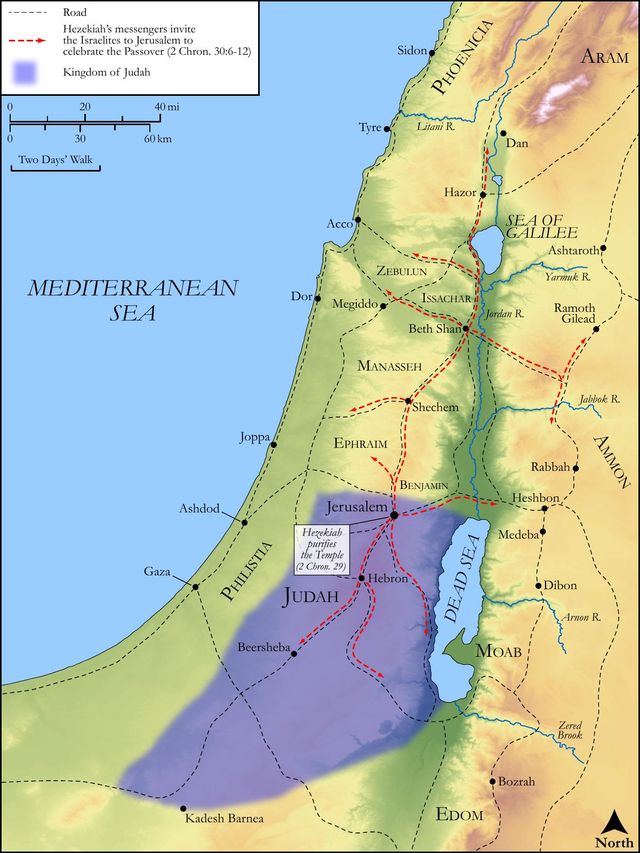
See on the biblical-era map
Study this verse
Public-domain commentary
Matthew Henry
From his Commentary on the Whole Bible. Henry comments on passages, not single verses — this entry covers 2 Chronicles 30:13–20. His three-level outline is real structure in the source text, so it is rendered as structure.
The time appointed for the passover having arrived, a very great congregation came together upon the occasion, Ch2 30:13. Now here we have,
I.The preparation they made for the passover, and good preparation it was:
They took away all the idolatrous altars that were found, not only in the temple, but in Jerusalem, Ch2 30:14. Before they kept the feast, they cast out this old leaven. The best preparation we can make for the gospel passover is to cast away our iniquities, our spiritual idolatries.
II.The celebration of the passover.
In this the people were so forward and zealous that the priests and Levites blushed to see themselves out-done by the commonalty, to see them more ready to bring sacrifices than they were to offer them. This put them upon sanctifying themselves (Ch2 30:15), that the work might not stand still for want of hands to carry it on. The notice we take of the zeal of others should make us ashamed of our own coldness, and quicken us not only to do our duty, but to do it well, and to sanctify ourselves to it. They did according to the duty of their place (Ch2 30:16), sprinkling the blood upon the altar, which was a type of Christ our passover sacrificed for us.
III.The irregularities they were guilty of in this solemnity.
The substance was well managed, and with a great deal of devotion; but, besides that it was a month out of time,
1.The Levites killed the passover, which should have been done by the priests only, Ch2 30:17. They also assisted more than the law ordinarily allowed in offering the other sacrifices, particularly those that were for the purifying of the unclean, many of which there was now occasion for. Some think that it was the offerers' work, not the priests', that the Levites had here the charge of. Ordinarily every man killed his lamb, but now for those that were under any ceremonial pollution the Levites killed it.
2.Many were permitted to eat the passover who were not purified according to the strictness of the law, Ch2 30:18. This was the second month, and there was not warrant to put them off further to the third month, as, if it had been the first month, the law would have permitted them to eat it the second. And they were loth to forbid them communicating at all, lest they should discourage new converts, and send those away complaining whom they desired to send away rejoicing. Grotius observes from this that ritual institutions must give way, not only to a public necessity, but to a public benefit and advantage.
IV.Hezekiah's prayer to God for the forgiveness of this irregularity.
It was his zeal that had called them together in such haste, and he would not that any should fare the worse for being straitened of time in their preparation. He therefore thought himself concerned to be an intercessor for those that ate the passover otherwise than it was written, that there might not be wrath upon them from the Lord. His prayer was,
1.A short prayer, but to the purpose: The good Lord pardon every one in the congregation that has fixed, engaged, or prepared, his heart to those services, though the ceremonial preparation be wanting. Note,
(1.)The great thing required in our attendance upon God in solemn ordinances is that we prepare our hearts to seek him, that we be sincere and upright in all we do, that the inward man be engaged and employed in it, and that we make heart-work of it; it is all nothing without this. Behold, thou desirest truth in the inward part. Hezekiah does not pray that this might be dispensed with, nor that the want of other things might be pardoned where there was not this. For this is the one thing needful, that we seek God, his favour, his honour, and that we set our hearts to do it.
(2.)Where this sincerity and fixedness of heart are there may still be many defects and infirmities, both the frame of the spirit and the performance of the service may be short of the purification of the sanctuary. Corruptions may not be so fully conquered, thoughts not so closely fixed, affections not so lively, faith not so operative, as they should be. Here is a defect in sanctuary purification. There is nothing perfect under the sun, nor a just man that doeth good, and sinneth not.
(3.)These defects need pardoning healing grace; for omissions in duty are sins as well as omissions of duty. If God should deal with us in strict justice according to the best of our performances, we should be undone.
(4.)The way to obtain pardon for our deficiencies in duty, and all the iniquities of our holy things, is to seek it of God by prayer; it is not so a pardon of course but that it must be obtained by petition through the blood of Christ.
(5.)In this prayer we must take encouragement from the goodness of God: The good Lord pardon; for, when he proclaimed his goodness, he insisted most upon this branch of it, forgiving iniquity, transgression, and sin.
(6.)It is the duty of those that have the charge of others, not only to look to themselves, but to those also that are under their charge, to see wherein they are wanting, and to pray for them, as Hezekiah here. See Job 1:5.
2.A successful prayer: The Lord hearkened to Hezekiah, was well pleased with his pious concern for the congregation, and, in answer to his prayer, healed the people (Ch2 30:20), not only did not lay their sin to their charge, but graciously accepted their services notwithstanding; for healing denotes not only forgiveness (Isa 6:10; Psa 103:3), but comfort and peace, Isa 57:18; Mal 4:2.
Continue studying 2 Chronicles 30:15 across the web’s major study libraries — every link below opens this exact verse, chapter, or book on the destination site.
Read & Compare
 BibleGatewayThis verse in more than 200 translations and 70 languages.
 Bible.comThe YouVersion reader — hundreds of translations, reading plans, and highlights.
 ESV.orgCrossway's official English Standard Version reader.
 NET BibleThe NET translation with 60,000+ translators' notes on every rendering decision.
 STEP BibleTyndale House's free study tool — original text, vocabulary, and scholarly resources.
 BibliaLogos Bible Software's free web reader.
 USCCBThe New American Bible (Revised Edition) with the U.S. bishops' study notes.
Commentaries
 BibleHub CommentariesDozens of classic commentaries on this verse, gathered on one page.
 StudyLightMore than 100 commentary sets — the largest collection on the web.
 BibleRefPlain-English commentary on what this verse means, verse by verse.
 Enduring WordDavid Guzik's free commentary on this chapter, widely used by Bible teachers.
 Bible Study ToolsVerse commentary alongside Greek and Hebrew study aids.
Original Language & Research
- BibleHub InterlinearThe verse word by word — original language, transliteration, and English.
- BibleHub LexiconEvery word's original-language definition and Strong's entry.
 Blue Letter BibleDeep-study tools — Strong's numbers, concordance, and word studies.
 SefariaThe Hebrew text with Rashi and centuries of Jewish commentary.
Sermons, Hymns & Audio


TrulyRandomVerse is not affiliated with these sites and doesn’t control their content. They’re linked because they’re genuinely useful.
Summary
2 Chronicles 30:15 describes a pivotal moment in King Hezekiah's spiritual revival, detailing the proper execution of the long-neglected Passover celebration. After generations of spiritual decline and the recent apostasy under King Ahaz, Hezekiah initiated widespread reform culminating in a grand Passover. This verse highlights the crucial actions of the priests and Levites who, moved by a profound sense of shame over their past negligence and impurity, underwent necessary self-sanctification, enabling them to properly facilitate the sacrificial worship, including the Passover and burnt offerings, in the restored Temple.
Context
ShowHideLiterary Context
This verse is situated within the broader narrative of King Hezekiah's reign (2 Chronicles 29-32), which marks a significant turning point from the apostasy of his father, Ahaz. Chapter 29 details Hezekiah's immediate actions to cleanse and reopen the Temple, re-establishing the Levitical service and sacrificial worship. Chapter 30 then describes his extraordinary initiative to invite all Israel and Judah to Jerusalem for a unified Passover celebration, an event that had not been observed nationally for a very long time. Verse 15 specifically describes the culminating act of this preparation, where the Levites and priests, having been spiritually convicted and ritually purified, take their proper place in offering the sacrifices. This act is essential for the legitimacy and efficacy of the entire celebration, leading into the joyous and extended feast described in the subsequent verses.
Historical & Cultural Context
Hezekiah's reign (c. 715-686 BC) occurred during a tumultuous period, with the Assyrian Empire posing a constant threat. Judah had recently experienced severe spiritual decline under King Ahaz, who had introduced pagan worship and closed the Temple. Hezekiah's reforms were a radical departure, aiming to restore the Mosaic covenant and the worship of Yahweh. The Passover, a foundational festival commemorating Israel's deliverance from Egyptian bondage (as detailed in Exodus 12), was central to Israelite identity and covenant renewal. Its neglect signified the depth of Judah's spiritual decay. The delay of the Passover from the first month to the second, as mentioned in the preceding verses, was a culturally significant decision, permitted by Mosaic Law for those who were unclean or on a distant journey (see Numbers 9:10-11). This demonstrates Hezekiah's commitment to proper, albeit delayed, observance rather than a hasty, impure one, emphasizing the importance of ritual purity for sacred acts.
Key Themes
ShowHideThe passage in 2 Chronicles 30 powerfully illustrates several key themes. Repentance and Humility are evident in the priests and Levites being "ashamed," signifying a deep conviction over their past negligence and spiritual impurity, which served as a catalyst for their purification. This leads directly to the theme of Sanctification and Purity, as their act of "sanctified themselves" (Hebrew: qadash) was essential for serving God. This underscores the biblical principle that those who serve God must be ceremonially and spiritually clean, a prerequisite for proper worship. The Restoration of Worship is another dominant theme, as the killing of the Passover lambs and the bringing of "burnt offerings into the house of the LORD" signify the full resumption of the divinely ordained sacrificial system. This was a crucial step in the nation's spiritual healing and re-establishment of their covenant relationship with God, echoing the initial cleansing of the Temple in 2 Chronicles 29. Finally, Obedience Despite Obstacles is highlighted by Hezekiah's decision to hold the Passover in the second month, demonstrating a commitment to obedience according to the provisions in Mosaic law for those who were unclean or unable to observe it at the prescribed time, prioritizing proper observance over rigid adherence to the calendar if purity was compromised.
Exposition and Analysis
ShowHideKey Word Analysis
ShowHideThis word properly means "to wound," but figuratively, "to taunt or insult." In this context, it signifies a profound internal conviction and remorse among the priests and Levites. Their shame was not merely external embarrassment but an inward recognition of their defilement and negligence in their sacred duties, which had contributed to the nation's spiritual decline. This feeling of shame was a necessary precursor to their subsequent act of sanctification, indicating a genuine turning from past impurity towards a desire for proper service.
Meaning "to be (causatively, make, pronounce or observe as) clean (ceremonially or morally)." When applied to the priests and Levites, it refers to a process of ritual purification and dedication that rendered them fit for sacred service. This involved specific washings, offerings, and a renewed commitment to their holy responsibilities, as prescribed in Mosaic Law (e.g., Exodus 29, Leviticus 8). Their self-sanctification was not merely external but implied an internal transformation—a renewed spiritual commitment prompted by their shame and desire to serve God rightly and acceptably.
This refers to a holocaust, meaning the entire animal (except for the hide) was consumed by fire on the altar as an act of complete dedication and atonement. Unlike the Passover sacrifice, which was primarily a communion meal, the burnt offering was a general offering for sin and a demonstration of complete devotion to God. Its inclusion here signifies the full restoration of the regular sacrificial system in the Temple, beyond just the specific Passover requirements, indicating a comprehensive return to Yahweh's prescribed worship.
Verse Breakdown
ShowHide"Then they killed the passover on the fourteenth [day] of the second month"
This clause describes the central sacrificial act of the Passover. "They" refers to the assembled people and, more specifically, the Levites who were tasked with slaughtering the lambs for the multitude, as indicated in 2 Chronicles 30:17. The "fourteenth day of the second month" highlights the unusual timing, permitted by the Mosaic Law for those who were unclean or unable to observe it in the first month (Numbers 9:10-11). This detail underscores Hezekiah's commitment to proper observance, even if delayed, ensuring the purity of the participants.
"and the priests and the Levites were ashamed"
This phrase reveals the internal state of the religious leaders. Their "shame" signifies a profound conviction and remorse over their previous spiritual negligence and defilement. This was not just embarrassment but a deep, humbling realization of their failure to maintain the holiness required for their sacred office, which had contributed to the nation's spiritual decline. This shame served as a catalyst for their subsequent actions.
"and sanctified themselves"
Following their shame, the priests and Levites undertook the necessary ritual and spiritual purification. To "sanctify themselves" (Hebrew: qadash) involved specific cleansing rites and a renewed dedication to their holy duties, making them ceremonially and spiritually fit to approach God and handle sacred things. This act was crucial for the legitimacy and efficacy of the sacrifices they were about to perform, demonstrating their commitment to purity in worship.
"and brought in the burnt offerings into the house of the LORD"
This final clause indicates the culmination of their purification and renewed service. After killing the Passover lambs, the priests and Levites, now sanctified, were able to properly present the "burnt offerings" (Hebrew: ʿôlâ) on the altar within the Temple ("the house of the LORD"). The burnt offering, symbolizing complete dedication and atonement, signifies the full restoration of the divinely ordained sacrificial system beyond just the Passover, marking a comprehensive return to proper worship and covenant relationship with God.
Literary Devices
ShowHideThe passage employs several effective literary devices to convey its powerful message. Narrative Progression is evident as the verse moves from the initial action of "killing the Passover" to the internal state of the priests and Levites ("ashamed"), then to their corrective action ("sanctified themselves"), and finally to the result of their purification ("brought in the burnt offerings"). This progression highlights a cause-and-effect relationship: conviction leading to purification, enabling proper worship. The phrase "priests and the Levites were ashamed" functions as a form of Metonymy, where the emotional state of "shame" represents the deeper spiritual conviction and recognition of their past failures and defilement. This shame is a Catalyst for their subsequent sanctification, underscoring the spiritual principle that humility and self-awareness are prerequisites for drawing near to God in holiness. The detailed description of the sacrificial acts, particularly the "burnt offerings," serves as Symbolism, representing the complete restoration of covenant worship and the nation's renewed dedication to Yahweh after a period of apostasy.
Theological and Thematic Connections
ShowHide2 Chronicles 30:15 powerfully illustrates the indispensable link between personal holiness and corporate worship. The shame felt by the priests and Levites, leading to their self-sanctification, underscores the biblical truth that those who draw near to God in service must be pure and consecrated. This passage emphasizes that true worship is not merely ritualistic but demands an internal transformation—a heart humbled by sin and dedicated to God's standards. It highlights the principle that spiritual revival often begins with the leaders acknowledging their failures and seeking purification, thereby enabling the entire community to participate in acceptable worship. The restoration of the Passover and burnt offerings signifies a return to covenant faithfulness and a re-establishment of the broken relationship between God and His people, demonstrating God's grace in accepting a repentant people.
Reflection and Application
ShowHideThe account of the priests and Levites in 2 Chronicles 30:15 offers profound lessons for contemporary believers. Their shame and subsequent sanctification serve as a powerful reminder that genuine spiritual renewal often begins with a deep, personal conviction of sin and a humble recognition of our shortcomings before God. Just as they needed to be ritually and spiritually pure to serve in the Temple, so too are believers called to pursue holiness in their lives, recognizing that our bodies are temples of the Holy Spirit. This involves a continuous process of confession, repentance, and dedication, allowing God to cleanse us and set us apart for His purposes. Whether in personal devotion, family life, or corporate worship, our service to God must flow from a heart that is both humble and purified, eager to align with His divine will. The passage encourages us to examine our own spiritual posture, asking if we are truly prepared to offer ourselves as living sacrifices, holy and pleasing to God.
Questions for Reflection
ShowHideFAQ
ShowHideWhy was the Passover delayed to the second month, and what does this signify?
ShowHideThe Passover was typically observed on the fourteenth day of the first month (Nisan) according to Exodus 12:6. However, in 2 Chronicles 30, King Hezekiah and the assembly decided to delay it to the fourteenth day of the second month (Iyyar). This delay was permissible under Mosaic Law for specific circumstances, such as being ceremonially unclean or on a distant journey (as outlined in Numbers 9:10-11). The text indicates that the delay was necessary because "the priests had not sanctified themselves sufficiently, neither had the people gathered themselves together to Jerusalem" (2 Chronicles 30:3). This signifies Hezekiah's profound commitment to proper, pure worship over rigid adherence to the calendar. It demonstrates that the spiritual readiness and purity of the participants were paramount, even if it meant adjusting the traditional timing, highlighting the importance of holiness in approaching God.
What does it mean that the priests and Levites were "ashamed" and "sanctified themselves"?
ShowHideThe phrase "were ashamed" (Hebrew: kâlam) indicates a deep sense of conviction, remorse, and humiliation. It suggests that the priests and Levites recognized their past negligence, spiritual impurity, and failure to uphold their sacred duties, which had contributed to the nation's apostasy. This shame was not merely external embarrassment but an internal, humbling realization of their defilement. Following this conviction, they "sanctified themselves" (Hebrew: qâdash), meaning they underwent a process of ritual purification and renewed dedication. This involved specific cleansing rites, as prescribed in the Law (e.g., washings, specific offerings), and a renewed commitment to their holy responsibilities. This act was crucial because only those who were ceremonially and spiritually pure could properly perform their duties in the Temple and mediate for the people, underscoring the absolute necessity of holiness in God's service.
Christ-Centered Fulfillment
ShowHideThe events of 2 Chronicles 30:15, particularly the sanctification of the priests and the offering of the Passover and burnt offerings, find their ultimate fulfillment in Jesus Christ. The Passover lamb, whose blood secured deliverance for Israel, powerfully foreshadows Jesus, the Lamb of God who takes away the sin of the world. His sacrificial death on the cross is the once-for-all Passover sacrifice, providing eternal redemption for all who believe, as Paul declares in 1 Corinthians 5:7. Furthermore, the shame felt by the priests and their subsequent self-sanctification point to the profound need for cleansing before approaching a holy God. While the Old Testament priests had to repeatedly purify themselves, Christ, our great High Priest, did not need to offer sacrifices for himself because He was without sin. Instead, He offered Himself as the perfect, unblemished burnt offering, a complete and final sacrifice that fully atones for sin and perfectly dedicates humanity to God. Through His blood, believers are not merely ritually cleansed but are truly sanctified once for all and given direct access to God's presence, becoming a holy priesthood in Him. Thus, the pursuit of holiness and the offering of sacrifices in 2 Chronicles 30:15 culminate in Christ, who is both the perfect sacrifice and the means of our eternal sanctification, enabling us to truly worship God in spirit and truth.