


2 Chronicles 30:16
- וַיַּעַמְדוּvai·ya·'am·Duand they stoodH5975Conj-w ¦ V-Qal-ConsecImperf-3mpVerb Qal Consecutive Imperfect 3rd Plural Masculineוַandיַּעַמְדוּthey stood
- עַל'alatH5921PrepPreposition
- עָמְדָם'a·me·Damtheir placeH5977N-msc ¦ 3mpNoun Singular Masculine Constructעָמְדָplaceםtheir
- כְּמִשְׁפָּטָםke·mish·pa·Tamaccording to their customH4941Prep-k ¦ N-msc ¦ 3mpNoun Singular Masculine Constructכְּaccording toמִשְׁפָּטָcustomםtheir
- כְּתוֹרַתke·to·Rataccording to [the] law ofH8451Prep-k ¦ N-fscNoun Singular Feminine Constructכְּaccording toתוֹרַת[the] law of
- מֹשֶׁהmo·ShehMosesH4872N-proper-mNoun Proper Masculine
- אִישׁ'ish[the] man ofH376N-mscNoun Singular Masculine Construct
- הָאֱלֹהִיםha·'E·lo·Him<the> GodH430Art ¦ N-mpNoun Plural Masculine Absoluteהָ<the>אֱלֹהִיםGod
- הַכֹּהֲנִיםha·ko·ha·Nimthe priestsH3548Art ¦ N-mpNoun Plural Masculine Absoluteהַtheכֹּהֲנִיםpriests
- זֹרְקִיםzo·re·Kim[were] sprinklingH2236V-Qal-Prtcpl-mpVerb Qal Participle Plural Masculine Absolute
- אֶת'et<obj.>H853DirObjMParticle Object Indicator
- הַדָּםha·Damthe bloodH1818Art ¦ N-msNoun Singular Masculine Absoluteהַtheדָּםblood
- מִיַּדmi·Yadfrom [the] hand ofH3027Prep-m ¦ N-cscNoun Singular common gender Constructמִfromיַּד[the] hand of
- הַלְוִיִּםhal·vi·Yimthe LevitesH3881Art ¦ N-mpNoun Gentilic Plural Masculine AbsoluteהַtheלְוִיִּםLevites
English is a literal word-by-word gloss of the Hebrew, not the KJV's wording. Why?
This is the original text the KJV's translators worked from — each Hebrew word with its own literal English meaning in this verse, prepared by scholars at Tyndale House, Cambridge. The KJV translates whole sentences, not word by word, so its wording differs: one Hebrew word can become several English words, and the KJV may choose “the LORD” where the gloss reads “Yahweh”. Both are faithful — they answer different questions. For the KJV's own rendering, switch to the KJV text.
Details
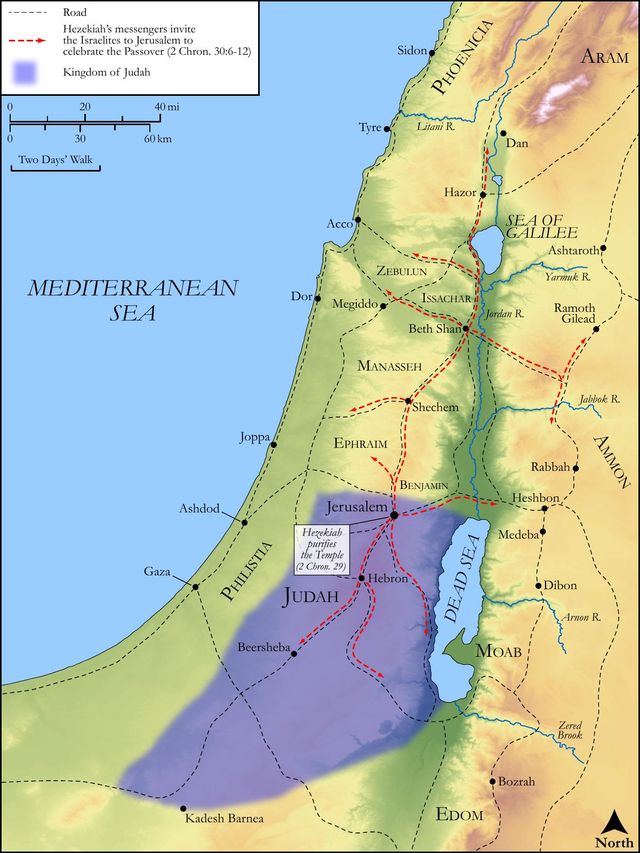
See on the biblical-era map
Study this verse
Public-domain commentary
Matthew Henry
From his Commentary on the Whole Bible. Henry comments on passages, not single verses — this entry covers 2 Chronicles 30:13–20. His three-level outline is real structure in the source text, so it is rendered as structure.
The time appointed for the passover having arrived, a very great congregation came together upon the occasion, Ch2 30:13. Now here we have,
I.The preparation they made for the passover, and good preparation it was:
They took away all the idolatrous altars that were found, not only in the temple, but in Jerusalem, Ch2 30:14. Before they kept the feast, they cast out this old leaven. The best preparation we can make for the gospel passover is to cast away our iniquities, our spiritual idolatries.
II.The celebration of the passover.
In this the people were so forward and zealous that the priests and Levites blushed to see themselves out-done by the commonalty, to see them more ready to bring sacrifices than they were to offer them. This put them upon sanctifying themselves (Ch2 30:15), that the work might not stand still for want of hands to carry it on. The notice we take of the zeal of others should make us ashamed of our own coldness, and quicken us not only to do our duty, but to do it well, and to sanctify ourselves to it. They did according to the duty of their place (Ch2 30:16), sprinkling the blood upon the altar, which was a type of Christ our passover sacrificed for us.
III.The irregularities they were guilty of in this solemnity.
The substance was well managed, and with a great deal of devotion; but, besides that it was a month out of time,
1.The Levites killed the passover, which should have been done by the priests only, Ch2 30:17. They also assisted more than the law ordinarily allowed in offering the other sacrifices, particularly those that were for the purifying of the unclean, many of which there was now occasion for. Some think that it was the offerers' work, not the priests', that the Levites had here the charge of. Ordinarily every man killed his lamb, but now for those that were under any ceremonial pollution the Levites killed it.
2.Many were permitted to eat the passover who were not purified according to the strictness of the law, Ch2 30:18. This was the second month, and there was not warrant to put them off further to the third month, as, if it had been the first month, the law would have permitted them to eat it the second. And they were loth to forbid them communicating at all, lest they should discourage new converts, and send those away complaining whom they desired to send away rejoicing. Grotius observes from this that ritual institutions must give way, not only to a public necessity, but to a public benefit and advantage.
IV.Hezekiah's prayer to God for the forgiveness of this irregularity.
It was his zeal that had called them together in such haste, and he would not that any should fare the worse for being straitened of time in their preparation. He therefore thought himself concerned to be an intercessor for those that ate the passover otherwise than it was written, that there might not be wrath upon them from the Lord. His prayer was,
1.A short prayer, but to the purpose: The good Lord pardon every one in the congregation that has fixed, engaged, or prepared, his heart to those services, though the ceremonial preparation be wanting. Note,
(1.)The great thing required in our attendance upon God in solemn ordinances is that we prepare our hearts to seek him, that we be sincere and upright in all we do, that the inward man be engaged and employed in it, and that we make heart-work of it; it is all nothing without this. Behold, thou desirest truth in the inward part. Hezekiah does not pray that this might be dispensed with, nor that the want of other things might be pardoned where there was not this. For this is the one thing needful, that we seek God, his favour, his honour, and that we set our hearts to do it.
(2.)Where this sincerity and fixedness of heart are there may still be many defects and infirmities, both the frame of the spirit and the performance of the service may be short of the purification of the sanctuary. Corruptions may not be so fully conquered, thoughts not so closely fixed, affections not so lively, faith not so operative, as they should be. Here is a defect in sanctuary purification. There is nothing perfect under the sun, nor a just man that doeth good, and sinneth not.
(3.)These defects need pardoning healing grace; for omissions in duty are sins as well as omissions of duty. If God should deal with us in strict justice according to the best of our performances, we should be undone.
(4.)The way to obtain pardon for our deficiencies in duty, and all the iniquities of our holy things, is to seek it of God by prayer; it is not so a pardon of course but that it must be obtained by petition through the blood of Christ.
(5.)In this prayer we must take encouragement from the goodness of God: The good Lord pardon; for, when he proclaimed his goodness, he insisted most upon this branch of it, forgiving iniquity, transgression, and sin.
(6.)It is the duty of those that have the charge of others, not only to look to themselves, but to those also that are under their charge, to see wherein they are wanting, and to pray for them, as Hezekiah here. See Job 1:5.
2.A successful prayer: The Lord hearkened to Hezekiah, was well pleased with his pious concern for the congregation, and, in answer to his prayer, healed the people (Ch2 30:20), not only did not lay their sin to their charge, but graciously accepted their services notwithstanding; for healing denotes not only forgiveness (Isa 6:10; Psa 103:3), but comfort and peace, Isa 57:18; Mal 4:2.
Continue studying 2 Chronicles 30:16 across the web’s major study libraries — every link below opens this exact verse, chapter, or book on the destination site.
Read & Compare
 BibleGatewayThis verse in more than 200 translations and 70 languages.
 Bible.comThe YouVersion reader — hundreds of translations, reading plans, and highlights.
 ESV.orgCrossway's official English Standard Version reader.
 NET BibleThe NET translation with 60,000+ translators' notes on every rendering decision.
 STEP BibleTyndale House's free study tool — original text, vocabulary, and scholarly resources.
 BibliaLogos Bible Software's free web reader.
 USCCBThe New American Bible (Revised Edition) with the U.S. bishops' study notes.
Commentaries
 BibleHub CommentariesDozens of classic commentaries on this verse, gathered on one page.
 StudyLightMore than 100 commentary sets — the largest collection on the web.
 BibleRefPlain-English commentary on what this verse means, verse by verse.
 Enduring WordDavid Guzik's free commentary on this chapter, widely used by Bible teachers.
 Bible Study ToolsVerse commentary alongside Greek and Hebrew study aids.
Original Language & Research
- BibleHub InterlinearThe verse word by word — original language, transliteration, and English.
- BibleHub LexiconEvery word's original-language definition and Strong's entry.
 Blue Letter BibleDeep-study tools — Strong's numbers, concordance, and word studies.
 SefariaThe Hebrew text with Rashi and centuries of Jewish commentary.
Sermons, Hymns & Audio


TrulyRandomVerse is not affiliated with these sites and doesn’t control their content. They’re linked because they’re genuinely useful.
Summary
Second Chronicles 30:16 captures a pivotal moment in King Hezekiah's unprecedented Passover celebration, meticulously detailing the restored, divinely ordained roles of the priests and Levites in the sacrificial rites. This verse specifically highlights their precise adherence to the Law of Moses as the priests received the blood from the Levites for the sacred act of sprinkling. It powerfully underscores the re-establishment of order, purity, and profound obedience to God's commands after a prolonged period of spiritual decline and neglect in Judah.
Context
ShowHideLiterary Context
This verse is deeply embedded within the comprehensive narrative of King Hezekiah's spiritual reforms and national revival, which spans 2 Chronicles 29-31. Following the widespread apostasy and neglect under previous kings, particularly his father Ahaz, Hezekiah initiated a radical cleansing and rededication of the Temple, culminating in a nationwide call for a Passover celebration. This invitation was extended not only to Judah but also to the remnant of the northern kingdom of Israel. The preceding verses in 2 Chronicles 30 describe the enthusiastic, albeit challenging, gathering of the people. Many participants were ritually unclean due to the long period of spiritual dormancy, prompting Hezekiah's compassionate prayer for them, which God graciously answered (2 Chronicles 30:20). Due to the immense volume of sacrifices and the ritual impurity of many individuals, the Levites took on the extraordinary responsibility of slaughtering the offerings for the entire congregation, a task normally performed by the offerer. Verse 16 then specifies the subsequent, critical step in this elaborate ritual: the precise transfer of the sacrificial blood from the Levites to the priests for its sacred application.
Historical & Cultural Context
Hezekiah's reign (c. 715-686 BC) represented a profound spiritual resurgence after decades of idolatry and disregard for the Mosaic covenant, particularly under his father, King Ahaz. The Passover, a foundational covenant festival commemorating Israel's miraculous deliverance from Egyptian bondage, had likely not been observed with such national fervor and adherence to Mosaic law for generations. The division of labor between priests and Levites was absolutely central to the Mosaic sacrificial system as prescribed in the Torah. Priests, as direct descendants of Aaron, held exclusive rights to perform the most sacred acts, such as offering incense, lighting the menorah, and, most crucially, applying the blood of sacrifices to the altar as part of the atonement process. Levites, from the tribe of Levi but not the Aaronic priestly line, served as essential assistants, performing duties like slaughtering animals, preparing sacrifices, and maintaining the Temple's cleanliness and order. The meticulous observance described in 2 Chronicles 30:16 underscores Hezekiah's unwavering commitment to restoring proper, divinely prescribed worship, emphasizing the sanctity of the Temple rituals and the non-negotiable necessity of ritual purity for approaching a holy God.
Key Themes
ShowHideThis verse profoundly contributes to several overarching theological and narrative themes within 2 Chronicles:
Obedience to God's Law
The explicit phrase "according to the law of Moses the man of God" underscores the paramount importance of following divine commands precisely. Hezekiah's reform was not an innovation but a faithful restoration, a return to the established covenant stipulations. This theme is a recurring motif throughout the Chronicler's work, which often evaluates the kings of Judah based on their adherence to the Torah.
Order and Structure in Worship
The verse vividly illustrates the distinct, divinely ordained roles of the Levites and priests. Each group had specific, non-interchangeable functions within the sacrificial system, highlighting that true worship is not chaotic or arbitrary but ordered according to God's precise design. The Levites' role in slaughtering and the priests' exclusive role in sprinkling the blood maintained the sanctity, integrity, and efficacy of the atonement process.
The Significance of Blood
Central to Old Testament worship, the sprinkling of blood was essential for purification, consecration, and atonement. As articulated in Leviticus 17:11, "for the life of a creature is in the blood, and I have given it to you to make atonement for yourselves on the altar; it is the blood that makes atonement for one's life." The careful handling and application of blood by the priests symbolized the transfer of guilt and the covering of sin, making reconciliation with God possible.
Exposition and Analysis
ShowHideKey Word Analysis
ShowHideThis term refers to "blood (as that which when shed causes death) of man or an animal." In the context of Old Testament sacrifices, blood was the very essence of life, and its shedding represented the giving of a life for atonement. Its application by the priests was the climactic act in the sacrificial ritual, symbolizing purification, consecration, and the covering of sin, making reconciliation with a holy God possible.
A primitive root meaning "to sprinkle (fluid or solid particles)." This verb describes a specific ritual action where blood or water was applied by flicking or dashing it onto an object, person, or the altar. In the sacrificial system, the act of sprinkling the blood was not merely disposal but a highly symbolic and sacred presentation of the life offered, signifying the application of the atonement to cleanse and purify.
This word properly signifies a "verdict," "ordinance," "custom," or "manner." In this context, "after their manner" refers to the established, prescribed way of performing the ritual. It emphasizes that the priests and Levites were operating according to long-standing, divinely sanctioned procedures and protocols, not according to their own discretion or convenience. This highlights the restoration of proper order and the strict adherence to the detailed instructions found in the Mosaic Law concerning Temple service.
Verse Breakdown
ShowHide"And they stood in their place after their manner, according to the law of Moses the man of God:"
This opening clause establishes the profound order, divine authority, and historical continuity governing the proceedings. "They" refers to both the priests and Levites, who were positioned in their designated areas within the Temple precincts, ready to fulfill their specific duties. "After their manner" (or "according to their custom/ordinance") underscores that their actions were not arbitrary but conformed to established, sacred protocol and tradition. The phrase "according to the law of Moses the man of God" provides the ultimate validation and source of this authority, emphasizing that Hezekiah's reforms were a faithful return to the foundational covenant stipulations given through Moses, God's chosen prophet and lawgiver. This highlights a deliberate and reverent adherence to divine instruction, signifying a true spiritual revival.
"the priests sprinkled the blood"
This is the central, sacred action of the verse, identifying the exclusive and non-transferable role of the priests. Only they, as direct descendants of Aaron, were authorized to perform this most sacred act. The sprinkling of blood was not merely a disposal of fluid; it was a ritual application, symbolizing the presentation of the life of the sacrifice to God for atonement and purification. It was the crucial step that mediated between the offerer and God, making reconciliation and forgiveness possible. This act was the culmination of the sacrificial process, signifying the covering of sin.
"[which they received] of the hand of the Levites"
This final clause clarifies the cooperative yet distinct roles of the two groups, illustrating the intricate division of labor within the Temple service. The Levites, having slaughtered the sacrificial animals (a task they undertook due to the large number of offerings and the ritual impurity of many people, as noted in preceding verses), collected the blood in basins. They then transferred this collected blood to the priests. This demonstrates that while the Levites performed essential preparatory tasks, the ultimate, most sacred act of blood application remained the exclusive domain of the Aaronic priesthood, maintaining the sanctity and integrity of the ritual.
Literary Devices
ShowHideThe verse employs several literary devices to emphasize its core message. Emphasis is achieved through the explicit and repeated mention of adherence to divine instruction, particularly with the phrase "according to the law of Moses the man of God." This phrase acts as a thematic anchor, validating the entire process and highlighting the absolute necessity of divine revelation for proper worship. There is also a clear delineation of roles, highlighting the distinct and complementary functions of the priests and Levites, which reinforces the theme of divine order and structure in worship. The act of "sprinkling the blood" functions as powerful symbolism, representing the life offered for atonement and purification. The blood itself, as a life-giving substance, becomes a sacred medium for reconciliation with God. Furthermore, the narrative's precise focus on this specific, seemingly small detail within a larger celebration uses synecdoche, where this particular, critical act (the sprinkling of blood) represents the efficacy and restoration of the entire sacrificial system and its profound theological implications.
Theological and Thematic Connections
ShowHide2 Chronicles 30:16 profoundly illustrates the Old Testament understanding of worship as a meticulously ordered, divinely prescribed activity, fundamentally centered on the principle of atonement through blood. The explicit emphasis on "the law of Moses" underscores that acceptable worship is always on God's terms, not human invention or convenience. The distinct roles of priests and Levites reveal a theology of mediation and divine order, where specific individuals were consecrated for specific sacred tasks to bridge the chasm between a holy God and sinful humanity. The centrality of blood in this ritual points to the foundational, unchanging truth articulated in the Old Testament: "without the shedding of blood there is no forgiveness of sins" (Hebrews 9:22). This verse, therefore, is not merely a historical account of a ritual; it is a profound theological statement about God's absolute holiness, humanity's pervasive sin, and the divinely provided means for reconciliation and purification.
Reflection and Application
ShowHideThis verse, while describing ancient rituals from a distant past, offers profound and timeless insights for contemporary believers. It serves as a powerful reminder that reverence for God and unwavering obedience to His revealed will are paramount in our worship and daily lives. Just as the priests and Levites diligently fulfilled their specific, divinely appointed roles, so too are believers called to serve God faithfully within the unique gifts and callings He has bestowed upon them, contributing to the harmonious and effective functioning of the body of Christ. The meticulous care taken in handling the blood underscores the immense value God places on life and the terrifying seriousness of sin, which requires a life (represented by blood) to atone for it. While we no longer offer animal sacrifices, the underlying principles of humility, obedience, and the recognition of God's absolute holiness remain vitally important. Our worship, whether corporate or individual, should be marked by intentionality, reverence, and a deep, abiding appreciation for the ultimate, perfect sacrifice that has made our direct access to God possible.
Questions for Reflection
ShowHideFAQ
ShowHideWhy were the Levites handling the slaughtering and the priests the sprinkling of blood?
ShowHideThis division of labor was strictly defined by the Mosaic Law, reflecting God's established order for Temple service and the sanctity of the atonement process. The Levites, as a tribe set apart for service, were responsible for many practical aspects of the tabernacle and later the Temple, including the slaughtering of sacrificial animals, preparing the offerings, and maintaining the sacred space. However, only the priests, who were direct descendants of Aaron within the tribe of Levi, were consecrated to perform the most sacred ritual acts, such as offering incense, lighting the menorah, and, crucially, applying the blood to the altar. This distinction underscored the unique holiness and mediatorial role of the priesthood, ensuring that the most sacred parts of the atonement ritual were performed by those divinely appointed for it, as detailed in passages like Numbers 18:1. This precise allocation of duties ensured both efficiency in handling large numbers of sacrifices and the maintenance of ritual purity and divine order.
Christ-Centered Fulfillment
ShowHide2 Chronicles 30:16, with its meticulous depiction of the priests sprinkling blood received from the Levites, finds its ultimate and perfect fulfillment in the person and work of Jesus Christ. The Old Testament sacrificial system, though divinely ordained, was inherently temporary and imperfect, requiring repeated offerings and the constant shedding of animal blood. These rituals were but "a shadow of the good things to come instead of the true form of these realities" (Hebrews 10:1). Jesus, as the perfect Lamb of God, offered Himself as the singular, once-for-all sacrifice for sin, fulfilling all the requirements of the Law and rendering the animal sacrifices obsolete (Hebrews 10:10). Moreover, Jesus is not only the sacrifice but also our Great High Priest, who, unlike the Aaronic priests, entered the true, heavenly sanctuary "not with the blood of goats and calves, but with his own blood, thus obtaining eternal redemption" (Hebrews 9:12). The Old Testament priests sprinkled blood on earthly altars; Christ, through His own shed blood, has secured perfect and lasting atonement, making direct and confident access to God possible for all who believe (Hebrews 10:19). The order and precision seen in 2 Chronicles 30:16 foreshadow the perfect, unblemished nature of Christ's sacrifice, which fully satisfied God's righteous demands and provided complete and eternal cleansing from sin.