


2 Chronicles 5:11
Bible text: King James Version (1769 Blayney text) · Public domain
Bible text: Berean Standard Bible · Public domain
Bible text: American Standard Version (1901) · Public domain
Bible text: World English Bible, Messianic edition · Public domain
Bible text: Geneva Bible (1599) · Public domain
Bible text: Young's Literal Translation · Public domain
- וַיְהִיvay·Hiand it wasH1961Conj-w ¦ V-Qal-ConsecImperf-3msVerb Qal Consecutive Imperfect 3rd Singular Masculineוַandיְהִיit was
- בְּצֵאתbe·Tzetwhen came outH3318Prep-b ¦ V-Qal-InfVerb Qal Infinitive Constructבְּwhenצֵאתcame out
- הַכֹּהֲנִיםha·ko·ha·Nimthe priestsH3548Art ¦ N-mpNoun Plural Masculine Absoluteהַtheכֹּהֲנִיםpriests
- מִןminfromH4480PrepPreposition
- הַקֹּדֶשׁha·Ko·deshthe holy placeH6944Art ¦ N-msNoun Title Singular Masculine Absoluteהַtheקֹּדֶשׁholy place
- כִּיkiforH3588PrtParticle Conditional
- כָּלkolallH3605N-mscNoun Singular Masculine Construct
- הַכֹּהֲנִיםha·ko·ha·Nimthe priestsH3548Art ¦ N-mpNoun Plural Masculine Absoluteהַtheכֹּהֲנִיםpriests
- הַנִּמְצְאִיםha·nim·tze·'Imwho were foundH4672Art ¦ V-Niphal-Prtcpl-mpVerb Niphal Participle Plural Masculine Absoluteהַwhoנִּמְצְאִיםwere found
- הִתְקַדָּשׁוּhit·ka·Da·shuthey had consecrated themselvesH6942V-Hithpael-Perf-3cpVerb Hithpael Perfect 3rd Plural common gender
- אֵין'einnotH369N-mscNoun Singular Masculine Construct
- לִשְׁמוֹרlish·Morto keepH8104Prep-l ¦ V-Qal-InfVerb Qal Infinitive Constructלִtoשְׁמוֹרkeep
- לְמַחְלְקוֹתle·mach·le·Kotto divisionsH4256Prep-l ¦ N-fpNoun Plural Feminine Absoluteלְtoמַחְלְקוֹתdivisions
English is a literal word-by-word gloss of the Hebrew, not the KJV's wording. Why?
This is the original text the KJV's translators worked from — each Hebrew word with its own literal English meaning in this verse, prepared by scholars at Tyndale House, Cambridge. The KJV translates whole sentences, not word by word, so its wording differs: one Hebrew word can become several English words, and the KJV may choose “the LORD” where the gloss reads “Yahweh”. Both are faithful — they answer different questions. For the KJV's own rendering, switch to the KJV text.
Details
See on the biblical-era maps
Study this verse
Public-domain commentary
Matthew Henry
From his Commentary on the Whole Bible. Henry comments on passages, not single verses — this entry covers 2 Chronicles 5:11–14. His three-level outline is real structure in the source text, so it is rendered as structure.
Solomon, and the elders of Israel, had done what they could to grace the solemnity of the introduction of the ark; but God, by testifying his acceptance of what they did, put the greatest honour upon it. The cloud of glory that filled the house beautified it more than all the gold with which it was overlaid or the precious stones with which it was garnished; and yet that was no glory in comparison with the glory of the gospel dispensation, Co2 3:8-10. Observe,
I.How God took possession of the temple: He filled it with a cloud, Ch2 5:13.
1.Thus he signified his acceptance of this temple to be the same to him that the tabernacle of Moses was, and assured them that he would be the same in it; for it was by a cloud that he made his public entry into that, Exo 40:34.
2.Thus he considered the weakness and infirmity of those to whom he manifested himself, who could not bear the dazzling lustre of the divine light: it would have overpowered them; he therefore spread his cloud upon it, Job 26:9. Christ revealed things unto his disciples as they were able to bear them, and in parables, which wrapped up divine things as in a cloud.
3.Thus he would affect all that worshipped in his courts with holy reverence and fear. Christ's disciples were afraid when they entered into a cloud, Luk 9:34.
4.Thus he would intimate the darkness of that dispensation, by reason of which they could not stedfastly look to the end of those things which were now abolished, Co2 3:13.
II.When he took possession of it.
1.When the priests had come out of the holy place, Ch2 5:11. This is the way of giving possession. All must come out, that the rightful owner may come in. Would we have God dwell in our hearts? We must leave room for him; let every thing else give way. We are here told that upon this occasion the whole family of the priests attended, and not any one particular course: All the priests that were present were sanctified (Ch2 5:11), because there was work enough for them all, when such a multitude of sacrifices were to be offered, and because it was fit that they should all be eye-witnesses of this solemnity and receive the impressions of it.
2.When the singers and musicians praised God, then the house was filled with a cloud. This is very observable; it was not when they offered sacrifices, but when they sang the praises of God, that God gave them this token of his favour; for the sacrifice of praise pleaseth the Lord better than that of an ox or bullock, Psa 69:31. All the singers and musicians were employed, those of all the three families; and, to complete the concert, 120 priests, with their trumpets, joined with them, all standing at the east end of the altar, on that side of the court which lay outmost towards the people, Ch2 5:12. And, when this part of the service began, the glory of God appeared. Observe,
(1.)It was when they were unanimous, when they were as one, to make one sound. The Holy God descended on the apostles when they met with one accord, Act 2:1-4. Where unity is the Lord commands the blessing.
(2.)It was when they were lively and hearty, and lifted up their voice to praise the Lord. Then we serve God acceptably when we are fervent in spirit serving him.
(3.)It was when they were, in their praises, celebrating the everlasting mercy and goodness of God. As there is one saying oftener repeated in scripture than this, his mercy endureth for ever (twenty-six times in one psalm, Ps. 136, and often elsewhere), so there is none more signally owned from heaven; for it was not the expression of some rapturous flights that the priests were singing when the glory of God appeared, but this plain song, He is good, and his mercy endureth for ever. God's goodness is his glory, and he is pleased when we give him the glory of it.
III.What was the effect of it.
The priests themselves could not stand to minister, by reason of the cloud (Ch2 5:14), which, as it was an evidence that the law made men priests that had infirmity, so (as bishop Patrick observes) it was a plain intimation that the Levitical priesthood should cease, and stand no longer to minister, when the Messiah should come, in whom the fulness of the godhead should dwell bodily. In him the glory of God dwelt among us, but covered with a cloud. The Word was made flesh; and when he comes to his temple, like a refiner's fire, who may abide the day of his coming? And who shall stand when he appeareth? Mal 3:1, Mal 3:2.
Continue studying 2 Chronicles 5:11 across the web’s major study libraries — every link below opens this exact verse, chapter, or book on the destination site.
Read & Compare
 BibleGatewayThis verse in more than 200 translations and 70 languages.
 Bible.comThe YouVersion reader — hundreds of translations, reading plans, and highlights.
 ESV.orgCrossway's official English Standard Version reader.
 NET BibleThe NET translation with 60,000+ translators' notes on every rendering decision.
 STEP BibleTyndale House's free study tool — original text, vocabulary, and scholarly resources.
 BibliaLogos Bible Software's free web reader.
 USCCBThe New American Bible (Revised Edition) with the U.S. bishops' study notes.
Commentaries
 BibleHub CommentariesDozens of classic commentaries on this verse, gathered on one page.
 StudyLightMore than 100 commentary sets — the largest collection on the web.
 BibleRefPlain-English commentary on what this verse means, verse by verse.
 Enduring WordDavid Guzik's free commentary on this chapter, widely used by Bible teachers.
 Bible Study ToolsVerse commentary alongside Greek and Hebrew study aids.
Original Language & Research
- BibleHub InterlinearThe verse word by word — original language, transliteration, and English.
- BibleHub LexiconEvery word's original-language definition and Strong's entry.
 Blue Letter BibleDeep-study tools — Strong's numbers, concordance, and word studies.
 SefariaThe Hebrew text with Rashi and centuries of Jewish commentary.
Sermons, Hymns & Audio


TrulyRandomVerse is not affiliated with these sites and doesn’t control their content. They’re linked because they’re genuinely useful.
Summary
2 Chronicles 5:11 describes a pivotal moment during the dedication of Solomon's Temple, immediately following the placement of the Ark of the Covenant in the Most Holy Place. This verse highlights the extraordinary state of the priesthood: all priests present were consecrated and, unusually, served together rather than by their customary divisions. This collective sanctification and unified service set the spiritual stage for the dramatic manifestation of God's glory that immediately followed, signaling divine approval and indwelling presence.
Context
ShowHideLiterary Context
This verse is situated at the crescendo of the Temple's dedication narrative in Jerusalem, a moment of immense national and spiritual significance. The preceding verses meticulously detail the Levites bringing the Ark of the Covenant, the very symbol of God's presence, into its final resting place within the inner sanctuary, the Most Holy Place, as described in 2 Chronicles 5:7-10. Verse 11 captures the priests' actions and spiritual state as they emerge from this sacred task, forming a crucial transition. It immediately precedes the climactic manifestation of God's glory, where the cloud of the Lord's presence fills the Temple, preventing the priests from ministering, as vividly recounted in 2 Chronicles 5:13-14, thereby validating the entire dedication process. The specific mention of the priests' sanctification and unified service underscores the unique and extraordinary nature of this event, distinguishing it from regular Temple liturgy.
Historical & Cultural Context
The dedication of Solomon's Temple marked a monumental epoch in Israelite history, fulfilling David's vision and establishing a permanent dwelling place for God among His people in Jerusalem. This event occurred during the Solomonic era (c. 970-931 BC), a period of great prosperity and national consolidation. The priesthood, descended from Aaron, held a central role in Israelite worship, mediating between God and the people. King David had previously organized the priests into twenty-four divisions or "courses" (as detailed in 1 Chronicles 24), ensuring an orderly and continuous system of service throughout the year. The explicit statement in 2 Chronicles 5:11 that "all the priests that were present were sanctified, and did not then wait by course" is highly significant. It indicates a deliberate suspension of these established norms, emphasizing the unparalleled importance and sacredness of the Temple dedication. This collective, unified participation, rather than a rotational duty, signified an extraordinary moment of national consecration and unified devotion before the Lord.
Key Themes
ShowHideThe verse powerfully contributes to several overarching themes within 2 Chronicles and the broader biblical narrative. Firstly, it highlights Unusual Priestly Unity and Full Participation. The suspension of the established "courses" (as seen in 1 Chronicles 24:1-19) underscores the unique and unparalleled nature of the Temple dedication. This was a moment demanding the collective, unified presence and service of all available priests, symbolizing a profound communal commitment to God. Secondly, the theme of Consecration and Readiness is central. The declaration that "all the priests... were sanctified" emphasizes the absolute necessity of ritual purity and spiritual preparedness for ministering in God's presence. This act of sanctification (Hebrew: qadash) was a prerequisite for approaching the Holy God, ensuring their fitness for such a sacred occasion. Finally, the verse builds an intense Anticipation of Divine Presence. The unified, consecrated state of the priesthood was not merely an administrative detail but a vital component in preparing the spiritual atmosphere for God's manifest glory. Their collective worship and readiness served as a prelude to the overwhelming cloud of the Lord's glory filling the Temple, as described in 2 Chronicles 5:13-14, a clear sign of His acceptance and indwelling presence.
Exposition and Analysis
ShowHideKey Word Analysis
ShowHideThis verb signifies being set apart, consecrated, or made holy for a specific sacred purpose. In the context of the Old Testament priesthood, it involved a process of ritual purification and dedication, often through washing, anointing, and specific sacrifices, rendering them fit to enter God's presence and perform sacred duties. Here, it implies that every priest present had undergone the necessary rites to be ceremonially and spiritually prepared for this momentous occasion, ensuring their purity and acceptability before the Lord.
The term "course" refers to the priestly divisions or rotations established by King David (1 Chronicles 24) to ensure an orderly and continuous system of service in the Tabernacle and later the Temple. Priests would serve for specific periods according to their assigned course. The phrase "did not then wait by course" indicates a deliberate suspension of this normal rotational duty. For the Temple dedication, all available priests were present and actively participating simultaneously, rather than adhering to their usual roster. This highlights the extraordinary nature of the event, demanding full, unified priestly involvement.
Verse Breakdown
ShowHide"And it came to pass, when the priests were come out of the holy [place]:"
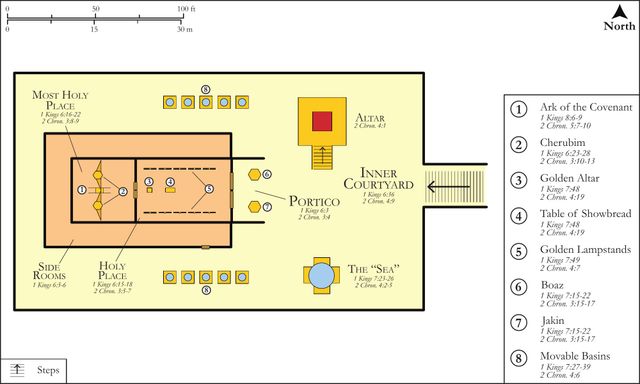
This clause marks a crucial transition. The "holy [place]" (Hebrew: qôdesh H6944) here refers to the inner sanctuary of the Temple, specifically the Most Holy Place (or Holy of Holies), from which the priests were emerging after having successfully placed the Ark of the Covenant within it (2 Chronicles 5:7-10). Their exit signifies the completion of the most sacred act of the dedication, opening the way for God's response.
"(for all the priests [that were] present were sanctified, [and] did not [then] wait by course:)"
This parenthetical explanation provides the vital context for the preceding action and the subsequent manifestation of God's glory. It explains why the priests were able to participate in such a unified and extraordinary manner. The phrase "all the priests that were present were sanctified" emphasizes their collective ritual purity and spiritual readiness, a prerequisite for ministering before the Lord. Furthermore, "did not then wait by course" highlights the suspension of their usual rotational duties, underscoring the unique and unparalleled nature of this dedication. It signifies a moment of complete unity and full participation, where every available priest was consecrated and actively engaged, rather than serving in their appointed shifts. This collective readiness was a necessary precursor to the divine glory that was about to descend.
Literary Devices
ShowHideThe verse primarily employs Parenthetical Explanation to provide crucial background information. The clause "(for all the priests [that were] present were sanctified, [and] did not [then] wait by course:)" functions as an explanatory aside, clarifying the extraordinary circumstances of the priests' actions. This device serves to emphasize the unique and unparalleled nature of the Temple dedication. By explicitly stating that all priests were sanctified and serving together, the text underscores the immense significance of the moment, distinguishing it from regular Temple service. This collective unity and consecration also serve as a form of foreshadowing, building anticipation for the divine manifestation that immediately follows. The meticulous preparation and unity of the priesthood create an atmosphere of expectation, hinting at the profound divine response that is about to occur.
Theological and Thematic Connections
ShowHide2 Chronicles 5:11 powerfully illustrates the themes of divine order, human preparation, and the manifestation of God's presence. The meticulous sanctification of the priests and their unified service underscore the biblical principle that approaching a holy God requires intentional purity and collective reverence. God delights in the unity of His people, especially in worship, and this verse demonstrates how such unity, coupled with consecration, can create an environment conducive to experiencing His manifest glory. It reminds us that while God's presence is sovereign, our posture of readiness and obedience plays a significant role in our capacity to perceive and receive it. This moment in Israel's history serves as a paradigm for the importance of corporate spiritual readiness in the life of God's people.
Reflection and Application
ShowHideThe scene in 2 Chronicles 5:11 offers profound lessons for the contemporary believer and the church. The unified and sanctified state of the priests challenges us to consider our own approach to corporate worship and individual spiritual discipline. Just as all available priests set aside their normal routines to participate fully in a moment of unparalleled significance, we are called to prioritize and prepare ourselves for encounters with God, whether in communal gatherings or in our private devotion. This verse reminds us that true worship is not merely a ritual but a consecrated act of unity and readiness, where our hearts are set apart for God's purposes. When we gather in unity, prepared in heart and spirit, we create an atmosphere of expectation for God to move and manifest His glory among us, fostering a deeper experience of His presence and power. It calls us to examine our own spiritual "sanctification" – our ongoing process of being set apart for God – and to embrace the power of collective, unified worship.
Questions for Reflection
ShowHideFAQ
ShowHideWhy were all the priests present and not serving by course?
ShowHideThe suspension of the normal priestly "courses" (rotational duties established by King David, as detailed in 1 Chronicles 24) was a deliberate and extraordinary measure for the dedication of Solomon's Temple. This event was a singular, monumental occasion in Israelite history, signifying the establishment of God's permanent dwelling place among His people. The presence and unified participation of all available priests, rather than just a rotating shift, underscored the unparalleled importance and sacredness of the moment. It symbolized a collective national consecration and unified devotion, demonstrating the entire priesthood's full commitment to this foundational act of worship and the establishment of God's presence.
What does "sanctified" mean in this context, and why was it important?
ShowHideIn this context, "sanctified" (Hebrew: qadash) means that the priests had undergone the necessary ritual purifications and consecrations to be set apart and made holy for sacred service. This involved specific ceremonies, washings, and offerings that rendered them ceremonially pure and spiritually fit to approach God's presence and perform their duties in the Temple. It was vitally important because God is holy, and only those who were ritually and spiritually pure could minister before Him without incurring His wrath (Leviticus 10:1-3). Their sanctified state ensured that their participation in the Temple dedication was acceptable to God, preparing the way for His glory to fill the house.
Christ-Centered Fulfillment
ShowHideThe Old Testament priesthood and the Temple, with their emphasis on sanctification and access to God's presence, find their ultimate fulfillment in Jesus Christ. The priests' collective sanctification and unified service in 2 Chronicles 5:11 foreshadow the perfect and singular ministry of Jesus, our great High Priest, who required no cleansing for Himself but offered Himself as the spotless sacrifice for our sins (Hebrews 4:14-16). His once-for-all sacrifice accomplished what the continual sacrifices of the Old Covenant priesthood could not: true and eternal sanctification for all who believe (Hebrews 10:10-14). Through Christ, the veil separating humanity from God's Most Holy Place has been torn (Matthew 27:51), and believers are now invited to draw near with confidence, not through a human priesthood or a physical temple, but through the blood of Jesus (Hebrews 10:19-22). Furthermore, the glory of the Lord filling the Temple in 2 Chronicles 5:13-14 prefigures the indwelling of the Holy Spirit in believers, making each one a "temple of the Holy Spirit" (1 Corinthians 6:19), and collectively, the church becomes the living temple where God's presence truly dwells (Ephesians 2:19-22). Thus, the unity and consecration of the priests at the Temple's dedication point forward to the new reality in Christ, where all believers are a "royal priesthood" (1 Peter 2:9), sanctified and united in Him, offering spiritual sacrifices and experiencing God's presence not in a building, but within their very being.