


2 Chronicles 35:4
Bible text: King James Version (1769 Blayney text) · Public domain
Bible text: King James Version with Strong's numbers · Public domain
Bible text: Berean Standard Bible · Public domain
Bible text: American Standard Version (1901) · Public domain
Bible text: World English Bible, Messianic edition · Public domain
Bible text: Geneva Bible (1599) · Public domain
Bible text: Young's Literal Translation · Public domain
- וְהָכִינוּve·hi·ko·nuand prepareH3559Conj-w ¦ V-Hiphil-Imp-2mpVerb Hiphil Imperative 2nd Plural Masculineוְandהָכִינוּprepare
- לְבֵיתle·veitto [the] house ofH1004Prep-l ¦ N-mscNoun Singular Masculine Constructלְtoבֵית[the] house of
- אֲבוֹתֵיכֶם'a·vo·tei·Khemyour ancestorsH1N-fpc ¦ 2mpNoun Plural Feminine Constructאֲבוֹתֵיancestorsכֶםyour
- כְּמַחְלְקוֹתֵיכֶםke·mach·le·ko·tei·Chemaccording to your divisionsH4256Prep-k ¦ N-fpc ¦ 2mpNoun Plural Feminine Constructכְּaccording toמַחְלְקוֹתֵיdivisionsכֶםyour
- בִּכְתָבbikh·Tavby [the] writing ofH3791Prep-b ¦ N-mscNoun Singular Masculine Constructבִּbyכְתָב[the] writing of
- דָּוִידda·VidDavidH1732N-proper-mNoun Proper Masculine
- מֶלֶךְMe·lekh[the] king ofH4428N-mscNoun Singular Masculine Construct
- יִשְׂרָאֵלYis·ra·'ElIsraelH3478N-properNoun Proper Location
- וּבְמִכְתַּבu·ve·mikh·Tavand by [the] writing ofH4385Conj-w ¦ Prep-b ¦ N-mscNoun Singular Masculine Constructוּandבְbyמִכְתַּב[the] writing of
- שְׁלֹמֹהshe·lo·MohSolomonH8010N-proper-mNoun Proper Masculine
- בְנוֹve·Nohis sonH1121N-msc ¦ 3msNoun Singular Masculine Constructבְנsonוֹhis
English is a literal word-by-word gloss of the Hebrew, not the KJV's wording. Why?
This is the original text the KJV's translators worked from — each Hebrew word with its own literal English meaning in this verse, prepared by scholars at Tyndale House, Cambridge. The KJV translates whole sentences, not word by word, so its wording differs: one Hebrew word can become several English words, and the KJV may choose “the LORD” where the gloss reads “Yahweh”. Both are faithful — they answer different questions. For the KJV's own rendering, switch to the KJV text.
Details
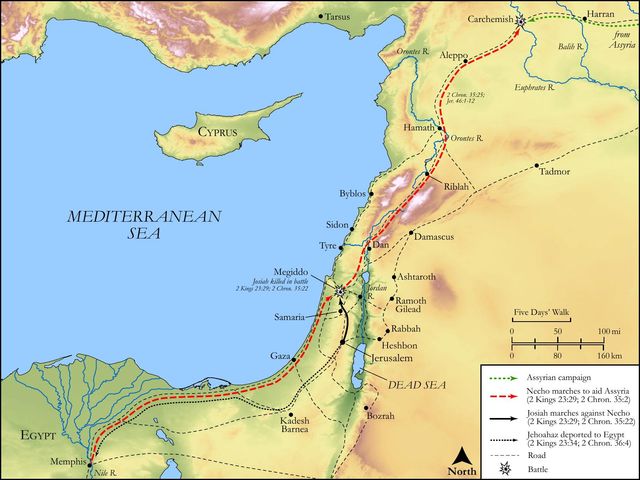
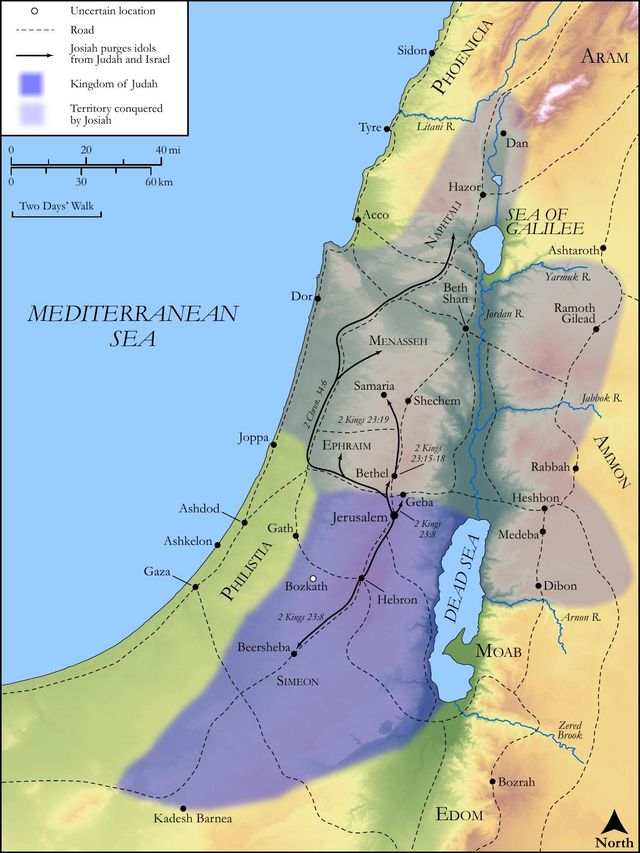
See on the biblical-era maps
Study this verse
Public-domain commentary
Matthew Henry
From his Commentary on the Whole Bible. Henry comments on passages, not single verses — this entry covers 2 Chronicles 35:1–19. His three-level outline is real structure in the source text, so it is rendered as structure.
The destruction which Josiah made of idols and idolatry was more largely related in the Kings, but just mentioned here in the foregoing chapter (v. 33); but his solemnizing the passover, which was touched upon there (Kg2 23:21), is very particularly related here. Many were the feasts of the Lord, appointed by the ceremonial law, but the passover was the chief. It began them all in the night wherein Israel came out of Egypt; it concluded them all in the night wherein Christ was betrayed; and in the celebration of it Hezekiah and Josiah, those two great reformers, revived religion in their day. The ordinance of the Lord's supper resembles the passover more than it does any of the Jewish festivals; and the due observance of that ordinance, according to the rule, is an instance and means both of the growing purity and beauty of churches and of the growing piety and devotion of particular Christians. Religion cannot flourish where that passover is either wholly neglected or not duly observed; return to that, revive that, make a solemn business of that affecting binding ordinance, and then, it is to be hoped, there will be a reformation in other instances also.
In the account we had of Hezekiah's passover the great zeal of the people was observable, and the transport of devout affection that they were in; but little of the same spirit appears here. It was more in compliance with the king that they all kept the passover (Ch2 35:17, Ch2 35:18) than from any great inclination they had to it themselves. Some pride they took in this form of godliness, but little pleasure in the power of it. But, whatever defect there was among the people in the spirit of the duty, both the magistrates and the ministers did their part and took care that the external part of the service should be performed with due solemnity.
I.The king exhorted and directed, quickened and encouraged, the priests and Levites to do their office in this solemnity.
Perhaps he saw them remiss and indifferent, unwilling to go out of their road or mend their pace. If ministers are so, it is not amiss for any, but most proper for magistrates, to stir them up to their business. Say to Archippus, Take heed to thy ministry, Col 4:17. Let us see how this good king managed his clergy upon this occasion.
1.He reduced them to the office they were appointed to by the law of Moses (Ch2 35:6) and the order they were put into by David and Solomon, Ch2 35:4. He set them in their charge, Ch2 35:2. He did not cut them out new work, nor put them into any new method, but called them back to their institution. Their courses were settled in writing; let them have recourse to that writing, and marshal themselves according to the divisions of their families, Ch2 35:5. Our rule is settled in the written word; let magistrates take care that ministers walk according to that rule and they do their duty.
2.He ordered the ark to be put in its place. It should seem, it had of late been displaced, either by the wicked kings, to make room for their idols in the most holy place, or by Hezekiah, to make room for the workmen that repaired the temple. However it was, Josiah bids the Levites put the ark in the house (Ch2 35:3), and not carry it about from place to place, as perhaps of late they had done, justifying themselves therein by the practice before the temple was built. Now that the priests were discharged from this burden of the ark they must be careful in other services about it.
3.He charged them to serve God and his people Israel, Ch2 35:3. Ministers must look upon themselves as servants both to Christ and to his church for his sake, Co2 4:5. They must take care, and take pains, and lay out themselves to the utmost,
(1.)For the glory and honour of God, and to advance the interests of his kingdom among men. Paul, a servant of God, Tit 1:1.
(2.)For the welfare and benefit of his people, not as having dominion over their faith, but as helpers of their holiness and joy; and there will be no difficulty, in the strength of God, in honestly serving these two masters.
4.He charged them to sanctify themselves, and prepare their brethren, Ch2 35:6. Ministers' work must begin at home, and they must sanctify themselves in the first place, purify themselves from sin, sequester themselves from the world, and devote themselves to God. But it must not end there; they must do what they can to prepare their brethren by admonishing, instructing, exhorting, quickening, and comforting, them. The preparation of the heart is indeed from the Lord; but ministers must be instruments in his hand.
5.He encouraged them to the service, Ch2 35:2. He spoke comfortably to them, as Hezekiah did, Ch2 30:22. He promised them his countenance. Note, Those whom we charge we should encourage. Most people love to be commended, and will be wrought upon by encouragements more than by threats.
II.The king and the princes, influenced by his example, gave liberally for the bearing of the charges of this passover.
The ceremonial services were expensive, which perhaps was one reason why they had been neglected. People had not zeal enough to be at the charge of them; nor were they now very fond of them, for that reason, and therefore,
1.Josiah, at his own proper cost, furnished the congregation with paschal lambs, and other sacrifices, to be offered during the seven days of the feast. He allowed out of his own estate 30,000 lambs for passover offerings, which the offerers were to feast upon, and 3000 bullocks (Ch2 35:7) to be offered during the following seven days. Note, Those who are serious in religion should, when they persuade others to do that which is good, make it as cheap and easy to them as may be. And where God sows plentifully he expects to reap accordingly. It is to be feared that the congregation generally had not come provided; so that, if Josiah had not furnished them, the work of God must have stood still.
2.The chief of the priests, who were men of great estates, contributed towards the priests' charges, as Josiah did towards the people's. The princes (Ch2 35:8), that is, the chief of the priests, the princes of the holy tribe, rulers of the house of God, bore the priests' charges. And some of the rich and great men of the Levites furnished them also with cattle, both great and small, for offerings, Ch2 35:9. For, as to those that sincerely desire to be found in the way of their duty, Providence sometimes raises up friends to bear them out in it, beyond what they could have expected.
III.The priests and Levites performed their office very readily, Ch2 35:10.
They killed the paschal lambs in the court of the temple, the priests sprinkled the blood upon the altar, the Levites flayed them, and then gave the flesh to the people according to their families (Ch2 35:11, Ch2 35:12), not fewer than ten, nor more than twenty, to a lamb. They took it to their several apartments, roasted it, and ate it according to the ordinance, Ch2 35:13. As for the other sacrifices that were eucharistical, the flesh of them was boiled according to the law of the peace-offerings and was divided speedily among the people, that they might feast upon it as a token of their joy in the atonement made and their reconciliation to God thereby. And, lastly, The priests and Levites took care to honour God by eating of the passover themselves, Ch2 35:14. Let not ministers think that the care they take for the souls of others will excuse their neglect of their own, or that being employed so much in public worship will supersede the religious exercises of their closets and families. The Levites here mace ready for themselves and for the priests, because the priests were wholly taken up all day in the service of the altar; therefore, that they might not have their lamb to dress when they should eat it, the Levites got it ready for them against supper time. Let ministers learn hence to help one another, and to forward one another's work, as brethren, and fellow-servants of the same Master.
IV.The singers and porters attended in their places, and did their office, Ch2 35:15.
The singers with their sacred songs and music expressed and excited the joy of the congregation, and made the service very pleasant to them; and the porters at the gates took care that there should be no breaking in of any thing to defile or disquiet the assembly, nor going out of any from it, that none should steal away till the service was done. While they were thus employed their brethren the Levites prepared paschal lambs for them.
V.The whole solemnity was performed with great exactness, according to the law (Ch2 35:16, Ch2 35:17), and, upon that account, there was none like it since Samuel's time (Ch2 35:18), for in Hezekiah's passover there were several irregularities. And bishop Patrick observes that in this also it exceeded the other passovers which the preceding kings had kept, that though Josiah was by no means so rich as David, and Solomon, and Jehoshaphat, yet he furnished the whole congregation with beasts for sacrifice, both paschal and eucharistical, at his own proper cost and charge, which was more than any king ever did before him.
Continue studying 2 Chronicles 35:4 across the web’s major study libraries — every link below opens this exact verse, chapter, or book on the destination site.
Read & Compare
 BibleGatewayThis verse in more than 200 translations and 70 languages.
 Bible.comThe YouVersion reader — hundreds of translations, reading plans, and highlights.
 ESV.orgCrossway's official English Standard Version reader.
 NET BibleThe NET translation with 60,000+ translators' notes on every rendering decision.
 STEP BibleTyndale House's free study tool — original text, vocabulary, and scholarly resources.
 BibliaLogos Bible Software's free web reader.
 USCCBThe New American Bible (Revised Edition) with the U.S. bishops' study notes.
Commentaries
 BibleHub CommentariesDozens of classic commentaries on this verse, gathered on one page.
 StudyLightMore than 100 commentary sets — the largest collection on the web.
 BibleRefPlain-English commentary on what this verse means, verse by verse.
 Enduring WordDavid Guzik's free commentary on this chapter, widely used by Bible teachers.
 Bible Study ToolsVerse commentary alongside Greek and Hebrew study aids.
Original Language & Research
- BibleHub InterlinearThe verse word by word — original language, transliteration, and English.
- BibleHub LexiconEvery word's original-language definition and Strong's entry.
 Blue Letter BibleDeep-study tools — Strong's numbers, concordance, and word studies.
 SefariaThe Hebrew text with Rashi and centuries of Jewish commentary.
Sermons, Hymns & Audio


TrulyRandomVerse is not affiliated with these sites and doesn’t control their content. They’re linked because they’re genuinely useful.
Summary
2 Chronicles 35:4 records King Josiah's precise instructions to the Levites, commanding them to organize and prepare themselves for Temple service in anticipation of the unprecedented Passover celebration. This directive mandated their arrangement according to their ancestral houses and established courses, strictly adhering to the divinely inspired organizational blueprints laid out by King David and subsequently implemented by his son, King Solomon. The verse profoundly underscores Josiah's unwavering commitment to restoring pure, orderly worship in Judah, aligning it meticulously with ancient, divinely sanctioned precedents rather than human innovation or expediency.
Context
ShowHideLiterary Context
This verse is strategically placed within the narrative of King Josiah's sweeping religious reforms, which commenced in 2 Chronicles 34 with the purification of Judah and Jerusalem from pervasive idolatry, the diligent repair of the Temple, and the pivotal rediscovery of the Book of the Law. Chapter 35 then shifts its narrative focus to the grand culmination of these reforms: the celebration of a Passover feast described as unparalleled since the days of the prophet Samuel. Verse 4 specifically targets the Levites, who were indispensable for the proper functioning of Temple service, particularly in the preparation and handling of the sacrifices required for the Passover. It immediately follows Josiah's instruction to the Levites in 2 Chronicles 35:3 to return the holy ark to its rightful place in the Temple and to sanctify themselves for their sacred duties. The meticulous nature of the instructions in verse 4 highlights the paramount importance of proper order, reverence, and strict adherence to established divine patterns for acceptable worship.
Historical & Cultural Context
King Josiah's reign (640-609 BC) occurred during a period of profound spiritual apostasy and decline in Judah, largely influenced by the idolatrous practices of his predecessors, Manasseh and Amon. His reforms represented a radical and courageous return to the covenant stipulations of Yahweh. The Levites, as descendants of Levi, were divinely consecrated to assist the priests in their Temple responsibilities, which included musical ministries, guarding the sacred precincts, and preparing sacrificial offerings. Their organization into "courses" or divisions was a highly structured system originally established by King David (meticulously detailed in 1 Chronicles 23-26), designed to ensure continuous, orderly, and efficient service throughout the year. King Solomon, upon the completion of the Temple, faithfully implemented and maintained these established arrangements. Josiah's command to follow "the writing of David" and "Solomon" was far more than a mere appeal to human tradition; it was an invocation of divinely inspired blueprints for Temple worship, emphasizing a profound return to the foundational principles of Israel's covenant relationship with God, particularly in light of the recently rediscovered Law.
Key Themes
ShowHideThis verse powerfully contributes to several overarching themes present within 2 Chronicles and the broader historical books of the Old Testament. Firstly, it prominently features the theme of Order and Structure in Worship. The detailed directives concerning the Levites' organization ("by the houses of your fathers, after your courses") underscore that true worship is not chaotic or arbitrary but must be conducted with precision, reverence, and intentionality, reflecting the orderly and holy character of God Himself. Secondly, it highlights the crucial theme of Adherence to Divine Precedent and Revealed Word. Josiah's insistence on following "the writing of David king of Israel, and according to the writing of Solomon his son" powerfully demonstrates that legitimate and acceptable worship must be firmly rooted in God's revealed will, as faithfully transmitted through His chosen instruments. This resonates deeply with the broader biblical theme of obedience to God's commands found throughout the Mosaic Law and prophetic literature. Finally, the verse significantly contributes to the overarching theme of Restoration and Revival. Josiah's reign is consistently portrayed as a period of profound spiritual renewal and national repentance, where the people, under their king's righteous leadership, earnestly sought to return to God's ways after generations of apostasy, culminating in the unparalleled Passover celebration described in 2 Chronicles 35.
Exposition and Analysis
ShowHideKey Word Analysis
ShowHideThis primitive root (H3559), often translated as "establish," "make ready," or "prepare," carries a profound sense of firming up, making something secure, or rendering it fit for a specific purpose. In this context, it implies not merely a casual readiness but a thorough, intentional, and divinely aligned preparation for sacred service. It suggests a deep commitment to ensuring that the Levites are properly consecrated, organized, and equipped according to established divine patterns, making them truly ready to fulfill their specific and vital roles in the Temple.
This noun (H1004) refers to a house in its broadest sense, encompassing not only a physical dwelling but also a family, household, or ancestral line. Here, "by the houses of your fathers" emphasizes the organization of the Levites according to their patriarchal lineages or family divisions. This was a fundamental aspect of Israelite identity and service, ensuring that each family unit understood its specific role and responsibility within the broader Levitical structure, maintaining genealogical purity and accountability.
This noun (H4256) refers to divisions, classes, or shifts, specifically denoting the organized groupings of priests and Levites for their rotating Temple service. King David meticulously arranged these courses (as documented in 1 Chronicles 24:1 and subsequent chapters) to ensure continuous and orderly worship throughout the year. The term underscores the structured, systematic, and rotational nature of their duties, preventing chaos, ensuring comprehensive coverage, and promoting accountability within the Levitical ministry.
Verse Breakdown
ShowHide"And prepare yourselves by the houses of your fathers"
This initial command instructs the Levites to organize and sanctify themselves according to their ancestral lineages or family divisions. This was a foundational aspect of Israelite identity and service, ensuring that each family unit understood its specific role and responsibility within the broader Levitical structure. It emphasizes a return to the divinely established tribal and familial order for sacred service, reinforcing the importance of proper lineage and heritage in their roles.
"after your courses"
This phrase specifies the precise method of organization: according to the established divisions or shifts for Temple service. This refers to the system of rotating service established by King David, where different groups of Levites would serve at designated times throughout the year. It underscores the importance of systematic, orderly, and continuous service, preventing overlap, ensuring efficiency, and guaranteeing that all necessary duties were performed without interruption.
"according to the writing of David king of Israel, and according to the writing of Solomon his son"
This crucial part of the verse provides the ultimate authority and divine mandate for the Levites' organization. It indicates that Josiah's reforms were not arbitrary innovations but were a faithful and precise restoration of the divinely inspired patterns for Temple worship and Levitical service laid down by King David and subsequently implemented by King Solomon. David was instrumental in organizing the Levites and their musical ministries (e.g., 1 Chronicles 23:6), and Solomon oversaw the construction of the Temple and the establishment of these services within it (e.g., 2 Chronicles 7:6). This appeal to their "writing" signifies a return to established, authoritative, and divinely sanctioned precedent, emphasizing the enduring validity of God's revealed will.
Literary Devices
ShowHideThe verse employs several potent literary devices to underscore its core message of order, authority, and restoration. The Repetition of the phrase "according to the writing of" serves as a powerful rhetorical device, emphatically highlighting the authoritative and foundational nature of the instructions given by David and Solomon. This repetition acts as an insistent reminder that Josiah's reforms are not innovative but rather a faithful restoration, firmly rooted in established, divinely-approved patterns. There is a strong sense of Allusion to earlier historical accounts, particularly the detailed organizational records found in the books of 1 Chronicles, which are implicitly invoked as the "writing" being referenced. This device lends significant historical weight, legitimacy, and continuity to Josiah's directives, connecting his present actions to a revered past. Furthermore, the verse utilizes Emphasis on both Order and Authority. The meticulous instructions for preparation, combined with the explicit reference to royal and divinely-inspired "writing," collectively highlight the paramount importance of structured, obedient worship. The very structure of the command, progressing from general preparation to specific organizational methods, and finally to the ultimate authoritative source, creates a sense of logical progression and an undeniable mandate for the Levites' actions.
Theological and Thematic Connections
ShowHideThis verse profoundly illustrates the enduring biblical principle that true worship is not subject to human whims, innovation, or convenience, but must meticulously conform to God's revealed will and established patterns. Josiah's diligent adherence to "the writing of David" and "Solomon" demonstrates a deep reverence for divine precedent and underscores the continuity of God's covenant relationship with His people across generations. It teaches that order, structure, and intentional preparation are not mere logistical preferences but are essential components of reverent, acceptable service to God, reflecting His own character of holiness, wisdom, and perfect order. The Levites' organization into courses and by family houses was not merely for administrative efficiency; it was divinely ordained for maintaining spiritual purity, accountability, and proper function within sacred duties. This commitment to established order and unwavering obedience to God's word was foundational to the profound spiritual revival experienced under Josiah, highlighting that genuine spiritual renewal often involves a humble return to foundational truths and practices revealed in Scripture.
Reflection and Application
ShowHide2 Chronicles 35:4 offers timeless and profound lessons for believers and the church in every age. It serves as a powerful reminder that our service and worship should never be haphazard, casual, or based on personal preference or cultural trends, but must always be intentional, orderly, and deeply rooted in God's unchanging, revealed truth. Just as King Josiah diligently looked back to the divinely inspired patterns established by David and Solomon, so too should the contemporary church and individual believers continually examine their practices, ministries, and personal spiritual disciplines against the clear instructions and enduring principles found in Holy Scripture. This verse calls us to cultivate a spirit of humility and profound obedience, recognizing that God, in His wisdom and sovereignty, has provided comprehensive guidance for how we are to approach Him and serve in His kingdom. It encourages us to value structure, intentionality, and thorough preparation in our spiritual lives, ensuring that our collective worship and individual service are conducted with utmost reverence, clear purpose, and in accordance with God's divine design, rather than human invention or convenience. It prompts us to engage in critical self-reflection, asking: Are we truly prepared for the service God calls us to? Is our service genuinely aligned with biblical principles, or have we drifted into practices born of human tradition or expediency? What specific areas of your personal or corporate spiritual life could profoundly benefit from more intentional preparation and a more rigorous adherence to biblical patterns and precepts?
Questions for Reflection
ShowHideFAQ
ShowHideWhat was the significance of "the writing of David king of Israel, and according to the writing of Solomon his son"?
ShowHideThis phrase is profoundly significant because it grounds Josiah's extensive religious reforms in authoritative, divinely inspired precedent rather than in human innovation or arbitrary decrees. King David, under divine guidance and inspiration, meticulously organized the Levites and priests into detailed divisions or "courses" for Temple service (as extensively documented in 1 Chronicles 23-26). His "writing" likely refers to these comprehensive organizational plans and instructions for the sacred duties within the tabernacle and later, the Temple. King Solomon, his son, then faithfully implemented these precise plans when he constructed and dedicated the magnificent Temple in Jerusalem (e.g., 2 Chronicles 7:6). By explicitly referencing their "writing," Josiah was not merely appealing to ancient tradition; he was invoking a divinely sanctioned blueprint for worship, emphasizing a return to the pure, original, and God-ordained way of serving in the Temple, which had been tragically neglected for generations. This appeal underscored the legitimacy, divine mandate, and restorative nature of his reforms, ensuring they were perceived as a faithful return to God's established order.
Christ-Centered Fulfillment
ShowHideWhile 2 Chronicles 35:4 meticulously details the rigorous preparation and orderly arrangement of the Levitical priesthood for Temple service under the Old Covenant, its ultimate and profound fulfillment is found in the person and work of Jesus Christ and the establishment of the New Covenant. The elaborate system of Levitical courses, preparations, and animal sacrifices served as a divinely appointed shadow, pointing forward to the perfect, once-for-all sacrifice and eternal priesthood of Jesus. Christ is the true Lamb of God who takes away the sin of the world, rendering all previous animal sacrifices obsolete and perfectly fulfilling their symbolic purpose. Furthermore, Jesus is our Great High Priest, who entered the true, heavenly sanctuary not by the blood of goats and calves, but by His own precious blood, thereby securing an eternal redemption for all who believe (Hebrews 9:11-12). Under the New Covenant, the rigid Levitical system of service is gloriously transformed: all believers are now made part of a "royal priesthood" and a holy nation, called to offer spiritual sacrifices of praise and good deeds that are pleasing to God through Jesus Christ (Hebrews 13:15-16). The order and preparation commanded in 2 Chronicles 35:4 thus foreshadow the divine order established by Christ for His church, where every member is equipped and called to serve according to His perfect plan, not through rigid Old Covenant rituals, but through the Spirit-empowered ministry of reconciliation and worship in truth and spirit (John 4:23-24).