


2 Chronicles 35:9
- וְכָנַנְיָהוּve·kha·v·nan·ya·huand KonaniahH3562Conj-w ¦ N-proper-mNoun Proper MasculineוְandכָנַנְיָהוּKonaniah
- וּשְׁמַעְיָהוּu·she·ma'·Ya·huand ShemaiahH8098Conj-w ¦ N-proper-mNoun Proper MasculineוּandשְׁמַעְיָהוּShemaiah
- וּנְתַנְאֵלu·ne·tan·'Eland NethanelH5417Conj-w ¦ N-proper-mNoun Proper MasculineוּandנְתַנְאֵלNethanel
- אֶחָיו'e·Chavhis brothersH251N-mpc ¦ 3msNoun Plural Masculine Constructאֶחָיbrothersוhis
- וַחֲשַׁבְיָהוּva·cha·shav·Ya·huand HashabiahH2811Conj-w ¦ N-proper-mNoun Proper MasculineוַandחֲשַׁבְיָהוּHashabiah
- וִיעִיאֵלvi·'i·'Eland JeielH3273Conj-w ¦ N-proper-mNoun Proper MasculineוִandיעִיאֵלJeiel
- וְיוֹזָבָדve·yo·za·Vadand JozabadH3107Conj-w ¦ N-proper-mNoun Proper MasculineוְandיוֹזָבָדJozabad
- שָׂרֵיsa·Rei[the] leaders ofH8269N-mpcNoun Plural Masculine Construct
- הַלְוִיִּםhal·vi·Yimthe LevitesH3881Art ¦ N-mpNoun Gentilic Plural Masculine AbsoluteהַtheלְוִיִּםLevites
- הֵרִימוּhe·Ri·muthey contributedH7311V-Hiphil-Perf-3cpVerb Hiphil Perfect 3rd Plural common gender
- לַלְוִיִּםlal·vi·Yimfor the LevitesH3881Prep-l ¦ N-mpNoun Gentilic Plural Masculine Absoluteלַfor theלְוִיִּםLevites
- לַפְּסָחִיםla·pe·sa·Chimfor the passoversH6453Prep-l ¦ N-mpNoun Title Plural Masculine Absoluteלַfor theפְּסָחִיםpassovers
- חֲמֵשֶׁתcha·Me·shetfiveH2568N-cscNoun Singular common gender Construct
- אֲלָפִים'a·la·Fimthousand<s>H505N-cpNoun Plural common gender Absolute
- וּבָקָרu·va·Karand cattleH1241Conj-w ¦ N-csNoun Singular common gender Absoluteוּandבָקָרcattle
- חֲמֵשׁcha·MeshfiveH2568N-cscNoun Singular common gender Construct
- מֵאוֹתme·'othundred<s>H3967N-fpNoun Plural Feminine Absolute
English is a literal word-by-word gloss of the Hebrew, not the KJV's wording. Why?
This is the original text the KJV's translators worked from — each Hebrew word with its own literal English meaning in this verse, prepared by scholars at Tyndale House, Cambridge. The KJV translates whole sentences, not word by word, so its wording differs: one Hebrew word can become several English words, and the KJV may choose “the LORD” where the gloss reads “Yahweh”. Both are faithful — they answer different questions. For the KJV's own rendering, switch to the KJV text.
Details
See on the biblical-era maps
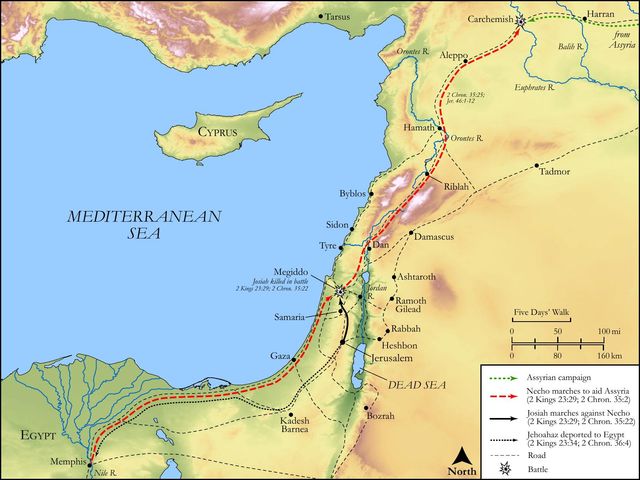
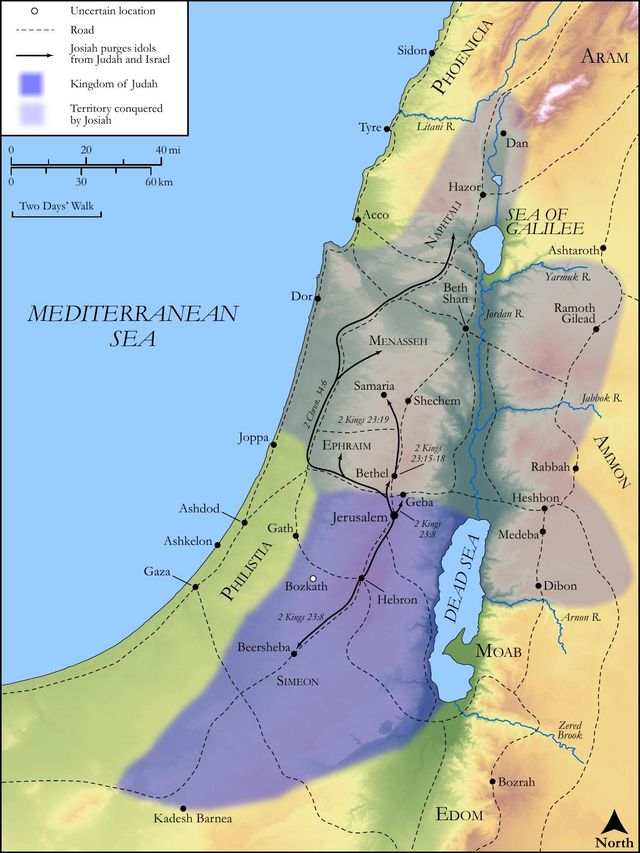
Study this verse
Public-domain commentary
Matthew Henry
From his Commentary on the Whole Bible. Henry comments on passages, not single verses — this entry covers 2 Chronicles 35:1–19. His three-level outline is real structure in the source text, so it is rendered as structure.
The destruction which Josiah made of idols and idolatry was more largely related in the Kings, but just mentioned here in the foregoing chapter (v. 33); but his solemnizing the passover, which was touched upon there (Kg2 23:21), is very particularly related here. Many were the feasts of the Lord, appointed by the ceremonial law, but the passover was the chief. It began them all in the night wherein Israel came out of Egypt; it concluded them all in the night wherein Christ was betrayed; and in the celebration of it Hezekiah and Josiah, those two great reformers, revived religion in their day. The ordinance of the Lord's supper resembles the passover more than it does any of the Jewish festivals; and the due observance of that ordinance, according to the rule, is an instance and means both of the growing purity and beauty of churches and of the growing piety and devotion of particular Christians. Religion cannot flourish where that passover is either wholly neglected or not duly observed; return to that, revive that, make a solemn business of that affecting binding ordinance, and then, it is to be hoped, there will be a reformation in other instances also.
In the account we had of Hezekiah's passover the great zeal of the people was observable, and the transport of devout affection that they were in; but little of the same spirit appears here. It was more in compliance with the king that they all kept the passover (Ch2 35:17, Ch2 35:18) than from any great inclination they had to it themselves. Some pride they took in this form of godliness, but little pleasure in the power of it. But, whatever defect there was among the people in the spirit of the duty, both the magistrates and the ministers did their part and took care that the external part of the service should be performed with due solemnity.
I.The king exhorted and directed, quickened and encouraged, the priests and Levites to do their office in this solemnity.
Perhaps he saw them remiss and indifferent, unwilling to go out of their road or mend their pace. If ministers are so, it is not amiss for any, but most proper for magistrates, to stir them up to their business. Say to Archippus, Take heed to thy ministry, Col 4:17. Let us see how this good king managed his clergy upon this occasion.
1.He reduced them to the office they were appointed to by the law of Moses (Ch2 35:6) and the order they were put into by David and Solomon, Ch2 35:4. He set them in their charge, Ch2 35:2. He did not cut them out new work, nor put them into any new method, but called them back to their institution. Their courses were settled in writing; let them have recourse to that writing, and marshal themselves according to the divisions of their families, Ch2 35:5. Our rule is settled in the written word; let magistrates take care that ministers walk according to that rule and they do their duty.
2.He ordered the ark to be put in its place. It should seem, it had of late been displaced, either by the wicked kings, to make room for their idols in the most holy place, or by Hezekiah, to make room for the workmen that repaired the temple. However it was, Josiah bids the Levites put the ark in the house (Ch2 35:3), and not carry it about from place to place, as perhaps of late they had done, justifying themselves therein by the practice before the temple was built. Now that the priests were discharged from this burden of the ark they must be careful in other services about it.
3.He charged them to serve God and his people Israel, Ch2 35:3. Ministers must look upon themselves as servants both to Christ and to his church for his sake, Co2 4:5. They must take care, and take pains, and lay out themselves to the utmost,
(1.)For the glory and honour of God, and to advance the interests of his kingdom among men. Paul, a servant of God, Tit 1:1.
(2.)For the welfare and benefit of his people, not as having dominion over their faith, but as helpers of their holiness and joy; and there will be no difficulty, in the strength of God, in honestly serving these two masters.
4.He charged them to sanctify themselves, and prepare their brethren, Ch2 35:6. Ministers' work must begin at home, and they must sanctify themselves in the first place, purify themselves from sin, sequester themselves from the world, and devote themselves to God. But it must not end there; they must do what they can to prepare their brethren by admonishing, instructing, exhorting, quickening, and comforting, them. The preparation of the heart is indeed from the Lord; but ministers must be instruments in his hand.
5.He encouraged them to the service, Ch2 35:2. He spoke comfortably to them, as Hezekiah did, Ch2 30:22. He promised them his countenance. Note, Those whom we charge we should encourage. Most people love to be commended, and will be wrought upon by encouragements more than by threats.
II.The king and the princes, influenced by his example, gave liberally for the bearing of the charges of this passover.
The ceremonial services were expensive, which perhaps was one reason why they had been neglected. People had not zeal enough to be at the charge of them; nor were they now very fond of them, for that reason, and therefore,
1.Josiah, at his own proper cost, furnished the congregation with paschal lambs, and other sacrifices, to be offered during the seven days of the feast. He allowed out of his own estate 30,000 lambs for passover offerings, which the offerers were to feast upon, and 3000 bullocks (Ch2 35:7) to be offered during the following seven days. Note, Those who are serious in religion should, when they persuade others to do that which is good, make it as cheap and easy to them as may be. And where God sows plentifully he expects to reap accordingly. It is to be feared that the congregation generally had not come provided; so that, if Josiah had not furnished them, the work of God must have stood still.
2.The chief of the priests, who were men of great estates, contributed towards the priests' charges, as Josiah did towards the people's. The princes (Ch2 35:8), that is, the chief of the priests, the princes of the holy tribe, rulers of the house of God, bore the priests' charges. And some of the rich and great men of the Levites furnished them also with cattle, both great and small, for offerings, Ch2 35:9. For, as to those that sincerely desire to be found in the way of their duty, Providence sometimes raises up friends to bear them out in it, beyond what they could have expected.
III.The priests and Levites performed their office very readily, Ch2 35:10.
They killed the paschal lambs in the court of the temple, the priests sprinkled the blood upon the altar, the Levites flayed them, and then gave the flesh to the people according to their families (Ch2 35:11, Ch2 35:12), not fewer than ten, nor more than twenty, to a lamb. They took it to their several apartments, roasted it, and ate it according to the ordinance, Ch2 35:13. As for the other sacrifices that were eucharistical, the flesh of them was boiled according to the law of the peace-offerings and was divided speedily among the people, that they might feast upon it as a token of their joy in the atonement made and their reconciliation to God thereby. And, lastly, The priests and Levites took care to honour God by eating of the passover themselves, Ch2 35:14. Let not ministers think that the care they take for the souls of others will excuse their neglect of their own, or that being employed so much in public worship will supersede the religious exercises of their closets and families. The Levites here mace ready for themselves and for the priests, because the priests were wholly taken up all day in the service of the altar; therefore, that they might not have their lamb to dress when they should eat it, the Levites got it ready for them against supper time. Let ministers learn hence to help one another, and to forward one another's work, as brethren, and fellow-servants of the same Master.
IV.The singers and porters attended in their places, and did their office, Ch2 35:15.
The singers with their sacred songs and music expressed and excited the joy of the congregation, and made the service very pleasant to them; and the porters at the gates took care that there should be no breaking in of any thing to defile or disquiet the assembly, nor going out of any from it, that none should steal away till the service was done. While they were thus employed their brethren the Levites prepared paschal lambs for them.
V.The whole solemnity was performed with great exactness, according to the law (Ch2 35:16, Ch2 35:17), and, upon that account, there was none like it since Samuel's time (Ch2 35:18), for in Hezekiah's passover there were several irregularities. And bishop Patrick observes that in this also it exceeded the other passovers which the preceding kings had kept, that though Josiah was by no means so rich as David, and Solomon, and Jehoshaphat, yet he furnished the whole congregation with beasts for sacrifice, both paschal and eucharistical, at his own proper cost and charge, which was more than any king ever did before him.
Continue studying 2 Chronicles 35:9 across the web’s major study libraries — every link below opens this exact verse, chapter, or book on the destination site.
Read & Compare
 BibleGatewayThis verse in more than 200 translations and 70 languages.
 Bible.comThe YouVersion reader — hundreds of translations, reading plans, and highlights.
 ESV.orgCrossway's official English Standard Version reader.
 NET BibleThe NET translation with 60,000+ translators' notes on every rendering decision.
 STEP BibleTyndale House's free study tool — original text, vocabulary, and scholarly resources.
 BibliaLogos Bible Software's free web reader.
 USCCBThe New American Bible (Revised Edition) with the U.S. bishops' study notes.
Commentaries
 BibleHub CommentariesDozens of classic commentaries on this verse, gathered on one page.
 StudyLightMore than 100 commentary sets — the largest collection on the web.
 BibleRefPlain-English commentary on what this verse means, verse by verse.
 Enduring WordDavid Guzik's free commentary on this chapter, widely used by Bible teachers.
 Bible Study ToolsVerse commentary alongside Greek and Hebrew study aids.
Original Language & Research
- BibleHub InterlinearThe verse word by word — original language, transliteration, and English.
- BibleHub LexiconEvery word's original-language definition and Strong's entry.
 Blue Letter BibleDeep-study tools — Strong's numbers, concordance, and word studies.
 SefariaThe Hebrew text with Rashi and centuries of Jewish commentary.
Sermons, Hymns & Audio


TrulyRandomVerse is not affiliated with these sites and doesn’t control their content. They’re linked because they’re genuinely useful.
Summary
2 Chronicles 35:9 meticulously records the remarkable generosity and organizational efforts of six prominent Levite leaders—Conaniah, Shemaiah, Nethaneel, Hashabiah, Jeiel, and Jozabad—who collectively provided an immense contribution of five thousand small cattle and five hundred oxen. These substantial provisions were specifically designated as Passover offerings, ensuring that the vast congregation gathered for King Josiah's unprecedented Passover celebration had ample animals for sacrifice and feasting, thereby facilitating widespread and fervent participation in this pivotal act of national worship and covenant renewal.
Context
ShowHideLiterary Context
This verse is strategically placed within the detailed account of King Josiah's monumental Passover celebration, as chronicled in 2 Chronicles 35. The preceding verses (2 Chronicles 35:1-8) establish the context by describing Josiah's personal piety, his meticulous preparations, and the generous provisions made by the king himself, his officials, and the princes. This sets a precedent for the Levites' equally significant contributions. The chapter emphasizes the careful adherence to Mosaic law in the execution of the Passover, highlighting the essential roles of the priests and Levites in consecrating themselves, preparing the offerings, and assisting the people according to the commands of Moses. Verse 9 specifically highlights the provision by the Levite leaders, underscoring their commitment to ensuring the entire nation could participate in this sacred feast, which the chronicler later extols as the greatest Passover observed in Israel since the days of the prophet Samuel (2 Chronicles 35:18).
Historical & Cultural Context
The events of 2 Chronicles 35 are situated in the latter part of King Josiah's reign (c. 640-609 BC), a period of profound religious reform in Judah. This reform movement was ignited by the discovery of the "Book of the Law" in the Temple (2 Kings 22:8), prompting Josiah to purge idolatry, restore the pure worship of Yahweh, and re-establish the Mosaic covenant as the bedrock of national life. The Passover, a foundational festival commemorating Israel's miraculous deliverance from slavery in Egypt (Exodus 12), was central to this spiritual revival. Culturally, the provision of animals for sacrifice was a significant act of piety, communal responsibility, and a demonstration of national commitment, especially for a large-scale national event. The Levites, as a hereditary priestly tribe, held crucial roles in the Temple service, including teaching the Law, maintaining the sanctuary, and assisting the priests in the sacrificial system, making their leadership and generosity particularly impactful and exemplary.
Key Themes
ShowHideThis verse powerfully illustrates several key themes prevalent throughout 2 Chronicles. Foremost among these is Generosity and Provision, as the immense donation by the Levite leaders ensures that all people, regardless of their personal means, can participate fully in the Passover. This reflects a spirit of communal responsibility and a deep commitment to facilitating worship for the entire nation. The detailed enumeration of contributors and quantities also highlights Order and Organization, emphasizing the meticulous planning and execution required for such a large-scale religious festival, a hallmark of proper worship under the Law. Furthermore, the collective effort underscores Communal Worship and Unity, as leaders and people unite in a shared act of remembrance and covenant renewal, fostering national cohesion and spiritual solidarity. Finally, this act of giving is a direct manifestation of the Restoration of True Worship, signifying a national recommitment to God's commands after generations of apostasy and neglect, a central and defining theme of Josiah's reign as described in 2 Chronicles 34.
Exposition and Analysis
ShowHideKey Word Analysis
ShowHideFrom H1241, this term refers to beef cattle or an animal of the ox family, used for various purposes including plowing and, significantly, for sacrificial offerings. In the context of the Passover, while a lamb was the primary offering, oxen were typically used for accompanying sacrifices such as peace offerings (Leviticus 3), which allowed worshippers to partake in the meat. The donation of five hundred oxen indicates the scale of the communal feasting and additional sacrifices that were integral to this grand celebration, providing sustenance for the vast assembly.
From H6453, this word refers to a "pretermission" or "exemption," used technically for the Jewish Passover festival or its victim. This highlights the specific purpose of the donated animals: they were intended for the ritual sacrifices and associated meals of the Passover, commemorating Israel's deliverance from Egypt. The Levites' provision directly facilitated the nation's ability to observe this foundational feast according to God's command.
From H8269, this term denotes a "head person" or "ruler" of any rank or class. Applied to Conaniah, Shemaiah, Nethaneel, Hashabiah, Jeiel, and Jozabad, it signifies their prominent leadership roles within the Levitical order. As "chiefs of the Levites," they held authority and responsibility for overseeing the various duties of the Levites, including the logistical and spiritual preparations for the Passover. Their generous contribution served as a powerful example of leadership, demonstrating their commitment not just in administration but also in sacrificial giving.
Verse Breakdown
ShowHide"Conaniah also, and Shemaiah and Nethaneel, his brethren, and Hashabiah and Jeiel and Jozabad, chief of the Levites"
This detailed enumeration of six prominent Levite leaders emphasizes their individual and collective responsibility in this significant act of provision. The phrase "his brethren" likely refers to Nethaneel being a brother of Shemaiah and Conaniah, indicating a familial or kinship group within the Levite leadership, though it could also broadly refer to fellow Levites. Their collective status as "chiefs" underscores their authority and influence within the Levitical order, making their generous contribution a significant act of leadership by example and a testament to their commitment to Josiah's reforms.
"gave unto the Levites for passover offerings"
This clause clarifies both the recipients and the precise purpose of the immense donation. The animals were given "unto the Levites," likely referring to the broader body of Levites who would assist the priests in the meticulous and labor-intensive process of slaughtering, skinning, and preparing the vast number of sacrifices. The explicit purpose, "for passover offerings," indicates that these animals were specifically and solely intended for the sacrificial rites and communal feasting associated with the Passover festival, ensuring that the people had the necessary provisions to observe this sacred commandment.
"five thousand [small cattle], and five hundred oxen"
The immense quantities specified here—5,000 sheep/goats (small cattle) and 500 oxen—underscore the extraordinary scale of Josiah's Passover. This was not a small, localized event but a national celebration requiring massive resources to accommodate a vast multitude of participants. The sheer numbers emphasize the profound generosity of these Levite leaders and the collective national commitment to facilitating a comprehensive and inclusive observance of the Passover for the entire nation, reflecting the depth of the spiritual revival.
Literary Devices
ShowHideThe verse employs Enumeration by meticulously listing the names of the six contributing Levite leaders. This serves to personalize the act of generosity, highlighting the specific individuals responsible for this significant provision and lending an air of historical accuracy and authenticity to the account. Furthermore, the sheer scale of the numbers—"five thousand [small cattle], and five hundred oxen"—functions as a form of Amplification, emphasizing the unprecedented magnitude of the offerings and, by extension, the extraordinary nature of Josiah's Passover. While these numbers are likely literal, their impact is to convey the overwhelming abundance and the national commitment to this restored worship. The act of giving itself can be seen as Symbolism, representing the Levites' dedication to God's law, their commitment to the spiritual well-being of the nation, and their active participation in Josiah's widespread reforms.
Theological and Thematic Connections
ShowHideThis verse powerfully illustrates the biblical principles of generous provision and corporate responsibility in worship. The Levite leaders' willingness to contribute such vast resources for the Passover underscores the importance of selfless giving to facilitate the spiritual life of the community. It reflects a deep understanding that true worship requires not only personal devotion but also communal effort and material support. This act of giving enabled the entire nation to participate in a pivotal covenant renewal, demonstrating that the health of a community's spiritual life is often intertwined with the generosity of its leaders and members. It also highlights the meticulous organization and commitment required to uphold God's commands, ensuring that worship is conducted with reverence and order, creating an environment where all can draw near to God.
Reflection and Application
ShowHideThe generous provision by these Levite leaders in 2 Chronicles 35:9 offers profound lessons for believers today, challenging us to consider our own roles in supporting and facilitating corporate worship and ministry. Their selflessness reminds us that true spiritual revival often requires tangible commitment and sacrificial giving, not just from a select few, but from all who are able, especially those in leadership. This passage encourages us to move beyond mere participation to active contribution, recognizing that our resources—whether financial, time, or talent—can be instrumental in enabling others to encounter God and grow in faith. It calls us to emulate their diligent preparation and commitment to order, ensuring that our collective spiritual endeavors are conducted with excellence and intentionality, so that all can draw near to God and experience His presence.
Questions for Reflection
ShowHideFAQ
ShowHideWhy were so many animals needed for the Passover celebration described in 2 Chronicles 35?
ShowHideThe sheer number of animals—five thousand small cattle and five hundred oxen—was necessary due to the unprecedented scale of Josiah's Passover. This was a national event, involving a vast multitude of people from all over Judah and even parts of Israel, as described in 2 Chronicles 35:18. According to the Mosaic Law, each household was required to provide a lamb or kid for the Passover sacrifice (Exodus 12:3-6). Additionally, oxen were provided for other communal sacrifices, such as peace offerings, which involved feasting and were common during major festivals. The immense provision ensured that every participant had an animal for sacrifice and that there was ample meat for the celebratory meals that accompanied the festival, making it truly a national and inclusive event.
What was the specific role of the "chief of the Levites" in facilitating the Passover, beyond their generous donations?
ShowHideThe "chief of the Levites" played a pivotal role in the administration and execution of the Passover, as outlined throughout 2 Chronicles 35. Beyond their significant material contributions, these leaders were responsible for organizing their fellow Levites to assist the priests in the intricate sacrificial process. This included slaughtering the Passover lambs, skinning the animals, preparing the sacrifices, and ensuring the blood was properly handled and sprinkled at the altar (2 Chronicles 35:10-11). They also had a crucial teaching role, instructing the people and priests on how to properly consecrate themselves and observe the Law (2 Chronicles 35:3). Their leadership was indispensable for the meticulous and orderly conduct of such a large-scale and ritually complex festival, ensuring its spiritual integrity and effectiveness.
Christ-Centered Fulfillment
ShowHideThe generous provision of "small cattle" and "oxen" for the Passover in 2 Chronicles 35:9, while a testament to human obedience and communal spirit, ultimately points forward to the ultimate and perfect provision found in Jesus Christ. The myriad of lambs sacrificed at the Passover, each serving as a temporary atonement and a vivid reminder of deliverance, foreshadows the singular, once-for-all sacrifice of the Lamb of God, who takes away the sin of the world!. Just as the Levites' gifts enabled the nation to participate in a physical deliverance from the consequences of sin, Christ's self-giving on the cross provides spiritual deliverance for all who believe, fulfilling the very essence of the Passover. He is our Passover lamb, who has been sacrificed, inaugurating a new covenant not with the blood of bulls and goats, but with His own precious blood (Hebrews 9:11-14). The boundless generosity of the Levites, though commendable, pales in comparison to the infinite generosity of God, who gave His only Son so that we might have eternal life, making Him the ultimate and inexhaustible provision for our spiritual nourishment and salvation.