


2 Corinthians 4:5
- ΟὐOuNotG3756PRT-NNegative Particle Negative
- γὰρgarforG1063CONJConjunction
- ἑαυτοὺςhe'autousourselvesG1438F-1APMReflexive pronoun Accusative 1st Plural Masculine
- κηρύσσομενkērussomendo we proclaimG2784V-PAI-1PVerb Present Active Indicative 1st Plural
- ἀλλ᾽all᾽butG235CONJConjunction
- ἸησοῦνIēsounJesusG2424N-ASM-PNoun Accusative Singular Masculine Individual
- ΧριστὸνChristonChristG5547N-ASM-TNoun Accusative Singular Masculine Title
- κύριονkurionLordG2962N-ASM-TNoun Accusative Singular Masculine Title
- ἑαυτοὺςhe'autousourselvesG1438F-1APMReflexive pronoun Accusative 1st Plural Masculine
- δὲdenowG1161CONJConjunction
- δούλουςdoulousservantsG1401N-APMNoun Accusative Plural Masculine
- ὑμῶνhumōnof youG4771P-2GPPersonal pronoun Genitive 2nd Plural
- διὰdiafor the sake ofG1223PREPPreposition
- ἸησοῦνIēsounJesusG2424N-ASM-PNoun Accusative Singular Masculine Individual
English is a literal word-by-word gloss of the Greek, not the KJV's wording. Why?
This is the original text the KJV's translators worked from — each Greek word with its own literal English meaning in this verse, prepared by scholars at Tyndale House, Cambridge. The KJV translates whole sentences, not word by word, so its wording differs: one Greek word can become several English words, and the KJV may choose “charity” where the gloss reads “love”. Both are faithful — they answer different questions. For the KJV's own rendering, switch to the KJV text.
Details
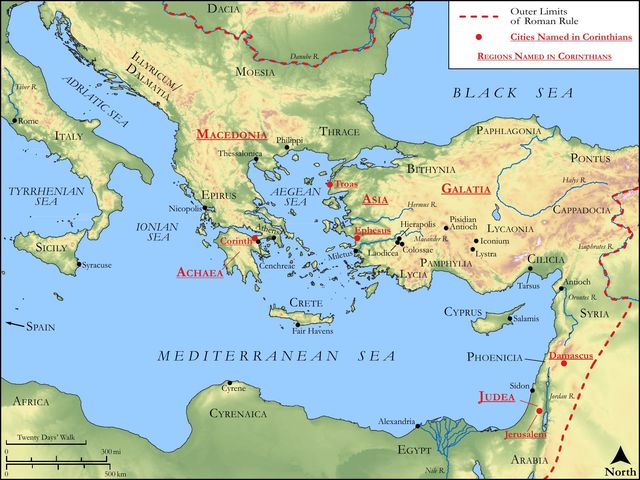
See on the biblical-era map

Study this verse
Public-domain commentary
Matthew Henry
From his Commentary on the Whole Bible. Henry comments on passages, not single verses — this entry covers 2 Corinthians 4:1–7. His three-level outline is real structure in the source text, so it is rendered as structure.
The apostle had, in the foregoing chapter, been magnifying his office, upon the consideration of the excellency or glory of that gospel about which he did officiate; and now in this chapter his design is to vindicate their ministry from the accusation of false teachers, who charged them as deceitful workers, or endeavoured to prejudice the minds of the people against them on account of their sufferings. He tells them, therefore, how they believed, and how they showed their value for their office as ministers of the gospel. They were not puffed up with pride, but spurred on to great diligence: "Seeing we have this ministry, are so much distinguished and dignified, we do not take state upon ourselves, nor indulge in idleness, but are excited to the better performance of our duty."
I.Two things in general we have an account of:
- Their constancy and sincerity in their work and labour, concerning which observe,
1.Their constancy and perseverance in their work are declared: "We faint not (Co2 4:1) under the difficulty of our work, nor do we desist from our labour." And this their stedfastness was owing to the mercy of God. From the same mercy and grace from which they received the apostleship (Rom 1:5), they received strength to persevere in the work of that office. Note, As it is great mercy and grace to be called to be saints, and especially to be counted faithful, and be put into the ministry (Ti1 1:12), so it is owing to the mercy and grace of God if we continue faithful and persevere in our work with diligence. The best men in the world would faint in their work, and under their burdens, if they did not receive mercy from God. By the grace of God I am what I am, said this great apostle in his former epistle to these Corinthians, Co1 15:10. And that mercy which has helped us out, and helped us on, hitherto, we may rely upon to help us even to the end.
2.Their sincerity in their work is avouched (Co2 4:2) in several expressions: We have renounced the hidden things of dishonesty. The things of dishonesty are hidden things, that will not bear the light; and those who practise them are, or should be, ashamed of them, especially when they are known. Such things the apostle did not allow of, but did renounce and avoid with indignation: Not walking in craftiness, or in disguise, acting with art and cunning, but in great simplicity, and with open freedom. They had no base and wicked designs covered with fair and specious pretences of something that was good. Nor did they in their preaching handle the word of God deceitfully; but, as he said before, they used great plainness of speech, and did not make their ministry serve a turn, or truckle to base designs. They had not cheated the people with falsehood instead of truth. Some think the apostle alludes to the deceit which treacherous gamesters use, or that of hucksters in the market, who mix bad wares with good. The apostles acted not like such persons, but they manifested the truth to every man's conscience, declaring nothing but what in their own conscience they believed to be true, and what might serve for the conviction of their consciences who heard them, who were to judge for themselves, and to give an account for themselves. And all this they did as in the sight of God, desirous thus to commend themselves to God, and to the consciences of men, by their undisguised sincerity. Note, A stedfast adherence to the truths of the gospel will commend ministers and people; and sincerity or uprightness will preserve a man's reputation, and the good opinion of wise and good men concerning him.
II.An objection is obviated, which might be thus formed:
"If it be thus, how then does it come to pass, that the gospel is hid, and proves ineffectual, as to some who hear it?" To which the apostle answers, by showing that this was not the fault of the gospel, nor of the preachers thereof. But the true reasons of this are,
1.Those are lost souls to whom the gospel is hid, or is ineffectual, Co2 4:3. Christ came to save that which was lost (Mat 17:11), and the gospel of Christ is sent to save such; and, if this do not find and save them, they are lost for ever; they must never expect any thing else to save them, for there is no other method or means of salvation. The hiding of the gospel therefore from souls is both an evidence and cause of their ruin.
2.The god of this world hath blinded their minds, Co2 4:4. They are under the influence and power of the devil, who is here called the god of this world, and elsewhere the prince of this world, because of the great interest he has in this world, the homage that is paid to him by multitudes in this world, and the great sway that, by divine permission, he bears in the world, and in the hearts of his subjects, or rather slaves. And as he is the prince of darkness, and ruler of the darkness of this world, so he darkens the understandings of men, and increases their prejudices, and supports his interest by keeping them in the dark, blinding their minds with ignorance, and error, and prejudices, that they should not behold the light of the glorious gospel of Christ, who is the image of God. Observe,
(1.)Christ's design by his gospel is to make a glorious discovery of God to the minds of men. Thus, as the image of God, he demonstrates the power and wisdom of God, and the grace and mercy of God for their salvation. But,
(2.)The design of the devil is to keep men in ignorance; and, when he cannot keep the light of the gospel out of the world, he makes it his great business to keep it out of the hearts of men.
III.A proof of their integrity is given, Co2 4:5.
They made it their business to preach Christ, and not themselves: We preach not ourselves. Self was not the matter nor the end of the apostles' preaching: they did not give their own notions and private opinions, nor their passions and prejudices, for the word and will of God; nor did they seek themselves, to advance their own secular interest or glory. But they preached Christ Jesus the Lord; and thus it did become them and behove them to do, as being Christ's servants. Their business was to make their Master known to the world as the Messiah, or the Christ of God, and as Jesus, the only Saviour of men, and as the rightful Lord, and to advance his honour and glory. Note, All the lines of Christian doctrine centre in Christ; and in preaching Christ we preach all we should preach. "As to ourselves," says the apostle, "we preach, or declare, that we are your servants for Jesus' sake." This was no compliment, but a real profession of a readiness to do good to their souls, and to promote their spiritual and eternal interest, and that for Jesus' sake; not for their own sake or their own advantage, but for Christ's sake, that they might imitate his great example, and advance his glory. Note, Ministers should not be of proud spirits, lording it over God's heritage, who are servants to the souls of men: yet, at the same time, they must avoid the meanness of spirit implied in becoming the servants of the humours or the lusts of men; if they should thus seek to please men, they would not be the servants of Christ, Gal 1:10. And there was good reason,
1.Why they should preach Christ. For by gospel light we have the knowledge of the glory of God, which shines in the face of Jesus Christ, Co2 4:6. And the light of this Sun of righteousness is more glorious than that light which God commanded to shine out of darkness. It is a pleasant thing for the eye to behold the sun in the firmament; but it is more pleasant and profitable when the gospel shines in the heart. Note, As light was the first-born of the first creation, so it is in the new creation: the illumination of the Spirit is his first work upon the soul. The grace of God created such a light in the soul that those who were sometimes darkness are made light in the Lord, Eph 5:8.
2.Why they should not preach themselves: because they were but earthen vessels, things of little or no worth or value. Here seems to be an allusion to the lamps which Gideon's soldiers carried in earthen pitchers, Jdg 7:16. The treasure of gospel light and grace is put into earthen vessels. The ministers of the gospel are weak and frail creatures, and subject to like passions and infirmities as other men; they are mortal, and soon broken in pieces. And God has so ordered it that the weaker the vessels are the stronger his power may appear to be, that the treasure itself should be valued the more. Note, There is an excellency of power in the gospel of Christ, to enlighten the mind, to convince the conscience, to convert the soul, and to rejoice the heart; but all this power is from God the author, and not from men, who are but instruments, so that God in all things must be glorified.
Historical interpretation
Historical reception
4 surviving comments on this verse. Each one is dated, so this reads as a timeline rather than a list.
Select a marker to jump to its quote. Markers stagger vertically where authors wrote within a few decades of each other.
In expressing himself humbly, Paul spoke in a way which was designed to show that he was not preaching the gospel for his own advantage but for the glory of the Lord Christ, to whom he is obedient.
And the apostle: “For we preach not ourselves but Jesus Christ as Lord, and ourselves merely as your servants in Jesus.” Knowing, then, the fruits of humility and the penalty of conceit, imitate the Master by loving one another and do not shrink from death or any other punishment for the good of each other. But the way which God entered upon for you, do you enter upon for him, proceeding with one body and one soul to the invitation from above, loving God and each other. For love and fear of the Lord are the first fulfillment of the law.
It is not we but he who enables our faith, accepting us and judging us by it.
"For we preach not ourselves, but Christ Jesus as Lord, and ourselves as your servants for Jesus' sake."
And what is the nature of the connexion there? What hath this in common with what has been said? He either hints at them as exalting themselves, and persuading the disciples to name themselves after them: as he said in the former Epistle, "I am of Paul and I of Apollos;" or else another thing of the gravest character. What then is this? Seeing that they waged fierce war against them, and plotted against them on every side; 'Is it,' he says, 'with us ye fight and war? [Nay but] with Him that is preached by us, "for we preach not ourselves." I am a servant, I am [but] a minister even of those who receive the Gospel, transacting every thing for Another, and for His glory doing whatsover I do. So that in warring against me thou throwest down what is His. For so far am I from turning to my own personal advantage any part of the Gospel, that I will not refuse to be even your servant for Christ's sake; seeing it seemed good to Him so to honor you, seeing He so loved you and did all things for you.' Wherefore also he saith, "and ourselves your servants for Christ's sake." Seest thou a soul pure from glory? 'For in truth,' saith he, 'we not only do not take to ourselves aught of our Master's, but even to you we submit ourselves for His sake.'
Continue studying 2 Corinthians 4:5 across the web’s major study libraries — every link below opens this exact verse, chapter, or book on the destination site.
Read & Compare
 BibleGatewayThis verse in more than 200 translations and 70 languages.
 Bible.comThe YouVersion reader — hundreds of translations, reading plans, and highlights.
 ESV.orgCrossway's official English Standard Version reader.
 NET BibleThe NET translation with 60,000+ translators' notes on every rendering decision.
 STEP BibleTyndale House's free study tool — original text, vocabulary, and scholarly resources.
 BibliaLogos Bible Software's free web reader.
 USCCBThe New American Bible (Revised Edition) with the U.S. bishops' study notes.
Commentaries
 BibleHub CommentariesDozens of classic commentaries on this verse, gathered on one page.
 StudyLightMore than 100 commentary sets — the largest collection on the web.
 BibleRefPlain-English commentary on what this verse means, verse by verse.
 Enduring WordDavid Guzik's free commentary on this chapter, widely used by Bible teachers.
 Bible Study ToolsVerse commentary alongside Greek and Hebrew study aids.
Original Language & Research
- BibleHub InterlinearThe verse word by word — original language, transliteration, and English.
- BibleHub LexiconEvery word's original-language definition and Strong's entry.
 Blue Letter BibleDeep-study tools — Strong's numbers, concordance, and word studies.
 CNTR CollationThe earliest Greek manuscripts of this verse, collated letter by letter.
Sermons, Hymns & Audio


TrulyRandomVerse is not affiliated with these sites and doesn’t control their content. They’re linked because they’re genuinely useful.
Summary
Second Corinthians 4:5 serves as a foundational declaration of apostolic ministry, articulating its singular focus: the proclamation of Christ Jesus as Lord, rather than the promotion of human personalities or achievements. It simultaneously defines the posture of ministers as humble servants of the church, motivated solely by their allegiance and devotion to Jesus Christ. This verse encapsulates the essence of selfless, Christ-exalting communication and service.
Context
ShowHideLiterary Context
This verse is strategically placed within Paul's defense of his apostolic ministry in 2 Corinthians, particularly within chapter 4. Paul begins by asserting the integrity and transparency of their gospel proclamation, contrasting it with deceptive practices and hidden motives (e.g., 2 Corinthians 4:2). He explains that if their gospel is veiled, it is veiled to those who are perishing, whose minds have been blinded by "the god of this world" (Satan), preventing them from seeing "the light of the glorious gospel of Christ, who is the image of God" (2 Corinthians 4:4). Verse 5 then directly follows, clarifying what they preach (Christ) and who they are in relation to the Corinthians (servants), thereby reinforcing the authenticity and divine origin of their message, which culminates in the powerful imagery of "treasure in jars of clay" in 2 Corinthians 4:7.
Historical & Cultural Context
Paul's ministry in Corinth was fraught with challenges, including internal divisions, moral issues, and the rise of "super-apostles" who challenged Paul's authority and integrity. These rival teachers often boasted of their eloquence, wisdom, and personal achievements, seeking to elevate themselves in the eyes of the Corinthians. In this cultural milieu, where rhetoric and personal charisma were highly valued, Paul's assertion that "we preach not ourselves" was a radical counter-cultural statement. The term "Lord" (κύριος, kýrios) for Jesus would have resonated deeply, evoking not only divine authority but also the Roman concept of a master over slaves, setting the stage for Paul's self-identification as a "servant" (δοῦλος, doûlos). This choice of words deliberately subverted the prevailing notions of leadership and status, aligning Paul's ministry with Christ's own example of humble servanthood.
Key Themes
ShowHideThis verse powerfully contributes to several overarching themes in 2 Corinthians and Paul's broader theology. The centrality of Christ is paramount, as He is the sole subject and object of their proclamation. This stands in stark contrast to the self-promotion of false teachers, underscoring the theme of humility in ministry versus human boasting. The declaration "ourselves your servants for Jesus' sake" highlights the theme of servanthood as the true mark of spiritual leadership, mirroring Christ's own example of self-emptying (Philippians 2:7). Furthermore, the verse implicitly touches upon the power of the gospel to illuminate spiritually blinded minds, as it is the message of Christ's Lordship that brings salvation and clarity, contrasting with the futility of human wisdom or self-exaltation (compare 1 Corinthians 1:18-25).
Exposition and Analysis
ShowHideKey Word Analysis
ShowHideThis verb signifies to "herald" or "proclaim as a public crier," particularly divine truth. It implies a public, authoritative, and unambiguous declaration of a message. In this context, it emphasizes that the apostles are not merely sharing opinions or personal insights, but authoritatively proclaiming the divinely revealed truth about Christ.
Derived from a root implying supremacy, kýrios denotes one who is "supreme in authority" or a "controller." It is a title of ultimate respect and power, often used for God in the Septuagint. Applying this title to Jesus signifies His divine sovereignty, absolute authority, and rightful claim over all creation and humanity.
This term, often translated "slave" or "bondservant," indicates a profound and complete dedication, submission, and even ownership. It is not merely a helper but one whose life is entirely devoted to the will of another. Paul's use of doûlos for himself and his companions underscores their total allegiance and subservience to Christ, which in turn compels their selfless service to the Corinthian believers.
Verse Breakdown
ShowHide"For we preach not ourselves,"
This opening clause establishes a crucial negative principle for Christian ministry. The "we" refers to Paul and his apostolic co-workers. Their proclamation is explicitly not about their own personalities, wisdom, achievements, or agendas. It rejects self-promotion, self-aggrandizement, and any attempt to build a personal following or reputation. It sets a clear boundary against the human tendency to seek glory or recognition in spiritual endeavors.
"but Christ Jesus the Lord;"
This is the positive and singular focus of their preaching. The message is entirely centered on the person and work of "Christ Jesus," emphasizing His identity as the Messiah (Christ) and His humanity (Jesus). The addition of "the Lord" underscores His divine authority, sovereignty, and rightful claim over all things. This clause asserts that the core content of the gospel message is the supremacy, deity, and salvific work of Jesus Christ.
"and ourselves your servants for Jesus' sake."
This final clause defines the apostles' posture and motivation in ministry. They identify themselves as "servants" (bondservants/slaves) of the Corinthian believers. This servanthood is not for personal gain or human approval, but "for Jesus' sake"—motivated by their ultimate allegiance to Christ, their love for Him, and their desire to see His kingdom advanced. This demonstrates that their service to the church flows directly from their submission to Christ, embodying the selfless love and humility exemplified by Christ Himself.
Literary Devices
ShowHideThe verse employs several powerful literary devices to convey its profound message. Antithesis is central, starkly contrasting "not ourselves" with "but Christ Jesus the Lord," highlighting the exclusive focus of true Christian proclamation. This creates a clear dichotomy between human self-exaltation and divine exaltation. Furthermore, an implicit chiasm or inverted parallelism can be observed in the verse's structure: "we preach not ourselves (A), but Christ Jesus the Lord (B); and ourselves your servants (A'), for Jesus' sake (B')." The self-denial (A) is for the sake of Christ's Lordship (B), and their servanthood (A') is also for Christ's sake (B'). This reinforces the Christ-centered nature of their self-abasement. The concept of being "servants" (δοῦλοι) while simultaneously being apostles (bearers of divine authority) presents a paradox, where true authority and influence in God's kingdom are found not in domination, but in humble, self-sacrificial service.
Theological and Thematic Connections
ShowHideThis verse is a cornerstone for understanding the nature of authentic Christian ministry and the gospel itself. It firmly establishes Christology as the irreducible core of all proclamation, asserting that the message is not about human wisdom, philosophy, or personality, but about the unique person and saving work of Jesus Christ, who is sovereign Lord. This Christ-centered focus naturally leads to a theology of humble servanthood, where those who proclaim Christ must embody His own self-giving nature. It challenges any form of spiritual pride, self-promotion, or ministry built on human charisma, redirecting all glory to God. The verse underscores that genuine ministry is an act of worship, flowing from a deep devotion to Christ and expressed through selfless service to His people.
Reflection and Application
ShowHideSecond Corinthians 4:5 offers timeless principles for every believer, particularly those engaged in any form of Christian leadership, teaching, or evangelism. It calls us to a radical self-assessment: Is our communication, whether from a pulpit, in a small group, or in personal witness, truly centered on Christ, or does it subtly (or overtly) draw attention to ourselves, our achievements, or our opinions? This verse challenges the pervasive temptation for self-promotion in a world that often values charisma and personal brand over humble service. It compels us to embrace a posture of genuine servanthood, recognizing that our ultimate allegiance is to Jesus, and our service to others is an extension of our love and obedience to Him. It reminds us that the power of the gospel lies in Christ Himself, not in the eloquence or personality of the messenger, fostering a ministry that is authentic, selfless, and truly transformative.
Questions for Reflection
ShowHideFAQ
ShowHideWhy is it so important for ministers not to preach themselves?
ShowHideIt is crucial for ministers not to preach themselves because the gospel message is about God's glory and His saving work through Jesus Christ, not about human achievement or wisdom. When ministers preach themselves, they subtly or overtly draw attention away from Christ, diminishing His supremacy and potentially leading people to follow a personality rather than the Lord Himself. This can create a cult of personality, undermine the authority of Scripture, and ultimately hinder genuine spiritual transformation, which only comes through faith in Christ (Romans 10:17). Paul's emphasis in 1 Corinthians 2:1-5 reinforces this, stating that his preaching was "not with wisdom of words," but in demonstration of the Spirit and power, "that your faith should not be in the wisdom of men, but in the power of God."
What does it mean to be "servants for Jesus' sake"?
ShowHideTo be "servants for Jesus' sake" means that one's service to others (whether in ministry, community, or daily life) is motivated by and directed towards Christ. It implies a profound sense of allegiance and love for Jesus, such that one willingly takes on a posture of humility and self-sacrifice, not for personal gain, recognition, or even human approval, but solely out of obedience and devotion to Him. This aligns with Christ's own example, who came "not to be served but to serve, and to give his life as a ransom for many" (Matthew 20:28). It means putting the needs of others before one's own, enduring hardship, and laboring diligently, all because of one's bond to Christ and desire to honor Him.
How does this verse relate to the concept of "treasure in jars of clay" in 2 Corinthians 4?
ShowHideSecond Corinthians 4:5 sets the stage for the profound metaphor of "treasure in jars of clay" found in 2 Corinthians 4:7. By stating "we preach not ourselves, but Christ Jesus the Lord," Paul establishes that the content of their ministry is the glorious, divine "treasure" (Christ, the gospel). The subsequent declaration, "and ourselves your servants for Jesus' sake," implicitly identifies the ministers themselves as the "jars of clay"—fragile, ordinary, and weak human vessels. This connection highlights the paradox that the immense power and glory of the gospel are entrusted to weak, fallible human beings, ensuring that "the surpassing power belongs to God and not to us" (2 Corinthians 4:7). This reinforces the message that the focus is always on Christ, the treasure, and never on the earthen vessel that carries it.
Christ-Centered Fulfillment
ShowHideSecond Corinthians 4:5 finds its ultimate Christ-centered fulfillment in the very person and work of Jesus Christ. He is the preeminent example of one who "preached not himself," but perfectly glorified the Father in all things (John 17:4). Indeed, the entire message of the gospel, which Paul proclaims, is Christ Himself—His incarnation, sinless life, atoning death, victorious resurrection, and glorious ascension, all culminating in His rightful status as "Lord" (Philippians 2:9-11). Furthermore, Jesus is the supreme "servant," who, though being God, "made himself nothing, taking the form of a servant, being born in the likeness of men" (Philippians 2:7). His life was a continuous act of servanthood, culminating in His ultimate sacrifice on the cross "for our sake" (2 Corinthians 5:21). Thus, the apostles' ministry, as described in this verse, is not merely an ethical imperative but a direct participation in and continuation of Christ's own mission—to proclaim His Lordship and to serve humanity out of love for Him, thereby reflecting the very heart of the God who is revealed in Jesus.