


2 Chronicles 35:3
Bible text: King James Version (1769 Blayney text) · Public domain
Bible text: King James Version with Strong's numbers · Public domain
Bible text: Berean Standard Bible · Public domain
Bible text: American Standard Version (1901) · Public domain
Bible text: World English Bible, Messianic edition · Public domain
Bible text: Geneva Bible (1599) · Public domain
Bible text: Young's Literal Translation · Public domain
- וַיֹּאמֶרvai·Yo·merand he saidH559Conj-w ¦ V-Qal-ConsecImperf-3msVerb Qal Consecutive Imperfect 3rd Singular Masculineוַandיֹּאמֶרhe said
- לַלְוִיִּםLal·vi·yimto the LevitesH3881Prep-l ¦ N-mpNoun Gentilic Plural Masculine Absoluteלַto theלְוִיִּםLevites
- הַמְּבִינִיםha·me·vu·nimthose teachingH995Art ¦ V-Hiphil-Prtcpl-mpVerb Hiphil Participle Plural Masculine Absoluteהַthoseמְּבִינִיםteaching
- לְכָלle·khol<to> allH3605Prep-l ¦ N-mscNoun Singular Masculine Constructלְ<to>כָלall
- יִשְׂרָאֵלYis·ra·'ElIsraelH3478N-properNoun Proper Location
- הַקְּדוֹשִׁיםha·ke·do·Shim<the> holyH6918Art ¦ Adj-mpAdjective Plural Masculine Absoluteהַ<the>קְּדוֹשִׁיםholy
- לַיהוָהla·Yah·wehto YahwehH3068Prep-l ¦ N-properNoun Proper TitleלַtoיהוָהYahweh
- תְּנוּte·NuputH5414V-Qal-Imp-2mpVerb Qal Imperative 2nd Plural Masculine
- אֶת'et<obj.>H853DirObjMParticle Object Indicator
- אֲרוֹן'a·ron[the] ark ofH727N-mscNoun Singular Masculine Construct
- הַקֹּדֶשׁha·Ko·desh<the> holinessH6944Art ¦ N-msNoun Singular Masculine Absoluteהַ<the>קֹּדֶשׁholiness
- בַּבַּיִתBa·ba·yitin the houseH1004Prep-b ¦ N-msNoun Singular Masculine Absoluteבַּin theבַּיִתhouse
- אֲשֶׁר'a·SherwhichH834RelParticle Relative
- בָּנָהba·Nahhe builtH1129V-Qal-Perf-3msVerb Qal Perfect 3rd Singular Masculine
- שְׁלֹמֹהshe·lo·MohSolomonH8010N-proper-mNoun Proper Masculine
- בֶןven[the] son ofH1121N-mscNoun Singular Masculine Construct
- דָּוִידda·VidDavidH1732N-proper-mNoun Proper Masculine
- מֶלֶךְMe·lekh[the] king ofH4428N-mscNoun Singular Masculine Construct
- יִשְׂרָאֵלYis·ra·'ElIsraelH3478N-properNoun Proper Location
- אֵין'einnotH369N-mscNoun Singular Masculine Construct
- לָכֶםla·Khem[will belong] to youPrep-l ¦ 2mpSuffix Personal 2nd Plural Masculineלָ[will belong] toכֶםyou
- מַשָּׂאma·Sa'a burdenH4853N-msNoun Singular Masculine Absolute
- בַּכָּתֵףba·ka·Tefon the shoulderH3802Prep-b ¦ N-fsNoun Singular Feminine Absoluteבַּon theכָּתֵףshoulder
- עַתָּה'a·TahnowH6258AdvAdverb
- עִבְדוּ'iv·DuserveH5647V-Qal-Imp-2mpVerb Qal Imperative 2nd Plural Masculine
- אֶת'et<obj.>H853DirObjMParticle Object Indicator
- יְהוָהYah·wehYahwehH3068N-properNoun Proper Title
- אֱלֹהֵיכֶם'e·lo·hei·Khemyour GodH430N-mpc ¦ 2mpNoun Plural Masculine ConstructאֱלֹהֵיGodכֶםyour
- וְאֵתve·'Etand <obj.>H853Conj-w ¦ DirObjMParticle Object Indicatorוְandאֵת<obj.>
- עַמּוֹa·Mohis peopleH5971N-msc ¦ 3msNoun Singular Masculine Constructעַמּpeopleוֹhis
- יִשְׂרָאֵלYis·ra·'ElIsraelH3478N-properNoun Proper Location
English is a literal word-by-word gloss of the Hebrew, not the KJV's wording. Why?
This is the original text the KJV's translators worked from — each Hebrew word with its own literal English meaning in this verse, prepared by scholars at Tyndale House, Cambridge. The KJV translates whole sentences, not word by word, so its wording differs: one Hebrew word can become several English words, and the KJV may choose “the LORD” where the gloss reads “Yahweh”. Both are faithful — they answer different questions. For the KJV's own rendering, switch to the KJV text.
Details
See on the biblical-era maps
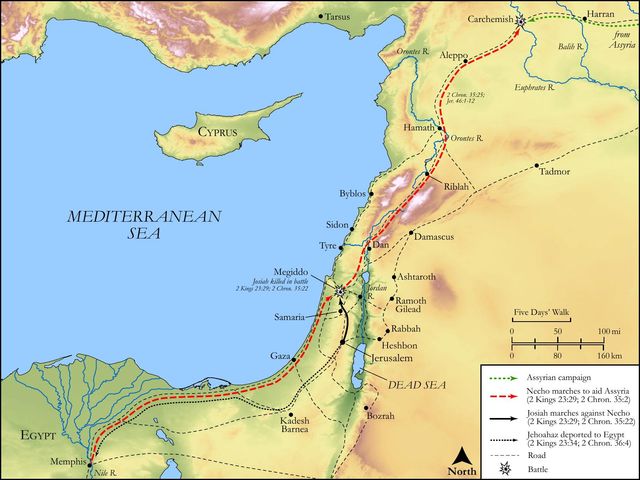
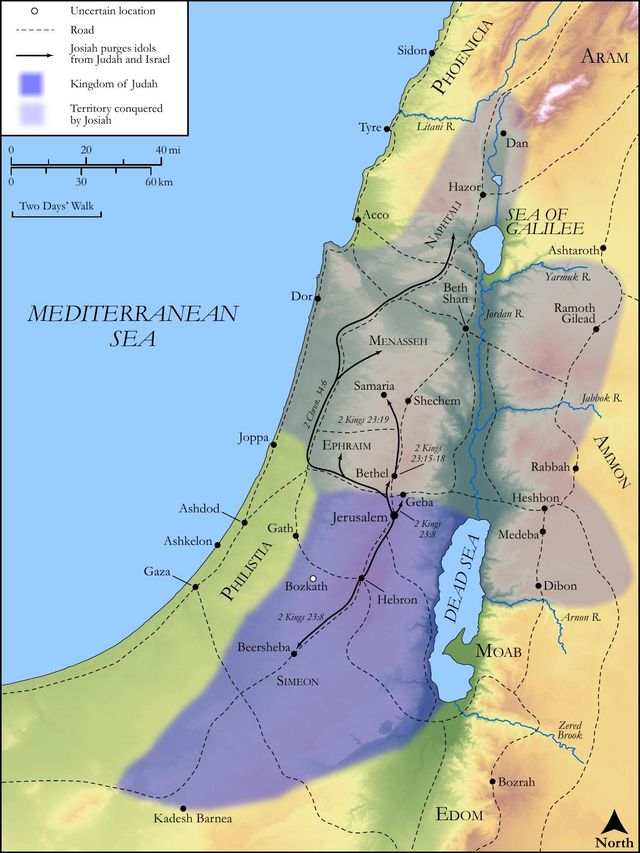
Study this verse
Public-domain commentary
Matthew Henry
From his Commentary on the Whole Bible. Henry comments on passages, not single verses — this entry covers 2 Chronicles 35:1–19. His three-level outline is real structure in the source text, so it is rendered as structure.
The destruction which Josiah made of idols and idolatry was more largely related in the Kings, but just mentioned here in the foregoing chapter (v. 33); but his solemnizing the passover, which was touched upon there (Kg2 23:21), is very particularly related here. Many were the feasts of the Lord, appointed by the ceremonial law, but the passover was the chief. It began them all in the night wherein Israel came out of Egypt; it concluded them all in the night wherein Christ was betrayed; and in the celebration of it Hezekiah and Josiah, those two great reformers, revived religion in their day. The ordinance of the Lord's supper resembles the passover more than it does any of the Jewish festivals; and the due observance of that ordinance, according to the rule, is an instance and means both of the growing purity and beauty of churches and of the growing piety and devotion of particular Christians. Religion cannot flourish where that passover is either wholly neglected or not duly observed; return to that, revive that, make a solemn business of that affecting binding ordinance, and then, it is to be hoped, there will be a reformation in other instances also.
In the account we had of Hezekiah's passover the great zeal of the people was observable, and the transport of devout affection that they were in; but little of the same spirit appears here. It was more in compliance with the king that they all kept the passover (Ch2 35:17, Ch2 35:18) than from any great inclination they had to it themselves. Some pride they took in this form of godliness, but little pleasure in the power of it. But, whatever defect there was among the people in the spirit of the duty, both the magistrates and the ministers did their part and took care that the external part of the service should be performed with due solemnity.
I.The king exhorted and directed, quickened and encouraged, the priests and Levites to do their office in this solemnity.
Perhaps he saw them remiss and indifferent, unwilling to go out of their road or mend their pace. If ministers are so, it is not amiss for any, but most proper for magistrates, to stir them up to their business. Say to Archippus, Take heed to thy ministry, Col 4:17. Let us see how this good king managed his clergy upon this occasion.
1.He reduced them to the office they were appointed to by the law of Moses (Ch2 35:6) and the order they were put into by David and Solomon, Ch2 35:4. He set them in their charge, Ch2 35:2. He did not cut them out new work, nor put them into any new method, but called them back to their institution. Their courses were settled in writing; let them have recourse to that writing, and marshal themselves according to the divisions of their families, Ch2 35:5. Our rule is settled in the written word; let magistrates take care that ministers walk according to that rule and they do their duty.
2.He ordered the ark to be put in its place. It should seem, it had of late been displaced, either by the wicked kings, to make room for their idols in the most holy place, or by Hezekiah, to make room for the workmen that repaired the temple. However it was, Josiah bids the Levites put the ark in the house (Ch2 35:3), and not carry it about from place to place, as perhaps of late they had done, justifying themselves therein by the practice before the temple was built. Now that the priests were discharged from this burden of the ark they must be careful in other services about it.
3.He charged them to serve God and his people Israel, Ch2 35:3. Ministers must look upon themselves as servants both to Christ and to his church for his sake, Co2 4:5. They must take care, and take pains, and lay out themselves to the utmost,
(1.)For the glory and honour of God, and to advance the interests of his kingdom among men. Paul, a servant of God, Tit 1:1.
(2.)For the welfare and benefit of his people, not as having dominion over their faith, but as helpers of their holiness and joy; and there will be no difficulty, in the strength of God, in honestly serving these two masters.
4.He charged them to sanctify themselves, and prepare their brethren, Ch2 35:6. Ministers' work must begin at home, and they must sanctify themselves in the first place, purify themselves from sin, sequester themselves from the world, and devote themselves to God. But it must not end there; they must do what they can to prepare their brethren by admonishing, instructing, exhorting, quickening, and comforting, them. The preparation of the heart is indeed from the Lord; but ministers must be instruments in his hand.
5.He encouraged them to the service, Ch2 35:2. He spoke comfortably to them, as Hezekiah did, Ch2 30:22. He promised them his countenance. Note, Those whom we charge we should encourage. Most people love to be commended, and will be wrought upon by encouragements more than by threats.
II.The king and the princes, influenced by his example, gave liberally for the bearing of the charges of this passover.
The ceremonial services were expensive, which perhaps was one reason why they had been neglected. People had not zeal enough to be at the charge of them; nor were they now very fond of them, for that reason, and therefore,
1.Josiah, at his own proper cost, furnished the congregation with paschal lambs, and other sacrifices, to be offered during the seven days of the feast. He allowed out of his own estate 30,000 lambs for passover offerings, which the offerers were to feast upon, and 3000 bullocks (Ch2 35:7) to be offered during the following seven days. Note, Those who are serious in religion should, when they persuade others to do that which is good, make it as cheap and easy to them as may be. And where God sows plentifully he expects to reap accordingly. It is to be feared that the congregation generally had not come provided; so that, if Josiah had not furnished them, the work of God must have stood still.
2.The chief of the priests, who were men of great estates, contributed towards the priests' charges, as Josiah did towards the people's. The princes (Ch2 35:8), that is, the chief of the priests, the princes of the holy tribe, rulers of the house of God, bore the priests' charges. And some of the rich and great men of the Levites furnished them also with cattle, both great and small, for offerings, Ch2 35:9. For, as to those that sincerely desire to be found in the way of their duty, Providence sometimes raises up friends to bear them out in it, beyond what they could have expected.
III.The priests and Levites performed their office very readily, Ch2 35:10.
They killed the paschal lambs in the court of the temple, the priests sprinkled the blood upon the altar, the Levites flayed them, and then gave the flesh to the people according to their families (Ch2 35:11, Ch2 35:12), not fewer than ten, nor more than twenty, to a lamb. They took it to their several apartments, roasted it, and ate it according to the ordinance, Ch2 35:13. As for the other sacrifices that were eucharistical, the flesh of them was boiled according to the law of the peace-offerings and was divided speedily among the people, that they might feast upon it as a token of their joy in the atonement made and their reconciliation to God thereby. And, lastly, The priests and Levites took care to honour God by eating of the passover themselves, Ch2 35:14. Let not ministers think that the care they take for the souls of others will excuse their neglect of their own, or that being employed so much in public worship will supersede the religious exercises of their closets and families. The Levites here mace ready for themselves and for the priests, because the priests were wholly taken up all day in the service of the altar; therefore, that they might not have their lamb to dress when they should eat it, the Levites got it ready for them against supper time. Let ministers learn hence to help one another, and to forward one another's work, as brethren, and fellow-servants of the same Master.
IV.The singers and porters attended in their places, and did their office, Ch2 35:15.
The singers with their sacred songs and music expressed and excited the joy of the congregation, and made the service very pleasant to them; and the porters at the gates took care that there should be no breaking in of any thing to defile or disquiet the assembly, nor going out of any from it, that none should steal away till the service was done. While they were thus employed their brethren the Levites prepared paschal lambs for them.
V.The whole solemnity was performed with great exactness, according to the law (Ch2 35:16, Ch2 35:17), and, upon that account, there was none like it since Samuel's time (Ch2 35:18), for in Hezekiah's passover there were several irregularities. And bishop Patrick observes that in this also it exceeded the other passovers which the preceding kings had kept, that though Josiah was by no means so rich as David, and Solomon, and Jehoshaphat, yet he furnished the whole congregation with beasts for sacrifice, both paschal and eucharistical, at his own proper cost and charge, which was more than any king ever did before him.
Continue studying 2 Chronicles 35:3 across the web’s major study libraries — every link below opens this exact verse, chapter, or book on the destination site.
Read & Compare
 BibleGatewayThis verse in more than 200 translations and 70 languages.
 Bible.comThe YouVersion reader — hundreds of translations, reading plans, and highlights.
 ESV.orgCrossway's official English Standard Version reader.
 NET BibleThe NET translation with 60,000+ translators' notes on every rendering decision.
 STEP BibleTyndale House's free study tool — original text, vocabulary, and scholarly resources.
 BibliaLogos Bible Software's free web reader.
 USCCBThe New American Bible (Revised Edition) with the U.S. bishops' study notes.
Commentaries
 BibleHub CommentariesDozens of classic commentaries on this verse, gathered on one page.
 StudyLightMore than 100 commentary sets — the largest collection on the web.
 BibleRefPlain-English commentary on what this verse means, verse by verse.
 Enduring WordDavid Guzik's free commentary on this chapter, widely used by Bible teachers.
 Bible Study ToolsVerse commentary alongside Greek and Hebrew study aids.
Original Language & Research
- BibleHub InterlinearThe verse word by word — original language, transliteration, and English.
- BibleHub LexiconEvery word's original-language definition and Strong's entry.
 Blue Letter BibleDeep-study tools — Strong's numbers, concordance, and word studies.
 SefariaThe Hebrew text with Rashi and centuries of Jewish commentary.
Sermons, Hymns & Audio


TrulyRandomVerse is not affiliated with these sites and doesn’t control their content. They’re linked because they’re genuinely useful.
Summary
Second Chronicles 35:3 records King Josiah's crucial directive to the Levites, instructing them to permanently place the holy Ark of the Covenant back in Solomon's Temple. This command was a foundational act in his sweeping religious reforms, signifying a profound restoration of proper worship and divine order in Judah. By securing the Ark, Josiah relieved the Levites of the historical burden of its transport, thereby enabling them to fully dedicate themselves to their primary, divinely appointed duties of teaching God's law to all Israel and serving both the Lord and His people.
Context
ShowHideLiterary Context
This verse is situated within the climactic account of King Josiah's extensive religious reforms, which are meticulously detailed in 2 Chronicles 34 and 2 Chronicles 35. Having already initiated a thorough cleansing of idolatry from the land and undertaken significant repairs to the Temple, Josiah's discovery of the Book of the Law (likely a copy of Deuteronomy) profoundly deepened his commitment to covenant fidelity. The immediate context of 2 Chronicles 35 focuses on the preparations for an unprecedented Passover celebration, which required the Temple to be fully functional and ritually pure. Josiah's directive to the Levites regarding the Ark is a pivotal step in re-establishing the sanctity and proper order of the Temple, ensuring that the sacred space and its personnel were aligned with Mosaic law in anticipation of this grand feast. It underscores the meticulous attention to detail required for genuine spiritual revival.
Historical & Cultural Context
Josiah ascended to the throne of Judah at a tender age, reigning during a period of significant regional instability marked by the decline of the Assyrian Empire and the ascendancy of Babylon. Domestically, Judah had endured decades of profound spiritual apostasy and idolatry under his predecessors, particularly Manasseh and Amon. Josiah's reforms represented a radical reversal of these trends, a concerted effort to guide the nation back to its covenant relationship with Yahweh. The Ark of the Covenant, Israel's most sacred object, symbolized God's tangible presence and covenant with His people, traditionally residing in the Holy of Holies within the Temple built by King Solomon. Its likely displacement or removal during previous idolatrous reigns—perhaps to make way for pagan altars, or possibly moved by faithful priests to protect it from desecration—meant the Temple was not operating according to divine design. Josiah's command, therefore, was a powerful symbolic and practical act of restoring the very heart of Israelite worship. The Levites, as a hereditary priestly class, were divinely appointed for Temple service, including ritual duties, musical worship, and, crucially, the instruction of God's Law to the populace, a role explicitly highlighted by the phrase "that taught all Israel."
Key Themes
ShowHideThis verse significantly contributes to several overarching themes prominent in the Chronicler's narrative and the broader biblical account. Firstly, it powerfully illustrates the theme of Restoration and Reform, showcasing Josiah's unwavering dedication to guiding Judah back to covenant faithfulness after generations of spiritual decline. The proper placement of the Ark is central to this restoration of true worship, symbolizing a return to divine order. Secondly, the verse emphasizes the Importance of Proper Worship and Order. God's dwelling place and the sacred rituals performed therein were to be meticulously ordered and pure, reflecting His inherent holiness. The Ark's permanent placement ensures the Temple functions precisely as God intended, freeing the Levites from the physical and spiritual "burden" of its transport. Thirdly, the passage underscores the Role and Responsibility of the Levites. They are described as "holy unto the LORD" and those who "taught all Israel," highlighting their dual function as consecrated servants and spiritual educators. Their relief from the "burden" of carrying the Ark allows them to fully embrace their primary duties of service and teaching, a key facet of the theme of Dedicated Service to God and His People. This echoes earlier divine mandates concerning their duties, such as those detailed in Numbers 4:15 and Deuteronomy 33:10.
Exposition and Analysis
ShowHideKey Word Analysis
ShowHideThis term signifies being set apart, consecrated, or dedicated for a sacred purpose, implying purity and distinctiveness for God's exclusive use. In this verse, it describes the Levites as "holy unto the LORD," emphasizing their ritual purity and their divinely appointed role as God's consecrated servants. This status set them apart from the rest of Israel, enabling them to handle sacred objects and perform sacred duties within the Temple, serving as intermediaries and instructors for the nation.
While literally referring to a physical load or something carried, massâʼ can also denote a heavy responsibility, a tribute, or even a prophetic utterance that is a "burden" to deliver. In this context, it primarily refers to the physical act of carrying the Ark, a task historically prescribed for the Levites during Israel's nomadic period and specific movements of the Ark (e.g., Numbers 4:15). Josiah's statement, "it shall not be a burden upon your shoulders," carries a profound implication: the constant movement or displacement of the Ark had become an unnecessary and distracting physical and perhaps spiritual imposition, hindering their other vital duties. Its permanent placement frees them from this.
This primitive root means to work, labor, minister, or serve. It is a broad term encompassing various forms of service, from agricultural labor to religious worship. When applied to the Levites, it specifically refers to their divinely mandated duties in the Temple and their ministry to God and the people of Israel. It implies a dedicated, active, and obedient engagement in their God-given roles, which include teaching, leading worship, and maintaining the Temple, as opposed to the more temporary and physically demanding task of continually transporting the Ark.
Verse Breakdown
ShowHide"And said unto the Levites that taught all Israel, which were holy unto the LORD"
This opening clause immediately identifies Josiah's audience and highlights their dual, indispensable roles within the nation. The Levites were not merely Temple functionaries but were explicitly recognized as the primary instructors, responsible for teaching God's law to the entire nation. Their designation as "holy unto the LORD" underscores their consecrated status and the spiritual purity required for their sacred service, setting them apart for divine purposes and enabling their unique ministry.
"Put the holy ark in the house which Solomon the son of David king of Israel did build;"
Josiah's direct, authoritative command is to return the Ark of the Covenant to its permanent, divinely ordained resting place within the Temple, specifically acknowledging its construction by King Solomon. This action signifies a profound restoration of proper worship and divine order, acknowledging the Ark's supreme sanctity and the Temple as the designated, stable dwelling place for God's presence among His people. Its previous displacement or movement is implicitly corrected by this decisive act.
"[it shall] not [be] a burden upon [your] shoulders"
This phrase directly addresses the practical and symbolic consequence of the Ark's permanent placement. Historically, the Ark was carried by the Levites during Israel's wilderness wanderings and during specific processions. By securing it in the Temple, Josiah alleviates the Levites from this physically demanding and potentially distracting task. This relief is not merely physical but carries a deeper symbolic meaning, freeing them from a "burden" that had perhaps diverted their energy and focus from their core responsibilities.
"serve now the LORD your God, and his people Israel"
This concluding imperative clarifies Josiah's ultimate purpose and the profound benefit of the Ark's proper placement. By removing the "burden" of carrying the Ark, the Levites are now enabled to fully dedicate themselves to their true, divinely ordained calling: serving God through their Temple ministries (including worship, sacrifice, and maintenance) and serving the people of Israel through dedicated teaching, spiritual guidance, and pastoral care. This re-focusing highlights the essence of their priestly and instructional ministry.
Literary Devices
ShowHideThe verse employs several literary devices to convey its profound message. Emphasis is placed on the Levites' dual and crucial role as both teachers of Israel and consecrated servants of the Lord, highlighting their unique and indispensable position in Israelite society. The phrase "not be a burden upon your shoulders" utilizes both Metaphor and Symbolism. While literally referring to the physical weight of the Ark, "burden" metaphorically represents any distraction, unnecessary hardship, or deviation from their primary, divinely appointed duties. The Ark itself is a powerful Symbolism of God's tangible presence and His covenant with Israel, and its proper, permanent placement within the Temple symbolizes the restoration of divine order, the sanctity of worship, and the re-establishment of a right relationship between God and His people. Josiah's command also demonstrates Direct Address and the Imperative Mood, underscoring his kingly authority and the urgency and importance of these reforms. The implicit contrast between the past "burden" of carrying the Ark and the future "service" it enables creates a subtle Antithesis, emphasizing the positive outcome of obedience and proper alignment with God's design.
Theological and Thematic Connections
ShowHideThis verse profoundly underscores the theological truth that God desires order, reverence, and proper alignment in worship and service. The Ark, as the preeminent symbol of God's presence and covenant, was intended to have a permanent, sacred dwelling once the Temple was built, not to be a continually portable burden. Josiah's decisive action reflects a deep understanding of covenant fidelity and the critical importance of adhering to God's prescribed ways for worship and ministry. When sacred things are out of their divine order, it invariably creates unnecessary "burdens" that hinder effective ministry, spiritual flourishing, and the people's access to God. By restoring the Ark to its rightful place, Josiah enables the Levites to fulfill their true calling of serving God and instructing His people, demonstrating that true, unhindered service flows from a rightly ordered relationship with God and diligent adherence to His commands. This principle extends beyond ritual to all aspects of life: when our priorities are aligned with God's will, we are freed from spiritual burdens and empowered for fruitful, dedicated service.
Reflection and Application
ShowHideJosiah's command to the Levites serves as a powerful and enduring reminder for believers today about the vital importance of spiritual order, discerning our core calling, and focusing our energies on what truly matters to God. Just as the Ark's displacement created an unnecessary "burden" for the Levites, diverting them from their divinely appointed duties of teaching and ministry, so too can misaligned priorities, spiritual "disorder," or unaddressed distractions create significant burdens in our own lives. When we allow things to be out of their proper place—whether it's our time, our resources, our relationships, our spiritual disciplines, or even our understanding of God's will—it can severely hinder our ability to genuinely "serve the LORD your God, and his people." This verse challenges us to prayerfully identify any "burdens" in our lives that are not from God but are rather the result of neglecting His design, allowing distractions to take precedence, or clinging to things we were never meant to carry. By intentionally "putting the holy ark" (symbolically, God's presence, His priorities, and His Word) back in its rightful, central place in our lives, we are freed from unnecessary weights and empowered to embrace our true calling to worship God wholeheartedly and serve others effectively. This involves a conscious process of discerning what truly matters, shedding what is unnecessary or distracting, and dedicating ourselves with renewed focus to the work God has called each of us to do, living out our "holy unto the LORD" identity in practical, impactful ways.
Questions for Reflection
ShowHideFAQ
ShowHideWhy was the Ark of the Covenant not in its proper place in the Temple during Josiah's reign?
ShowHideThe biblical text of 2 Chronicles 35:3 does not explicitly detail the circumstances that led to the Ark's displacement from the Holy of Holies. However, scholars commonly propose several plausible reasons. During the reigns of Josiah's idolatrous predecessors, particularly Manasseh and Amon, the Temple was severely desecrated with pagan altars, images, and various forms of idolatrous worship (2 Chronicles 33:1-9). It is highly probable that the Ark, as the most sacred object representing Yahweh's presence, was either removed by impious kings to make room for their idols, or perhaps it was moved by faithful priests or Levites to protect it from desecration and the rampant idolatry that had gripped Judah. Given the extensive nature of Josiah's reforms, which included a thorough cleansing and repair of the Temple, it is entirely consistent that the Ark would have been found displaced or temporarily stored elsewhere to preserve its sanctity. Josiah's command, therefore, was a crucial and symbolic act of restoring the Temple's sacred order and the Ark's central, rightful position as the preeminent symbol of God's presence and covenant with His people.
Christ-Centered Fulfillment
ShowHideThe narrative of King Josiah restoring the Ark to its rightful place in the Temple, thereby relieving the Levites of their "burden" and enabling them to fulfill their true service, beautifully foreshadows the ultimate redemptive work of Jesus Christ. The Ark of the Covenant, representing God's presence and the place of atonement, finds its perfect and complete fulfillment in Christ Himself. He is the true Immanuel, "God with us", the very embodiment of God's tangible presence and glory dwelling among humanity. Just as the Ark was the focal point of Israel's worship and access to God, Christ is now the center of our worship and faith, the sole mediator through whom we approach the Father. Furthermore, the "burden" lifted from the Levites powerfully points to the profound freedom Christ offers from the heavy yokes of sin, legalism, and the endless demands of the Old Covenant law. Jesus Himself extends the gracious invitation, "Come to me, all you who are weary and burdened, and I will give you rest." He is the Lamb of God who takes away the sin of the world, providing the ultimate, once-for-all atonement, which renders the ceremonial duties of the Levites obsolete. Through His finished work on the cross, believers are now constituted as a "royal priesthood," no longer needing to carry the physical burdens of ritualistic service, but freed by grace to "serve the LORD your God, and his people Israel" by proclaiming the good news of the Gospel and living lives of dedicated, Spirit-empowered service, all flowing from the indwelling presence of Christ.