


Nehemiah 11:20
Bible text: King James Version (1769 Blayney text) · Public domain
Bible text: Berean Standard Bible · Public domain
Bible text: American Standard Version (1901) · Public domain
Bible text: World English Bible, Messianic edition · Public domain
Bible text: Geneva Bible (1599) · Public domain
Bible text: Young's Literal Translation · Public domain
- וּשְׁאָרu·she·'Arand [the] rest ofH7605Conj-w ¦ N-mscNoun Singular Masculine Constructוּandשְׁאָר[the] rest of
- יִשְׂרָאֵלYis·ra·'ElIsraelH3478N-properNoun Proper Location
- הַכֹּהֲנִיםha·ko·ha·Nimthe priestsH3548Art ¦ N-mpNoun Plural Masculine Absoluteהַtheכֹּהֲנִיםpriests
- הַלְוִיִּםhal·vi·Yimthe LevitesH3881Art ¦ N-mpNoun Gentilic Plural Masculine AbsoluteהַtheלְוִיִּםLevites
- בְּכָלbe·khol[were] in allH3605Prep-b ¦ N-mscNoun Singular Masculine Constructבְּ[were] inכָלall
- עָרֵי'a·Rei[the] cities ofH5892N-mpcNoun Plural Masculine Construct
- יְהוּדָהye·hu·DahJudahH3063N-properNoun Proper Location
- אִישׁ'isheach oneH376N-msNoun Singular Masculine Absolute
- בְּנַחֲלָתוֹbe·na·cha·la·Toon his own inheritanceH5159Prep-b ¦ N-fsc ¦ 3msNoun Singular Feminine Constructבְּonנַחֲלָתown inheritanceוֹhis
English is a literal word-by-word gloss of the Hebrew, not the KJV's wording. Why?
This is the original text the KJV's translators worked from — each Hebrew word with its own literal English meaning in this verse, prepared by scholars at Tyndale House, Cambridge. The KJV translates whole sentences, not word by word, so its wording differs: one Hebrew word can become several English words, and the KJV may choose “the LORD” where the gloss reads “Yahweh”. Both are faithful — they answer different questions. For the KJV's own rendering, switch to the KJV text.
Details
See on the biblical-era map
Study this verse
Public-domain commentary
Matthew Henry
From his Commentary on the Whole Bible. Henry comments on passages, not single verses — this entry covers Nehemiah 11:20–36.
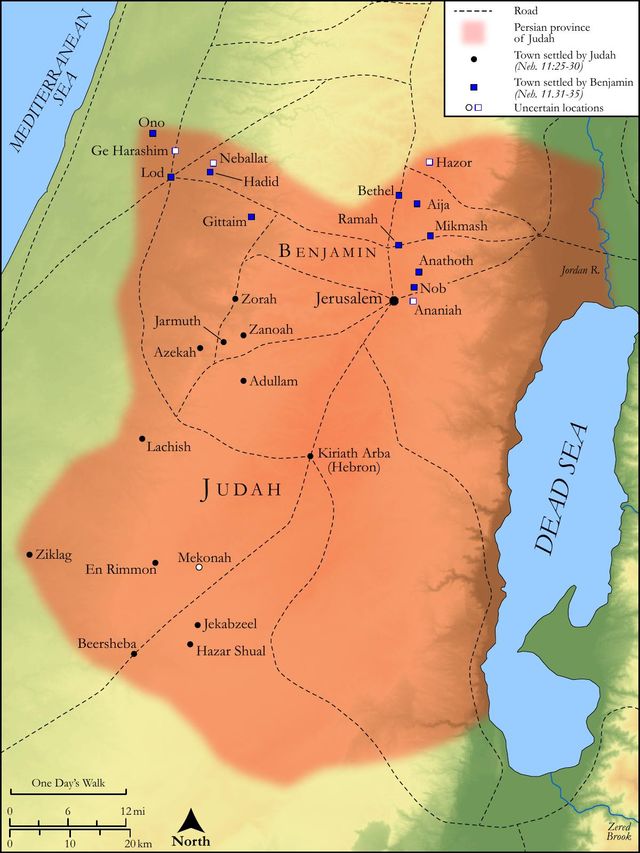
Having given an account of the principal persons that dwelt in Jerusalem (a larger account of whom he had before, Ch1 9:2, etc.), Nehemiah, in these verses, gives us some account of the other cities, in which dwelt the residue of Israel, Neh 11:20. It was requisite that Jerusalem should be replenished, yet not so as to drain the country. The king himself is served of the field, which will do little service if there be not hands to manage it. Let there therefore be no strife, no envy, no contempt, no ill will, between the inhabitants of the cities and those of the villages; both are needful, both useful, and neither can be spared. 1. The Nethinims, the posterity of the Gibeonites, dwelt in Ophel, which was upon the wall of Jerusalem (Neh 3:26), because they were to do the servile work of the temple, which therefore they must be posted near to, that they might be ready to attend, Neh 11:21. 2. Though the Levites were dispersed through the cities of Judah, yet they had an overseer who resided in Jerusalem, superior of their order and their provincial, to whom they applied for direction, who took care of their affairs and took cognizance of their conduct, whether they did their duty, Neh 11:22. 3. Some of the singers were appointed to look after the necessary repairs of the temple, being ingenious men, and having leisure between their hours of service; they were over the business of the house of God, Neh 11:22. And, it seems, the king of Persia had such a kindness for their office that he allotted a particular maintenance for them, besides what belonged to them as Levites, Neh 11:23. 4. Here is one that was the king's commissioner at Jerusalem. He was of the posterity of Zerah (Neh 11:24); for of that family of Judah there were some new settled in Jerusalem, and not all of Pharez, as appears by that other catalogue, Ch1 9:6. He is said to be at the king's hand, or on the king's part, in all matters concerning the people, to determine controversies that arose between the king's officers and his subjects, to see that what was due to the king from the people was duly paid in and what was allowed by the king for the temple service was duly paid out, and happy it was for the Jews that one of themselves was in this post. 5. Here is an account of the villages, or country towns, which were inhabited by the residue of Israel - the towns in which the children of Judah dwelt (Neh 11:25-30), those that were inhabited by the children of Benjamin (Neh 11:31-35), and divisions for the Levites among both, Neh 11:36. We will now suppose them safe and easy, though few and poor, but by the blessing of God they were likely to increase in wealth and power, and they would have been more likely if there had not been that general profaneness among them, and lukewarmness in religion, with which they were charged in God's name by the prophet Malachi, who, it is supposed, prophesied about this time, and in whom prophecy ceased for some ages, till it revived in the great prophet and his forerunner.
Continue studying Nehemiah 11:20 across the web’s major study libraries — every link below opens this exact verse, chapter, or book on the destination site.
Read & Compare
 BibleGatewayThis verse in more than 200 translations and 70 languages.
 Bible.comThe YouVersion reader — hundreds of translations, reading plans, and highlights.
 ESV.orgCrossway's official English Standard Version reader.
 NET BibleThe NET translation with 60,000+ translators' notes on every rendering decision.
 STEP BibleTyndale House's free study tool — original text, vocabulary, and scholarly resources.
 BibliaLogos Bible Software's free web reader.
 USCCBThe New American Bible (Revised Edition) with the U.S. bishops' study notes.
Commentaries
 BibleHub CommentariesDozens of classic commentaries on this verse, gathered on one page.
 StudyLightMore than 100 commentary sets — the largest collection on the web.
 BibleRefPlain-English commentary on what this verse means, verse by verse.
 Enduring WordDavid Guzik's free commentary on this chapter, widely used by Bible teachers.
 Bible Study ToolsVerse commentary alongside Greek and Hebrew study aids.
Original Language & Research
- BibleHub InterlinearThe verse word by word — original language, transliteration, and English.
- BibleHub LexiconEvery word's original-language definition and Strong's entry.
 Blue Letter BibleDeep-study tools — Strong's numbers, concordance, and word studies.
 SefariaThe Hebrew text with Rashi and centuries of Jewish commentary.
Sermons, Hymns & Audio


TrulyRandomVerse is not affiliated with these sites and doesn’t control their content. They’re linked because they’re genuinely useful.
Summary
Nehemiah 11:20 provides a vital administrative detail regarding the comprehensive re-settlement of the post-exilic Jewish community throughout the territory of Judah. It meticulously records that the faithful remnant of Israel, including the indispensable priestly and Levitical classes, were strategically dispersed across various cities, each returning to their divinely allotted ancestral land. This verse underscores the meticulous and divinely guided efforts undertaken by Nehemiah to re-establish a fully functioning society and spiritual infrastructure beyond the confines of Jerusalem, thereby ensuring the restoration of both national identity and covenantal religious practice in the promised land.
Context
ShowHideLiterary Context
Nehemiah 11 serves as a pivotal chapter, bridging the monumental work of rebuilding Jerusalem's walls (Nehemiah 1-6) and the subsequent re-establishment of covenant life and worship, culminating in the dedication of the wall and the reforms under Ezra and Nehemiah (Nehemiah 12-13). Following the successful completion of the wall, a significant challenge emerged: Jerusalem, though fortified, remained "large and spacious, but the people in it were few, and the houses were not rebuilt" (Nehemiah 7:4). Nehemiah 11:1-19 details the repopulation of Jerusalem, describing those chosen by lot or volunteering to reside within the capital's newly secured boundaries. Verse 20 then expands this scope, clarifying that while Jerusalem was being re-inhabited, the broader Israelite community, especially the crucial religious leaders, were settling throughout the other cities of Judah. This demonstrates a holistic, organized effort to re-inhabit and re-establish the entire land, not merely its capital, ensuring a widespread return to covenant living.
Historical & Cultural Context
The setting for this verse is the mid-5th century BCE, during the post-exilic period following the return of Jewish exiles from their seventy-year captivity in Babylon. The return, initiated by the decree of Cyrus, aimed to restore Jewish life in their ancestral homeland. A foundational aspect of Israelite identity and societal structure was the concept of tribal land inheritance, deeply rooted in the initial division of Canaan under Joshua (Joshua 14:1). The phrase "every one in his inheritance" in Nehemiah 11:20 signifies a deliberate return to this ancient, divinely ordained system, re-establishing ancestral claims and territorial identity after the profound disruption of exile. The specific mention of "priests" and "Levites" is highly significant; these were the designated religious functionaries responsible for Temple service, teaching the Mosaic Law, and maintaining spiritual order. Their strategic dispersion throughout Judah ensured that spiritual oversight, instruction, and the practice of divine worship were accessible to the broader community, extending beyond the immediate vicinity of the rebuilt Temple in Jerusalem.
Key Themes
ShowHideThis verse contributes significantly to several overarching themes within the book of Nehemiah and the broader post-exilic narrative. Firstly, it powerfully illustrates Restoration and Re-establishment, showcasing God's unwavering faithfulness in bringing His people back to their land and enabling the rebuilding of their national and spiritual life after a period of severe judgment. Secondly, it highlights the paramount importance of Order and Organization in a functioning society, particularly one striving to live in accordance with God's covenant. Nehemiah's meticulous attention to the distribution of the population reflects a divine emphasis on proper administration and structure as essential for communal well-being and spiritual health. Thirdly, the return to "his inheritance" represents a tangible, albeit partial, Fulfillment of Promise, directly connecting the post-exilic community to God's ancient covenant promises regarding the land of Israel, even after a period of divine discipline. Finally, it underscores Community Responsibility and Participation, demonstrating that the entire community, including its vital religious leadership, had an essential role to play in the rebuilding and spiritual renewal of the nation, each contributing in their appointed place according to God's design.
Exposition and Analysis
ShowHideKey Word Analysis
ShowHideThe Hebrew word שְׁאָר (shᵉʼâr) literally means "remainder" or "rest." In a theological context, especially prominent in prophetic literature (e.g., Isaiah, Jeremiah), it often carries the profound meaning of a "remnant"—a portion of God's people preserved through judgment, calamity, or apostasy, destined to continue His covenant purposes. This concept emphasizes God's enduring faithfulness and His sovereign plan to maintain a people for Himself, even when the majority may have fallen away or faced divine discipline through exile. In Nehemiah 11:20, it refers to the bulk of the Jewish population who had returned from Babylonian exile, distinct from those specifically chosen to dwell in Jerusalem, yet still representing the preserved core of Israel.
The Hebrew term נַחֲלָה (nachălâh) refers to something inherited, an allotted portion, particularly land received as a permanent possession. For the tribes of Israel, their land inheritance was foundational to their identity, their socio-economic stability, and their relationship with God, as it was a direct fulfillment of divine promise. While the Levites did not receive a tribal land inheritance in the same way as the other tribes, they were allotted specific cities throughout Israel (Numbers 35:2), and their ultimate "inheritance" was often described as the Lord Himself and the offerings of Israel (Deuteronomy 18:1). Thus, "every one in his inheritance" signifies a return to the established, divinely sanctioned order of land tenure and tribal identity, a crucial step in the restoration of the nation.
Verse Breakdown
ShowHide"And the residue of Israel"
This initial phrase identifies the primary subject of the verse: the main body of the Jewish population who had returned from Babylonian exile. It serves to differentiate them from the specific group detailed in the preceding verses (Nehemiah 11:1-19) who had settled within Jerusalem. The use of "residue" or "remnant" carries significant theological weight, signifying those who survived the judgment of exile and were now being faithfully restored to their land, embodying God's enduring faithfulness to His covenant promises despite Israel's national sin.
"of the priests, [and] the Levites"
This clause specifies that the religious leadership—those divinely appointed for Temple service, teaching the Law, and maintaining the spiritual life of the community—were explicitly included in this broader settlement. Their strategic presence throughout the various cities of Judah was crucial for the spiritual health, instruction, and worship practices of the wider community, ensuring that divine ordinances and covenant obedience could be practiced beyond the immediate vicinity of the rebuilt Temple in Jerusalem. It underscores the comprehensive nature of the restoration effort, encompassing both civil and spiritual dimensions.
"[were] in all the cities of Judah"
This indicates the geographical distribution of the returned exiles. Rather than concentrating solely in the capital, Jerusalem, the population was intentionally spread across the various towns and cities within the territory of Judah. This strategic dispersion was essential for the full re-establishment and revitalization of the land, providing a demographic base for agricultural production, trade, local governance, and defense, thereby ensuring that the entire region was re-inhabited and made productive by God's people.
"every one in his inheritance"
This deeply significant phrase refers to the return to the ancestral land allotments that were originally divided among the tribes of Israel by Joshua following the conquest of Canaan. It signifies a re-assertion of the divinely ordained tribal and familial land rights, which were central to Israelite identity, economic stability, and covenant faithfulness. For the Levites, their "inheritance" would refer to their allotted cities and their portion from the offerings of the people, as they did not receive a tribal land portion like the other tribes. This re-establishment of land tenure underscored the restoration of divine order, national identity, and a profound sense of belonging to the promised land.
Literary Devices
ShowHideNehemiah 11:20, though concise, effectively employs several literary techniques to convey its significance. The verse functions as a form of Census or Register, a common and important literary device in biblical historical books (e.g., Numbers, Ezra, Nehemiah) used to establish identity, demonstrate divine ordering, and underscore the fulfillment of promises. By specifically listing the "residue of Israel" and then particularly mentioning "priests" and "Levites," the text utilizes Synecdoche, where a crucial part (the religious leaders) represents the whole (the re-established community), thereby emphasizing their indispensable role in the national and spiritual restoration. The phrase "every one in his inheritance" carries strong Symbolism, representing not merely physical land ownership but also the restoration of covenant relationship, identity, and divine order after the profound chaos and displacement of exile. It powerfully evokes the foundational promises of God regarding the land. Furthermore, the overall context of Nehemiah 11, moving from the repopulation of Jerusalem to the wider cities, demonstrates a Progressive Disclosure of the comprehensive nature of God's restorative work, moving from the vital core to the surrounding periphery, ensuring the full re-establishment of the nation.
Theological and Thematic Connections
ShowHideNehemiah 11:20 stands as a powerful testament to God's unwavering faithfulness and His enduring commitment to His covenant people. It illustrates that even after severe judgment and prolonged exile, God meticulously orchestrates the restoration of His people to their land, re-establishing their identity and purpose. The return to "his inheritance" signifies not merely a physical relocation but a profound act of divine re-ordering, echoing the original distribution of the land under Joshua and affirming God's enduring promises to Abraham's descendants. This verse underscores the importance of a structured, ordered community for the flourishing of spiritual life, with the priests and Levites playing a vital role in ensuring spiritual instruction and oversight throughout the land. It speaks directly to the concept of the "remnant," a core theological idea woven throughout the Old Testament, indicating that God always preserves a faithful portion of His people through whom His redemptive purposes will continue, demonstrating His sovereign plan for salvation history.
Reflection and Application
ShowHideNehemiah 11:20 offers profound and enduring insights for contemporary believers. It serves as a powerful reminder that God is a God of restoration, who faithfully brings His people back from periods of spiritual or physical displacement, rebuilding what was broken and breathing new life into desolate places. Just as the Israelites were called to re-inhabit their ancestral lands, we too are called to occupy and steward the "inheritance" God has graciously given us—our unique gifts, callings, and spheres of influence within His kingdom. This verse challenges us to prayerfully consider where God has placed us, whether in specific ministries, professions, families, or communities, and how we can faithfully contribute to His ongoing work of rebuilding and spiritual renewal in our own context. The organized dispersion of priests and Levites highlights the enduring importance of spiritual leadership and sound biblical instruction being accessible throughout the community, not just centralized in one location. This encourages us to actively support and participate in local church communities, recognizing that every member, in their unique "inheritance" of gifts, has a vital role in building up the body of Christ and extending His transformative presence into the world. It calls us to embrace our individual "inheritance" with a spirit of order, intentionality, and communal responsibility, trusting in God's overarching plan for restoration and flourishing.
Questions for Reflection
ShowHideFAQ
ShowHideWhy was it important for the "residue of Israel" to be in all the cities of Judah, not just Jerusalem?
ShowHideWhile Jerusalem was undoubtedly the spiritual and political capital of the returning Jewish community, its repopulation was only one part of a much broader and essential restoration. For the nation of Judah to truly be re-established and thrive, the entire land needed to be re-inhabited, cultivated, and made productive. Dispersing the population, including the vital priests and Levites, across all the cities of Judah ensured several crucial outcomes: it fostered economic viability through the resumption of agriculture, trade, and local industries in various regions; it provided a more robust defense against potential enemies by establishing a wider network of fortified towns; and, perhaps most importantly, it facilitated the re-establishment of spiritual oversight, instruction, and communal worship in local communities, ensuring that the covenant life could flourish throughout the land, not just in one concentrated area around the Temple. It reflected a comprehensive vision for national and spiritual renewal, extending God's presence and order across the entire territory.
What does "every one in his inheritance" mean for the Levites, since they didn't receive a tribal land inheritance?
ShowHideThe phrase "every one in his inheritance" primarily refers to the return to the ancestral land allotments that were distributed among the other tribes of Israel, which formed the bedrock of their identity and economic life. For the Levites, however, their inheritance was distinct according to Mosaic Law. Unlike the other tribes, the Levites were not given a tribal land inheritance in the same way (e.g., Numbers 18:20). Instead, the Lord Himself was declared to be their inheritance, meaning they were sustained by the tithes and offerings of the other tribes, and they were given specific cities to dwell in throughout Israel, along with their surrounding pasturelands (Numbers 35:2). Therefore, for the Levites mentioned in Nehemiah 11:20, "his inheritance" would refer to their return to these designated Levitical cities or towns where they would carry out their priestly, teaching, and administrative duties, supported by the community's faithful offerings, thereby fulfilling their unique role within the restored nation.
Christ-Centered Fulfillment
ShowHideNehemiah 11:20, with its profound emphasis on the faithful remnant, divine restoration, and the return to an inheritance, finds its ultimate and most glorious fulfillment in Jesus Christ and the New Covenant. The "residue of Israel" points forward to the faithful remnant through whom God's redemptive purposes are carried forward across history; this remnant culminates in Christ, who is the true Israel, and then extends to all who are "in Christ" by faith, whether Jew or Gentile, forming the new people of God (Romans 9:6-8). The physical return to the land and "every one in his inheritance" foreshadows the far greater, spiritual inheritance believers receive in Christ—an inheritance that is imperishable, undefiled, and unfading, securely kept in heaven (1 Peter 1:4). Indeed, Christ Himself is our true and eternal inheritance and portion, infinitely surpassing any earthly land allotment (Psalm 16:5). Furthermore, the re-establishment of order and the strategic dispersion of priests and Levites throughout Judah prefigure the new spiritual temple, the Church, where every believer is now a "royal priesthood" and a "holy nation" (1 Peter 2:9). We are called to live out our unique callings and serve within the body of Christ, extending the knowledge of God's glory and the good news of the Gospel throughout the entire world, no longer confined to a single geographical location. Jesus is the ultimate restorer, rebuilding not just walls and cities, but human hearts and lives, bringing us into a new covenant relationship and a spiritual inheritance that will endure for all eternity.