


Nehemiah 11:21
Bible text: King James Version (1769 Blayney text) · Public domain
Bible text: Berean Standard Bible · Public domain
Bible text: American Standard Version (1901) · Public domain
Bible text: World English Bible, Messianic edition · Public domain
Bible text: Geneva Bible (1599) · Public domain
Bible text: Young's Literal Translation · Public domain
- וְהַנְּתִינִיםve·ha·ne·ti·Nimand the temple servantsH5411Conj-w ¦ Art ¦ N-mpNoun Plural Masculine Absoluteוְandהַtheנְּתִינִיםtemple servants
- יֹשְׁבִיםyo·she·Vim[were] dwellingH3427V-Qal-Prtcpl-mpVerb Qal Participle Plural Masculine Absolute
- בָּעֹפֶלba·'O·felon <the> OphelH6077Prep-b ¦ N-properNoun Proper Locationבָּon <the>עֹפֶלOphel
- וְצִיחָאve·tzi·Cha'and ZihaH6727Conj-w ¦ N-proper-mNoun Proper MasculineוְandצִיחָאZiha
- וְגִשְׁפָּאve·gish·Pa'and GishpaH1658Conj-w ¦ N-proper-mNoun Proper MasculineוְandגִשְׁפָּאGishpa
- עַל'al[were] overH5921PrepPreposition
- הַנְּתִינִיםha·ne·ti·Nimthe temple servantsH5411Art ¦ N-mpNoun Plural Masculine Absoluteהַtheנְּתִינִיםtemple servants
English is a literal word-by-word gloss of the Hebrew, not the KJV's wording. Why?
This is the original text the KJV's translators worked from — each Hebrew word with its own literal English meaning in this verse, prepared by scholars at Tyndale House, Cambridge. The KJV translates whole sentences, not word by word, so its wording differs: one Hebrew word can become several English words, and the KJV may choose “the LORD” where the gloss reads “Yahweh”. Both are faithful — they answer different questions. For the KJV's own rendering, switch to the KJV text.
Details
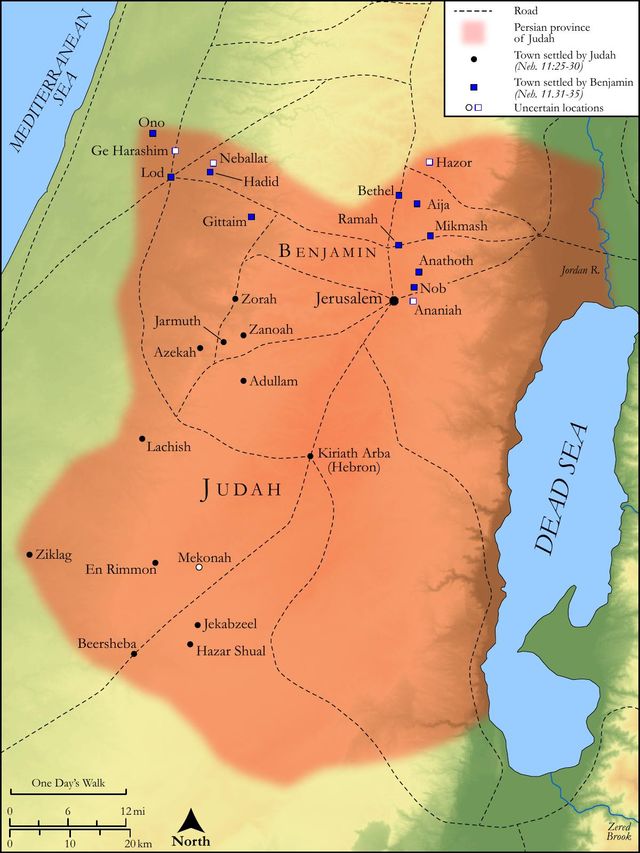
See on the biblical-era map
Study this verse
Public-domain commentary
Matthew Henry
From his Commentary on the Whole Bible. Henry comments on passages, not single verses — this entry covers Nehemiah 11:20–36.
Having given an account of the principal persons that dwelt in Jerusalem (a larger account of whom he had before, Ch1 9:2, etc.), Nehemiah, in these verses, gives us some account of the other cities, in which dwelt the residue of Israel, Neh 11:20. It was requisite that Jerusalem should be replenished, yet not so as to drain the country. The king himself is served of the field, which will do little service if there be not hands to manage it. Let there therefore be no strife, no envy, no contempt, no ill will, between the inhabitants of the cities and those of the villages; both are needful, both useful, and neither can be spared. 1. The Nethinims, the posterity of the Gibeonites, dwelt in Ophel, which was upon the wall of Jerusalem (Neh 3:26), because they were to do the servile work of the temple, which therefore they must be posted near to, that they might be ready to attend, Neh 11:21. 2. Though the Levites were dispersed through the cities of Judah, yet they had an overseer who resided in Jerusalem, superior of their order and their provincial, to whom they applied for direction, who took care of their affairs and took cognizance of their conduct, whether they did their duty, Neh 11:22. 3. Some of the singers were appointed to look after the necessary repairs of the temple, being ingenious men, and having leisure between their hours of service; they were over the business of the house of God, Neh 11:22. And, it seems, the king of Persia had such a kindness for their office that he allotted a particular maintenance for them, besides what belonged to them as Levites, Neh 11:23. 4. Here is one that was the king's commissioner at Jerusalem. He was of the posterity of Zerah (Neh 11:24); for of that family of Judah there were some new settled in Jerusalem, and not all of Pharez, as appears by that other catalogue, Ch1 9:6. He is said to be at the king's hand, or on the king's part, in all matters concerning the people, to determine controversies that arose between the king's officers and his subjects, to see that what was due to the king from the people was duly paid in and what was allowed by the king for the temple service was duly paid out, and happy it was for the Jews that one of themselves was in this post. 5. Here is an account of the villages, or country towns, which were inhabited by the residue of Israel - the towns in which the children of Judah dwelt (Neh 11:25-30), those that were inhabited by the children of Benjamin (Neh 11:31-35), and divisions for the Levites among both, Neh 11:36. We will now suppose them safe and easy, though few and poor, but by the blessing of God they were likely to increase in wealth and power, and they would have been more likely if there had not been that general profaneness among them, and lukewarmness in religion, with which they were charged in God's name by the prophet Malachi, who, it is supposed, prophesied about this time, and in whom prophecy ceased for some ages, till it revived in the great prophet and his forerunner.
Continue studying Nehemiah 11:21 across the web’s major study libraries — every link below opens this exact verse, chapter, or book on the destination site.
Read & Compare
 BibleGatewayThis verse in more than 200 translations and 70 languages.
 Bible.comThe YouVersion reader — hundreds of translations, reading plans, and highlights.
 ESV.orgCrossway's official English Standard Version reader.
 NET BibleThe NET translation with 60,000+ translators' notes on every rendering decision.
 STEP BibleTyndale House's free study tool — original text, vocabulary, and scholarly resources.
 BibliaLogos Bible Software's free web reader.
 USCCBThe New American Bible (Revised Edition) with the U.S. bishops' study notes.
Commentaries
 BibleHub CommentariesDozens of classic commentaries on this verse, gathered on one page.
 StudyLightMore than 100 commentary sets — the largest collection on the web.
 BibleRefPlain-English commentary on what this verse means, verse by verse.
 Enduring WordDavid Guzik's free commentary on this chapter, widely used by Bible teachers.
 Bible Study ToolsVerse commentary alongside Greek and Hebrew study aids.
Original Language & Research
- BibleHub InterlinearThe verse word by word — original language, transliteration, and English.
- BibleHub LexiconEvery word's original-language definition and Strong's entry.
 Blue Letter BibleDeep-study tools — Strong's numbers, concordance, and word studies.
 SefariaThe Hebrew text with Rashi and centuries of Jewish commentary.
Sermons, Hymns & Audio


TrulyRandomVerse is not affiliated with these sites and doesn’t control their content. They’re linked because they’re genuinely useful.
Summary
Nehemiah 11:21 precisely identifies the Nethinims, a distinct group of temple servants, as residents of Ophel in Jerusalem and names Ziha and Gispa as their overseers. This verse underscores the meticulous organizational efforts undertaken by Nehemiah to repopulate and restore the functionality of Jerusalem after the Babylonian exile, highlighting the essential role played by all members, including those in supportive capacities, in re-establishing the city's sacred and civic life.
Context
ShowHideLiterary Context
Nehemiah 11 is a pivotal chapter that meticulously lists the families and individuals who took up residence in Jerusalem after the completion of the city walls and the covenant renewal. Following the dedication of the wall in Nehemiah 12, Nehemiah recognized that while Jerusalem's defenses were strong, its population was "large and great, but the people were few therein" as noted in Nehemiah 7:4. To address this demographic deficit and ensure the city's viability, a system was implemented where one-tenth of the returning exiles were chosen by lot to reside within the holy city, while the rest settled in surrounding towns. This chapter systematically enumerates the various groups—including priests, Levites, and lay Israelites—who committed to living within the city walls. Nehemiah 11:21 specifically focuses on the Nethinims, highlighting their designated place within this meticulously organized repopulation, emphasizing their integral role alongside other temple workers.
Historical & Cultural Context
The setting for the book of Nehemiah is the post-exilic period, specifically during the second wave of returns from Babylonian captivity under the leadership of Nehemiah, around 445 BC. The Jewish community was re-establishing itself under Persian rule, with a strong focus on rebuilding Jerusalem's walls and restoring temple worship and civic order. The Nethinims were a distinct class of temple servants, whose name derives from the Hebrew "given ones," indicating their dedication to the sanctuary. They were not of Israelite descent but likely descendants of foreign captives, such as the Gibeonites who were made "woodcutters and water carriers for the congregation and for the altar of the Lord" in Joshua 9:27. Their presence among the returning exiles is well-documented in the lists of Ezra 2:43-58 and Nehemiah 7:46-60. Their dwelling in Ophel is significant, as this area, located on the southeastern slope of the Temple Mount, was historically associated with temple personnel and administrative functions, making it a logical and strategic location for those dedicated to temple service.
Key Themes
ShowHideThis verse contributes to several overarching themes within the book of Nehemiah. Firstly, it underscores the theme of Community Organization and Restoration. Nehemiah's leadership was characterized by meticulous planning and implementation, ensuring that every aspect of the restored community, from its physical defenses to its spiritual administration, was properly structured. The detailed listing of families and their assigned places, as seen in Nehemiah 11, exemplifies this commitment to order. Secondly, the verse highlights the Value of Dedicated Service. The Nethinims, though performing what might be considered humble tasks, were indispensable for the daily operations of the Temple. Their inclusion emphasizes that all roles, regardless of perceived status, are vital for the functioning of God's people and the worship of God. This echoes the broader principle that God uses diverse individuals for His purposes, as seen in the varied contributions of the people in Nehemiah 3. Finally, the mention of Ziha and Gispa points to the theme of Effective Leadership and Oversight. The appointment of specific individuals to oversee groups like the Nethinims demonstrates the necessary administrative structure for maintaining order, accountability, and efficiency within the burgeoning community, a hallmark of Nehemiah's effective governance throughout the book, as exemplified in his own oversight of the wall's construction in Nehemiah 4.
Exposition and Analysis
ShowHideKey Word Analysis
ShowHideThis term, derived from the Hebrew for "given ones" or "dedicated ones," refers to a distinct class of non-Israelite temple servants. Their origins are often traced back to the Gibeonites, who were "given" to the service of the tabernacle (and later the Temple) as woodcutters and water carriers after their deception of Joshua (Joshua 9:27). Over time, other foreign captives or dedicated individuals were added to their ranks. They performed various manual and supportive tasks essential for the daily functioning of the sanctuary, such as cleaning, carrying supplies, and assisting the priests and Levites. Their inclusion in the post-exilic community underscores the comprehensive nature of the restoration, ensuring all necessary temple functions could resume.
This verb signifies to sit down, specifically to dwell, to remain, or to settle. In the context of Nehemiah 11:21, it indicates the established residence of the Nethinims in Ophel. It implies not merely a temporary stay but a permanent settlement, reflecting the intentional and organized repopulation efforts to ensure Jerusalem's viability as a functioning city with its temple services fully restored.
Meaning "mound," "hill," or "fortified place," Ophel refers to a specific geographical area in ancient Jerusalem. It is the spur of land extending south from the Temple Mount, between the Kidron Valley to the east and the Tyropoeon Valley to the west. Archeological findings confirm its significance as a residential and administrative area, particularly for those connected with the Temple. Its proximity to the sanctuary made it an ideal and practical dwelling place for the Nethinims, allowing them ready access to their duties and integrating them into the core of the sacred city.
Verse Breakdown
ShowHide"But the Nethinims dwelt in Ophel"
This clause specifies the residential location for the Nethinims, emphasizing their integration into the repopulated city of Jerusalem. Their dwelling in Ophel, a strategic area adjacent to the Temple Mount, highlights their continued and essential role in the restored temple service. It signifies not merely a place of residence but a functional assignment within the city's renewed spiritual infrastructure. The use of "But" (KJV) or "However" (NIV/ESV) subtly contrasts their specific placement with the general list of other groups, perhaps indicating their unique status or particular importance in the temple's daily operations.
"and Ziha and Gispa [were] over the Nethinims"
This part of the verse details the administrative oversight for the Nethinims. The naming of Ziha and Gispa as their leaders demonstrates the meticulous organizational structure implemented by Nehemiah. This leadership ensured accountability, order, and efficient deployment of the Nethinims for their temple duties. It reflects the broader principle of delegated authority and structured management necessary for the proper functioning of any large community, especially one focused on the restoration of sacred worship and civic life. The mention of specific names further personalizes and validates their roles within the post-exilic community.
Literary Devices
ShowHideNehemiah 11:21, though part of a detailed administrative list, employs several subtle literary devices. The primary device is Enumeration or Cataloging, as the verse is part of a larger list of individuals and groups residing in Jerusalem. This meticulous listing serves to emphasize the comprehensive and orderly nature of Nehemiah's repopulation efforts, presenting a detailed record of the restored community. Furthermore, the verse uses Specificity by naming not only the group (Nethinims) and their location (Ophel) but also their direct overseers (Ziha and Gispa). This precision lends an air of historical authenticity and underscores the practical, hands-on approach to leadership and organization during this period of rebuilding. The placement of this specific detail within the broader census also serves as a form of Highlighting, drawing particular attention to the Nethinims, a group often overlooked, thereby affirming their indispensable contribution to the re-establishment of temple worship.
Theological and Thematic Connections
ShowHideThis verse, while seemingly administrative, carries significant theological weight. It underscores God's providential care for His people, not only in their physical return from exile but also in the meticulous re-establishment of their sacred worship and community life. The inclusion of the Nethinims, a non-Israelite group dedicated to temple service, highlights the principle that all who serve God, regardless of their origin or the perceived humility of their tasks, are valued and have a place within His kingdom. It speaks to the divine order and the importance of every "part" in the "body" of God's people, ensuring that the restored worship in Jerusalem could function effectively and honorably. The detailed organization reflects God's character as a God of order, not chaos, and His desire for His people to live in well-structured community.
Reflection and Application
ShowHideNehemiah 11:21 offers profound insights for contemporary believers and communities. It reminds us that every person, every role, and every task within the body of Christ holds inherent value and contributes to the overall health and mission of the church. Just as the Nethinims, with their seemingly mundane duties, were indispensable for the functioning of the Temple, so too are all members of God's household essential, whether their contributions are visible or behind the scenes. This verse challenges us to recognize and affirm the diverse gifts and services within our own communities, fostering an environment where all feel valued and empowered to serve. It also highlights the importance of good leadership and organization, not for control, but for facilitating effective ministry and ensuring that the work of God is carried out with order and purpose. We are called to serve faithfully in our designated places, understanding that our individual contributions, however small they may seem, are part of God's larger, magnificent plan for His kingdom.
Questions for Reflection
ShowHideFAQ
ShowHideWho were the Nethinims, and what was their role?
ShowHideThe Nethinims were a class of non-Israelite temple servants, whose name means "given ones" or "dedicated ones." They performed essential support tasks for the Temple, such as drawing water, cutting wood, cleaning, and other manual labor. Their origins are often traced to the Gibeonites, who were made servants of the sanctuary in Joshua 9:27, and their presence is noted in post-exilic lists in books like Ezra 2:43-58 and Nehemiah 7:46-60. They were crucial for the daily operations of the Temple, freeing the priests and Levites for their more specialized ritual and teaching duties.
Why was Ophel an important location for the Nethinims?
ShowHideOphel was a strategic and historically significant area of Jerusalem, located on the southeastern slope directly adjacent to the Temple Mount. Its proximity to the Temple made it an ideal dwelling place for the Nethinims, as their duties required constant access to the sanctuary. Historically, Ophel had been associated with royal and temple administration, and housing temple servants there ensured their ready availability for service and integrated them into the core infrastructure of the city's spiritual life. It was a practical and logical choice for those dedicated to the daily support of temple worship, as seen in Nehemiah 3:26.
Christ-Centered Fulfillment
ShowHideWhile Nehemiah 11:21 details the administrative organization of post-exilic Jerusalem, it finds profound Christ-centered fulfillment in the New Covenant. The Nethinims, as "given ones" dedicated to the service of the earthly Temple, prefigure the Church, which is comprised of all believers "given" to Christ and dedicated to His service. In Christ, the distinctions of origin and status that might have separated groups like the Nethinims from Israel are abolished, as "there is neither Jew nor Gentile, neither slave nor free, nor is there male and female, for you are all one in Christ Jesus" (Galatians 3:28). Jesus Himself is the ultimate "given one," the Lamb of God who takes away the sin of the world, whose sacrifice fulfilled all temple rituals and made direct access to God possible. Furthermore, the meticulous organization and valuing of every role, as seen in Nehemiah, is perfectly realized in the New Testament concept of the Church as the Body of Christ, where every member, regardless of their perceived prominence, is indispensable and gifted for service by the Holy Spirit. Just as Ziha and Gispa oversaw the Nethinims, Christ is the Head of the Church, orchestrating every part for His glory and the building up of His people, a spiritual temple not made with human hands, but built on the foundation of the apostles and prophets, with Christ Jesus Himself as the chief cornerstone.