


Nehemiah 11:22
Bible text: King James Version (1769 Blayney text) · Public domain
Bible text: King James Version with Strong's numbers · Public domain
Bible text: Berean Standard Bible · Public domain
Bible text: American Standard Version (1901) · Public domain
Bible text: World English Bible, Messianic edition · Public domain
Bible text: Geneva Bible (1599) · Public domain
Bible text: Young's Literal Translation · Public domain
- וּפְקִידu·fe·Kidand [the] overseer ofH6496Conj-w ¦ N-mscNoun Singular Masculine Constructוּandפְקִיד[the] overseer of
- הַלְוִיִּםhal·vi·Yimthe LevitesH3881Art ¦ N-mpNoun Gentilic Plural Masculine AbsoluteהַtheלְוִיִּםLevites
- בִּירוּשָׁלִַםbi·Ru·sha·Limin JerusalemH3389Prep-b ¦ N-properNoun Proper LocationבִּinירוּשָׁלִַםJerusalem
- עֻזִּי'u·Zi[was] UzziH5813N-proper-mNoun Proper Masculine
- בֶןven[the] son ofH1121N-mscNoun Singular Masculine Construct
- בָּנִיba·NiBaniH1137N-proper-mNoun Proper Masculine
- בֶּןben[the] son ofH1121N-mscNoun Singular Masculine Construct
- חֲשַׁבְיָהcha·shav·YahHashabiahH2811N-proper-mNoun Proper Masculine
- בֶּןben[the] son ofH1121N-mscNoun Singular Masculine Construct
- מַתַּנְיָהma·tan·YahMattaniahH4983N-proper-mNoun Proper Masculine
- בֶּןben[the] son ofH1121N-mscNoun Singular Masculine Construct
- מִיכָאmi·Kha'MicaH4316N-proper-mNoun Proper Masculine
- מִבְּנֵיmi·be·Neione of [the] descendants ofH1121Prep-m ¦ N-mpcNoun Plural Masculine Constructמִone ofבְּנֵי[the] descendants of
- אָסָף'a·SafAsaphH623N-proper-mNoun Proper Masculine
- הַמְשֹׁרְרִיםham·Sho·re·Rimthe singersH7891Art ¦ V-Piel-Prtcpl-mpVerb Piel Participle Plural Masculine Absoluteהַtheמְשֹׁרְרִיםsingers
- לְנֶגֶדle·Ne·gedto beforeH5048Prep-l ¦ Adj-mscAdjective Numerical Singular Masculine Constructלְtoנֶגֶדbefore
- מְלֶאכֶתme·Le·khet[the] work ofH4399N-fscNoun Singular Feminine Construct
- בֵּיתbeit[the] house ofH1004N-mscNoun Singular Masculine Construct
- הָאֱלֹהִיםha·'E·lo·Him<the> GodH430Art ¦ N-mpNoun Plural Masculine Absoluteהָ<the>אֱלֹהִיםGod
English is a literal word-by-word gloss of the Hebrew, not the KJV's wording. Why?
This is the original text the KJV's translators worked from — each Hebrew word with its own literal English meaning in this verse, prepared by scholars at Tyndale House, Cambridge. The KJV translates whole sentences, not word by word, so its wording differs: one Hebrew word can become several English words, and the KJV may choose “the LORD” where the gloss reads “Yahweh”. Both are faithful — they answer different questions. For the KJV's own rendering, switch to the KJV text.
Details
See on the biblical-era map
Study this verse
Public-domain commentary
Matthew Henry
From his Commentary on the Whole Bible. Henry comments on passages, not single verses — this entry covers Nehemiah 11:20–36.
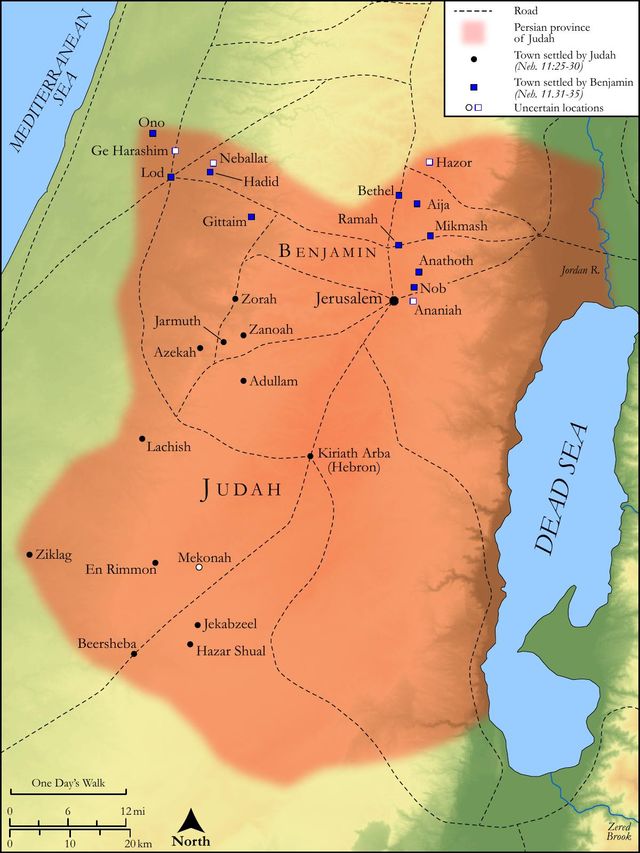
Having given an account of the principal persons that dwelt in Jerusalem (a larger account of whom he had before, Ch1 9:2, etc.), Nehemiah, in these verses, gives us some account of the other cities, in which dwelt the residue of Israel, Neh 11:20. It was requisite that Jerusalem should be replenished, yet not so as to drain the country. The king himself is served of the field, which will do little service if there be not hands to manage it. Let there therefore be no strife, no envy, no contempt, no ill will, between the inhabitants of the cities and those of the villages; both are needful, both useful, and neither can be spared. 1. The Nethinims, the posterity of the Gibeonites, dwelt in Ophel, which was upon the wall of Jerusalem (Neh 3:26), because they were to do the servile work of the temple, which therefore they must be posted near to, that they might be ready to attend, Neh 11:21. 2. Though the Levites were dispersed through the cities of Judah, yet they had an overseer who resided in Jerusalem, superior of their order and their provincial, to whom they applied for direction, who took care of their affairs and took cognizance of their conduct, whether they did their duty, Neh 11:22. 3. Some of the singers were appointed to look after the necessary repairs of the temple, being ingenious men, and having leisure between their hours of service; they were over the business of the house of God, Neh 11:22. And, it seems, the king of Persia had such a kindness for their office that he allotted a particular maintenance for them, besides what belonged to them as Levites, Neh 11:23. 4. Here is one that was the king's commissioner at Jerusalem. He was of the posterity of Zerah (Neh 11:24); for of that family of Judah there were some new settled in Jerusalem, and not all of Pharez, as appears by that other catalogue, Ch1 9:6. He is said to be at the king's hand, or on the king's part, in all matters concerning the people, to determine controversies that arose between the king's officers and his subjects, to see that what was due to the king from the people was duly paid in and what was allowed by the king for the temple service was duly paid out, and happy it was for the Jews that one of themselves was in this post. 5. Here is an account of the villages, or country towns, which were inhabited by the residue of Israel - the towns in which the children of Judah dwelt (Neh 11:25-30), those that were inhabited by the children of Benjamin (Neh 11:31-35), and divisions for the Levites among both, Neh 11:36. We will now suppose them safe and easy, though few and poor, but by the blessing of God they were likely to increase in wealth and power, and they would have been more likely if there had not been that general profaneness among them, and lukewarmness in religion, with which they were charged in God's name by the prophet Malachi, who, it is supposed, prophesied about this time, and in whom prophecy ceased for some ages, till it revived in the great prophet and his forerunner.
Continue studying Nehemiah 11:22 across the web’s major study libraries — every link below opens this exact verse, chapter, or book on the destination site.
Read & Compare
 BibleGatewayThis verse in more than 200 translations and 70 languages.
 Bible.comThe YouVersion reader — hundreds of translations, reading plans, and highlights.
 ESV.orgCrossway's official English Standard Version reader.
 NET BibleThe NET translation with 60,000+ translators' notes on every rendering decision.
 STEP BibleTyndale House's free study tool — original text, vocabulary, and scholarly resources.
 BibliaLogos Bible Software's free web reader.
 USCCBThe New American Bible (Revised Edition) with the U.S. bishops' study notes.
Commentaries
 BibleHub CommentariesDozens of classic commentaries on this verse, gathered on one page.
 StudyLightMore than 100 commentary sets — the largest collection on the web.
 BibleRefPlain-English commentary on what this verse means, verse by verse.
 Enduring WordDavid Guzik's free commentary on this chapter, widely used by Bible teachers.
 Bible Study ToolsVerse commentary alongside Greek and Hebrew study aids.
Original Language & Research
- BibleHub InterlinearThe verse word by word — original language, transliteration, and English.
- BibleHub LexiconEvery word's original-language definition and Strong's entry.
 Blue Letter BibleDeep-study tools — Strong's numbers, concordance, and word studies.
 SefariaThe Hebrew text with Rashi and centuries of Jewish commentary.
Sermons, Hymns & Audio


TrulyRandomVerse is not affiliated with these sites and doesn’t control their content. They’re linked because they’re genuinely useful.
Summary
Nehemiah 11:22 meticulously details the administrative structure of the Levites in post-exilic Jerusalem, specifically identifying Uzzi as a key overseer. This verse critically highlights the continued and expanded role of the "sons of Asaph," the esteemed guild of temple singers, who were entrusted not merely with their primary musical worship duties but with the comprehensive "business of the house of God," thereby underscoring the meticulous re-establishment of sacred order, dedicated service, and the holistic nature of worship in the restored community.
Context
ShowHideLiterary Context
Nehemiah 11 marks a pivotal transition in the post-exilic restoration narrative, shifting focus from the physical rebuilding of Jerusalem's walls (Nehemiah 6-7) and the spiritual revival under Ezra's teaching (Nehemiah 8-10) to the crucial task of repopulating the holy city. The chapter begins by describing the process of selecting residents for Jerusalem, emphasizing the communal commitment to establishing a vibrant center for worship and civic life (Nehemiah 11:1-2). The subsequent verses, including Nehemiah 11:22, provide extensive registers of the families—from Judah, Benjamin, priests, and Levites—who settled in Jerusalem and the surrounding villages. This detailed census serves to document the re-establishment of a structured society and, particularly, to identify key personnel responsible for the proper functioning of the temple and its sacred services, demonstrating the meticulous organization essential for the community's spiritual and civic reconstitution.
Historical & Cultural Context
The return of the Jewish exiles from Babylon under the benevolent decree of the Persian Empire was an immense undertaking, encompassing not only physical reconstruction but also the profound spiritual and social reconstitution of a shattered nation. Central to this restoration was the re-establishment of the temple and its intricate services, which were paramount for maintaining Jewish identity and their covenant relationship with God. The Levites, divinely appointed as temple servants, were indispensable to this process. Their diverse roles included maintaining the temple precincts, assisting the priests, guarding the sacred areas, and, significantly, leading the community in worship through music. The "sons of Asaph" were not merely a group of musicians but a distinguished guild of temple singers with a venerable history, tracing their lineage and function back to King David's original organization of temple worship. The meticulous genealogical and administrative registers found in Nehemiah reflect Israel's careful practice of precise record-keeping, particularly vital for administrative, religious, and political accountability, ensuring the proper functioning and legitimacy of public institutions.
Key Themes
ShowHideNehemiah 11:22 powerfully contributes to several overarching themes evident throughout the book of Nehemiah and the broader post-exilic historical books. Firstly, it highlights the theme of Order and Administration, showcasing the deliberate and systematic effort to establish clear lines of authority and responsibility within the newly restored community and the temple service. The precise naming of individuals and their lineages underscores a commitment to structured governance in the "house of God," reflecting a divine principle of order and decency in all things, as echoed in later biblical teaching (e.g., 1 Corinthians 14:40). Secondly, the verse emphasizes the Centrality of Temple Worship, demonstrating that the "business of the house of God" was not a peripheral activity but foundational to the spiritual life and identity of the returning exiles. The prominent and expanded role of the singers, specifically the sons of Asaph, underscores the integral nature of music and worship as essential spiritual disciplines. Finally, the verse speaks to the Continuity of Ministry and Covenant, as the Asaphite lineage extends back to the pre-exilic era, specifically to King David's time (1 Chronicles 25:1). Their continued and elevated role after the exile signifies God's enduring faithfulness to His covenant promises and the preservation of established spiritual practices, even after generations of disruption and displacement.
Exposition and Analysis
ShowHideKey Word Analysis
ShowHideThis term (H6496) denotes a superintendent, governor, or one who has been put in charge. It implies a position of significant authority and responsibility, indicating that Uzzi was not merely a Levite but held a crucial administrative role among them, tasked with ensuring proper order and function within the temple system. The word suggests a delegated authority to oversee and manage.
The term "sons" (H1121, bên) refers to descendants or members of a particular group, while "Asaph" (H623, ʼÂçâph) designates the prominent Levite musician appointed by King David. Together, "sons of Asaph" refers to the hereditary guild or lineage of temple singers and musicians who continued Asaph's legacy. Their mention here signifies the re-establishment of organized temple music and, more broadly, their integral and continued role in the temple's operations and worship.
This crucial phrase combines "business" (H4399, mᵉlâʼkâh), meaning work, ministry, employment, or management; "house" (H1004, bayith), referring to the temple building and its associated structures; and "God" (H430, ʼĕlôhîym), referring to the Supreme God. The combined phrase signifies all the practical affairs, administration, and comprehensive management necessary for the temple's operations—from financial oversight and maintenance to the coordination of rituals and personnel. This indicates that the Asaphite singers were entrusted with far more than just leading songs; they were deeply involved in the holistic logistical and administrative oversight of the entire temple complex.
Verse Breakdown
ShowHide"The overseer also of the Levites at Jerusalem [was] Uzzi the son of Bani, the son of Hashabiah, the son of Mattaniah, the son of Micha."
This initial clause precisely identifies Uzzi by name and a detailed lineage, establishing his administrative authority and legitimate position among the Levites who resided in Jerusalem. The inclusion of a multi-generational genealogy underscores the importance of proper lineage and established order within the post-exilic community, ensuring accountability, legitimate authority, and continuity in sacred roles. It highlights the meticulous record-keeping crucial for the re-establishment of the community.
"Of the sons of Asaph, the singers [were] over the business of the house of God."
This second clause reveals a specific and highly significant responsibility entrusted to the Asaphite singers. Beyond their well-known primary role as musicians and worship leaders, they were given comprehensive administrative and managerial oversight of the temple's affairs. This demonstrates the multifaceted nature of temple service and the high level of trust placed in this particular guild, signifying their critical role in ensuring the smooth, proper, and holy functioning of Israel's central place of worship.
Literary Devices
ShowHideNehemiah 11:22 effectively employs several literary devices to convey its message and reinforce its significance. The most prominent is Register or Genealogy, as the verse is an integral part of a longer, meticulous list of individuals and their lineages. This detailed cataloging serves to establish legitimacy, accountability, and the structured re-establishment of the community after the exile, emphasizing divine order. The mention of "the sons of Asaph" functions as a form of Synecdoche, where a specific part (the renowned guild of temple singers) represents a larger, more comprehensive whole (the organized musical, administrative, and spiritual component of temple service). Furthermore, the repeated emphasis on the "house of God" throughout Nehemiah, and implicitly in this verse's reference to its "business," serves as a powerful Thematic Reinforcement, underscoring the temple's centrality as the focal point of Israel's restored identity, worship, and national life.
Theological and Thematic Connections
ShowHideNehemiah 11:22 offers profound theological insights into God's desire for order, dedicated service, and the centrality of worship within His covenant community. It illustrates that spiritual vitality and effective ministry are often accompanied by meticulous organization and the faithful execution of diverse roles. The fact that singers were also entrusted with significant administrative responsibilities underscores a holistic view of service: all aspects of temple life, from the aesthetically beautiful and spiritually uplifting to the practically mundane and administratively demanding, were considered sacred and essential for God's glory. This integrated approach to service reflects a divine principle that every gift and calling within the body of believers contributes uniquely and indispensably to the overall health, effectiveness, and flourishing of God's work.
Reflection and Application
ShowHideNehemiah 11:22 serves as a powerful reminder that God values both the grand, visible acts of faith and the diligent, often unseen, work of administration and organization. The monumental task of re-establishing Jerusalem and its temple after the exile was not left to chance or mere enthusiasm; it required dedicated individuals like Uzzi and the sons of Asaph to faithfully steward their specific and diverse responsibilities. For believers today, this verse calls us to thoughtfully consider our own roles within the "house of God," which is now the church, the living body of Christ. Whether our gifts are public and visible, such as leading worship or teaching, or more behind-the-scenes, like administration, finance, hospitality, or prayer, every contribution is vital for the effective functioning, spiritual health, and missional impact of the community. It challenges us to embrace our callings with the same commitment, diligence, and sense of sacred purpose as these post-exilic Levites, recognizing that our service, in whatever capacity, contributes directly to the ongoing work of God's kingdom and the flourishing of His people.
Questions for Reflection
ShowHideFAQ
ShowHideWhy is a detailed list of names and lineages important in a biblical text like Nehemiah 11:22?
ShowHideDetailed lists of names and lineages, often referred to as genealogies or registers, serve several crucial purposes in biblical texts, particularly in post-exilic books like Nehemiah. Firstly, they establish legitimacy and continuity, especially for those serving in sacred roles like the Levites and priests, ensuring they belong to the proper lineage designated for temple service according to Mosaic law. This was vital for maintaining the purity and authenticity of worship. Secondly, these lists provide historical and administrative accountability, meticulously documenting who was responsible for what roles and where they resided in the re-established community. This helped in organizing the population, allocating resources, and ensuring the proper functioning of civic and religious life. Thirdly, these registers emphasize the divine faithfulness in preserving a remnant of His people and fulfilling His covenant promises, even after generations of exile and disruption. They demonstrate that God's redemptive plan unfolds through specific individuals and families, highlighting the meticulous care with which He orchestrates His purposes. Such details underscore the importance of every individual's role in God's larger narrative, demonstrating that the restoration was not haphazard but divinely ordered and meticulously executed, reflecting God's character as a God of order (e.g., 1 Corinthians 14:33).
Christ-Centered Fulfillment
ShowHideNehemiah 11:22, with its focus on the meticulous organization of temple service and the dedicated roles of Levites and singers, finds its ultimate fulfillment in the person and work of Jesus Christ and the establishment of His church. While the physical temple and its Levitical system were divinely ordained shadows pointing to a greater reality, Christ is that glorious reality. Jesus is the ultimate "overseer" and the head of the new "house of God," which is no longer a physical building but the spiritual temple comprised of believers (Ephesians 2:19-22). He perfectly administers His kingdom, ensuring that all things are done decently and in order for the glory of God. Furthermore, in Christ, the rigid distinctions between "singers" and "administrators" found in the Old Covenant blur, as all believers are now part of a "royal priesthood" (1 Peter 2:9), called to offer spiritual sacrifices of praise and service. Every member of the church is empowered by the Holy Spirit to contribute their unique gifts to the "business" of God's kingdom—which is the spreading of the Gospel to all nations (Matthew 28:19-20) and the building up of the body of Christ (Ephesians 4:12-16). Our worship in the New Covenant is no longer tied to a physical structure or specific lineage but is offered "in spirit and truth" by all who believe (John 4:23-24). Thus, the dedicated service and ordered worship of Nehemiah's time foreshadow the unified, Spirit-empowered ministry of the church under Christ's headship.