


Mark 11:17
Bible text: King James Version (1769 Blayney text) · Public domain
Bible text: King James Version with Strong's numbers · Public domain
Bible text: Berean Standard Bible · Public domain
Bible text: American Standard Version (1901) · Public domain
Bible text: World English Bible, Messianic edition · Public domain
Bible text: Geneva Bible (1599) · Public domain
Bible text: Young's Literal Translation · Public domain
- καὶkaiAndG2532CONJConjunction
- ἐδίδασκενedidaskenHe was teachingG1321V-IAI-3SVerb Imperfect Active Indicative 3rd Singular
- ἔλεγενelegenwas sayingG3004V-IAI-3SVerb Imperfect Active Indicative 3rd Singular
- αὐτοῖς·autoisto themG846P-DPMPersonal pronoun Dative Plural Masculine
- οὐouSurelyG3756PRT-NNegative Particle Negative
- γέγραπταιgegraptaiit has been writtenG1125V-RPI-3SVerb Perfect Passive Indicative 3rd Singular
- ὅτιhotithatG3754CONJConjunction
- ὁhoTheG3588T-NSMDefinite article Nominative Singular Masculine
- οἶκόςoikoshouseG3624N-NSMNoun Nominative Singular Masculine
- μουmouof MineG3165P-1GSPersonal pronoun Genitive 1st Singular
- οἶκοςoikosa houseG3624N-NSMNoun Nominative Singular Masculine
- προσευχῆςproseuchēsof prayerG4335N-GSFNoun Genitive Singular Feminine
- κληθήσεταιklēthēsetaiwill be calledG2564V-FPI-3SVerb Future Passive Indicative 3rd Singular
- πᾶσινpasinfor allG3956A-DPNAdjective Dative Plural Neuter
- τοῖςtoistheG3588T-DPNDefinite article Dative Plural Neuter
- ἔθνεσιν;ethnesinnations’?G1484N-DPNNoun Dative Plural Neuter
- ὑμεῖςhumeisYou yourselvesG4771P-2NPPersonal pronoun Nominative 2nd Plural
- δὲdehoweverG1161CONJConjunction
- πεποιήκατεpepoiēkatehave madeG4160V-RAI-2PVerb Perfect Active Indicative 2nd Plural
- αὐτὸνautonitG846P-ASMPersonal pronoun Accusative Singular Masculine
- σπήλαιονspēlaiona denG4693N-ASNNoun Accusative Singular Neuter
- λῃστῶνlēstōnof robbers.’G3027N-GPMNoun Genitive Plural Masculine
English is a literal word-by-word gloss of the Greek, not the KJV's wording. Why?
This is the original text the KJV's translators worked from — each Greek word with its own literal English meaning in this verse, prepared by scholars at Tyndale House, Cambridge. The KJV translates whole sentences, not word by word, so its wording differs: one Greek word can become several English words, and the KJV may choose “charity” where the gloss reads “love”. Both are faithful — they answer different questions. For the KJV's own rendering, switch to the KJV text.
Details
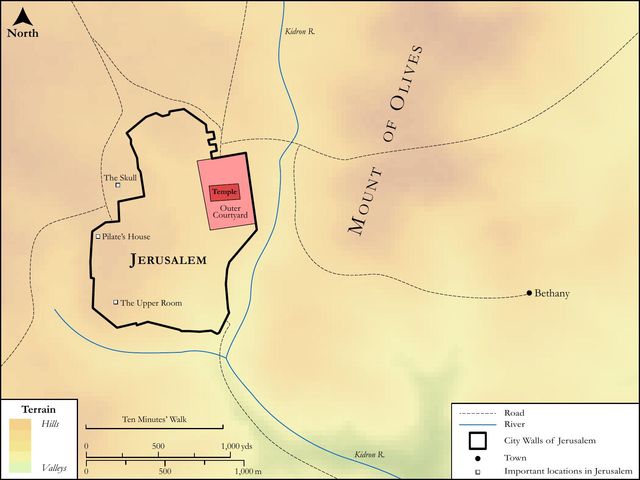
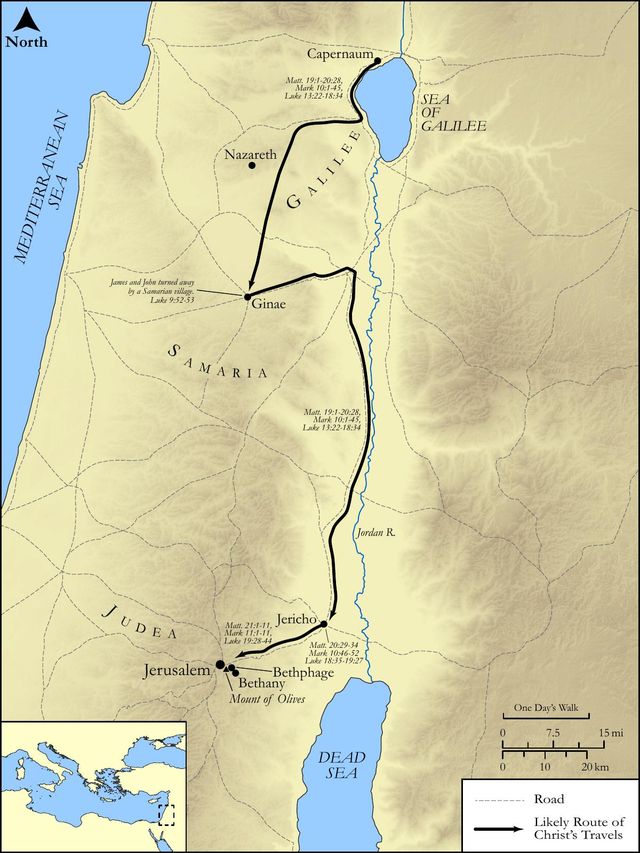
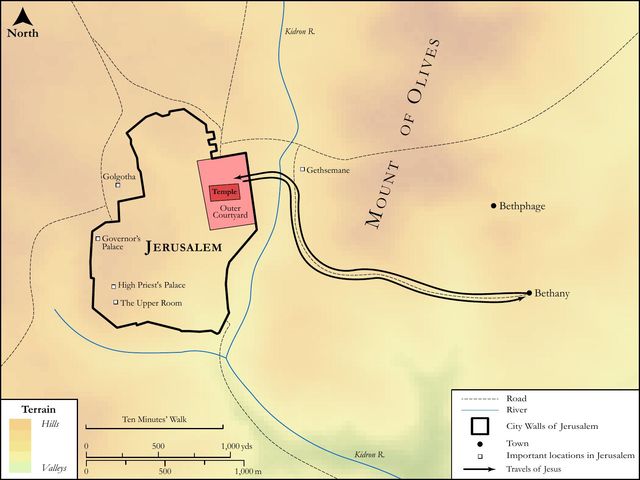
See on the biblical-era maps
Study this verse
Public-domain commentary
Matthew Henry
From his Commentary on the Whole Bible. Henry comments on passages, not single verses — this entry covers Mark 11:12–26. His four-level outline is real structure in the source text, so it is rendered as structure.
Here is, I. Christ's cursing the fruitless fig-tree. He had a convenient resting-place at Bethany, and therefore thither he went at resting-time; but his work lay at Jerusalem, and thither therefore he returned in the morning, at working-time; and so intent was he upon his work, that he went out from Bethany without breakfast, which, before he was gone far, he found the want of, and was hungry (Mar 11:12), for he was subject to all the sinless infirmities of our nature. Finding himself in want of food, he went to a fig-tree, which he saw at some distance, and which being well adorned with green leaves he hoped to find enriched with some sort of fruit. But he found nothing but leaves; he hoped to find some fruit, for though the time of gathering in figs was near, it was not yet; so that it could not be pretended that it had had fruit, but that it was gathered and gone; for the season had not yet arrived. Or, He found none, for indeed it was not a season of figs, it was no good fig-year. But this was worse than any fig-tree, for there was not so much as one fig to be found upon it, though it was so full of leaves. However, Christ was willing to make an example of it, not to the trees, but to the men, of that generation, and therefore cursed it with that curse which is the reverse of the first blessing, Be fruitful; he said unto it, Never let any man eat fruit of thee hereafter for ever, Mar 11:14. Sweetness and good fruit are, in Jotham's parable, the honour of the fig-tree (Jdg 9:11), and its serviceableness therein to man, preferable to the preferment of being promoted over the trees; now to be deprived of that, was a grievous curse. This was intended to be a type and figure of the doom passed upon the Jewish church, to which he came, seeking fruit, but found none (Luk 13:6, Luk 13:7); and though it was not, according to the doom in the parable, immediately cut down, yet, according to this in the history, blindness and hardness befell them (Rom 11:8, Rom 11:25), so that they were from henceforth good for nothing. The disciples heard what sentence Christ passed on this tree, and took notice of it. Woes from Christ's mouth are to be observed and kept in mind, as well as blessings.
II.His clearing the temple of the market-people that frequented it, and of those that made it a thoroughfare.
We do not find that Christ met with food elsewhere, when he missed of it on the fig-tree; but the zeal of God's house so ate him up, and made him forget himself, that he came, hungry as he was, to Jerusalem, and went straight to the temple, and began to reform those abuses which the day before he had marked out; to show that when the Redeemer came to Zion, his errand was, to turn away ungodliness from Jacob (Rom 11:26), and that he came not, as he was falsely accused, to destroy the temple, but to purify and refine it, and reduce his church to its primitive rectitude.
1.He cast out the buyers and sellers, overthrew the tables of the money-changers (and threw the money to the ground, the fitter place for it), and threw down the seats of them that sold doves. This he did as one having authority, as a Son in his own house. The filth of the daughter of Zion is purged away, not by might, nor by power, but by the spirit of judgment, and the spirit of burning. And he did it without opposition; for what he did, was manifested to be right and good, even in the consciences of those that had connived at it, and countenanced it, because they got money by it. Note, It may be some encouragement to zealous reformers, that frequently the purging out of corruptions, and the correcting of abuses, prove an easier piece of work than was apprehended. Prudent attempts sometimes prove successful beyond expectation, and there are not those lions found in the way, that were feared to be.
2.He would not suffer that any man should carry any vessel, any sort of goods or wares, through the temple, or any of the courts of it, because it was the nearer way, and would save them the labour of going about, Mar 11:16. The Jews owned that it was one of the instances of honour due to the temple, not to make the mountain of the house, or the court of the Gentiles, a road, or common passage, or to come into it with any bundle.
3.He gave a good reason for this; because it was written, My house shall be called of all nations, The house of prayer, Mar 11:17. So it is written, Isa 56:7. It shall pass among all people under that character. It shall be the house of prayer to all nations; it was so in the first institution of it; when Solomon dedicated it, it was with an eye to the sons of the strangers, Kg1 8:41. And it was prophesied that it should be yet more so. Christ will have the temple, as a type of the gospel-church, to be,
(1.)A house of prayer. After he had turned out the oxen and doves, which were things for sacrifice, he revived the appointment of it as a house of prayer, to teach us that when all sacrifices and offerings should be abolished, the spiritual sacrifices of prayer and praise should continue and remain for ever.
(2.)That it should be so to all nations, and not to the people of the Jews only; for whosoever shall call upon the name of the Lord, shall be saved, though not of the seed of Jacob, according to the flesh. It was therefore insufferable for them to make it a den of thieves, which would prejudice those nations against it, whom they should have invited to it. When Christ drove out the buyers and sellers at the beginning of his ministry, he only charged them with making the temple a house of merchandise (Joh 2:16); but now he chargeth them with making it a den of thieves, because since then they had twice gone about to stone him in the temple (Joh 8:59; Joh 10:31), or because the traders there were grown notorious for cheating their customers, and imposing upon the ignorance and necessity of the country people, which is no better than downright thievery. Those that suffer vain worldly thoughts to lodge within them when they are at their devotions, turn the house of prayer into a house of merchandise; but they that make long prayers for pretence to devour widows' houses, turn it into a den of thieves.
4.The scribes and the chief priests were extremely nettled at this, Mar 11:18. They hated him, and hated to be reformed by him; and yet they feared him, lest he should next overthrow their seats, and expel them, being conscious to themselves of the profaning and abusing of their power. They found that he had a great interest, that all the people were astonished at his doctrine, and that every thing he said, was an oracle and a law to them; and what durst he not attempt, what could he not effect, being thus supported? They therefore sought, not how he might make their peace with him, but how they might destroy him. A desperate attempt, and which, one would think, they themselves could not but fear was fighting against God. But they care not what they do, to support their own power and grandeur.
III.His discourse with his disciples, upon occasion of the fig-tree's withering away which he had cursed.
At even, as usual, he went out of the city (Mar 11:19), to Bethany; but it is probable that it was in the dark, so that they could not see the fig-tree; but the next morning, as they passed by, they observed the fig-tree dried up from the roots, Mar 11:20. More is included many times in Christ's curses than is expressed, as appears by the effects of them. The curse was no more than that it should never bear fruit again, but the effect goes further, it is dried up from the roots. If it bear no fruit, it shall bear no leaves to cheat people. Now observe,
1.How the disciples were affected with it. Peter remembered Christ's words, and said, with surprise, Master, behold, the fig-tree which thou cursedst is withered away, Mar 11:21. Note, Christ's curses have wonderful effects, and make those to wither presently, that flourished like the green bay-tree. Those whom he curseth are cursed indeed. This represented the character and state of the Jewish church; which, from henceforward, was a tree dried up from the roots; no longer fit for food, but for fuel only. The first establishment of the Levitical priesthood was ratified and confirmed by the miracle of a dry rod, which in one night budded, and blossomed, and brought forth almonds (Num 17:8), a happy omen of the fruitlessness and flourishing of that priesthood. And now, by a contrary miracle, the expiration of that priesthood was signified by a flourishing tree dried up in a night; the just punishment of those priests that had abused it. And this seemed very strange to the disciples, and scarcely credible, that the Jews, who had been so long God's own, his only professing people in the world, should be thus abandoned; they could not imagine how that fig-tree should so soon wither away: but this comes of rejecting Christ, and being rejected by him.
2.The good instructions Christ gave them from it; for of those even this withered tree was fruitful.
(1.)Christ teacheth them from hence to pray in faith (Mar 11:22); Have faith in God. They admired the power of Christ's word of command; "Why," said Christ, "a lively active faith would put as great a power into your prayers, Mar 11:23, Mar 11:24. Whosoever shall say to this mountain, this mount of Olives, Be removed, and be cast into the sea; if he has but any word of God, general or particular, to build his faith upon, and if he shall not doubt in his heart, but shall believe that those things which he saith, according to the warrant he has from what God hath said, shall come to pass, he shall have whatsoever he saith." Through the strength and power of God in Christ, the greatest difficulty shall be got over, and the thing shall be effected. And therefore (Mar 11:24), "What things soever ye desire, when ye pray believe that ye shall receive them; nay, believe that ye do receive them, and he that has power to give them, saith, Ye shall have them. I say unto you, Ye shall, Mar 11:24. Verily I say unto you, Ye shall," Mar 11:23. Now this is to be applied,
[1.]To that faith of miracles which the apostles and first preachers of the gospel were endued with, which did wonders in things natural, healing the sick, raising the dead, casting out devils; these were, in effect, the removing of mountains. The apostles speak of a faith which would do that, and yet might be found where holy love was not, Co1 13:2.
[2.]It may be applied to that miracle of faith, which all true Christians are endued with, which doeth wonders in things spiritual. It justifies us (Rom 5:1), and so removes the mountains of guilt, and casts them into the depths of the sea, never to rise up in judgment against us, Mic 7:19. It purifies the heart (Act 15:9), and so removes mountains of corruption, and makes them plains before the grace of God, Zac 4:7. It is by faith that the world is conquered, Satan's fiery darts are quenched, a soul is crucified with Christ, and yet lives; by faith we set the Lord always before us, and see him that is invisible, and have him present to our minds; and this is effectual to remove mountains, for at the presence of the Lord, at the presence of the God of Jacob, the mountains were not only moved, but removed, Psa 114:4-7.
(2.)To this is added here that necessary qualification of the prevailing prayer, that we freely forgive those who have been any way injurious to us, and be in charity with all men (Mar 11:25, Mar 11:26); When ye stand praying, forgive. Note, Standing is no improper posture for prayer; it was generally used among the Jews; hence they called their prayers, their standings; when they would say how the world was kept up by prayer, they expressed it thus, Stationibus stat mundus - The world is held up by standings. But the primitive Christians generally used more humble and reverent gesture of kneeling, especially on fast days, though not on Lord's days. When we are at prayer, we must remember to pray for others, particularly for our enemies, and those that have wronged us; now we cannot pray sincerely that God would do them good, if we bear malice to them, and wish them ill. If we have injured others before we pray, we must go and be reconciled to them; Mat 5:23, Mat 5:24. But if they have injured us, we go a nearer way to work, and must immediately from our hearts forgive them. [1.] Because this is a good step towards obtaining the pardon of our own sins: Forgive, that your Father may forgive you; that is, "that he may be qualified to receive forgiveness, that he may forgive you without injury to his honour, as it would be, if he should suffer those to have such benefit by his mercy, as are so far from being conformable to the pattern of it." [2.] Because the want of this is a certain bar to the obtaining of the pardon of our sins; "If ye do not forgive those who have injured you, if he hate their persons, bear them a grudge, meditate revenge, and take all occasion to speak ill of them, neither will your Father forgive your trespasses." This ought to be remembered in prayer, because one great errand we have to the throne of grace, is, to pray for the pardon of our sins: and care about it ought to be our daily care, because prayer is a part of our daily work. Our Saviour often insists on this, for it was his great design to engage his disciples to love one another.
Historical interpretation
Eleven Centuries of Reception
9 surviving comments on this verse. Each one is dated, so this reads as a timeline rather than a list.
Select a marker to jump to its quote. Markers stagger vertically where authors wrote within a few decades of each other.
According to Isaiah: But ye have made it a den of thieves, (Jer. 7:11) according to Jeremiah.
She has none to whom to make such a promise; and if she have had, she does not make it; since even the earthly temple of God can sooner have been called by the Lord a "den of robbers," than of adulterers and fornicators.
So, then, brethren, if we do the will of our Father God, we shall be members of the first church, the spiritual, — that which was created before sun and moon; but if we shall not do the will of the Lord, we shall come under the Scripture which says, "My house became a den of robbers." [Jeremiah 7:11]
(de Con. Evan. lib. ii. 67) John, however, relates this in a very different order, wherefore it is manifest that not once only, but twice, this was done by the Lord, and that the first time was related by John, this last, by all the other three.
(de Con. Evan. lib. ii. 68) In this again Mark does not keep the same order as Matthew; because however Matthew connects the facts together by this sentence, And he left them, and went out of the city into Bethany, (Matt. 21:17) returning from whence in the morning, according to his relation, Christ cursed the tree, therefore it is supposed with greater probability that he rather has kept to the order of time, as to the ejection from the temple of the buyers and sellers. Mark therefore passed over what was done the first day when He entered into the temple, and on remembering it inserted it, when he had said that He found nothing on the fig tree but leaves, which was done on the second day, as both testify.
About this temple it is soon added: "My house is a house of prayer, but you have made it a den of thieves." For those who sat in the temple to receive gifts, it was certainly not doubtful that they would seek to harm those who gave nothing. Therefore the house of prayer had been made a den of thieves, because they knew how to stand in the temple for this purpose: either to eagerly pursue bodily those not giving gifts, or to kill spiritually those who did give.
To them it is rightly said: "My house is a house of prayer, but you have made it a den of thieves," because when perverse men sometimes hold a place of religion, there they slay with the swords of their malice where they ought to have given life to their neighbors through the intercession of their prayer.
The temple and house of God is also the very mind and conscience of the faithful. If at any time it brings forth perverse thoughts in injury to a neighbor, it is as though robbers are dwelling in a cave and killing those who walk by in simplicity, when they thrust swords of injury into those who are guilty of nothing. For the mind of the faithful is no longer a house of prayer but a den of thieves when, having abandoned the innocence and simplicity of holiness, it strives to do that by which it might harm its neighbors.
(ubi sup.) What the Lord had done in figure, when He cursed the barren fig tree, He now shows more openly, by casting out the wicked from the temple. For the fig tree was not in fault, in not having fruit before its time, but the priests were blameable; wherefore it is said, And they come to Jerusalem; and Jesus went into the temple, and began to cast out them that sold and bought in the temple. Nevertheless, it is probable that He found them buying and selling in the temple things which were necessary for its ministry. If then the Lord forbids men to carry on in the temple worldly matters, which they might freely do any where else, how much more do they deserve a greater portion of the anger of Heaven, who carry on in the temple consecrated to Him those things, which are unlawful wherever they may be done. It goes on: and overthrew the tables of the moneychangers.
(ubi sup.) Because the Holy Spirit appeared over the Lord in the shape of a dove, the gifts of the Holy Spirit are fitly pointed out under the name of doves. The Dove therefore is sold, when the laying on of hands by which the Holy Spirit is received is sold for a price. Again, He overturns the seats of them who sell doves, because they who sell spiritual grace, are deprived of their priesthood, either before men, or in the eyes of God.
(ubi sup.) He speaks of those vessels which were carried there for the purpose of merchandise. But God forbid that it should be taken to mean, that the Lord cast out of the temple, or forbade men to bring into it, the vessels consecrated to God; for here He shows a type of the judgment to come, for He thrusts away the wicked from the Church, and restrains them by His everlasting word from ever again coming in to trouble the Church. Furthermore, sorrow, sent into the heart from above, takes away from the souls of the faithful those sins which were in them, and Divine grace assists them so that they should never again commit them. It goes on: And he taught, saying unto them, My house shall be called of all nations the house of prayer. (Isa. 56:7)
(ubi sup.) He says, to all nations, not to the Jewish nation alone, nor in the city of Jerusalem alone, but over the whole world; and he does not say a house of bulls, goats, and rams, but of prayer.
(ubi sup.) For they were in the temple for this purpose, either that they might persecute with corporal pains those who did not bring gifts, or spiritually kill those who did. The mind and conscience of the faithful is also the temple and the house of God, but if it puts forth perverse thoughts, to the hurt of any one, it may be said that thieves haunt it as a den; therefore the mind of the faithful becomes the den of a thief, when leaving the simplicity of holiness, it plans that which may hurt others.
But you have made it a den of robbers. Those who sat in the temple to receive gifts, certainly it was no doubt that they would seek harms from some who did not give. Therefore, the house of prayer had become a den of robbers, because they had learned to stand in the temple for this purpose, to either pursue those not giving gifts physically or to kill those giving spiritually. The temple and the house of God are also the mind and conscience of the faithful, which, if ever it produces perverse thoughts in the injury of a neighbor, resides as it were in a den of robbers. And they simply kill those walking uprightly, when they thrust swords into those who are guilty of no offense. For the mind of the faithful is no longer a house of prayer, but a den of robbers, when, having abandoned the innocence and simplicity of holiness, it strives to do that by which it may harm its neighbors.
He calls moneychangers, changers of a particular sort of money, for the word means a small brass coin. There follows, and the seats of them that sold doves.
But if a man by sinning gives up to the devil the grace and purity of baptism, he has sold his Dove, and for this reason is cast out of the temple. There follows, And would not suffer that any man should carry any vessel through the temple.
Further, He calls the temple, a den of thieves, on account of the money gained there; for thieves always troop together for gain. Since then they sold those animals which were offered in sacrifice for the sake of gain, He called them thieves.
Which also turns to the greater condemnation of the Jews, because though the Lord did this so many times, nevertheless they did not correct their conduct.
(non occ.) But the Evangelist shows what effect the correction of the Lord had on the ministers of the temple, when he adds: And the Scribes and Chief Priests heard it, and sought how they might destroy him; according to that saying of Amos: They hate him that rebuketh in the gate, and they abhor him that speaketh uprightly. (Amos 5:10) From this wicked design, however, they were kept back for a time solely by fear. Wherefore it is added, For they feared him, because all the people were astonished at his doctrine. For he taught them as one having authority, and not as the Scribes and Pharisees, as is said elsewhere.
Continue studying Mark 11:17 across the web’s major study libraries — every link below opens this exact verse, chapter, or book on the destination site.
Read & Compare
 BibleGatewayThis verse in more than 200 translations and 70 languages.
 Bible.comThe YouVersion reader — hundreds of translations, reading plans, and highlights.
 ESV.orgCrossway's official English Standard Version reader.
 NET BibleThe NET translation with 60,000+ translators' notes on every rendering decision.
 STEP BibleTyndale House's free study tool — original text, vocabulary, and scholarly resources.
 BibliaLogos Bible Software's free web reader.
 USCCBThe New American Bible (Revised Edition) with the U.S. bishops' study notes.
Commentaries
 BibleHub CommentariesDozens of classic commentaries on this verse, gathered on one page.
 StudyLightMore than 100 commentary sets — the largest collection on the web.
 BibleRefPlain-English commentary on what this verse means, verse by verse.
 Enduring WordDavid Guzik's free commentary on this chapter, widely used by Bible teachers.
 Bible Study ToolsVerse commentary alongside Greek and Hebrew study aids.
Original Language & Research
- BibleHub InterlinearThe verse word by word — original language, transliteration, and English.
- BibleHub LexiconEvery word's original-language definition and Strong's entry.
 Blue Letter BibleDeep-study tools — Strong's numbers, concordance, and word studies.
 CNTR CollationThe earliest Greek manuscripts of this verse, collated letter by letter.
Sermons, Hymns & Audio


TrulyRandomVerse is not affiliated with these sites and doesn’t control their content. They’re linked because they’re genuinely useful.
Summary
Mark 11:17 captures Jesus' forceful denunciation of the commercialization and corruption within the Jerusalem Temple, a pivotal moment demonstrating His divine authority and zeal for the sanctity of God's house. By quoting Old Testament prophecies, Jesus reasserts the Temple's intended purpose as a universal house of prayer for all nations, contrasting it sharply with the exploitative practices that had transformed it into a "den of thieves." This act serves as a powerful prophetic sign, challenging the religious establishment and foreshadowing the radical redefinition of worship under the New Covenant.
Context
ShowHideLiterary Context
This verse is situated immediately after Jesus' Triumphal Entry into Jerusalem, an event that publicly declared His messianic claims (Mark 11:1-11). Following this, Jesus inspects the Temple but does not act on the first day (Mark 11:11). The next day, after cursing a fig tree as a symbolic act of judgment against unfruitful Israel (Mark 11:12-14), Jesus returns to the Temple. It is then that He actively cleanses it, overturning tables and driving out merchants and money changers (Mark 11:15-16). Mark 11:17 provides Jesus' theological justification for His dramatic actions, framing them within the prophetic tradition and divine intention for the Temple. The subsequent narrative details the astonishment and opposition from the chief priests and scribes (Mark 11:18), highlighting the direct challenge Jesus posed to their authority and practices.
Historical & Cultural Context
The Second Temple, rebuilt after the Babylonian exile and significantly expanded by Herod the Great, was the center of Jewish religious life. Pilgrims from all over the Roman world would come to Jerusalem, especially for Passover. For sacrifices, they needed unblemished animals, and for the Temple tax, they needed specific Tyrian coinage, which was considered pure. This led to a bustling marketplace within the Temple courts, particularly in the Court of the Gentiles, where merchants sold animals and money changers converted foreign currency. While these services were necessary, they had become rife with exploitation. Priests often colluded with vendors, charging exorbitant prices for animals and unfair exchange rates, turning a profit at the expense of sincere worshippers. This commercial activity, especially in the only area accessible to Gentiles, obstructed their access to prayer and worship, violating the inclusive spirit of the Temple's purpose.
Key Themes
ShowHideMark 11:17 powerfully contributes to several key themes in Mark's Gospel. Firstly, it underscores Jesus' divine authority and zeal for God's holiness, as He takes direct action to purify His Father's house, acting as more than just a prophet but as one with inherent power over the sacred space. Secondly, it highlights the theme of true worship versus corrupted ritual, contrasting genuine devotion with external performance and financial exploitation. The Temple, meant to facilitate communion with God, had become a barrier. Thirdly, the verse emphasizes God's universal plan of salvation, as Jesus quotes Isaiah to stress that the Temple was intended to be a "house of prayer for all nations," not just for Jews. This foreshadows the breaking down of barriers between Jew and Gentile in the new covenant, a theme prominent in the early church's mission. Finally, Jesus' condemnation of the Temple's corruption as a "den of thieves" echoes Old Testament prophetic critiques of religious hypocrisy and injustice, aligning Jesus with the long line of prophets who called Israel to repentance, particularly seen in Jeremiah 7.
Exposition and Analysis
ShowHideKey Word Analysis
ShowHideThis verb signifies instruction, to teach in a broad application. Jesus' actions in the Temple were not merely a display of anger but a didactic act, a powerful lesson delivered through both word and deed. He was teaching them, through this dramatic demonstration, the true nature and purpose of God's house and the corruption that had defiled it.
This word refers to a race, a tribe, or specifically, a foreign, non-Jewish people, often implying pagan nations. By quoting Isaiah 56:7, Jesus emphasizes God's original intention for the Temple to be a place of prayer and worship accessible to all peoples, not exclusively for the Jewish community. The commercial activity in the Court of the Gentiles directly hindered this universal access.
This term denotes a brigand or robber, someone who plunders. Jesus' use of this word, drawn from Jeremiah 7:11, is a severe indictment. It implies that those engaged in the Temple commerce were not merely conducting business poorly, but were actively exploiting and defrauding worshippers, essentially robbing them under the guise of religious service, and then using the Temple as a supposed sanctuary from divine judgment for their illicit gains.
Verse Breakdown
ShowHide"And he taught, saying unto them"
This opening clause establishes Jesus' authoritative posture. His actions in the Temple are not random outbursts but deliberate, divinely inspired teachings. He is actively instructing the people and the religious leaders about the true nature of worship and the sanctity of God's house, using both His physical actions and His spoken words as a powerful lesson.
"Is it not written, My house shall be called of all nations the house of prayer?"
Jesus appeals to the authority of Scripture, specifically quoting Isaiah 56:7. This rhetorical question implies that the answer should be obvious to those familiar with the Law and Prophets. The Temple's fundamental purpose, as ordained by God, was to be a place of prayer, open and accessible to all peoples, including Gentiles, fostering a universal communion with God. The commercial activities, especially in the Court of the Gentiles, directly violated this divine intention.
"but ye have made it a den of thieves."
This is Jesus' scathing indictment, drawn from Jeremiah 7:11. The conjunction "but" (Greek, dé') highlights the stark contrast between God's intention and their perversion. A "den of thieves" implies a place where robbers gather after committing their crimes, believing themselves safe from justice. Jesus accuses the Temple authorities and merchants of turning God's sacred space into a hideout for their dishonest and exploitative practices, suggesting they believed their religious rituals would somehow protect them from the consequences of their unrighteousness.
Literary Devices
ShowHideMark 11:17 is rich in literary devices that amplify Jesus' message. The most prominent is Allusion and Quotation, as Jesus directly quotes two significant Old Testament passages: Isaiah 56:7 and Jeremiah 7:11. These allusions serve to ground Jesus' actions in prophetic tradition, demonstrating that His zeal is not arbitrary but rooted in God's long-standing covenantal expectations. The use of Contrast is also central, juxtaposing God's intended purpose for the Temple ("house of prayer for all nations") with the corrupt reality ("den of thieves"). This stark opposition highlights the severity of the desecration. Furthermore, the phrase "den of thieves" functions as a powerful Metaphor, portraying the Temple not as a place of refuge for the righteous, but as a sanctuary for the unrighteous, where exploitation and greed are harbored under the cloak of piety. This metaphor carries a strong sense of Irony, as the very place meant for holiness and justice had become a haven for injustice.
Theological and Thematic Connections
ShowHideMark 11:17 stands as a powerful theological statement about the nature of true worship, the sanctity of sacred space, and God's universal redemptive plan. Jesus' actions and words reveal that God prioritizes genuine devotion, justice, and accessibility over mere ritualistic performance or commercial gain. The Temple, intended to be a beacon for all humanity to seek God through prayer, had become a barrier, symbolizing the spiritual blindness and corruption of the religious leadership. This event underscores that God's house is not a place for personal enrichment or exploitation, but a sanctuary where all people, regardless of their background, can draw near to Him in sincere prayer and worship. It foreshadows the coming new covenant where access to God is not confined to a physical structure but is open to all who believe.
Reflection and Application
ShowHideJesus' cleansing of the Temple in Mark 11:17 serves as a perpetual challenge to believers and religious institutions across all generations. It compels us to rigorously examine our own hearts and the practices within our faith communities, ensuring that our worship remains pure, our motives are righteous, and our spaces are truly welcoming and conducive to genuine prayer for all people. This passage reminds us that God is deeply concerned with justice and integrity, especially within the confines of what is called "His house." We are called to reject any form of exploitation, greed, or self-serving activity that might hinder others from encountering God or distort the true purpose of worship. Our spiritual "temples," both individual and corporate, must be places of sincere devotion, ethical conduct, and open access to God's presence, rather than havens for compromise or self-interest.
Questions for Reflection
ShowHideFAQ
ShowHideWhy did Jesus get so angry and overturn tables in the Temple?
ShowHideJesus' actions were not a loss of temper but a deliberate, prophetic act of divine judgment and teaching. He was demonstrating His authority as the Son of God and fulfilling Old Testament prophecies concerning the purification of the Temple (e.g., Malachi 3:1-3). His anger stemmed from a righteous zeal for God's holiness and a deep concern for the integrity of worship. The commercial activities, particularly the exploitative practices of the money changers and merchants, had desecrated the sacred space, especially the Court of the Gentiles, which was meant for all nations to pray. By calling it a "den of thieves," Jesus condemned the corruption and injustice that had replaced sincere devotion, thus necessitating His dramatic intervention.
Christ-Centered Fulfillment
ShowHideMark 11:17, with Jesus' zealous cleansing of the Temple, profoundly points to His ultimate Christ-centered fulfillment. Jesus' declaration that "My house shall be called of all nations the house of prayer" is not merely a call to reform a physical structure, but a prophetic announcement of a new era of worship centered on Himself. He is the true Temple, the ultimate meeting place between God and humanity, as foreshadowed in John 2:19-21. The physical Temple, with its sacrificial system, was a temporary shadow, and its corruption underscored its impending obsolescence. By condemning the Temple's commercialization and exclusion of Gentiles, Jesus anticipates the tearing of the Temple veil at His crucifixion (Mark 15:38), signifying open access to God for all through His atoning sacrifice. In Christ, the barriers between Jew and Gentile are broken down (Ephesians 2:14), and true worship is no longer confined to a physical building in Jerusalem but occurs "in spirit and truth" through Him (John 4:21-24). Thus, Jesus' actions in Mark 11:17 are a powerful declaration that He is inaugurating the new covenant, where He Himself is the universal "house of prayer" for all nations, through whom all may draw near to God.