


Mark 11:21
Bible text: King James Version (1769 Blayney text) · Public domain
Bible text: Berean Standard Bible · Public domain
Bible text: American Standard Version (1901) · Public domain
Bible text: World English Bible, Messianic edition · Public domain
Bible text: Geneva Bible (1599) · Public domain
Bible text: Young's Literal Translation · Public domain
- καὶkaiAndG2532CONJConjunction
- ἀναμνησθεὶςanamnēstheishaving rememberedG363V-AOP-NSMVerb Aorist Passive Deponent Participle Nominative Singular Masculine
- ὁho<the>G3588T-NSMDefinite article Nominative Singular Masculine
- ΠέτροςPetrosPeterG4074N-NSM-PNoun Nominative Singular Masculine Individual
- λέγειlegeisaysG3004V-PAI-3SVerb Present Active Indicative 3rd Singular
- αὐτῷ·autōto HimG846P-DSMPersonal pronoun Dative Singular Masculine
- ῥαββίrhabbiRabbiG4461N-VSM-TNoun Vocative Singular Masculine Person Gentilic
- ἴδεidelookG2396INJInterjection
- ἡhētheG3588T-NSFDefinite article Nominative Singular Feminine
- συκῆsukēfig treeG4808N-NSFNoun Nominative Singular Feminine
- ἣνhēnthatG3739R-ASFRelative pronoun Accusative Singular Feminine
- κατηράσωkatērasōYou cursedG2672V-ADI-2SVerb Aorist Middle Deponent Indicative 2nd Singular
- ἐξήρανταιexērantaihas been dried upG3583V-RPI-3SVerb Perfect Passive Indicative 3rd Singular
English is a literal word-by-word gloss of the Greek, not the KJV's wording. Why?
This is the original text the KJV's translators worked from — each Greek word with its own literal English meaning in this verse, prepared by scholars at Tyndale House, Cambridge. The KJV translates whole sentences, not word by word, so its wording differs: one Greek word can become several English words, and the KJV may choose “charity” where the gloss reads “love”. Both are faithful — they answer different questions. For the KJV's own rendering, switch to the KJV text.
Details
See on the biblical-era maps
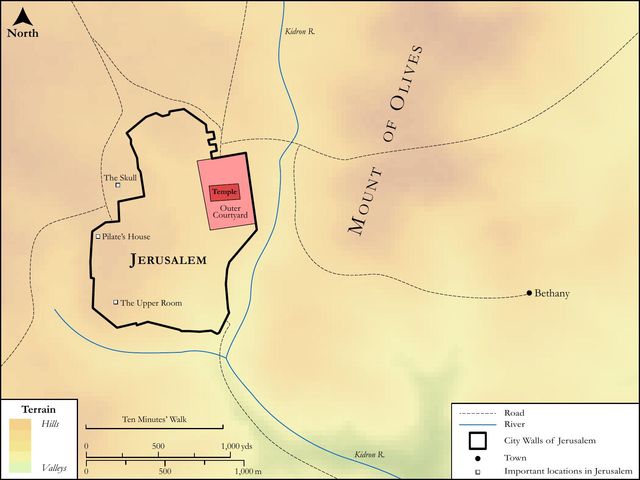
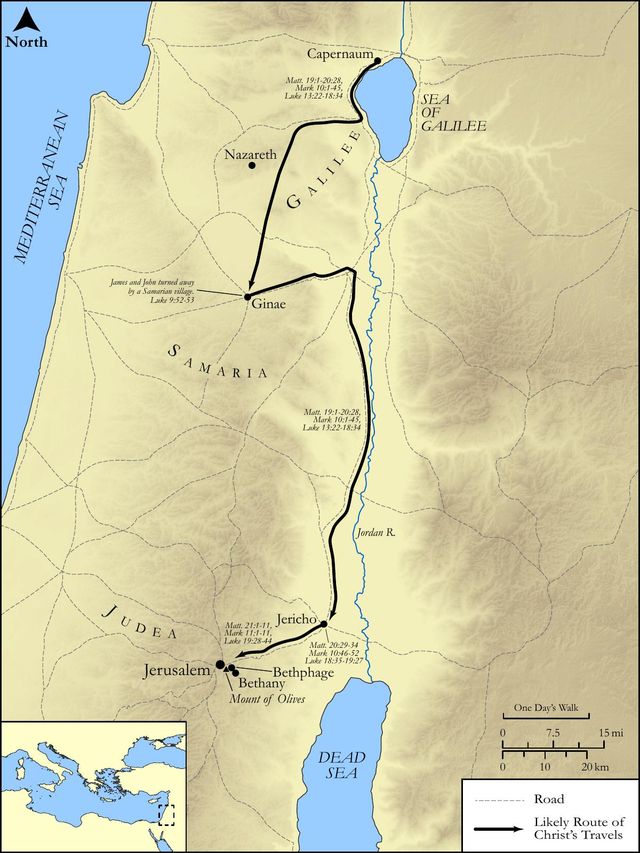
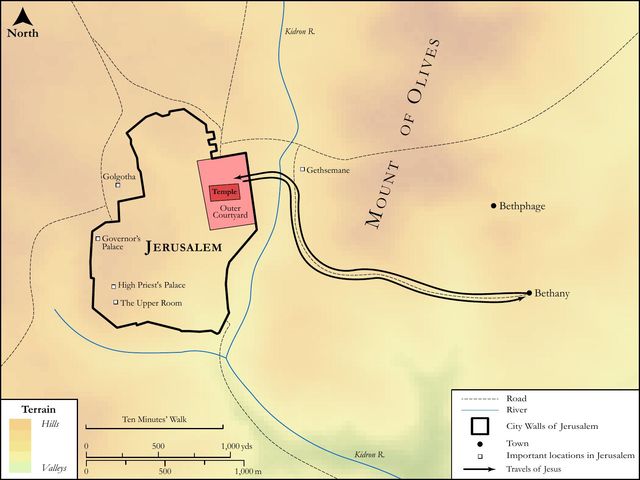
Study this verse
Public-domain commentary
Matthew Henry
From his Commentary on the Whole Bible. Henry comments on passages, not single verses — this entry covers Mark 11:12–26. His four-level outline is real structure in the source text, so it is rendered as structure.
Here is, I. Christ's cursing the fruitless fig-tree. He had a convenient resting-place at Bethany, and therefore thither he went at resting-time; but his work lay at Jerusalem, and thither therefore he returned in the morning, at working-time; and so intent was he upon his work, that he went out from Bethany without breakfast, which, before he was gone far, he found the want of, and was hungry (Mar 11:12), for he was subject to all the sinless infirmities of our nature. Finding himself in want of food, he went to a fig-tree, which he saw at some distance, and which being well adorned with green leaves he hoped to find enriched with some sort of fruit. But he found nothing but leaves; he hoped to find some fruit, for though the time of gathering in figs was near, it was not yet; so that it could not be pretended that it had had fruit, but that it was gathered and gone; for the season had not yet arrived. Or, He found none, for indeed it was not a season of figs, it was no good fig-year. But this was worse than any fig-tree, for there was not so much as one fig to be found upon it, though it was so full of leaves. However, Christ was willing to make an example of it, not to the trees, but to the men, of that generation, and therefore cursed it with that curse which is the reverse of the first blessing, Be fruitful; he said unto it, Never let any man eat fruit of thee hereafter for ever, Mar 11:14. Sweetness and good fruit are, in Jotham's parable, the honour of the fig-tree (Jdg 9:11), and its serviceableness therein to man, preferable to the preferment of being promoted over the trees; now to be deprived of that, was a grievous curse. This was intended to be a type and figure of the doom passed upon the Jewish church, to which he came, seeking fruit, but found none (Luk 13:6, Luk 13:7); and though it was not, according to the doom in the parable, immediately cut down, yet, according to this in the history, blindness and hardness befell them (Rom 11:8, Rom 11:25), so that they were from henceforth good for nothing. The disciples heard what sentence Christ passed on this tree, and took notice of it. Woes from Christ's mouth are to be observed and kept in mind, as well as blessings.
II.His clearing the temple of the market-people that frequented it, and of those that made it a thoroughfare.
We do not find that Christ met with food elsewhere, when he missed of it on the fig-tree; but the zeal of God's house so ate him up, and made him forget himself, that he came, hungry as he was, to Jerusalem, and went straight to the temple, and began to reform those abuses which the day before he had marked out; to show that when the Redeemer came to Zion, his errand was, to turn away ungodliness from Jacob (Rom 11:26), and that he came not, as he was falsely accused, to destroy the temple, but to purify and refine it, and reduce his church to its primitive rectitude.
1.He cast out the buyers and sellers, overthrew the tables of the money-changers (and threw the money to the ground, the fitter place for it), and threw down the seats of them that sold doves. This he did as one having authority, as a Son in his own house. The filth of the daughter of Zion is purged away, not by might, nor by power, but by the spirit of judgment, and the spirit of burning. And he did it without opposition; for what he did, was manifested to be right and good, even in the consciences of those that had connived at it, and countenanced it, because they got money by it. Note, It may be some encouragement to zealous reformers, that frequently the purging out of corruptions, and the correcting of abuses, prove an easier piece of work than was apprehended. Prudent attempts sometimes prove successful beyond expectation, and there are not those lions found in the way, that were feared to be.
2.He would not suffer that any man should carry any vessel, any sort of goods or wares, through the temple, or any of the courts of it, because it was the nearer way, and would save them the labour of going about, Mar 11:16. The Jews owned that it was one of the instances of honour due to the temple, not to make the mountain of the house, or the court of the Gentiles, a road, or common passage, or to come into it with any bundle.
3.He gave a good reason for this; because it was written, My house shall be called of all nations, The house of prayer, Mar 11:17. So it is written, Isa 56:7. It shall pass among all people under that character. It shall be the house of prayer to all nations; it was so in the first institution of it; when Solomon dedicated it, it was with an eye to the sons of the strangers, Kg1 8:41. And it was prophesied that it should be yet more so. Christ will have the temple, as a type of the gospel-church, to be,
(1.)A house of prayer. After he had turned out the oxen and doves, which were things for sacrifice, he revived the appointment of it as a house of prayer, to teach us that when all sacrifices and offerings should be abolished, the spiritual sacrifices of prayer and praise should continue and remain for ever.
(2.)That it should be so to all nations, and not to the people of the Jews only; for whosoever shall call upon the name of the Lord, shall be saved, though not of the seed of Jacob, according to the flesh. It was therefore insufferable for them to make it a den of thieves, which would prejudice those nations against it, whom they should have invited to it. When Christ drove out the buyers and sellers at the beginning of his ministry, he only charged them with making the temple a house of merchandise (Joh 2:16); but now he chargeth them with making it a den of thieves, because since then they had twice gone about to stone him in the temple (Joh 8:59; Joh 10:31), or because the traders there were grown notorious for cheating their customers, and imposing upon the ignorance and necessity of the country people, which is no better than downright thievery. Those that suffer vain worldly thoughts to lodge within them when they are at their devotions, turn the house of prayer into a house of merchandise; but they that make long prayers for pretence to devour widows' houses, turn it into a den of thieves.
4.The scribes and the chief priests were extremely nettled at this, Mar 11:18. They hated him, and hated to be reformed by him; and yet they feared him, lest he should next overthrow their seats, and expel them, being conscious to themselves of the profaning and abusing of their power. They found that he had a great interest, that all the people were astonished at his doctrine, and that every thing he said, was an oracle and a law to them; and what durst he not attempt, what could he not effect, being thus supported? They therefore sought, not how he might make their peace with him, but how they might destroy him. A desperate attempt, and which, one would think, they themselves could not but fear was fighting against God. But they care not what they do, to support their own power and grandeur.
III.His discourse with his disciples, upon occasion of the fig-tree's withering away which he had cursed.
At even, as usual, he went out of the city (Mar 11:19), to Bethany; but it is probable that it was in the dark, so that they could not see the fig-tree; but the next morning, as they passed by, they observed the fig-tree dried up from the roots, Mar 11:20. More is included many times in Christ's curses than is expressed, as appears by the effects of them. The curse was no more than that it should never bear fruit again, but the effect goes further, it is dried up from the roots. If it bear no fruit, it shall bear no leaves to cheat people. Now observe,
1.How the disciples were affected with it. Peter remembered Christ's words, and said, with surprise, Master, behold, the fig-tree which thou cursedst is withered away, Mar 11:21. Note, Christ's curses have wonderful effects, and make those to wither presently, that flourished like the green bay-tree. Those whom he curseth are cursed indeed. This represented the character and state of the Jewish church; which, from henceforward, was a tree dried up from the roots; no longer fit for food, but for fuel only. The first establishment of the Levitical priesthood was ratified and confirmed by the miracle of a dry rod, which in one night budded, and blossomed, and brought forth almonds (Num 17:8), a happy omen of the fruitlessness and flourishing of that priesthood. And now, by a contrary miracle, the expiration of that priesthood was signified by a flourishing tree dried up in a night; the just punishment of those priests that had abused it. And this seemed very strange to the disciples, and scarcely credible, that the Jews, who had been so long God's own, his only professing people in the world, should be thus abandoned; they could not imagine how that fig-tree should so soon wither away: but this comes of rejecting Christ, and being rejected by him.
2.The good instructions Christ gave them from it; for of those even this withered tree was fruitful.
(1.)Christ teacheth them from hence to pray in faith (Mar 11:22); Have faith in God. They admired the power of Christ's word of command; "Why," said Christ, "a lively active faith would put as great a power into your prayers, Mar 11:23, Mar 11:24. Whosoever shall say to this mountain, this mount of Olives, Be removed, and be cast into the sea; if he has but any word of God, general or particular, to build his faith upon, and if he shall not doubt in his heart, but shall believe that those things which he saith, according to the warrant he has from what God hath said, shall come to pass, he shall have whatsoever he saith." Through the strength and power of God in Christ, the greatest difficulty shall be got over, and the thing shall be effected. And therefore (Mar 11:24), "What things soever ye desire, when ye pray believe that ye shall receive them; nay, believe that ye do receive them, and he that has power to give them, saith, Ye shall have them. I say unto you, Ye shall, Mar 11:24. Verily I say unto you, Ye shall," Mar 11:23. Now this is to be applied,
[1.]To that faith of miracles which the apostles and first preachers of the gospel were endued with, which did wonders in things natural, healing the sick, raising the dead, casting out devils; these were, in effect, the removing of mountains. The apostles speak of a faith which would do that, and yet might be found where holy love was not, Co1 13:2.
[2.]It may be applied to that miracle of faith, which all true Christians are endued with, which doeth wonders in things spiritual. It justifies us (Rom 5:1), and so removes the mountains of guilt, and casts them into the depths of the sea, never to rise up in judgment against us, Mic 7:19. It purifies the heart (Act 15:9), and so removes mountains of corruption, and makes them plains before the grace of God, Zac 4:7. It is by faith that the world is conquered, Satan's fiery darts are quenched, a soul is crucified with Christ, and yet lives; by faith we set the Lord always before us, and see him that is invisible, and have him present to our minds; and this is effectual to remove mountains, for at the presence of the Lord, at the presence of the God of Jacob, the mountains were not only moved, but removed, Psa 114:4-7.
(2.)To this is added here that necessary qualification of the prevailing prayer, that we freely forgive those who have been any way injurious to us, and be in charity with all men (Mar 11:25, Mar 11:26); When ye stand praying, forgive. Note, Standing is no improper posture for prayer; it was generally used among the Jews; hence they called their prayers, their standings; when they would say how the world was kept up by prayer, they expressed it thus, Stationibus stat mundus - The world is held up by standings. But the primitive Christians generally used more humble and reverent gesture of kneeling, especially on fast days, though not on Lord's days. When we are at prayer, we must remember to pray for others, particularly for our enemies, and those that have wronged us; now we cannot pray sincerely that God would do them good, if we bear malice to them, and wish them ill. If we have injured others before we pray, we must go and be reconciled to them; Mat 5:23, Mat 5:24. But if they have injured us, we go a nearer way to work, and must immediately from our hearts forgive them. [1.] Because this is a good step towards obtaining the pardon of our own sins: Forgive, that your Father may forgive you; that is, "that he may be qualified to receive forgiveness, that he may forgive you without injury to his honour, as it would be, if he should suffer those to have such benefit by his mercy, as are so far from being conformable to the pattern of it." [2.] Because the want of this is a certain bar to the obtaining of the pardon of our sins; "If ye do not forgive those who have injured you, if he hate their persons, bear them a grudge, meditate revenge, and take all occasion to speak ill of them, neither will your Father forgive your trespasses." This ought to be remembered in prayer, because one great errand we have to the throne of grace, is, to pray for the pardon of our sins: and care about it ought to be our daily care, because prayer is a part of our daily work. Our Saviour often insists on this, for it was his great design to engage his disciples to love one another.
Historical interpretation
Nine Centuries of Reception
7 surviving comments on this verse. Each one is dated, so this reads as a timeline rather than a list.
Select a marker to jump to its quote. Markers stagger vertically where authors wrote within a few decades of each other.
The Lord, leaving darkness behind Him in the hearts of the Jews, went out, as the sun, from that city to another which is well-disposed and obedient. And this is what is meant, when it is said, And when even was come, he went out of the city. But the sun sets in one place, rises in another, for the light, taken from the Scribes, shines in the Apostles; wherefore He returns into the city; on which account there is added, And in the morning, as they passed by, (that is, going into the city,) they saw the fig tree dried up from the root.
Now the fig tree withered from the roots is the synagogue withered from Cain, and the rest, from whom all the blood from Abel up to Zechariah is required.
Peter perceives the dry root, which is cut off, and has been replaced by the beautiful and fruitful olive, called by the Lord; wherefore it goes on: And Peter calling to remembrance saith unto him, Master, behold, the fig tree which thou cursedst is withered away.
Christ then who is the mountain, which grew from the stone, cut out without hands, is taken up and cast into the sea, when the Apostles with justice say, Let us turn ourselves to other nations, since ye judged yourselves unworthy of hearing the word of God. (Acts 13:46)
Mark has, as he is wont, expressed seven verses of the Lord's prayer in one prayer. But what can he, whose sins are all forgiven, require more, save that he may persevere in what has been granted unto him.
You are now being joined with the holy vine. If, then, you abide in the vine, you grow into a fruitful branch, but if you do not so abide, you will be burnt in the fire. Let us therefore bring forth worthy fruit. For let it not come about that it should happen to us what happened to the barren fig tree in the Gospel. Let not Jesus come in these days and utter the same curse upon the fruitless. But instead may all of you say, “I am like a green olive tree in the house of God.”
(non occ.) The wonder of the disciples was the consequence of imperfect faith, for this was no great thing for God to do; since then they did not clearly know His power, their ignorance made them break out into wonder; and therefore it is added, And Jesus answering saith unto them, Have faith in God. For verily I say unto you, That whosoever shall say unto this mountain, &c. That is; Thou shalt not only be able to dry up a tree, but also to change a mountain by thy command and order.
(non occ.) Or else, as He did not dry up the fig tree for its own sake, but for a sign that Jerusalem should come to destruction, in order to show His power, in the same way we must also understand the promise concerning the mountain, though a removal of this sort is not impossible with God.
(de Con. Evan. ii. 68) The meaning is not that it dried up at the time, when they saw it, but immediately after the word of the Lord; for they saw it, not beginning to dry up, but completely dried up; and they thus understood that it had withered immediately after our Lord spoke.
(ubi sup.) Further, the fig tree was dried up from the roots to show that the nation was impious not only for a time and in part, and was to be smitten for ever, not merely to be afflicted by the attacks of nations from without and then to be freed, as had often been done; or else it was dried up from the roots, to show that it was stripped not only of the external favour of man, but altogether of the favour of heaven within it; for it lost both its life in heaven, and its country on earth.
(ubi sup.) The Gentiles, who have attacked the Church, are in the habit of objecting to us, that we have never had full faith in God, for we have never been able to change mountains. 1It could, however, be done, if necessity called for it, as once we read that it was done by the prayers of the blessed Father Gregory of Neocæsarea, Bishop of Pontus, by which a mountain left as much space of ground for the inhabitants of a city as they wanted.
(ubi sup.) Or else, because the devil is often on account of his pride called by the name of a mountain, this mountain, at the command of those who are strong in the faith, is taken up from the earth and cast into the sea, whenever, at the preaching of the word of God by the holy doctors, the unclean spirit is expelled from the hearts of those who are fore-ordained to life, and is allowed to exert the tyranny of his power over the troubled and embittered souls of the faithless. At which time, he rages the more fiercely, the more he grieves at being turned away from hurting the faithful. It goes on: Therefore I say unto you, What things soever ye desire, when ye pray, believe that ye receive them, and ye shall have them.
(ubi sup.) But we must observe that there is a difference in those who pray; he who has perfect faith, which worketh by love, can by his prayer or even his command remove spiritual mountains, as Paul did with Elymas the sorcerer. But let those who are unable to mount up to such a height of perfection pray that their sins should be forgiven them, and they shall obtain what they pray for, provided that they themselves first forgive those who have sinned against them. If however they disdain to do this, not only shall they be unable to perform miracles by their prayers, but they shall not even be able to obtain pardon for their sins, which is implied in what follows; But if ye do not forgive, neither will your Father which is in heaven forgive your trespasses.
The greatness of the miracle appears in the drying up so juicy and green a tree. But though Matthew says that the fig tree was at once dried up, and that the disciples on seeing it wondered, there is no reason for perplexity, though Mark now says, that the disciples saw the fig tree dried up on the morrow; for what Matthew says must be understood to mean that they did not see it at once, but on the next day.
Consider the Divine mercy, how it confers on us, if we approach Him in faith, the power of miracles, which He Himself possesses by nature, so that we should be able even to change mountains.
For whosoever sincerely believes evidently lifts up his heart to God, and is joined to Him, and his burning heart feels sure that he has received what he asked for, which he who has experienced will understand; and those persons appear to me to experience this, who attend to the measure and the manner of their prayers. For this reason the Lord says, Ye shall receive whatsoever ye ask in faith; for he who believes that he is altogether in the hands of God, and interceding with tears, feels that he as it were has hold of the feet of the Lord in prayer, he shall receive what he has rightly asked for. Again, would you in another way receive what you ask for? Forgive your brother, if he has in any way sinned against you; this is also what is added: And when ye stand praying, forgive, if ye have ought against any: that your Father also which is in heaven may forgive you your trespasses.
(non occ.) But the Evangelist shows what effect the correction of the Lord had on the ministers of the temple, when he adds: And the Scribes and Chief Priests heard it, and sought how they might destroy him; according to that saying of Amos: They hate him that rebuketh in the gate, and they abhor him that speaketh uprightly. (Amos 5:10) From this wicked design, however, they were kept back for a time solely by fear. Wherefore it is added, For they feared him, because all the people were astonished at his doctrine. For he taught them as one having authority, and not as the Scribes and Pharisees, as is said elsewhere.
Continue studying Mark 11:21 across the web’s major study libraries — every link below opens this exact verse, chapter, or book on the destination site.
Read & Compare
 BibleGatewayThis verse in more than 200 translations and 70 languages.
 Bible.comThe YouVersion reader — hundreds of translations, reading plans, and highlights.
 ESV.orgCrossway's official English Standard Version reader.
 NET BibleThe NET translation with 60,000+ translators' notes on every rendering decision.
 STEP BibleTyndale House's free study tool — original text, vocabulary, and scholarly resources.
 BibliaLogos Bible Software's free web reader.
 USCCBThe New American Bible (Revised Edition) with the U.S. bishops' study notes.
Commentaries
 BibleHub CommentariesDozens of classic commentaries on this verse, gathered on one page.
 StudyLightMore than 100 commentary sets — the largest collection on the web.
 BibleRefPlain-English commentary on what this verse means, verse by verse.
 Enduring WordDavid Guzik's free commentary on this chapter, widely used by Bible teachers.
 Bible Study ToolsVerse commentary alongside Greek and Hebrew study aids.
Original Language & Research
- BibleHub InterlinearThe verse word by word — original language, transliteration, and English.
- BibleHub LexiconEvery word's original-language definition and Strong's entry.
 Blue Letter BibleDeep-study tools — Strong's numbers, concordance, and word studies.
 CNTR CollationThe earliest Greek manuscripts of this verse, collated letter by letter.
Sermons, Hymns & Audio


TrulyRandomVerse is not affiliated with these sites and doesn’t control their content. They’re linked because they’re genuinely useful.
Summary
Mark 11:21 records Peter's astonished exclamation to Jesus upon seeing the fig tree, which Jesus had cursed the previous day, completely withered from its roots. This moment serves as a powerful validation of Jesus' divine authority and the immediate efficacy of His spoken word, setting the stage for His subsequent teaching on the power of faith and prayer.
Context
ShowHideLiterary Context
This verse is a crucial pivot in Mark's narrative, bridging Jesus' symbolic act of cursing the fig tree on Monday morning (Mark 11:12-14) with His teaching on faith and prayer on Tuesday morning (Mark 11:22-25). The fig tree incident is intentionally sandwiched around the cleansing of the Temple (Mark 11:15-19), forming a literary "sandwich" or "Markan intercalation." This structure highlights the thematic connection between the barren fig tree and the spiritually unfruitful Temple system. Peter's observation confirms the immediate and complete fulfillment of Jesus' pronouncement, providing a tangible demonstration of Jesus' authority before He delivers His lesson to the disciples.
Historical & Cultural Context
Fig trees were a common sight in ancient Israel, prized for their fruit, which was a staple food. A fig tree with leaves but no fruit, especially outside the typical fruiting season, could be seen as deceptive, promising what it did not deliver. In Jewish prophetic tradition, the fig tree often symbolized Israel (e.g., Jeremiah 8:13, Hosea 9:10). Jesus' action of cursing the barren fig tree, therefore, carries profound symbolic weight, representing a divine judgment on Israel's spiritual barrenness and the hypocrisy of its religious leadership, particularly as manifested in the corrupted Temple system. The Temple, intended as a "house of prayer for all nations" (Mark 11:17), had become a place of commercial exploitation.
Key Themes
ShowHideMark 11:21 contributes significantly to several key themes within the Gospel of Mark and the broader biblical narrative. It underscores the divine authority and power of Jesus, demonstrating that His words are not merely pronouncements but carry immediate, transformative, and even destructive power. The fig tree serves as a potent symbol of spiritual barrenness and impending judgment, particularly directed towards a religious system that had outward appearances of piety but lacked genuine fruitfulness. Furthermore, Peter's astonishment and the disciples' witness set the stage for Jesus' teaching on faith and prayer, emphasizing that the power demonstrated by Jesus is accessible to those who believe without wavering, as seen in Mark 11:22-24.
Exposition and Analysis
ShowHideKey Word Analysis
ShowHideThis word, meaning "a piece of rock" or "rock," is the name given to Simon by Jesus. Peter's role here as the one "calling to remembrance" and making the observation underscores his typical position as the spokesman for the disciples, often quick to speak and react. His recognition of the withered tree highlights the tangible, undeniable nature of Jesus' miracle.
This verb signifies the act of recalling or recollecting something to mind. Peter's act of "calling to remembrance" indicates that he consciously connected the withered state of the tree to Jesus' specific action and words from the previous day. It's not a casual observation but a deliberate recognition of cause and effect, leading to his astonished declaration.
Used here as an interjection, this word expresses surprise, wonder, or a call to attention. Peter's use of "behold" conveys his astonishment at the dramatic and complete fulfillment of Jesus' curse. It draws Jesus' attention, and by extension, the reader's, to the undeniable evidence of divine power at work.
Derived from a word meaning "dry," this verb signifies to desiccate, shrivel, or dry up completely. The perfect passive participle used here ("is withered away") emphasizes the completed and permanent state of the fig tree. It's not merely wilting but utterly dried up, implying a total and irreversible judgment, demonstrating the absolute efficacy and finality of Jesus' curse.
Verse Breakdown
ShowHide"And Peter calling to remembrance saith unto him,"
This clause establishes Peter as the speaker and highlights his active recollection of Jesus' previous action. His "calling to remembrance" (anamimnḗskō) suggests a deliberate mental process of connecting the current observation with the prior event, emphasizing the direct cause-and-effect relationship between Jesus' curse and the tree's state. It sets up his ensuing declaration as a direct response to this realization.
"Master, behold,"
Peter addresses Jesus with respect ("Master," rhabbí), acknowledging His authority. The interjection "behold" (íde) conveys Peter's astonishment and urgency, drawing Jesus' attention to the dramatic outcome. It functions as an exclamation of profound surprise and a call for Jesus to witness the powerful result of His own word.
"the fig tree which thou cursedst is withered away."
This is the core of Peter's observation, directly linking the tree's withered state to Jesus' specific act of cursing. The phrase "is withered away" (xēraínō) uses a perfect tense verb, emphasizing the complete and permanent desiccation of the tree, signifying not just a temporary wilting but a thorough and irreversible judgment. This immediate and total fulfillment underscores the immense, tangible power of Jesus' spoken word.
Literary Devices
ShowHideThe passage employs several significant literary devices. Symbolism is paramount, with the fig tree serving as a clear representation of Israel, particularly its religious leadership, which outwardly appeared prosperous (leaves) but lacked spiritual fruit (no figs). The immediate and complete withering of the tree functions as a powerful visual metaphor for divine judgment on unfruitfulness and hypocrisy, echoing prophetic warnings against a barren nation. Peter's exclamation, "behold," introduces an element of dramatic revelation, highlighting the sudden and undeniable manifestation of Jesus' power. The entire episode also serves as foreshadowing, not only of the judgment awaiting unrepentant Israel but also of the power available to believers through faith and prayer, which Jesus will elaborate on in the subsequent verses.
Theological and Thematic Connections
ShowHideMark 11:21 powerfully demonstrates the absolute authority of Jesus' word, linking His creative and judgmental power directly to His spoken commands. The immediate and complete withering of the fig tree serves as a vivid object lesson, not merely about agricultural failure, but about spiritual barrenness and the certainty of divine judgment on those who bear no fruit for God's kingdom. This event, sandwiched around the Temple cleansing, underscores the expectation of genuine spiritual life and worship from God's people, contrasting outward religious display with inward reality. It also sets the stage for Jesus' teaching on faith, connecting the efficacy of His power to the potential power available to His disciples through unwavering belief and prayer.
Reflection and Application
ShowHidePeter's astonishment at the withered fig tree should prompt us to consider the profound implications of Jesus' authority and the nature of true spiritual fruitfulness. This passage challenges us to move beyond superficial religious observance to cultivate a life that genuinely bears fruit for God's glory. Just as the fig tree had leaves but no fruit, we are called to examine whether our outward expressions of faith are matched by inward transformation and tangible acts of love, justice, and righteousness. The swift and complete judgment on the fig tree serves as a sobering reminder that God seeks authenticity and will not tolerate spiritual barrenness indefinitely. Furthermore, the transition to Jesus' teaching on faith and prayer in the following verses encourages us to embrace a radical trust in God's power, believing that what He declares, He will accomplish, and that through faith, we too can participate in His mighty works. This passage calls us to a life of genuine fruitfulness, unwavering faith, and persistent prayer.
Questions for Reflection
ShowHideFAQ
ShowHideWhy did Jesus curse a fig tree that wasn't in season for fruit?
ShowHideThe cursing of the fig tree is primarily a symbolic act, not a literal expectation of fruit out of season. While it was not the time for ripe figs, fig trees in that region typically produced early, edible buds or "breba" figs before the main crop. A tree with full leaves, as this one had, would typically indicate that these early figs should be present. Therefore, its barrenness despite its leafy appearance signaled a deceptive promise of fruit. More importantly, the act serves as a prophetic parable, symbolizing God's judgment on Israel's spiritual barrenness and hypocrisy, particularly in the context of the Temple, which had become a place of commerce rather than prayer, as described in Mark 11:15-17. Jesus was demonstrating the consequences of unfruitfulness for those who outwardly appeared religious but lacked true spiritual life.
Christ-Centered Fulfillment
ShowHideThe withered fig tree in Mark 11:21 finds its ultimate Christ-centered fulfillment in Jesus' identity as the true source of life and fruitfulness, and in His role as the one who brings both judgment and new covenant life. The barren fig tree, a symbol of old covenant Israel's unfruitfulness and impending judgment, points to Jesus as the one who inaugurates a new spiritual reality. He is the true vine from whom all genuine spiritual fruit must come, contrasting with the barrenness of the old system. His curse on the tree demonstrates His divine authority, not only over creation but also as the ultimate judge who will one day separate the fruitful from the unfruitful, as seen in parables like the wheat and weeds. Furthermore, the event transitions directly into Jesus' teaching on faith, emphasizing that through Him, believers are empowered to bear fruit and participate in God's kingdom work, a fruitfulness that is not based on outward religious performance but on a living, abiding relationship with Christ and the indwelling of the Holy Spirit, leading to the fruit of the Spirit. Thus, the withered fig tree serves as a stark backdrop against which the vibrant, life-giving, and fruit-bearing reality of Christ and His new covenant people shines forth.