


Matthew 5:23
- ἘὰνEanIfG1437CONDConjunction
- οὖνounthereforeG3767CONJConjunction
- προσφέρῃςprospherēsyou shall offerG4374V-PAS-2SVerb Present Active Subjunctive 2nd Singular
- τὸtotheG3588T-ASNDefinite article Accusative Singular Neuter
- δῶρόνdōrongiftG1435N-ASNNoun Accusative Singular Neuter
- σουsouof youG4771P-2GSPersonal pronoun Genitive 2nd Singular
- ἐπὶepiatG1909PREPPreposition
- τὸtotheG3588T-ASNDefinite article Accusative Singular Neuter
- θυσιαστήριονthusiastērionaltarG2379N-ASNNoun Accusative Singular Neuter
- κἀκεῖkakeiand thereG1563CONJ + G1563=ADV
- μνησθῇςmnēsthēasshall rememberG3403V-APS-2SVerb Aorist Passive Subjunctive 2nd Singular
- ὅτιhotithatG3754CONJConjunction
- ὁhotheG3588T-NSMDefinite article Nominative Singular Masculine
- ἀδελφόςadelphosbrotherG80N-NSMNoun Nominative Singular Masculine
- σουsouof youG4771P-2GSPersonal pronoun Genitive 2nd Singular
- ἔχειecheihasG2192V-PAI-3SVerb Present Active Indicative 3rd Singular
- τιtisomethingG5100X-ASNIndefinite pronoun Accusative Singular Neuter
- κατὰkataagainstG2596PREPPreposition
- σοῦsouyouG4771P-2GSPersonal pronoun Genitive 2nd Singular
English is a literal word-by-word gloss of the Greek, not the KJV's wording. Why?
This is the original text the KJV's translators worked from — each Greek word with its own literal English meaning in this verse, prepared by scholars at Tyndale House, Cambridge. The KJV translates whole sentences, not word by word, so its wording differs: one Greek word can become several English words, and the KJV may choose “charity” where the gloss reads “love”. Both are faithful — they answer different questions. For the KJV's own rendering, switch to the KJV text.
Details
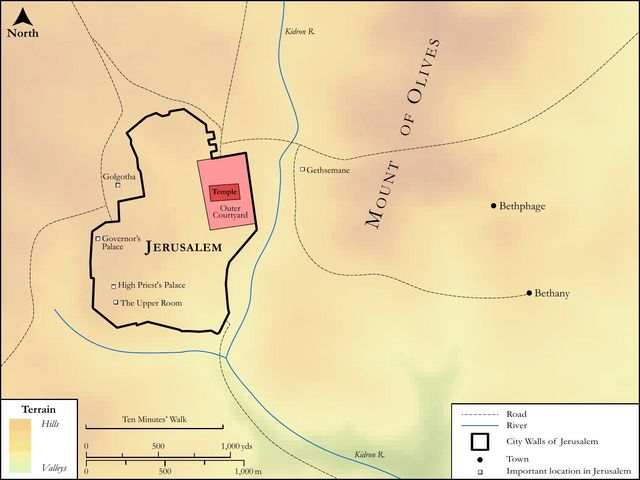
See on the biblical-era map


Study this verse
Public-domain commentary
Matthew Henry
From his Commentary on the Whole Bible. Henry comments on passages, not single verses — this entry covers Matthew 5:21–26. His three-level outline is real structure in the source text, so it is rendered as structure.
Christ having laid down these principles, that Moses and the prophets were still to be their rulers, but that the scribes and Pharisees were to be no longer their rulers, proceeds to expound the law in some particular instances, and to vindicate it from the corrupt glosses which those expositors had put upon it. He adds not any thing new, only limits and restrains some permissions which had been abused: and as to the precepts, shows the breadth, strictness, and spiritual nature of them, adding such explanatory statutes as made them more clear, and tended much toward the perfecting of our obedience to them. In these verses, he explains the law of the sixth commandment, according to the true intent and full extent of it.
I.Here is the command itself laid down (Mat 5:12); We have heard it, and remember it; he speaks to them who know the law, who had Moses read to them in their synagogues every sabbath-day; you have heard that it was said by them, or rather as it is in the margin, to them of old time, to your forefathers the Jews, Thou shalt not kill. Note, The laws of God are not novel, upstart laws, but were delivered to them of old time; they are ancient laws, but of that nature as never to be antiquated nor grow obsolete. The moral law agrees with the law of nature, and the eternal rules and reasons of good and evil, that is, the rectitude of the eternal Mind. Killing is here forbidden, killing ourselves, killing any other, directly or indirectly, or being any way accessory to it. The law of God, the God of life, is a hedge of protection about our lives. It was one of the precepts of Noah, Gen 9:5, Gen 9:6.
II.The exposition of this command which the Jewish teachers contended themselves with; their comment upon it was, Whosoever shall kill, shall be in danger of the judgment. This was all they had to say upon it, that wilful murderers were liable to the sword of justice, and casual ones to the judgment of the city of refuge. The courts of judgment sat in the gate of their principal cities; the judges, ordinarily, were in number twenty-three; these tried, condemned, and executed murderers; so that whoever killed, was in danger of their judgment. Now this gloss of theirs upon this commandment was faulty, for it intimated,
1.That the law of the sixth commandment was only external, and forbade no more than the act of murder, and laid to restraint upon the inward lusts, from which wars and fightings come. This was indeed the prōton pseudos - the fundamental error of the Jewish teachers, that the divine law prohibited only the sinful act, not the sinful thought; they were disposed haerere in cortice - to rest in the letter of the law, and they never enquired into the spiritual meaning of it. Paul, while a Pharisee, did not, till, by the key of the tenth commandment, divine grace let him into the knowledge of the spiritual nature of all the rest, Rom 7:7, Rom 7:14.
2.Another mistake of theirs was, that this law was merely political and municipal, given for them, and intended as a directory for their courts, and no more; as if they only were the people, and the wisdom of the law must die with them.
III.The exposition which Christ gave of this commandment; and we are sure that according to his exposition of it we must be judged hereafter, and therefore ought to be ruled now. The commandment is exceeding broad, and not to be limited by the will of the flesh, or the will of men.
1.Christ tells them that rash anger is heart-murder (Mat 5:22); Whosoever is angry with his brother without a cause, breaks the sixth commandment. By our brother here, we are to understand any person, though ever so much our inferior, as a child, a servant, for we are all made of one blood. Anger is a natural passion; there are cases in which it is lawful and laudable; but it is then sinful, when we are angry without cause. The word is eikē, which signifies, sine caus, sine effectu, et sine modo - without cause, without any good effect, without moderation; so that the anger is then sinful,
(1.)When it is without any just provocation given; either for no cause, or no good cause, or no great and proportionable cause; when we are angry at children or servants for that which could not be helped, which was only a piece of forgetfulness or mistake, that we ourselves might easily have been guilty of, and for which we should not have been angry at ourselves; when we are angry upon groundless surmises, or for trivial affronts not worth speaking of.
(2.)When it is without any good end aimed at, merely to show our authority, to gratify a brutish passion, to let people know our resentments, and excite ourselves to revenge, then it is in vain, it is to do hurt; whereas if we are at any time angry, it should be to awaken the offender to repentance, and prevent his doing so again; to clear ourselves (Co2 7:11), and to give warning to others.
(3.)When it exceeds due bounds; when we are hardy and headstrong in our anger, violent and vehement, outrageous and mischievous, and when we seek the hurt of those we are displeased at. This is a breach of the sixth commandment, for he that is thus angry, would kill if he could and durst; he has taken the first step toward it; Cain's killing his brother began in anger; he is a murderer in the account of God, who knows his heart, whence murder proceeds, Mat 15:19.
2.He tells them, that given opprobrious language to our brother is tongue-murder, calling him, Raca, and, Thou fool. When this is done with mildness and for a good end, to convince others of their vanity and folly, it is not sinful. Thus James says, O vain man; and Paul, Thou fool; and Christ himself, O fools, and slow of heart. But when it proceeds from anger and malice within, it is the smoke of that fire which is kindled from hell, and falls under the same character.
(1.)Raca is a scornful word, and comes from pride, "Thou empty fellow;" it is the language of that which Solomon calls proud wrath (Pro 21:24), which tramples upon our brother - disdains to set him even with the dogs of our flock. This people who knoweth not the law, is cursed, is such language, Joh 7:49.
(2.)Thou fool, is a spiteful word, and comes from hatred; looking upon him, not only as mean and not to be honoured, but as vile and not to be loved; "Thou wicked man, thou reprobate." The former speaks a man without sense, this (in scripture language) speaks a man without grace; the more the reproach touches his spiritual condition, the worse it is; the former is a haughty taunting of our brother, this is a malicious censuring and condemning of him, as abandoned of God. Now this is a breach of the sixth commandment; malicious slanders and censures are poison under the tongue, that kills secretly and slowly; bitter words are as arrows that would suddenly (Psa 64:3), or as a sword in the bones. The good name of our neighbour, which is better than life, is thereby stabbed and murdered; and it is an evidence of such an ill-will to our neighbour as would strike at his life, if it were in our power.
3.He tells them, that how light soever they made of these sins, they would certainly be reckoned for; he that is angry with is brother shall be in danger of the judgment and anger of God; he that calls him Raca, shall be in danger of the council, of being punished by the Sanhedrim for reviling an Israelite; but whosoever saith, Thou fool, thou profane person, thou child of hell, shall be in danger of hell-fire, to which he condemns his brother; so the learned Dr. Whitby. Some think, in allusion to the penalties used in the several courts of judgment among the Jews, Christ shows that the sin of rash anger exposes men to lower or higher punishments, according to the degrees of its proceeding. The Jews had three capital punishments, each worse than the other; beheading, which was inflicted by the judgment; stoning, by the council or chief Sanhedrim; and burning in the valley of the son of Hinnom, which was used only in extraordinary cases: it signifies, therefore, that rash anger and reproachful language are damning sins; but some are more sinful than others, and accordingly there is a greater damnation, and a sorer punishment reserved for them: Christ would thus show which sin was most sinful, by showing which it was the punishment whereof was most dreadful.
IV.From all this it is here inferred, that we ought carefully to preserve Christian love and peace with our brethren, and that if at any time a breach happens, we should labour for a reconciliation, by confessing our fault, humbling ourselves to our brother, begging his pardon, and making restitution, or offering satisfaction for wrong done in word or deed, according as the nature of the thing is; and that we should do this quickly for two reasons:
1.Because, till this be done, we are utterly unfit for communion with God in holy ordinances, Mat 5:23, Mat 5:24. The case supposed is, "That thy brother have somewhat against thee," that thou has injured and offended him, either really or in his apprehension; if thou are the party offended, there needs not this delay; if thou have aught against thy brother, make short work of it; no more is to be done but to forgive him (Mar 11:25), and forgive the injury; but if the quarrel began on thy side, and the fault was either at first or afterwards thine, so that thy brother has a controversy with thee, go and be reconciled to him before thou offer thy gift at the altar, before thou approach solemnly to God in the gospel-services of prayer and praise, hearing the word or the sacraments. Note,
(1.)When we are addressing ourselves to any religious exercises, it is good for us to take that occasion of serious reflection and self-examination: there are many things to be remembered, when we bring our gift to the altar, and this among the rest, whether our brother hath aught against us; then, if ever, we are disposed to be serious, and therefore should then call ourselves to an account.
(2.)Religious exercises are not acceptable to God, if they are performed when we are in wrath; envy, malice, and uncharitableness, are sins so displeasing to God, that nothing pleases him which comes from a heart wherein they are predominant, Ti1 2:8. Prayers made in wrath are written in gall, Isa 1:15; Isa 58:4.
(3.)Love or charity is so much better than all burnt-offerings and sacrifice, that God will have reconciliation made with an offended brother before the gift be offered; he is content to stay for the gift, rather than have it offered while we are under guilt and engaged in a quarrel.
(4.)Though we are unfitted for communion with God, by a continual quarrel with a brother, yet that can be no excuse for the omission or neglect of our duty: "Leave there thy gift before the altar, lest otherwise, when thou has gone away, thou be tempted not to come again." Many give this as a reason why they do not come to church or to the communion, because they are at variance with some neighbour; and whose fault is that? One sin will never excuse another, but will rather double the guilt. Want of charity cannot justify the want of piety. The difficulty is easily got over; those who have wronged us, we must forgive; and those whom we have wronged, we must make satisfaction to, or at least make a tender of it, and desire a renewal of the friendship, so that if reconciliation be not made, it may not be our fault; and then come, come and welcome, come and offer thy gift, and it shall be accepted. Therefore we must not let the sun go down upon our wrath any day, because we must go to prayer before we go to sleep; much less let the sun rise upon our wrath on a sabbath-day, because it is a day of prayer.
2.Because, till this be done, we lie exposed to much danger, Mat 5:25, Mat 5:26. It is at our peril if we do not labour after an agreement, and that quickly, upon two accounts:
(1.)Upon a temporal account. If the offence we have done to our brother, in his body, goods, or reputation, be such as will bear action, in which he may recover considerable damages, it is our wisdom, and it is our duty to our family, to prevent that by a humble submission and a just and peaceable satisfaction; lest otherwise he recover it by law, and put us to the extremity of a prison. In such a case it is better to compound and make the best terms we can, than to stand it out; for it is in vain to contend with the law, and there is danger of our being crushed by it. Many ruin their estates by an obstinate persisting in the offences they have given, which would soon have been pacified by a little yielding at first. Solomon's advice in case of suretyship is, Go, humble thyself, and so secure and deliver thyself, Pro 6:1-5. It is good to agree, for the law is costly. Though we must be merciful to those we have advantage against, yet we must be just to those that have advantage against us, as far as we are able. "Agree, and compound with thine adversary quickly, lest he be exasperated by thy stubbornness, and provoked to insist upon the utmost demand, and will not make thee the abatement which at first he would have made." A prison is an uncomfortable place to those who are brought to it by their own pride and prodigality, their own wilfulness and folly.
(2.)Upon a spiritual account. "Go, and be reconciled to thy brother, be just to him, be friendly with him, because while the quarrel continues, as thou art unfit to bring thy gift to the altar, unfit to come to the table of the Lord, so thou art unfit to die: if thou persist in this sin, there is danger lest thou be suddenly snatched away by the wrath of God, whose judgment thou canst not escape nor except against; and if that iniquity be laid to thy charge, thou art undone for ever." Hell is a prison for all that live and die in malice and uncharitableness, for all that are contentious (Rom 2:8), and out of that prison there is no rescue, no redemption, no escape, to eternity.
This is very applicable to the great business of our reconciliation to God through Christ; Agree with him quickly, whilst thou art in the way. Note, [1.] The great God is an Adversary to all sinners, antidikos - a law-adversary; he has a controversy with them, an action against them. [2.] It is our concern to agree with him, to acquaint ourselves with him, that we may be at peace, Job 22:21; Co2 5:20. [3.] It is our wisdom to do this quickly, while we are in the way. While we are alive, we are in the way; after death, it will be too late to do it; therefore give not sleep to thine eyes till it be done. [4.] They who continue in a state of enmity to God, are continually exposed to the arrests of his justice, and the most dreadful instances of his wrath. Christ is the Judge, to whom impenitent sinners will be delivered; for all judgment is committed to the Son; he that was rejected as a Saviour, cannot be escaped as a Judge, Rev 6:16, Rev 6:17. It is a fearful thing to be thus turned over to the Lord Jesus, when the Lamb shall become the Lion. Angels are the officers to whom Christ will deliver them (Mat 13:41, Mat 13:42); devils are so too, having the power of death as executioners to all unbelievers, Heb 2:14. Hell is the prison, into which those will be cast that continue in a state of enmity to God, Pe2 2:4. [5.] Damned sinners must remain in it to eternity; they shall not depart till they have paid the uttermost farthing, and that will not be to the utmost ages of eternity: divine justice will be for ever in the satisfying, but never satisfied.
Historical interpretation
Four Centuries of Reception
12 surviving comments on this verse. Each one is dated, so this reads as a timeline rather than a list.
Select a marker to jump to its quote. Markers stagger vertically where authors wrote within a few decades of each other.
As regards the rule of peace, which is so pleasing to God, who in the world that is prone to impatience will even once forgive his brother, I will not say "seven times," or "seventy-seven times? " Who that is contemplating a suit against his adversary will compose the matter by agreement, unless he first begin by lopping off chagrin, hardheartedness, and bitterness, which are in fact the poisonous outgrowths of impatience? How will you "remit, and remission shall be granted" you if the absence of patience makes you tenacious of a wrong? No one who is at variance with his brother in his mind, will finish offering his "duteous gift at the altar," unless he first, with intent to "re-conciliate his brother," return to patience. If "the sun go down over our wrath," we are in jeopardy: we are not allowed to remain one day without patience.
He bids us when peace with our fellow-men is restored, then to return to peace with God, passing from the love of men to the love of God; then go and offer thy gift.
"If thou bring thy gift to the altar, and there rememberest that thy brother hath ought against thee; leave there thy gift before the altar, and go away; first be reconciled to thy brother, and then come and offer thy gift."
O goodness! O exceeding love to man! He makes no account of the honor due unto Himself, for the sake of our love towards our neighbor; implying that not at all from any enmity, nor out of any desire to punish, had He uttered those former threatenings, but out of very tender affection. For what can be milder than these sayings? "Let my service," saith he, "be interrupted, that thy love may continue; since this also is a sacrifice, thy being reconciled to thy brother." Yea, for this cause He said not, "after the offering," or "before the offering;" but, while the very gift lies there, and when the sacrifice is already beginning, He sends thee to be reconciled to thy brother; and neither after removing that which lies before us, nor before presenting the gift, but while it lies in the midst, He bids thee hasten thither.
With what motive then doth He command so to do, and wherefore? These two ends, as it appears to me, He is hereby shadowing out and providing for. First, as I have said, His will is to point out that He highly values charity, and considers it to be the greatest sacrifice: and that without it He doth not receive even that other; next, He is imposing such a necessity of reconciliation, as admits of no excuse. For whoso hath been charged not to offer before he be reconciled, will hasten, if not for love of his neighbor, yet, that this may not lie unconsecrated, to run unto him who hath been grieved, and do away the enmity. For this cause He hath also expressed it all most significantly, to alarm and thoroughly to awaken him. Thus, when He had said, "Leave thy gift," He stayed not at this, but added, "before the altar" (by the very place again causing him to shudder); "and go away." And He said not merely, "Go away," but He added, "first, and then come and offer thy gift." By all these things making it manifest, that this table receives not them that are at enmity with each other.
Let the initiated hear this, as many as draw nigh in enmity: and let the uninitiated hear too: yea, for the saying hath some relation to them also. For they too offer a gift and a sacrifice: prayer, I mean, and alms-giving. For as to this also being a sacrifice, hear what the prophet saith: "A sacrifice of praise will glorify me;" and again, "Sacrifice to God a sacrifice of praise;" and, "The lifting up of mine hands is an evening sacrifice." So that if it be but a prayer, which thou art offering in such a frame of mind, it were better to leave thy prayer, and become reconciled to thy brother, and then to offer thy prayer.
For to this end were all things done: to this end even God became man, and took order for all those works, that He might set us at one.
And whereas in this place He is sending the wrong doer to the sufferer, in His prayer He leads the sufferer to the wrong doer, and reconciles them. For as there He saith, "Forgive men their debts;" so here, "If he hath ought against thee, go thy way unto him."
Or rather, even here too He seems to me to be sending the injured person: and for some such reason He said not, "Reconcile thyself to thy brother," but, "Be thou reconciled." And while the saying seems to pertain to the aggressor, the whole of it really pertains to him that is aggrieved. Thus, "If thou art reconciled to him," saith Christ, "through thy love to him thou wilt have me also propitious, and wilt be able to offer thy sacrifice with great confidence. But if thou art still irritated, consider that even I readily command that which is mine to be lightly esteemed, that ye may become friends; and let these thoughts be soothing to thine anger."
And He said not, "When thou hast suffered any of the greater wrongs, then be reconciled; but, "Though it be some trifle that he hath against thee." And He added not, "Whether justly or unjustly; but merely, "If he hath ought against thee." For though it be justly, not even in that case oughtest thou to protract the enmity; since Christ also was justly angered with us, yet nevertheless He gave Himself for us to be slain, "not imputing those trespasses."
If love alone is not enough to induce us to be reconciled to our neighbour, the desire that our work should not remain imperfect, and especially in the holy place, should induce us.
It is not, If thou hast ought against thy brother; but, If thy brother has ought against thee, that the necessity of reconciliation may be more imperative.
(Vers. 23, 24.) Therefore, if you offer your gift at the altar, and there you remember that your brother has something against you, leave your gift there before the altar, and go first to be reconciled to your brother: and then coming, offer your gift. He did not say, if you have something against your brother, but if your brother has something against you, so that a harsher necessity of reconciliation may be imposed on you. As long as we cannot appease him, I do not know whether we should consequently offer our gifts to God.
Next there follows here: Therefore, if you have brought your gift to the altar, and there rememberest that your brother has ought against you; leave there your gift before the altar, and go your way; first be reconciled to your brother, and then come and offer your gift. From this surely it is clear that what is said above is said of a brother: inasmuch as the sentence which follows is connected by such a conjunction that it confirms the preceding one; for He does not say, But if you bring your gift to the altar; but He says, Therefore, if you bring your gift to the altar. For if it is not lawful to be angry with one's brother without a cause, or to say Raca, or to say You fool, much less is it lawful so to retain anything in one's mind, as that indignation may be turned into hatred. And to this belongs also what is said in another passage: Let not the sun go down upon your wrath. We are therefore commanded, when about to bring our gift to the altar, if we remember that our brother has ought against us, to leave the gift before the altar, and to go and be reconciled to our brother, and then to come and offer the gift. But if this is to be understood literally, one might perhaps suppose that such a thing ought to be done if the brother is present; for it cannot be delayed too long, since you are commanded to leave your gift before the altar. If, therefore, such a thing should come into your mind respecting one who is absent, and, as may happen, even settled down beyond the sea, it is absurd to suppose that your gift is to be left before the altar until you may offer it to God after having traversed both lands and seas. And therefore we are compelled to have recourse to an altogether internal and spiritual interpretation, in order that what has been said may be understood without absurdity.
And so we may interpret the altar spiritually, as being faith itself in the inner temple of God, whose emblem is the visible altar. For whatever offering we present to God, whether prophecy, or teaching, or prayer, or a psalm, or a hymn, and whatever other such like spiritual gift occurs to the mind, it cannot be acceptable to God, unless it be sustained by sincerity of faith, and, as it were, placed on that fixedly and immoveably, so that what we utter may remain whole and uninjured. For many heretics, not having the altar, i.e. true faith, have spoken blasphemies for praise; being weighed down, to wit, with earthly opinions, and thus, as it were, throwing down their offering on the ground. But there ought also to be purity of intention on the part of the offerer. And therefore, when we are about to present any such offering in our heart, i.e. in the inner temple of God (For, as it is said, the temple of God is holy, which temple you are; and, That Christ may dwell in the inner man by faith in your hearts) if it occur to our mind that a brother has ought against us, i.e. if we have injured him in anything (for then he has something against us whereas we have something against him if he has injured us, and in that case it is not necessary to proceed to reconciliation: for you will not ask pardon of one who has done you an injury, but merely forgive him, as you desire to be forgiven by the Lord what you have committed against Him), we are therefore to proceed to reconciliation, when it has occurred to our mind that we have perhaps injured our brother in something; but this is to be done not with the bodily feet, but with the emotions of the mind, so that you are to prostrate yourself with humble disposition before your brother, to whom you have hastened in affectionate thought, in the presence of Him to whom you are about to present your offering. For thus, even if he should be present, you will be able to soften him by a mind free from dissimulation, and to recall him to goodwill by asking pardon, if first you have done this before God, going to him not with the slow movement of the body, but with the very swift impulse of love; and then coming, i.e. recalling your attention to that which you were beginning to do, you will offer your gift.
28. But who acts in a way that he is neither angry with his brother without a cause, nor says Raca without a cause, nor calls him a fool without a cause, all of which are most proudly committed; or so, that, if perchance he has fallen into any of these, he asks pardon with suppliant mind, which is the only remedy; who but just the man that is not puffed up with the spirit of empty boasting? Blessed therefore are the poor in spirit: for theirs is the kingdom of heaven. Let us look now at what follows.
(ubi sup.) In all these three sentences there are some words understood. In the first indeed, as many copies read without cause, there is nothing to be supplied. In the second, He who saith to his brother, Racha, we must supply the words, without cause; and again, in He who says, Thou fool, two things are understood, to his brother, and, without cause. And this forms the defence of the Apostle, when he calls the Galatians fools, though he considers them his brethren; for he did it not without cause.
(Serm. in Mont. i. 10.) If it be not lawful to be angry with a brother, or to say to him Racha, or Thou fool, much less is it lawful to keep in the memory any thing which might convert anger into hate.
(ubi sup.) And he has somewhat against us when we have wronged him; and we have somewhat against him when he has wronged us, in which case there were no need to go to be reconciled to him, seeing we had only to forgive him, as we desire the Lord to forgive us.
(ubi sup.) If this direction be taken literally, it might lead some to suppose that this ought indeed to be so done if our brother is present, for that no long time can be meant when we are bid to leave our offering there before the altar. For if he be absent, or possibly beyond sea, it is absurd to suppose that the offering must be left before the altar; to be offered after we have gone over land and sea to seek him. Wherefore we must embrace an inward, spiritual sense of the whole, if we would understand it without involving any absurdity. The gift which we offer to God, whether learning, or speech, or whatever it be, cannot be accepted of God unless it be supported by faith. If then we have in aught harmed a brother, we must go and be reconciled with him, not with the bodily feet, but in thoughts of the heart, when in humble contrition you may cast yourself at your brother's feet in sight of Him whose offering you are about to offer. For thus in the same manner as though He were present, you may with unfeigned heart seek His forgiveness; and returning thence, that is, bringing back again your thoughts to what you had first begun to do, may make your offering.
The statement “if you should bring your gift” shows that this is conceived as a means of salvation and as an escape from punishment for sinners. For this God invented repentance. One will avert punishment, however, who tends to the feelings of another who has been wounded. But one who does not love his brother does not love the Lord. Hence it is fitting that whoever bears hard feelings toward his brother is not accepted, since he does not approach the Lord in truth.
A brother learnt that another brother was angry with him, and went to make it up but the other did not open the door of his cell. So he went to a hermit, and told him about it. The hermit said, ‘See that you have no reason, which looks like a just reason, in your heart for blaming your brother: as though you would accuse him and justify yourself, for if so God will not touch his heart to open the door to you. I tell you this: even if he has sinned against you, think in your heart that you have sinned against him; justify your brother rather than yourself and then God will put it into his heart to make peace with you.’
But if it is he that hath done you the wrong, and yet you be the first to seek reconciliation, you shall have a great reward.
See the mercy of God, that He thinks rather of man's benefit than of His own honour; He loves concord in the faithful more than offerings at His altar; for so long as there are dissensions among the faithful, their gift is not looked upon, their prayer is not heard. For no one can be a true friend at the same time to two who are enemies to each other. In like manner, we do not keep our fealty to God, if we do not love His friends and hate His enemies. But such as was the offence, such should also be the reconciliation. If you have offended in thought, be reconciled in thought; if in words, be reconciled in words; if in deeds, in deeds be reconciled. For so it is in every sin, in whatsoever kind it was committed, in that kind is the penance done.
(Hom. 1. in Ezech. viii. 9.) Lo He is not willing to accept sacrifice at the hands of those who are at variance. Hence then consider how great an evil is strife, which throws away what should be the means of remission of sin.
Continue studying Matthew 5:23 across the web’s major study libraries — every link below opens this exact verse, chapter, or book on the destination site.
Read & Compare
 BibleGatewayThis verse in more than 200 translations and 70 languages.
 Bible.comThe YouVersion reader — hundreds of translations, reading plans, and highlights.
 ESV.orgCrossway's official English Standard Version reader.
 NET BibleThe NET translation with 60,000+ translators' notes on every rendering decision.
 STEP BibleTyndale House's free study tool — original text, vocabulary, and scholarly resources.
 BibliaLogos Bible Software's free web reader.
 USCCBThe New American Bible (Revised Edition) with the U.S. bishops' study notes.
Commentaries
 BibleHub CommentariesDozens of classic commentaries on this verse, gathered on one page.
 StudyLightMore than 100 commentary sets — the largest collection on the web.
 BibleRefPlain-English commentary on what this verse means, verse by verse.
 Enduring WordDavid Guzik's free commentary on this chapter, widely used by Bible teachers.
 Bible Study ToolsVerse commentary alongside Greek and Hebrew study aids.
Original Language & Research
- BibleHub InterlinearThe verse word by word — original language, transliteration, and English.
- BibleHub LexiconEvery word's original-language definition and Strong's entry.
 Blue Letter BibleDeep-study tools — Strong's numbers, concordance, and word studies.
 CNTR CollationThe earliest Greek manuscripts of this verse, collated letter by letter.
Sermons, Hymns & Audio


TrulyRandomVerse is not affiliated with these sites and doesn’t control their content. They’re linked because they’re genuinely useful.
Summary
Matthew 5:23, a foundational teaching from Jesus's Sermon on the Mount, profoundly connects the vertical dimension of worship with the horizontal reality of human relationships. It asserts that genuine devotion to God cannot be separated from one's conduct towards others, establishing reconciliation with an offended brother as a prerequisite for acceptable worship. This radical reordering of priorities challenges the superficiality of ritualistic piety, emphasizing the transformative power of love and peacemaking as integral to true righteousness in the Kingdom of God.
Context
ShowHideLiterary Context
This verse is strategically placed within Jesus's radical reinterpretation of the Mosaic Law, specifically following His teachings on anger and murder in Matthew 5:21-22. Having expanded the prohibition against murder to include internal anger and insults, Jesus now extends the principle to the realm of worship. The "Therefore" (G3767, oûn) at the beginning of Matthew 5:23 explicitly links it to the preceding discourse, demonstrating that unresolved interpersonal conflict is a manifestation of the very heart issues Jesus has just condemned. This passage, along with Matthew 5:24, forms a cohesive unit emphasizing the paramount importance of reconciliation before approaching God in worship. It is part of a larger section (Matthew 5:21-48) where Jesus systematically contrasts traditional interpretations of the Law ("You have heard that it was said...") with His own deeper, more demanding standard ("But I tell you..."), revealing the true spirit of God's commands.
Historical & Cultural Context
In first-century Judaism, the Temple in Jerusalem was the epicenter of religious life, and bringing offerings or sacrifices to the altar was a central act of worship, atonement, and thanksgiving. These rituals were meticulously prescribed in the Mosaic Law and were understood as essential for maintaining a right relationship with God. The act of bringing a "gift to the altar" (G2379, thysiastḗrion) was a solemn and sacred duty. Jesus's teaching here is revolutionary because it subordinates this highly esteemed religious ritual to the often-overlooked ethical demand of interpersonal reconciliation. It challenges the prevailing notion that external religious observance alone could suffice for righteousness, highlighting that God values a contrite and reconciled heart more than any material offering. This teaching would have been particularly shocking to those who placed immense emphasis on Temple rituals and sacrifices as the primary means of appeasing God.
Key Themes
ShowHideMatthew 5:23 contributes significantly to several key themes within the Sermon on the Mount and the broader Gospel of Matthew. Firstly, it underscores the Integrity of Worship, asserting that true worship is not merely an outward act but must flow from an internal state of righteousness, which includes right relationships with others. Secondly, it highlights the Priority of Reconciliation, revealing that God values restored relationships among His people even above traditional religious duties. This theme is echoed in Jesus's teaching on forgiveness in Matthew 6:14-15 and the importance of unity among believers. Thirdly, it emphasizes Kingdom Righteousness, which transcends mere external obedience to the Law and penetrates to the motives and attitudes of the heart, demanding a proactive pursuit of peace and justice within the community, as further elaborated in Matthew 5:9. This verse powerfully illustrates that genuine love for God is inextricably linked to genuine love for one's neighbor.
Exposition and Analysis
ShowHideKey Word Analysis
ShowHideThis term (G1435) refers to a present, offering, or sacrifice, specifically an offering brought to God. In the context of the Temple, it would typically denote a material offering, such as an animal, grain, or money, presented as an act of worship, thanksgiving, or atonement. Jesus uses this common, sacred practice as the immediate context for His radical teaching.
Derived from a word meaning "sacrifice," this term (G2379) denotes the place where sacrifices are offered, specifically the altar in the Temple precinct. It represents the very locus of communion with God through prescribed ritual. Jesus's instruction to leave the gift at the altar emphasizes the immediate and tangible nature of the dilemma presented: the worshipper is already in the act of approaching God.
This verb (G3415) means "to bear in mind," "recollect," or "to be mindful." It implies an active recall, not a passive forgetting. The responsibility is placed squarely on the individual worshipper to actively consider their relationships and whether any "brother" (G80, adelphós) has a legitimate grievance against them. It suggests a state of awareness or a sudden realization that an unresolved conflict exists.
This phrase combines the verb "to hold" or "to have" (G2192, échō) with the preposition "against" (G2596, katá), often used with the indefinite pronoun "ought" (G5100, tìs). It signifies that someone holds a grievance, resentment, or a legitimate charge against you. It implies that you are the one who has caused offense or injury, whether intentionally or unintentionally, and that the other person has a valid reason for feeling wronged. This is not about someone merely having a negative opinion, but about a specific, unresolved issue that stands between you.
Verse Breakdown
ShowHide"Therefore if thou bring thy gift to the altar,"
This opening clause establishes the setting and the action: a worshipper is in the very act of presenting an offering at the Temple altar, a sacred and significant religious duty. The "Therefore" (G3767, oûn) links this instruction directly to Jesus's preceding teachings on anger and reconciliation, indicating that the principles discussed earlier have direct implications for one's approach to God in worship. The conditional "if" (G1437, eán) suggests a common scenario, not an isolated incident, making the instruction broadly applicable.
"and there rememberest"
While in the midst of this solemn act of worship, a crucial realization occurs. The worshipper is prompted to recall or becomes aware of something vital. This "remembering" (G3415, mnáomai) is not a casual thought but a divinely prompted awareness that interrupts the ritual, shifting the focus from the external act to an internal spiritual condition and an external relational obligation.
"that thy brother hath ought against thee;"
The content of this remembrance is the critical point: another person, specifically a "brother" (G80, adelphós – a fellow member of the community, a neighbor, or even a fellow believer), has a legitimate grievance or unresolved issue against the worshipper. The phrase "hath ought against thee" (G2192, échō... G5100, tìs... G2596, katá... G4675, soû) implies that the worshipper is the one who has caused offense or harm, and the other person holds a valid complaint. This is not about the worshipper having something against the brother, but the reverse, placing the responsibility for initiation of reconciliation on the one approaching God.
Literary Devices
ShowHideJesus employs several potent literary devices in Matthew 5:23 to underscore His radical teaching. The primary device is Paradox or Hyperbole, as Jesus presents a scenario where a sacred, divinely commanded act of worship (bringing a gift to the altar) is explicitly interrupted and postponed in favor of a seemingly less "religious" act (reconciliation with a brother). This creates a striking contrast that forces the audience to re-evaluate their priorities, elevating interpersonal relationships to a status equal to, or even momentarily higher than, direct communion with God. The "gift" and "altar" serve as powerful Symbols of traditional religious piety and the means of atonement. By instructing the worshipper to leave the gift at the altar, Jesus uses Metonymy or Synecdoche, where the gift stands for the entire act of worship, and the altar for the sacred space of divine encounter. This vivid imagery creates a memorable and impactful command, emphasizing the urgency and non-negotiable nature of reconciliation.
Theological and Thematic Connections
ShowHideMatthew 5:23 profoundly reshapes our understanding of worship, demonstrating that true devotion is holistic, encompassing both our vertical relationship with God and our horizontal relationships with others. Jesus reveals that a broken human relationship, particularly one where we are the cause of offense, acts as a barrier to acceptable worship. God desires not merely ritualistic obedience but a heart that is reconciled and at peace with its neighbor. This teaching highlights the indivisible nature of the two great commandments: love for God and love for neighbor. One cannot genuinely love God while harboring unresolved conflict or being the source of grievance for another. This principle elevates the ethical dimension of faith, making it clear that righteousness is lived out in community before it is expressed in ritual.
Reflection and Application
ShowHideMatthew 5:23 serves as a powerful and convicting mirror for every believer, challenging us to examine the authenticity of our worship and the integrity of our relationships. It calls us to a proactive and humble posture, where we are willing to initiate reconciliation even when it is uncomfortable or inconvenient. This verse reminds us that our spiritual walk is not compartmentalized; our prayers, offerings, and acts of devotion are deeply intertwined with how we treat those around us. If we are truly seeking to honor God, we must also diligently pursue peace and reconciliation with our "brother" or "sister" against whom we know there is a legitimate grievance. This isn't about achieving perfect relationships before approaching God, but about demonstrating a sincere willingness to address conflict and seek restoration, prioritizing the healing of relationships as an act of worship itself.
Questions for Reflection
ShowHideFAQ
ShowHideDoes "brother" in this verse only refer to a fellow Christian?
ShowHideWhile the term "brother" (G80, adelphós) often refers to fellow believers in the New Testament, in the broader context of Jesus's ethical teachings, especially in the Sermon on the Mount, it extends to any fellow human being, particularly those within one's community or sphere of influence. Jesus frequently uses "neighbor" or "brother" to denote anyone with whom we interact, emphasizing universal love and reconciliation. The spirit of the command certainly applies most acutely to those within the faith community, but its ethical imperative extends to all people, reflecting the expansive nature of God's love and the call to be peacemakers in the world.
Christ-Centered Fulfillment
ShowHideMatthew 5:23 finds its ultimate fulfillment in the person and work of Jesus Christ, who perfectly embodied the principle of reconciliation before all else. Jesus, the Lamb of God, did not merely teach about reconciliation; He became our reconciliation, bridging the chasm between a holy God and sinful humanity through His atoning sacrifice on the cross. His entire ministry was a pursuit of reconciliation, culminating in His death and resurrection, which made it possible for us to be reconciled to God. Furthermore, Christ's life serves as the supreme example of prioritizing others' needs and seeking peace, even at immense personal cost, as seen in His humility and willingness to suffer for the sake of His enemies (Romans 5:10). The New Covenant, inaugurated by Christ, moves beyond external rituals to emphasize the internal transformation of the heart, where love for God is inextricably linked to love for one another (John 13:34-35). Thus, when we pursue reconciliation with a brother, we are not just obeying a command; we are participating in the very nature and mission of Christ, who is our peace (Ephesians 2:14). Our "gift" to the altar, in the truest sense, becomes a life lived in Christ-like love and reconciliation, a spiritual offering acceptable to God through Him (Hebrews 13:15-16).