


Ezekiel 40:21
Bible text: King James Version (1769 Blayney text) · Public domain
Bible text: King James Version with Strong's numbers · Public domain
Bible text: Berean Standard Bible · Public domain
Bible text: American Standard Version (1901) · Public domain
Bible text: World English Bible, Messianic edition · Public domain
Bible text: Geneva Bible (1599) · Public domain
Bible text: Young's Literal Translation · Public domain
- וְתָאָיוve·ta·'ovand its chambersH8372Conj-w ¦ N-mpc ¦ 3msNoun Plural Masculine Constructוְandתָאָיchambersוits
- שְׁלוֹשָׁהshe·lo·ShahthreeH7969Adj-csAdjective Numerical Singular common gender Absolute
- מִפּוֹmi·Pofrom hereH6311Prep-m ¦ AdvAdverbמִfromפּוֹhere
- וּשְׁלֹשָׁהu·she·lo·Shahand threeH7969Conj-w ¦ Adj-csAdjective Numerical Singular common gender Absoluteוּandשְׁלֹשָׁהthree
- מִפּוֹmi·Pofrom hereH6311Prep-m ¦ AdvAdverbמִfromפּוֹhere
- וְאֵילָיוve·'ei·lovand its pillarsH352Conj-w ¦ N-mpc ¦ 3msNoun Plural Masculine Constructוְandאֵילָיpillarsוits
- וְאֵלַמָּיוve·'e·la·movand its porchesH361Conj-w ¦ N-mpc ¦ 3msNoun Plural Masculine Constructוְandאֵלַמָּיporchesוits
- הָיָהha·Yahit wasH1961V-Qal-Perf-3msVerb Qal Perfect 3rd Singular Masculine
- כְּמִדַּתke·mi·Datlike [the] measurement ofH4060Prep-k ¦ N-fscNoun Singular Feminine Constructכְּlikeמִדַּת[the] measurement of
- הַשַּׁעַרha·Sha·'arthe gateH8179Art ¦ N-msNoun Singular Masculine Absoluteהַtheשַּׁעַרgate
- הָרִאשׁוֹןha·ri·Shon<the> firstH7223Art ¦ Adj-msAdjective Numerical Position Singular Masculine Absoluteהָ<the>רִאשׁוֹןfirst
- חֲמִשִּׁיםcha·mi·Shim[was] fiftyH2572Adj-mpAdjective Numerical Plural Masculine Absolute
- אַמָּה'a·Mahcubit[s]H520N-fsNoun Singular Feminine Absolute
- אָרְכּוֹ'a·re·Koits lengthH753N-msc ¦ 3msNoun Singular Masculine Constructאָרְכּlengthוֹits
- וְרֹחַבve·Ro·chavand [the] breadthH7341Conj-w ¦ N-msNoun Singular Masculine Absoluteוְandרֹחַב[the] breadth
- חָמֵשׁcha·Mesh[was] fiveH2568Adj-csAdjective Numerical Singular common gender Absolute
- וְעֶשְׂרִיםve·'es·Rimand twentyH6242Conj-w ¦ Adj-mpAdjective Numerical Plural Masculine Absoluteוְandעֶשְׂרִיםtwenty
- בָּאַמָּהba·'a·Mahby the cubitH520Prep-b ¦ N-fsNoun Singular Feminine Absoluteבָּby theאַמָּהcubit
English is a literal word-by-word gloss of the Hebrew, not the KJV's wording. Why?
This is the original text the KJV's translators worked from — each Hebrew word with its own literal English meaning in this verse, prepared by scholars at Tyndale House, Cambridge. The KJV translates whole sentences, not word by word, so its wording differs: one Hebrew word can become several English words, and the KJV may choose “the LORD” where the gloss reads “Yahweh”. Both are faithful — they answer different questions. For the KJV's own rendering, switch to the KJV text.
Details
See on the biblical-era map
Study this verse
Public-domain commentary
Matthew Henry
From his Commentary on the Whole Bible. Henry comments on passages, not single verses — this entry covers Ezekiel 40:5–26. His three-level outline is real structure in the source text, so it is rendered as structure.
The measuring-reed which was in the hand of the surveyor-general was mentioned before, Eze 40:3. Here we are told (Eze 40:5) what was the exact length of it, which must be observed, because the house was measured by it. It was six cubits long, reckoning, not by the common cubit, but the cubit of the sanctuary, the sacred cubit, by which it was fit that this holy house should be measured, and that was a hand-breadth (that it, four inches) longer than the common cubit: the common cubit was eighteen inches, this twenty-two, see Eze 43:13. Yet some of the critics contend that this measuring-reed was but six common cubits in length, and one handbreadth added to the whole. The former seems more probable. Here is an account,
I.Of the outer wall of the house, which encompassed it round, which was three yards thick and three yards high, which denotes the separation between the church and the world on every side and the divine protection which the church is under. If a wall of this vast thickness will not secure it, God himself will be a wall of fire round about it; whoever attack it will do so at their peril.
II.Of the several gates with the chambers adjoining to them.
Here is no mention of the outer court of all, which was called the court of the Gentiles, some think because in gospel-times there should be such a vast confluence of Gentiles to the church that their court should be left unmeasured, to signify that the worshippers in that court should be unnumbered, Rev 7:9, Rev 7:11, Rev 7:12.
1.He begins with the east gate, because that was the usual way of entering into the lower end of the temple, the holy of holies being at the west end, in opposition to the idolatrous heathen that worshipped towards the east. Now, in the account of this gate, observe,
(1.)That he went up to it by stairs (Eze 40:6), for the gospel-church was exalted above that of the Old Testament, and when we go to worship God we must ascend; so is the call, Rev 4:1. Come up hither. Sursum corda - Up with your hearts.
(2.)That the chambers adjoining to the gates were but little chambers, about ten feet square, Eze 40:7. These were for those to lodge in who attended the service of the house. And it becomes such as are made spiritual priests to God to content themselves with little chambers and not to seek great things to themselves; so that we may but have a place within the verge of God's court we have reason to be thankful though it be in a little chamber, a mean apartment, though we be but door-keepers there.
(3.)The chambers, as they were each of them four-square, denoting their stability and due proportion and their exact agreement with the rule (for they were each of them one reed long and one reed broad), so they were all of one measure, that there might be an equality among the attendants on the service of the house.
(4.)The chambers were very many; for in our Father's house there are many mansions (Joh 14:2), in his house above, and in that here on earth. In the secret of his tabernacle shall those be hid, and in a safe pavilion, whose desire is to dwell in the house of the Lord all the days of their life, Psa 27:4, Psa 27:5. Some make these chambers to represent the particular congregations of believers, which are parts of the great temple, the universal church, which are, and must be, framed by the scripture-line and rule, and which Jesus Christ takes the measure of, that is, takes cognizance of, for he walks in the midst of the seven golden candle-sticks.
(5.)It is said (Eze 40:14), He made also the posts. He that now measured them was the same that made them; for Christ is the builder of his church and therefore is best able to give us the knowledge of it. And his reducing them to the rule and standard is called his making them, for no account is made of them further than they agree with that. To the law and to the testimony.
(6.)Here are posts of sixty cubits, which, some think, was literally fulfilled when Cyrus, in his edict for rebuilding the temple at Jerusalem, ordered that the height thereof should be sixty cubits, that is, thirty yards and more, Ezr 6:3.
(7.)Here were windows to the little chambers, and windows to the posts and arches (that is, to the cloisters below), and windows round about (Eze 40:16), to signify the light from heaven with which the church is illuminated; divine revelation is let into it for instruction, direction, and comfort, to those that dwell in God's house, light to work by, light to walk by, light to see themselves and one another by. There were lights to the little chambers; even the least, and least considerable, parts and members of the church, shall have light afforded them. All thy children shall be taught of the Lord. But they are narrow windows, as those in the temple, Kg1 6:4. The discoveries made to the church on earth are but narrow and scanty compared with what shall be in the future state, when we shall no longer see through a glass darkly.
(8.)Divers courts are here spoken of, an outermost of all, then an outer court, then an inner, and then the innermost of all, into which the priests only entered, which (some think) may put us in mind "of the diversities of gifts, and graces, and offices, in the several members of Christ's mystical body here, as also of the several degrees of glory in the courts and mansions of heaven, as there are stars in several spheres and stars of several magnitudes in the fixed firmament." English Annotations. Some draw nearer to God than others and have a more intimate acquaintance with divine things; but to a child of God a day in any of his courts is better than a thousand elsewhere. These courts had porches, or piazzas, round them, for the shelter of those that attended in them from wind and weather; for when we are in the way of our duty to God we may believe ourselves to be under his special protection, that he will graciously provide for us, nay, that he will himself be to us a covert from the storm and tempest, Isa 4:5, Isa 4:6.
(9.)On the posts were palm-trees engraven (Eze 40:16), to signify that the righteous shall flourish like the palm-tree in the courts of God's house, Psa 92:12. The more they are depressed with the burden of affliction the more strongly do they grow, as they say of the palm-trees. It likewise intimates the saints' victory and triumph over their spiritual enemies; they have palms in their hands (Rev 7:9); but lest they should drop these, or have them snatched out of their hands, they are here engraven upon the posts of the temple as perpetual monuments of their honour. Thanks be to God, who always causes us to triumph. Nay, believers shall themselves be made pillars in the temple of our God, and shall go no more out, and shall have his name engraven on them, which will be their brightest ornament and honour, Rev 3:12.
(10.)Notice is here taken of the pavement of the court, Eze 40:17, Eze 40:18. The word intimates that the pavement was made of porphyry-stone, which was of the colour of burning coals; for the brightest and most sparkling glories of this world should be put and kept under our feet when we draw near to God and are attending upon him. The stars are, as it were, the burning coals, or stones of a fiery colour, with which the pavement of God's celestial temple is laid; and, if the pavement of the court be so bright and glittering, how glorious must we conclude the mansions of that house to be!
2.The gates that looked towards the north (Eze 40:20) and towards the south (Eze 40:24), with their appurtenances, are much the same with that towards the east, after the measure of the first gate, Eze 40:21. But the description is repeated very particularly. And thus largely was the structure of the tabernacle related in Exodus, and of the temple in the books of Kings and Chronicles, to signify the special notice God does take, and his ministers should take, of all that belong to his church. His delight is in them; his eye is upon them. He knows all that are his, all his living temples and all that belongs to them. Observe,
(1.)This temple had not only a gate towards the east, to let into it the children of the east, that were famous for their wealth and wisdom, but it had a gate to the north, and another to the south, for the admission of the poorer and less civilized nations. The new Jerusalem has twelve gates, three towards each quarter of the world (Rev 21:13); for many shall come from all parts to sit down there, Mat 8:11.
(2.)To those gates they went up by steps, seven steps (Eze 40:22-26), which, as some observe, may remind us of the necessity of advancing in grace and holiness, adding one grace to another, going from step to step, from strength to strength, still pressing forward towards perfection - upward, upward, towards heaven, the temple above.
Historical interpretation
Two Centuries of Reception
3 surviving comments on this verse. Each one is dated, so this reads as a timeline rather than a list.
Select a marker to jump to its quote. Markers stagger vertically where authors wrote within a few decades of each other.
After seven weeks, there are fifty days designated for eternal respite, stretching from the day of the resurrection to the kingdom of heaven, in which there is true respite.
(Verse 20, 21.) He also measured the gate of the outer court that faced north, both in length and width. It had three rooms on each side, and its front and vestibule were the same size as those of the gate that faced east. The gate was fifty cubits long and twenty-five cubits wide, and its windows, vestibule, and carvings were all the same size as those of the gate that faced east. There were seven steps in its ascent, and a vestibule before it. And there was a gate of the inner court opposite the gate to the north and east. And it was measured from gate to gate, one hundred cubits. Seventy: And he brought me to the north gate and behold, a gate facing the outer court. And it was measured, its length and its width, with its three sides here, and three there, and its threshing floor, and its rooms (which it did not have in Hebrew) and its palm tree. And it was made in the measurement of the gate facing east: its length was fifty cubits, and its width was twenty-five cubits. And its windows and palm trees were like the gate that faced east. And it had seven steps leading up to it, with palm trees on the inside. And the inner gate of the courtyard faced the gate of the north (which is not mentioned in Hebrew, like the gate that faces east). And the courtyard was measured from gate to gate, a hundred cubits. What the Hebrew words "thee," "elau," and "elamoth" mean, we have already explained in more detail. But our translation will teach you their meaning in the present context. However, there was a man whose cord was in his hand, and also the gate of the outer court of the north, or he brought the prophet through the gate of the north to the outer court. In which it is to be considered that it is first introduced through the gate of the north, secondly, through the gate of the south, thirdly, through the gate of the east. For from the north evil flames are kindled upon the inhabitants of the earth. And it is clear that the one who dwells on the earth, and is not a stranger or a foreigner, is exposed to the spears of him who comes from the north, whose spears are on fire, which, according to the Apostle, are extinguished by the shield of faith. And towards the North, the outer courtyard is called; but towards the South, that is, towards the South, it is not outside, but inside. For the Scripture says: And he brought me to the inner court by the South gate, which is also found written in the Eastern courtyard. For the first one entered with power, trampling underfoot the North, and by the fiftieth and twenty-fifth number, reached the top of the hundredth; then he was brought in to the South side, and expelled the cold of the North: and then he reached perfect power, that is, the Eastern gate, where the sun of justice rises, and through which only the high priest enters. And this must be noted, that while there are four cardinal directions, the western gate is not mentioned, about which it is written in the beginning of the sixty-seventh psalm: Make a way for Him who ascends in the West, the Lord is His name (Psalm 7:5); so that after we prepare a way for the Lord and fulfill what John the Baptist proclaims in the wilderness: Prepare the way for the Lord, make straight His paths (Matthew 3:3), we may be able to hear what is said in the last part of the same psalm: Sing to God, sing praises to the Lord, who ascends above the highest heavens to the East (Psalm 68:33). But what is said about the three chambers in this passage, three on one side and three on the other, teaches us that both the letter and the spirit, as well as understanding in both literal and figurative sense, pertain to the sacraments of the Trinity. And what is said about the front and the vestibule according to the measurement of the previous gate signifies the Eastern gate, which is called 'first' not in order but in merit. And it had, it says, fifty cubits in length and twenty-five in width, so that eternal rest might be demonstrated after fifty weeks following seven weeks: extending during the day of resurrection to the kingdoms of heaven, in which true rest is found. But in twenty-five, of which number we spoke earlier, let the measurement of the five senses be preserved through the five orders of the square, of which one is adapted to length and another to width, so that in length there may be rest and delight of a more sacred knowledge; in width, a demonstration of present things that pertain to the senses. And it is inferred: And its windows, and vestibules, and sculptures, or as the Seventy added, palm trees, were according to the measurement of the gate that looked towards the East, this is subtly indicated, that whoever is positioned at the entrance of virtues, enters three and three chambers, recognizes the front and vestibule of the measurement of the previous gate, comes to them, and sees what has been most abundantly received in the Eastern gate. Furthermore, what follows: And there was a seven-step ascent, and a vestibule before it, or within it, this has the meaning that through the seven steps of the week, and the lamps that are lit from the face of the North, and the Jewish ceremonies to which God gave commandments that are not good, and the justifications in which they do not live, we ascend to higher things and to its vestibule, that is, to the gates, for which the Seventy Elamites translated. The vestibule before the gate is both interior and exterior. Not only is there one gate to the North, which is called the outer gate, but there is also another inner gate, which resembles the Eastern gate, as the Seventy have clearly stated. And the inner gate of the court faces the gate to the North, just as the gate that faced the East. And the distance from the outer gate to the inner gate of the same North is one hundred cubits, so that by means of these steps and measurements, we may be able to reach the inner gate by departing from the outer gate, as has been said in the explanation of the numbers.
And because in the knowledge of the Holy Trinity hearers advance from the word of preaching in love of the same Trinity, this same gate has three chambers on one side and three on the other, because everything that the Creator speaks concerning the Trinity through the New Testament, He also shows from the Old Testament. And the heart of hearers advances in love of the heavenly fatherland, so that the soul clinging to God may sit as a bride with the bridegroom in a certain chamber already, and turn itself completely away from earthly desires.
Or certainly, as was said far above, because there are three orders of those living well, namely of the good married, the continent, and the preachers, and because some even placed in marriages long for the heavenly fatherland with love, while others through hope of eternal joy even mortify the flesh, and flee all earthly activities, and scorn to be entangled in the care of this world, while others both despise earthly goods and preach the heavenly joys which they have come to know, what are these if not chambers in the spiritual building, in whose thought and meditation the soul is joined to the heavenly spouse? Because the Church from the Gentiles not only has these three orders of the good, but also the Synagogue once had them, while a great multitude of spiritual persons ardently awaited the grace of the Redeemer, the gate of the heavenly building has three chambers on this side and three on that side, because every preacher, when he summons his hearer to the heavenly fatherland, demonstrates that both new and old fathers longed with heavenly desire. For examples often pierce more than words of reasoning; and when the preacher says what kind of persons others were in marriage, or in continence, or in preaching regarding love of almighty God in the New Testament, or what kind others were in the Old, the gate which speaks shows that it has three chambers on each side. This gate also has a front, because there are in the preacher's life open works which are seen. It also has a vestibule before the front, because before he introduces good works, he preaches faith, through which the soul coming humbly may be lifted up to the height of good actions. All of which are according to the measure of the former gate, according to what is added: "That he measured its length at fifty cubits, and its width at twenty-five cubits."
You remember that I have said these things more extensively above. For we said that rest is signified by the number fifty, because the fiftieth year was given to the ancient people for rest, since it was called the jubilee; and the number seven, through which this entire time unfolds, multiplied seven times leads to forty-nine. To this a unit is added, because eternal rest is perfected in the contemplation of the One. Therefore the same number fifty is for us in length, because one cannot arrive at that rest unless one can now patiently extend one's hope toward it. For since we are called to eternal rest through the number fifty, this also instructs us completely: that in the tabernacle ten curtains were commanded to be made, which would have fifty loops each, and fifty golden rings on the side and at the top. For the curtains of the tabernacle are all the saints who advance in the adornment of Holy Church from the diverse colors of virtues. They both veil the interior things and adorn the exterior things in every way, because their life, insofar as it is seen, is an ornament; and their understanding is hidden within, while the heavenly things which they keep in mind and cannot express are in some way veiled in them. Rightly there are ten curtains, because through the keeping of the Decalogue the very hearts of the saints have progressed. The hyacinth-colored loops of the curtains were commanded to be made fifty in number. Hyacinth has the appearance of the sky. Therefore the loops of the curtains are the heavenly precepts, by which souls are bound, so that lifted up from lower things they may hang above. These loops indeed have golden rings, namely understanding shining with true wisdom. This understanding, because it ought to be circumspect in all things and fortified by the vigilance of cautious solicitude, is rightly designated by rings.
And it should be noted that loops or rings are commanded to be made on the side and at the top of the curtains, because heavenly precepts and spiritual understanding ought not only to suspend us upward in the love of God, but also to unite us with our neighbor in charity. For in that we love our Creator, we hang in the air, as it were, by the upper loops. But in that we love our neighbors as ourselves, we have loops and rings on the side, so that the curtains of the tabernacle, that is, the souls of the faithful, may be joined together through charity and not divided through discord. Hence here also, after the length of fifty cubits, the width of twenty-five cubits is immediately added, which width indeed pertains to love of neighbor. For it expands itself into love of the brethren and exercises toward them every good work that it can. Moreover, all the good works that are done bodily are performed through the five senses of the body, namely through sight, hearing, touch, taste, and smell. The number five multiplied by itself arrives at twenty-five, because good works, when they have begun to be done, stir up the mind through fervor to increase, and are multiplied through themselves. Hence they also create breadth for the mind, so that it may not be narrow through lukewarmness, but expanded in good actions through charity. For all sluggishness of lukewarmness is narrowness, but all kindness of charity is great breadth. For even if resources are lacking that might perhaps be offered to a needy neighbor, the substance of good will is ample, which suffices for the reward of the kingdom, as it is written: "On earth peace to men of good will."
Continue studying Ezekiel 40:21 across the web’s major study libraries — every link below opens this exact verse, chapter, or book on the destination site.
Read & Compare
 BibleGatewayThis verse in more than 200 translations and 70 languages.
 Bible.comThe YouVersion reader — hundreds of translations, reading plans, and highlights.
 ESV.orgCrossway's official English Standard Version reader.
 NET BibleThe NET translation with 60,000+ translators' notes on every rendering decision.
 STEP BibleTyndale House's free study tool — original text, vocabulary, and scholarly resources.
 BibliaLogos Bible Software's free web reader.
 USCCBThe New American Bible (Revised Edition) with the U.S. bishops' study notes.
Commentaries
 BibleHub CommentariesDozens of classic commentaries on this verse, gathered on one page.
 StudyLightMore than 100 commentary sets — the largest collection on the web.
 BibleRefPlain-English commentary on what this verse means, verse by verse.
 Enduring WordDavid Guzik's free commentary on this chapter, widely used by Bible teachers.
 Bible Study ToolsVerse commentary alongside Greek and Hebrew study aids.
Original Language & Research
- BibleHub InterlinearThe verse word by word — original language, transliteration, and English.
- BibleHub LexiconEvery word's original-language definition and Strong's entry.
 Blue Letter BibleDeep-study tools — Strong's numbers, concordance, and word studies.
 SefariaThe Hebrew text with Rashi and centuries of Jewish commentary.
Sermons, Hymns & Audio


TrulyRandomVerse is not affiliated with these sites and doesn’t control their content. They’re linked because they’re genuinely useful.
Summary
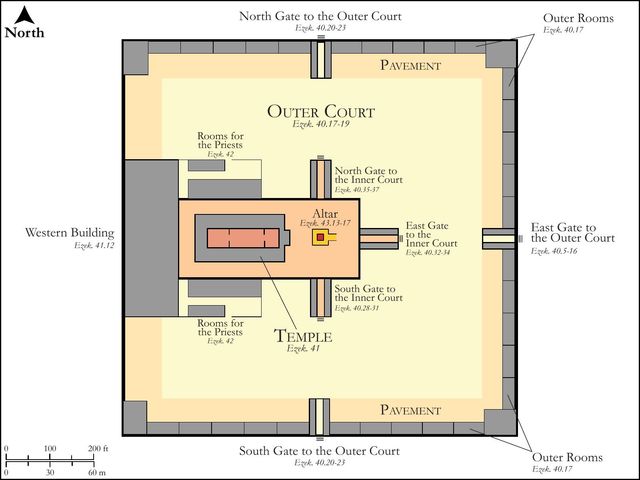
Ezekiel 40:21 provides a detailed architectural description of one of the gates within the visionary temple complex revealed to the prophet Ezekiel. It meticulously outlines the arrangement of "little chambers," posts, and arches, specifying their dimensions—fifty cubits in length and twenty-five cubits in breadth—and confirming their consistency with the design of the "first gate" previously described. This precise accounting of features and measurements underscores the divine origin, perfect order, and grand scale of the future temple, serving as a profound symbol of God's unwavering faithfulness and His meticulous plan for the restoration of His people and His sacred dwelling place among them.
Context
ShowHideLiterary Context
Ezekiel 40 initiates a significant literary shift within the book, introducing an extensive and intricate vision of a new temple, spanning chapters 40-48. This visionary journey commences in Ezekiel 40:1 with Ezekiel's supernatural transportation to a towering mountain in Israel, where he encounters a celestial guide equipped with a measuring rod. The subsequent chapters unfold as an exhaustive architectural tour, systematically detailing the outer court gates, the inner court, the temple edifice itself, and the surrounding precincts. Verse 21 specifically describes one of the outer gates, most likely the north gate, by explicitly comparing its features and dimensions to the "first gate," which was the east gate, previously detailed in Ezekiel 40:6-16. This deliberate repetition of measurements and structural elements across multiple gates emphatically highlights a consistent, divinely ordained blueprint that governs the entire complex, emphasizing its unity and perfection.
Historical & Cultural Context
The profound vision of the new temple was bestowed upon Ezekiel in the 25th year of his Babylonian captivity, around 573 BC. This period was marked by deep despair and profound displacement for the exiled Israelites, as Jerusalem and its revered temple lay in ruins, fostering a pervasive sense of abandonment by God. Within this bleak historical backdrop, the detailed and glorious vision of a future temple served as an extraordinary beacon of hope, assurance, and divine faithfulness. It promised a future restoration that transcended mere return to the land, pointing instead to a renewed and intimate relationship with God, centered around His holy dwelling. The meticulous architectural details would have resonated deeply with the exiles, who knew that the temple was built after the LORD's own pattern, directly reflecting divine order and presence. The emphasis on precise measurements further underscored the divine authority and supernatural origin of this blueprint, distinguishing it sharply from any humanly conceived design.
Key Themes
ShowHideThe meticulous description in Ezekiel 40:21 contributes significantly to several overarching themes woven throughout the book of Ezekiel and the broader biblical narrative. Firstly, it powerfully illustrates Divine Precision and Order, demonstrating God's meticulousness in His sovereign plans and His unwavering commitment to perfect order, even amidst human chaos and destruction. Every dimension and feature is divinely ordained, signifying a flawless and unalterable blueprint. Secondly, the entire vision, including these specific details, underscores Future Restoration and Hope, offering a tangible and concrete promise of God's faithfulness to His covenant people, even after severe judgment and exile. This visionary temple stands as a potent symbol of a future era when God's glory would decisively return to dwell among His people, as explicitly affirmed later in Ezekiel 43:4. Lastly, the intricate details emphasize the Sanctity of God's Dwelling Place, reinforcing the profound truth that the space where God's presence resides is inherently holy and set apart, necessitating specific and divinely prescribed arrangements for worship, access, and communion. This vision profoundly prepares the way for a deeper, ultimate understanding of God's presence among His people.
Exposition and Analysis
ShowHideKey Word Analysis
ShowHideFrom the base of a verb meaning "to circumscribe," this noun (H8372) refers to a "room" or "chamber." In the context of the temple gates, these were likely small, enclosed spaces or guardrooms integrated into the gate complex itself, designed to provide areas for security personnel, priestly functions, or storage. The specific mention of "three on this side and three on that side" indicates a precise and symmetrical arrangement of six such chambers, highlighting the functional and ordered design of the gate structure.
Derived from a root meaning "strength," this word (H352) refers to anything strong, specifically a "pilaster" or robust support. In architectural terms, these are the doorposts or jambs—the strong, vertical elements that frame the entrance. Their substantial nature is critical for the structural integrity of the massive gates, emphasizing the strength and durability of the divine construction.
This term (H520) denotes a fundamental unit of linear measurement in Israel, typically based on the length of the forearm. As noted in Ezekiel 40:5, the cubit employed in Ezekiel's vision was a "long cubit," which was a common cubit plus a handbreadth (approximately 20.6 inches or 52.3 cm). The pervasive use of "cubits" throughout the architectural descriptions underscores the precise, quantifiable, and divinely ordained nature of the entire temple blueprint, leaving no ambiguity regarding its dimensions.
Verse Breakdown
ShowHide"And the little chambers thereof were three on this side and three on that side"
This clause meticulously describes the symmetrical layout of six small rooms or guard chambers integrated within the gate structure. These chambers, three positioned on each side of the gate passage, would have served various practical purposes essential to the temple's operation and security, illustrating the thoughtful and functional design embedded within the sacred space.
"and the posts thereof and the arches thereof were after the measure of the first gate"
This phrase emphatically highlights the consistency and uniformity of design and measurement throughout the visionary complex. The "posts" (doorjambs) and "arches" (likely referring to pillar-spaces or porticoes) of this specific gate—presumed to be the north gate—were identical in dimension and form to those of the "first gate," which was the east gate described earlier in the chapter. This deliberate repetition reinforces the singular, divinely inspired origin and perfect consistency of the entire temple blueprint.
"the length thereof was fifty cubits, and the breadth five and twenty cubits"
This final clause provides the overall dimensions of the gate complex itself. A length of fifty cubits (approximately 86 feet or 26.15 meters) and a breadth of twenty-five cubits (approximately 43 feet or 13.07 meters) indicate a structure of immense scale and imposing presence. These substantial dimensions reflect the grandeur, significance, and sacredness of the visionary temple, underscoring its divine origin and purpose.
Literary Devices
ShowHideThe primary literary device at play in Ezekiel 40:21, and indeed pervasive throughout chapters 40-48, is Hyper-realism or Detailed Description. The prophet provides an almost overwhelming amount of specific measurements and intricate architectural features, creating an exceptionally vivid, almost tangible mental image of the temple. This meticulous detail serves to underscore the Divine Precision of God's plans, suggesting that every aspect of His future dwelling place is perfectly ordered and divinely ordained, leaving no room for human error or improvisation. The Repetition of phrases like "after the measure of the first gate" reinforces the consistency, uniformity, and unchangeable nature of the divine blueprint. Furthermore, the entire vision functions as profound Symbolism, where the physical temple represents God's renewed presence, His absolute holiness, and the complete restoration of His covenant relationship with Israel. The gate itself, with its chambers and imposing dimensions, symbolizes both the controlled access to and the divine protection of the sacred space.
Theological and Thematic Connections
ShowHideEzekiel 40:21, with its emphasis on precise measurements and consistent design, powerfully communicates God's character as a God of order, intention, and meticulous planning. This divine precision in the blueprint of a future temple speaks profoundly to His unwavering faithfulness in fulfilling His promises of restoration, even when circumstances appear chaotic and utterly hopeless. The detailed nature of the vision serves to assure the exiled Israelites that God's future plans are not vague aspirations but concrete, certain realities, deeply rooted in His unchanging nature and perfect wisdom. The physical temple, though never fully realized in the exact form described, serves as a profound type and shadow, pointing to a greater spiritual reality of God's dwelling among His people. It foreshadows the ultimate spiritual temple, built not of stone, but of living stones, where God's presence truly resides in an even more profound way.
Reflection and Application
ShowHideThe overwhelming detail of Ezekiel's temple vision, including the precise dimensions of its gates, offers profound spiritual lessons for believers today. It serves as a powerful reminder that God is a God of order, purpose, and intentionality in all His dealings. Even in seasons of personal or communal desolation, when life feels chaotic, plans seem shattered, and hope appears distant, this passage assures us that God is actively at work with a meticulous blueprint for restoration, renewal, and blessing. This vision encourages us to cultivate an unshakeable trust in God's sovereign design, knowing that His plans are perfect and purposeful, even if we cannot fully grasp every intricate detail. Just as the visionary temple was designed for God's glory and the manifestation of His presence, our individual lives and the collective church are called to reflect His divine order and holiness. We are invited to align ourselves with His divine architecture, seeking to build our lives and communities according to His standards, knowing that true flourishing and spiritual vitality come from living in accordance with His perfect and revealed will. The call to precision embedded in the ancient temple blueprint foreshadows the call to intentionality, purity, and holiness in the lives of God's people today, who are themselves the very dwelling place of the Holy Spirit.
Questions for Reflection
ShowHideFAQ
ShowHideWhat is the significance of the "cubit" measurement in Ezekiel's vision?
ShowHideThe cubit was a standard unit of measurement in Israel, typically based on the length of a forearm. However, Ezekiel 40:5 explicitly states that the cubit used in this vision was a "long cubit," which was a common cubit plus a handbreadth (approximately 20.6 inches or 52.3 cm), distinguishing it from the common cubit. This larger cubit, consistently applied throughout the vision's architectural descriptions, underscores the grand scale and profound divine significance of the visionary temple. It suggests that this temple is not merely a human construction but a divinely revealed blueprint, exceeding typical human standards and emphasizing its sacred, supernatural origin and purpose.
Why does Ezekiel's vision contain such exhaustive architectural details? Is it meant to be built literally?
ShowHideThe exhaustive architectural details in Ezekiel's vision serve multiple profound purposes. Firstly, they powerfully validate the divine origin of the vision, demonstrating God's meticulousness, perfect order, and comprehensive planning. Such precision would have provided immense assurance to the exiled Israelites that God's promises of restoration were concrete and certain, not vague hopes. Secondly, the details emphasize the sanctity and absolute holiness of God's dwelling place, setting it apart from all other structures and underscoring the reverence due to His presence. While some scholars interpret the vision as a literal blueprint for a future temple to be built, many others understand it as a highly symbolic representation of God's renewed presence among His people, the restoration of true and pure worship, and the ultimate spiritual reality of the New Covenant. The sheer scale and ideal nature of the temple, combined with the historical context, suggest a symbolic rather than strictly literal fulfillment, pointing instead to the spiritual temple found in Christ and His Church.
Christ-Centered Fulfillment
ShowHideThe meticulous detail of Ezekiel 40:21, describing the precise dimensions and features of the temple gates, finds its ultimate and most profound fulfillment in the person and work of Jesus Christ. While the visionary temple represented God's fervent desire to dwell among His people in a physical structure, it was ultimately a shadow, a type pointing to the greater spiritual reality to come. Jesus Himself declared, "Destroy this temple, and in three days I will raise it up," clearly referring to the temple of His own body (John 2:19-21). Christ is the ultimate dwelling place of God, the one in whom "all the fullness of the Deity lives in bodily form" (Colossians 2:9). The precise measurements of Ezekiel's gates, designed for ordered access and sacred protection, foreshadow Christ as the "gate" or "door" through whom humanity gains true and eternal access to God the Father (John 10:9). He is the one who perfectly embodies the divine order, holiness, and glory that the visionary temple represented. Furthermore, through Christ's atoning work and the indwelling of His Spirit, believers are incorporated into a spiritual temple, becoming "living stones" built into a "spiritual house" for God's dwelling by the Spirit (1 Peter 2:5). Thus, the detailed blueprint of Ezekiel's temple ultimately points to the perfect, divinely ordained reality of God's presence in Christ and His church, where the glory of the Lord truly dwells in an unprecedented and eternal way.