


Ezekiel 40:36
Bible text: King James Version (1769 Blayney text) · Public domain
Bible text: King James Version with Strong's numbers · Public domain
Bible text: Berean Standard Bible · Public domain
Bible text: American Standard Version (1901) · Public domain
Bible text: World English Bible, Messianic edition · Public domain
Bible text: Geneva Bible (1599) · Public domain
Bible text: Young's Literal Translation · Public domain
- תָּאָיוta·'ovits chambersH8372N-mpc ¦ 3msNoun Plural Masculine Constructתָּאָיchambersוits
- אֵלָיו'e·lovits pillarsH352N-mpc ¦ 3msNoun Plural Masculine Constructאֵלָיpillarsוits
- וְאֵלַמָּיוve·'e·la·movand its porchesH361Conj-w ¦ N-mpc ¦ 3msNoun Plural Masculine Constructוְandאֵלַמָּיporchesוits
- וְחַלּוֹנוֹתve·cha·lo·Notand windowsH2474Conj-w ¦ N-fpNoun Plural Feminine Absoluteוְandחַלּוֹנוֹתwindows
- לוֹlo[belonged] to itPrep-l ¦ 3msSuffix Personal 3rd Singular Masculineל[belonged] toוֹit
- סָבִיבsa·Vivall aroundH5439N-csNoun Singular common gender Absolute
- סָבִיבsa·Vivall aroundH5439N-csNoun Singular common gender Absolute
- אֹרֶךְ'O·rekh[the] lengthH753N-msNoun Singular Masculine Absolute
- חֲמִשִּׁיםcha·mi·Shim[was] fiftyH2572Adj-mpAdjective Numerical Plural Masculine Absolute
- אַמָּה'a·Mahcubit[s]H520N-fsNoun Singular Feminine Absolute
- וְרֹחַבve·Ro·chavand [the] breadthH7341Conj-w ¦ N-msNoun Singular Masculine Absoluteוְandרֹחַב[the] breadth
- חָמֵשׁcha·Mesh[was] fiveH2568Adj-csAdjective Numerical Singular common gender Absolute
- וְעֶשְׂרִיםve·'es·Rimand twentyH6242Conj-w ¦ Adj-mpAdjective Numerical Plural Masculine Absoluteוְandעֶשְׂרִיםtwenty
- אַמָּה'a·Mahcubit[s]H520N-fsNoun Singular Feminine Absolute
English is a literal word-by-word gloss of the Hebrew, not the KJV's wording. Why?
This is the original text the KJV's translators worked from — each Hebrew word with its own literal English meaning in this verse, prepared by scholars at Tyndale House, Cambridge. The KJV translates whole sentences, not word by word, so its wording differs: one Hebrew word can become several English words, and the KJV may choose “the LORD” where the gloss reads “Yahweh”. Both are faithful — they answer different questions. For the KJV's own rendering, switch to the KJV text.
Details
See on the biblical-era map
Study this verse
Public-domain commentary
Matthew Henry
From his Commentary on the Whole Bible. Henry comments on passages, not single verses — this entry covers Ezekiel 40:27–38.
In these verses we have a delineation of the inner court. The survey of the outer court ended with the south side of it. This of the inner court begins with the south side (Eze 40:27), proceeds to the east (Eze 40:32), and so to the north (Eze 40:35); for here is no gate either of the outer or inner court towards the west. It should seem that in Solomon's temple there were gates westward, for we find porters towards the west, Ch1 9:24; Ch1 26:8. But Josephus says that in the second temple there was no gate on the west side. Observe, 1. These gates into the inner court were exactly uniform with those into the outer court, the dimensions the same, the chambers adjoining the same, the galleries or rows round the court the same, and the very engravings on the posts the same. The work of grace, and its workings, are the same, for substance, in grown Christians that they are in young beginners, only that the former have got so much nearer their perfection. The faith of all the saints is alike precious, though it be not alike strong. There is a great resemblance between one child of God and another; for all they are brethren and bear the same image. 2. The ascent into the outer court at each gate was by seven steps, but the ascent into the inner court at each gate was by eight steps. This is expressly taken notice of (Eze 40:31, Eze 40:34, Eze 40:37), to signify that the nearer we approach to God the more we should rise above this world and the things of it. The people, who worshipped in the outer court, must rise seven steps above other people, but the priests, who attended in the inner court, must rise eight steps above them, must exceed them at least one step more than they exceed other people.
Historical interpretation
Two Centuries of Reception
2 surviving comments on this verse. Each one is dated, so this reads as a timeline rather than a list.
Select a marker to jump to its quote. Markers stagger vertically where authors wrote within a few decades of each other.
(Verse 35 and following) 'And he brought me to the gate that faced the north, and he measured it according to the higher measurements: its chamber, its facade, its vestibule, and its windows all around: it was fifty cubits long and twenty-five cubits wide. Its vestibule faced the outer court, and its palm tree engravings on its facade on both sides, and its staircase with eight steps.' And at each treasury there shall be a door in the gates (or fronts) of the doors: there they shall wash the holocaust. And at the entrance of the gate, there shall be two tables on this side, and two tables on that side, upon which the holocaust shall be immolated, and for sin, and for trespass. And on the outer side, which goes to the gate that leads to the north, there shall be two tables, and on the other side, before the vestibule of the gate, there shall be two tables. Four tables on this side, and four tables on that side: by the sides of the gate, there were eight tables, upon which they shall immolate (or used to immolate): but there were four tables for holocaust made of square stones, of one cubit and a half long, and of one cubit and a half wide, and of one cubit high, upon which the vessels were laid in which the holocaust and the victims are immolated. And their lips were a cubit long, turned inward all around; but on the tables were the flesh of the offering.» There is much disagreement in this testimony between the Hebrew Truth and the edition of the Seventy Interpreters. For what we have said: There they shall wash the burnt offering, and in the vestibule of the gate there are two tables on this side, and again: That the burnt offering and the sin offering be offered on them, is not found in the Seventy, but it is added in many copies from Theodotion. Again, when we said: And their lips turned inward by one palm's measure all around, Seventy translated it, and having the measurement of a span all around. Whether this word is Hebrew or Greek, we cannot know, except only that for 'gisum,' Symmachus and Theodotion translated it as 'lips,' Aquila's first edition translated it as 'ἐπιστάσεις' in the plural number; the second translated it as 'lips': for which in Hebrew it is written as 'Asephathaim'(). And when we say, above the tables however the meats of the offering, the Seventy put from their own, and they put coverings on the tables from above, so that they may be protected from rain and dryness. But that which they have given in Hebrew names, Thee, and Elau, and Elalamoth, and Aelam, what it signifies, and we have shown above, and our translation can show from the context: it is not necessary to often remind the reader about this, and to doubt their prudence and effort. Therefore, he is brought again to the gate that looked towards the North: but not as before to the outer courtyard, but to the inner one. For in what follows it is said: Its vestibule looked towards the outer courtyard, showing that this courtyard was inside. Through this, the progress of the one entering is shown; for in each place there are specific names and measures, and windows all around filled with the light of knowledge, showing all things, and through fifty and twenty-five cubits are the sacraments of divine sense and remission placed, as positioned in the vestibule of the inner courtyard, that we may see the exterior: contemplating knowledge of past and present, through which we may come to double palms and victories, and understand the mysteries of the eight degrees, having entered the treasuries, in which the riches of the temple are contained, and our prayers are cleansed from all the filth of sin; and tables are placed on both sides, so that the burnt offering may be first offered.
The diligent shepherd follows the custom of his father, and Gesaque, the barker of Sydon, etc., all of which the sacred fire consumes, first for sin, and finally for ignorance: whether we commit them knowingly or unknowingly. On the outer side, next to the Seventy, there was a man-made stream that carried away the ashes of the burnt offering and the harmfulness of the flesh externally: either there were two tables, and on the other side of the vestibule of the same gate there were two tables, that is, four on each side, four here and four there, and behind, or on the side of these there were eight other tables, so that they make a total of sixteen tables: by this number the mysteries of the prophets are shown, so that whatever we offer through the Gospel dispensation, we may affirm as foretold by their prophecies. And there are four tables made of square stones, and these themselves are for sacrifice and burnt offering (also called holocausts). These are living stones that are rolled upon the earth, and they have with them a corner stone, by which the walls of the old and new Covenant are held together. Now the number four signifies the Gospel sacraments, having in length and width one and a half cubits, that is, a square, which, when joined together, make three cubits, which three cubits have one cubit in height, so that the mysteries of the Trinity may preserve the measure of one cubit, that is, the divine majesty, as the Lord tells the disciples: Go, baptize all nations in the name of the Father, and of the Son, and of the Holy Spirit (Matthew 28:19). The name of God, as it were, is of one (or, one) cubit in height, which encompasses three properties, and always accepts the holocaust offerings of our oblations. Above these, however, are four tables of holocausts built with living stones, the length, width, and height of which have been described; vessels are placed in them in which the holocaust of the martyrs is offered, of whom it is said: Precious in the sight of the Lord is the death of his saints (Ps. 116:15); and their victims, who, through self-control and the holiness of their bodies, offer their souls as a sacrifice to the Lord. I believe that the meaning of these tables is contained in the books of Matthew, Luke, Mark, and John, which are about the apostles. Above these tables there was a curved crown on the inside, encircling the edges, to contain the sacrificial offerings and prevent them from flowing freely. It also held the meat of the offering, or as the Septuagint translated: 'And the tables themselves were covered on top, because of the violence of the rain and the excessive dryness of the summer sun, so that the meat placed on top could say with the prophet: “By day the sun will not harm us nor the moon by night."' (Psalm 121:6). One of which, with excessive rains and storms, dissolves the offerings of tribulations; the other, with violent heat, dries up whatever has been offered. Forgive me, reader, for the difficulty of the places; or if you can find something better, teach us: we gladly learn what we do not know.
"And its windows round about, fifty cubits in length, and twenty-five cubits in width." But because our discourse has led us to the resurrection of the flesh, it is exceedingly sad and greatly lamentable that we know some stand in the Church and yet doubt the resurrection of the flesh. The ancient fathers most certainly believed this would come, even when they held no example yet of that same resurrection. With what condemnation, therefore, are those worthy who have already received the example of the Lord's resurrection, and yet still distrust their own resurrection? They hold the pledge, and have not faith. They fill the Church, but because they doubt their own resurrection, they stand with empty minds. Concerning this resurrection it is said through blessed Job: "I know that my Redeemer lives, and on the last day I shall rise from the earth, and again I shall be clothed with my skin, and in my flesh I shall see God; whom I myself shall see, and my eyes shall behold, and not another." Hence also through the Psalmist it is said: "In his sight all who descend into the earth fall prostrate." For the dead descend into the earth not in spirit, but in body. Therefore those who descend into the earth fall prostrate in the sight of the Lord, because those who now rot in dust come to judgment by rising again.
Continue studying Ezekiel 40:36 across the web’s major study libraries — every link below opens this exact verse, chapter, or book on the destination site.
Read & Compare
 BibleGatewayThis verse in more than 200 translations and 70 languages.
 Bible.comThe YouVersion reader — hundreds of translations, reading plans, and highlights.
 ESV.orgCrossway's official English Standard Version reader.
 NET BibleThe NET translation with 60,000+ translators' notes on every rendering decision.
 STEP BibleTyndale House's free study tool — original text, vocabulary, and scholarly resources.
 BibliaLogos Bible Software's free web reader.
 USCCBThe New American Bible (Revised Edition) with the U.S. bishops' study notes.
Commentaries
 BibleHub CommentariesDozens of classic commentaries on this verse, gathered on one page.
 StudyLightMore than 100 commentary sets — the largest collection on the web.
 BibleRefPlain-English commentary on what this verse means, verse by verse.
 Enduring WordDavid Guzik's free commentary on this chapter, widely used by Bible teachers.
 Bible Study ToolsVerse commentary alongside Greek and Hebrew study aids.
Original Language & Research
- BibleHub InterlinearThe verse word by word — original language, transliteration, and English.
- BibleHub LexiconEvery word's original-language definition and Strong's entry.
 Blue Letter BibleDeep-study tools — Strong's numbers, concordance, and word studies.
 SefariaThe Hebrew text with Rashi and centuries of Jewish commentary.
Sermons, Hymns & Audio


TrulyRandomVerse is not affiliated with these sites and doesn’t control their content. They’re linked because they’re genuinely useful.
Summary
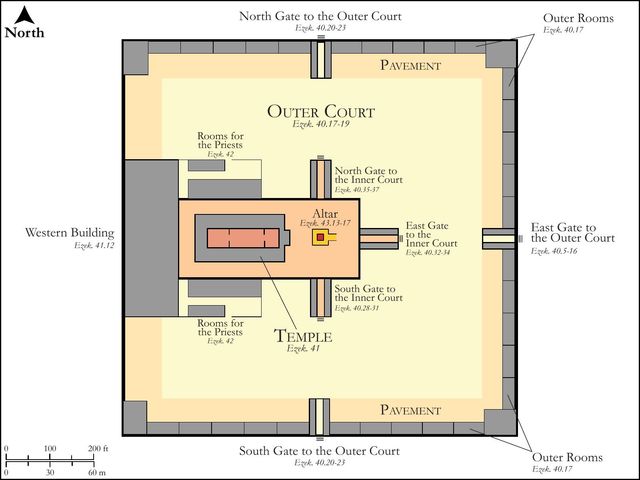
Ezekiel 40:36 offers a meticulously detailed architectural description of specific components within the visionary temple complex, delineating the "little chambers," "posts," "arches," and "windows" of a gate structure, along with its precise dimensions of fifty cubits in length and twenty-five cubits in breadth. This verse is an integral part of a larger divine blueprint, emphasizing God's perfect order, His unwavering commitment to Israel's future restoration, and the profound sacredness of His dwelling place, all communicated with an extraordinary level of precision and detail.
Context
ShowHideLiterary Context
Ezekiel 40:36 is situated within the expansive and highly detailed temple vision that dominates Ezekiel chapters 40-48. This grand vision commences with Ezekiel being transported by God's hand to a very high mountain, where he encounters a man with a measuring rod, commanded to show all he sees to the house of Israel (Ezekiel 40:1-4). Chapter 40 specifically focuses on the outer court and its gates, beginning with a meticulous description of the eastern gate, its guardrooms, and precise dimensions (Ezekiel 40:6-16). Verse 36, along with its surrounding verses, continues this precise architectural description, likely detailing one of the other gate structures (the north gate, as described in Ezekiel 40:20-23, or the south gate, in Ezekiel 40:24-27). The consistent use of exact measurements throughout these chapters underscores the divine precision and the tangible reality of the entire vision, setting the stage for the return of God's glory to this new, perfect sanctuary.
Historical & Cultural Context
The vision of the new temple was granted to the prophet Ezekiel around 573 BC, approximately fourteen years after the devastating destruction of the First Temple in Jerusalem by the Babylonians in 586 BC, and while Ezekiel himself was in exile in Babylon (Ezekiel 1:1-3). For the exiled Jewish people, who had endured the loss of their land, their monarchy, and the physical manifestation of God's presence in the temple, this vision served as an unparalleled source of hope and divine reassurance. It promised a future restoration, a return to the land, and, most significantly, the glorious return of God's presence to a new, perfectly ordered dwelling place. The emphasis on precise measurements and architectural details would have resonated deeply with a culture that understood the temple as the central axis of their religious, social, and national identity, where every detail was believed to reflect divine order and holiness. The "cubit" was a common unit of measure in the architecture of Israel, but Ezekiel's vision specifies a "long cubit" (a cubit and a handbreadth, approximately 20.6 inches), emphasizing the grand scale and unique, divinely ordained nature of this blueprint (Ezekiel 40:5).
Key Themes
ShowHideThe meticulous descriptions in Ezekiel 40, including verse 36, powerfully convey several major theological themes central to the book of Ezekiel and the broader biblical narrative. First, they underscore Divine Precision and Order, demonstrating God's absolute sovereignty and meticulous planning for His people and His dwelling place. Every measurement and architectural feature, no matter how minute, reflects a divine blueprint, not a human one, signifying God's complete control and purposeful design. Second, the vision offers profound Future Hope and Restoration for a disheartened people. The detailed portrayal of a glorious, perfectly ordered temple symbolized God's unwavering faithfulness to His covenant promises and His intention to restore Israel to a place of blessed communion and worship, where His presence would once again dwell among them (Ezekiel 43:1-5). Third, the intricate design and the strict adherence to measurements highlight the concept of Holiness and Sacred Space. The various courts, chambers, and precise dimensions served to define and protect the sanctity of God's presence, emphasizing the separation required for the worship of a holy God and the necessity of purity for those who would draw near to Him, echoing the divine command for holiness throughout the Old Testament (Leviticus 11:44-45).
Exposition and Analysis
ShowHideKey Word Analysis
ShowHideThis term (H8372) refers to a room or cell, specifically a circumscribed space. In the context of the visionary temple, these "little chambers" were integral components of the gate complex, likely serving various functions such as guardrooms, storage for temple implements or offerings, or lodging for priests. Their inclusion emphasizes the functional, organized, and practical nature of the divine blueprint.
Derived from a root meaning "strength" (H352), this word denotes a strong support, specifically a pilaster or doorpost. These were robust architectural elements providing structural integrity to the gates and chambers. Their mention highlights the solidity, durability, and enduring nature of the divinely ordained structure, signifying stability and permanence.
This (H520) is the standard unit of measurement in Israel, typically the length from the elbow to the fingertips. Crucially, Ezekiel's vision specifies a "long cubit" (approximately 20.6 inches), indicating a larger scale than the common cubit. The precise enumeration of "fifty cubits" for length and "five and twenty cubits" for breadth underscores the exactness and divine origin of the temple's blueprint, leaving no room for human approximation or error.
Verse Breakdown
ShowHide"The little chambers thereof, the posts thereof, and the arches thereof, and the windows to it round about:"
This opening clause meticulously lists the architectural features of a specific section of the temple complex, most likely one of the grand gate structures. The "little chambers" (or guardrooms/side rooms) were integral to these gates, potentially serving as quarters for guards, storage, or rooms for priestly functions. The "posts" were the strong, vertical supports, providing structural stability. The "arches" (or porticoes/colonnades) provided covered walkways or entrances, adding to the grandeur and functionality. The presence of "windows to it round about" indicates that these were not merely solid blocks but functional, well-designed spaces allowing for light and ventilation. The repetitive "thereof" strongly links each element directly to the larger gate or structure being described, emphasizing their integrated and essential relationship within the grand design.
"the length [was] fifty cubits,"
This specifies the primary dimension of the described structure. Fifty cubits, utilizing the longer Ezekielian cubit (approximately 20.6 inches), translates to roughly 85.8 feet (26.15 meters), indicating a substantial length for this section of the temple. This precise measurement highlights the scale and importance of the structure.
"and the breadth five and twenty cubits."
This provides the secondary dimension, indicating the width of the structure. Twenty-five cubits, or half the length, translates to approximately 42.9 feet (13.07 meters). The exactness of these measurements, down to specific cubits, underscores the divine precision and the non-negotiable nature of God's architectural plan, signifying its divine origin and absolute authority.
Literary Devices
ShowHideEzekiel 40:36, like much of Ezekiel's temple vision, is dominated by Architectural Imagery and Detailed Enumeration. The prophet meticulously lists specific structural components—chambers, posts, arches, windows—and provides their precise dimensions. This extreme Precision is itself a powerful literary device, conveying a sense of divine authority, absolute control, and the tangible reality of the vision. It is not a vague dream but a concrete, divinely ordained blueprint. The Repetition of "thereof" (e.g., "chambers thereof, the posts thereof") serves to link each element directly to the larger structure being described, emphasizing their integrated and functional relationship within the grand design. Furthermore, the entire passage is a prime example of Visionary Literature, where a profound divine encounter is translated into highly specific, tangible details, making the abstract concept of God's future dwelling place concrete and comprehensible for the exiles. This detailed description also functions as Symbolism, where the perfect order, precise measurements, and intricate design of the temple represent God's perfect order, His sovereignty, and the future restoration of a holy, ordered community in right relationship with Him.
Theological and Thematic Connections
ShowHideEzekiel 40:36, with its painstaking detail, serves as a profound theological statement about the nature of God and His relationship with His people. The divine architect's meticulous planning of every chamber, post, and window underscores God's absolute sovereignty and His profound attention to detail, not only in the physical structure of a temple but also in His overarching redemptive plan for humanity. For the exiles, this vision was a tangible promise of future hope, signaling that God had not abandoned them but was preparing a new, glorious dwelling place where His presence would return in fullness. The precision speaks to the holiness required for God's presence and the order He desires for His people's worship and lives. It also foreshadows the ultimate spiritual reality where God dwells among His people, not in a building made with hands, but in a living, spiritual temple, emphasizing the transition from a physical dwelling to a spiritual one.
Reflection and Application
ShowHideEzekiel 40:36 invites us to marvel at God's incredible precision and His deep care for order, even in the minute details of a visionary building. For the exiled Israelites, this detailed blueprint was a profound assurance that God had not forgotten them, that His promises were sure, and that a future of restoration and renewed communion awaited them. For us today, this passage reminds us that God is a God of intentionality and purpose; nothing about His plans is haphazard or accidental. This should inspire profound confidence in His divine providence, knowing that He meticulously orchestrates even the smallest details of our lives and the grand narrative of redemption. It challenges us to consider the "architecture" of our own lives—are we built with the same intentionality and order that God desires? Do we recognize our bodies as temples of the Holy Spirit, called to holiness and precise obedience in every area? The vision of a perfectly ordered sacred space also calls us to consider the order and holiness of our corporate worship and community life, striving to reflect God's character in every aspect, ensuring that our lives collectively and individually are a fitting dwelling place for His Spirit.
Questions for Reflection
ShowHideFAQ
ShowHideWhat is the significance of the precise measurements in Ezekiel's temple vision?
ShowHideThe precise measurements, like those found in Ezekiel 40:36, are highly significant for several reasons. First, they underscore the divine origin of the vision, indicating that this was not a human construct but a direct, authoritative revelation from God. The exactness removes any ambiguity and highlights God's perfect design. Second, for the exiled Israelites, it offered concrete hope and assurance of a future restoration; the temple was not a vague dream but a detailed blueprint, implying its eventual reality and God's faithfulness to His covenant. Third, the precision emphasizes God's order and holiness. Every dimension and feature contributed to creating a sacred space set apart for a holy God, demonstrating that God is a God of order who demands reverence and purity from those who approach Him. Finally, it serves as a powerful literary device, lending credibility and weight to the prophetic message, making the visionary temple feel tangible and real.
Was Ezekiel's temple vision meant to be built literally?
ShowHideThe interpretation of Ezekiel's temple vision, including the detailed descriptions in Ezekiel 40, is one of the most debated topics in biblical scholarship. Some interpretations suggest it describes a literal temple to be built in the future (often called the Millennial Temple), given the extreme detail and the specific measurements. Others view it as a symbolic representation of the ideal spiritual community (the Church) or a heavenly reality, emphasizing its theological rather than its literal architectural significance. Still others see it as a blueprint for a restored Israel that was never fully realized due to the people's disobedience, or a blend of literal and symbolic elements. Regardless of the literal interpretation, its immediate impact on the exiles was to provide profound hope and a vivid vision of God's future dwelling among His people, reinforcing His enduring covenant promises.
Christ-Centered Fulfillment
ShowHideWhile Ezekiel's temple vision provides a detailed blueprint for a physical structure, its ultimate fulfillment and profound spiritual significance are found preeminently in Jesus Christ. The meticulous design and precise measurements of the temple in Ezekiel 40:36, emphasizing God's desire for a perfect, holy dwelling place among His people, find their ultimate reality in Christ Himself. Jesus declared, "Destroy this temple, and in three days I will raise it up," referring to the temple of His own body (John 2:19-21). He is the true and ultimate dwelling place of God, the full embodiment of divine presence and glory, surpassing any physical structure. Furthermore, Christ's sacrificial death on the cross opened the way for believers to become a "spiritual house" and a "holy priesthood" (1 Peter 2:5), forming the new temple where God's Spirit dwells through Him (Ephesians 2:19-22). The detailed order of Ezekiel's temple thus foreshadows the perfect order, holiness, and accessibility to God established by Christ, who serves as our Great High Priest in the heavenly sanctuary, offering a superior sacrifice that truly cleanses and grants eternal access to God's presence (Hebrews 9:11-14). Therefore, the precise dimensions of the visionary temple point to the perfect, unblemished nature of Christ and the new covenant community established through Him, where God's presence is not confined to chambers or posts, but intimately indwells His redeemed people by the Spirit.