


Ezekiel 40:14
Bible text: King James Version (1769 Blayney text) · Public domain
Bible text: Berean Standard Bible · Public domain
Bible text: American Standard Version (1901) · Public domain
Bible text: World English Bible, Messianic edition · Public domain
Bible text: Geneva Bible (1599) · Public domain
Bible text: Young's Literal Translation · Public domain
- וַיַּעַשׂvai·Ya·'asand he madeH6213Conj-w ¦ V-Qal-ConsecImperf-3msVerb Qal Consecutive Imperfect 3rd Singular Masculineוַandיַּעַשׂhe made
- אֶת'et<obj.>H853DirObjMParticle Object Indicator
- אֵילִים'ei·LimpillarsH352N-mpNoun Plural Masculine Absolute
- שִׁשִּׁיםshi·ShimsixtyH8346Adj-mpAdjective Numerical Plural Masculine Absolute
- אַמָּה'a·Mahcubit[s]H520N-fsNoun Singular Feminine Absolute
- וְאֶלve·'eland [was] toH413Conj-w ¦ PrepPrepositionוְandאֶל[was] to
- אֵיל'eila pillarH352N-mscNoun Singular Masculine Construct
- הֶחָצֵרhe·cha·Tzerthe courtyardH2691Art ¦ N-csNoun Singular common gender Absoluteהֶtheחָצֵרcourtyard
- הַשַּׁעַרha·Sha·'arthe gateH8179Art ¦ N-msNoun Singular Masculine Absoluteהַtheשַּׁעַרgate
- סָבִיבsa·Vivall aroundH5439N-csNoun Singular common gender Absolute
- סָבִיבsa·Vivall aroundH5439N-csNoun Singular common gender Absolute
English is a literal word-by-word gloss of the Hebrew, not the KJV's wording. Why?
This is the original text the KJV's translators worked from — each Hebrew word with its own literal English meaning in this verse, prepared by scholars at Tyndale House, Cambridge. The KJV translates whole sentences, not word by word, so its wording differs: one Hebrew word can become several English words, and the KJV may choose “the LORD” where the gloss reads “Yahweh”. Both are faithful — they answer different questions. For the KJV's own rendering, switch to the KJV text.
Details
See on the biblical-era map
Study this verse
Public-domain commentary
Matthew Henry
From his Commentary on the Whole Bible. Henry comments on passages, not single verses — this entry covers Ezekiel 40:5–26. His three-level outline is real structure in the source text, so it is rendered as structure.
The measuring-reed which was in the hand of the surveyor-general was mentioned before, Eze 40:3. Here we are told (Eze 40:5) what was the exact length of it, which must be observed, because the house was measured by it. It was six cubits long, reckoning, not by the common cubit, but the cubit of the sanctuary, the sacred cubit, by which it was fit that this holy house should be measured, and that was a hand-breadth (that it, four inches) longer than the common cubit: the common cubit was eighteen inches, this twenty-two, see Eze 43:13. Yet some of the critics contend that this measuring-reed was but six common cubits in length, and one handbreadth added to the whole. The former seems more probable. Here is an account,
I.Of the outer wall of the house, which encompassed it round, which was three yards thick and three yards high, which denotes the separation between the church and the world on every side and the divine protection which the church is under. If a wall of this vast thickness will not secure it, God himself will be a wall of fire round about it; whoever attack it will do so at their peril.
II.Of the several gates with the chambers adjoining to them.
Here is no mention of the outer court of all, which was called the court of the Gentiles, some think because in gospel-times there should be such a vast confluence of Gentiles to the church that their court should be left unmeasured, to signify that the worshippers in that court should be unnumbered, Rev 7:9, Rev 7:11, Rev 7:12.
1.He begins with the east gate, because that was the usual way of entering into the lower end of the temple, the holy of holies being at the west end, in opposition to the idolatrous heathen that worshipped towards the east. Now, in the account of this gate, observe,
(1.)That he went up to it by stairs (Eze 40:6), for the gospel-church was exalted above that of the Old Testament, and when we go to worship God we must ascend; so is the call, Rev 4:1. Come up hither. Sursum corda - Up with your hearts.
(2.)That the chambers adjoining to the gates were but little chambers, about ten feet square, Eze 40:7. These were for those to lodge in who attended the service of the house. And it becomes such as are made spiritual priests to God to content themselves with little chambers and not to seek great things to themselves; so that we may but have a place within the verge of God's court we have reason to be thankful though it be in a little chamber, a mean apartment, though we be but door-keepers there.
(3.)The chambers, as they were each of them four-square, denoting their stability and due proportion and their exact agreement with the rule (for they were each of them one reed long and one reed broad), so they were all of one measure, that there might be an equality among the attendants on the service of the house.
(4.)The chambers were very many; for in our Father's house there are many mansions (Joh 14:2), in his house above, and in that here on earth. In the secret of his tabernacle shall those be hid, and in a safe pavilion, whose desire is to dwell in the house of the Lord all the days of their life, Psa 27:4, Psa 27:5. Some make these chambers to represent the particular congregations of believers, which are parts of the great temple, the universal church, which are, and must be, framed by the scripture-line and rule, and which Jesus Christ takes the measure of, that is, takes cognizance of, for he walks in the midst of the seven golden candle-sticks.
(5.)It is said (Eze 40:14), He made also the posts. He that now measured them was the same that made them; for Christ is the builder of his church and therefore is best able to give us the knowledge of it. And his reducing them to the rule and standard is called his making them, for no account is made of them further than they agree with that. To the law and to the testimony.
(6.)Here are posts of sixty cubits, which, some think, was literally fulfilled when Cyrus, in his edict for rebuilding the temple at Jerusalem, ordered that the height thereof should be sixty cubits, that is, thirty yards and more, Ezr 6:3.
(7.)Here were windows to the little chambers, and windows to the posts and arches (that is, to the cloisters below), and windows round about (Eze 40:16), to signify the light from heaven with which the church is illuminated; divine revelation is let into it for instruction, direction, and comfort, to those that dwell in God's house, light to work by, light to walk by, light to see themselves and one another by. There were lights to the little chambers; even the least, and least considerable, parts and members of the church, shall have light afforded them. All thy children shall be taught of the Lord. But they are narrow windows, as those in the temple, Kg1 6:4. The discoveries made to the church on earth are but narrow and scanty compared with what shall be in the future state, when we shall no longer see through a glass darkly.
(8.)Divers courts are here spoken of, an outermost of all, then an outer court, then an inner, and then the innermost of all, into which the priests only entered, which (some think) may put us in mind "of the diversities of gifts, and graces, and offices, in the several members of Christ's mystical body here, as also of the several degrees of glory in the courts and mansions of heaven, as there are stars in several spheres and stars of several magnitudes in the fixed firmament." English Annotations. Some draw nearer to God than others and have a more intimate acquaintance with divine things; but to a child of God a day in any of his courts is better than a thousand elsewhere. These courts had porches, or piazzas, round them, for the shelter of those that attended in them from wind and weather; for when we are in the way of our duty to God we may believe ourselves to be under his special protection, that he will graciously provide for us, nay, that he will himself be to us a covert from the storm and tempest, Isa 4:5, Isa 4:6.
(9.)On the posts were palm-trees engraven (Eze 40:16), to signify that the righteous shall flourish like the palm-tree in the courts of God's house, Psa 92:12. The more they are depressed with the burden of affliction the more strongly do they grow, as they say of the palm-trees. It likewise intimates the saints' victory and triumph over their spiritual enemies; they have palms in their hands (Rev 7:9); but lest they should drop these, or have them snatched out of their hands, they are here engraven upon the posts of the temple as perpetual monuments of their honour. Thanks be to God, who always causes us to triumph. Nay, believers shall themselves be made pillars in the temple of our God, and shall go no more out, and shall have his name engraven on them, which will be their brightest ornament and honour, Rev 3:12.
(10.)Notice is here taken of the pavement of the court, Eze 40:17, Eze 40:18. The word intimates that the pavement was made of porphyry-stone, which was of the colour of burning coals; for the brightest and most sparkling glories of this world should be put and kept under our feet when we draw near to God and are attending upon him. The stars are, as it were, the burning coals, or stones of a fiery colour, with which the pavement of God's celestial temple is laid; and, if the pavement of the court be so bright and glittering, how glorious must we conclude the mansions of that house to be!
2.The gates that looked towards the north (Eze 40:20) and towards the south (Eze 40:24), with their appurtenances, are much the same with that towards the east, after the measure of the first gate, Eze 40:21. But the description is repeated very particularly. And thus largely was the structure of the tabernacle related in Exodus, and of the temple in the books of Kings and Chronicles, to signify the special notice God does take, and his ministers should take, of all that belong to his church. His delight is in them; his eye is upon them. He knows all that are his, all his living temples and all that belongs to them. Observe,
(1.)This temple had not only a gate towards the east, to let into it the children of the east, that were famous for their wealth and wisdom, but it had a gate to the north, and another to the south, for the admission of the poorer and less civilized nations. The new Jerusalem has twelve gates, three towards each quarter of the world (Rev 21:13); for many shall come from all parts to sit down there, Mat 8:11.
(2.)To those gates they went up by steps, seven steps (Eze 40:22-26), which, as some observe, may remind us of the necessity of advancing in grace and holiness, adding one grace to another, going from step to step, from strength to strength, still pressing forward towards perfection - upward, upward, towards heaven, the temple above.
Historical interpretation
Two Centuries of Reception
2 surviving comments on this verse. Each one is dated, so this reads as a timeline rather than a list.
Select a marker to jump to its quote. Markers stagger vertically where authors wrote within a few decades of each other.
(Verse 14 and following) He made fronts for sixty cubits, and the courtyard of the gate had a surrounding circuit. And before the face of the gate, which reached up to the face of the interior vestibule gate, there were fifty cubits, and oblique windows in the chambers, and in their fronts which were inside the gate all around. Similarly, there were windows in the vestibules all around inside: and before the fronts, there was a depiction of palms. LXX: And under the sky was the court of the gate sixty cubits, and the threshold of the court of the gate all round. And under the sky of the court outside was the gate of the inner court fifty cubits, and windows screened with palm trees, and also the threshold of the gate within the court round about. And similarly the gate chambers, and windows all around inside, and the thresholds of the gates were palm trees on both sides." Symmachus interpreted this passage as follows: And he made circuits, which we can call surroundings: for which in Hebrew he has Elim (), which Aquila interpreted as κρίωμα, and we translate as frontiers. Again, where the Seventy placed the entrance of the atrium, in Hebrew it has El () in the singular number, which Symmachus translated as near the entrance, Aquila as κρίωμα, that is, the front of the atrium. Also, under the open sky, Aquila, before the face of the gate's posts; Symmachus, opposite the face of the gate's vestibule, translated. The hidden windows called Atemoth in Hebrew, Symmachus translated as τοξικὰς. And where the Seventy said above the entrance and above the gate's post, Symmachus placed the posts and the surroundings; Aquila, the chambers, and their fronts: for which it is written in Hebrew Theim and Ele. Moreover, Elamoth, which Septuagint and Theodotion also translated similarly; Symmachus translated circumstantias [circumstances], Aquila translated frontes [fronts]. But Aelam, for which it is written El in Hebrew ((Mss. Ul)), is called ostium [door] or porticus [porch]. Also, for palmis [palms], it is written in Hebrew as Thamarim [plural number]: because in the singular number, it calls palmam [palm], Thamar. I know that these things will be annoying to a fastidious reader: but I wanted to show briefly how much the ancient translation differs from the Hebrew truth due to the length of time, or rather the fault of the scribes, and, to speak more openly, our lack of knowledge of Hebrew: especially in Hebrew names, which we have translated from other editions into the Latin language, indicating not so much an explanation of the words as our simple suspicion. However, I think that around the wall of the temple on the outside, and the temple itself in the courtyard, that is, in the middle, there were certain things placed for decoration, which Symmachus interprets as surroundings, that is, certain standing structures, raised high from the ground, and these occupied a space of sixty cubits. And again, as one went out from the inner gate to the front of the vestibule, which faced the outer gate, there were fifty cubits of space, in which there were oblique windows, which Seventy called 'toxicas'. And in these windows were in the chambers, that is, in each room, and in the porticoes that extended before the rooms, measuring fifty cubits. These windows were slanted or arched, therefore they were called 'sagittae', which means 'arrows', because they allow a narrow light to enter the house, like arrows, and expand inward: and all around they were full of such windows. And in front of the facades of the porticoes, he says, there were paintings or carvings of palm trees, through which it is shown at the entrance of the gate, and immediately upon entering, a wall measuring sixty cubits with various ornaments meets, which refer to the condition of the world, so that the Creator may be understood through His creations: and everything in order and with reason, show the variety of the world, which among the Greeks is called 'kosmos', derived from adornment: and it was made in six days, so that each day, ten decades are reckoned, which we have mentioned above as the perfect number. After this, as we enter the inner atrium, we come across before us the vestibule of the inner gate of the bedroom, with oblique windows, occupying a space of fifty cubits, which itself is a sacred number. And after seven full weeks of festivity and joy, the first day of the Octave begins, which is the Day of Resurrection, and it brings us close to the temple. For when we have done all things, repenting for our previous errors, then we become neighbors and close to God, so that in the outer atrium, the order of creatures teaches us knowledge of the Creator with constancy, and in the inner [atrium] true jubilation, in which all our debts are forgiven, instructs us in the theology, and introduces us to the Holy of Holies. It is also worth noting that the inner courtyard has several windows, which are not direct and equal, but rather oblique and narrow on the outside, and widening inward, so that we can penetrate the interior through small openings and reach the fullness of the brightest light, which is present in the temple. Finally, after sixty and fifty cubits, and chambers, and porticoes, and the facades of the porticoes, and numerous windows all around, the carving or painting of palm trees is shown to us, so that as victors of the world, we may become worthy to see the palm trees of virtues.
And he made fronts of sixty cubits, and to the front of the gate was the court on every side round about.
We have often said that perfection of good work is signified by the number six, not following what the wise men of this age have striven to establish, saying that the number six is perfect because it is completed when counted in its own order, as when one, two, three are said, the number six is filled up; or because it is divided into three parts, that is, a sixth, a third, and a half, namely into one, two, and three; but we say that the number six is perfect because, as was said a little before, God completed all His works on the sixth day. Since indeed He gave the law to sinful man, which is written in ten precepts, and six times ten makes sixty, rightly through sixty cubits the perfection of good works is signified. This the Lord also clearly indicates in the Gospel, who, when He was explaining the parable of the sower, said: "Other seed fell on good ground, and yielded fruit that sprang up and increased, and brought forth one thirty, and one sixty, and one a hundred." For the fruit of good ground brings forth thirty when the mind has conceived the perfection of faith, which is in the Trinity. It brings forth sixty when it has produced perfect works of a good life. But it brings forth a hundred when it has advanced to the contemplation of eternal life. For our left hand is the present life, but the right hand is the life to come. And rightly through the number one hundred the contemplation of eternal life is signified, because when after thirty and sixty we arrive by counting at the number one hundred, that same hundredth number passes to the right hand. Faith and works are still on the left hand, because while we are still placed here, we both believe what we do not see, and we work so that we may see. But when the soul has already raised itself to the contemplation of eternal life, the counting, as it were, reaches the right hand. Therefore he made the fronts sixty cubits long. For since perfection is signified by the number sixty, what is signified by the fronts of the building but the very works that are seen outwardly? For to give the word of preaching, to give food to the hungry, clothing to those who are cold, and to endure adversities patiently for the sake of good work—what else are these but the fronts of the heavenly building? Because the beauty of outward works adorns the dwelling place of God, which still lies hidden within. But these fronts have a court all around on every side, because works are great in this regard, if the breadth of charity enlarges them in the mind. Concerning charity it is written: "Your commandment is exceedingly broad." Concerning this the Psalmist again says: "You have set my feet in a spacious place."
But behold, while I speak, it occurs to my mind how broad charity is. If God is reached through charity, and Truth says of itself: Enter through the narrow gate. And again I hear the Psalmist saying: Because of the words of your lips I have kept hard ways. And in the Gospel the Lord says: For my yoke is sweet, and my burden is light. How then is charity broad, if the gate is narrow? Or how is the yoke sweet and the burden light, if in God's precepts the ways that are kept are hard? But charity itself quickly resolves this question for us, because the way of God is narrow for those beginning, and broad for those already living perfectly. And the things we spiritually propose to our mind against habit are hard, and yet God's burden is light, after we have begun to bear it, so that for love of him even persecution is pleasing, and all affliction for his sake comes with sweetness of mind, just as the holy apostles also rejoiced when they endured scourges for the Lord. Therefore that narrow gate becomes broad for those who love, those hard ways become soft and level for those running spiritually; for when the mind knows it will receive eternal joys for temporal pains, it begins to love even that by which it is afflicted. Therefore the court before its front is the breadth of love in perfection of work.
And it should be noted that it says "on every side round about," so that a man through everything he does may always expand himself in the breadth of charity, lest either fear or hatred constrain him. If therefore someone speaks the word of God, and does not keep in his mind the charity which he preaches, he has the front of the building, but does not have the court before the front. If someone bestows alms upon the needy, and through this perhaps is lifted up in heart, and does not relieve the want of his neighbor out of charity, but exalts himself with silent pride, he indeed shows the front in the building, but has not made a court beside the front. If someone endures insults inflicted by a neighbor, and silently bears the evils cast at him, great is the patience which he demonstrates, but only if he does not hold pain in his heart, if he seeks to win even the one who had offended him to the tranquility of meekness. For if while outwardly showing patience he inwardly holds pain, and does not love him whom he endures, he indeed has the front in the building, but does not have the court before the front, because he who has subjected himself to the constraint of hatreds has surely lost the breadth of charity. For as we have already said in the earlier part, that patience is true which also loves the one whom it bears. For to tolerate but to hate is not the virtue of meekness, but a veil for fury. And it should be noted that this same court is called the court of the gate. For our gate is the entrance to the kingdom. And to love God and neighbor perfectly is already to stretch toward the entrance of the kingdom. For insofar as anyone loves, to that extent he draws near to the entrance. But insofar as he neglects to love, to that extent he refuses to enter, because he does not strive to see what he desires. Therefore we have the court of the gate when from the breadth of charity we already enter through desire into the heavenly life which we are not yet able to attain. And so when a good work is done toward a neighbor, it remains that the intention of that same good work be discerned: whether it does not seek the repayment of present favor, but the soul directs its hope toward the future promise, so that from temporal things it may hope for eternal, from earthly things heavenly. For the hope of heavenly things makes the mind firm, lest it be shaken by the waves of earthly tumults. Concerning which it is also said through Paul: "Which we have as an anchor of the soul, safe and firm, and entering into the interior of the veil."
Continue studying Ezekiel 40:14 across the web’s major study libraries — every link below opens this exact verse, chapter, or book on the destination site.
Read & Compare
 BibleGatewayThis verse in more than 200 translations and 70 languages.
 Bible.comThe YouVersion reader — hundreds of translations, reading plans, and highlights.
 ESV.orgCrossway's official English Standard Version reader.
 NET BibleThe NET translation with 60,000+ translators' notes on every rendering decision.
 STEP BibleTyndale House's free study tool — original text, vocabulary, and scholarly resources.
 BibliaLogos Bible Software's free web reader.
 USCCBThe New American Bible (Revised Edition) with the U.S. bishops' study notes.
Commentaries
 BibleHub CommentariesDozens of classic commentaries on this verse, gathered on one page.
 StudyLightMore than 100 commentary sets — the largest collection on the web.
 BibleRefPlain-English commentary on what this verse means, verse by verse.
 Enduring WordDavid Guzik's free commentary on this chapter, widely used by Bible teachers.
 Bible Study ToolsVerse commentary alongside Greek and Hebrew study aids.
Original Language & Research
- BibleHub InterlinearThe verse word by word — original language, transliteration, and English.
- BibleHub LexiconEvery word's original-language definition and Strong's entry.
 Blue Letter BibleDeep-study tools — Strong's numbers, concordance, and word studies.
 SefariaThe Hebrew text with Rashi and centuries of Jewish commentary.
Sermons, Hymns & Audio


TrulyRandomVerse is not affiliated with these sites and doesn’t control their content. They’re linked because they’re genuinely useful.
Summary
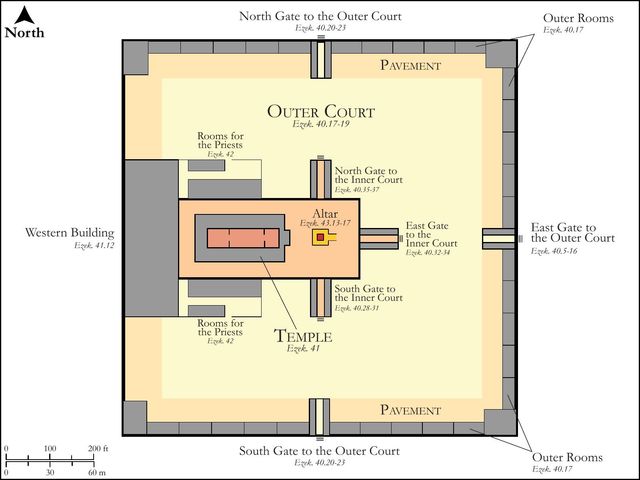
Ezekiel 40:14 presents a precise architectural detail within the prophet Ezekiel's profound visionary tour of a new, ideal temple, extensively described in chapters 40-48. This verse specifically outlines the significant dimensions of the "posts" or pillars within the elaborate gate complex leading into the temple's outer court, emphasizing the meticulous divine blueprint for God's future dwelling place among His people. It contributes to the overarching themes of divine order, restoration, and the sacredness of God's presence.
Context
ShowHideLiterary Context
Ezekiel 40 marks a pivotal shift in the book of Ezekiel, moving from prophecies of judgment and destruction (chapters 1-39) to a profound vision of restoration and hope. Following the devastating news of Jerusalem's fall and the temple's destruction, Ezekiel is transported in a vision to a very high mountain, where an angelic guide meticulously measures and describes a new, ideal temple. Chapters 40-42 are dedicated to the architectural details of this temple, beginning with the outer court and its gates. Verse 14 is embedded within this detailed description of the eastern gate, following measurements of its various chambers and thresholds, and preceding further details about the outer court itself. The precise measurements, including the "threescore cubits" for the posts, underscore the divine origin and perfect order of this visionary structure, contrasting sharply with the desolation left by the Babylonian invasion.
Historical & Cultural Context
The vision of the temple in Ezekiel 40-48 was given to Ezekiel during the Babylonian exile, a period of profound national and spiritual crisis for the Israelites. The First Temple, built by Solomon, had been destroyed by Nebuchadnezzar in 586 BC, and the people were far from their homeland and their sacred center of worship. Among the nations, temples were considered the dwelling places of their gods, and their destruction signified the god's abandonment or defeat. For the exiled Israelites, the destruction of the temple was a theological catastrophe. Ezekiel's vision, therefore, served as a powerful message of hope, promising God's renewed presence and the restoration of His covenant with Israel. The meticulous architectural details would have resonated deeply with a people who understood the importance of sacred space and the precise rituals associated with it, offering a tangible vision of future glory and the re-establishment of proper worship.
Key Themes
ShowHideThe detailed descriptions in Ezekiel 40:14 and the surrounding chapters contribute to several key themes. First, Divine Precision and Order are paramount, highlighted by the exacting measurements of every architectural element. This meticulousness signifies God's absolute sovereignty and His perfect design for His dwelling place and the worship of His people, contrasting with human imperfection and chaos. Second, the vision embodies Hope and Restoration for the exiled nation. The promise of a new, glorious temple signifies God's faithfulness to His covenant, assuring Israel of a future where His presence would once again dwell among them, as depicted in the return of the glory of the Lord to the temple. This vision served as a spiritual anchor, providing a future-oriented hope that transcended their present suffering. Third, the emphasis on the temple structure underscores the Sacredness of God's Presence and the importance of proper boundaries for approaching Him. The gates and courts, with their specific dimensions, delineate holy space, preparing the way for the return of God's glory and emphasizing the reverence required in His presence, a concept foundational throughout the Old Testament, from the tabernacle in Exodus 25 to the First Temple in 1 Kings 6.
Exposition and Analysis
ShowHideKey Word Analysis
ShowHideFrom the same root as "strength," this word properly denotes anything strong. In an architectural context, as here, it specifically refers to a strong support such as a pilaster, doorpost, or jamb. The use of "posts" emphasizes the structural integrity and foundational strength of the gate system, crucial for a sacred edifice.
This term refers to an ancient unit of length, primarily based on the fore-arm (from the elbow to the tip of the middle finger). While its precise length varied historically, it was typically around 18-21 inches (approximately 45-53 cm). The specification of "threescore cubits" (sixty cubits) for the posts underscores the immense scale and grandeur of the visionary temple, far exceeding typical human constructions and highlighting its divine origin.
This word describes an enclosed space, such as a yard or, in this context, a court within the temple complex. The mention of the "post of the court" indicates that these massive posts were integral to the entrance of the temple's outer court, serving as a boundary and a point of entry into the sacred precincts.
Verse Breakdown
ShowHide"He made also posts of threescore cubits,"
This initial clause introduces the construction of specific architectural elements—the "posts" or pillars. The phrase "threescore cubits" (sixty cubits) provides an astonishingly large dimension for these posts, emphasizing the monumental scale of the visionary temple. This detail immediately conveys a sense of grandeur and divine design, far beyond what human hands could typically construct or even imagine for a temple of that era. The verb "made" (H6213, ʻâsâh) suggests the divine architect's active role in bringing this structure into being, even if only in vision.
"even unto the post of the court"
This phrase clarifies the location and function of these massive posts. They extend "unto the post of the court," indicating their integration into the entrance structure of the temple's outer court. This connection highlights their role as foundational elements of the gateway, marking the transition from the profane to the sacred space. The repetition of "post" (H352, ʼayil) emphasizes the specific architectural feature being described and its importance in defining the boundaries of the court.
"round about the gate."
This final phrase specifies that these posts encircle or are integral to the entire gate structure. The term "gate" (H8179, shaʻar) refers to the grand entrance, a significant point of access and control in ancient architecture. The phrase "round about" (H5439, çâbîyb) suggests a comprehensive and encompassing design, where these large posts form a consistent and imposing feature throughout the entire perimeter of the gate, reinforcing the sense of order, security, and sacred demarcation.
Literary Devices
ShowHideEzekiel 40:14, like much of the temple vision, employs several literary devices. Most prominently, Detailed Description and Precision are used to convey the divine origin and perfect nature of the temple. The exact measurements, such as "threescore cubits," serve not merely as architectural specifications but as a literary means to emphasize God's meticulousness and the absolute order of His plans. This extensive detailing also functions as Symbolism, where the physical structure of the temple symbolizes God's renewed presence, His faithfulness to His covenant, and the restored relationship with His people. The sheer scale implied by "sixty cubits" can also be seen as a form of Hyperbole, emphasizing the transcendent and awe-inspiring nature of God's future dwelling, a structure far grander than any earthly temple. The vision itself is a form of Prophetic Vision, a common literary device in prophetic books, allowing for the communication of future realities and divine truths through symbolic imagery and detailed narratives.
Theological and Thematic Connections
ShowHideEzekiel 40:14, with its precise architectural details, contributes significantly to the broader biblical theology of God's dwelling among His people and the sacredness of His presence. The meticulous measurements and grand scale of the visionary temple underscore God's absolute sovereignty and His desire for perfect order in worship and in the lives of His people. This vision served as a profound reassurance to the exiled Israelites that God had not abandoned them, but was preparing a glorious future where His presence would be restored in an even more magnificent way. It speaks to the enduring truth that God cares about the details, not just the grand narrative, and that His dwelling place, whether a physical temple or His people, is to be set apart and holy. The emphasis on the "gate" and "posts" also highlights the concept of access to God—it is divinely ordained, structured, and requires reverence.
Reflection and Application
ShowHideThe meticulous details of Ezekiel's temple vision, including the dimensions of the posts in Ezekiel 40:14, might seem far removed from our daily lives, yet they convey profound truths for contemporary believers. They remind us that God is a God of order, precision, and intentionality. His plans are not haphazard but perfectly conceived and executed, even in the midst of human chaos and brokenness. This should inspire confidence in His sovereignty over our lives and the world. Just as the temple was designed for God's glory and the proper worship of His name, our lives as believers are called to reflect His character and order. We are living temples of the Holy Spirit, and the details of our lives—our habits, our words, our actions—matter to God. This vision also speaks to the enduring hope of God's presence. For the exiles, it was a promise of physical restoration; for us, it is a reminder that God desires to dwell with us, both individually through the Spirit and corporately as the Church. We are called to cultivate an environment, both personally and communally, that honors His sacred presence.
Questions for Reflection
ShowHideFAQ
ShowHideWas the temple described in Ezekiel 40-48 ever built?
ShowHideNo, the temple described in Ezekiel 40-48 was never built exactly as detailed in the vision. While a Second Temple was constructed after the return from exile (completed around 516 BC), its dimensions and features did not match Ezekiel's elaborate blueprint. Scholars generally interpret Ezekiel's temple vision in one of three ways: as a literal temple yet to be built in a future millennial age, as a symbolic representation of God's ideal dwelling and the perfect worship He desires, or as a prophetic picture fulfilled spiritually in Christ and His Church. The immense and intricate details, including the "threescore cubits" for the posts in Ezekiel 40:14, suggest an ideal, divinely perfect structure that transcends a mere physical building.
What is the significance of the precise measurements in Ezekiel's vision?
ShowHideThe precise measurements, such as the "threescore cubits" for the posts, are highly significant. They emphasize God's meticulousness, His perfect order, and His absolute control. In a time of chaos and destruction for Israel, these exact specifications provided a tangible vision of divine order and a future where God's presence would be restored in a perfectly designed sacred space. The precision underscores the holiness and sacredness of the temple, indicating that every detail matters to God. It also serves to highlight the divine origin of the vision, as such an intricate and immense design would be beyond human capacity to conceive or execute without divine guidance. This attention to detail speaks to God's character as a God who is purposeful and intentional in all His plans, from the grandest to the most minute, as seen in the detailed instructions for the tabernacle in Exodus 25.
Christ-Centered Fulfillment
ShowHideEzekiel's temple vision, with its massive posts and meticulously measured gates, finds its ultimate and most profound fulfillment not in a physical edifice, but in Jesus Christ and the new covenant He inaugurated. While the vision spoke of a restored physical dwelling for God, the New Testament reveals that Jesus Himself is the true temple, the ultimate meeting place between God and humanity. As Jesus declared, He spoke of the temple of His body, which would be destroyed and raised in three days. Through His sacrificial death and resurrection, Jesus became the perfect access point to God, fulfilling the symbolic function of the temple's gates and courts. Furthermore, the Church, comprised of believers, is now the spiritual temple, the dwelling place of God's Spirit on earth, as Paul teaches. The meticulous order and sacredness emphasized in Ezekiel's vision are thus realized in the holiness of Christ and the call to holiness for His body, the Church. Ultimately, the vision points to the eternal reality of the New Jerusalem in Revelation 21, where there is no physical temple because "the Lord God Almighty and the Lamb are its temple," signifying God's direct and unmediated presence with His people forever.