


Ezekiel 40:15
Bible text: King James Version (1769 Blayney text) · Public domain
Bible text: Berean Standard Bible · Public domain
Bible text: American Standard Version (1901) · Public domain
Bible text: World English Bible, Messianic edition · Public domain
Bible text: Geneva Bible (1599) · Public domain
Bible text: Young's Literal Translation · Public domain
- וְעַלve·'Aland onH5921Conj-w ¦ PrepPrepositionוְandעַלon
- פְּנֵיpe·Nei[the] face ofH6440N-mpcNoun Plural Masculine Construct
- הַשַּׁעַרha·Sha·'arthe gateH8179Art ¦ N-mscNoun Singular Masculine Constructהַtheשַּׁעַרgate
- הָאִיתוֹןhai·yo·tonthe entranceH2978Art ¦ N-msNoun Singular Masculine Absoluteהָtheאִיתוֹןentrance
- עַל'alonH5921PrepPreposition
- לִפְנֵיlif·Nei<to> beforeH6440Prep-l ¦ N-mpcNoun Plural Masculine Constructלִ<to>פְנֵיbefore
- אֻלָם'u·Lam[the] porch ofH197N-mscNoun Singular Masculine Construct
- הַשַּׁעַרha·Sha·'arthe gateH8179Art ¦ N-msNoun Singular Masculine Absoluteהַtheשַּׁעַרgate
- הַפְּנִימִיha·pe·ni·Mi<the> innerH6442Art ¦ Adj-msAdjective Singular Masculine Absoluteהַ<the>פְּנִימִיinner
- חֲמִשִּׁיםcha·mi·ShimfiftyH2572Adj-mpAdjective Numerical Plural Masculine Absolute
- אַמָּה'a·Mahcubit[s]H520N-fsNoun Singular Feminine Absolute
English is a literal word-by-word gloss of the Hebrew, not the KJV's wording. Why?
This is the original text the KJV's translators worked from — each Hebrew word with its own literal English meaning in this verse, prepared by scholars at Tyndale House, Cambridge. The KJV translates whole sentences, not word by word, so its wording differs: one Hebrew word can become several English words, and the KJV may choose “the LORD” where the gloss reads “Yahweh”. Both are faithful — they answer different questions. For the KJV's own rendering, switch to the KJV text.
Details
See on the biblical-era map
Study this verse
Public-domain commentary
Matthew Henry
From his Commentary on the Whole Bible. Henry comments on passages, not single verses — this entry covers Ezekiel 40:5–26. His three-level outline is real structure in the source text, so it is rendered as structure.
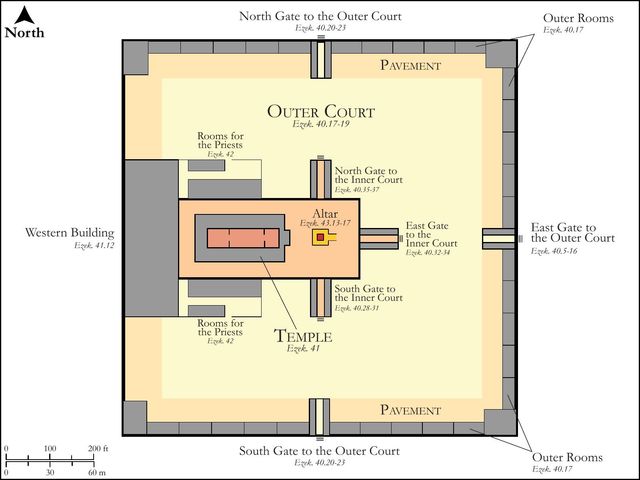
The measuring-reed which was in the hand of the surveyor-general was mentioned before, Eze 40:3. Here we are told (Eze 40:5) what was the exact length of it, which must be observed, because the house was measured by it. It was six cubits long, reckoning, not by the common cubit, but the cubit of the sanctuary, the sacred cubit, by which it was fit that this holy house should be measured, and that was a hand-breadth (that it, four inches) longer than the common cubit: the common cubit was eighteen inches, this twenty-two, see Eze 43:13. Yet some of the critics contend that this measuring-reed was but six common cubits in length, and one handbreadth added to the whole. The former seems more probable. Here is an account,
I.Of the outer wall of the house, which encompassed it round, which was three yards thick and three yards high, which denotes the separation between the church and the world on every side and the divine protection which the church is under. If a wall of this vast thickness will not secure it, God himself will be a wall of fire round about it; whoever attack it will do so at their peril.
II.Of the several gates with the chambers adjoining to them.
Here is no mention of the outer court of all, which was called the court of the Gentiles, some think because in gospel-times there should be such a vast confluence of Gentiles to the church that their court should be left unmeasured, to signify that the worshippers in that court should be unnumbered, Rev 7:9, Rev 7:11, Rev 7:12.
1.He begins with the east gate, because that was the usual way of entering into the lower end of the temple, the holy of holies being at the west end, in opposition to the idolatrous heathen that worshipped towards the east. Now, in the account of this gate, observe,
(1.)That he went up to it by stairs (Eze 40:6), for the gospel-church was exalted above that of the Old Testament, and when we go to worship God we must ascend; so is the call, Rev 4:1. Come up hither. Sursum corda - Up with your hearts.
(2.)That the chambers adjoining to the gates were but little chambers, about ten feet square, Eze 40:7. These were for those to lodge in who attended the service of the house. And it becomes such as are made spiritual priests to God to content themselves with little chambers and not to seek great things to themselves; so that we may but have a place within the verge of God's court we have reason to be thankful though it be in a little chamber, a mean apartment, though we be but door-keepers there.
(3.)The chambers, as they were each of them four-square, denoting their stability and due proportion and their exact agreement with the rule (for they were each of them one reed long and one reed broad), so they were all of one measure, that there might be an equality among the attendants on the service of the house.
(4.)The chambers were very many; for in our Father's house there are many mansions (Joh 14:2), in his house above, and in that here on earth. In the secret of his tabernacle shall those be hid, and in a safe pavilion, whose desire is to dwell in the house of the Lord all the days of their life, Psa 27:4, Psa 27:5. Some make these chambers to represent the particular congregations of believers, which are parts of the great temple, the universal church, which are, and must be, framed by the scripture-line and rule, and which Jesus Christ takes the measure of, that is, takes cognizance of, for he walks in the midst of the seven golden candle-sticks.
(5.)It is said (Eze 40:14), He made also the posts. He that now measured them was the same that made them; for Christ is the builder of his church and therefore is best able to give us the knowledge of it. And his reducing them to the rule and standard is called his making them, for no account is made of them further than they agree with that. To the law and to the testimony.
(6.)Here are posts of sixty cubits, which, some think, was literally fulfilled when Cyrus, in his edict for rebuilding the temple at Jerusalem, ordered that the height thereof should be sixty cubits, that is, thirty yards and more, Ezr 6:3.
(7.)Here were windows to the little chambers, and windows to the posts and arches (that is, to the cloisters below), and windows round about (Eze 40:16), to signify the light from heaven with which the church is illuminated; divine revelation is let into it for instruction, direction, and comfort, to those that dwell in God's house, light to work by, light to walk by, light to see themselves and one another by. There were lights to the little chambers; even the least, and least considerable, parts and members of the church, shall have light afforded them. All thy children shall be taught of the Lord. But they are narrow windows, as those in the temple, Kg1 6:4. The discoveries made to the church on earth are but narrow and scanty compared with what shall be in the future state, when we shall no longer see through a glass darkly.
(8.)Divers courts are here spoken of, an outermost of all, then an outer court, then an inner, and then the innermost of all, into which the priests only entered, which (some think) may put us in mind "of the diversities of gifts, and graces, and offices, in the several members of Christ's mystical body here, as also of the several degrees of glory in the courts and mansions of heaven, as there are stars in several spheres and stars of several magnitudes in the fixed firmament." English Annotations. Some draw nearer to God than others and have a more intimate acquaintance with divine things; but to a child of God a day in any of his courts is better than a thousand elsewhere. These courts had porches, or piazzas, round them, for the shelter of those that attended in them from wind and weather; for when we are in the way of our duty to God we may believe ourselves to be under his special protection, that he will graciously provide for us, nay, that he will himself be to us a covert from the storm and tempest, Isa 4:5, Isa 4:6.
(9.)On the posts were palm-trees engraven (Eze 40:16), to signify that the righteous shall flourish like the palm-tree in the courts of God's house, Psa 92:12. The more they are depressed with the burden of affliction the more strongly do they grow, as they say of the palm-trees. It likewise intimates the saints' victory and triumph over their spiritual enemies; they have palms in their hands (Rev 7:9); but lest they should drop these, or have them snatched out of their hands, they are here engraven upon the posts of the temple as perpetual monuments of their honour. Thanks be to God, who always causes us to triumph. Nay, believers shall themselves be made pillars in the temple of our God, and shall go no more out, and shall have his name engraven on them, which will be their brightest ornament and honour, Rev 3:12.
(10.)Notice is here taken of the pavement of the court, Eze 40:17, Eze 40:18. The word intimates that the pavement was made of porphyry-stone, which was of the colour of burning coals; for the brightest and most sparkling glories of this world should be put and kept under our feet when we draw near to God and are attending upon him. The stars are, as it were, the burning coals, or stones of a fiery colour, with which the pavement of God's celestial temple is laid; and, if the pavement of the court be so bright and glittering, how glorious must we conclude the mansions of that house to be!
2.The gates that looked towards the north (Eze 40:20) and towards the south (Eze 40:24), with their appurtenances, are much the same with that towards the east, after the measure of the first gate, Eze 40:21. But the description is repeated very particularly. And thus largely was the structure of the tabernacle related in Exodus, and of the temple in the books of Kings and Chronicles, to signify the special notice God does take, and his ministers should take, of all that belong to his church. His delight is in them; his eye is upon them. He knows all that are his, all his living temples and all that belongs to them. Observe,
(1.)This temple had not only a gate towards the east, to let into it the children of the east, that were famous for their wealth and wisdom, but it had a gate to the north, and another to the south, for the admission of the poorer and less civilized nations. The new Jerusalem has twelve gates, three towards each quarter of the world (Rev 21:13); for many shall come from all parts to sit down there, Mat 8:11.
(2.)To those gates they went up by steps, seven steps (Eze 40:22-26), which, as some observe, may remind us of the necessity of advancing in grace and holiness, adding one grace to another, going from step to step, from strength to strength, still pressing forward towards perfection - upward, upward, towards heaven, the temple above.
Historical interpretation
Two Centuries of Reception
3 surviving comments on this verse. Each one is dated, so this reads as a timeline rather than a list.
Select a marker to jump to its quote. Markers stagger vertically where authors wrote within a few decades of each other.
The first day of the eight is the day of the resurrection, and it leads us to the entrance of the temple, for when we have done everything and repented of the sins we have committed, then we are brought close to God.
(Verse 14 and following) He made fronts for sixty cubits, and the courtyard of the gate had a surrounding circuit. And before the face of the gate, which reached up to the face of the interior vestibule gate, there were fifty cubits, and oblique windows in the chambers, and in their fronts which were inside the gate all around. Similarly, there were windows in the vestibules all around inside: and before the fronts, there was a depiction of palms. LXX: And under the sky was the court of the gate sixty cubits, and the threshold of the court of the gate all round. And under the sky of the court outside was the gate of the inner court fifty cubits, and windows screened with palm trees, and also the threshold of the gate within the court round about. And similarly the gate chambers, and windows all around inside, and the thresholds of the gates were palm trees on both sides." Symmachus interpreted this passage as follows: And he made circuits, which we can call surroundings: for which in Hebrew he has Elim (), which Aquila interpreted as κρίωμα, and we translate as frontiers. Again, where the Seventy placed the entrance of the atrium, in Hebrew it has El () in the singular number, which Symmachus translated as near the entrance, Aquila as κρίωμα, that is, the front of the atrium. Also, under the open sky, Aquila, before the face of the gate's posts; Symmachus, opposite the face of the gate's vestibule, translated. The hidden windows called Atemoth in Hebrew, Symmachus translated as τοξικὰς. And where the Seventy said above the entrance and above the gate's post, Symmachus placed the posts and the surroundings; Aquila, the chambers, and their fronts: for which it is written in Hebrew Theim and Ele. Moreover, Elamoth, which Septuagint and Theodotion also translated similarly; Symmachus translated circumstantias [circumstances], Aquila translated frontes [fronts]. But Aelam, for which it is written El in Hebrew ((Mss. Ul)), is called ostium [door] or porticus [porch]. Also, for palmis [palms], it is written in Hebrew as Thamarim [plural number]: because in the singular number, it calls palmam [palm], Thamar. I know that these things will be annoying to a fastidious reader: but I wanted to show briefly how much the ancient translation differs from the Hebrew truth due to the length of time, or rather the fault of the scribes, and, to speak more openly, our lack of knowledge of Hebrew: especially in Hebrew names, which we have translated from other editions into the Latin language, indicating not so much an explanation of the words as our simple suspicion. However, I think that around the wall of the temple on the outside, and the temple itself in the courtyard, that is, in the middle, there were certain things placed for decoration, which Symmachus interprets as surroundings, that is, certain standing structures, raised high from the ground, and these occupied a space of sixty cubits. And again, as one went out from the inner gate to the front of the vestibule, which faced the outer gate, there were fifty cubits of space, in which there were oblique windows, which Seventy called 'toxicas'. And in these windows were in the chambers, that is, in each room, and in the porticoes that extended before the rooms, measuring fifty cubits. These windows were slanted or arched, therefore they were called 'sagittae', which means 'arrows', because they allow a narrow light to enter the house, like arrows, and expand inward: and all around they were full of such windows. And in front of the facades of the porticoes, he says, there were paintings or carvings of palm trees, through which it is shown at the entrance of the gate, and immediately upon entering, a wall measuring sixty cubits with various ornaments meets, which refer to the condition of the world, so that the Creator may be understood through His creations: and everything in order and with reason, show the variety of the world, which among the Greeks is called 'kosmos', derived from adornment: and it was made in six days, so that each day, ten decades are reckoned, which we have mentioned above as the perfect number. After this, as we enter the inner atrium, we come across before us the vestibule of the inner gate of the bedroom, with oblique windows, occupying a space of fifty cubits, which itself is a sacred number. And after seven full weeks of festivity and joy, the first day of the Octave begins, which is the Day of Resurrection, and it brings us close to the temple. For when we have done all things, repenting for our previous errors, then we become neighbors and close to God, so that in the outer atrium, the order of creatures teaches us knowledge of the Creator with constancy, and in the inner [atrium] true jubilation, in which all our debts are forgiven, instructs us in the theology, and introduces us to the Holy of Holies. It is also worth noting that the inner courtyard has several windows, which are not direct and equal, but rather oblique and narrow on the outside, and widening inward, so that we can penetrate the interior through small openings and reach the fullness of the brightest light, which is present in the temple. Finally, after sixty and fifty cubits, and chambers, and porticoes, and the facades of the porticoes, and numerous windows all around, the carving or painting of palm trees is shown to us, so that as victors of the world, we may become worthy to see the palm trees of virtues.
And before the face of the gate which extended to the face of the vestibule of the inner gate, fifty cubits.
That which is said in this place, "Before the face of the gate," describes not the exterior, but the interior place before the gate, since it is reported to extend up to the face of the vestibule of the inner gate. Hence that same place is said to have been measured at fifty cubits. For by the number fifty, eternal rest is signified. For the number seven has its own perfection, because on that day the number of days was completed. And through the law the Sabbath was given for rest. Moreover, that same number seven multiplied by itself yields forty-nine, and if a monad is added to it, one arrives at fifty, because all our perfection will be in the contemplation of that One, in whose vision there will no longer be anything lacking of salvation and joy for us. Hence also the jubilee, that is, the fiftieth year, was given for rest, because whoever has arrived at the eternal joys of almighty God will no longer have labor and groaning.
It should be noted that the place which is described as extending for fifty cubits is said to reach to the face of the vestibule of the inner gate. Therefore in this place the prophet is not describing the vestibule of the inner gate itself, but the place within which extends to the vestibule of the inner gate. By which place, of course, as we have said, our hope is signified, which while it seeks eternal rest, leads the mind to the vestibule of the inner gate. For in this very fact that we desire heavenly things, that we sigh for the promised joys, that we seek the rest of eternal life, we are already approaching the face of the inner vestibule. Therefore let faith be signified by the gate, charity by the court, and by the place which approaches the face of the vestibule of the inner gate let hope be figured, without which three virtues whoever can now use reason cannot enter into the heavenly building. Therefore let faith be held in the gate, which introduces to understanding; charity in the court, which expands the mind in love; hope in the place which is described as fifty cubits, because through desires and sighs it introduces the soul to the secret joys of rest. Concerning which rest, even if we do not yet perceive the light of truth as it is, nevertheless we already see something through the cracks of understanding.
Continue studying Ezekiel 40:15 across the web’s major study libraries — every link below opens this exact verse, chapter, or book on the destination site.
Read & Compare
 BibleGatewayThis verse in more than 200 translations and 70 languages.
 Bible.comThe YouVersion reader — hundreds of translations, reading plans, and highlights.
 ESV.orgCrossway's official English Standard Version reader.
 NET BibleThe NET translation with 60,000+ translators' notes on every rendering decision.
 STEP BibleTyndale House's free study tool — original text, vocabulary, and scholarly resources.
 BibliaLogos Bible Software's free web reader.
 USCCBThe New American Bible (Revised Edition) with the U.S. bishops' study notes.
Commentaries
 BibleHub CommentariesDozens of classic commentaries on this verse, gathered on one page.
 StudyLightMore than 100 commentary sets — the largest collection on the web.
 BibleRefPlain-English commentary on what this verse means, verse by verse.
 Enduring WordDavid Guzik's free commentary on this chapter, widely used by Bible teachers.
 Bible Study ToolsVerse commentary alongside Greek and Hebrew study aids.
Original Language & Research
- BibleHub InterlinearThe verse word by word — original language, transliteration, and English.
- BibleHub LexiconEvery word's original-language definition and Strong's entry.
 Blue Letter BibleDeep-study tools — Strong's numbers, concordance, and word studies.
 SefariaThe Hebrew text with Rashi and centuries of Jewish commentary.
Sermons, Hymns & Audio


TrulyRandomVerse is not affiliated with these sites and doesn’t control their content. They’re linked because they’re genuinely useful.
Summary
Ezekiel 40:15 offers a precise architectural measurement within the prophet Ezekiel's monumental vision of a new temple. This specific verse delineates a distance of fifty cubits from the outer face of the entrance gate to the inner face of the porch of the inner gate, a crucial dimension that contributes to the meticulously detailed blueprint of God's future dwelling place. It profoundly underscores the divine precision, order, and inherent holiness embedded within God's redemptive plans for His people, emphasizing the tangible and authoritative nature of the visionary revelation granted to Ezekiel during the profound despair of the Babylonian exile.
Context
ShowHideLiterary Context
Ezekiel 40 marks a pivotal transition in the book of Ezekiel, shifting dramatically from prophecies of judgment, destruction, and exile (chapters 1-39) to a profound and hopeful vision of restoration, renewal, and a meticulously detailed new temple (chapters 40-48). This chapter initiates an extensive architectural tour, where Ezekiel is guided by a celestial figure through the visionary complex. The preceding verses (Ezekiel 40:1-14) meticulously describe the outer court and the precise dimensions of the outer gate, establishing the foundational measurements for the entire structure. Ezekiel 40:15 seamlessly integrates into this systematic description, providing a specific measurement crucial for understanding the transition and flow from the outer to the inner parts of the temple complex. The subsequent verses (Ezekiel 40:16ff) continue to elaborate on the various chambers, gates, and courts, progressively building a comprehensive and intricate picture of the temple's divine layout.
Historical & Cultural Context
The book of Ezekiel was composed during the traumatic period of the Babylonian exile (597-538 BC), a time of immense national despair and theological crisis for the Jewish people. Jerusalem had been utterly destroyed, Solomon's Temple lay in ruins, and the covenant people were forcibly removed from their promised land. In this profound context of desolation and perceived divine abandonment, God graciously grants Ezekiel this elaborate vision of a restored temple and land. This vision served as an incredibly powerful message of hope, divine faithfulness, and future restoration for Israel. In Israel, the architecture of the tabernacle and the temple was not merely functional; it was deeply symbolic, reflecting the order of God's house, His divine presence, and the stability of His dwelling. The hyper-detailed measurements in Ezekiel's vision would have resonated deeply with this understanding, signifying the divine origin, perfect order, and inviolable holiness of this future sanctuary, starkly contrasting with any humanly conceived or constructed edifice.
Key Themes
ShowHideThe meticulous architectural details presented in Ezekiel 40, including the precise measurement in verse 15, are foundational to several overarching themes woven throughout the book. Foremost among these is Divine Precision and Order, revealing God as the ultimate architect whose plans are perfectly conceived, meticulously detailed, and flawlessly executed, even amidst human chaos and destruction. This emphasis on exact dimensions also powerfully underscores Holiness and Separation, as the intricate design of gates, courts, and chambers symbolizes the necessary progression from the common or profane to the sacred and holy, emphasizing the reverence, purity, and intentionality required to approach God's glorious presence. Furthermore, for a people languishing in exile, this profoundly detailed vision of a new temple was an unparalleled message of Future Hope and Restoration. It served as an unwavering affirmation of God's faithfulness to His covenant promises, holding forth the certain prospect of a time when His glory would return to dwell powerfully among His people, as vividly depicted in the climactic vision of the glory of God filling the temple in Ezekiel 43:1-5. This vision was designed to counteract the pervasive despair of exile, offering a tangible and divinely guaranteed promise of a future where God's presence would be re-established in perfect order and unblemished holiness.
Exposition and Analysis
ShowHideKey Word Analysis
ShowHideThis word (H6440) appears twice in the verse, "from the face of the gate... unto the face of the porch." Derived from an unused root signifying "to turn," pânîym literally refers to the front or the turning part of something, hence "face." In a broader sense, it can denote presence, surface, or appearance. In architectural contexts like Ezekiel 40, its repetition emphasizes a precise point of reference – the outermost front surface or leading edge of the gate and the porch. This specificity is crucial for understanding the exact dimensions and the precise spatial relationship between different components of the temple complex, highlighting the objective and measurable reality of the vision.
The term (H197) refers to a vestibule, portico, or an open, covered entranceway leading into a larger structure. In ancient temple architecture, the porch was often a significant and sometimes ornate feature, serving as a transitional area between the outer courts and the more sacred inner sanctuary. Its specific inclusion in this measurement indicates a distinct architectural component of the inner gate, not merely the gate itself, further emphasizing the granular detail of Ezekiel's vision. It suggests a deliberate design for controlled access and sacred transition within the holy space.
This unit of measure (H520) was a standard ancient measurement, typically defined as the length from the elbow to the tip of the middle finger, roughly 18-21 inches (approximately 45-53 cm). The specific "cubit" used in Ezekiel's vision is explicitly stated in Ezekiel 40:5 as the "long cubit," which was a handbreadth longer than the common cubit, making it approximately 20.65 inches (52.5 cm). The consistent use of ʼammâh throughout chapters 40-42 underscores the tangible, measurable reality of the vision, providing concrete dimensions for every part of the temple. It signifies divine precision and an exactitude that leaves no room for human estimation or imprecision, reflecting the divine architect's meticulous planning and the absolute certainty of His future plans.
Verse Breakdown
ShowHide"And from the face of the gate of the entrance"
This clause precisely establishes the starting point for the measurement. "The face of the gate" refers to the outermost front surface or leading edge of the primary entrance gate. This indicates a clear, unambiguous, and externally visible point from which the distance is to be calculated, underscoring the architectural precision and clarity of the visionary blueprint.
"unto the face of the porch of the inner gate"
This specifies the exact ending point of the measurement. It is not merely the inner gate itself, but specifically the "face of the porch" associated with that inner gate. This detailed distinction highlights the complex and multi-layered structure of the temple, where distinct architectural elements like porches serve as significant transitional and functional spaces. The measurement thus spans a considerable and specific architectural segment within the temple complex.
"[were] fifty cubits"
This final phrase provides the precise numerical distance. Fifty cubits, when calculated using the long cubit (approximately 20.65 inches or 52.5 cm), would be roughly 86 feet or 26.25 meters. This exact numerical value, like all other measurements throughout the vision, conveys an overwhelming sense of divine order, completeness, and exactitude, leaving no room for human estimation or imprecision in God's perfect design. It reinforces the reality and authority of the divine blueprint.
Literary Devices
ShowHideThe primary literary device prominently featured in Ezekiel 40:15, and indeed pervading chapters 40-42, is Precision and Detail. The overwhelming emphasis on exact measurements, specific architectural components (such as "porch" and "gate of the entrance"), and clearly defined points of reference ("face of") serves to ground the visionary experience in a tangible, almost engineering-like reality. This meticulous detailing is not merely descriptive; it profoundly functions as Symbolism, where the precise dimensions and intricate layout symbolize divine order, perfection, and the absolute holiness of God's dwelling place. Every cubit, every chamber, and every architectural feature points to God's meticulous planning, His unwavering sovereignty, and His ultimate control over the future. Furthermore, the entire passage is a quintessential example of Visionary Literature, a common prophetic mode where complex spiritual truths and future realities are conveyed through elaborate, often symbolic, visual experiences. The vivid and concrete nature of these architectural descriptions makes the future hope and restoration promised by God feel both real and profoundly attainable to a people burdened by despair and exile.
Theological and Thematic Connections
ShowHideEzekiel 40:15, with its emphasis on precise measurements within the grand temple vision, connects deeply to the overarching biblical theme of God's meticulous design and sovereign order. This divine precision is never arbitrary but is a direct reflection of God's character as a God who brings perfect order out of chaos, whose plans are flawlessly conceived and executed. The temple, in all its detailed glory, serves as a powerful and tangible symbol of God's profound desire to dwell intimately among His people in holiness and righteousness—a foundational promise that undergirds the entire biblical narrative from Eden to the New Jerusalem. This vision speaks powerfully to the restoration of pure worship, the re-establishment of a righteous and unblemished relationship between God and Israel, and the ultimate fulfillment of God's redemptive purposes for all creation.
Reflection and Application
ShowHideEzekiel 40:15, though seemingly a dry architectural detail, offers profound and enduring spiritual lessons for the believer. It serves as a powerful reminder that God is a God of infinite precision, perfect order, and unwavering intentionality. His plans are never haphazard or accidental but are meticulously laid out, even down to the "fifty cubits" of a visionary temple. For believers, this truth instills profound confidence in God's sovereign control over all circumstances, especially during times of chaos, uncertainty, or deep despair, much like the exiles to whom Ezekiel originally prophesied. We are profoundly encouraged to trust in God's perfect design for our individual lives and for the grand unfolding of His kingdom, knowing with certainty that every detail is within His purview and serves His ultimate, glorious purpose. This verse calls us to recognize and appreciate the inherent beauty and wisdom in divine order, prompting us to seek alignment with His perfect will and to cultivate a deep reverence for the holiness inherent in His presence. It reassures us that God is actively and precisely working, even in the unseen and seemingly insignificant details, to bring about His glorious future and our ultimate good.
Questions for Reflection
ShowHideFAQ
ShowHideWhat is the significance of the "fifty cubits" measurement in Ezekiel 40:15?
ShowHideThe "fifty cubits" (approximately 86 feet or 26.25 meters) in Ezekiel 40:15 is highly significant because it is one of many precise and exact measurements given throughout Ezekiel's extensive temple vision. This meticulous detailing emphasizes God's absolute precision, perfect order, and unwavering intentionality in all His plans. It underscores that the vision is not a vague or symbolic dream but a divinely revealed blueprint, symbolizing the perfect order, holiness, and accessibility of God's future dwelling place among His people. The exactness of the dimensions conveys a profound sense of divine completeness and the tangible reality of God's redemptive purposes, reassuring the exiles of God's faithfulness.
Is Ezekiel's temple a literal structure that will be built, or is it symbolic?
ShowHideThe interpretation of Ezekiel's temple vision (chapters 40-48) is a subject of ongoing and rich theological debate among scholars. Some interpret it as a literal temple that will be physically built in Jerusalem during a future millennial reign of Christ. Others view it as primarily symbolic, representing the spiritual reality of God's presence among His people, the church, or the perfected New Jerusalem. A third perspective suggests it is a blueprint for a future temple that will be built, but its primary significance is symbolic of God's restored relationship with Israel and the renewed, pure worship of God. Regardless of whether one holds a literal or symbolic interpretation, the vision's consistent emphasis on precision, order, and holiness profoundly points to the perfect order and glorious presence of God.
Christ-Centered Fulfillment
ShowHideWhile Ezekiel 40:15 describes a physical measurement within a visionary temple, its ultimate fulfillment and profound spiritual significance are found preeminently in Jesus Christ. The meticulous design and precise measurements of Ezekiel's temple powerfully foreshadow the perfect order, divine holiness, and ultimate accessibility embodied in Christ, who is the true and ultimate temple of God. As Jesus Himself declared, concerning the Jerusalem temple, "Destroy this temple, and in three days I will raise it up," referring prophetically to the temple of his body. In Him, the dwelling of God among humanity is perfectly and fully realized. The precise dimensions of Ezekiel's temple, symbolizing divine order and the pathway of access to God, find their spiritual reality in Christ, who emphatically proclaimed, "I am the way, the truth, and the life. No one comes to the Father except through me," thereby becoming the only means by which we can truly come to the Father. Furthermore, through Christ's redemptive work, believers themselves become the spiritual temple of God, individually and corporately indwelt by the Holy Spirit, as the Apostle Paul teaches in 1 Corinthians 3:16. Thus, the detailed measurements of a physical structure ultimately point to the spiritual reality of God's perfect plan of redemption, meticulously executed in Christ, leading to a new creation where God's presence is fully realized not in a building made with hands, but in the Lamb and His redeemed people, as seen in the New Jerusalem where there is no temple in the city, for the Lord God Almighty and the Lamb are its temple.