


1 Kings 7:3
Bible text: King James Version (1769 Blayney text) · Public domain
Bible text: Berean Standard Bible · Public domain
Bible text: American Standard Version (1901) · Public domain
Bible text: World English Bible, Messianic edition · Public domain
Bible text: Geneva Bible (1599) · Public domain
Bible text: Young's Literal Translation · Public domain
- וְסָפֻןve·sa·Funand [it was] paneledH5603Conj-w ¦ V-Qal-PassPrtcpl-msVerb Qal Participle Passive Singular Masculine Absoluteוְandסָפֻן[it was] paneled
- בָּאֶרֶזba·'E·rezwith <the> cedarH730Prep-b ¦ N-msNoun Singular Masculine Absoluteבָּwith <the>אֶרֶזcedar
- מִמַּעַלmi·Ma·'alfrom aboveH4605Prep-m ¦ Adj-csAdjective Numerical Singular common gender Absoluteמִfromמַּעַלabove
- עַל'alaboveH5921PrepPreposition
- הַצְּלָעֹתha·tze·la·'Otthe side-chambersH6763Art ¦ N-fpNoun Plural Feminine Absoluteהַtheצְּלָעֹתside-chambers
- אֲשֶׁר'a·SherwhichH834RelParticle Relative
- עַל'al[were] onH5921PrepPreposition
- הָעַמּוּדִיםha·'a·mu·Dimthe pillarsH5982Art ¦ N-mpNoun Plural Masculine Absoluteהָtheעַמּוּדִיםpillars
- אַרְבָּעִים'ar·ba·'ImfortyH705N-mpNoun Plural Masculine Absolute
- וַחֲמִשָּׁהva·cha·mi·Shahand fiveH2568Conj-w ¦ N-csNoun Singular common gender Absoluteוַandחֲמִשָּׁהfive
- חֲמִשָּׁהcha·mi·Shahfif-H2568N-csNoun Singular common gender Absolute
- עָשָׂר'a·SarteenH6240N-csNoun Singular common gender Absolute
- הַטּוּרha·Turthe rowH2905Art ¦ N-msNoun Singular Masculine Absoluteהַtheטּוּרrow
English is a literal word-by-word gloss of the Hebrew, not the KJV's wording. Why?
This is the original text the KJV's translators worked from — each Hebrew word with its own literal English meaning in this verse, prepared by scholars at Tyndale House, Cambridge. The KJV translates whole sentences, not word by word, so its wording differs: one Hebrew word can become several English words, and the KJV may choose “the LORD” where the gloss reads “Yahweh”. Both are faithful — they answer different questions. For the KJV's own rendering, switch to the KJV text.
Details
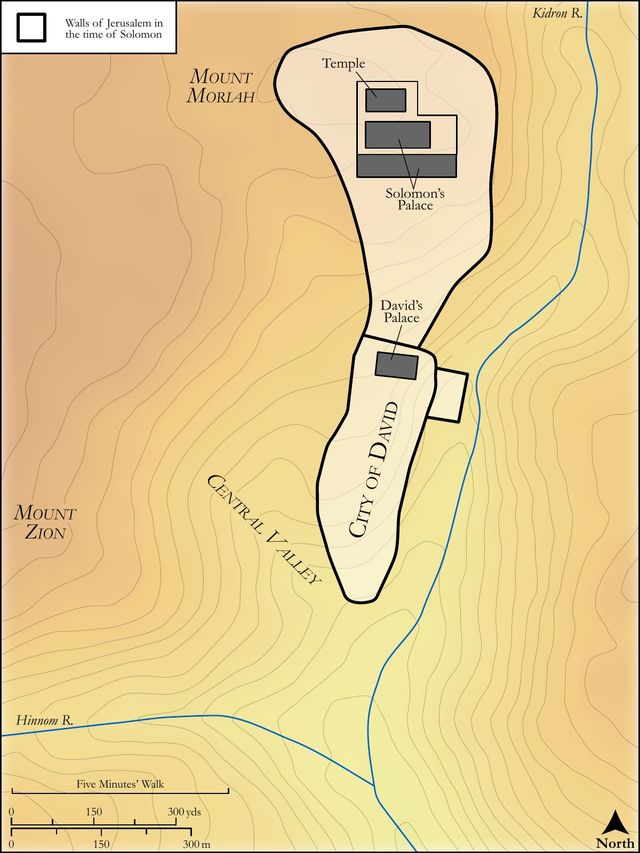
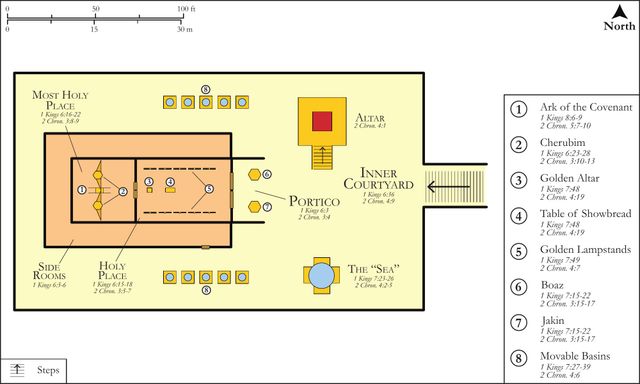
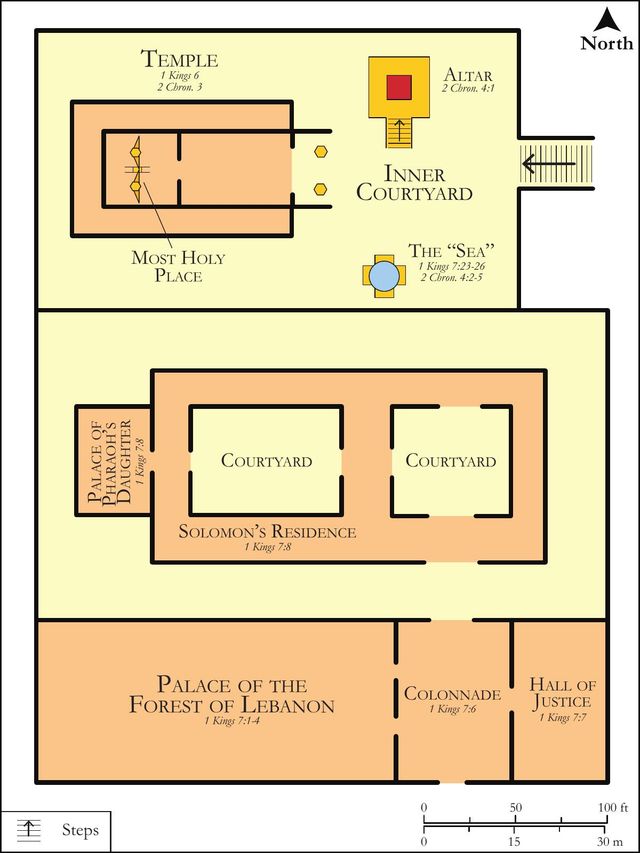
See on the biblical-era maps
Study this verse
Public-domain commentary
Matthew Henry
From his Commentary on the Whole Bible. Henry comments on passages, not single verses — this entry covers 1 Kings 7:1–12.
Never had any man so much of the spirit of building as Solomon had, nor to better purpose; he began with the temple, built for God first, and then all his other buildings were comfortable. The surest foundations of lasting prosperity are those which are laid in an early piety, Mat 6:33. 1. He built a house for himself (Kg1 7:1), where he dwelt, Kg1 7:8. His father had built a good house; but it was no reflection upon his father for him to build a better, in proportion to the estate wherewith God had blessed him. Much of the comfort of this life is connected with an agreeable house. He was thirteen years building this house, whereas he built the temple in little more than seven years; not that he was more exact, but less eager and intent, in building his own house than in building God's. He was in no haste for his own palace, but impatient till the temple was finished and fit for use. Thus we ought to prefer God's honour before our own ease and satisfaction. 2. He built the house of the forest at Lebanon (Kg1 7:2), supposed to be a country seat near Jerusalem, so called from the pleasantness of its situation and the trees that encompassed it. I rather incline to think that it was a house built in the forest of Lebanon itself, whither (though far distant from Jerusalem) Solomon (having so many chariots and horses, and those dispersed into chariot-cities, which probably were his stages) might frequently retire with ease. It does not appear that his throne (mentioned Kg1 7:7) was at the house of the forest of Lebanon, and it was not at all improper to put his shields there as in a magazine. Express notice is taken of his buildings, not only in Jerusalem, but in Lebanon (Kg1 9:19), and we read of the tower of Lebanon, which looks towards Damascus (Sol 7:4), which probably was part of this house. A particular account is given of this house, that being built in Lebanon, a place famed for cedars, the pillars, and beams, and roof, were all cedar (Kg1 7:2, Kg1 7:3), and, being designed for pleasant prospects, there were three tiers of windows on each side, light against light (Kg1 7:4, Kg1 7:5), or, as it may be read, prospect against prospect. Those whose lost i cast in the country may be well reconciled to a country life by this, that some of the greatest princes have thought those the most pleasant of their days which they have spent in their country retirements. 3. He built piazzas before one of his houses, either that at Jerusalem or that in Lebanon, which were very famous - a porch of pillars (Kg1 7:6), perhaps for an exchange or a guard-house, or for those to walk in that attended him about business till they could have audience, or for state and magnificence. He himself speaks of Wisdom's building her house, and hewing out her seven pillars (Pro 9:1), for the shelter of those that, three verses before (Kg1 8:34), are said to watch daily at her gates and to wait at the posts of her doors. 4. At his house where he dwelt in Jerusalem he built a great hall, or porch of judgment, where was set the throne, or king's bench, for the trial of causes, in which he himself was appealed to (placita coram ipso rege tenenda - causes were to be adjusted in the king's presence), and this was richly wainscoted with cedar, from the floor to the roof, Kg1 7:7. He had there also another court within the porch, nearer his house, of similar work, for his attendants to walk in, Kg1 7:8. 5. He built a house for his wife, where she kept her court, Kg1 7:8. It is said to be like the porch, because built of cedar like it, though not in the same form; this, no doubt, was nearer adjoining to his own palace, yet perhaps if it had been as near as it ought to have been Solomon would not have multiplied wives as he did.
The wonderful magnificence of all these buildings is taken notice of, Kg1 7:9, etc. All the materials were the best of their kind. The foundation-stones were costly for their size, four or five yards square, or at least so many yards long (Kg1 7:10), and the stones of the building were costly for the workmanship, hewn and sawn, and in all respects finely wrought, Kg1 7:9, Kg1 7:11. The court of his own house was like that of the temple (Kg1 7:12, compare Kg1 6:36); so well did he like the model of God's courts that he made his own by it.
Continue studying 1 Kings 7:3 across the web’s major study libraries — every link below opens this exact verse, chapter, or book on the destination site.
Read & Compare
 BibleGatewayThis verse in more than 200 translations and 70 languages.
 Bible.comThe YouVersion reader — hundreds of translations, reading plans, and highlights.
 ESV.orgCrossway's official English Standard Version reader.
 NET BibleThe NET translation with 60,000+ translators' notes on every rendering decision.
 STEP BibleTyndale House's free study tool — original text, vocabulary, and scholarly resources.
 BibliaLogos Bible Software's free web reader.
 USCCBThe New American Bible (Revised Edition) with the U.S. bishops' study notes.
Commentaries
 BibleHub CommentariesDozens of classic commentaries on this verse, gathered on one page.
 StudyLightMore than 100 commentary sets — the largest collection on the web.
 BibleRefPlain-English commentary on what this verse means, verse by verse.
 Enduring WordDavid Guzik's free commentary on this chapter, widely used by Bible teachers.
 Bible Study ToolsVerse commentary alongside Greek and Hebrew study aids.
Original Language & Research
- BibleHub InterlinearThe verse word by word — original language, transliteration, and English.
- BibleHub LexiconEvery word's original-language definition and Strong's entry.
 Blue Letter BibleDeep-study tools — Strong's numbers, concordance, and word studies.
 SefariaThe Hebrew text with Rashi and centuries of Jewish commentary.
Sermons, Hymns & Audio


TrulyRandomVerse is not affiliated with these sites and doesn’t control their content. They’re linked because they’re genuinely useful.
Summary
1 Kings 7:3 provides a meticulous architectural description of a significant component of King Solomon's vast palace complex, known as the "House of the Forest of Lebanon." This verse specifically details the opulent use of cedar wood for its ceiling and the substantial structural support provided by forty-five pillars, arranged in three precise rows of fifteen. It vividly illustrates the immense scale, sophisticated craftsmanship, and luxurious materials characteristic of Solomon's reign, reflecting his unparalleled wealth, the advanced building capabilities of the era, and the grandeur of his kingdom.
Context
ShowHideLiterary Context
This verse is situated within a detailed account of Solomon's monumental building projects in Jerusalem, immediately following the completion and dedication of the Temple of the Lord (1 Kings 6). While the Temple's construction took seven years, Solomon's personal palace complex, which included the "House of the Forest of Lebanon," the Porch of Pillars, the Porch of Judgment, and his private dwelling, remarkably took thirteen years to complete, as noted in 1 Kings 7:1. Verses 1 Kings 7:2-5 provide a comprehensive description of the "House of the Forest of Lebanon," with verse 3 specifically detailing its roofing and internal support structure. This placement highlights the sheer scale of Solomon's personal endeavors, implicitly inviting a comparison between the king's priorities and the time invested in God's house.
Historical & Cultural Context
Solomon's reign (c. 970-931 BC) marked a golden age for ancient Israel, characterized by unprecedented peace, prosperity, and extensive international trade. This period allowed for ambitious architectural undertakings, often employing advanced techniques and materials. The lavish use of Lebanon cedar (a highly prized, durable, and fragrant timber) and the involvement of skilled Phoenician craftsmen from Tyre, as seen in 1 Kings 5:6, were hallmarks of such royal projects. The "House of the Forest of Lebanon" was likely a multi-purpose royal edifice, serving as a grand audience hall, an armory (as suggested by 1 Kings 10:16-17), or a treasury. Its name probably derived from the dense rows of cedar pillars, reminiscent of a forest, and the vast quantities of cedar imported from Lebanon for its construction, reflecting the king's immense power and administrative capacity.
Key Themes
ShowHideThe description in 1 Kings 7:3 contributes to several overarching themes within the book of Kings. Firstly, it highlights the Grandeur and Scale of Solomon's reign, showcasing his immense wealth and power through the sheer size and luxurious materials of his palace complex, which stood as a testament to his kingdom's prosperity. Secondly, it emphasizes Architectural Detail and Meticulous Craftsmanship, with specific numbers like "forty-five pillars, fifteen in a row" underscoring the precision and advanced engineering involved in these monumental constructions, reflecting the high level of skill available in Solomon's day. Thirdly, the extensive use of "cedar" signifies Opulence and the Value of Materials, demonstrating the vast resources at Solomon's disposal, often attributed to God's blessing upon his wisdom and reign, as noted in 1 Kings 10:23-24. Implicitly, the text also invites reflection on the contrast between the time taken for God's house and the king's house, subtly raising questions about human priorities and the potential for earthly splendor to overshadow spiritual devotion, a theme woven throughout the narrative of Solomon's reign.
Exposition and Analysis
ShowHideKey Word Analysis
ShowHideThis verb (H5603) means "to hide by covering," and specifically "to roof or wainscot." In this context, it implies not merely a roof but a finished interior ceiling or paneling. The cedar was likely applied as decorative and structural planks, creating an elaborate and luxurious inner lining. This suggests a high level of craftsmanship and a focus on aesthetic appeal beyond mere functionality, characteristic of the royal architecture of Solomon's day.
Refers to the renowned cedar of Lebanon (H730), highly esteemed for its durability, resistance to decay, aromatic qualities, and beautiful grain. Its extensive use in both the Temple and the palace underscored the immense cost, prestige, and permanence associated with these royal and sacred structures. It was a potent symbol of strength, beauty, and wealth, often associated with royalty and divine favor.
These were substantial, freestanding columns (H5982) designed to bear the weight of the roof and upper stories. The mention of "forty-five pillars" speaks to the massive scale of the hall and the sophisticated engineering required to construct such a large, multi-storied building. The arrangement of "fifteen in a row" implies three parallel rows of fifteen pillars each, creating a majestic colonnade that would have been visually striking and structurally sound.
Verse Breakdown
ShowHide"And [it was] covered with cedar above upon the beams"
This phrase describes the ceiling or upper interior surface of the "House of the Forest of Lebanon." The use of cedar "above upon the beams" indicates that the cedar wood formed the visible, finished ceiling, laid over the primary structural beams. This detail emphasizes the luxurious and visually impressive nature of the hall's interior, showcasing the opulence of Solomon's court.
"that [lay] on forty five pillars"
This specifies the primary support structure for the cedar-covered roof and possibly an upper story or gallery. The sheer number of pillars—forty-five—highlights the enormous size and weight of the structure, requiring extensive internal support. It conveys a sense of architectural ambition and engineering prowess, demonstrating the ability to construct monumental buildings.
"fifteen [in] a row"
This detail clarifies the precise arrangement of the forty-five pillars. It suggests that the pillars were organized into three parallel rows, with fifteen pillars in each row. This symmetrical and ordered arrangement would have created a grand, imposing space, reminiscent of a vast hypostyle hall, suitable for state functions, royal display, and the storage of valuable armaments.
Literary Devices
ShowHideThe description in 1 Kings 7:3 employs several literary devices to convey the grandeur and significance of Solomon's building projects. The precise Enumeration of "forty-five pillars, fifteen in a row" serves to emphasize the meticulous planning and immense scale of the construction, lending an air of factual accuracy and impressive detail that underscores the magnitude of the king's resources and vision. The repeated mention of "cedar" throughout the description of Solomon's palace (and the Temple) functions as potent Symbolism, representing wealth, luxury, durability, and the king's vast resources and international connections. There is an implied Hyperbole in the overall description of Solomon's buildings, where the sheer magnitude and opulence are presented in a way that evokes awe and reinforces his unparalleled status and the glory of his reign. Furthermore, the detailed focus on a specific architectural element like the ceiling and pillars (Synecdoche or Merism) serves to represent the overall magnificence and complexity of the entire palace complex, inviting the reader to imagine the full scope of its splendor.
Theological and Thematic Connections
ShowHideThe architectural grandeur of Solomon's palace, as detailed in 1 Kings 7:3, serves as a tangible testament to the unparalleled prosperity and peace granted to Israel under his reign, a direct fulfillment of God's promises. While the primary focus of the biblical narrative often rests on the Temple, the extensive description of the palace underscores God's abundant blessing upon Solomon, enabling him to undertake such monumental and luxurious projects. However, it also subtly introduces a theological tension: the palace, though magnificent, took nearly twice as long to build as the Temple, implicitly inviting reflection on human priorities and the potential for earthly splendor to overshadow spiritual devotion. This passage reminds us that while God blesses and enables human achievement, true and lasting glory belongs to Him alone, and our ultimate priorities should align with His kingdom, ensuring that our "houses" do not eclipse the "house" of God.
Reflection and Application
ShowHideThe meticulous detail provided in 1 Kings 7:3, describing the cedar-covered beams and numerous pillars, invites us to consider the diligence, excellence, and thoughtful use of resources that characterized Solomon's building endeavors. This passage can inspire us to approach our own work, whether professional, domestic, or spiritual, with a similar commitment to quality and intentionality, recognizing that all our efforts, when offered to God, can ultimately reflect His own creative and orderly nature. Furthermore, the implicit contrast between the seven years taken to build God's Temple and the thirteen years for Solomon's palace prompts a vital self-examination: where do our primary investments of time, energy, and resources lie? Are we more dedicated to building our own "houses" of comfort, status, or earthly security, or are we equally, if not more, committed to participating in God's work and advancing His kingdom? This verse encourages a balanced perspective on prosperity, acknowledging God's blessings while guarding against the subtle allure of self-aggrandizement and ensuring that our pursuits align with eternal values.
Questions for Reflection
ShowHideFAQ
ShowHideWhat was the "House of the Forest of Lebanon" used for?
ShowHideThe "House of the Forest of Lebanon" was a grand, multi-purpose royal building within Solomon's palace complex, not merely a private residence. Its immense size and structure suggest it served as a state hall for official functions, an armory (as evidenced by 1 Kings 10:16-17 which mentions Solomon's golden shields being kept there), and possibly a treasury or a place for receiving foreign dignitaries. Its name likely derived from the vast amount of cedar wood imported from Lebanon for its construction, giving the impression of a dense, pillar-filled forest.
Why is so much detail given to Solomon's palace after the Temple?
ShowHideThe detailed description of Solomon's palace complex, including the "House of the Forest of Lebanon," serves several purposes within the biblical narrative. It highlights the unprecedented wealth, power, and international prestige of Solomon's reign, which was a direct result of God's blessing and the fulfillment of His covenant promises. It showcases the architectural and engineering marvels of the era, underscoring the king's ability to command vast resources and skilled labor. Furthermore, by contrasting the thirteen years taken for the palace with the seven years for the Temple, the narrative subtly invites readers to consider the king's priorities and the potential for earthly splendor to eclipse devotion to God's house, a theme that becomes increasingly relevant as Solomon's reign progresses.
What is the significance of "forty-five pillars, fifteen in a row"?
ShowHideThis precise numerical detail emphasizes the immense scale and meticulous design of the "House of the Forest of Lebanon." "Forty-five pillars" indicates the sheer number of structural supports required for such a large building, suggesting a grand, imposing interior space. "Fifteen in a row" clarifies the arrangement, implying three parallel rows of fifteen pillars each. This symmetrical and ordered layout would have created a majestic colonnaded hall, showcasing advanced architectural planning and contributing to the building's awe-inspiring grandeur. It speaks to the high level of craftsmanship and engineering prowess available during Solomon's time, making the structure a marvel of its age.
Christ-Centered Fulfillment
ShowHideThe earthly grandeur and meticulous construction of Solomon's "House of the Forest of Lebanon," with its lavish cedar and numerous pillars, ultimately point to the incomparably greater and eternal dwelling of God's presence found in Jesus Christ. Solomon's palace, though magnificent, was a temporary structure built by human hands, subject to decay and eventual destruction. In contrast, Christ is the ultimate and perfect "house" where God's glory truly resides, the very embodiment of divine presence among humanity. He is the true Temple, as He declared in John 2:19-21, referring to the temple of His own body, which would be destroyed and raised in three days. The luxurious materials and precise design of Solomon's edifice foreshadow the perfect and enduring design of God's redemptive plan, with Christ as the foundational cornerstone (Ephesians 2:20) upon whom the spiritual house of believers is built (1 Peter 2:5). Unlike Solomon's earthly kingdom, which eventually divided and fell due to his unfaithfulness, Christ's kingdom is eternal and unshakable (Hebrews 12:28), and the dwelling He prepares for His people is one of everlasting glory and perfect communion with God (John 14:2-3). Thus, the splendor of the earthly king's dwelling points to the infinite and enduring majesty of the heavenly King, in whom all the treasures of wisdom and knowledge are hidden (Colossians 2:3) and who is building a spiritual house far more glorious and lasting than any earthly structure.