


1 Kings 7:2
Bible text: King James Version (1769 Blayney text) · Public domain
Bible text: King James Version with Strong's numbers · Public domain
Bible text: Berean Standard Bible · Public domain
Bible text: American Standard Version (1901) · Public domain
Bible text: World English Bible, Messianic edition · Public domain
Bible text: Geneva Bible (1599) · Public domain
Bible text: Young's Literal Translation · Public domain
- וַיִּבֶןvai·Yi·venand he builtH1129Conj-w ¦ V-Qal-ConsecImperf-3msVerb Qal Consecutive Imperfect 3rd Singular Masculineוַandיִּבֶןhe built
- אֶת'et<obj.>H853DirObjMParticle Object Indicator
- בֵּיתbeit[the] House ofH1004N-mscNoun Singular Masculine Construct
- יַעַרYa·'ar[the] Forest ofH3293N-mscNoun Singular Masculine Construct
- הַלְּבָנוֹןha·le·va·Non<the> LebanonH3844Art ¦ N-properNoun Proper Locationהַ<the>לְּבָנוֹןLebanon
- מֵאָהme·'Ah[was] one hundredH3967N-fsNoun Singular Feminine Absolute
- אַמָּה'a·Mahcubit[s]H520N-fsNoun Singular Feminine Absolute
- אָרְכּוֹ'a·re·Koits lengthH753N-msc ¦ 3msNoun Singular Masculine Constructאָרְכּlengthוֹits
- וַחֲמִשִּׁיםva·cha·mi·Shimand [was] fiftyH2572Conj-w ¦ N-mpNoun Plural Masculine Absoluteוַandחֲמִשִּׁים[was] fifty
- אַמָּה'a·Mahcubit[s]H520N-fsNoun Singular Feminine Absolute
- רָחְבּוֹra·che·Boits breadthH7341N-msc ¦ 3msNoun Singular Masculine Constructרָחְבּbreadthוֹits
- וּשְׁלֹשִׁיםu·she·lo·Shimand [was] thirtyH7970Conj-w ¦ N-mpNoun Plural Masculine Absoluteוּandשְׁלֹשִׁים[was] thirty
- אַמָּה'a·Mahcubit[s]H520N-fsNoun Singular Feminine Absolute
- קוֹמָתוֹko·ma·Toits heightH6967N-fsc ¦ 3msNoun Singular Feminine Constructקוֹמָתheightוֹits
- עַל'AlonH5921PrepPreposition
- אַרְבָּעָה'ar·ba·'AhfourH702N-csNoun Singular common gender Absolute
- טוּרֵיtu·Reirows ofH2905N-mpcNoun Plural Masculine Construct
- עַמּוּדֵי'a·mu·Deipillars ofH5982N-mpcNoun Plural Masculine Construct
- אֲרָזִים'a·ra·Zimcedar<s>H730N-mpNoun Plural Masculine Absolute
- וּכְרֻתוֹתu·khe·ru·Totand beams ofH3773Conj-w ¦ N-fpcNoun Plural Feminine Constructוּandכְרֻתוֹתbeams of
- אֲרָזִים'a·ra·Zimcedar<s>H730N-mpNoun Plural Masculine Absolute
- עַל'al[were] onH5921PrepPreposition
- הָעַמּוּדִיםha·'a·mu·Dimthe pillarsH5982Art ¦ N-mpNoun Plural Masculine Absoluteהָtheעַמּוּדִיםpillars
English is a literal word-by-word gloss of the Hebrew, not the KJV's wording. Why?
This is the original text the KJV's translators worked from — each Hebrew word with its own literal English meaning in this verse, prepared by scholars at Tyndale House, Cambridge. The KJV translates whole sentences, not word by word, so its wording differs: one Hebrew word can become several English words, and the KJV may choose “the LORD” where the gloss reads “Yahweh”. Both are faithful — they answer different questions. For the KJV's own rendering, switch to the KJV text.
Details
See on the biblical-era maps

Study this verse
Public-domain commentary
Matthew Henry
From his Commentary on the Whole Bible. Henry comments on passages, not single verses — this entry covers 1 Kings 7:1–12.
Never had any man so much of the spirit of building as Solomon had, nor to better purpose; he began with the temple, built for God first, and then all his other buildings were comfortable. The surest foundations of lasting prosperity are those which are laid in an early piety, Mat 6:33. 1. He built a house for himself (Kg1 7:1), where he dwelt, Kg1 7:8. His father had built a good house; but it was no reflection upon his father for him to build a better, in proportion to the estate wherewith God had blessed him. Much of the comfort of this life is connected with an agreeable house. He was thirteen years building this house, whereas he built the temple in little more than seven years; not that he was more exact, but less eager and intent, in building his own house than in building God's. He was in no haste for his own palace, but impatient till the temple was finished and fit for use. Thus we ought to prefer God's honour before our own ease and satisfaction. 2. He built the house of the forest at Lebanon (Kg1 7:2), supposed to be a country seat near Jerusalem, so called from the pleasantness of its situation and the trees that encompassed it. I rather incline to think that it was a house built in the forest of Lebanon itself, whither (though far distant from Jerusalem) Solomon (having so many chariots and horses, and those dispersed into chariot-cities, which probably were his stages) might frequently retire with ease. It does not appear that his throne (mentioned Kg1 7:7) was at the house of the forest of Lebanon, and it was not at all improper to put his shields there as in a magazine. Express notice is taken of his buildings, not only in Jerusalem, but in Lebanon (Kg1 9:19), and we read of the tower of Lebanon, which looks towards Damascus (Sol 7:4), which probably was part of this house. A particular account is given of this house, that being built in Lebanon, a place famed for cedars, the pillars, and beams, and roof, were all cedar (Kg1 7:2, Kg1 7:3), and, being designed for pleasant prospects, there were three tiers of windows on each side, light against light (Kg1 7:4, Kg1 7:5), or, as it may be read, prospect against prospect. Those whose lost i cast in the country may be well reconciled to a country life by this, that some of the greatest princes have thought those the most pleasant of their days which they have spent in their country retirements. 3. He built piazzas before one of his houses, either that at Jerusalem or that in Lebanon, which were very famous - a porch of pillars (Kg1 7:6), perhaps for an exchange or a guard-house, or for those to walk in that attended him about business till they could have audience, or for state and magnificence. He himself speaks of Wisdom's building her house, and hewing out her seven pillars (Pro 9:1), for the shelter of those that, three verses before (Kg1 8:34), are said to watch daily at her gates and to wait at the posts of her doors. 4. At his house where he dwelt in Jerusalem he built a great hall, or porch of judgment, where was set the throne, or king's bench, for the trial of causes, in which he himself was appealed to (placita coram ipso rege tenenda - causes were to be adjusted in the king's presence), and this was richly wainscoted with cedar, from the floor to the roof, Kg1 7:7. He had there also another court within the porch, nearer his house, of similar work, for his attendants to walk in, Kg1 7:8. 5. He built a house for his wife, where she kept her court, Kg1 7:8. It is said to be like the porch, because built of cedar like it, though not in the same form; this, no doubt, was nearer adjoining to his own palace, yet perhaps if it had been as near as it ought to have been Solomon would not have multiplied wives as he did.
The wonderful magnificence of all these buildings is taken notice of, Kg1 7:9, etc. All the materials were the best of their kind. The foundation-stones were costly for their size, four or five yards square, or at least so many yards long (Kg1 7:10), and the stones of the building were costly for the workmanship, hewn and sawn, and in all respects finely wrought, Kg1 7:9, Kg1 7:11. The court of his own house was like that of the temple (Kg1 7:12, compare Kg1 6:36); so well did he like the model of God's courts that he made his own by it.
Historical interpretation
Historical reception
1 surviving comment on this verse from the historical church.
“The House of the Forest of the Lebanon” does not mean that this house was built in a forest or in Lebanon, as is sometimes asserted, but that [Solomon] built a huge house where weapons were gathered in large quantity, just as the Forest of Lebanon [abounds] in trees.
Continue studying 1 Kings 7:2 across the web’s major study libraries — every link below opens this exact verse, chapter, or book on the destination site.
Read & Compare
 BibleGatewayThis verse in more than 200 translations and 70 languages.
 Bible.comThe YouVersion reader — hundreds of translations, reading plans, and highlights.
 ESV.orgCrossway's official English Standard Version reader.
 NET BibleThe NET translation with 60,000+ translators' notes on every rendering decision.
 STEP BibleTyndale House's free study tool — original text, vocabulary, and scholarly resources.
 BibliaLogos Bible Software's free web reader.
 USCCBThe New American Bible (Revised Edition) with the U.S. bishops' study notes.
Commentaries
 BibleHub CommentariesDozens of classic commentaries on this verse, gathered on one page.
 StudyLightMore than 100 commentary sets — the largest collection on the web.
 BibleRefPlain-English commentary on what this verse means, verse by verse.
 Enduring WordDavid Guzik's free commentary on this chapter, widely used by Bible teachers.
 Bible Study ToolsVerse commentary alongside Greek and Hebrew study aids.
Original Language & Research
- BibleHub InterlinearThe verse word by word — original language, transliteration, and English.
- BibleHub LexiconEvery word's original-language definition and Strong's entry.
 Blue Letter BibleDeep-study tools — Strong's numbers, concordance, and word studies.
 SefariaThe Hebrew text with Rashi and centuries of Jewish commentary.
Sermons, Hymns & Audio


TrulyRandomVerse is not affiliated with these sites and doesn’t control their content. They’re linked because they’re genuinely useful.
Summary
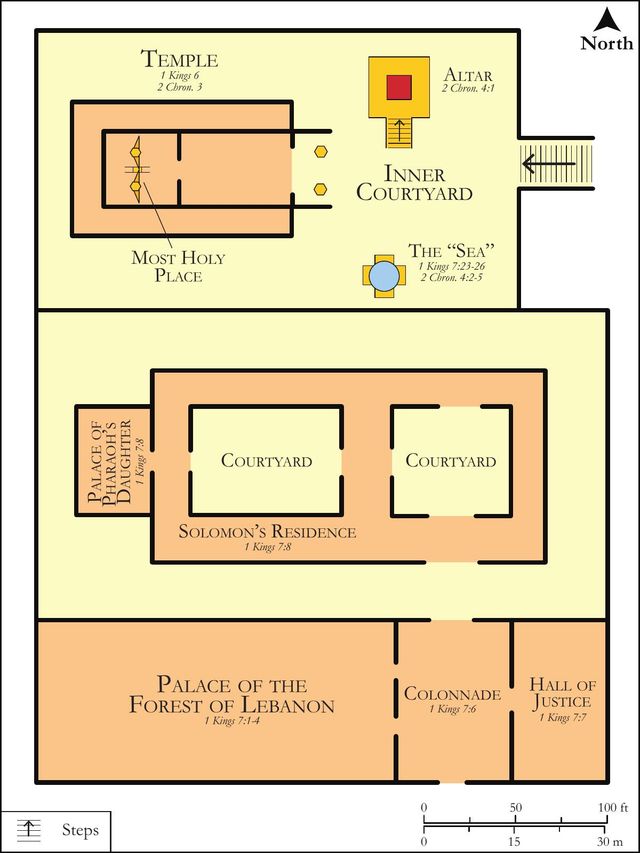
1 Kings 7:2 introduces the "House of the Forest of Lebanon," a monumental and architecturally significant edifice within King Solomon's vast royal complex in Jerusalem. This grand structure, named for the immense quantities of prized cedar wood imported from Lebanon used in its construction, measured an impressive one hundred cubits in length, fifty cubits in breadth, and thirty cubits in height. Supported by four rows of majestic cedar pillars and adorned with cedar beams, it stood as a powerful testament to Solomon's unprecedented wealth, power, and the architectural grandeur of his reign, serving as a prominent symbol of Israel's golden age.
Context
ShowHideLiterary Context
This verse is strategically placed within a detailed account of King Solomon's extensive building projects in Jerusalem, specifically focusing on his royal complex after the completion of the Temple. While 1 Kings 6:38 notes that the Temple of the Lord was completed in seven years, 1 Kings 7:1 explicitly states that Solomon spent thirteen years building his own palace complex. The description of the "House of the Forest of Lebanon" immediately follows this general statement, indicating its prominence as the first and perhaps most impressive structure within the royal precinct to be detailed. The meticulous enumeration of dimensions and materials in this chapter emphasizes the scale and opulence of Solomon's earthly kingdom, often drawing a subtle comparison or contrast with the divinely commanded specifications for the Temple.
Historical & Cultural Context
Solomon's reign (c. 970-931 BC) marked the zenith of ancient Israel's political and economic power, characterized by extensive trade networks and diplomatic relations. The construction of such monumental buildings was a hallmark of powerful monarchs among the kings of that day, serving not only practical purposes but also as potent displays of wealth, prestige, and divine favor. The "cedar of Lebanon" was the most highly prized building material of the era, known for its durability, aromatic quality, and resistance to decay. Its acquisition involved significant international trade, notably with Hiram, King of Tyre (1 Kings 5:1-12). The sheer volume of cedar used in this "House of the Forest of Lebanon" underscored Solomon's immense resources and his ability to command vast labor and material from across the region, reflecting the unparalleled prosperity of his kingdom.
Key Themes
ShowHideThe description of the "House of the Forest of Lebanon" contributes significantly to several key themes within the book of Kings. Firstly, it powerfully illustrates Solomon's Grandeur and Wealth, showcasing the unprecedented prosperity and power that characterized his reign, fulfilling, in part, God's promise of wisdom and riches (1 Kings 3:13). Secondly, it highlights the Architectural Magnificence and Human Achievement of the era, demonstrating sophisticated engineering and design capabilities, which were often seen as reflections of the king's wisdom and the nation's advanced state. Lastly, the narrative's meticulous distinction between the Temple's construction and the subsequent building of Solomon's palace complex underscores the Distinction Between Sacred and Secular Spheres. While both were grand, the Temple was built first and dedicated to God, signifying spiritual priority, even as the royal dwelling emphasized the earthly reign's splendor and its potential for both blessing and eventual pitfalls, as seen in later chapters of 1 Kings.
Exposition and Analysis
ShowHideKey Word Analysis
ShowHideThis term, while broadly meaning "house," encompasses a wide array of applications, from a private dwelling to a temple or palace. In this context, it refers to a grand, public structure within the royal complex, distinct from Solomon's personal residence, yet serving a significant royal function. Its usage here emphasizes its architectural grandeur and its role as a prominent edifice.
The cubit was the standard unit of measurement in Israel, typically approximating the length from the elbow to the tip of the middle finger. While its precise length varied, it is generally estimated at around 18 inches (approximately 45 cm). The dimensions provided (100, 50, 30 cubits) translate to approximately 150 feet (45 meters) long, 75 feet (22.5 meters) wide, and 45 feet (13.5 meters) high, underscoring the truly monumental scale of this building for its time.
Referring specifically to the Cedrus libani, this wood was highly esteemed in Israel and in Tyre for its impressive size, strength, durability, aromatic quality, and resistance to decay. Its extensive use in Solomon's palace, as well as the Temple, symbolized luxury, permanence, and royal grandeur, reflecting the zenith of Israel's material prosperity and architectural sophistication.
Verse Breakdown
ShowHide"He built also the house of the forest of Lebanon"
"He" unequivocally refers to King Solomon, highlighting his direct involvement and initiative in this colossal construction endeavor. The inclusion of "also" signals that this edifice was part of a broader series of building projects undertaken by Solomon for his royal complex, following the completion of the Temple. The "house of the forest of Lebanon" was a distinct and renowned structure within his royal precinct, named for its primary material and perhaps its appearance.
"the length thereof [was] an hundred cubits, and the breadth thereof fifty cubits, and the height thereof thirty cubits"
These meticulously stated dimensions underscore the truly monumental scale of the building. Such precise measurements emphasize that this was an exceptionally large and imposing structure, designed not only for practical utility but also to convey immense power, wealth, and royal authority, capable of accommodating significant state functions.
"upon four rows of cedar pillars, with cedar beams upon the pillars"
This clause details the core structural framework of the building. The mention of "four rows of cedar pillars" suggests a grand, colonnaded hall, possibly with multiple internal divisions or aisles, providing robust support for the roof. The "cedar beams upon the pillars" indicates the comprehensive and luxurious use of this precious wood throughout the load-bearing and roofing elements, signifying the building's robust construction and opulent finish.
Literary Devices
ShowHideThe description of the "House of the Forest of Lebanon" in 1 Kings 7:2 employs several literary devices to convey its grandeur and significance. Architectural Description is paramount, as the verse meticulously details the dimensions (length, breadth, height) and materials (cedar pillars, cedar beams), providing a vivid mental image of the structure. This precision functions as a form of Ekphrasis, a detailed and vivid description of a physical object, serving to underscore the sheer scale and opulence of Solomon's reign. The repeated emphasis on "cedar" and "Lebanon" acts as Symbolism, associating the building with the highest quality, luxury, and the vast resources at Solomon's disposal, while also subtly hinting at his extensive international connections and the prosperity of his kingdom. The sheer immensity of the dimensions, particularly for an ancient structure, can also be interpreted as a form of Hyperbole, emphasizing the extraordinary nature of Solomon's achievements and wealth, perhaps even beyond typical human scale, to highlight his unique status among kings.
Theological and Thematic Connections
ShowHideThe construction of the "House of the Forest of Lebanon," alongside Solomon's other lavish building projects, serves as a powerful testament to the peak of Israel's earthly glory and prosperity under his reign. While undeniably impressive and a fulfillment of God's promise to bless Solomon with wealth and honor, these grand structures also subtly introduce a tension between human ambition and divine priorities. The extensive time and resources dedicated to the palace, compared to the Temple, can be seen as a foreshadowing of the kingdom's eventual decline, where the pursuit of earthly splendor and self-aggrandizement began to overshadow devotion to God. The narrative, therefore, invites reflection on the ephemeral nature of human achievements and the ultimate vanity of seeking glory apart from God, even when blessed by Him.
Reflection and Application
ShowHideThe account of Solomon's magnificent buildings, particularly the "House of the Forest of Lebanon," serves as a profound reminder of human ambition and achievement when blessed with abundant resources. For believers today, it underscores the principle of stewardship—how we manage the wealth, talents, and opportunities God provides. While Solomon's earthly splendor was immense and awe-inspiring, it ultimately points to a greater, eternal glory found in God's presence, which transcends any earthly construction. This passage challenges us to examine our own priorities: are we building monuments to ourselves, or are we investing in things of eternal value? It prompts us to consider whether our pursuits, however grand, are aligned with God's purposes or if they risk leading us away from Him, as they ultimately did for Solomon. True wisdom lies not just in acquiring resources but in discerning how to use them for God's glory and the advancement of His kingdom, recognizing that all earthly grandeur is fleeting compared to the enduring reality of God's reign.
Questions for Reflection
ShowHideFAQ
ShowHideWhat was the primary purpose of the "House of the Forest of Lebanon"?
ShowHideWhile the Bible does not explicitly state its singular purpose, its immense size, robust construction, and the detailed descriptions in 1 Kings 10:16-17 and Isaiah 22:8 strongly suggest it likely served multiple functions. It is widely believed to have functioned as a royal armory, housing weapons and shields, a treasury for storing valuable goods, and potentially a grand hall for state receptions, judicial proceedings, or other official royal functions. Its name, derived from the vast amount of cedar, emphasizes its material and appearance rather than a specific, singular function.
Christ-Centered Fulfillment
ShowHideThe earthly glory and magnificent structures of King Solomon, particularly the "House of the Forest of Lebanon," serve as a poignant shadow of the far greater and eternal glory of Jesus Christ. Solomon, in his wisdom and unparalleled wealth, built a physical kingdom and a grand house for himself, symbolizing the peak of human achievement and earthly dominion. However, this earthly splendor was ultimately temporary and flawed, eventually leading to the division of his kingdom. In contrast, Jesus Christ is the true and ultimate builder of an eternal house, not made with human hands, but composed of living stones—His Church (Ephesians 2:19-22). While Solomon's house was built with the finest cedar, Christ Himself is the chief cornerstone (Psalm 118:22), upon whom the entire spiritual edifice rests. The wisdom and glory of Solomon, which drew the Queen of Sheba from afar (1 Kings 10:1-13), are infinitely surpassed by the wisdom and glory of Christ, in whom "are hidden all the treasures of wisdom and knowledge" (Colossians 2:3). Unlike Solomon's transient palace, Christ's kingdom is eternal, and His presence is the true Temple, as revealed in the New Jerusalem where there is no need for a physical temple because "the Lord God Almighty and the Lamb are its temple" (Revelation 21:22). Thus, Solomon's grand construction ultimately points to the superior and everlasting spiritual reality found in Christ, the ultimate King and Builder.