


1 Kings 7:7
Bible text: King James Version (1769 Blayney text) · Public domain
Bible text: King James Version with Strong's numbers · Public domain
Bible text: Berean Standard Bible · Public domain
Bible text: American Standard Version (1901) · Public domain
Bible text: World English Bible, Messianic edition · Public domain
Bible text: Geneva Bible (1599) · Public domain
Bible text: Young's Literal Translation · Public domain
- וְאוּלָםve·'u·Lamand [the] porch ofH197Conj-w ¦ N-mscNoun Singular Masculine Constructוְandאוּלָם[the] porch of
- הַכִּסֵּאha·ki·Se'the throneH3678Art ¦ N-msNoun Singular Masculine Absoluteהַtheכִּסֵּאthrone
- אֲשֶׁר'a·SherwhereH834RelParticle Relative
- יִשְׁפָּטyish·pothe gave judgmentH8199V-Qal-Imperf-3msVerb Qal Imperfect 3rd Singular Masculine
- שָׁםShamthereH8033AdvAdverb
- אֻלָם'u·Lam[the] porch ofH197N-mscNoun Singular Masculine Construct
- הַמִּשְׁפָּטha·mish·Pat<the> judgmentH4941Art ¦ N-msNoun Singular Masculine Absoluteהַ<the>מִּשְׁפָּטjudgment
- עָשָׂה'a·Sahhe madeH6213V-Qal-Perf-3msVerb Qal Perfect 3rd Singular Masculine
- וְסָפוּןve·sa·Funand [it was] paneledH5603Conj-w ¦ V-Qal-PassPrtcpl-msVerb Qal Participle Passive Singular Masculine Absoluteוְandסָפוּן[it was] paneled
- בָּאֶרֶזba·'E·rezwith <the> cedarH730Prep-b ¦ N-msNoun Singular Masculine Absoluteבָּwith <the>אֶרֶזcedar
- מֵהַקַּרְקַעme·ha·kar·Ka'from the floorH7172Prep-m ¦ Art ¦ N-msNoun Singular Masculine Absoluteמֵfromהַtheקַּרְקַעfloor
- עַד'adtoH5704PrepPreposition
- הַקַּרְקָעha·kar·Ka'the floorH7172Art ¦ N-msNoun Singular Masculine Absoluteהַtheקַּרְקָעfloor
English is a literal word-by-word gloss of the Hebrew, not the KJV's wording. Why?
This is the original text the KJV's translators worked from — each Hebrew word with its own literal English meaning in this verse, prepared by scholars at Tyndale House, Cambridge. The KJV translates whole sentences, not word by word, so its wording differs: one Hebrew word can become several English words, and the KJV may choose “the LORD” where the gloss reads “Yahweh”. Both are faithful — they answer different questions. For the KJV's own rendering, switch to the KJV text.
Details
See on the biblical-era maps

Study this verse
Public-domain commentary
Matthew Henry
From his Commentary on the Whole Bible. Henry comments on passages, not single verses — this entry covers 1 Kings 7:1–12.
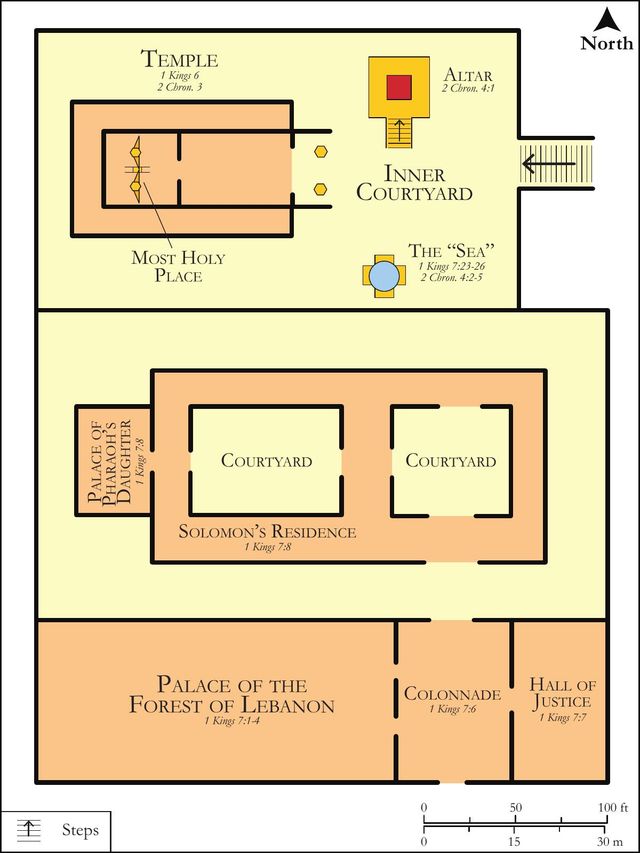
Never had any man so much of the spirit of building as Solomon had, nor to better purpose; he began with the temple, built for God first, and then all his other buildings were comfortable. The surest foundations of lasting prosperity are those which are laid in an early piety, Mat 6:33. 1. He built a house for himself (Kg1 7:1), where he dwelt, Kg1 7:8. His father had built a good house; but it was no reflection upon his father for him to build a better, in proportion to the estate wherewith God had blessed him. Much of the comfort of this life is connected with an agreeable house. He was thirteen years building this house, whereas he built the temple in little more than seven years; not that he was more exact, but less eager and intent, in building his own house than in building God's. He was in no haste for his own palace, but impatient till the temple was finished and fit for use. Thus we ought to prefer God's honour before our own ease and satisfaction. 2. He built the house of the forest at Lebanon (Kg1 7:2), supposed to be a country seat near Jerusalem, so called from the pleasantness of its situation and the trees that encompassed it. I rather incline to think that it was a house built in the forest of Lebanon itself, whither (though far distant from Jerusalem) Solomon (having so many chariots and horses, and those dispersed into chariot-cities, which probably were his stages) might frequently retire with ease. It does not appear that his throne (mentioned Kg1 7:7) was at the house of the forest of Lebanon, and it was not at all improper to put his shields there as in a magazine. Express notice is taken of his buildings, not only in Jerusalem, but in Lebanon (Kg1 9:19), and we read of the tower of Lebanon, which looks towards Damascus (Sol 7:4), which probably was part of this house. A particular account is given of this house, that being built in Lebanon, a place famed for cedars, the pillars, and beams, and roof, were all cedar (Kg1 7:2, Kg1 7:3), and, being designed for pleasant prospects, there were three tiers of windows on each side, light against light (Kg1 7:4, Kg1 7:5), or, as it may be read, prospect against prospect. Those whose lost i cast in the country may be well reconciled to a country life by this, that some of the greatest princes have thought those the most pleasant of their days which they have spent in their country retirements. 3. He built piazzas before one of his houses, either that at Jerusalem or that in Lebanon, which were very famous - a porch of pillars (Kg1 7:6), perhaps for an exchange or a guard-house, or for those to walk in that attended him about business till they could have audience, or for state and magnificence. He himself speaks of Wisdom's building her house, and hewing out her seven pillars (Pro 9:1), for the shelter of those that, three verses before (Kg1 8:34), are said to watch daily at her gates and to wait at the posts of her doors. 4. At his house where he dwelt in Jerusalem he built a great hall, or porch of judgment, where was set the throne, or king's bench, for the trial of causes, in which he himself was appealed to (placita coram ipso rege tenenda - causes were to be adjusted in the king's presence), and this was richly wainscoted with cedar, from the floor to the roof, Kg1 7:7. He had there also another court within the porch, nearer his house, of similar work, for his attendants to walk in, Kg1 7:8. 5. He built a house for his wife, where she kept her court, Kg1 7:8. It is said to be like the porch, because built of cedar like it, though not in the same form; this, no doubt, was nearer adjoining to his own palace, yet perhaps if it had been as near as it ought to have been Solomon would not have multiplied wives as he did.
The wonderful magnificence of all these buildings is taken notice of, Kg1 7:9, etc. All the materials were the best of their kind. The foundation-stones were costly for their size, four or five yards square, or at least so many yards long (Kg1 7:10), and the stones of the building were costly for the workmanship, hewn and sawn, and in all respects finely wrought, Kg1 7:9, Kg1 7:11. The court of his own house was like that of the temple (Kg1 7:12, compare Kg1 6:36); so well did he like the model of God's courts that he made his own by it.
Continue studying 1 Kings 7:7 across the web’s major study libraries — every link below opens this exact verse, chapter, or book on the destination site.
Read & Compare
 BibleGatewayThis verse in more than 200 translations and 70 languages.
 Bible.comThe YouVersion reader — hundreds of translations, reading plans, and highlights.
 ESV.orgCrossway's official English Standard Version reader.
 NET BibleThe NET translation with 60,000+ translators' notes on every rendering decision.
 STEP BibleTyndale House's free study tool — original text, vocabulary, and scholarly resources.
 BibliaLogos Bible Software's free web reader.
 USCCBThe New American Bible (Revised Edition) with the U.S. bishops' study notes.
Commentaries
 BibleHub CommentariesDozens of classic commentaries on this verse, gathered on one page.
 StudyLightMore than 100 commentary sets — the largest collection on the web.
 BibleRefPlain-English commentary on what this verse means, verse by verse.
 Enduring WordDavid Guzik's free commentary on this chapter, widely used by Bible teachers.
 Bible Study ToolsVerse commentary alongside Greek and Hebrew study aids.
Original Language & Research
- BibleHub InterlinearThe verse word by word — original language, transliteration, and English.
- BibleHub LexiconEvery word's original-language definition and Strong's entry.
 Blue Letter BibleDeep-study tools — Strong's numbers, concordance, and word studies.
 SefariaThe Hebrew text with Rashi and centuries of Jewish commentary.
Sermons, Hymns & Audio


TrulyRandomVerse is not affiliated with these sites and doesn’t control their content. They’re linked because they’re genuinely useful.
Summary
1 Kings 7:7 meticulously describes a pivotal architectural feature within King Solomon's vast palace complex: the Porch of the Throne, also explicitly named the Porch of Judgment. This structure, lavishly adorned with cedar paneling from floor to ceiling, served as the king's dedicated judicial chamber, underscoring his divinely appointed role as the supreme arbiter of justice and the central figure in Israel's legal and administrative system, thereby symbolizing the foundational importance of righteous governance in the kingdom.
Context
ShowHideLiterary Context
This verse is strategically positioned within the detailed account of Solomon's monumental building projects in 1 Kings 6-7. Immediately following the completion of the magnificent Temple for the Lord, which took seven years to build (1 Kings 6:38), the narrative shifts to Solomon's own royal palace complex, a project that spanned an even longer thirteen years (1 Kings 7:1). This deliberate juxtaposition invites a subtle yet profound comparison between the house dedicated to God and the house built for the king. The detailed architectural descriptions, including that of the Porch of Judgment, serve not only to highlight Solomon's immense wealth and administrative prowess but also to set the stage for later theological evaluations of his reign, particularly concerning the balance between his personal glory and his devotion to the Lord.
Historical & Cultural Context
In Israel, the king was the ultimate judicial authority, embodying the law and serving as the final court of appeal, as when Solomon gave judgment between the two women who stood before him. Royal palaces were therefore designed to include specific, often prominent, spaces where the monarch could publicly hold court, hear petitions, and render judgments. The "porch" or "gate" area was a common location for such public legal proceedings due to its accessibility and visibility. The extensive use of "cedar from one side of the floor to the other" in the Porch of Judgment signifies unparalleled luxury and durability. Cedar of Lebanon was an exceptionally prized and costly timber, imported from Phoenicia, reflecting Solomon's vast resources and his strategic alliance with Hiram of Tyre (1 Kings 5:1-12). The construction of such a grand judicial space underscored the king's absolute authority and his divinely ordained responsibility to maintain justice and order within the land, a core expectation of Israelite kingship rooted in Mosaic law.
Key Themes
ShowHideThe construction of the Porch of Judgment in 1 Kings 7:7 powerfully contributes to several overarching themes in the book of Kings. Firstly, it emphatically highlights Royal Authority and Responsibility, particularly the king's indispensable role as the supreme judge. This space was not merely ceremonial but profoundly functional, symbolizing the king's direct engagement in the legal system and his sacred duty to uphold righteousness, a theme echoed in wisdom literature such as Proverbs 29:4. Secondly, it vividly exemplifies Solomon's Grandeur and Wealth, showcasing the unparalleled resources and architectural sophistication of his reign. The lavish use of cedar aligns with the broader portrayal of Solomon's extraordinary prosperity and wisdom, which garnered admiration from across the known world (1 Kings 10:23-25). Finally, it profoundly underscores the theme of Justice and Governance, emphasizing that a stable, prosperous, and divinely favored kingdom is inextricably linked to equitable and accessible judgment. The very existence of such a dedicated and magnificent space underscores the critical importance of a structured legal process for the well-being of the nation, reflecting the divine mandate for rulers to champion justice, as beautifully articulated in Psalm 72:1-4.
Exposition and Analysis
ShowHideKey Word Analysis
ShowHideThis term, derived from a root suggesting "tying" or "binding," refers to a vestibule, portico, or hall, typically serving as a grand, often open-fronted, entrance or public space within a building. In Solomon's building, an 'ûlâm was designed to impress and accommodate gatherings, making it a fitting location for public proceedings. Its specific designation as "the porch of judgment" clarifies its unique, functional role, distinguishing it from other halls within the extensive palace complex and emphasizing its identity as a formal forum for legal and administrative affairs.
This multifaceted and crucial term encompasses far more than simple legal decision-making. Mishpâṭ signifies a verdict, a sentence, a formal decree, and abstractly, justice itself. It includes the act of judging, the place of judgment, and the principles of divine or human law. When applied to the king's porch, it denotes that this was the sacred space where disputes were settled, royal decrees were issued, and the overarching principles of justice were upheld, reflecting God's own character and His standards for righteous governance.
Cedar, specifically the renowned cedar of Lebanon, was the most esteemed building material of Solomon's day. It was prized for its exceptional durability, aromatic qualities, natural resistance to decay and insects, and its majestic appearance. Its extensive use, described as "from one side of the floor to the other," in the Porch of Judgment signifies the structure's immense value, permanence, and the king's unparalleled wealth. It also imbues the space with a sense of majesty, solemnity, and sacredness, befitting a place where divine justice was to be administered.
Verse Breakdown
ShowHide"Then he made a porch for the throne where he might judge"
This initial clause directly articulates the architectural creation and its foundational purpose. Solomon constructed a dedicated "porch" or grand hall, not merely as an aesthetic addition, but as the specific locus of his authority ("for the throne") and the operational center for his most vital kingly duty: to "judge." This highlights the practical, governmental, and authoritative importance of this particular space within the sprawling palace.
"[even] the porch of judgment"
This appositional phrase serves as a direct clarification and emphatic reinforcement of the structure's function, explicitly naming it based on its primary purpose. The repetition and specific naming leave no ambiguity about its role as the central hub for all judicial and administrative affairs of the kingdom, underscoring the paramount significance of justice as a cornerstone of Solomon's reign.
"and [it was] covered with cedar from one side of the floor to the other"
This descriptive phrase elaborates on the luxurious and enduring materials employed in the construction. The verb "covered" (H5603, çâphan) suggests that the interior surfaces—likely the walls, ceiling, and possibly even the floor—were meticulously adorned with this precious and revered wood. The hyperbolic expression "from one side of the floor to the other" conveys the sheer extensiveness and lavishness of the cedar paneling, signifying the grandeur, permanence, and immense cost associated with this vital governmental and judicial space.
Literary Devices
ShowHideThe verse masterfully employs several literary devices to convey its profound meaning and impact. Metonymy is powerfully evident in the phrase "porch for the throne where he might judge," where "throne" serves as a direct substitute for the king's ultimate authority, his royal office, and the very act of ruling itself. The structure is thus intrinsically linked to the immense power and responsibility it represents. Symbolism is paramount, as the entire "porch of judgment" functions as a potent symbol of royal authority, divine justice, and the king's divinely appointed role as the supreme arbiter and dispenser of law in Israel. The lavish use of Hyperbole in the description "covered with cedar from one side of the floor to the other" dramatically emphasizes the extraordinary opulence and grandeur of the construction, underscoring Solomon's unparalleled wealth and the profound significance he ascribed to this judicial space. Furthermore, the Repetition of "porch" and its explicit naming as "porch of judgment" serves to underscore its singular and crucial function within the expansive and complex royal residence.
Theological and Thematic Connections
ShowHideThe Porch of Judgment stands as a tangible and potent representation of the king's sacred responsibility to embody divine justice on earth. In ancient Israel, the king was understood as God's chosen representative, divinely tasked with upholding the covenant and ensuring that God's righteous laws were applied equitably among the people. This magnificent space was where the abstract concept of divine justice became concrete and actionable, where the king, seated on his throne, was expected to dispense wisdom, righteousness, and truth, thereby reflecting the very character of God, who is the ultimate and perfect Judge. The sheer magnificence and permanence of the building underscored the solemnity and paramount importance of this task, serving as a constant reminder to both the king and the people that justice was not a trivial matter but a foundational pillar essential for the nation's well-being, its covenant faithfulness, and its ongoing relationship with God.
Reflection and Application
ShowHideThe Porch of Judgment, with its grandeur and explicit function, serves as a profound and enduring reminder that leadership, particularly in positions of power and authority, carries an immense and sacred responsibility to administer justice fairly, impartially, and with unwavering integrity. While contemporary societies no longer operate under a monarchy with a single earthly judge, the timeless principles embodied in this structure remain vitally relevant for all governing bodies, institutions, and individuals. It compels us to critically examine how we, within our diverse spheres of influence—be it in our families, workplaces, communities, or churches—actively uphold truth, diligently seek fairness, and courageously plead the cause of the vulnerable and overlooked. The lavishness of the porch suggests that justice is not a peripheral concern but a foundational pillar of societal flourishing, demanding significant investment of resources, profound wisdom, and dedicated, sustained effort. It challenges us to ensure that our societal systems, our organizational structures, and our personal conduct consistently reflect an unwavering commitment to righteousness, recognizing that true human flourishing and divine blessing are inextricably linked to the equitable and compassionate application of justice for all.
Questions for Reflection
ShowHideFAQ
ShowHideWhat was the primary function of the Porch of Judgment?
ShowHideThe primary function of the Porch of Judgment was to serve as the dedicated and magnificent space where King Solomon would sit on his throne to administer justice, hear legal disputes, and issue royal decrees. It was the central hub for the judicial and administrative functions of his reign, symbolizing his crucial role as the supreme arbiter and dispenser of law and order in ancient Israel. This practice was common for the kings of Israel and Judah, the monarch being the ultimate legal authority, responsible for maintaining righteousness within the kingdom, as beautifully expressed in Psalm 72:1-4.
Christ-Centered Fulfillment
ShowHideThe earthly "Porch of Judgment" built by Solomon, a place where justice was imperfectly administered by a fallible and ultimately flawed king, serves as a profound Old Testament type pointing forward to the perfect and ultimate Judge, Jesus Christ. While Solomon's throne was adorned with the finest cedar, signifying earthly majesty, Christ's throne is one of eternal righteousness, truth, and perfect equity (Psalm 9:7-8). The temporary nature of Solomon's reign and his eventual moral compromises highlight the inherent limitations of human kingship and underscore the profound need for a King whose justice is unwavering, whose wisdom is infinite, and whose reign is everlasting. Jesus, the true and greater Son of David, perfectly fulfills the ideal of the righteous King who not only dispenses justice but is justice incarnate. He is the one appointed by God to ultimately judge the living and the dead (2 Timothy 4:1), and before whose glorious judgment seat all humanity will one day stand (Romans 14:10). His coming kingdom will be eternally characterized by perfect justice, absolute righteousness, and enduring peace, where every wrong will be made right, and His sovereign reign will have no end (Isaiah 9:7).