


1 Kings 7:6
Bible text: King James Version (1769 Blayney text) · Public domain
Bible text: King James Version with Strong's numbers · Public domain
Bible text: Berean Standard Bible · Public domain
Bible text: American Standard Version (1901) · Public domain
Bible text: World English Bible, Messianic edition · Public domain
Bible text: Geneva Bible (1599) · Public domain
Bible text: Young's Literal Translation · Public domain
- וְאֵתve·'Etand <obj.>H853Conj-w ¦ DirObjMParticle Object Indicatorוְandאֵת<obj.>
- אוּלָם'u·Lam[the] porch ofH197N-mscNoun Singular Masculine Construct
- הָעַמּוּדִיםha·'a·mu·Dimthe pillarsH5982Art ¦ N-mpNoun Plural Masculine Absoluteהָtheעַמּוּדִיםpillars
- עָשָׂה'a·Sahhe madeH6213V-Qal-Perf-3msVerb Qal Perfect 3rd Singular Masculine
- חֲמִשִּׁיםcha·mi·Shim[was] fiftyH2572N-mpNoun Plural Masculine Absolute
- אַמָּה'a·Mahcubit[s]H520N-fsNoun Singular Feminine Absolute
- אָרְכּוֹ'a·re·Koits lengthH753N-msc ¦ 3msNoun Singular Masculine Constructאָרְכּlengthוֹits
- וּשְׁלֹשִׁיםu·she·lo·Shimand [was] thirtyH7970Conj-w ¦ N-mpNoun Plural Masculine Absoluteוּandשְׁלֹשִׁים[was] thirty
- אַמָּה'a·Mahcubit[s]H520N-fsNoun Singular Feminine Absolute
- רָחְבּוֹra·che·Boits breadthH7341N-msc ¦ 3msNoun Singular Masculine Constructרָחְבּbreadthוֹits
- וְאוּלָםve·'u·Lamand a porchH197Conj-w ¦ N-msNoun Singular Masculine Absoluteוְandאוּלָםa porch
- עַל'al[was] onH5921PrepPreposition
- פְּנֵיהֶםpe·nei·Hemtheir faceH6440N-mpc ¦ 3mpNoun Plural Masculine Constructפְּנֵיfaceהֶםtheir
- וְעַמֻּדִיםve·'a·mu·Dimand pillarsH5982Conj-w ¦ N-mpNoun Plural Masculine Absoluteוְandעַמֻּדִיםpillars
- וְעָבve·'Avand a thresholdH5646Conj-w ¦ N-msNoun Singular Masculine Absoluteוְandעָבa threshold
- עַל'al[were] onH5921PrepPreposition
- פְּנֵיהֶםpe·nei·Hemtheir faceH6440N-mpc ¦ 3mpNoun Plural Masculine Constructפְּנֵיfaceהֶםtheir
English is a literal word-by-word gloss of the Hebrew, not the KJV's wording. Why?
This is the original text the KJV's translators worked from — each Hebrew word with its own literal English meaning in this verse, prepared by scholars at Tyndale House, Cambridge. The KJV translates whole sentences, not word by word, so its wording differs: one Hebrew word can become several English words, and the KJV may choose “the LORD” where the gloss reads “Yahweh”. Both are faithful — they answer different questions. For the KJV's own rendering, switch to the KJV text.
Details
See on the biblical-era maps

Study this verse
Public-domain commentary
Matthew Henry
From his Commentary on the Whole Bible. Henry comments on passages, not single verses — this entry covers 1 Kings 7:1–12.
Never had any man so much of the spirit of building as Solomon had, nor to better purpose; he began with the temple, built for God first, and then all his other buildings were comfortable. The surest foundations of lasting prosperity are those which are laid in an early piety, Mat 6:33. 1. He built a house for himself (Kg1 7:1), where he dwelt, Kg1 7:8. His father had built a good house; but it was no reflection upon his father for him to build a better, in proportion to the estate wherewith God had blessed him. Much of the comfort of this life is connected with an agreeable house. He was thirteen years building this house, whereas he built the temple in little more than seven years; not that he was more exact, but less eager and intent, in building his own house than in building God's. He was in no haste for his own palace, but impatient till the temple was finished and fit for use. Thus we ought to prefer God's honour before our own ease and satisfaction. 2. He built the house of the forest at Lebanon (Kg1 7:2), supposed to be a country seat near Jerusalem, so called from the pleasantness of its situation and the trees that encompassed it. I rather incline to think that it was a house built in the forest of Lebanon itself, whither (though far distant from Jerusalem) Solomon (having so many chariots and horses, and those dispersed into chariot-cities, which probably were his stages) might frequently retire with ease. It does not appear that his throne (mentioned Kg1 7:7) was at the house of the forest of Lebanon, and it was not at all improper to put his shields there as in a magazine. Express notice is taken of his buildings, not only in Jerusalem, but in Lebanon (Kg1 9:19), and we read of the tower of Lebanon, which looks towards Damascus (Sol 7:4), which probably was part of this house. A particular account is given of this house, that being built in Lebanon, a place famed for cedars, the pillars, and beams, and roof, were all cedar (Kg1 7:2, Kg1 7:3), and, being designed for pleasant prospects, there were three tiers of windows on each side, light against light (Kg1 7:4, Kg1 7:5), or, as it may be read, prospect against prospect. Those whose lost i cast in the country may be well reconciled to a country life by this, that some of the greatest princes have thought those the most pleasant of their days which they have spent in their country retirements. 3. He built piazzas before one of his houses, either that at Jerusalem or that in Lebanon, which were very famous - a porch of pillars (Kg1 7:6), perhaps for an exchange or a guard-house, or for those to walk in that attended him about business till they could have audience, or for state and magnificence. He himself speaks of Wisdom's building her house, and hewing out her seven pillars (Pro 9:1), for the shelter of those that, three verses before (Kg1 8:34), are said to watch daily at her gates and to wait at the posts of her doors. 4. At his house where he dwelt in Jerusalem he built a great hall, or porch of judgment, where was set the throne, or king's bench, for the trial of causes, in which he himself was appealed to (placita coram ipso rege tenenda - causes were to be adjusted in the king's presence), and this was richly wainscoted with cedar, from the floor to the roof, Kg1 7:7. He had there also another court within the porch, nearer his house, of similar work, for his attendants to walk in, Kg1 7:8. 5. He built a house for his wife, where she kept her court, Kg1 7:8. It is said to be like the porch, because built of cedar like it, though not in the same form; this, no doubt, was nearer adjoining to his own palace, yet perhaps if it had been as near as it ought to have been Solomon would not have multiplied wives as he did.
The wonderful magnificence of all these buildings is taken notice of, Kg1 7:9, etc. All the materials were the best of their kind. The foundation-stones were costly for their size, four or five yards square, or at least so many yards long (Kg1 7:10), and the stones of the building were costly for the workmanship, hewn and sawn, and in all respects finely wrought, Kg1 7:9, Kg1 7:11. The court of his own house was like that of the temple (Kg1 7:12, compare Kg1 6:36); so well did he like the model of God's courts that he made his own by it.
Continue studying 1 Kings 7:6 across the web’s major study libraries — every link below opens this exact verse, chapter, or book on the destination site.
Read & Compare
 BibleGatewayThis verse in more than 200 translations and 70 languages.
 Bible.comThe YouVersion reader — hundreds of translations, reading plans, and highlights.
 ESV.orgCrossway's official English Standard Version reader.
 NET BibleThe NET translation with 60,000+ translators' notes on every rendering decision.
 STEP BibleTyndale House's free study tool — original text, vocabulary, and scholarly resources.
 BibliaLogos Bible Software's free web reader.
 USCCBThe New American Bible (Revised Edition) with the U.S. bishops' study notes.
Commentaries
 BibleHub CommentariesDozens of classic commentaries on this verse, gathered on one page.
 StudyLightMore than 100 commentary sets — the largest collection on the web.
 BibleRefPlain-English commentary on what this verse means, verse by verse.
 Enduring WordDavid Guzik's free commentary on this chapter, widely used by Bible teachers.
 Bible Study ToolsVerse commentary alongside Greek and Hebrew study aids.
Original Language & Research
- BibleHub InterlinearThe verse word by word — original language, transliteration, and English.
- BibleHub LexiconEvery word's original-language definition and Strong's entry.
 Blue Letter BibleDeep-study tools — Strong's numbers, concordance, and word studies.
 SefariaThe Hebrew text with Rashi and centuries of Jewish commentary.
Sermons, Hymns & Audio


TrulyRandomVerse is not affiliated with these sites and doesn’t control their content. They’re linked because they’re genuinely useful.
Summary
1 Kings 7:6 provides a precise architectural description of a significant component of King Solomon's vast palace complex: the "Porch of Pillars." This verse meticulously details its substantial dimensions—fifty cubits in length and thirty cubits in breadth—and specifies its prominent placement, thereby underscoring the immense grandeur, scale, and structural magnificence of Solomon's royal building endeavors in Jerusalem, which served as a tangible testament to his unparalleled wealth, wisdom, and divinely bestowed authority.
Context
ShowHideLiterary Context
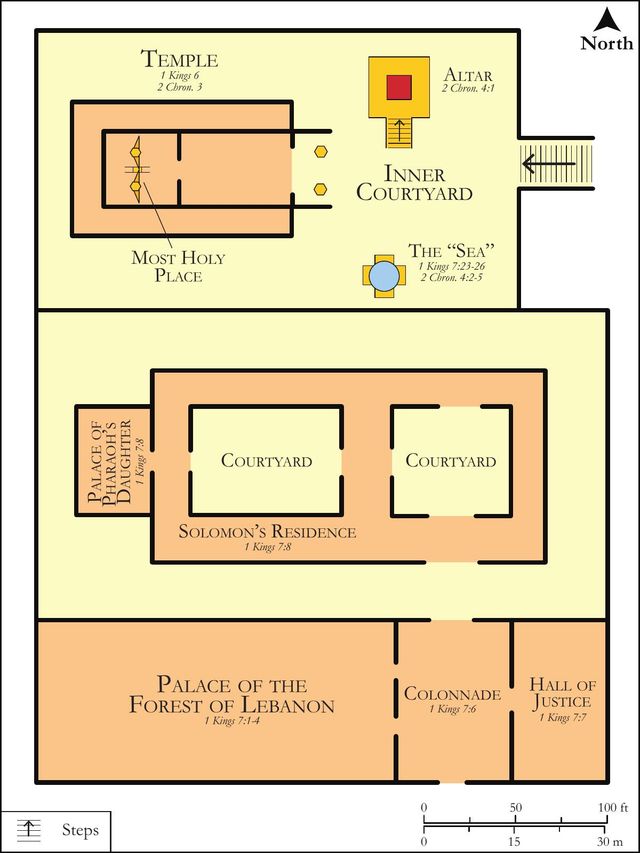
This verse is intricately woven into the broader narrative of King Solomon's extensive construction projects, particularly the detailed account of his royal palace complex as presented in 1 Kings chapter 7. It immediately follows the exhaustive and reverent description of the Temple of the Lord's construction in 1 Kings chapter 6, creating a deliberate juxtaposition between the sacred and the royal. The narrative highlights a significant temporal difference: while the Temple took seven years to complete, Solomon's personal residence, encompassing various halls, courtyards, and this very Porch of Pillars, required thirteen years, as explicitly stated in 1 Kings 7:1. These meticulous architectural descriptions, far from being mere technical details, serve a crucial literary purpose: they emphasize the unparalleled scale of Solomon's reign, the vast resources at his command, and the fulfillment of God's promises of prosperity and peace. The Porch of Pillars is further elaborated upon in 1 Kings 7:7, where it is identified as the "Porch of the Throne" or "Porch of Judgment," revealing its functional significance as a primary venue for royal audiences and the administration of justice.
Historical & Cultural Context
Solomon's reign, conventionally dated from approximately 970 to 931 BC, marked a zenith of peace, economic prosperity, and international prestige for the united kingdom of Israel. His ambitious building programs, encompassing not only the Jerusalem Temple and his sprawling palace but also numerous fortified cities across the kingdom (e.g., 1 Kings 9:15-19), were emblematic of his administration. Such monumental architectural undertakings were characteristic of the great kings of that day, serving not merely practical functions but primarily as potent symbols of their authority, divine favor, and capacity to mobilize immense wealth, skilled labor, and advanced engineering. The dimensions and materials—including imported cedar from Lebanon and skilled Phoenician craftsmen—described in this verse reflect the sophisticated building techniques and extensive trade networks Solomon commanded. The "cubit," a standard ancient measurement derived from the length of a forearm (roughly 18-21 inches), renders the porch approximately 75 feet long and 45 feet wide, an imposing structure designed to project power and impress both subjects and foreign dignitaries.
Key Themes
ShowHideThe meticulous detailing of the Porch of Pillars in 1 Kings 7:6 contributes significantly to several overarching themes present throughout the book of 1 Kings. Firstly, it powerfully underscores the theme of Royal Splendor and Architectural Grandeur, showcasing Solomon's immense wealth, prestige, and the unprecedented prosperity of his kingdom, a direct result of God's blessing and Solomon's divinely granted wisdom, as celebrated in passages like 1 Kings 4:29-30. Secondly, the precise measurements and structural descriptions highlight the theme of Order, Design, and Meticulous Craftsmanship. The biblical narrative consistently emphasizes the careful planning and execution of both the Temple and the palace, reflecting a profound value for structured undertakings and detailed artistry. Finally, this passage implicitly touches upon the theme of Divine Blessing and Human Stewardship. Solomon's ability to undertake such massive projects was undeniably a direct consequence of God's favor and covenant faithfulness. However, the sheer scale of his personal palace, described immediately after the Temple, also subtly raises questions about the proper use of such abundance and the delicate balance between glorifying God through one's endeavors and the potential for human achievement to become an end in itself, rather than a means to honor the divine.
Exposition and Analysis
ShowHideKey Word Analysis
ShowHideThis term refers to a vestibule, antechamber, or portico, typically forming an impressive and often open-fronted entrance to a larger edifice. In the context of Solomon's palace, its designation as a "porch" signifies a grand, imposing entry space, likely designed for public reception or official functions. The same Hebrew word is notably employed to describe the porch of the Temple in 1 Kings 6:3, suggesting a similar architectural function as a significant and majestic point of access that conveyed both dignity and an invitation to enter.
These are vertical supports, often cylindrical or rectangular, fundamental for bearing the weight of a roof, an upper story, or an architrave. The plural "pillars" (ʻammûdîm) indicates a colonnade—a series or multiple rows of these supports—which would have created a visually striking and structurally robust facade. Their presence is central to the description, emphasizing both the monumental scale and the structural integrity of the porch.
This word denotes a substantial, heavy piece of timber, specifically used as an architectural term for an architrave or a prominent crossbeam. Within the context of a porch supported by pillars, this "thick beam" would have spanned horizontally across the tops of the columns, forming the primary support for the roof structure above. Its "thickness" (derived from a root meaning "to cover" or "to shade") implies its robust nature, essential for stability and contributing significantly to the overall impression of strength, durability, and imposing design.
Verse Breakdown
ShowHide"And he made a porch of pillars;"
This initial clause immediately introduces the specific architectural feature being described—a grand entrance hall distinguished by its prominent supporting columns. The phrase "he made" directly attributes the construction to King Solomon, highlighting his active role, initiative, and the monumental scale of his building projects.
"the length thereof [was] fifty cubits, and the breadth thereof thirty cubits:"
This segment provides the precise dimensions of the porch, firmly establishing its substantial size. With a length of fifty cubits (approximately 75 feet) and a breadth of thirty cubits (approximately 45 feet), the description paints a picture of a very large, rectangular space, clearly designed to accommodate significant gatherings, ceremonies, or to serve as an impressive, expansive approach to other, more private sections of the palace complex.
"and the porch [was] before them:"
This phrase clarifies the orientation and strategic placement of the porch within the larger palace layout. "Them" most likely refers to the main palace buildings or courtyards, indicating that the Porch of Pillars served as the primary facade or a grand entrance leading directly into the more central and important areas of the royal residence. It was the initial, most impressive structure encountered by those approaching the palace.
"and the [other] pillars and the thick beam [were] before them."
This concluding clause offers further detail regarding the structural elements and their arrangement, potentially indicating a deeper or more complex colonnade within the porch itself. The mention of "the other pillars" suggests additional columns beyond those forming the initial facade, perhaps in a second row or supporting a more interior section of the porch. The "thick beam" is reiterated, emphasizing its critical role as a prominent, weighty structural component, likely spanning across these additional pillars, thereby reinforcing the porch's imposing, robust, and intricately designed appearance.
Literary Devices
ShowHideThe description in 1 Kings 7:6 primarily employs Description/Detailing, providing precise measurements (fifty cubits, thirty cubits) and explicitly naming specific architectural components ("porch," "pillars," "thick beam"). This meticulous detailing serves to convey the immense scale, grandeur, and structural complexity of Solomon's palace, enabling the reader to vividly visualize the impressive structure. There is also an element of Repetition, as the term "pillars" (and "porch") is mentioned multiple times, underscoring their prominence as the defining architectural feature of this section of the palace. Implicitly, the passage also utilizes Juxtaposition or Contrast by following the exhaustive account of the Temple's construction. While not explicitly stated, the reader is invited to compare the scale, purpose, and dedication of Solomon's earthly palace with the divine dwelling, subtly highlighting the distinction between human and divine glory, even amidst the king's unparalleled opulence and the blessings he received.
Theological and Thematic Connections
ShowHideThe construction of the Porch of Pillars, as an integral part of Solomon's magnificent palace, stands as a tangible manifestation of God's abundant blessing upon Israel and its king. Solomon's unprecedented wealth, peace, and wisdom, all divinely bestowed, empowered him to undertake architectural projects of immense scale and breathtaking beauty. While the Temple was unequivocally dedicated to God's glory and presence, the palace, including this grand porch, served as a powerful testament to the king's earthly power, prestige, and the nation's prosperity—all ultimately gifts from the Lord. This passage subtly yet profoundly raises questions concerning the stewardship of divine blessings and the inherent potential for human achievement and material splendor to, perhaps unintentionally, overshadow or even compete with divine purpose. It serves as a timeless reminder that even the most impressive human endeavors, though executed with skill and vast resources, are ultimately temporal and derive their true, enduring significance from their relationship to God's greater, eternal plan.
Reflection and Application
ShowHideThe detailed description of Solomon's Porch of Pillars, though rooted in ancient architecture, offers profound and timeless insights for contemporary reflection. It speaks directly to the enduring human desire for grandeur, stability, and a visible manifestation of accomplishment. For believers today, this passage prompts us to critically examine what "porches" we are diligently building in our own lives—what structures, endeavors, or reputations we are investing our precious time, talent, and resources into. Are these "porches" constructed upon solid, enduring foundations, akin to the "pillars" and "thick beam" described here, or are they flimsy, temporary, and destined to crumble? More critically, what do these "porches" truly signify? Do they primarily point to our own glory, our personal achievements, or do they, much like the Temple that precedes the palace in the biblical narrative, ultimately serve to glorify God and provide an inviting access point to His divine presence? Our lives, our work, our resources, and our very abilities are all precious gifts from God. We are called to be wise and faithful stewards, ensuring that our "building projects" reflect His character, advance His kingdom, and contribute to eternal significance, rather than merely serving our temporal comfort, fleeting prestige, or self-exaltation.
Questions for Reflection
ShowHideFAQ
ShowHideWhat was the primary purpose of the Porch of Pillars in Solomon's palace?
ShowHideThe Porch of Pillars served multiple significant functions within Solomon's sprawling palace complex. Primarily, it functioned as a grand vestibule or an imposing entrance hall, meticulously designed to impress visitors and powerfully convey the king's immense wealth, authority, and prestige. As explicitly mentioned in 1 Kings 7:7, this structure was also known as the "Porch of the Throne" or "Porch of Judgment." This designation indicates its crucial role as a formal setting where Solomon would sit to administer justice, hear petitions, and conduct official royal business. Its substantial size, imposing structure, and prominent placement would have provided a fitting and awe-inspiring backdrop for such important public functions, effectively showcasing the monarch's supreme authority and the stability of his divinely blessed kingdom.
Christ-Centered Fulfillment
ShowHideWhile 1 Kings 7:6 meticulously describes a physical structure of earthly grandeur and human design, it finds its profound and ultimate spiritual fulfillment in the person and work of Jesus Christ. Solomon's Porch of Pillars was an impressive, yet finite, entryway to a king's earthly domain, a place of human judgment and temporal power. In stark contrast, Jesus Christ is the true, eternal, and living "porch" or access point to the very presence of God. He unequivocally declares in John 14:6, "I am the way, the truth, and the life. No one comes to the Father except through me." He is not merely a structural support but the ultimate "pillar" and the very foundation upon which God's spiritual house, the Church, is immutably built, as powerfully affirmed in 1 Corinthians 3:11 and 1 Timothy 3:15. The earthly structure, built with human hands and finite resources, serves as a shadow, pointing forward to the eternal reality of God's spiritual kingdom, where Christ Himself is the magnificent entrance, the secure and everlasting foundation, and indeed, the very radiant glory of the heavenly city, as vividly depicted in the visions of the New Jerusalem in Revelation 21. Through Him, believers gain unhindered access not to a temporary earthly throne room, but to the very throne of grace, where true justice, eternal peace, and boundless mercy forever reside, as we are graciously invited in Hebrews 4:16.