


1 Kings 7:12
Bible text: King James Version (1769 Blayney text) · Public domain
Bible text: King James Version with Strong's numbers · Public domain
Bible text: Berean Standard Bible · Public domain
Bible text: American Standard Version (1901) · Public domain
Bible text: World English Bible, Messianic edition · Public domain
Bible text: Geneva Bible (1599) · Public domain
Bible text: Young's Literal Translation · Public domain
- וְחָצֵרve·cha·Tzerand [the] courtH2691Conj-w ¦ N-csNoun Singular common gender Absoluteוְandחָצֵר[the] court
- הַגְּדוֹלָהha·ge·do·Lah<the> greatH1419Art ¦ Adj-fsAdjective Singular Feminine Absoluteהַ<the>גְּדוֹלָהgreat
- סָבִיבsa·Viv[were] all aroundH5439N-csNoun Singular common gender Absolute
- שְׁלֹשָׁהshe·lo·ShahthreeH7969N-csNoun Singular common gender Absolute
- טוּרִיםtu·RimrowsH2905N-mpNoun Plural Masculine Absolute
- גָּזִיתga·Zithewn [stone]H1496N-fsNoun Singular Feminine Absolute
- וְטוּרve·Turand a row ofH2905Conj-w ¦ N-mscNoun Singular Masculine Constructוְandטוּרa row of
- כְּרֻתֹתke·ru·Totbeams ofH3773N-fpcNoun Plural Feminine Construct
- אֲרָזִים'a·ra·Zimcedar<s>H730N-mpNoun Plural Masculine Absolute
- וְלַחֲצַרve·la·cha·Tzarand to [the] court ofH2691Conj-w ¦ Prep-l ¦ N-cscNoun Singular common gender Constructוְandלַtoחֲצַר[the] court of
- בֵּיתbeit[the] house ofH1004N-mscNoun Singular Masculine Construct
- יְהוָהYah·wehYahwehH3068N-properNoun Proper Title
- הַפְּנִימִיתha·pe·ni·Mit<the> innerH6442Art ¦ Adj-fscAdjective Singular Feminine Constructהַ<the>פְּנִימִיתinner
- וּלְאֻלָםu·le·'u·Lamand to [the] porch ofH197Conj-w ¦ Prep-l ¦ N-mscNoun Singular Masculine Constructוּandלְtoאֻלָם[the] porch of
- הַבָּיִתha·Ba·yitthe houseH1004Art ¦ N-msNoun Singular Masculine Absoluteהַtheבָּיִתhouse
English is a literal word-by-word gloss of the Hebrew, not the KJV's wording. Why?
This is the original text the KJV's translators worked from — each Hebrew word with its own literal English meaning in this verse, prepared by scholars at Tyndale House, Cambridge. The KJV translates whole sentences, not word by word, so its wording differs: one Hebrew word can become several English words, and the KJV may choose “the LORD” where the gloss reads “Yahweh”. Both are faithful — they answer different questions. For the KJV's own rendering, switch to the KJV text.
Details
See on the biblical-era maps

Study this verse
Public-domain commentary
Matthew Henry
From his Commentary on the Whole Bible. Henry comments on passages, not single verses — this entry covers 1 Kings 7:1–12.
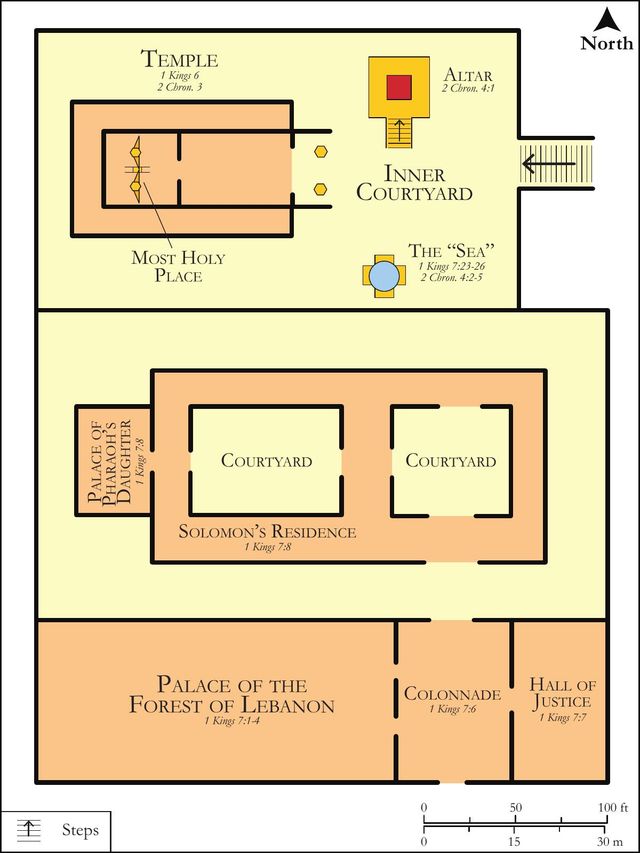
Never had any man so much of the spirit of building as Solomon had, nor to better purpose; he began with the temple, built for God first, and then all his other buildings were comfortable. The surest foundations of lasting prosperity are those which are laid in an early piety, Mat 6:33. 1. He built a house for himself (Kg1 7:1), where he dwelt, Kg1 7:8. His father had built a good house; but it was no reflection upon his father for him to build a better, in proportion to the estate wherewith God had blessed him. Much of the comfort of this life is connected with an agreeable house. He was thirteen years building this house, whereas he built the temple in little more than seven years; not that he was more exact, but less eager and intent, in building his own house than in building God's. He was in no haste for his own palace, but impatient till the temple was finished and fit for use. Thus we ought to prefer God's honour before our own ease and satisfaction. 2. He built the house of the forest at Lebanon (Kg1 7:2), supposed to be a country seat near Jerusalem, so called from the pleasantness of its situation and the trees that encompassed it. I rather incline to think that it was a house built in the forest of Lebanon itself, whither (though far distant from Jerusalem) Solomon (having so many chariots and horses, and those dispersed into chariot-cities, which probably were his stages) might frequently retire with ease. It does not appear that his throne (mentioned Kg1 7:7) was at the house of the forest of Lebanon, and it was not at all improper to put his shields there as in a magazine. Express notice is taken of his buildings, not only in Jerusalem, but in Lebanon (Kg1 9:19), and we read of the tower of Lebanon, which looks towards Damascus (Sol 7:4), which probably was part of this house. A particular account is given of this house, that being built in Lebanon, a place famed for cedars, the pillars, and beams, and roof, were all cedar (Kg1 7:2, Kg1 7:3), and, being designed for pleasant prospects, there were three tiers of windows on each side, light against light (Kg1 7:4, Kg1 7:5), or, as it may be read, prospect against prospect. Those whose lost i cast in the country may be well reconciled to a country life by this, that some of the greatest princes have thought those the most pleasant of their days which they have spent in their country retirements. 3. He built piazzas before one of his houses, either that at Jerusalem or that in Lebanon, which were very famous - a porch of pillars (Kg1 7:6), perhaps for an exchange or a guard-house, or for those to walk in that attended him about business till they could have audience, or for state and magnificence. He himself speaks of Wisdom's building her house, and hewing out her seven pillars (Pro 9:1), for the shelter of those that, three verses before (Kg1 8:34), are said to watch daily at her gates and to wait at the posts of her doors. 4. At his house where he dwelt in Jerusalem he built a great hall, or porch of judgment, where was set the throne, or king's bench, for the trial of causes, in which he himself was appealed to (placita coram ipso rege tenenda - causes were to be adjusted in the king's presence), and this was richly wainscoted with cedar, from the floor to the roof, Kg1 7:7. He had there also another court within the porch, nearer his house, of similar work, for his attendants to walk in, Kg1 7:8. 5. He built a house for his wife, where she kept her court, Kg1 7:8. It is said to be like the porch, because built of cedar like it, though not in the same form; this, no doubt, was nearer adjoining to his own palace, yet perhaps if it had been as near as it ought to have been Solomon would not have multiplied wives as he did.
The wonderful magnificence of all these buildings is taken notice of, Kg1 7:9, etc. All the materials were the best of their kind. The foundation-stones were costly for their size, four or five yards square, or at least so many yards long (Kg1 7:10), and the stones of the building were costly for the workmanship, hewn and sawn, and in all respects finely wrought, Kg1 7:9, Kg1 7:11. The court of his own house was like that of the temple (Kg1 7:12, compare Kg1 6:36); so well did he like the model of God's courts that he made his own by it.
Continue studying 1 Kings 7:12 across the web’s major study libraries — every link below opens this exact verse, chapter, or book on the destination site.
Read & Compare
 BibleGatewayThis verse in more than 200 translations and 70 languages.
 Bible.comThe YouVersion reader — hundreds of translations, reading plans, and highlights.
 ESV.orgCrossway's official English Standard Version reader.
 NET BibleThe NET translation with 60,000+ translators' notes on every rendering decision.
 STEP BibleTyndale House's free study tool — original text, vocabulary, and scholarly resources.
 BibliaLogos Bible Software's free web reader.
 USCCBThe New American Bible (Revised Edition) with the U.S. bishops' study notes.
Commentaries
 BibleHub CommentariesDozens of classic commentaries on this verse, gathered on one page.
 StudyLightMore than 100 commentary sets — the largest collection on the web.
 BibleRefPlain-English commentary on what this verse means, verse by verse.
 Enduring WordDavid Guzik's free commentary on this chapter, widely used by Bible teachers.
 Bible Study ToolsVerse commentary alongside Greek and Hebrew study aids.
Original Language & Research
- BibleHub InterlinearThe verse word by word — original language, transliteration, and English.
- BibleHub LexiconEvery word's original-language definition and Strong's entry.
 Blue Letter BibleDeep-study tools — Strong's numbers, concordance, and word studies.
 SefariaThe Hebrew text with Rashi and centuries of Jewish commentary.
Sermons, Hymns & Audio


TrulyRandomVerse is not affiliated with these sites and doesn’t control their content. They’re linked because they’re genuinely useful.
Summary
1 Kings 7:12 concludes the detailed architectural description of Solomon's magnificent Temple complex, specifically detailing the construction of its surrounding courts. This verse highlights the meticulous design and the use of premium materials—three rows of precisely hewn stones and a row of cedar beams—for both the expansive "great court" and the more exclusive "inner court" of the LORD's house, as well as for the porch. The emphasis on such durable and costly materials underscores the profound dedication and reverence invested in creating a sacred space worthy of God's dwelling among His people, establishing clear boundaries and facilitating ordered worship.
Context
ShowHideLiterary Context
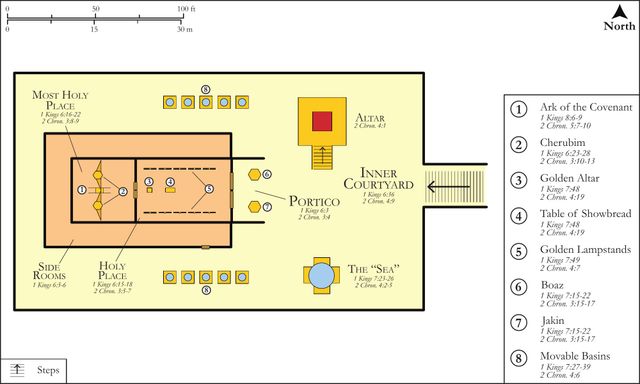
This verse is situated within a lengthy and detailed architectural account spanning 1 Kings 6 and 1 Kings 7. Chapter 6 meticulously describes the Temple's interior and dimensions, while chapter 7 shifts to the construction of Solomon's personal palace, followed by the various courts and the Temple's furnishings. Verse 12 specifically serves as a concluding summary of the exterior courts, providing a holistic picture of the entire sacred precinct after the internal structures and the king's residence have been detailed. It emphasizes the comprehensive nature of the building project, ensuring that even the surrounding areas reflected the same quality and intentionality as the main sanctuary, thereby completing the architectural narrative before moving on to the intricate bronze furnishings in the subsequent verses, such as the detailed account of the bronze pillars in 1 Kings 7:15-22.
Historical & Cultural Context
The construction of Solomon's Temple was the most significant architectural undertaking in ancient Israel, a monumental project that spanned seven years, as noted in 1 Kings 6:38. The Temple served not only as the place of worship but also as a central symbol of the nation's wealth, power, and divine favor. The use of "hewed stones" (Hebrew: gâzîyth), meticulously cut and shaped off-site, as indicated in 1 Kings 6:7, signifies the highest level of craftsmanship and precision, reflecting the sacredness of the structure. Cedar beams, imported from Lebanon, were highly prized for their durability, aromatic qualities, and resistance to decay, making them a premium building material reserved for royal and divine structures. The "great court" and "inner court" were essential features of ancient temple architecture, designed to regulate access and maintain the sanctity of the inner sanctuary, reflecting the hierarchical nature of worship and the separation between the holy and the common in Israelite religious practice.
Key Themes
ShowHideThe meticulous description in 1 Kings 7:12 contributes to several overarching themes within the book of Kings and the broader biblical narrative. Firstly, it underscores the theme of Magnificence and Dedication, showcasing the immense resources, skilled labor, and profound reverence dedicated to constructing a dwelling place for God. This mirrors the principle of offering God one's very best, as seen in the sacrificial system outlined in Leviticus 1:3. Secondly, the precise measurements and specified materials highlight Order and Structure, emphasizing that God's presence and worship are associated with intentionality, beauty, and careful design, reflecting divine order. This resonates with the orderly creation account in Genesis 1. Lastly, the distinct "great court" and "inner court" reinforce the theme of Sacred Boundaries and Access, illustrating the careful delineation of space necessary for maintaining holiness and regulating participation in worship, a concept central to the Mosaic Law and the Temple's function as described in books like Exodus.
Exposition and Analysis
ShowHideKey Word Analysis
ShowHideThis term signifies something large, significant, or impressive in scale. When applied to the "great court," it emphasizes the expansive nature of the outer perimeter of the Temple complex, indicating its grandeur and capacity to accommodate a large number of worshippers or activities. The use of "great" here highlights the monumental scope of Solomon's building project and the majesty intended for the dwelling place of the LORD.
This refers to stones that have been meticulously cut, dressed, and shaped, as opposed to rough or natural stones. The use of gâzîyth signifies a high level of craftsmanship, precision, and expense. It implies that the stones were prepared off-site, as indicated in 1 Kings 6:7, to ensure quiet construction at the Temple site. This detail emphasizes the intentionality and perfection sought in building God's house, reflecting a commitment to excellence in worship and service.
This word denotes an enclosed yard or open space. In the context of the Temple, it refers to the various courtyards that surrounded the main sanctuary. These courts served as transitional and functional spaces, regulating access to the sacred inner areas and providing room for various aspects of Israelite worship, including sacrifices, gatherings, and priestly duties. The presence of both a "great court" and an "inner court" underscores the hierarchical and ordered nature of access to God's presence.
Verse Breakdown
ShowHide"And the great court round about [was] with three rows of hewed stones"
This clause describes the outer, larger court that encompassed the entire Temple complex. The "three rows of hewed stones" indicate a substantial and precisely constructed wall or foundation for this court, signaling its permanence and the clear demarcation of the sacred precinct from the common world outside. The use of hewn stones further emphasizes the quality and deliberate design.
"and a row of cedar beams"
This phrase describes the upper course or coping of the court walls, or perhaps a decorative element, made from precious cedar wood. This addition would have provided both structural integrity and aesthetic beauty, highlighting the blend of strength and magnificence in the Temple's design, extending even to its outer boundaries.
"both for the inner court of the house of the LORD"
This specifies that the same high-quality construction (three rows of hewed stones and a row of cedar beams) was also applied to the "inner court." This court, closer to the sanctuary, was even more sacred. The application of identical, premium materials for both courts underscores a consistent standard of excellence throughout the entire sacred complex, reinforcing the sanctity of all areas within God's dwelling.
"and for the porch of the house"
This final phrase indicates that the same construction method and materials were used for the porch (or vestibule) leading into the main Temple building. The porch served as the entrance to the sanctuary, a transitional space between the courts and the holy interior. Its construction with hewn stones and cedar beams ensured that even the entryway reflected the grandeur and sacredness of the Temple itself, setting a tone of reverence for all who approached.
Literary Devices
ShowHide1 Kings 7:12, like much of the Temple description, employs Detailed Enumeration to convey the grandeur and precision of the construction. By listing specific materials ("hewed stones," "cedar beams") and their arrangement ("three rows," "a row"), the text creates a vivid mental image of the Temple's robust and beautiful exterior. This meticulous detailing serves to emphasize the immense effort and resources invested, underscoring the significance of the structure as God's dwelling. Furthermore, the verse uses Symbolism, where the choice of materials like durable hewn stone and fragrant, long-lasting cedar is not merely functional but also symbolic of permanence, value, and the enduring nature of God's covenant and presence. The distinct courts themselves are a form of Spatial Symbolism, representing the ordered nature of God's holiness and the structured access to His presence, moving from the general "great court" to the more sacred "inner court" and finally the "porch" leading to the sanctuary.
Theological and Thematic Connections
ShowHideThe meticulous description of the Temple courts in 1 Kings 7:12 speaks volumes about the Israelite understanding of God's holiness and the reverence due to His dwelling place. The use of the finest materials and precise construction for even the outer courts underscores the theological principle that everything associated with God's presence must reflect His glory and perfection. This dedication to excellence in physical construction served as a tangible expression of Israel's covenant relationship with Yahweh, a commitment to creating a space where the Holy God could dwell among His people. It also highlights the importance of order and boundaries in approaching a holy God, foreshadowing the ultimate perfect access provided through Christ.
Reflection and Application
ShowHideWhile the physical Temple in Jerusalem no longer stands, the principles embedded in its construction remain profoundly relevant for believers today. 1 Kings 7:12 reminds us that our approach to God and our service to Him should be marked by intentionality, excellence, and a deep sense of reverence. Just as the courts were built with the finest materials and meticulous care, our spiritual lives—our worship, our character, our relationships, and our service—should reflect our utmost dedication to God. We are called to be "living stones" (1 Peter 2:5) in God's spiritual house, the Church, and this requires us to build with integrity, purity, and a commitment to holiness. The boundaries of the courts also remind us of the importance of spiritual discernment and maintaining sacred space in our lives, guarding against anything that would defile or diminish our walk with God. Our lives, individually and corporately, are meant to be a dwelling place for God's Spirit, a place where His glory is revealed and His presence is honored.
Questions for Reflection
ShowHideFAQ
ShowHideWhy is so much detail given to the Temple's construction, even down to the courts?
ShowHideThe extensive detail given to the Temple's construction, including its courts, underscores its immense theological significance as the central dwelling place of God among His people. In ancient Israelite theology, the Temple was not merely a building but a microcosm of God's ordered creation and the nexus where heaven and earth met. The meticulous descriptions, such as those found in 1 Kings 7:12, emphasize several key points:
Christ-Centered Fulfillment
ShowHideThe meticulous construction of Solomon's Temple, particularly its courts with their hewn stones and cedar beams, finds its ultimate and infinitely superior fulfillment in Jesus Christ. The physical Temple, designed as God's dwelling place among His people, was a shadow of the true and living Temple—Jesus Himself. Just as the Temple's courts were built with the finest materials to signify holiness and provide ordered access, Christ's body became the ultimate sanctuary, perfectly constructed and consecrated. Jesus declared, "Destroy this temple, and in three days I will raise it up" (John 2:19), referring to His own body. He is the one through whom the separation between the "inner court" of God's presence and the "great court" of humanity is abolished. Through His perfect sacrifice, Christ, our great High Priest, entered the true heavenly sanctuary, not made with hands, once for all, securing eternal redemption (Hebrews 9:11-12). Furthermore, through Christ, believers are now "living stones," being built into a spiritual house, a holy priesthood, where God's Spirit truly dwells (1 Peter 2:5; Ephesians 2:20-22). The costly materials and precise design of the Temple foreshadowed the immeasurable value and perfect work of Christ, who is the cornerstone and the very foundation of this new, living temple, making it possible for all who believe to draw near to God with full assurance (Hebrews 10:19-22).