


1 Kings 7:9
Bible text: King James Version (1769 Blayney text) · Public domain
Bible text: King James Version with Strong's numbers · Public domain
Bible text: Berean Standard Bible · Public domain
Bible text: American Standard Version (1901) · Public domain
Bible text: World English Bible, Messianic edition · Public domain
Bible text: Geneva Bible (1599) · Public domain
Bible text: Young's Literal Translation · Public domain
- כָּלkolallH3605N-msNoun Singular Masculine Absolute
- אֵלֶּה'E·lehtheseH428PrtParticle Demonstrative
- אֲבָנִים'a·va·Nim[were] stonesH68N-fpNoun Plural Feminine Absolute
- יְקָרֹתye·ka·RotcostlyH3368Adj-fpAdjective Plural Feminine Absolute
- כְּמִדֹּתke·mi·Dotaccording to measurements ofH4060Prep-k ¦ N-fpcNoun Plural Feminine Constructכְּaccording toמִדֹּתmeasurements of
- גָּזִיתga·Zithewn [stone]H1496N-fsNoun Singular Feminine Absolute
- מְגֹרָרוֹתme·go·ra·RotsawnH1641V-Pual-PassPrtcpl-fpVerb Pual Participle Passive Plural Feminine Absolute
- בַּמְּגֵרָהba·me·ge·Rahwith <the> sawH4050Prep-b ¦ N-fsNoun Singular Feminine Absoluteבַּwith <the>מְּגֵרָהsaw
- מִבַּיִתmi·Ba·yitfrom insideH1004Prep-m ¦ N-msNoun Singular Masculine Absoluteמִfromבַּיִתinside
- וּמִחוּץu·mi·Chutzand from outsideH2351Conj-w ¦ Prep-m ¦ N-msNoun Singular Masculine Absoluteוּandמִfromחוּץoutside
- וּמִמַּסָּדu·mi·ma·Sadand from [the] foundationH4527Conj-w ¦ Prep-m ¦ N-msNoun Singular Masculine Absoluteוּandמִfromמַּסָּד[the] foundation
- עַד'adtoH5704PrepPreposition
- הַטְּפָחוֹתha·te·fa·Chotthe coping stoneH2947Art ¦ N-fpNoun Plural Feminine Absoluteהַtheטְּפָחוֹתcoping stone
- וּמִחוּץu·mi·Chutzand from [the] outsideH2351Conj-w ¦ Prep-m ¦ N-msNoun Singular Masculine Absoluteוּandמִfromחוּץ[the] outside
- עַד'adtoH5704PrepPreposition
- הֶחָצֵרhe·cha·Tzerthe courtH2691Art ¦ N-csNoun Singular common gender Absoluteהֶtheחָצֵרcourt
- הַגְּדוֹלָהha·ge·do·Lah<the> greatH1419Art ¦ Adj-fsAdjective Singular Feminine Absoluteהַ<the>גְּדוֹלָהgreat
English is a literal word-by-word gloss of the Hebrew, not the KJV's wording. Why?
This is the original text the KJV's translators worked from — each Hebrew word with its own literal English meaning in this verse, prepared by scholars at Tyndale House, Cambridge. The KJV translates whole sentences, not word by word, so its wording differs: one Hebrew word can become several English words, and the KJV may choose “the LORD” where the gloss reads “Yahweh”. Both are faithful — they answer different questions. For the KJV's own rendering, switch to the KJV text.
Details
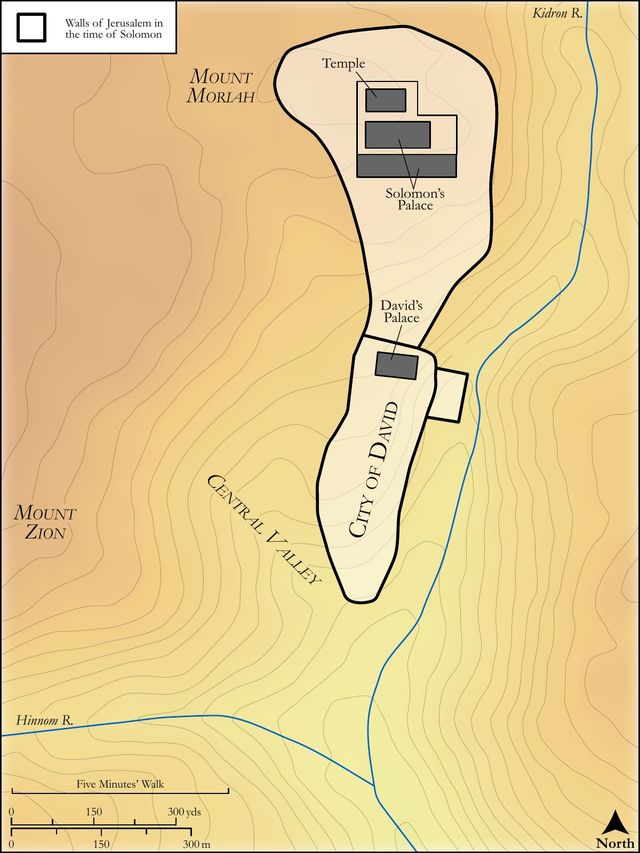
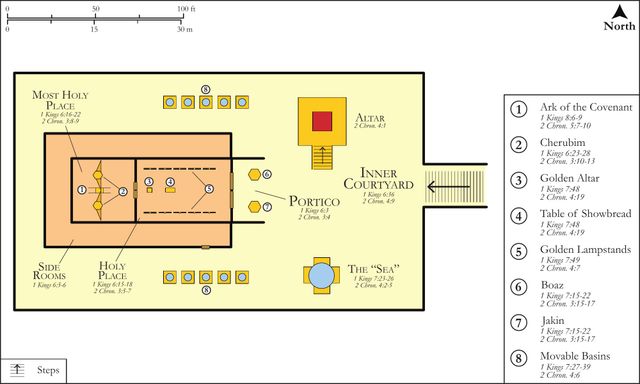
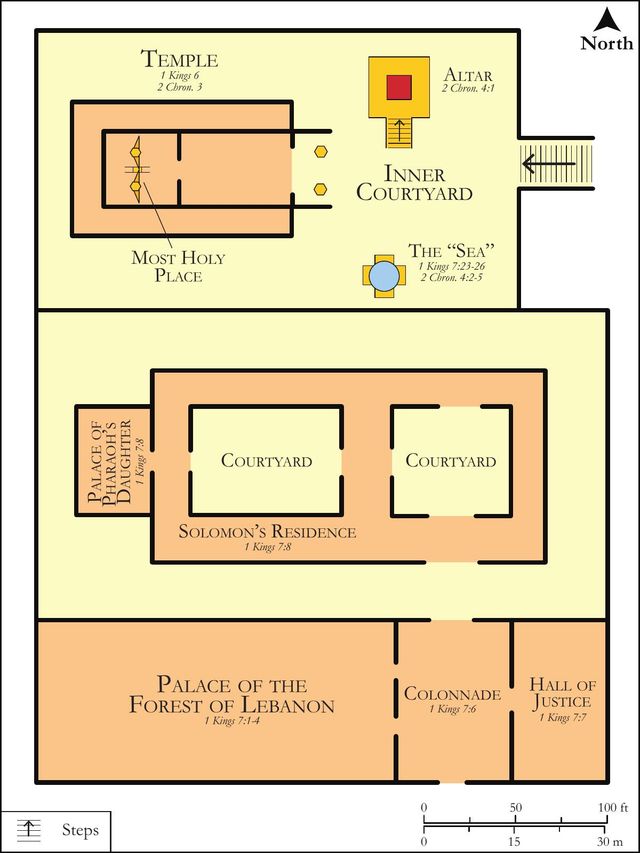
See on the biblical-era maps
Study this verse
Public-domain commentary
Matthew Henry
From his Commentary on the Whole Bible. Henry comments on passages, not single verses — this entry covers 1 Kings 7:1–12.
Never had any man so much of the spirit of building as Solomon had, nor to better purpose; he began with the temple, built for God first, and then all his other buildings were comfortable. The surest foundations of lasting prosperity are those which are laid in an early piety, Mat 6:33. 1. He built a house for himself (Kg1 7:1), where he dwelt, Kg1 7:8. His father had built a good house; but it was no reflection upon his father for him to build a better, in proportion to the estate wherewith God had blessed him. Much of the comfort of this life is connected with an agreeable house. He was thirteen years building this house, whereas he built the temple in little more than seven years; not that he was more exact, but less eager and intent, in building his own house than in building God's. He was in no haste for his own palace, but impatient till the temple was finished and fit for use. Thus we ought to prefer God's honour before our own ease and satisfaction. 2. He built the house of the forest at Lebanon (Kg1 7:2), supposed to be a country seat near Jerusalem, so called from the pleasantness of its situation and the trees that encompassed it. I rather incline to think that it was a house built in the forest of Lebanon itself, whither (though far distant from Jerusalem) Solomon (having so many chariots and horses, and those dispersed into chariot-cities, which probably were his stages) might frequently retire with ease. It does not appear that his throne (mentioned Kg1 7:7) was at the house of the forest of Lebanon, and it was not at all improper to put his shields there as in a magazine. Express notice is taken of his buildings, not only in Jerusalem, but in Lebanon (Kg1 9:19), and we read of the tower of Lebanon, which looks towards Damascus (Sol 7:4), which probably was part of this house. A particular account is given of this house, that being built in Lebanon, a place famed for cedars, the pillars, and beams, and roof, were all cedar (Kg1 7:2, Kg1 7:3), and, being designed for pleasant prospects, there were three tiers of windows on each side, light against light (Kg1 7:4, Kg1 7:5), or, as it may be read, prospect against prospect. Those whose lost i cast in the country may be well reconciled to a country life by this, that some of the greatest princes have thought those the most pleasant of their days which they have spent in their country retirements. 3. He built piazzas before one of his houses, either that at Jerusalem or that in Lebanon, which were very famous - a porch of pillars (Kg1 7:6), perhaps for an exchange or a guard-house, or for those to walk in that attended him about business till they could have audience, or for state and magnificence. He himself speaks of Wisdom's building her house, and hewing out her seven pillars (Pro 9:1), for the shelter of those that, three verses before (Kg1 8:34), are said to watch daily at her gates and to wait at the posts of her doors. 4. At his house where he dwelt in Jerusalem he built a great hall, or porch of judgment, where was set the throne, or king's bench, for the trial of causes, in which he himself was appealed to (placita coram ipso rege tenenda - causes were to be adjusted in the king's presence), and this was richly wainscoted with cedar, from the floor to the roof, Kg1 7:7. He had there also another court within the porch, nearer his house, of similar work, for his attendants to walk in, Kg1 7:8. 5. He built a house for his wife, where she kept her court, Kg1 7:8. It is said to be like the porch, because built of cedar like it, though not in the same form; this, no doubt, was nearer adjoining to his own palace, yet perhaps if it had been as near as it ought to have been Solomon would not have multiplied wives as he did.
The wonderful magnificence of all these buildings is taken notice of, Kg1 7:9, etc. All the materials were the best of their kind. The foundation-stones were costly for their size, four or five yards square, or at least so many yards long (Kg1 7:10), and the stones of the building were costly for the workmanship, hewn and sawn, and in all respects finely wrought, Kg1 7:9, Kg1 7:11. The court of his own house was like that of the temple (Kg1 7:12, compare Kg1 6:36); so well did he like the model of God's courts that he made his own by it.
Continue studying 1 Kings 7:9 across the web’s major study libraries — every link below opens this exact verse, chapter, or book on the destination site.
Read & Compare
 BibleGatewayThis verse in more than 200 translations and 70 languages.
 Bible.comThe YouVersion reader — hundreds of translations, reading plans, and highlights.
 ESV.orgCrossway's official English Standard Version reader.
 NET BibleThe NET translation with 60,000+ translators' notes on every rendering decision.
 STEP BibleTyndale House's free study tool — original text, vocabulary, and scholarly resources.
 BibliaLogos Bible Software's free web reader.
 USCCBThe New American Bible (Revised Edition) with the U.S. bishops' study notes.
Commentaries
 BibleHub CommentariesDozens of classic commentaries on this verse, gathered on one page.
 StudyLightMore than 100 commentary sets — the largest collection on the web.
 BibleRefPlain-English commentary on what this verse means, verse by verse.
 Enduring WordDavid Guzik's free commentary on this chapter, widely used by Bible teachers.
 Bible Study ToolsVerse commentary alongside Greek and Hebrew study aids.
Original Language & Research
- BibleHub InterlinearThe verse word by word — original language, transliteration, and English.
- BibleHub LexiconEvery word's original-language definition and Strong's entry.
 Blue Letter BibleDeep-study tools — Strong's numbers, concordance, and word studies.
 SefariaThe Hebrew text with Rashi and centuries of Jewish commentary.
Sermons, Hymns & Audio


TrulyRandomVerse is not affiliated with these sites and doesn’t control their content. They’re linked because they’re genuinely useful.
Summary
1 Kings 7:9 meticulously describes the exceptional quality and precision of the stonework used in King Solomon's royal palace complex, emphasizing that the same high standards of material and craftsmanship applied to his secular structures as to the recently completed Temple. This verse highlights the use of expensive, expertly hewn, and precisely cut stones, meticulously installed from the very foundation to the coping, ensuring consistent excellence both internally and externally, particularly visible from the grand court.
Context
ShowHideLiterary Context
1 Kings 7:9 is situated within a lengthy architectural description of King Solomon's extensive building program, immediately following the detailed account of the construction of the Temple of the Lord. While 1 Kings 6 focuses exclusively on the sacred edifice, 1 Kings 7 shifts to Solomon's own royal complex, including the House of the Forest of Lebanon, the Porch of Pillars, the Porch of Judgment, and his personal dwelling. This verse specifically details the exceptional quality of materials and craftsmanship applied to these grand, albeit secular, structures, underscoring that the king's residence was built with the same meticulous standards as God's house, reflecting Solomon's immense wealth and commitment to excellence.
Historical & Cultural Context
Solomon's reign (c. 970-931 BC) marked a zenith of Israelite power, wealth, and international influence, largely due to his wisdom and strategic alliances. His extensive building projects, including the Temple and his sprawling palace complex, were not merely functional but served as powerful symbols of his divinely bestowed prosperity and the nation's prominence among its neighbors. The use of "costly stones" and highly skilled techniques like "hewing" and "sawing" reflects the advanced architectural capabilities of the era, often influenced by master craftsmen from Phoenicia, particularly those sent by Hiram of Tyre, who were renowned for their expertise in working with timber and stone. These monumental constructions were designed to project an image of unparalleled grandeur and stability, both to Solomon's own people and to foreign dignitaries visiting Jerusalem.
Key Themes
ShowHideThis verse contributes significantly to several key themes woven throughout 1 Kings. Firstly, it highlights the excellence in craftsmanship and materials that characterized Solomon's entire building program, reflecting a commitment to quality that extended beyond the sacred Temple to his personal dwellings. This meticulous attention to detail, from the selection of "costly stones" to their precise "sawing," underscores a standard of perfection. Secondly, the sheer scale and opulence described, particularly the use of such valuable and expertly prepared materials, vividly portrays the grandeur and wealth of Solomon, a recurring motif in 1 Kings 10 that emphasizes God's abundant blessing upon him (1 Kings 10:23). Finally, the phrase "from the foundation unto the coping" emphasizes the thoroughness and integrity of construction, signifying that quality was maintained consistently throughout the entire structure, not just on visible surfaces. This speaks to a holistic approach to building, where the unseen elements were as crucial as the outward display.
Exposition and Analysis
ShowHideKey Word Analysis
ShowHideThis word signifies something valuable, precious, or excellent. Its application to the stones indicates not just their monetary worth but also their superior quality, beauty, and perhaps rarity. The selection of such materials for Solomon's palace complex underscores his immense resources and his desire for unparalleled grandeur and aesthetic appeal in his royal constructions.
This term refers to stones that have been cut, dressed, or squared, as opposed to being left in their natural, rough state. This implies a process of meticulous shaping and finishing, likely using chisels and other tools, to achieve precise dimensions and smooth surfaces. Such preparation was crucial for creating structurally sound and aesthetically pleasing masonry, ensuring a tight and uniform fit between individual blocks.
This primitive root means "to drag off roughly" or, by analogy, "to saw." In the context of stone, it highlights the advanced method of cutting employed. The use of saws (likely bronze or iron saws with abrasive sand) allowed for exceptionally precise, straight cuts, far superior to what could be achieved with only chiseling. This precision was vital for creating perfectly fitted blocks, contributing significantly to the structural integrity and seamless appearance of the walls, demonstrating a high degree of architectural sophistication.
Verse Breakdown
ShowHide"All these [were of] costly stones"
This opening phrase establishes the universal standard of excellence for the materials used across all the structures within Solomon's palace complex, not just a select few. The "costly stones" signify both their inherent value and the king's boundless resources, setting a tone of unparalleled opulence and quality.
"according to the measures of hewed stones, sawed with saws"
This clause details the meticulous craftsmanship involved in preparing the stones. They were not merely "costly" but also precisely shaped ("hewed") and cut with advanced tools ("sawed with saws"). This indicates a high degree of precision engineering, ensuring uniformity in size and shape, which was critical for creating stable and aesthetically pleasing masonry.
"within and without"
This emphasizes the comprehensive application of this high standard. The quality of the stonework was consistent throughout the entire structure, both on the interior and exterior surfaces. It suggests that the integrity and beauty were not merely a facade but extended to every part of the building, regardless of visibility.
"even from the foundation unto the coping"
This phrase further underscores the thoroughness and consistency of the construction. From the very lowest part of the building (the "foundation") to its uppermost finishing element (the "coping" or cornice), the same high-quality, precisely prepared stones were used. This speaks to the complete structural integrity and uniform excellence of the entire edifice.
"and [so] on the outside toward the great court"
This final clause highlights the prominent visibility of this quality. The magnificent stonework was particularly evident on the exterior facing the "great court," the main public area of the palace complex. This served as a public display of Solomon's wealth, power, and the kingdom's architectural prowess, impressing both subjects and foreign visitors.
Literary Devices
ShowHide1 Kings 7:9 employs several literary devices to convey the extraordinary nature of Solomon's building projects. The phrase "from the foundation unto the coping" is a clear example of Merism, a figure of speech where two contrasting parts represent the whole, effectively communicating that the quality and precision of the stonework extended throughout the entire structure, from its very base to its highest point. The meticulous description of "costly stones," "hewed stones," and stones "sawed with saws" creates vivid Imagery, allowing the reader to visualize the superior materials and advanced craftsmanship. This detailed enumeration also borders on Hyperbole, emphasizing the unparalleled grandeur and perfection of the construction, suggesting a level of excellence that was truly exceptional for its time. Furthermore, the "costly stones" themselves can function as a form of Synecdoche, where a part (the building material) stands for the whole (Solomon's immense wealth, power, and the splendor of his reign).
Theological and Thematic Connections
ShowHideThe meticulous detail in 1 Kings 7:9, though describing a secular palace, carries profound theological resonance. It reflects a standard of excellence that permeated Solomon's kingdom, echoing the divine command for quality in the Tabernacle and Temple construction. This commitment to using the best materials and craftsmanship, even in areas not directly sacred, suggests that all human endeavor, when blessed by God, should strive for integrity and perfection. It underscores the principle that God's blessings enable grand achievements, and these achievements, in turn, can serve as a testament to His provision and the wisdom He bestows. The thoroughness "from foundation unto coping" can also be seen as a metaphor for spiritual integrity, where one's inner character and unseen foundations are as crucial as outward appearance.
Reflection and Application
ShowHide1 Kings 7:9, though detailing ancient architecture, offers timeless principles for contemporary life. The commitment to using "costly stones" and precise craftsmanship "from the foundation unto the coping" challenges us to consider the quality of our own endeavors, whether in our professional work, personal relationships, or spiritual disciplines. It prompts us to move beyond superficiality, encouraging us to invest deeply in the unseen foundations of character, integrity, and faith, knowing that true excellence is holistic. This verse reminds us that the resources God entrusts to us, be they talents, time, or material wealth, are meant to be stewarded with diligence and a pursuit of excellence, reflecting the grandeur of the God who provides. It calls us to build lives and communities marked by thoroughness, beauty, and lasting value, not just for outward show, but with an intrinsic commitment to quality that honors God in all things.
Questions for Reflection
ShowHideFAQ
ShowHideWhat was the significance of using "costly stones" for Solomon's palace?
ShowHideThe use of "costly stones" for Solomon's palace, as described in 1 Kings 7:9, signified several things. Firstly, it demonstrated the immense wealth and prosperity that God had bestowed upon Solomon, positioning him as an unparalleled monarch among the kings of the earth (1 Kings 10:23). Secondly, it reflected the grandeur and prestige of his reign, serving as a powerful symbol of his kingdom's stability and influence. Thirdly, it underscored a commitment to excellence in construction, applying the same high standards of material and craftsmanship seen in the Temple to his royal residence, indicating that even secular structures were built with the utmost integrity and quality.
Why is the detail "sawed with saws" important?
ShowHideThe detail "sawed with saws" is significant because it highlights the advanced architectural and engineering capabilities available during Solomon's time. While "hewed stones" suggests shaping with chisels, "sawed with saws" implies a higher degree of precision cutting, likely using specialized bronze or iron saws with abrasive agents. This allowed for perfectly straight and uniform cuts, ensuring that the stones fit together seamlessly. This level of precision contributed to both the structural integrity and the aesthetic beauty of the buildings, distinguishing them as works of sophisticated craftsmanship, far beyond simple rough-hewn construction. It speaks to the meticulous attention to detail that characterized Solomon's entire building program, as also seen in the construction of the Temple.
Christ-Centered Fulfillment
ShowHideWhile 1 Kings 7:9 describes the grandeur of an earthly king's palace, its emphasis on costly materials, precise craftsmanship, and thorough construction "from the foundation unto the coping" points forward to the ultimate builder and the ultimate temple: Jesus Christ and the spiritual house He constructs. Just as Solomon's palace was built with the finest, perfectly fitted stones, so too is the church, the body of Christ, built upon the cornerstone of Jesus Himself. We, as believers, are described as living stones being built into a spiritual house, a holy priesthood, for God's dwelling. The integrity "from foundation unto coping" foreshadows the complete and perfect work of Christ, who not only laid the foundation of salvation through His sacrifice on the cross (1 Corinthians 3:11) but also brings it to completion, ensuring that every part of His spiritual temple is perfectly fitted and eternally secure. The visible glory of Solomon's court, built with such care, pales in comparison to the invisible, eternal glory of God revealed in Christ, who is the true temple, in whom all the fullness of God dwells (Colossians 2:9).