


Jeremiah 22:14
Bible text: King James Version (1769 Blayney text) · Public domain
Bible text: King James Version with Strong's numbers · Public domain
Bible text: Berean Standard Bible · Public domain
Bible text: American Standard Version (1901) · Public domain
Bible text: World English Bible, Messianic edition · Public domain
Bible text: Geneva Bible (1599) · Public domain
Bible text: Young's Literal Translation · Public domain
- הָאֹמֵרha·'o·Merthe [one who] saysH559Art ¦ V-Qal-Prtcpl-msVerb Qal Participle Singular Masculine Absoluteהָtheאֹמֵר[one who] says
- אֶבְנֶה'ev·nehI will buildH1129V-Qal-Imperf-1csVerb Qal Imperfect 1st Singular common gender
- לִּיlifor <the> myselfPrep-l ¦ 1csSuffix Personal 1st Singular common genderלִּfor <the>יmyself
- בֵּיתbeita house ofH1004N-mscNoun Singular Masculine Construct
- מִדּוֹתmi·Dotsize<s>H4060N-fpNoun Plural Feminine Absolute
- וַעֲלִיּוֹתva·'a·li·Yotand upper roomsH5944Conj-w ¦ N-fpNoun Plural Feminine Absoluteוַandעֲלִיּוֹתupper rooms
- מְרֻוָּחִיםme·ru·va·ChimspaciousH7304V-Pual-PassPrtcpl-mpVerb Pual Participle Passive Plural Masculine Absolute
- וְקָרַעve·Ka·ra'and he will tearH7167Conj-w ¦ V-Qal-ConsecPerf-3msVerb Qal Consecutive Perfect 3rd Singular Masculineוְandקָרַעhe will tear
- לוֹlofor <the> himselfPrep-l ¦ 3msSuffix Personal 3rd Singular Masculineלfor <the>וֹhimself
- חַלּוֹנָיcha·lo·Naimy windowsH2474N-mp ¦ 1csNoun Plural Masculine Absoluteחַלּוֹנָwindowsיmy
- וְסָפוּןve·sa·Funand paneledH5603Conj-w ¦ V-Qal-PassPrtcpl-msVerb Qal Participle Passive Singular Masculine Absoluteוְandסָפוּןpaneled
- בָּאָרֶזba·'A·rezwith <the> cedarH730Prep-b ¦ N-msNoun Singular Masculine Absoluteבָּwith <the>אָרֶזcedar
- וּמָשׁוֹחַu·ma·Sho·achand he will smear [it]H4886Conj-w ¦ V-Qal-InfAbsVerb Qal Infinitive Absoluteוּandמָשׁוֹחַhe will smear [it]
- בַּשָּׁשַׁרba·sha·Sharwith <the> vermilionH8350Prep-b ¦ N-msNoun Singular Masculine Absoluteבַּwith <the>שָּׁשַׁרvermilion
English is a literal word-by-word gloss of the Hebrew, not the KJV's wording. Why?
This is the original text the KJV's translators worked from — each Hebrew word with its own literal English meaning in this verse, prepared by scholars at Tyndale House, Cambridge. The KJV translates whole sentences, not word by word, so its wording differs: one Hebrew word can become several English words, and the KJV may choose “the LORD” where the gloss reads “Yahweh”. Both are faithful — they answer different questions. For the KJV's own rendering, switch to the KJV text.
Details
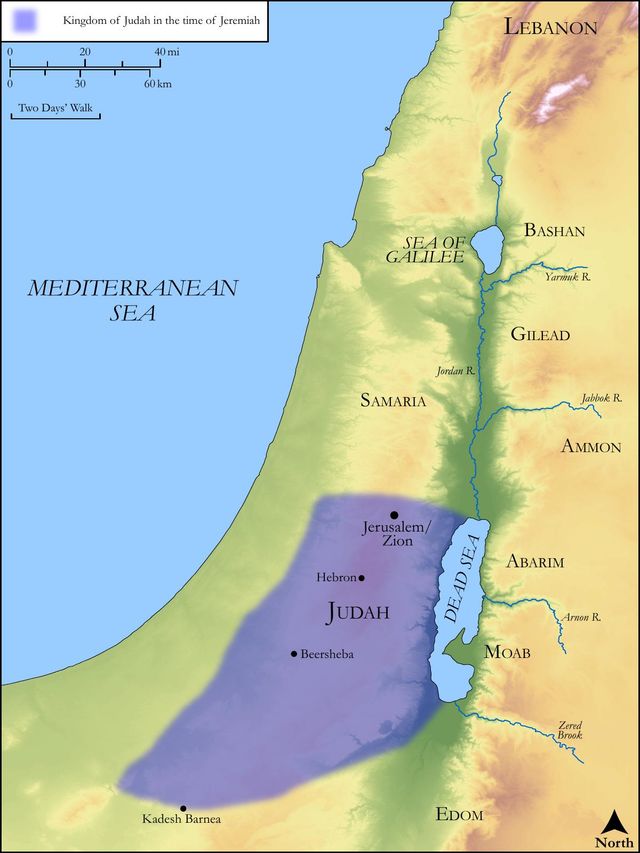
See on the biblical-era map
Study this verse
Public-domain commentary
Matthew Henry
From his Commentary on the Whole Bible. Henry comments on passages, not single verses — this entry covers Jeremiah 22:10–19. His four-level outline is real structure in the source text, so it is rendered as structure.
Kings, though they are gods to us, are men to God, and shall die like men; so it appears in these verses, where we have a sentence of death passed upon two kings who reigned successively in Jerusalem, two brothers, and both the ungracious sons of a very pious father.
I.Here is the doom of Shallum, who doubtless is the same with Jehoahaz, for he is that son of Josiah king of Judah who reigned in the stead of Josiah his father (Jer 22:11), which Jehoahaz did by the act of the people, who made him king though he was not the eldest son, Kg2 23:30; Ch2 36:1. Among the sons of Josiah (Ch1 3:15) there is one Shallum mentioned, and not Jehoahaz. Perhaps the people preferred him before his elder brother because they thought him a more active daring young man, and fitter to rule; but God soon showed them the folly of their injustice, and that it could not prosper, for within three months the king of Egypt came upon him, deposed him, and carried him away prisoner into Egypt, as God had threatened, Deu 28:68. It does not appear that any of the people were taken into captivity with him. We have the story Kg2 23:34; Ch2 36:4. Now here,
1.The people are directed to lament him rather than his father Josiah: "Weep not for the dead, weep not any more for Josiah." Jeremiah had been himself a true mourner for hm, and had stirred up the people to mourn for him (Ch2 35:25): yet now he will have them go out of mourning for him, though it was but three months after his death, and to turn their tears into another channel. They must weep sorely for Jehoahaz, who had gone into Egypt; not that there was any great loss of him to the public, as there was of his father, but that his case was much more deplorable. Josiah went to the grave in peace and honour, was prevented from seeing the evil to come in this world and removed to see the good to come in the other world; and therefore, Weep not for him, but for his unhappy son, who is likely to live and die in disgrace and misery, a wretched captive. Note, Dying saints may be justly envied, while living sinners are justly pitied. And so dismal perhaps the prospect of the times may be that tears even for a Josiah, even for a Jesus, must be restrained, that they may be reserved for ourselves and for our children, Luk 23:28.
2.The reason given is because he shall never return out of captivity, as he and his people expected, but shall die there. They were loth to believe this, therefore it is repeated here again and again, He shall return no more, Jer 22:10. He shall never have the pleasure of seeing his native country, but shall have the continual grief of hearing of the desolations of it. He has gone forth out of this place, and shall never return, Jer 22:11. He shall die in the place whither they have led him captive, Jer 22:12. This came of his forsaking the good example of his father, and usurping the right of his elder brother. In Ezekiel's lamentation for the princes of Israel this Jehoahaz is represented as a young lion, that soon learned to catch the prey, but was taken, and brought in chains to Egypt, and was long expected to return, but in vain. See Eze 19:3-5.
II.Here is the doom of Jehoiakim, who succeeded him.
Whether he had any better right to the crown than Shallum we know not; for, though he was older than his predecessor, there seems to be another son of Josiah, older than he, called Johanan, Ch1 3:15. But this we know he ruled no better, and fared no better at last. Here we have,
1.His sins faithfully reproved. It is not fit for a private person to say to a king, Thou art wicked; but a prophet, who has a message from God, betrays his trust if he does not deliver it, be it ever so unpleasing, even to kings themselves. Jehoiakim is not here charged with idolatry, and probably he had not yet put Urijah the prophet to death (as we find afterwards he did, Jer 26:22, Jer 26:23), for then he would have been told of it here; but the crimes for which he is here reproved are,
(1.)Pride and affection of pomp and splendour; as if all the business of a king were to look great, and to do good were to be the least of his care. He must build himself a stately palace, a wide house, and large chambers, Jer 22:14. He must have windows cut out after the newest fashion, perhaps like sash-windows with us. The rooms must be ceiled with cedar, the richest sort of wood. His house must be as well-roofed and wainscoted as the temple itself, or else it will not please him, Kg1 6:15, Kg1 6:16. Nay, it must exceed that, for it must be painted with minium, or vermilion, which dyes red, or, as some read it, with indigo, which dyes blue. No doubt it is lawful for princes and great men to build, and beautify, and furnish their houses so as is agreeable to their dignity; but he that knows what is in man knew that Jehoiakim did this in the pride of his heart, which makes that to be sinful, exceedingly sinful, which is in itself lawful. Those therefore that are enlarging their houses, and making them more sumptuous, have need to look well to the frame of their own spirits in the doing of it, and carefully to watch against all the workings of vain-glory. But that which was particularly amiss in Jehoiakim's case was that he did this when he could not but perceive, both by the word of God and by his providence, that divine judgments were breaking in upon him. He reigned his first three years by the permission and allowance of the king of Egypt, and all the rest by the permission and allowance of the king of Babylon; and yet he that was no better than a viceroy will covet to vie with the greatest monarchs in building and furniture. Observe how peremptory he is in this resolution: "I will build myself a wide house; I am resolved I will, whoever advises me to the contrary." Note, It is the common folly of those that are sinking in their estates to covet to make a fair show. Many have unhumbled hearts under humbling providences, and look most haughty when God is bringing them down. This is striving with our Maker.
(2.)Carnal security and confidence in his wealth, depending upon the continuance of his prosperity, as if his mountain now stood so strong that it could never be moved. He thought he must reign without any disturbance or interruption because he had enclosed himself in cedar (Jer 22:15), as if that were too fine to be assaulted and too strong to be broken through, and as if God himself could not, for pity, give up such a stately house as that to be burned. Thus when Christ spoke of the destruction of the temple his disciples came to him, to show him what a magnificent structure it was, Mat 23:38; Mat 24:1. Note, Those wretchedly deceive themselves who think their present prosperity is a lasting security, and dream of reigning because they are enclosed in cedar. It is but in his own conceit that the rich man's wealth is his strong city.
(3.)Some think he is here charged with sacrilege, and robbing the house of God to beautify and adorn his own house. He cuts him out my windows (so it is in the margin), which some understand as if he had taken windows out of the temple to put into his own palace and then painted them (as it follows) with vermilion, that it might not be discovered, but might look of a piece with his own buildings. Note, Those cheat themselves, and ruin themselves at last, who think to enrich themselves by robbing God and his house; and, however they may disguise it, God discovers it.
(4.)He is here charged with extortion and oppression, violence and injustice. He built his house by unrighteousness, with money unjustly got and materials which were not honestly come by, and perhaps upon ground obtained as Ahab obtained Naboth's vineyard. And, because he went beyond what he could afford, he defrauded his workmen of their wages, which is one of the sins that cries in the ears of the Lord of hosts, Jam 5:4. God takes notice of the wrong done by the greatest of men to their poor servants and labourers, and will repay those, in justice, that will not in justice pay those whom they employ, but use their neighbour's service without wages. Observe, The greatest of men must look upon the meanest as their neighbours, and be just to them accordingly, and love them as themselves. Jehoiakim was oppressive, not only in his buildings, but in the administration of his government. He did not do justice, made no conscience of shedding innocent blood, when it was to serve the purposes of his ambition, avarice, and revenge. He was all for oppression and violence, not to threaten it only, but to do it; and, when he was set upon any act of injustice, nothing should stop him, but he would go through with it. And that which was at the bottom of all was covetousness, that love of money which is the root of all evil. Thy eyes and thy heart are not but for covetousness; they were for that, and nothing else. Observe, In covetousness the heart walks after the eyes: it is therefore called the lust of the eye, Jo1 2:16; Job 31:7. It is setting the eyes upon that which is not, Pro 23:5. The eyes and the heart are then for covetousness when the aims and affections are wholly set upon the wealth of this world; and, where they are so, the temptation is strong to murder, oppression, and all manner of violence and villany.
(5.)That which aggravated all his sins was that he was the son of a good father, who had left him a good example, if he would but have followed it (Jer 22:15, Jer 22:16): Did not thy father eat and drink? When Jehoiakim enlarged and enlightened his house it is probable that he spoke scornfully of his father for contenting himself with such a mean and inconvenient dwelling, below the grandeur of a sovereign prince, and ridiculed him as one that had a dull fancy, a low spirit, and could not find in his heart to lay out his money, nor cared for what was fashionable; that should not serve him which served his father: but God, by the prophet, tells him that his father, though he had not the spirit of building, was a man of an excellent spirit, a better man than he, and did better for himself and his family. Those children that despise their parents' old fashions commonly come short of their real excellences. Jeremiah tells him,
[1.]That he was directed to do his duty by his father's practice: He did judgment and justice; he never did wrong to any of his subjects, never oppressed them, nor put any hardship upon them, but was careful to preserve all their just rights and properties. Nay, he not only did not abuse his power for the support of wrong, but he used it for the maintaining of right. He judged the cause of the poor and needy, was ready to hear the cause of the meanest of his subjects and do them justice. Note, The care of magistrates must be, not to support their grandeur and take their ease, but to do good, not only not to oppress the poor themselves, but to defend those that are oppressed.
[2.]That he was encouraged to do his duty by his father's prosperity. First, God accepted him: "Was not this to know me, saith the Lord? Did he not hereby make it to appear that he rightly knew his God, and worshipped him, and consequently was known and owned of him?" Note, The right knowledge of God consists in doing our duty, particularly that which is the duty of our place and station in the world. Secondly, He himself had the comfort of it: Did he not eat and drink soberly and cheerfully, so as to fit himself for his business, for strength and not for drunkenness? Ecc 10:17. He did eat, and drink, and do judgment; he did not (as perhaps Jehoiakim and his princes did) drink, and forget the law, and pervert the judgment of the afflicted, Pro 31:5. He did eat and drink; that is, God blessed him with great plenty, and he had the comfortable enjoyment of it himself and gave handsome entertainments to his friends, was very hospitable and very charitable. It was Jehoiakim's pride that he had built a fine house, but Josiah's true praise that he kept a good house. Many times those have least in them of true generosity that have the greatest affection for pomp and grandeur; for, to support the extravagant expense of that, hospitality, bounty to the poor, yea, and justice itself, will be pinched. It is better to live with Josiah in an old-fashioned house, and do good, than live with Jehoiakim in a stately house, and leave debts unpaid. Josiah did justice and judgment, and then it was well with him, Jer 22:15, and it is repeated again, Jer 22:16. He lived very comfortably; his own subjects, and all his neighbours, respected him; and whatever he put his hand to prospered. Note, While we do well we may expect it will be well with us. This Jehoiakim knew, that his father found the way of duty to be the way of comfort, and yet he would not tread in his steps. Note, It should engage us to keep up religion in our day that our godly parents kept it up in theirs and recommended it to us from their own experience of the benefit of it. They told us that they had found the promises which godliness has of the life that now is made good to them, and that religion and piety are friendly to outward prosperity. So that we are inexcusable if we turn aside from that good way.
2.Here we have Jehoiakim's doom faithfully read, Jer 22:18, Jer 22:19. We may suppose that it was in the utmost peril of his own life that Jeremiah here foretold the shameful death of Jehoiakim; but thus saith the Lord concerning him, and therefore thus saith he.
(1.)He shall die unlamented; he shall make himself so odious by his oppression and cruelty that all about him shall be glad to part with him, and none shall do him the honour of dropping one tear for him, whereas his father, who did judgment and justice, was universally lamented; and it is promised to Zedekiah that he should be lamented at his death, for he conducted himself better than Jehoiakim had done, Jer 34:5. His relations shall not lament him, no, not with the common expressions of grief used at the funeral of the meanest, where they cried, Ah, my brother! or, Ah, sister! His subjects shall not lament him, nor cry out, as they used to do at the graves of their princes, Ah, lord! or Ah his glory! It is sad for any to live so that, when they die, none will be sorry to part with them. Nay,
(2.)He shall lie unburied. This is worse than the former. Even those that have no tears to grace the funerals of the dead with would willingly have them buried out of their sight; but Jehoiakim shall be buried with the burial of an ass, that is, he shall have no burial at all, but his dead body shall be cast into a ditch or upon a dunghill; it shall be drawn, or dragged, ignominiously, and cast forth beyond the gates of Jerusalem. It is said, in the story of Jehoiakim (Ch2 36:6), that Nebuchadnezzar bound him in fetters, to carry him to Babylon, and (Eze 19:9) that he was brought in chains to the king of Babylon. But it is probable that he died a prisoner, before he was carried away to Babylon as was intended; perhaps he died for grief, or, in the pride of his heart, hastened his own end, and, for that reason, was denied a decent burial, as self-murderers usually are with us. Josephus says that Nebuchadnezzar slew him at Jerusalem, and left his body thus exposed, somewhere at a grat distance from the gates of Jerusalem. And it is said (Kg2 24:6) he slept with his fathers. When he built himself a stately house, no doubt he designed himself a stately sepulchre; but see how he was disappointed. Note, Those that are lifted up with great pride are commonly reserved for some great disgrace in life or death.
Historical interpretation
Historical reception
1 surviving comment on this verse from the historical church.
(Verse 12 and following) Woe to him who builds his house with injustice, and his upper rooms without justice. He oppresses his neighbor in vain, and does not pay him his wages. He says, 'I will build for myself a spacious house with large upper rooms.' He opens windows for himself, and makes it with cedar and paints it with vermilion. Are you going to reign because you have luxury? Didn't your father eat and drink, and do judgment and justice when he was prospering? He judged the cause of the poor and needy for their own good: did he not do so because he knew me? says the Lord. But your eyes and heart are set on greed, on shedding innocent blood, on deceit, and on pursuing evil. LXX: O you who build your house without justice, and your upper rooms without judgment! Your neighbor works for him for nothing, and does not receive wages. You built for yourself a small house, upper rooms with open windows, and paneled with cedar, and painted with vermilion. Will you reign because you contend against your father Achaz? They shall not eat, and they shall not drink. It would have been better for you to do judgment and good justice; they have not known, they have not judged the judgment of the humble, nor the judgment of the poor. Is it not to ignore me? says the Lord. Behold, your eyes are not straight, nor is your heart good, but for your greed, and to shed innocent blood, and to wickedness and murder, to do these things. I have presented both editions in their entirety, so that both the Hebrew truth and the difficulty of the Vulgate edition can be more easily understood. This is a discourse against Jehoiakim, the son of King Josiah of Judah, about whom we spoke earlier, whom Neco Pharaoh, the king of Egypt, made ruler in place of his brother Jehoahaz, whom he took captive to Egypt. However, we read in the histories of both Kings and Chronicles (2 Kings 23-24, 2 Chronicles 36) that Jehoiakim reigned in Jerusalem for eleven years, and he reigned cruelly and became impious, and afterwards he died. Yet, the Scripture does not mention his burial, even though it is customary for the holy Scriptures to mention all the kings who died and were buried. But he specifically narrates about this dead and unburied man, about whom we will speak in the later parts. Therefore, the aforementioned king laments because he trusts in injustice and thinks it is his perpetual royal dignity. He makes for himself chambers and oppresses his friends, and he does not give them their due wages for their work, and he believes it is the eternal construction of his palace. Can you, the divine word says, reign forever because you desire to be compared to the lofty cedar, namely your father Josiah, the righteous king? Father, he says, both ate and drank, and enjoyed royal wealth, yet he did not offend God because he had riches, but he pleased Him because he administered justice and righteousness. And therefore, both in the present age and in the future, it went well with him, and will continue to do so. He judged the case of the poor and needy, and for their relief he heard them, and for his own good. But all these things happened to him prosperously because he knew me, says the Lord. But truly, O Joacim, your eyes turn towards greed, and you shed innocent blood, towards slander, and towards the path of evil deeds. However, according to the Septuagint, I cannot understand what meaning they have. For although the other parts somewhat agree with each other, that which is inferred: Will you reign because you strive against your father Achaz? for which in Hebrew it is written 'Araz', and here the word signifies a cedar, it is clear that it has no meaning. Also what follows: They shall not eat and they shall not drink, and the other things that are so scattered and confused among themselves, that they have no understanding without the truth of Hebrew reading. However, we can understand this place against the heretics in a mystical sense, who build for themselves a not great house, and not a very abundant Church, but a small one. However, they build not with righteousness and judgment, desiring to plunder what belongs to others. Where it is said: You have built for yourself a small house, with low-roofed chambers, which are surrounded by every wind of doctrine, and distinguished by windows: for they do not have a permanent structure, nor solid stability. And it is adorned, he says, with cedar. Indeed, they seem to have a most beautiful adornment; but they quickly rot and collapse in rains and storms of persecution. And they are painted with red lead. And they indeed participate in the suffering of the Lord, and they are stained with his blood; but they do not reign forever, because they strive and provoke to anger Araz, that is, their father cedar. For every heretic is born in the Church, but is expelled from the Church, and contends and fights against the parent. And what he brings in is understood to be the Body and Blood of the Savior, and other things similar to these. And he says that every error descends from this, namely, that they have ignored God, and do not have upright eyes, but their heart is inclined to greed so that they may plunder what belongs to others, and shed the blood of the deceived. This is indeed committing murder. The obscure things need to be discussed more extensively.
Continue studying Jeremiah 22:14 across the web’s major study libraries — every link below opens this exact verse, chapter, or book on the destination site.
Read & Compare
 BibleGatewayThis verse in more than 200 translations and 70 languages.
 Bible.comThe YouVersion reader — hundreds of translations, reading plans, and highlights.
 ESV.orgCrossway's official English Standard Version reader.
 NET BibleThe NET translation with 60,000+ translators' notes on every rendering decision.
 STEP BibleTyndale House's free study tool — original text, vocabulary, and scholarly resources.
 BibliaLogos Bible Software's free web reader.
 USCCBThe New American Bible (Revised Edition) with the U.S. bishops' study notes.
Commentaries
 BibleHub CommentariesDozens of classic commentaries on this verse, gathered on one page.
 StudyLightMore than 100 commentary sets — the largest collection on the web.
 BibleRefPlain-English commentary on what this verse means, verse by verse.
 Enduring WordDavid Guzik's free commentary on this chapter, widely used by Bible teachers.
 Bible Study ToolsVerse commentary alongside Greek and Hebrew study aids.
Original Language & Research
- BibleHub InterlinearThe verse word by word — original language, transliteration, and English.
- BibleHub LexiconEvery word's original-language definition and Strong's entry.
 Blue Letter BibleDeep-study tools — Strong's numbers, concordance, and word studies.
 SefariaThe Hebrew text with Rashi and centuries of Jewish commentary.
Sermons, Hymns & Audio


TrulyRandomVerse is not affiliated with these sites and doesn’t control their content. They’re linked because they’re genuinely useful.
Summary
Jeremiah 22:14 offers a stark portrayal of the unrighteous King Jehoiakim's self-serving ambition, detailing his opulent building projects. The verse vividly describes his insatiable desire for personal luxury and grandeur, manifested in the construction of an extravagant palace adorned with costly materials like imported cedar and vibrant vermilion. This ostentatious display of wealth stands in direct opposition to the divine mandate for justice and righteousness, serving as a powerful prophetic indictment of leadership that prioritizes personal gain and material splendor over the welfare of the people and adherence to God's covenantal law.
Context
ShowHideLiterary Context
This verse is deeply embedded within a significant prophetic oracle delivered by Jeremiah, specifically addressing the kings of Judah and the royal household (see Jeremiah 21:1-14 and Jeremiah 22:1-30). The immediate preceding verses (compare Jeremiah 22:1-5) establish a clear covenantal framework, promising the continuation of the Davidic dynasty if the king and his people uphold justice and righteousness. However, the tone shifts dramatically in Jeremiah 22:6-9, foretelling the desolation of Jerusalem due to their disobedience. Crucially, Jeremiah 22:13 directly condemns King Jehoiakim for building his house "by unrighteousness, and his chambers by wrong," explicitly mentioning his failure to pay his laborers. Thus, verse 14 provides the concrete, vivid description of the very luxury acquired through such unjust means, setting the stage for the stark contrast with his righteous father Josiah (as detailed in Jeremiah 22:15-16) and the pronouncement of Jehoiakim's ignominious end (see Jeremiah 22:18-19). The entire passage functions as a powerful, sustained critique of corrupt and self-serving leadership.
Historical & Cultural Context
King Jehoiakim reigned over Judah from 609 to 598 BC, a highly tumultuous period marked by the decline of the Neo-Assyrian Empire and the ascendance of Babylon and Egypt. He was placed on the throne by Pharaoh Neco II of Egypt after his righteous father, King Josiah, was killed at Megiddo (as recorded in 2 Kings 23:34). Unlike Josiah, who "did justice and righteousness" (as affirmed in Jeremiah 22:15), Jehoiakim was notorious for his oppressive rule, heavy taxation, and blatant exploitation of his own people to finance his lavish lifestyle and grandiose building projects. The use of "cedar" (likely imported from Lebanon, a costly and prestigious material) and "vermilion" (a vibrant red pigment, also expensive and often imported) for palace decoration were potent symbols of immense wealth, power, and status among the kings of that day, typically reserved for royal residences and temples. The condemnation in this verse is not simply for building, but for building through unrighteousness, reflecting a widespread cultural practice of powerful rulers using forced labor or unpaid workers for grand architectural endeavors—a practice explicitly forbidden by Mosaic Law regarding fair wages and the treatment of laborers (for example, Deuteronomy 24:14-15).
Key Themes
ShowHideThis verse powerfully contributes to several overarching themes prevalent within the book of Jeremiah and the broader prophetic tradition. Firstly, it highlights Corrupt Leadership, starkly contrasting Jehoiakim's self-serving ambition with the divinely ordained expectation for kings to uphold justice and diligently care for the vulnerable, as seen in the broader prophetic call for righteous governance (e.g., Isaiah 1:17). Secondly, it underscores the theme of Materialism and Self-Indulgence, illustrating how the relentless pursuit of opulent luxury, particularly when achieved through exploitation and injustice, inevitably leads to moral decay and divine judgment. The detailed description of the palace profoundly underscores the king's misplaced priorities, valuing personal comfort and outward display over the welfare of his subjects and faithful obedience to God's law. Finally, the verse serves as a stark Warning Against Injustice, demonstrating with chilling clarity that unrighteous gain and the oppression of the poor ultimately invite severe divine retribution, a recurring motif throughout the prophetic books (e.g., Amos 5:24).
Exposition and Analysis
ShowHideKey Word Analysis
ShowHideThis primitive root means "to say" but carries a wide semantic range, including to declare, appoint, command, or intend. Here, it emphasizes the king's personal will and autocratic decree ("That saith, I will build me..."), highlighting his self-directed ambition and the active pursuit of his desires rather than a response to divine or communal needs.
A primitive root meaning "to build" both literally and figuratively. In this context, it refers to the physical construction of the palace. However, when read in conjunction with the preceding verse (Jeremiah 22:13), it carries the strong negative connotation of building through unrighteous means, implying forced labor and unpaid wages. The act of building, which can be a positive, creative, and even divinely sanctioned endeavor, is here corrupted by the king's unjust and exploitative methods.
This primitive root primarily means "to rub with oil" or "to anoint," often in a sacred context for consecration (e.g., anointing priests or kings). However, it also means "to paint" or "to smear." The use of this word here for "painted with vermilion" is striking. While it denotes the decorative aspect of the palace, the underlying sense of "anointing" or "smearing" might subtly imply a superficiality, a covering up, or even a defilement of something that should be sacred (the king's divinely appointed role as God's anointed leader) by its use in an unholy pursuit of personal luxury and self-aggrandizement.
Verse Breakdown
ShowHide"That saith, I will build me a wide house and large chambers"
This opening clause immediately establishes the king's personal initiative and profoundly self-centered ambition. The emphatic "I will build me" underscores that this project is for his own benefit, glory, and comfort, not for the welfare of his kingdom or the glory of God. The desire for a "wide house" (implying spaciousness and expansiveness) and "large chambers" (referring to extensive upper rooms, perhaps multiple stories or numerous private quarters) speaks directly to an appetite for opulence and comfort far beyond necessity, reflecting a deep-seated desire for status, display, and personal indulgence.
"and cutteth him out windows"
This specific detail further illustrates the king's meticulous attention to the design and grandeur of his palace. "Cutting out windows" implies careful architectural planning, significant labor, and precise execution, ensuring ample light, ventilation, and perhaps strategic views, all contributing to the luxurious and refined feel of the royal residence. It speaks to a level of aesthetic consideration and material investment typical of the most elite dwellings of that day.
"and [it is] cieled with cedar, and painted with vermilion"
This final clause provides the most vivid and damning description of the palace's extravagance. "Cieled with cedar" refers to the costly and prestigious practice of paneling the interior walls or ceilings with aromatic cedar wood, likely imported from Lebanon, which was a clear symbol of immense wealth, royal power, and luxury. "Painted with vermilion" highlights the use of a costly, vibrant red pigment for decoration, further emphasizing the ostentatious, showy, and self-aggrandizing nature of the king's building projects. These details collectively underscore the king's profound obsession with outward appearance and material splendor, all of which were achieved at the direct expense of justice and the welfare of his oppressed people.
Literary Devices
ShowHideJeremiah 22:14 masterfully employs several potent literary devices to convey its powerful message. Imagery is paramount, painting a vivid and concrete picture of the king's luxurious palace through specific, sensory details such as "wide house," "large chambers," "cieled with cedar," and "painted with vermilion." This rich sensory description allows the audience to fully visualize the king's self-indulgence and the scale of his misplaced priorities. The verse also utilizes implicit Contrast, setting the king's opulent lifestyle against the backdrop of the poverty and exploitation of his people, which is explicitly detailed in the preceding verse. This stark contrast powerfully highlights the king's profound moral failing and his egregious disregard for divine law. Furthermore, there is a profound element of Irony in the king's zealous pursuit of such material grandeur; while he meticulously constructs a magnificent physical structure, he simultaneously dismantles the moral and spiritual foundations of his kingdom through his pervasive injustice and unrighteousness. The very materials of his luxury, like the cedar and vermilion, function as powerful Symbolism of power and wealth, but in this context, they become potent symbols of his corruption, his spiritual bankruptcy, and the impending divine judgment. The detailed enumeration of the palace's features also functions as a form of Amplification, emphasizing the sheer scale and audacity of the king's self-serving ambition and his utter contempt for God's righteous standards.
Theological and Thematic Connections
ShowHideJeremiah 22:14 serves as a profound theological statement on the very nature of true leadership and the inherent dangers of unchecked power, materialism, and self-aggrandizement. It articulates a core biblical principle: God unequivocally values justice and righteousness above any outward displays of wealth, power, or human grandeur. The king's self-aggrandizing building project, explicitly fueled by injustice and exploitation, is presented as a direct affront to God's covenantal demands for ethical governance and compassionate rule. This passage profoundly underscores that material prosperity, when severed from moral integrity, compassion for the vulnerable, and adherence to divine law, becomes not a source of blessing but a catalyst for divine judgment. It challenges the common notion that earthly grandeur equates to divine favor, instead revealing it as a stark manifestation of spiritual bankruptcy, idolatry of self, and the worship of wealth.
Reflection and Application
ShowHideJeremiah 22:14 speaks across millennia, offering a timeless and piercing challenge to individuals, leaders, and societies alike. It compels us to critically examine the sources, uses, and ultimate motivations behind our acquisition of resources and the exercise of our influence. Are we driven primarily by a desire for personal accumulation, comfort, and outward display, or are we guided by principles of justice, faithful stewardship, and genuine compassion for others? The king's actions serve as a sobering reminder that true prosperity, in God's eyes, is not measured by the size of our houses, the lavishness of our possessions, or the breadth of our earthly empires, but rather by the integrity of our character, the righteousness of our actions, and the depth of our love for God and neighbor. This verse calls us to profound introspection, prompting us to consider whether our pursuits genuinely contribute to human flourishing and God's glory, or if they are built upon foundations of exploitation, injustice, and self-indulgence, ultimately leading to spiritual and societal decay. It is a powerful and enduring reminder that God holds all leaders, and indeed all people, accountable for how they manage the resources entrusted to them and, most importantly, how they treat their neighbors, especially the vulnerable.
Questions for Reflection
ShowHideFAQ
ShowHideWhat was King Jehoiakim's primary sin condemned in this passage?
ShowHideKing Jehoiakim's primary sin condemned in Jeremiah 22:14, and most explicitly in the preceding verse (Jeremiah 22:13), was building his lavish palace "by unrighteousness" and "by wrong." This included the egregious acts of using forced labor and failing to pay his workers their due wages, essentially exploiting the poor and vulnerable for his own extravagant projects. His sin was not merely the act of building, but building through injustice and prioritizing his own luxury and self-aggrandizement over the welfare and basic rights of his subjects, thereby directly violating God's laws concerning fair labor practices (e.g., Deuteronomy 24:14-15).
Why is the description of the palace so detailed in this verse?
ShowHideThe detailed description of the palace in Jeremiah 22:14 ("wide house and large chambers," "cieled with cedar," "painted with vermilion") serves a crucial prophetic purpose: to vividly emphasize the extreme opulence, self-indulgence, and moral corruption of King Jehoiakim. This level of detail highlights the king's misplaced priorities and his obsessive preoccupation with outward grandeur and personal comfort. By painting such a vivid picture of the lavishness, the prophet Jeremiah powerfully underscores the stark contrast between the king's personal luxury and the widespread injustice and suffering of his people, which was precisely the means by which this splendor was achieved. It makes the indictment against his corrupt leadership all the more powerful, concrete, and deeply unsettling, showcasing the profound extent of his moral depravity and his disregard for God's covenantal demands.
Christ-Centered Fulfillment
ShowHideJeremiah 22:14 presents a stark and damning portrait of earthly kingship corrupted by self-interest, pervasive injustice, and an insatiable hunger for material glory. King Jehoiakim's relentless pursuit of a "wide house and large chambers," sumptuously adorned with costly cedar and vibrant vermilion, stands in direct and profound antithesis to the very nature and mission of the true King, Jesus Christ. While Jehoiakim sought to build an earthly kingdom for himself through exploitation and oppression, Christ, though existing in the very form of God, "did not consider equality with God as something to be grasped, but emptied Himself, taking the form of a bondservant" (Philippians 2:6-7). He did not seek earthly palaces or luxurious dwellings but humbly declared, "Foxes have holes and birds of the air have nests, but the Son of Man has nowhere to lay His head" (Matthew 8:20). Unlike Jehoiakim, who shamelessly oppressed his people for his own personal gain, Jesus came "not to be served, but to serve, and to give His life a ransom for many" (Matthew 20:28). The ultimate King's glory was not found in painted chambers or opulent palaces but in a humble cross, where He poured out His life in self-sacrificial love to build a spiritual house not made with human hands, a living dwelling place for God among His people, built upon the foundation of the apostles and prophets, with Christ Jesus Himself as the chief cornerstone (Ephesians 2:19-22). Thus, Jeremiah 22:14, by exposing the profound depravity and self-serving nature of human kingship, implicitly points forward to the perfect, just, and utterly self-sacrificing reign of Christ, whose kingdom is built on eternal righteousness, divine love, and redemptive grace, not on unrighteous gain or human exploitation.