


Amos 3:15
- וְהִכֵּיתִיve·hi·kei·Tiand I will strikeH5221Conj-w ¦ V-Hiphil-ConsecPerf-1csVerb Hiphil Consecutive Perfect 1st Singular common genderוְandהִכֵּיתִיI will strike
- בֵיתveit[the] house ofH1004N-mscNoun Singular Masculine Construct
- הַחֹרֶףha·Cho·refthe winterH2779Art ¦ N-msNoun Singular Masculine Absoluteהַtheחֹרֶףwinter
- עַל'altoH5921PrepPreposition
- בֵּיתbeit[the] house ofH1004N-mscNoun Singular Masculine Construct
- הַקָּיִץha·Ka·yitzthe summerH7019Art ¦ N-msNoun Singular Masculine Absoluteהַtheקָּיִץsummer
- וְאָבְדוּve·'a·ve·Duand they will perishH6Conj-w ¦ V-Qal-ConsecPerf-3cpVerb Qal Consecutive Perfect 3rd Plural common genderוְandאָבְדוּthey will perish
- בָּתֵּיba·Tei[the] houses ofH1004N-mpcNoun Plural Masculine Construct
- הַשֵּׁןha·Shen<the> ivoryH8127Art ¦ N-fsNoun Singular Feminine Absoluteהַ<the>שֵּׁןivory
- וְסָפוּve·sa·Fuand people will snatch awayH5595Conj-w ¦ V-Qal-ConsecPerf-3cpVerb Qal Consecutive Perfect 3rd Plural common genderוְandסָפוּpeople will snatch away
- בָּתִּיםba·TimhousesH1004N-mpNoun Plural Masculine Absolute
- רַבִּיםra·BimgreatH7227Adj-mpAdjective Plural Masculine Absolute
- נְאֻםne·'um[the] utterance ofH5002N-mscNoun Singular Masculine Construct
- יְהוָהYah·wehYahwehH3068N-properNoun Proper Title
English is a literal word-by-word gloss of the Hebrew, not the KJV's wording. Why?
This is the original text the KJV's translators worked from — each Hebrew word with its own literal English meaning in this verse, prepared by scholars at Tyndale House, Cambridge. The KJV translates whole sentences, not word by word, so its wording differs: one Hebrew word can become several English words, and the KJV may choose “the LORD” where the gloss reads “Yahweh”. Both are faithful — they answer different questions. For the KJV's own rendering, switch to the KJV text.
Details
See on the biblical-era map
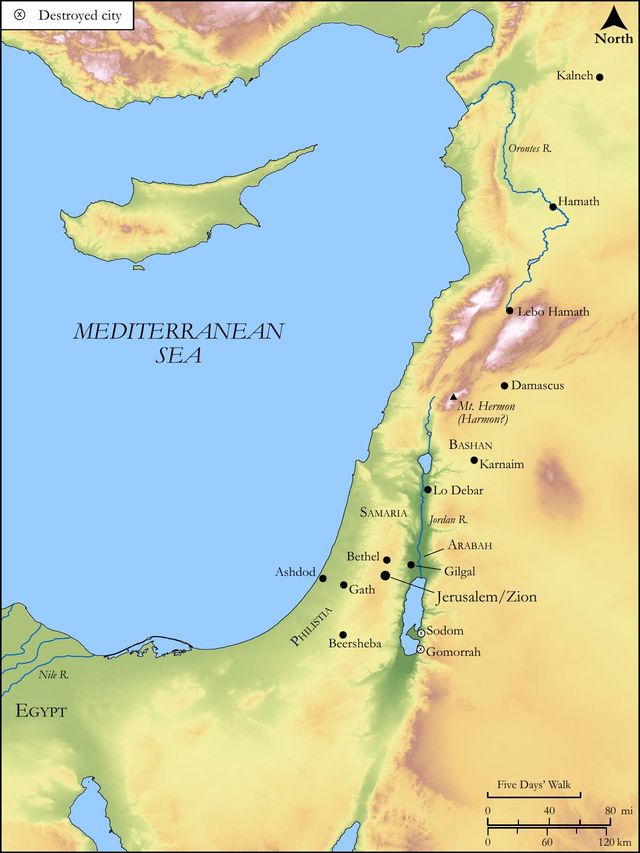
Study this verse
Public-domain commentary
Matthew Henry
From his Commentary on the Whole Bible. Henry comments on passages, not single verses — this entry covers Amos 3:9–15. His four-level outline is real structure in the source text, so it is rendered as structure.
The Israelites are here again convicted and condemned, and particular notice given of the crimes they are convicted of and the punishment they are condemned to.
1.Notice is given of it to their neighbours. The prophet is ordered to publish it in the palaces of Ashdod, one of the chief cities of the Philistines; nay, the summons must go further, even to the palaces in the land of Egypt. "The great men of both those nations, that dwell in the palaces, that are inquisitive concerning the affairs of the neighboring nations, and are conversant with the public intelligence, let them assemble themselves upon the mountains of Samaria," Amo 3:9. There, upon a throne high and lifted up, the judgment is set. Samaria is the criminal that is to be tried; let them be present at the trial, for it shall be (as other trials are) public, in the face of the country; let them make an appointment to meet there from all parts, to judge between God and his vineyard. God appeals to all impartial righteous men, Eze 23:45. They will all subscribe to the equity of his proceedings when they see how the case stands. Note, God's controversies with sinners do not fear a scrutiny; even Philistines and Egyptians will be made to see, and say, that the ways of the Lord are equal, but our ways are unequal. They are likewise summoned to attend, not only that they may justify God and be witness for him that he deals fairly, but that they may themselves take warning; for, if judgment begin at the house of God, as they see it does, what shall be the end of those that are strangers to him? Pe1 4:17. If this be done in a green tree, what shall be done in a dry? Or this intimates that the sin of Israel had been so notorious that the neighboring nations could come in witnesses against them, and therefore it was fit that their punishment should be so. "If it could have been concealed, we would have said, Tell it not in Gath; publish it not in the streets of Ashkelon;" but why should their friends consult their reputation, when they themselves do not consult it? If they have grown impudent in sin, let them bear the shame: "Publish it in Ashdod, in Egypt."
1.Let them see how black the charge is, and how well proved. Let them observe the behaviour of the inhabitants of Samaria; let them look off from the adjacent hills, and they may see how rude and boisterous they are, and hear how loud they cry of their sin is, as was that of Sodom.
(1.)Look into their streets and you will see nothing but riot and disorder, great tumults in the midst thereof; reason and justice are upon all occasions run down by the noise and fury of an outrageous mob, the dominion of which is the sin and shame of any people, and is likely to be their ruin.
(2.)Look into their prisons, and you will see them filled with injured innocents: The oppressed are in the midst thereof, thrown down and crushed by their oppressors, overpowered and overwhelmed, and they had no comforter, Ecc 4:1.
(3.)Look into their courts of justice, and you will see that those who preside in those courts know not to do right, because they have always been accustomed to do wrong; they act as if they had no notion at all of the thing called justice, are in no care to do justice themselves nor to see that others do justice.
(4.)Look into their treasures and stores, and you will see them replenished with violence and robbery, with that which was unjustly got and is still unjustly kept. Thus they have heaped treasures together for the last days, but it will prove a treasure of wrath against the day of wrath. It may well be said, Those know not to do right who think to enrich themselves by doing wrong.
2.Let them see how heavy the doom is, and how well executed, Amo 3:11, Amo 3:12.
(1.)Their country shall be invaded and ruined; and observe how the punishment answers to the sin.
[1.]Great tumults are in the midst of the land, and therefore an adversary shall be even round about the land; the Assyrian forces shall surround it and break in upon it on every side. Note, When sin is harboured and indulged in the midst of a people they can expect no other than that adversaries should be round about them, so that, go which way they will, they go into the mouth of danger, Luk 19:43.
[2.]They strengthened themselves in their wickedness, but the enemy shall bring down their strength from them, that strength which they abused in oppressing the poor, and doing violence to all about them. Note, That power which is made an instrument of unrighteousness will justly be brought down and broken.
[3.]They stored up robbery in their palaces, and therefore their palaces shall be spoiled; for what is got and kept wrongfully will not be kept long. Even palaces will be no protection to fraud and oppression; but the greatest of men, if they have spoiled others, shall themselves be spoiled, for the Lord is the avenger of all such.
(2.)Their countrymen shall not escape, Amo 3:12. They shall be in the hands of the enemy, as a lamb in the mouth of a lion, all devoured and eaten up, and they shall be utterly unable to make an resistance; and if any do make their escape, so as neither to fall by the sword or go into captivity, yet they shall be very few, and those of the meanest and least considerable, like two legs, or shanks, of a lamb, or, it may be, a piece of an ear, which the lion drops, or the shepherd takes from him, when he has eaten the whole body; so, perhaps, here and there one may escape from Samaria and from Damascus, when the king of Assyria shall fall upon them both, but none to make any account of; and those that do escape shall do so with the utmost difficult and hazard, by hiding themselves in the corner of a bed or under the bed's feet, which intimates that their spirits shall sneak shamefully in the time of danger. They shall not hide themselves in dens and caves, but in the corner of a bed, or the piece of a bed, such as poor people must be content with. They shall very narrowly escape, as it is foretold concerning the last destruction of Jerusalem that there shall be two in a bed together, one taken and the other left. Note, When God's judgments come forth against a people with commission it will be in vain to think of escaping them. Some make their dwelling in the corner of a bed, and in a couch, to denote their present security and sensuality; they are at ease, as in a bed, or on a couch, but, when God comes to contend with them, he shall make them uneasy, shall take them away out of the bed of their sloth and slumber. Those that stretch themselves lazily upon their couches when God's judgments are abroad shall go captive with the first that go captive.
II.Notice is given of it to themselves, Amo 3:13.
Let this be testified, and heard, in the house of Jacob, among all the seed of Israel, for it is spoken by the Lord God, the God of hosts, who has authority to pass this sentence and ability to execute it; let them know from him that the day is at hand when God will visit the transgressions of Israel upon him, when he will enquire into them and reckon for them: there will come a day of visitation, a day of punishment, and in that day all those things they are proud of, and put confidence in, shall fail them, and so they shall smart for the sins they have been guilty of about them.
1.Woe to their altars, for God will visit them. He will enquire into the sins they have been guilty of at their altars, and bring into the account all their superstition and idolatry, all their expenses on their false gods, and all their expectations from them; and he will lay the altars themselves under the marks of his displeasure, for the horns of the altar shall be cut off, and fall to the ground, and with them the altar itself demolished and broken to pieces. We find the altar at Bethel prophesied against (Kg1 13:2), and immediately rent (Amo 3:3), and that prophecy fulfilled with Josiah burnt men's bones upon it, Kg2 23:15, Kg2 23:16. This seconds that prophecy, and seems to point at the same event. Note, If men will not destroy idolatrous altars, God will, and those with them that had them in veneration. Some make the horns of the altar to signify all those things which they flee to for refuge, and trust in, and which they make their sanctuary: they shall all be cut off, so that they shall have nothing to take hold of.
2.Woe to their houses, for God will visit them too. He will enquire into the sins they have been guilty of in their houses, the robbery that have stored up in their houses, and the luxury in which they lived: and I will smite the winter-house with the summer-house, Amo 3:15. Their nobility, and gentry, and rich merchants, had their winter-houses in the city and their summer-houses in the country, so nice were they in guarding against the inconveniences of the winter when the country was thought too cold, and of the summer when the city was thought too hot, though the climate of that good land was so temperate, like that of ours, that neither the cold nor heat was ever in extremity. They indulged a foolish affectation of change and variety; but God will, either by war or by the earthquake, smite both the winter-house and the summer-house; neither shall serve to shelter them from his judgments. The houses of ivory (so called because the ceiling, or wainscot, or some of the ornaments of them, were edged or inlaid with ivory) shall perish, shall be burnt or pulled down; and the great houses shall have an end; the most splendid and spacious houses, the houses of their great men, shall no longer be, or at least be no longer theirs. Note, The pomp or pleasantness of men's houses will be so far from fortifying them against God's judgments that it will make them the more grievous and vexatious, as their extravagance about them will be put to the score of their sins and follies.
Historical interpretation
Historical reception
1 surviving comment on this verse from the historical church.
(Verse 14, 15.) Listen and testify in the house of Jacob, says the Lord God of hosts, because on the day when I begin to visit the transgressions of Israel upon him, I will also visit the altars of Bethel: and the horns of the altar shall be cut off, and shall fall to the ground: and I will strike the winter house with the summer house, and the houses of ivory shall perish: and many houses shall be destroyed, says the Lord. LXX: O priests, listen: testify in the house of Jacob, says the Lord God Almighty: because on the day when I will avenge the iniquities of Israel upon him, I will also avenge upon the altars of Bethel: and the horns of the altar shall be undermined, and shall fall upon the ground. I will confuse and strike the house with wings over the summer house, and the ivory houses will perish, and many other houses will be added, says the Lord. What is written at the beginning of the chapter according to the Septuagint is not found in Hebrew, but instead the word Ares () is read for this, which Aquila interpreted as bed; and I think the Septuagint used this Hebrew word, which some who did not understand read as ἱερεῖς, that is, priests. But the prophetic word commands that they first listen, and then respond in the house of Jacob, that is, in the ten tribes that the Lord has spoken about. 'When I begin,' he says, 'to punish the transgressions or impieties of the house of Israel, and to give them what they deserve, and the time of captivity comes, then the altars of Bethel, where the golden calves were, will be destroyed, and the horns of the altar, which was also broken by Jeroboam's hand, will be cut off (3 Kings 13); and they will fall to the ground, shattered by the invading Assyrians.' And I will strike, he said, the winter house with the summer house, which we can simply understand literally: they had such great wealth that they had two houses, a winter house and a summer house, and some of them faced the North, while others faced the South, so that they could provide for the variations in weather, cold and heat, and the temperate climate. We can call the winter house the kingdom of Israel, where there was the cold of religion and worship of God, and the fierce storms of various winds; and the summer house, Judah and Jerusalem, where the temple was, and morning and evening burnt offerings were made, and the fervor of religion thrived. And they shall perish, he said, the ivory houses, which can also be supported by history. For we read that Ahab, king of Israel, indulged in such great delights that he made for himself an ivory house (3 Kings 22). Instead of ivory, we find the term 'tooth houses', that is, houses made of elephant tusks, in Hebrew. Concerning these, it is written in the forty-fourth psalm: From ivory houses: from which the daughters of kings have delighted you in your honor. When the Lord begins to visit the transgressions of Israel, who previously beheld God with their mind, he will also visit the altars of Bethel: not just one altar, as the Church has, but many altars of heretics. For as many altars as there are schisms, so many will the altars be stripped of their horns, which they boast of having through pride. And their horns will fall, that is, their arrogance, upon the earth; and it will strike the wintry house, those heretics who engage in continence and fasting, in dry diets and camel's hair garments, among whom are Tatianus and Manichaeus. And it will strike the summer house, that is, the Nicolaitans and Eunomians, and the followers of the old heresy, who, because of the gluttony of their bellies, indulge in every pleasure. And the ivory houses, which are composed of the skillful tooth and the splendor of rhetorical brilliance, will perish. And many buildings, which are dispersed throughout the whole world, will be scattered. For when one truth arises, many lies will be destroyed. Regarding the winter house, they have translated it as 'peripteros', which we have interpreted as 'winged', because it has small doors through the windows, and as if wings to repel the severity of the cold.
Continue studying Amos 3:15 across the web’s major study libraries — every link below opens this exact verse, chapter, or book on the destination site.
Read & Compare
 BibleGatewayThis verse in more than 200 translations and 70 languages.
 Bible.comThe YouVersion reader — hundreds of translations, reading plans, and highlights.
 ESV.orgCrossway's official English Standard Version reader.
 NET BibleThe NET translation with 60,000+ translators' notes on every rendering decision.
 STEP BibleTyndale House's free study tool — original text, vocabulary, and scholarly resources.
 BibliaLogos Bible Software's free web reader.
 USCCBThe New American Bible (Revised Edition) with the U.S. bishops' study notes.
Commentaries
 BibleHub CommentariesDozens of classic commentaries on this verse, gathered on one page.
 StudyLightMore than 100 commentary sets — the largest collection on the web.
 BibleRefPlain-English commentary on what this verse means, verse by verse.
 Enduring WordDavid Guzik's free commentary on this chapter, widely used by Bible teachers.
 Bible Study ToolsVerse commentary alongside Greek and Hebrew study aids.
Original Language & Research
- BibleHub InterlinearThe verse word by word — original language, transliteration, and English.
- BibleHub LexiconEvery word's original-language definition and Strong's entry.
 Blue Letter BibleDeep-study tools — Strong's numbers, concordance, and word studies.
 SefariaThe Hebrew text with Rashi and centuries of Jewish commentary.
Sermons, Hymns & Audio


TrulyRandomVerse is not affiliated with these sites and doesn’t control their content. They’re linked because they’re genuinely useful.
Summary
Amos 3:15 serves as a stark declaration of divine judgment against the wealthy and oppressive elite of the northern kingdom of Israel, particularly those residing in Samaria. The verse prophesies the utter destruction of their luxurious seasonal residences—the "winter house" and "summer house"—along with their "houses of ivory" and other "great houses," symbolizing the complete eradication of their ill-gotten opulence and the injustice that sustained it, all affirmed by the sovereign word of the LORD.
Context
ShowHideLiterary Context
Amos 3:15 concludes a powerful prophetic oracle in Amos chapter 3, which opens with a unique indictment against Israel. Having established their singular covenant relationship with Yahweh—"You only have I known of all the families of the earth" (Amos 3:2)—the prophet immediately declares the consequence of their privileged status: "therefore I will punish you for all your iniquities." The subsequent verses (Amos 3:3-8) build a series of rhetorical questions, each demanding an affirmative answer, to establish the certainty of God's prophetic word and the inevitability of His judgment. Amos 3:9-10 specifically condemns the violence, robbery, and lack of justice within Samaria's palaces, setting the stage for the specific targets of destruction in verse 15. This verse, therefore, acts as the concrete manifestation of the judgment previously announced, directly targeting the material symbols of the very injustices described.
Historical & Cultural Context
The prophecy of Amos was delivered during the reign of Jeroboam II (c. 786-746 BCE) in the northern kingdom of Israel, a period marked by unprecedented economic prosperity and territorial expansion. This affluence, however, was not evenly distributed; it was largely concentrated among the elite, who exploited the poor and vulnerable. Culturally, the practice of owning multiple residences, specifically "winter houses" (for cooler, potentially lower elevations or more temperate climates) and "summer houses" (for higher, breezier elevations during the heat), was a clear indicator of extreme wealth and luxury, accessible only to the very rich. Furthermore, the mention of "houses of ivory" points to the opulence of Samaria, where archaeological excavations have indeed uncovered significant quantities of carved ivory inlays, likely used to adorn furniture, walls, and other domestic items. These were highly expensive, imported materials, signifying the pinnacle of lavish living and a stark contrast to the widespread poverty and oppression that Amos so vehemently condemned.
Key Themes
ShowHideAmos 3:15 powerfully contributes to several overarching themes within the book of Amos and broader prophetic literature. A primary theme is Divine Judgment on Injustice and Opulence. The verse directly targets the physical manifestations of the wealthy elite's ill-gotten gains, demonstrating God's abhorrence for wealth accumulated through oppression and used for excessive self-indulgence. This aligns with Amos's consistent condemnation of injustice, as seen in passages like Amos 2:6-8 and Amos 5:11-12. Another key theme is the Certainty and Authority of God's Word. The concluding phrase, "saith the LORD," underscores that this is not merely a human prediction but a divine decree, guaranteeing its fulfillment. This echoes the rhetorical questions in Amos 3:7-8, emphasizing that when God speaks, His word will come to pass. Finally, the verse highlights the Transient Nature of Earthly Possessions when amassed through unrighteousness. The destruction of these grand houses serves as a vivid reminder that material wealth, especially when prioritized over justice and righteousness, offers no lasting security or protection from divine wrath.
Exposition and Analysis
ShowHideKey Word Analysis
ShowHideThis verb (H5221) signifies a forceful and decisive blow, encompassing a wide range of actions from a light tap to a severe, even fatal, strike. In this context, it denotes a destructive, punitive action by God, indicating a comprehensive and devastating judgment. It's not a gentle touch but a powerful, irreversible act of demolition.
The term (H1004) is foundational, referring to a dwelling place but extending metaphorically to encompass family, household, palace, or temple. Here, its repetition ("winter house," "summer house," "houses of ivory," "great houses") emphasizes the sheer quantity and variety of opulent residences targeted, highlighting the extensive luxury and material accumulation of the elite.
This root (H6) means to wander away, lose oneself, or by implication, to be lost, destroyed, or utterly undone. Its use here, alongside "have an end," underscores the complete and irrevocable destruction of these structures. They will not merely be damaged or abandoned but will cease to exist, reflecting the total collapse of the unjust rule they represent.
Verse Breakdown
ShowHide"And I will smite the winter house with the summer house"
This opening clause immediately establishes the divine agent ("I will smite" - the LORD) and the primary targets of judgment. The "winter house" (Hebrew: bêṯ haḥōreph) and "summer house" (Hebrew: bêṯ haqqayiṣ) refer to separate, luxurious residences used seasonally by the wealthy elite. This practice symbolized extreme affluence and comfort, allowing the rich to escape the discomforts of extreme temperatures. God's declaration to "smite" both indicates a comprehensive judgment that leaves no place of their indulgence untouched.
"and the houses of ivory shall perish"
This phrase specifies another category of opulent dwellings. "Houses of ivory" (Hebrew: bāttê haššēn) refers to residences adorned with expensive ivory inlays, often imported and intricately carved. These were the epitome of luxury and extravagant display in ancient Samaria, as confirmed by archaeological finds. The verb "perish" (Hebrew: ʼâbad) emphasizes the complete and utter destruction of these symbols of ill-gotten wealth, signifying their irreversible demise.
"and the great houses shall have an end"
This broadens the scope of judgment to encompass all "great houses" (Hebrew: bāttîm rabbîm), referring to any large, impressive, or stately homes. The phrase "shall have an end" (Hebrew: çûwph) reinforces the idea of termination and cessation, mirroring the "perish" of the ivory houses. It signifies that the entire infrastructure of their luxurious and unjust lifestyle will be brought to a definitive and final halt by divine intervention.
"saith the LORD."
This concluding divine oracle (Hebrew: nᵉʼum Yᵉhôvâh) acts as a powerful seal on the entire pronouncement. It authenticates the prophecy as the direct, authoritative word of Yahweh, the covenant God of Israel (H3068). This phrase underscores the certainty, inevitability, and divine origin of the judgment, leaving no doubt about its fulfillment.
Literary Devices
ShowHideAmos 3:15 is rich in literary devices that amplify its prophetic message. The most prominent is Symbolism, where the "winter house," "summer house," "houses of ivory," and "great houses" are not merely physical structures but powerful symbols of the unjust wealth, excessive luxury, and social stratification that characterized the northern kingdom's elite. Their destruction thus symbolizes the complete dismantling of the oppressive rule and the judgment against those who profited from it. The prophet also employs Hyperbole to emphasize the totality of the destruction; while not every single house might be literally leveled, the language conveys a judgment so severe that it feels absolute, leaving no aspect of their opulent lifestyle untouched. Finally, the concluding phrase, "saith the LORD," serves as a powerful instance of Divine Fiat or Prophetic Authority. It is a direct declaration from God Himself, imbuing the prophecy with absolute certainty and underscoring the divine sovereignty behind the impending judgment.
Theological and Thematic Connections
ShowHideAmos 3:15 powerfully articulates God's unwavering commitment to justice and His condemnation of materialism and social oppression. It reveals that God does not overlook the exploitation of the vulnerable, nor does He tolerate the accumulation of wealth through unrighteous means, especially when it leads to extravagant self-indulgence while others suffer. The destruction of these symbols of luxury underscores a profound theological truth: earthly security and material possessions, when pursued apart from righteousness and justice, are ultimately fleeting and offer no protection from divine judgment. This verse serves as a timeless warning that God holds His covenant people to a higher standard of ethical conduct, and their privileged status only intensifies the severity of their accountability for sin.
Reflection and Application
ShowHideAmos 3:15 delivers a sobering message that transcends its ancient context, speaking directly to contemporary societies and individual lives. In a world often driven by consumerism, wealth accumulation, and stark disparities between rich and poor, this verse challenges us to examine the source of our prosperity, the manner in which we use our resources, and our attitudes toward material possessions. It calls us to recognize that true security and lasting value are not found in "winter houses" or "houses of ivory"—the modern equivalents of lavish homes, luxury goods, or excessive comforts—but in a just relationship with God and compassionate engagement with our neighbors. The passage compels us to consider whether our pursuit of comfort or wealth comes at the expense of others, or if it distracts us from the spiritual and ethical mandates of our faith. It urges us to live with integrity, to seek justice, and to steward our resources in a way that honors God and serves humanity, remembering that all earthly possessions are temporary and subject to divine scrutiny.
Questions for Reflection
ShowHideFAQ
ShowHideWhat were "winter houses" and "summer houses" and why were they significant?
ShowHide"Winter houses" (Hebrew: bêṯ haḥōreph) and "summer houses" (Hebrew: bêṯ haqqayiṣ) were separate, specialized residences owned by the extremely wealthy elite in ancient Israel. The "winter house" would have been designed for warmth and protection during the colder, rainy season, likely in a lower, more sheltered location. The "summer house" would have been situated in a higher, breezier location to provide relief from the intense heat of the summer months. Their significance lay in the fact that owning two such distinct, elaborate dwellings was a clear marker of immense wealth, luxury, and social status, far beyond the means of the common person. Amos's prophecy of their destruction underscores God's judgment against the excessive opulence and the oppression that enabled such extravagance.
Why were "houses of ivory" specifically mentioned?
ShowHide"Houses of ivory" (Hebrew: bāttê haššēn) refers to residences that were lavishly decorated with ivory inlays. Ivory was an extremely expensive, imported material, often carved into intricate designs and used to adorn furniture, wall panels, and other decorative elements within the homes of the super-rich. Archaeological excavations in Samaria, the capital of the northern kingdom, have indeed uncovered numerous exquisite ivory carvings, confirming their widespread use among the elite. The mention of ivory houses in Amos 3:15 highlights the pinnacle of luxury and conspicuous consumption, making them a prime symbol of the unrighteous wealth that God was determined to destroy.
Does this verse mean God condemns all wealth?
ShowHideNo, this verse does not condemn wealth itself, but rather wealth accumulated through injustice, exploited for excessive self-indulgence, and prioritized over God's commands for righteousness and care for the vulnerable. The sin of the Israelite elite was not simply having wealth, but how they acquired it (through violence, robbery, and oppression, as mentioned in Amos 3:10) and how they used it (for lavish living while the poor suffered, as implied throughout Amos). The Bible contains examples of righteous wealthy individuals (e.g., Abraham, Job). The condemnation is against the love of money, greed, injustice, and the failure to use resources responsibly and compassionately, as well as the false security placed in material possessions.
Christ-Centered Fulfillment
ShowHideAmos 3:15, with its pronouncement of judgment on the opulent houses of the unjust, finds its ultimate Christ-centered fulfillment in several profound ways. Jesus, the perfect embodiment of God's justice and righteousness, consistently challenged the very attitudes and practices that Amos condemned. He warned against the deceptive nature of earthly riches, famously teaching His disciples not to "store up for yourselves treasures on earth, where moths and vermin destroy, and where thieves break in and steal" but rather to "store up for yourselves treasures in heaven" (Matthew 6:19-21). Christ's parables, such as the rich fool who built larger barns only to lose his soul (Luke 12:13-21), directly underscore the transient nature of material possessions and the folly of trusting in them for security. Furthermore, Jesus's ministry was characterized by His unwavering defense of the poor and overlooked, and His sharp rebukes of religious leaders who exploited others and neglected justice (Matthew 23:1-36). Ultimately, the judgment pronounced by Amos on the "great houses" foreshadows Christ's final judgment, where all earthly systems and structures built on injustice will pass away, and only those who have lived righteously and shown mercy will inherit the eternal "house" or dwelling place prepared by God (Matthew 25:31-46; John 14:2-3). The destruction of the ivory houses points to the coming of a new heaven and a new earth, where righteousness dwells and the glory of God is the ultimate treasure, not perishable earthly wealth (Revelation 21:1-4).