


2 Chronicles 9:2
Bible text: King James Version (1769 Blayney text) · Public domain
Bible text: Berean Standard Bible · Public domain
Bible text: American Standard Version (1901) · Public domain
Bible text: World English Bible, Messianic edition · Public domain
Bible text: Geneva Bible (1599) · Public domain
Bible text: Young's Literal Translation · Public domain
- וַיַּגֶּדvai·ya·gedand he toldH5046Conj-w ¦ V-Hiphil-ConsecImperf-3msVerb Hiphil Consecutive Imperfect 3rd Singular Masculineוַandיַּגֶּדhe told
- לָהּlahto herPrep-l ¦ 3fsSuffix Personal 3rd Singular Feminineלָtoהּher
- שְׁלֹמֹהshe·lo·MohSolomonH8010N-proper-mNoun Proper Masculine
- אֶת'et<obj.>H853DirObjMParticle Object Indicator
- כָּלkolallH3605N-mscNoun Singular Masculine Construct
- דְּבָרֶיהָde·va·Rei·haher wordsH1697N-mpc ¦ 3fsNoun Plural Masculine Constructדְּבָרֶיwordsהָher
- וְלֹאve·lo'and notH3808Conj-w ¦ NegParticle Negativeוְandלֹאnot
- נֶעְלַםne'·Lamit was concealedH5956V-Niphal-Perf-3msVerb Niphal Perfect 3rd Singular Masculine
- דָּבָרda·Vara wordH1697N-msNoun Singular Masculine Absolute
- מִשְּׁלֹמֹהmi·she·lo·Mohfrom SolomonH8010Prep-m ¦ N-proper-mNoun Proper MasculineמִfromשְּׁלֹמֹהSolomon
- אֲשֶׁר'a·SherwhichH834RelParticle Relative
- לֹאlo'notH3808NegParticle Negative
- הִגִּידhi·Gidhe toldH5046V-Hiphil-Perf-3msVerb Hiphil Perfect 3rd Singular Masculine
- לָהּLahto herPrep-l ¦ 3fsSuffix Personal 3rd Singular Feminineלָtoהּher
English is a literal word-by-word gloss of the Hebrew, not the KJV's wording. Why?
This is the original text the KJV's translators worked from — each Hebrew word with its own literal English meaning in this verse, prepared by scholars at Tyndale House, Cambridge. The KJV translates whole sentences, not word by word, so its wording differs: one Hebrew word can become several English words, and the KJV may choose “the LORD” where the gloss reads “Yahweh”. Both are faithful — they answer different questions. For the KJV's own rendering, switch to the KJV text.
Details
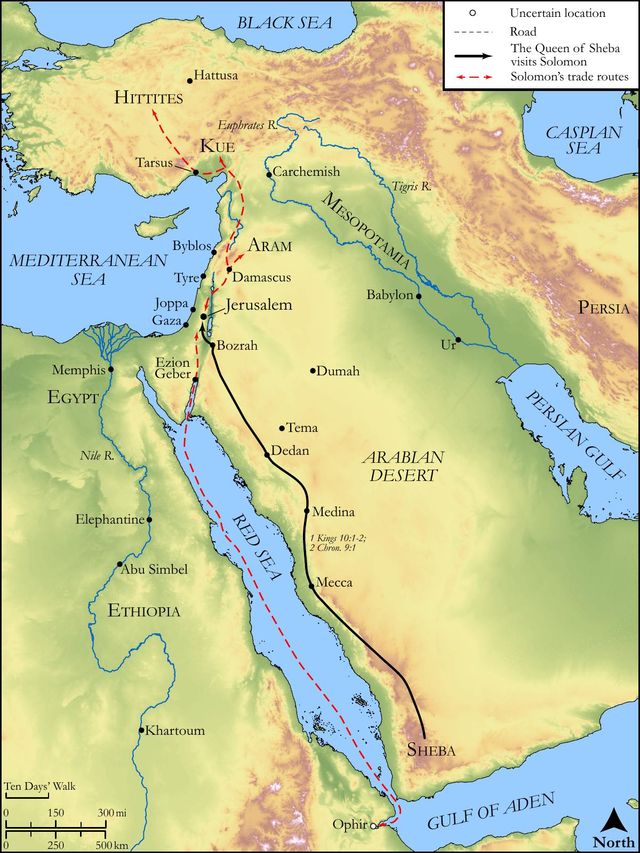
See on the biblical-era map
Study this verse
Public-domain commentary
Matthew Henry
From his Commentary on the Whole Bible. Henry comments on passages, not single verses — this entry covers 2 Chronicles 9:1–12.
This passage of story had been largely considered in the Kings; yet, because our Saviour has proposed it as an example to us in our enquiries after him (Mat 12:42), we must not pass it over without observing briefly, 1. Those who honour God he will honour, Sa1 2:30. Solomon had greatly honoured God, in building, beautifying, and dedicating the temple; all his wisdom and all his wealth were employed for the making of that a consummate piece: and now God made his wisdom and wealth to redound greatly to his reputation. The way to have both the credit and comfort of all our endowments and all our enjoyments is to consecrate them to God and use them for him. 2. Those who know the worth of true wisdom will grudge no pains nor cost to obtain it. The queen of Sheba put herself to a great deal of trouble and expense to hear the wisdom of Solomon; and yet, learning from him to serve God and do her duty, she thought herself well paid for her pains. Heavenly wisdom is that pearl of great price which is a good bargain to purchase by parting with all that we have. 3. As every man has received the gift so he ought to minister the same for the edification of others, as he has opportunity. Solomon was communicative of his wisdom and willing to teach others what he knew himself. Being taught of God, freely he had received, and freely he gave. Let those that are rich in wisdom, as well as wealth, learn to do good and be ready to distribute. Give to every one that asketh. 4. Good order in a family, a great family, especially in the things of God, and a regular discharge of the duties of religious worship, are highly expedient, and to be much admired wherever found. The queen of Sheba was exceedingly affected to see the propriety with which Solomon's servants attended him and with which both he and they attended in the house of God. David's ascent to the house of the Lord was also pleasant and interesting, Psa 42:4. 5. Those are happy who have the opportunity of a constant converse with such as are knowing, wise, and good. The queen of Sheba thought Solomon's servants happy who continually heard his wisdom; for, it seems, even to them he was communicative. And it is observable that the posterity of those who had places in his court were willing to have the names of their ancestors forgotten, and thought themselves sufficiently distinguished and dignified when they were called the children of Solomon's servants (Ezr 2:55; Neh 7:57); so eminent were they that it was honour enough to be named from them. 6. We ought to rejoice and give God thanks for the gifts, graces, and usefulness, of others. The queen of Sheba blessed God for the honour he put upon Solomon, and the favour he did to Israel, in advancing him to the throne, Ch2 9:8. By giving God the praise of the prosperity of others, we share in the comfort of it; whereas, by envying the prosperity of others, we lose the comfort even of our own. The happiness of both king and kingdom she traces up to the fountain of all bliss, the divine favour: it was because thy God delighted in thee and because he loved Israel. Those mercies are doubly sweet in which we can taste the kindness and good will of God as our God. 7. It becomes those that are wise and good to be generous according to their place and power. The queen of Sheba was so to Solomon, Solomon was so to her, Ch2 9:9, Ch2 9:12. They both knew how to value wisdom, and therefore were neither of them covetous of their money, but cultivated the acquaintance and confirmed the friendship they had contracted by mutual presents. Our Lord Jesus has promised to give us all our desire: Ask, and it shall be given you. Let us study what we shall render to him, and not think any thing too much to do, or suffer, or part with, for him.
Continue studying 2 Chronicles 9:2 across the web’s major study libraries — every link below opens this exact verse, chapter, or book on the destination site.
Read & Compare
 BibleGatewayThis verse in more than 200 translations and 70 languages.
 Bible.comThe YouVersion reader — hundreds of translations, reading plans, and highlights.
 ESV.orgCrossway's official English Standard Version reader.
 NET BibleThe NET translation with 60,000+ translators' notes on every rendering decision.
 STEP BibleTyndale House's free study tool — original text, vocabulary, and scholarly resources.
 BibliaLogos Bible Software's free web reader.
 USCCBThe New American Bible (Revised Edition) with the U.S. bishops' study notes.
Commentaries
 BibleHub CommentariesDozens of classic commentaries on this verse, gathered on one page.
 StudyLightMore than 100 commentary sets — the largest collection on the web.
 BibleRefPlain-English commentary on what this verse means, verse by verse.
 Enduring WordDavid Guzik's free commentary on this chapter, widely used by Bible teachers.
 Bible Study ToolsVerse commentary alongside Greek and Hebrew study aids.
Original Language & Research
- BibleHub InterlinearThe verse word by word — original language, transliteration, and English.
- BibleHub LexiconEvery word's original-language definition and Strong's entry.
 Blue Letter BibleDeep-study tools — Strong's numbers, concordance, and word studies.
 SefariaThe Hebrew text with Rashi and centuries of Jewish commentary.
Sermons, Hymns & Audio


TrulyRandomVerse is not affiliated with these sites and doesn’t control their content. They’re linked because they’re genuinely useful.
Summary
2 Chronicles 9:2 profoundly illustrates the apex of King Solomon's divinely-granted wisdom during the Queen of Sheba's pivotal visit. This verse unequivocally declares that Solomon comprehensively answered every inquiry and enigma she presented, leaving no question unresolved or beyond his profound understanding. It stands as a powerful testament to the complete fulfillment of God's promise to Solomon regarding his unparalleled discernment and insight.
Context
ShowHideLiterary Context
This verse immediately follows 2 Chronicles 9:1, which introduces the Queen of Sheba's grand arrival in Jerusalem, laden with gifts, "to test Solomon with hard questions." The broader narrative of 2 Chronicles 9 (and its parallel in 1 Kings 10) is dedicated to showcasing the zenith of Solomon's reign, emphasizing his immense wealth and, more significantly, his profound wisdom. Verse 2 functions as the conclusive statement regarding the success of the Queen's "test," affirming that Solomon's wisdom was indeed as great, if not greater, than its widespread renown. It sets the stage for the Queen's astonished reaction and lavish praise in the subsequent verses, validating the divine source of his extraordinary abilities.
Historical & Cultural Context
Among the kings of that day, a king's wisdom was not merely a personal attribute but a crucial aspect of his divine legitimation and his ability to rule justly and effectively, and in Solomon's case it was the LORD's gift, for "God gave Solomon wisdom and understanding exceeding much." Rulers were expected to be dispensers of wisdom, resolving disputes, understanding complex matters, and guiding their kingdoms. The Queen of Sheba, likely from the prosperous kingdom of Saba (modern-day Yemen), would have traveled a significant distance, underscoring the extraordinary reputation of Solomon's wisdom, which had reached far beyond Israel's borders. Her "hard questions" (Hebrew: chidot) were not simple inquiries but often referred to riddles, enigmas, or perplexing problems, a common intellectual challenge among ancient royalty designed to test a ruler's sagacity and discernment. Solomon's ability to unravel all of these chidot without exception further solidified his reputation as a divinely favored monarch.
Key Themes
ShowHideThe primary theme underscored by 2 Chronicles 9:2 is Solomon's Unparalleled Wisdom, which is presented as a direct, supernatural gift from God, fulfilling the divine promise given to him in 2 Chronicles 1:12. This wisdom is not just intellectual acumen but a comprehensive understanding that encompasses all knowledge and discernment, distinguishing him above all other kings of his time, as noted in 1 Kings 10:23. Another key theme is the Global Recognition of God's Glory through Israel's King. The Queen's journey and her subsequent awe serve as a testament to how God's blessing upon Solomon brought international acclaim, drawing distant nations to witness the manifest presence of God's wisdom and prosperity in Jerusalem. This verse also highlights the theme of Completeness and Clarity of Divine Revelation, as Solomon's answers leave "nothing hid," signifying a full and transparent unveiling of truth.
Exposition and Analysis
ShowHideKey Word Analysis
ShowHideThe name itself, derived from the Hebrew word for "peace" (shalom), is fitting for a king whose reign was marked by unprecedented peace and prosperity. Here, Solomon is the central figure, the recipient of divine wisdom, whose extraordinary intellect is showcased. His identity as the one who "told her all her questions" underscores his unique role as the divinely appointed dispenser of knowledge and understanding.
This primitive root means "to front, i.e. stand boldly out opposite; by implication (causatively), to manifest; figuratively, to announce." The verb emphasizes Solomon's active and complete communication. He didn't merely possess the answers; he articulated them clearly and fully to the Queen, ensuring her understanding and leaving no ambiguity. This highlights not only his profound knowledge but also his ability to convey it effectively and openly, manifesting the truth.
While this word has a broad semantic range including "word, matter, thing, affair," in this context, it specifically refers to the inquiries, riddles, or perplexing problems posed by the Queen. Her "questions" were designed to test the limits of Solomon's famed wisdom. Solomon's ability to answer every "dâbâr" demonstrates a comprehensive understanding that transcends mere human intellect, suggesting a divinely-inspired insight that could unravel even the most complex mysteries or affairs.
This primitive root means "to veil from sight, i.e. conceal (literally or figuratively)." The passive form used here ("nothing hid from Solomon") signifies that no question, no matter how obscure or challenging, remained concealed or beyond his grasp. This phrase acts as a powerful hyperbole, underscoring the absolute comprehensiveness of Solomon's wisdom. It implies a divine omniscience that operated through Solomon, allowing him to perceive and understand all things presented to him, leaving no secrets veiled.
Verse Breakdown
ShowHide"And Solomon told her all her questions"
This clause immediately establishes the successful outcome of the Queen's deliberate test. Solomon did not merely answer some of her inquiries or only the easy ones; he addressed "all" of them. This indicates a complete and thorough engagement with her challenges, demonstrating a breadth of knowledge and understanding that was truly exceptional. The act of "telling" implies not just knowing the answers but articulating them clearly and comprehensively, making the hidden known.
"and there was nothing hid from Solomon which he told her not."
This second clause reinforces and amplifies the first, using a strong double negative to emphasize the absolute nature of Solomon's wisdom. "Nothing hid from Solomon" means no enigma, no riddle, no profound inquiry was beyond his grasp or comprehension. Furthermore, "which he told her not" confirms that he withheld no answer; every solution, every insight, was fully revealed to the Queen. This highlights both the depth of his understanding and his willingness to share it without reservation, leaving no room for doubt about his unparalleled, divinely-sourced wisdom.
Literary Devices
ShowHideThe verse employs several literary devices to underscore the profound nature of Solomon's wisdom. Hyperbole is powerfully evident in the phrase "there was nothing hid from Solomon," which dramatically emphasizes the absolute completeness of his knowledge, suggesting an almost divine level of insight. This is further strengthened by the Repetition of the verb "told" and the subsequent Negation in "which he told her not," creating a strong rhetorical flourish that leaves no doubt about the exhaustive nature of his replies. The structure of the verse also demonstrates Parallelism, with the second clause reinforcing and expanding upon the first, building a crescendo of affirmation regarding Solomon's unparalleled understanding. These devices collectively serve to elevate Solomon's wisdom to a legendary status, preparing the reader for the Queen's awe-struck response in the verses that follow.
Theological and Thematic Connections
ShowHideThe account of Solomon's wisdom, as epitomized in 2 Chronicles 9:2, is a profound theological statement about the nature of divine wisdom and God's faithfulness to His promises. Solomon's ability to answer every question, leaving "nothing hid," is not merely a testament to human intellect but a direct manifestation of God's supernatural endowment. This wisdom was granted by God in response to Solomon's humble request for a discerning heart to govern His people (2 Chronicles 1:10), demonstrating that true wisdom originates from and is sustained by God. It underscores the biblical principle that God delights in revealing truth to those who seek it and that His wisdom is comprehensive, capable of illuminating every mystery and solving every enigma.
Reflection and Application
ShowHideThe narrative of Solomon and the Queen of Sheba, particularly 2 Chronicles 9:2, offers a powerful model for seeking and applying wisdom in our lives. In a world saturated with information yet often starved for true understanding, Solomon's example reminds us that genuine wisdom comes from a divine source. His ability to answer "all her questions" without anything being "hid" speaks to a comprehensive and discerning insight that is deeply needed today. For believers, this account encourages us to diligently seek God's wisdom through His Word and prayer, trusting that He will illuminate our paths and equip us to navigate complex situations. Furthermore, it challenges us to be people of understanding and clarity, able to articulate truth and offer guidance to those who seek answers, reflecting the light of Christ in a confused world. Our lives should be a testimony to the transformative power of God's wisdom, enabling us to respond to life's "hard questions" with discernment and grace.
Questions for Reflection
ShowHideFAQ
ShowHideWhat kind of "questions" did the Queen of Sheba ask Solomon?
ShowHideThe Hebrew word used in the parallel account, chidot (חִידוֹת), refers to riddles, enigmas, or perplexing problems, not just simple inquiries. This suggests the Queen posed profound intellectual challenges and complex dilemmas designed to truly test the limits of Solomon's famed wisdom. Her goal was to ascertain if his reputation for extraordinary insight was indeed accurate. Solomon's ability to unravel all these chidot without exception further solidified his reputation for profound and divinely-inspired insight, as detailed in 2 Chronicles 9:2.
Why was it important for Solomon to answer all of the Queen's questions?
ShowHideIn Israel, a king's wisdom was seen as a direct reflection of divine favor and a crucial aspect of his ability to rule justly and prosperously. For Solomon, answering all of the Queen's challenging questions, leaving "nothing hid," was paramount. It validated God's promise to him of unparalleled wisdom (1 Kings 3:12), confirmed his divine mandate, and solidified his international reputation. His comprehensive answers demonstrated that his wisdom was not merely human intellect but a supernatural gift from God, bringing glory to God and enhancing Israel's standing among nations.
Does this account of the Queen of Sheba and Solomon have any New Testament significance?
ShowHideYes, this account is referenced by Jesus Himself in the New Testament. In Matthew 12:42, Jesus states, "The queen of the South will rise up at the judgment with this generation and condemn it, for she came from the ends of the earth to hear the wisdom of Solomon, and behold, something greater than Solomon is here." This reference highlights the Queen's diligent pursuit of truth and wisdom, contrasting it with the spiritual blindness of those who rejected Jesus, who is the ultimate embodiment of divine wisdom. Her journey serves as a powerful indictment against those who had the very Son of God among them, yet refused to listen.
Christ-Centered Fulfillment
ShowHideThe unparalleled wisdom of Solomon, so strikingly demonstrated in his ability to answer all the Queen of Sheba's questions with nothing "hid" from his understanding (2 Chronicles 9:2), serves as a rich foreshadowing of Jesus Christ. Solomon's wisdom, though divinely given, was finite and ultimately imperfect, yet it pointed to the One who is the very embodiment of God's perfect wisdom. In Christ, "are hidden all the treasures of wisdom and knowledge" (Colossians 2:3). Unlike Solomon, who received wisdom as a gift, Jesus is Wisdom incarnate, the "power of God and the wisdom of God" (1 Corinthians 1:24). He is the ultimate answer to humanity's deepest questions, the one who fully reveals the Father, for "no one has ever seen God; the only God, who is at the Father's side, he has made him known" (John 1:18). Where Solomon's wisdom brought the Queen of Sheba to awe, Christ's wisdom brings salvation and eternal life, for He is "the way, and the truth, and the life" (John 14:6). The Queen sought answers from a king; we find ultimate answers and perfect revelation in our King of Kings, Jesus Christ, who is infinitely greater than Solomon.