


2 Chronicles 9:3
Bible text: King James Version (1769 Blayney text) · Public domain
Bible text: Berean Standard Bible · Public domain
Bible text: American Standard Version (1901) · Public domain
Bible text: World English Bible, Messianic edition · Public domain
Bible text: Geneva Bible (1599) · Public domain
Bible text: Young's Literal Translation · Public domain
- וַתֵּרֶאva·Te·re'and she sawH7200Conj-w ¦ V-Qal-ConsecImperf-3fsVerb Qal Consecutive Imperfect 3rd Singular Feminineוַandתֵּרֶאshe saw
- מַלְכַּתmal·kat[the] queen ofH4436N-fscNoun Title Singular Feminine Construct
- שְׁבָאshe·Va'ShebaH7614N-properNoun Proper Location
- אֵת'et<obj.>H853DirObjMParticle Object Indicator
- חָכְמַתcha·khe·Mat[the] wisdom ofH2451N-fscNoun Singular Feminine Construct
- שְׁלֹמֹהshe·lo·MohSolomonH8010N-proper-mNoun Proper Masculine
- וְהַבַּיִתve·ha·Ba·yitand the houseH1004Conj-w ¦ Art ¦ N-msNoun Singular Masculine Absoluteוְandהַtheבַּיִתhouse
- אֲשֶׁר'a·SherwhichH834RelParticle Relative
- בָּנָהba·Nahhe had builtH1129V-Qal-Perf-3msVerb Qal Perfect 3rd Singular Masculine
English is a literal word-by-word gloss of the Hebrew, not the KJV's wording. Why?
This is the original text the KJV's translators worked from — each Hebrew word with its own literal English meaning in this verse, prepared by scholars at Tyndale House, Cambridge. The KJV translates whole sentences, not word by word, so its wording differs: one Hebrew word can become several English words, and the KJV may choose “the LORD” where the gloss reads “Yahweh”. Both are faithful — they answer different questions. For the KJV's own rendering, switch to the KJV text.
Details
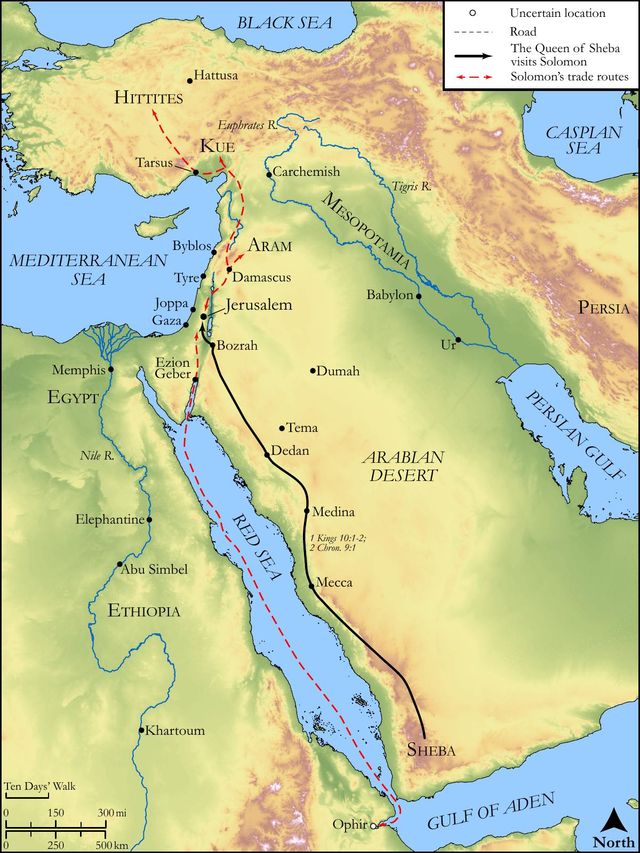
See on the biblical-era map
Study this verse
Public-domain commentary
Matthew Henry
From his Commentary on the Whole Bible. Henry comments on passages, not single verses — this entry covers 2 Chronicles 9:1–12.
This passage of story had been largely considered in the Kings; yet, because our Saviour has proposed it as an example to us in our enquiries after him (Mat 12:42), we must not pass it over without observing briefly, 1. Those who honour God he will honour, Sa1 2:30. Solomon had greatly honoured God, in building, beautifying, and dedicating the temple; all his wisdom and all his wealth were employed for the making of that a consummate piece: and now God made his wisdom and wealth to redound greatly to his reputation. The way to have both the credit and comfort of all our endowments and all our enjoyments is to consecrate them to God and use them for him. 2. Those who know the worth of true wisdom will grudge no pains nor cost to obtain it. The queen of Sheba put herself to a great deal of trouble and expense to hear the wisdom of Solomon; and yet, learning from him to serve God and do her duty, she thought herself well paid for her pains. Heavenly wisdom is that pearl of great price which is a good bargain to purchase by parting with all that we have. 3. As every man has received the gift so he ought to minister the same for the edification of others, as he has opportunity. Solomon was communicative of his wisdom and willing to teach others what he knew himself. Being taught of God, freely he had received, and freely he gave. Let those that are rich in wisdom, as well as wealth, learn to do good and be ready to distribute. Give to every one that asketh. 4. Good order in a family, a great family, especially in the things of God, and a regular discharge of the duties of religious worship, are highly expedient, and to be much admired wherever found. The queen of Sheba was exceedingly affected to see the propriety with which Solomon's servants attended him and with which both he and they attended in the house of God. David's ascent to the house of the Lord was also pleasant and interesting, Psa 42:4. 5. Those are happy who have the opportunity of a constant converse with such as are knowing, wise, and good. The queen of Sheba thought Solomon's servants happy who continually heard his wisdom; for, it seems, even to them he was communicative. And it is observable that the posterity of those who had places in his court were willing to have the names of their ancestors forgotten, and thought themselves sufficiently distinguished and dignified when they were called the children of Solomon's servants (Ezr 2:55; Neh 7:57); so eminent were they that it was honour enough to be named from them. 6. We ought to rejoice and give God thanks for the gifts, graces, and usefulness, of others. The queen of Sheba blessed God for the honour he put upon Solomon, and the favour he did to Israel, in advancing him to the throne, Ch2 9:8. By giving God the praise of the prosperity of others, we share in the comfort of it; whereas, by envying the prosperity of others, we lose the comfort even of our own. The happiness of both king and kingdom she traces up to the fountain of all bliss, the divine favour: it was because thy God delighted in thee and because he loved Israel. Those mercies are doubly sweet in which we can taste the kindness and good will of God as our God. 7. It becomes those that are wise and good to be generous according to their place and power. The queen of Sheba was so to Solomon, Solomon was so to her, Ch2 9:9, Ch2 9:12. They both knew how to value wisdom, and therefore were neither of them covetous of their money, but cultivated the acquaintance and confirmed the friendship they had contracted by mutual presents. Our Lord Jesus has promised to give us all our desire: Ask, and it shall be given you. Let us study what we shall render to him, and not think any thing too much to do, or suffer, or part with, for him.
Continue studying 2 Chronicles 9:3 across the web’s major study libraries — every link below opens this exact verse, chapter, or book on the destination site.
Read & Compare
 BibleGatewayThis verse in more than 200 translations and 70 languages.
 Bible.comThe YouVersion reader — hundreds of translations, reading plans, and highlights.
 ESV.orgCrossway's official English Standard Version reader.
 NET BibleThe NET translation with 60,000+ translators' notes on every rendering decision.
 STEP BibleTyndale House's free study tool — original text, vocabulary, and scholarly resources.
 BibliaLogos Bible Software's free web reader.
 USCCBThe New American Bible (Revised Edition) with the U.S. bishops' study notes.
Commentaries
 BibleHub CommentariesDozens of classic commentaries on this verse, gathered on one page.
 StudyLightMore than 100 commentary sets — the largest collection on the web.
 BibleRefPlain-English commentary on what this verse means, verse by verse.
 Enduring WordDavid Guzik's free commentary on this chapter, widely used by Bible teachers.
 Bible Study ToolsVerse commentary alongside Greek and Hebrew study aids.
Original Language & Research
- BibleHub InterlinearThe verse word by word — original language, transliteration, and English.
- BibleHub LexiconEvery word's original-language definition and Strong's entry.
 Blue Letter BibleDeep-study tools — Strong's numbers, concordance, and word studies.
 SefariaThe Hebrew text with Rashi and centuries of Jewish commentary.
Sermons, Hymns & Audio


TrulyRandomVerse is not affiliated with these sites and doesn’t control their content. They’re linked because they’re genuinely useful.
Summary
2 Chronicles 9:3 captures a pivotal moment in the Queen of Sheba's visit to King Solomon, as her initial skepticism or curiosity gives way to profound astonishment. Having traveled from afar to test the renowned monarch, she now personally observes and comprehends the full scope of Solomon's divinely bestowed wisdom, evident not merely in his answers to her challenging questions but also in the tangible splendor and meticulous order of his kingdom, particularly the magnificent structures he had erected. This verse encapsulates her comprehensive assessment, setting the stage for her subsequent declaration of praise for God.
Context
ShowHideLiterary Context
This verse is strategically placed within the narrative of the Queen of Sheba's visit, which commences in 2 Chronicles 9:1. Her arrival is prompted by the widespread reports of Solomon's fame and wisdom, leading her to come with "hard questions" (2 Chronicles 9:1) to test the veracity of these claims. Verse 3 serves as the culmination of her investigative phase, indicating that she has now moved beyond mere hearing to direct observation and internal conviction. It immediately precedes her overwhelming reaction of astonishment and the detailed description of what she saw in 2 Chronicles 9:4-5, leading to her blessing of the Lord in 2 Chronicles 9:8. This verse is thus a crucial turning point, signifying the irrefutable evidence of Solomon's God-given wisdom and prosperity.
Historical & Cultural Context
The visit of the Queen of Sheba (likely from a region in modern-day Yemen or Ethiopia) was a significant international event in Solomon's day. Such royal visits often served diplomatic, economic, and political purposes, involving the exchange of gifts and the forging of alliances. For the Queen to undertake such a long and arduous journey underscores the immense reputation Solomon had garnered across the known world. His reign (c. 970-931 BC) was a golden age for Israel, characterized by unprecedented peace, prosperity, and architectural achievements. The "house that he had built" primarily refers to the glorious Temple in Jerusalem, completed seven years prior (2 Chronicles 5:1), but also includes his own magnificent royal palace and other administrative buildings. These structures were not merely displays of wealth but were integral to the functioning of his kingdom and served as tangible symbols of God's blessing on Israel and its king.
Key Themes
ShowHideThis verse powerfully contributes to several key themes within 2 Chronicles and the broader biblical narrative. Firstly, it highlights the Manifestation of Divine Wisdom, demonstrating that God's wisdom, granted to Solomon in 2 Chronicles 1:12, was not abstract but visibly expressed in the order, administration, and even the aesthetics of his kingdom. Secondly, it underscores Architectural Grandeur as Testimony, as the "house that he had built" stands as a concrete testament to God's presence and the prosperity He had brought to Israel. The Temple, in particular, was the epicenter of Israel's worship and a symbol of God's covenant faithfulness. Thirdly, the Queen's visit signifies the Global Recognition of God's Blessing, as a foreign monarch travels great distances to witness the glory of Solomon, and by extension, the God who blessed him. This serves as a powerful testimony to the nations of God's glory and power, as seen through the success of His chosen king, fulfilling the promise that God's name would be known among the nations. The parallel account in 1 Kings 10:1-13 further details this significant encounter.
Exposition and Analysis
ShowHideKey Word Analysis
ShowHideThis verb (H7200) signifies more than a casual glance; it implies a thorough observation, a comprehensive understanding, and an experiential encounter. The Queen didn't just visually perceive Solomon's wisdom and buildings; she grasped their full import, their order, their beauty, and their divine origin. This "seeing" leads directly to her profound astonishment and confession, indicating a deep, almost revelatory, perception of what lay before her.
While often translated as "wisdom" (H2451), chokmâh encompasses a broader range of meaning than mere intellectual knowledge. It refers to practical skill, discernment, administrative ability, and the capacity to live skillfully and successfully according to God's principles. The Queen observed this comprehensive wisdom in action, not only in Solomon's profound answers to her riddles but also in the efficient administration of his court, the orderly conduct of his servants, and the very design and construction of his kingdom's infrastructure. It is a wisdom that enables one to "skillfully" navigate life and leadership.
While literally meaning "house" or "palace" (H1004), in this context, "the house that he had built" primarily refers to the magnificent Temple dedicated to the Lord, which was the crowning achievement of Solomon's building program. It also implicitly includes his grand royal palace and other governmental structures. These buildings were not just displays of wealth but were tangible expressions of the order, prosperity, and divine blessing that characterized Solomon's reign, all stemming from his God-given wisdom. The term can refer to a dwelling, a family, or even a temple, highlighting its central importance.
Verse Breakdown
ShowHide"And when the queen of Sheba had seen"
This phrase marks a crucial transition from the Queen's initial hearing of reports and her subsequent testing of Solomon to a state of direct, undeniable observation. Her journey and her "hard questions" were aimed at verifying what she had heard; now, she has personally witnessed the reality, leading to an irrefutable conviction that transcends mere hearsay.
"the wisdom of Solomon"
This refers to the practical, administrative, and discerning wisdom that God had granted Solomon (2 Chronicles 1:10-12). The Queen saw this wisdom manifested in Solomon's ability to govern justly, to organize his vast kingdom efficiently, to manage his immense wealth, and to answer her most perplexing questions with unparalleled insight. It was a wisdom that permeated every aspect of his rule, reflecting God's blessing upon him and demonstrating its comprehensive nature.
"and the house that he had built"
This refers to the tangible evidence of Solomon's wisdom and God's blessing, most notably the Temple in Jerusalem and his royal palace complex. These architectural marvels were not only aesthetically grand but also functionally sophisticated, demonstrating Solomon's skill in planning, construction, and resource management—all products of his divine wisdom. The sheer scale, beauty, and order of these structures served as a powerful, visible testimony to the greatness of Solomon's kingdom and, by extension, the God who empowered him.
Literary Devices
ShowHideThe verse employs several literary devices to convey its profound message. Juxtaposition is evident in the pairing of "wisdom" (an intangible, intellectual quality) with "the house that he had built" (a tangible, monumental achievement). This highlights that Solomon's divine wisdom was not merely theoretical but had concrete, visible manifestations that could be observed and admired. The narrative also employs Emphasis through the Queen's direct observation, underscoring the undeniable and irrefutable nature of what she witnessed, moving beyond mere reports to personal experience. The "house" itself functions as Symbolism, representing not only Solomon's power and wealth but, more significantly, the manifest presence of God among His people and the prosperity that flows from divine blessing and covenant faithfulness. The grandeur described, though understated in this specific verse, implies a degree of Hyperbole in the broader narrative, suggesting that the reality far exceeded any prior reports, leading to the Queen's overwhelming reaction in subsequent verses.
Theological and Thematic Connections
ShowHide2 Chronicles 9:3 serves as a powerful theological statement about the visible manifestation of God's blessing and wisdom in the world. Solomon's wisdom and the grandeur of his kingdom were not merely for his personal glory but were intended to be a testimony to the nations, drawing them to recognize the one true God. The Queen of Sheba's journey and her subsequent awe demonstrate that divine wisdom, when applied in human affairs, produces tangible results that bear witness to the source of that wisdom. It underscores the biblical principle that true wisdom is practical and impactful, transforming not only individuals but also societies and structures, reflecting God's order and glory. This encounter foreshadows a time when all nations would come to Jerusalem to learn of the Lord.
Reflection and Application
ShowHideThis verse offers a profound challenge and encouragement for believers today. Just as the Queen of Sheba was compelled to acknowledge Solomon's wisdom through its tangible manifestations, so too should our lives, when lived according to God's wisdom, bear visible fruit that testifies to His character and power. Our integrity in work, the orderliness of our homes, the love in our relationships, and the excellence in our endeavors can all become "houses" that we build, reflecting the divine wisdom at work within us. This isn't about seeking personal glory, but about living in such a way that others are drawn to inquire about the source of our peace, discernment, and fruitfulness. It encourages us to prayerfully seek God's wisdom not just for intellectual understanding, but for practical application in every sphere of life, knowing that such a life can be a powerful, attractive witness to a watching world, ultimately pointing to God's greatness and drawing others to Him.
Questions for Reflection
ShowHideFAQ
ShowHideWhat was the "house" Solomon built that impressed the Queen of Sheba?
ShowHideThe "house" primarily refers to the magnificent Temple in Jerusalem, which was the center of Israel's worship and a symbol of God's presence among His people. However, it also implicitly includes Solomon's grand royal palace and other impressive administrative and residential structures he constructed throughout his kingdom. These buildings were not only aesthetically grand but also demonstrated remarkable engineering, sophisticated design, and meticulous organization, all products of Solomon's God-given wisdom and the unprecedented prosperity of his reign.
Why was the Queen of Sheba so impressed by Solomon's wisdom and his buildings?
ShowHideThe Queen had heard widespread reports of Solomon's extraordinary wealth and wisdom, but seeing it firsthand far exceeded her expectations. Her astonishment stemmed from witnessing the practical, comprehensive nature of his wisdom, evident not only in his profound answers to her "hard questions" but also in the meticulous order of his court, the efficiency of his administration, the abundance of his provisions, and the sheer grandeur and sophistication of his architectural achievements, especially the Temple. It was a visible, undeniable testament to God's blessing upon him, as described in 2 Chronicles 9:4-5.
Is there a parallel account of the Queen of Sheba's visit to Solomon in another book of the Bible?
ShowHideYes, a very similar and complementary account of the Queen of Sheba's visit to King Solomon is found in 1 Kings 10:1-13. Both accounts emphasize the Queen's testing of Solomon, her overwhelming impression, and her subsequent praise for God who had blessed Solomon, providing a consistent witness to this significant historical and theological event.
Christ-Centered Fulfillment
ShowHideThe glory of Solomon's wisdom and the splendor of the "house that he had built" serve as a magnificent, albeit imperfect, foreshadowing of the ultimate wisdom and glory found in Jesus Christ. Solomon's wisdom, though divinely granted, was but a shadow of God's own perfect wisdom, which is fully embodied in Christ, who is described as the "power of God and the wisdom of God" (1 Corinthians 1:24). Jesus Himself declared, "Behold, something greater than Solomon is here" (Matthew 12:42), indicating that all the wisdom, wealth, and glory of Solomon's reign find their true and eternal fulfillment in Him. Furthermore, the magnificent Temple built by Solomon, which so impressed the Queen of Sheba, ultimately points to Christ as the true Temple—the place where God perfectly dwells among His people. Jesus spoke of destroying and raising up the Temple in three days, referring to His own body (John 2:19-21), and through Him, believers are built together into a spiritual house, a dwelling place for God by the Spirit (Ephesians 2:19-22). The Queen of Sheba's journey from the ends of the earth to witness Solomon's glory prefigures the ultimate gathering of all nations to Christ, the King of kings, who will build an eternal kingdom and a perfect spiritual house, far surpassing any earthly splendor.