


2 Chronicles 9:4
Bible text: King James Version (1769 Blayney text) · Public domain
Bible text: King James Version with Strong's numbers · Public domain
Bible text: Berean Standard Bible · Public domain
Bible text: American Standard Version (1901) · Public domain
Bible text: World English Bible, Messianic edition · Public domain
Bible text: Geneva Bible (1599) · Public domain
Bible text: Young's Literal Translation · Public domain
- וּמַאֲכַלu·ma·'a·Khaland [the] food ofH3978Conj-w ¦ N-mscNoun Singular Masculine Constructוּandמַאֲכַל[the] food of
- שֻׁלְחָנוֹshul·cha·Nohis tableH7979N-msc ¦ 3msNoun Singular Masculine Constructשֻׁלְחָנtableוֹhis
- וּמוֹשַׁבu·mo·Shavand [the] seating ofH4186Conj-w ¦ N-mscNoun Singular Masculine Constructוּandמוֹשַׁב[the] seating of
- עֲבָדָיו'a·va·Davhis servantsH5650N-mpc ¦ 3msNoun Plural Masculine Constructעֲבָדָיservantsוhis
- וּמַעֲמַדu·ma·'a·Madand [the] standing ofH4612Conj-w ¦ N-mscNoun Singular Masculine Constructוּandמַעֲמַד[the] standing of
- מְשָׁרְתָיוme·sha·re·Tavhis servantsH8334V-Piel-Prtcpl-mp ¦ 3msVerb Piel Participle Plural Masculine Constructמְשָׁרְתָיservantsוhis
- וּמַלְבּוּשֵׁיהֶםu·mal·bu·shei·Hemand their clothesH4403Conj-w ¦ N-mpc ¦ 3mpNoun Plural Masculine Constructוּandמַלְבּוּשֵׁיclothesהֶםtheir
- וּמַשְׁקָיוu·mash·Kavand his cup-bearersH4945Conj-w ¦ N-mpc ¦ 3msNoun Plural Masculine Constructוּandמַשְׁקָיcup-bearersוhis
- וּמַלְבּוּשֵׁיהֶםu·mal·Bu·shei·Hemand their clothesH4403Conj-w ¦ N-mpc ¦ 3mpNoun Plural Masculine Constructוּandמַלְבּוּשֵׁיclothesהֶםtheir
- וַעֲלִיָּתוֹva·'a·li·ya·Toand his upper roomH5944Conj-w ¦ N-fsc ¦ 3msNoun Singular Feminine Constructוַandעֲלִיָּתupper roomוֹhis
- אֲשֶׁר'a·SherwhichH834RelParticle Relative
- יַעֲלֶהya·'a·Lehhe went upH5927V-Qal-Imperf-3msVerb Qal Imperfect 3rd Singular Masculine
- בֵּיתbeit[the] house ofH1004N-mscNoun Singular Masculine Construct
- יְהוָהYah·wehYahwehH3068N-properNoun Proper Title
- וְלֹאve·lo'and notH3808Conj-w ¦ NegParticle Negativeוְandלֹאnot
- הָיָהHa·yahit wasH1961V-Qal-Perf-3msVerb Qal Perfect 3rd Singular Masculine
- עוֹדodstillH5750Adj-msAdjective Numerical Singular Masculine Absolute
- בָּהּbahin herPrep-b ¦ 3fsSuffix Personal 3rd Singular Feminineבָּinהּher
- רוּחַRu·achbreathH7307N-fsNoun Singular Feminine Absolute
English is a literal word-by-word gloss of the Hebrew, not the KJV's wording. Why?
This is the original text the KJV's translators worked from — each Hebrew word with its own literal English meaning in this verse, prepared by scholars at Tyndale House, Cambridge. The KJV translates whole sentences, not word by word, so its wording differs: one Hebrew word can become several English words, and the KJV may choose “the LORD” where the gloss reads “Yahweh”. Both are faithful — they answer different questions. For the KJV's own rendering, switch to the KJV text.
Details
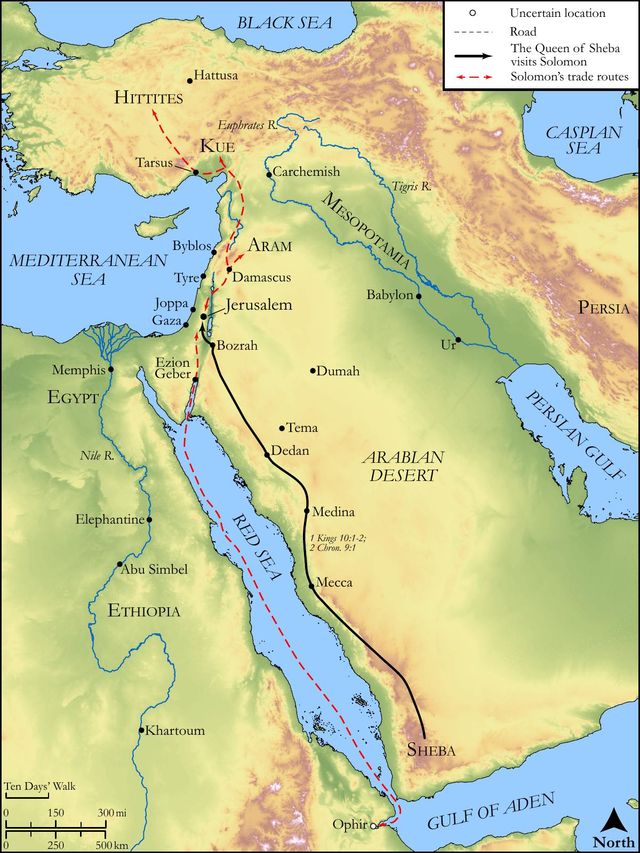
See on the biblical-era map
Study this verse
Public-domain commentary
Matthew Henry
From his Commentary on the Whole Bible. Henry comments on passages, not single verses — this entry covers 2 Chronicles 9:1–12.
This passage of story had been largely considered in the Kings; yet, because our Saviour has proposed it as an example to us in our enquiries after him (Mat 12:42), we must not pass it over without observing briefly, 1. Those who honour God he will honour, Sa1 2:30. Solomon had greatly honoured God, in building, beautifying, and dedicating the temple; all his wisdom and all his wealth were employed for the making of that a consummate piece: and now God made his wisdom and wealth to redound greatly to his reputation. The way to have both the credit and comfort of all our endowments and all our enjoyments is to consecrate them to God and use them for him. 2. Those who know the worth of true wisdom will grudge no pains nor cost to obtain it. The queen of Sheba put herself to a great deal of trouble and expense to hear the wisdom of Solomon; and yet, learning from him to serve God and do her duty, she thought herself well paid for her pains. Heavenly wisdom is that pearl of great price which is a good bargain to purchase by parting with all that we have. 3. As every man has received the gift so he ought to minister the same for the edification of others, as he has opportunity. Solomon was communicative of his wisdom and willing to teach others what he knew himself. Being taught of God, freely he had received, and freely he gave. Let those that are rich in wisdom, as well as wealth, learn to do good and be ready to distribute. Give to every one that asketh. 4. Good order in a family, a great family, especially in the things of God, and a regular discharge of the duties of religious worship, are highly expedient, and to be much admired wherever found. The queen of Sheba was exceedingly affected to see the propriety with which Solomon's servants attended him and with which both he and they attended in the house of God. David's ascent to the house of the Lord was also pleasant and interesting, Psa 42:4. 5. Those are happy who have the opportunity of a constant converse with such as are knowing, wise, and good. The queen of Sheba thought Solomon's servants happy who continually heard his wisdom; for, it seems, even to them he was communicative. And it is observable that the posterity of those who had places in his court were willing to have the names of their ancestors forgotten, and thought themselves sufficiently distinguished and dignified when they were called the children of Solomon's servants (Ezr 2:55; Neh 7:57); so eminent were they that it was honour enough to be named from them. 6. We ought to rejoice and give God thanks for the gifts, graces, and usefulness, of others. The queen of Sheba blessed God for the honour he put upon Solomon, and the favour he did to Israel, in advancing him to the throne, Ch2 9:8. By giving God the praise of the prosperity of others, we share in the comfort of it; whereas, by envying the prosperity of others, we lose the comfort even of our own. The happiness of both king and kingdom she traces up to the fountain of all bliss, the divine favour: it was because thy God delighted in thee and because he loved Israel. Those mercies are doubly sweet in which we can taste the kindness and good will of God as our God. 7. It becomes those that are wise and good to be generous according to their place and power. The queen of Sheba was so to Solomon, Solomon was so to her, Ch2 9:9, Ch2 9:12. They both knew how to value wisdom, and therefore were neither of them covetous of their money, but cultivated the acquaintance and confirmed the friendship they had contracted by mutual presents. Our Lord Jesus has promised to give us all our desire: Ask, and it shall be given you. Let us study what we shall render to him, and not think any thing too much to do, or suffer, or part with, for him.
Continue studying 2 Chronicles 9:4 across the web’s major study libraries — every link below opens this exact verse, chapter, or book on the destination site.
Read & Compare
 BibleGatewayThis verse in more than 200 translations and 70 languages.
 Bible.comThe YouVersion reader — hundreds of translations, reading plans, and highlights.
 ESV.orgCrossway's official English Standard Version reader.
 NET BibleThe NET translation with 60,000+ translators' notes on every rendering decision.
 STEP BibleTyndale House's free study tool — original text, vocabulary, and scholarly resources.
 BibliaLogos Bible Software's free web reader.
 USCCBThe New American Bible (Revised Edition) with the U.S. bishops' study notes.
Commentaries
 BibleHub CommentariesDozens of classic commentaries on this verse, gathered on one page.
 StudyLightMore than 100 commentary sets — the largest collection on the web.
 BibleRefPlain-English commentary on what this verse means, verse by verse.
 Enduring WordDavid Guzik's free commentary on this chapter, widely used by Bible teachers.
 Bible Study ToolsVerse commentary alongside Greek and Hebrew study aids.
Original Language & Research
- BibleHub InterlinearThe verse word by word — original language, transliteration, and English.
- BibleHub LexiconEvery word's original-language definition and Strong's entry.
 Blue Letter BibleDeep-study tools — Strong's numbers, concordance, and word studies.
 SefariaThe Hebrew text with Rashi and centuries of Jewish commentary.
Sermons, Hymns & Audio


TrulyRandomVerse is not affiliated with these sites and doesn’t control their content. They’re linked because they’re genuinely useful.
Summary
2 Chronicles 9:4 vividly portrays the profound and overwhelming impression King Solomon's unparalleled wisdom, magnificent court, meticulous administration, and devout worship made upon the Queen of Sheba. After witnessing the exquisite order, lavish provision, and the reverent devotion displayed in Solomon's kingdom—from the abundance on his table and the precise arrangement of his servants to the solemn procession to the Temple—she was left utterly breathless and astonished, her spirit completely overcome by the sheer grandeur and evident divine favor that characterized his reign.
Context
ShowHideLiterary Context
This verse marks the climax of the Queen of Sheba's visit to King Solomon, a narrative detailed in 2 Chronicles 9:1-12 and paralleled in 1 Kings 10. The Queen, drawn by reports of Solomon's extraordinary fame and wisdom, traveled from a distant land to test him with "hard questions" (2 Chronicles 9:1). After Solomon flawlessly answered all her inquiries (2 Chronicles 9:2), her attention shifted from his intellectual prowess to the tangible manifestations of his kingdom's prosperity and order. Verse 3 describes her initial reaction to seeing "the wisdom of Solomon, and the house that he had built," setting the stage for the comprehensive list of impressive elements in verse 4. This verse functions as the narrative's peak, underscoring the all-encompassing nature of Solomon's glory, which was so profound it left a powerful foreign dignitary utterly amazed.
Historical & Cultural Context
Solomon's reign (c. 970-931 BC) is depicted as Israel's golden age, characterized by unprecedented peace, immense wealth, and significant international influence. Jerusalem flourished as a major center for trade and diplomacy, attracting dignitaries such as the Queen of Sheba, who likely hailed from the ancient kingdom of Saba (modern-day Yemen), a vital hub for the lucrative incense trade. Among the kings of that day, royal courts served as powerful reflections of a king's power, prestige, and divine favor. Solomon's court was meticulously designed to impress, conveying his status and the divine blessing upon him. The detailed mention of the "meat of his table," the "sitting of his servants," the "attendance of his ministers," and their "apparel" highlights the highly structured and hierarchical nature of royal administration. Every detail, from the quality and abundance of food to the uniforms of the staff, communicated the king's wealth and control. The "ascent by which he went up into the house of the LORD" critically underscores the centrality of the Temple in Israelite life and Solomon's public piety, which was a crucial aspect of his kingship and a testament to his relationship with Yahweh.
Key Themes
ShowHide2 Chronicles 9:4 contributes significantly to several overarching themes within the book of Chronicles. Firstly, it powerfully illustrates Solomon's Unparalleled Glory and Wisdom, which is presented as a direct fulfillment of God's promise to grant him riches, honor, and wisdom beyond any king before or after him (2 Chronicles 1:12). The meticulous description of his court showcases not just material wealth but also the efficiency and order of his administration, reflecting his divinely bestowed wisdom in governance. Secondly, the verse highlights the Global Recognition of God's Blessing. The Queen of Sheba, a prominent foreign dignitary, represents the nations coming to witness the splendor of God's chosen king, serving as a powerful testament to the Lord's power and favor extending beyond Israel's borders. Finally, the inclusion of "his ascent by which he went up into the house of the LORD" emphasizes the Centrality of Worship and Piety. Her astonishment was not solely due to material opulence but also to the evident spiritual devotion and the integral role of the Temple in Solomon's life and kingdom, suggesting that true greatness and divine favor are rooted in a relationship with God and expressed through public worship. This blend of material glory and spiritual devotion is a hallmark of Solomon's reign as presented in Chronicles.
Exposition and Analysis
ShowHideKey Word Analysis
ShowHideFrom the root אָכַל (ʼâkal), meaning "to eat," maʼăkâl (H3978) refers to "eatable" items, including food, provisions, flesh, or fruit. In "the meat of his table," it signifies the lavish and abundant provisions served at Solomon's royal banquets. This word emphasizes the sheer quantity and quality of food, symbolizing the king's immense wealth, generosity, and the prosperity of his kingdom, capable of sustaining a vast and opulent court.
The word môwshâb (H4186), derived from יָשַׁב (yâshab) meaning "to sit" or "dwell," denotes a "seat," "sitting," "abode," or "situation." In the phrase "the sitting of his servants," it refers to the orderly arrangement, assigned places, and disciplined conduct of Solomon's numerous servants. This highlights the highly organized, hierarchical, and efficient nature of his royal household and administration, reflecting the king's administrative prowess and the smooth functioning of his court.
The Hebrew word רוּחַ (rûwach, H7307) is remarkably versatile, encompassing "wind," "breath," and "spirit." In the context of "there was no more spirit in her," it functions as an idiom signifying a complete loss of breath, vitality, or inner composure due to overwhelming shock or awe. It conveys that the Queen was left utterly breathless, speechless, and profoundly overcome, as if her very life force or inner resolve had been momentarily suspended. This goes beyond mere admiration, communicating a deep, almost physical, impact of the astonishing spectacle she witnessed.
Verse Breakdown
ShowHide"And the meat of his table"
This clause describes the lavish and abundant provisions served at King Solomon's royal banquets and daily meals. It speaks to the immense wealth and generosity of the king, capable of feeding a vast court with exquisite and plentiful food, symbolizing the prosperity and well-managed nature of his kingdom.
"and the sitting of his servants"
This refers to the orderly, disciplined, and hierarchical arrangement of Solomon's vast retinue of servants. It implies a highly organized and efficient court, where each servant had an assigned place and performed their duties with precision, reflecting the king's administrative prowess and the smooth functioning of his household.
"and the attendance of his ministers, and their apparel;"
This highlights the efficient, respectful, and ready service of Solomon's high-ranking officials and advisors, along with their impressive and likely uniform attire. Their "attendance" suggests their attentiveness and the seamless execution of their duties, while their "apparel" speaks to the splendor, dignity, and decorum of the royal court, further emphasizing the king's wealth and the sophistication of his administration.
"his cupbearers also, and their apparel;"
The specific mention of "cupbearers" underscores the meticulousness and grandeur of Solomon's court. Cupbearers were highly trusted officials, often of high rank, responsible for the king's safety and well-being, tasting his drinks to guard against poison. Their inclusion, along with their distinctive "apparel," further illustrates the extensive, specialized, and impressive nature of Solomon's royal staff and the opulence of his daily life.
"and his ascent by which he went up into the house of the LORD;"
This crucial detail shifts the focus from material wealth and administrative order to Solomon's spiritual devotion and the centrality of the Temple. It refers to the magnificent and solemn procession or pathway Solomon used to ascend to the Temple for worship. This was likely a grand, elevated walkway or ramp, possibly adorned, that emphasized the solemnity and importance of approaching the sacred space, indicating that Solomon's public worship and the grandeur associated with his devotion to God were as impactful to the Queen as his material wealth and administrative efficiency.
"there was no more spirit in her."
This powerful idiomatic expression signifies the Queen of Sheba's utter astonishment and being completely overwhelmed. It means she was left breathless, speechless, and profoundly moved, unable to process the sheer magnitude of what she had witnessed—a comprehensive display of Solomon's wisdom, wealth, order, and his evident devotion to God. Her spirit was literally "taken away" by the awe-inspiring spectacle, indicating a state of profound, almost spiritual, awe.
Literary Devices
ShowHideThe verse employs several literary devices to powerfully convey the Queen of Sheba's profound astonishment. Merism is evident in the comprehensive listing of various aspects of Solomon's court—from the "meat of his table" to the "apparel" of his "cupbearers"—to represent the totality of his splendor and order. This detailed enumeration creates a cumulative effect, building up the impression of overwhelming grandeur by covering the full spectrum of his royal life. The phrase "there was no more spirit in her" is a powerful example of Hyperbole, an exaggeration used for emphatic effect. It is not meant literally to suggest she died or lost consciousness, but rather to vividly convey the intensity of her shock and awe, leaving her breathless and speechless. Furthermore, the strategic placement of "his ascent by which he went up into the house of the LORD" within this list demonstrates Emphasis on the spiritual dimension of Solomon's glory. By including his public devotion and the grandeur of his worship alongside his material wealth and administrative efficiency, the text highlights that his piety was as impressive, if not more so, than his earthly possessions, underscoring the divine source and holistic nature of his unparalleled greatness.
Theological and Thematic Connections
ShowHideThe profound astonishment of the Queen of Sheba, as described in 2 Chronicles 9:4, serves as a powerful testament to the tangible manifestation of God's blessings upon King Solomon and, by extension, upon Israel. God had promised Solomon unprecedented wisdom, riches, and honor, and this verse illustrates the magnificent fulfillment of that promise, demonstrating God's faithfulness. The Queen's reaction signifies that God's glory, when channeled through His chosen instruments, can be so overwhelming that it leaves even the most discerning and powerful observers breathless. This narrative underscores the theological principle that divine blessing is not merely for the benefit of the recipient but also serves as a visible witness to the nations, drawing them to acknowledge the greatness of the God of Israel. It suggests that a life ordered by divine wisdom and devoted to worship can have a profound, even evangelistic, impact on those who observe it, leading them to declare, as the Queen did, "Blessed be the LORD your God!" (2 Chronicles 9:8).
Reflection and Application
ShowHideThe Queen of Sheba's response to Solomon's kingdom invites us to consider what truly leaves us breathless in our own lives. Is it the accumulation of material wealth, the efficiency of human systems, or the profound beauty and order that flow from God's presence and blessing? This verse challenges us to cultivate a life where our "ascent to the house of the LORD"—our devotion, worship, and spiritual disciplines—is as prominent and impactful as any earthly success we might achieve. When our lives, our homes, and our communities genuinely reflect God's wisdom, order, and generosity, they become powerful testimonies that can leave others in awe, not primarily of us, but of the God we serve. We are called to live in such a way that the divine favor evident in our lives points beyond ourselves to the ultimate source of all wisdom and glory, prompting others to seek the true King and acknowledge His reign. Our witness is most compelling when our spiritual devotion is seamlessly integrated with the practical order and blessing in our daily existence.
Questions for Reflection
ShowHideFAQ
ShowHideWhat does "there was no more spirit in her" truly mean in this context?
ShowHideThe phrase "there was no more spirit in her" (Hebrew: וְלֹא הָיָה בָהּ עוֹד רוּחַ, v'lo hayah bah 'od ruach) is a powerful idiom meaning she was utterly overwhelmed, breathless, and profoundly astonished. It signifies a state of shock so deep that it temporarily robbed her of her composure, vitality, or ability to speak. It's akin to saying someone was "left speechless" or that something "took their breath away." This expression conveys the immense emotional and physical impact of witnessing Solomon's unparalleled wisdom, wealth, and the divine order of his kingdom. It was not mere admiration but a profound, almost spiritual, experience of awe that transcended ordinary human reaction.
Why was the "ascent by which he went up into the house of the LORD" included in the list of impressive things?
ShowHideThe inclusion of "his ascent by which he went up into the house of the LORD" is highly significant because it demonstrates that the Queen of Sheba's astonishment was not solely based on Solomon's material wealth or administrative efficiency. It highlights the centrality of worship and the Temple in Solomon's kingdom and life. This "ascent" likely refers to a grand, ceremonial procession or a magnificent architectural feature (such as a bridge, ramp, or elaborate stairway) that led from the palace complex to the Temple. Its grandeur and the solemnity of Solomon's public devotion to God were as awe-inspiring as his riches and the order of his court. It underscored that Solomon's wisdom and prosperity were divinely granted and rooted in his relationship with the Lord, making his piety an integral and deeply impressive part of his overall glory.
Christ-Centered Fulfillment
ShowHideThe unparalleled glory of Solomon, which left the Queen of Sheba breathless, serves as a magnificent but imperfect foreshadowing of the far greater and eternal glory of Jesus Christ. Solomon's wisdom, wealth, and the order of his kingdom were a reflection of God's temporal blessing, yet they were ultimately limited and faded. Jesus, however, is the very Wisdom of God incarnate (1 Corinthians 1:24), the King of kings whose kingdom is not of this world, yet it infinitely surpasses all earthly splendor. While the Queen of Sheba traveled from afar to witness Solomon's wisdom, Jesus declares, "Behold, something greater than Solomon is here" (Matthew 12:42). His "table" is one of spiritual nourishment and eternal life (John 6:35), His "servants" are those who follow Him in humility and truth, called to a higher purpose (John 13:13-15). And His "ascent" was not merely to an earthly temple but to heaven itself, where He now reigns as our High Priest, interceding for us at the right hand of God (Hebrews 9:24). The true "spirit" that leaves us breathless is the Holy Spirit, who reveals the glory of Christ and transforms us into His image, from one degree of glory to another (2 Corinthians 3:18). Solomon's glory was a shadow; Christ is the substance, the ultimate King whose presence truly leaves us in eternal awe and brings true, abundant life.