


2 Chronicles 9:5
Bible text: King James Version (1769 Blayney text) · Public domain
Bible text: Berean Standard Bible · Public domain
Bible text: American Standard Version (1901) · Public domain
Bible text: World English Bible, Messianic edition · Public domain
Bible text: Geneva Bible (1599) · Public domain
Bible text: Young's Literal Translation · Public domain
- וַתֹּאמֶרva·To·merand she saidH559Conj-w ¦ V-Qal-ConsecImperf-3fsVerb Qal Consecutive Imperfect 3rd Singular Feminineוַandתֹּאמֶרshe said
- אֶל'eltoH413PrepPreposition
- הַמֶּלֶךְha·Me·lekhthe kingH4428Art ¦ N-msNoun Singular Masculine Absoluteהַtheמֶּלֶךְking
- אֱמֶת'e·Met[was] truthH571N-fsNoun Singular Feminine Absolute
- הַדָּבָרha·da·Varthe wordH1697Art ¦ N-msNoun Singular Masculine Absoluteהַtheדָּבָרword
- אֲשֶׁר'a·SherwhichH834RelParticle Relative
- שָׁמַעְתִּיsha·Ma'·tiI heardH8085V-Qal-Perf-1csVerb Qal Perfect 1st Singular common gender
- בְּאַרְצִיbe·'ar·Tziin my own landH776Prep-b ¦ N-csc ¦ 1fsNoun Singular common gender Constructבְּinאַרְצִown landיmy
- עַל'alonH5921PrepPreposition
- דְּבָרֶיךָde·va·Rei·khayour wordsH1697N-mpc ¦ 2msNoun Plural Masculine Constructדְּבָרֶיwordsךָyour
- וְעַלve·'aland onH5921Conj-w ¦ PrepPrepositionוְandעַלon
- חָכְמָתֶךָcha·khe·ma·Te·khayour wisdomH2451N-fsc ¦ 2msNoun Singular Feminine Constructחָכְמָתֶwisdomךָyour
English is a literal word-by-word gloss of the Hebrew, not the KJV's wording. Why?
This is the original text the KJV's translators worked from — each Hebrew word with its own literal English meaning in this verse, prepared by scholars at Tyndale House, Cambridge. The KJV translates whole sentences, not word by word, so its wording differs: one Hebrew word can become several English words, and the KJV may choose “the LORD” where the gloss reads “Yahweh”. Both are faithful — they answer different questions. For the KJV's own rendering, switch to the KJV text.
Details
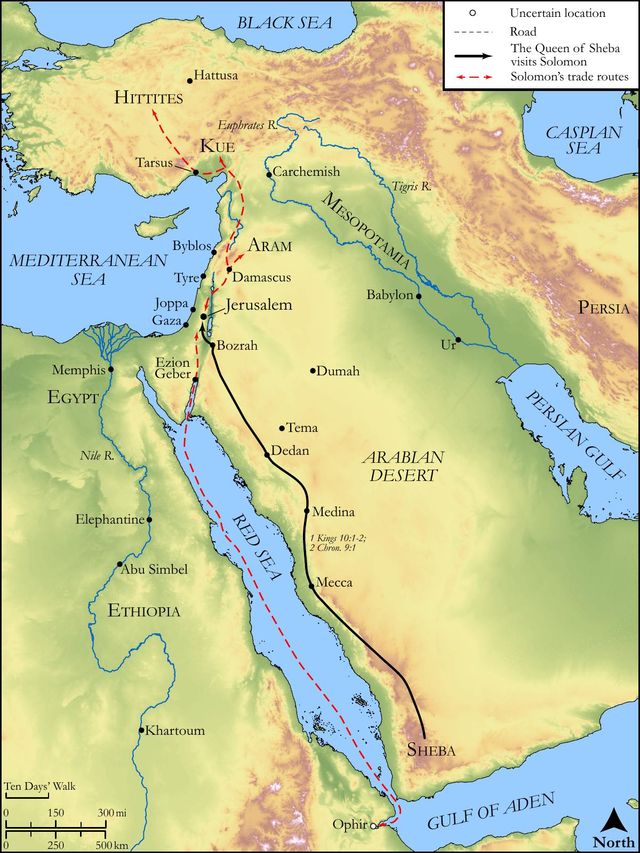
See on the biblical-era map
Study this verse
Public-domain commentary
Matthew Henry
From his Commentary on the Whole Bible. Henry comments on passages, not single verses — this entry covers 2 Chronicles 9:1–12.
This passage of story had been largely considered in the Kings; yet, because our Saviour has proposed it as an example to us in our enquiries after him (Mat 12:42), we must not pass it over without observing briefly, 1. Those who honour God he will honour, Sa1 2:30. Solomon had greatly honoured God, in building, beautifying, and dedicating the temple; all his wisdom and all his wealth were employed for the making of that a consummate piece: and now God made his wisdom and wealth to redound greatly to his reputation. The way to have both the credit and comfort of all our endowments and all our enjoyments is to consecrate them to God and use them for him. 2. Those who know the worth of true wisdom will grudge no pains nor cost to obtain it. The queen of Sheba put herself to a great deal of trouble and expense to hear the wisdom of Solomon; and yet, learning from him to serve God and do her duty, she thought herself well paid for her pains. Heavenly wisdom is that pearl of great price which is a good bargain to purchase by parting with all that we have. 3. As every man has received the gift so he ought to minister the same for the edification of others, as he has opportunity. Solomon was communicative of his wisdom and willing to teach others what he knew himself. Being taught of God, freely he had received, and freely he gave. Let those that are rich in wisdom, as well as wealth, learn to do good and be ready to distribute. Give to every one that asketh. 4. Good order in a family, a great family, especially in the things of God, and a regular discharge of the duties of religious worship, are highly expedient, and to be much admired wherever found. The queen of Sheba was exceedingly affected to see the propriety with which Solomon's servants attended him and with which both he and they attended in the house of God. David's ascent to the house of the Lord was also pleasant and interesting, Psa 42:4. 5. Those are happy who have the opportunity of a constant converse with such as are knowing, wise, and good. The queen of Sheba thought Solomon's servants happy who continually heard his wisdom; for, it seems, even to them he was communicative. And it is observable that the posterity of those who had places in his court were willing to have the names of their ancestors forgotten, and thought themselves sufficiently distinguished and dignified when they were called the children of Solomon's servants (Ezr 2:55; Neh 7:57); so eminent were they that it was honour enough to be named from them. 6. We ought to rejoice and give God thanks for the gifts, graces, and usefulness, of others. The queen of Sheba blessed God for the honour he put upon Solomon, and the favour he did to Israel, in advancing him to the throne, Ch2 9:8. By giving God the praise of the prosperity of others, we share in the comfort of it; whereas, by envying the prosperity of others, we lose the comfort even of our own. The happiness of both king and kingdom she traces up to the fountain of all bliss, the divine favour: it was because thy God delighted in thee and because he loved Israel. Those mercies are doubly sweet in which we can taste the kindness and good will of God as our God. 7. It becomes those that are wise and good to be generous according to their place and power. The queen of Sheba was so to Solomon, Solomon was so to her, Ch2 9:9, Ch2 9:12. They both knew how to value wisdom, and therefore were neither of them covetous of their money, but cultivated the acquaintance and confirmed the friendship they had contracted by mutual presents. Our Lord Jesus has promised to give us all our desire: Ask, and it shall be given you. Let us study what we shall render to him, and not think any thing too much to do, or suffer, or part with, for him.
Continue studying 2 Chronicles 9:5 across the web’s major study libraries — every link below opens this exact verse, chapter, or book on the destination site.
Read & Compare
 BibleGatewayThis verse in more than 200 translations and 70 languages.
 Bible.comThe YouVersion reader — hundreds of translations, reading plans, and highlights.
 ESV.orgCrossway's official English Standard Version reader.
 NET BibleThe NET translation with 60,000+ translators' notes on every rendering decision.
 STEP BibleTyndale House's free study tool — original text, vocabulary, and scholarly resources.
 BibliaLogos Bible Software's free web reader.
 USCCBThe New American Bible (Revised Edition) with the U.S. bishops' study notes.
Commentaries
 BibleHub CommentariesDozens of classic commentaries on this verse, gathered on one page.
 StudyLightMore than 100 commentary sets — the largest collection on the web.
 BibleRefPlain-English commentary on what this verse means, verse by verse.
 Enduring WordDavid Guzik's free commentary on this chapter, widely used by Bible teachers.
 Bible Study ToolsVerse commentary alongside Greek and Hebrew study aids.
Original Language & Research
- BibleHub InterlinearThe verse word by word — original language, transliteration, and English.
- BibleHub LexiconEvery word's original-language definition and Strong's entry.
 Blue Letter BibleDeep-study tools — Strong's numbers, concordance, and word studies.
 SefariaThe Hebrew text with Rashi and centuries of Jewish commentary.
Sermons, Hymns & Audio


TrulyRandomVerse is not affiliated with these sites and doesn’t control their content. They’re linked because they’re genuinely useful.
Summary
The Queen of Sheba, having undertaken an arduous journey to verify the extraordinary accounts of King Solomon's reign, articulates her profound astonishment and validation. Her declaration confirms that the widespread reports of Solomon's unparalleled wisdom and his magnificent accomplishments were not only accurate but were, in fact, understated, reflecting the tangible reality of God's abundant blessing upon him and his kingdom, thereby magnifying the divine source of his glory.
Context
ShowHideLiterary Context
This verse is a climactic moment within the detailed account of the Queen of Sheba's visit to King Solomon, found in both 1 Kings 10 and 2 Chronicles 9. The Chronicler strategically places this narrative immediately after describing Solomon's immense wealth, his administrative prowess, and the completion of the magnificent Temple, establishing that his fame had spread far and wide. Prior to her declaration in verse 5, the Queen had "communed with him of all that was in her heart" (2 Chronicles 9:1), observing his palace, the order of his court, his servants, his food, and the grandeur of the Temple and its services. Her statement serves as the pinnacle of her awe, a direct affirmation that the reality of Solomon's wisdom and the splendor of his kingdom surpassed even the most incredible rumors she had heard, thereby validating all the preceding descriptions of Solomon's glory and setting the stage for her lavish gifts and Solomon's even greater wealth.
Historical & Cultural Context
The Kingdom of Sheba is widely identified with an ancient South Arabian kingdom, likely encompassing modern-day Yemen or Ethiopia. The extensive and arduous journey from Sheba to Jerusalem underscores the extraordinary nature of the reports about Solomon, compelling a powerful monarch to undertake such a significant expedition to verify them. Among the kings of that day, royal visits often served as crucial diplomatic events, fostering alliances and facilitating the exchange of knowledge, goods, and cultural practices. The Queen's assessment of Solomon's "acts" would have encompassed his vast building projects (notably the Temple and his royal palace), his sophisticated administrative organization, his equitable judicial decisions, and his economic policies, all of which were tangible expressions of his divinely granted wisdom. Her acknowledgment of the "true report" highlights the high value placed on verifiable truth and the profound impact of a ruler's reputation in that age, when a king's fame often preceded him across vast distances, influencing political and economic relations.
Key Themes
ShowHideThe Queen's declaration in 2 Chronicles 9:5 powerfully contributes to several overarching themes within 2 Chronicles and the broader biblical narrative. Firstly, it underscores the theme of Divine Wisdom Manifested, illustrating how God's gift of wisdom to Solomon (1 Kings 3:9) was not merely an intellectual capacity but a practical, administrative, and spiritual discernment that led to unprecedented national prosperity and international renown. Secondly, the Queen's emphatic statement, "It was a true report," highlights the Confirmation of Truth, emphasizing that the reality of God's blessing and Solomon's glory exceeded all prior expectations, serving as an undeniable testimony to God's faithfulness. This theme resonates with the biblical principle that divine truth often surpasses human comprehension or anticipation, revealing itself in tangible ways. Finally, the verse speaks to Solomon's Magnificence as a Reflection of God's Glory, where his "acts" and "wisdom" are not solely personal achievements but a direct result of God's favor, intended to demonstrate His glory to the nations, drawing even distant rulers to Jerusalem to witness the splendor of the Lord's chosen king and the blessings that flow from obedience to Him.
Exposition and Analysis
ShowHideKey Word Analysis
ShowHideThis noun signifies "a word," "a matter (as spoken of)," "a thing," or "tidings." In this context, it refers to the widespread accounts, news, and reputation of Solomon that had reached the Queen's distant land. The use of dâbâr' here emphasizes the power of oral tradition and the global reach of Solomon's fame, implying that his renown was so great it became a subject of international discourse and curiosity, compelling even a foreign monarch to undertake a perilous journey to verify its veracity.
This term denotes "stability," "certainty," "truth," or "trustworthiness." The Queen's affirmation that the report was "true" is a powerful validation. It implies that her firsthand observation not only confirmed the veracity of the rumors but found them to be understated, suggesting the reality was even more astonishing than what she had heard. This word underscores the objective reality of Solomon's wisdom and prosperity, contrasting mere hearsay with verifiable fact, and ultimately pointing to the faithfulness of God who bestowed such blessings.
A foundational biblical concept, chokmâh refers to practical skill, discernment, insight, and the ability to apply knowledge effectively for righteous living and governance. It is often portrayed as divinely bestowed, as it was in Solomon's case (1 Kings 3:12). The Queen's recognition of Solomon's chokmâh extends beyond mere intellectual capacity to encompass his administrative acumen, his judicial fairness, his ability to manage a vast and prosperous kingdom, and his understanding of the natural world, all of which were seen as manifestations of God's presence and favor.
Verse Breakdown
ShowHide"And she said to the king"
This clause formally introduces the Queen of Sheba as the speaker and King Solomon as the recipient of her declaration. It signifies a moment of profound importance and public acknowledgment, delivered after her extensive observations and interactions with Solomon, marking the culmination of her investigative visit.
"[It was] a true report which I heard in mine own land"
The Queen directly addresses the widespread rumors and accounts that had preceded her visit. Her emphatic declaration of "a true report" serves as a powerful validation, confirming that the extraordinary stories of Solomon's kingdom and abilities, which she had heard from afar, were not exaggerated but grounded in reality. The phrase "in mine own land" highlights the global reach of Solomon's fame and the considerable distance the Queen traveled, underscoring the compelling nature of these reports that compelled her to undertake such an arduous journey.
"of thine acts, and of thy wisdom"
This final clause specifies the content of the "true report." The Queen explicitly attributes Solomon's renown to two key aspects: his "acts" (his deeds, accomplishments, and the tangible manifestations of his reign, such as the Temple, his palace, his administrative achievements, and the prosperity of his kingdom) and his "wisdom" (his profound insight, discernment, and administrative skill, which guided all his endeavors). This pairing emphasizes that Solomon's greatness was not merely theoretical but was demonstrably evident in both his character and his tangible achievements, all flowing from his divinely granted wisdom.
Literary Devices
ShowHideThe Chronicler masterfully employs several literary devices in this verse to emphasize Solomon's unparalleled glory and the divine source of his renown. Understatement is powerfully at play, as the Queen's statement implies that the reality of Solomon's wisdom and splendor far exceeded even the most incredible "reports." This subtle technique magnifies Solomon's greatness by suggesting that mere words could not adequately capture the truth of what she witnessed. The Queen's declaration also functions as a powerful testimony or affirmation, providing external, objective validation from a foreign dignitary, thereby lending immense credibility to the Chronicler's portrayal of Solomon's reign and the divine blessing upon him. Furthermore, there is an implicit contrast between what was merely heard (the report) and what was personally witnessed (the reality), highlighting the overwhelming impact of Solomon's kingdom. This contrast serves to underscore the tangible and undeniable nature of God's blessing on Solomon, making his wisdom and wealth a global spectacle that compelled even a distant queen to seek him out.
Theological and Thematic Connections
ShowHideThe Queen of Sheba's declaration in 2 Chronicles 9:5 serves as a profound theological statement on the nature of God's wisdom and its manifestation in the world. Solomon's wisdom was not innate but a divine gift, granted in response to his humble prayer for an understanding heart to govern God's people (1 Kings 3:9). This verse thus underscores that true wisdom and lasting prosperity flow from God's hand, demonstrating His capacity to bless and empower His chosen servants beyond measure. The Queen's journey and her subsequent awe demonstrate that God's glory, when expressed through His chosen instruments, transcends geographical and cultural boundaries, drawing even those from distant lands to witness His truth. Her verification of the "true report" highlights the reliability of divine revelation and the tangible evidence of God's work in the world, inviting all to seek and acknowledge the source of such extraordinary wisdom, which ultimately points to the Creator Himself, the fount of all true wisdom and blessing.
Reflection and Application
ShowHideThe Queen of Sheba's journey and her astonished declaration offer rich lessons for contemporary believers. Her active pursuit of truth, traveling a great distance to verify reports, challenges us to cultivate a similar earnestness in seeking God's wisdom and truth in our own lives. Just as Solomon's wisdom and "acts" were a tangible witness that drew a foreign queen, our lives, when lived in alignment with God's principles, can become compelling testimonies to the reality of His transforming power. We are called not merely to hear about God's truth but to experience it, allowing it to shape our character and actions so profoundly that our lives reflect His glory. This verse encourages us to pray for and pursue divine wisdom, recognizing that it is not just for personal benefit but for the flourishing of our communities and as a powerful witness to a watching world. When we embody God's wisdom, our "acts" become a living sermon, exceeding mere reports and inviting others to discover the source of true life and understanding, which is found in a relationship with the living God, who alone grants genuine wisdom and lasting prosperity.
Questions for Reflection
ShowHideFAQ
ShowHideWhat was the primary motivation for the Queen of Sheba's visit to Solomon?
ShowHideThe primary motivation for the Queen of Sheba's visit was to personally verify the widespread and extraordinary reports she had heard in her own land concerning King Solomon's unparalleled wisdom and the immense prosperity and grandeur of his kingdom. As 2 Chronicles 9:1 states, she came "to prove Solomon with hard questions," indicating a desire to test the veracity and depth of his wisdom firsthand, not merely to engage in diplomatic pleasantries. Her journey was driven by a deep curiosity and a desire to witness the source of such remarkable fame, which ultimately led her to acknowledge that the reality far exceeded the reports.
How did Solomon's wisdom differ from the wisdom of other ancient rulers?
ShowHideSolomon's wisdom was distinct because it was explicitly a divine gift, bestowed by God in response to Solomon's humble request for an "understanding heart to judge Your people" (1 Kings 3:9). While other ancient rulers might have possessed practical intelligence, strategic acumen, or philosophical insights, Solomon's wisdom was uniquely comprehensive, encompassing not only judicial discernment and administrative skill but also profound knowledge of the natural world and the ability to compose proverbs and songs (1 Kings 4:29-34). It was a wisdom that led to unprecedented peace and prosperity for his kingdom, demonstrating God's favor and power in a way that drew international attention, as evidenced by the Queen of Sheba's visit.
What is the significance of the Queen stating the report was "true" and not "exaggerated"?
ShowHideThe significance of the Queen stating the report was "true" and not "exaggerated" lies in its powerful affirmation of the tangible reality of God's blessing on Solomon. In an age where rumors and hyperbole were common, her personal verification from a position of power and skepticism lends immense credibility to the Chronicler's account of Solomon's glory. It underscores that God's work is not merely theoretical or whispered about, but demonstrably real and impactful. Her statement implies that the reality she witnessed was so overwhelming that it surpassed even the most incredible stories, serving as an undeniable testament to the divine source of Solomon's wisdom and prosperity. This validates the truth of God's promises and His ability to bless beyond human imagination, demonstrating His glory to the nations.
Christ-Centered Fulfillment
ShowHideThe awe-struck declaration of the Queen of Sheba concerning Solomon's unparalleled wisdom and magnificent "acts" finds its ultimate and infinitely greater fulfillment in Jesus Christ. Solomon, in all his glory, was a type and shadow of the coming Messiah, a temporary king whose wisdom and kingdom eventually faded. While the Queen traveled from the ends of the earth to hear the wisdom of Solomon, Jesus himself declared that "a greater than Solomon is here" (Matthew 12:42). Christ embodies perfect wisdom, not as a divinely granted gift, but as the very Wisdom of God incarnate (1 Corinthians 1:24, Colossians 2:3). His "acts" far surpass Solomon's building projects or judicial decisions; they include the creation of all things (John 1:3), the miracles that demonstrate His divine authority (John 2:11), and supremely, His atoning death and resurrection, which establish an eternal kingdom of righteousness and peace (Hebrews 9:12). The "report" of Christ's wisdom and redemptive acts is the Gospel, a truth that not only proves true but infinitely exceeds all human expectation, drawing people from every nation to worship Him, the true King of kings, whose glory and wisdom are eternal and inexhaustible (Revelation 5:12).