


2 Chronicles 9:6
Bible text: King James Version (1769 Blayney text) · Public domain
Bible text: King James Version with Strong's numbers · Public domain
Bible text: Berean Standard Bible · Public domain
Bible text: American Standard Version (1901) · Public domain
Bible text: World English Bible, Messianic edition · Public domain
Bible text: Geneva Bible (1599) · Public domain
Bible text: Young's Literal Translation · Public domain
- וְלֹאve·lo'and notH3808Conj-w ¦ NegParticle Negativeוְandלֹאnot
- הֶאֱמַנְתִּיhe·'e·Man·tiI believedH539V-Hiphil-Perf-1csVerb Hiphil Perfect 1st Singular common gender
- לְדִבְרֵיהֶםle·div·rei·Hem<to> their wordsH1697Prep-l ¦ N-mpc ¦ 3mpNoun Plural Masculine Constructלְ<to>דִבְרֵיwordsהֶםtheir
- עַד'aduntilH5704PrepPreposition
- אֲשֶׁר'a·SherthatH834RelParticle Relative
- בָּאתִיba·tiI cameH935V-Qal-Perf-1csVerb Qal Perfect 1st Singular common gender
- וַתִּרְאֶינָהva·tir·'Ei·nahand they sawH7200Conj-w ¦ V-Qal-ConsecImperf-3fpVerb Qal Consecutive Imperfect 3rd Plural Feminineוַandתִּרְאֶינָהthey saw
- עֵינַי'ei·Naimy eyesH5869N-fdc ¦ 1csNoun Dual Feminine Constructעֵינַeyesיmy
- וְהִנֵּהve·hi·Nehand here!H2009Conj-w ¦ PrtParticle Interjectionוְandהִנֵּהhere!
- לֹאlo'notH3808NegParticle Negative
- הֻגַּדhu·gadit was toldH5046V-Hophal-Perf-3msVerb Hophal Perfect 3rd Singular Masculine
- לִיLito mePrep-l ¦ 1csSuffix Personal 1st Singular common genderלִtoיme
- חֲצִיcha·Tzi[the] half ofH2677N-mscNoun Singular Masculine Construct
- מַרְבִּיתmar·Bit[the] greatness ofH4768N-fscNoun Singular Feminine Construct
- חָכְמָתֶךָcha·khe·ma·Te·khayour wisdomH2451N-fsc ¦ 2msNoun Singular Feminine Constructחָכְמָתֶwisdomךָyour
- יָסַפְתָּya·Saf·tayou have addedH3254V-Qal-Perf-2msVerb Qal Perfect 2nd Singular Masculine
- עַל'altoH5921PrepPreposition
- הַשְּׁמוּעָהha·she·mu·'Ahthe reportH8052Art ¦ N-fsNoun Singular Feminine Absoluteהַtheשְּׁמוּעָהreport
- אֲשֶׁר'a·SherwhichH834RelParticle Relative
- שָׁמָעְתִּיsha·Ma·'e·tiI heardH8085V-Qal-Perf-1csVerb Qal Perfect 1st Singular common gender
English is a literal word-by-word gloss of the Hebrew, not the KJV's wording. Why?
This is the original text the KJV's translators worked from — each Hebrew word with its own literal English meaning in this verse, prepared by scholars at Tyndale House, Cambridge. The KJV translates whole sentences, not word by word, so its wording differs: one Hebrew word can become several English words, and the KJV may choose “the LORD” where the gloss reads “Yahweh”. Both are faithful — they answer different questions. For the KJV's own rendering, switch to the KJV text.
Details
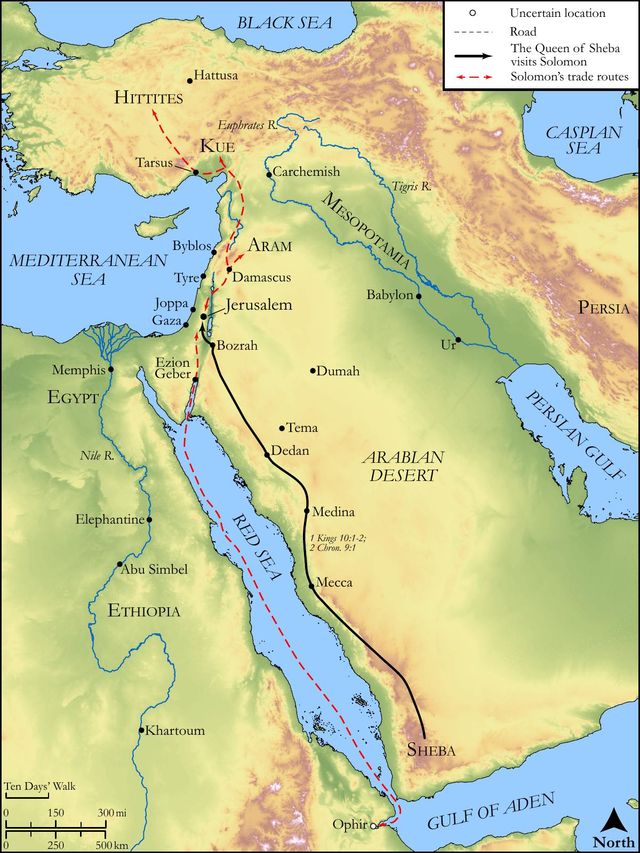
See on the biblical-era map
Study this verse
Public-domain commentary
Matthew Henry
From his Commentary on the Whole Bible. Henry comments on passages, not single verses — this entry covers 2 Chronicles 9:1–12.
This passage of story had been largely considered in the Kings; yet, because our Saviour has proposed it as an example to us in our enquiries after him (Mat 12:42), we must not pass it over without observing briefly, 1. Those who honour God he will honour, Sa1 2:30. Solomon had greatly honoured God, in building, beautifying, and dedicating the temple; all his wisdom and all his wealth were employed for the making of that a consummate piece: and now God made his wisdom and wealth to redound greatly to his reputation. The way to have both the credit and comfort of all our endowments and all our enjoyments is to consecrate them to God and use them for him. 2. Those who know the worth of true wisdom will grudge no pains nor cost to obtain it. The queen of Sheba put herself to a great deal of trouble and expense to hear the wisdom of Solomon; and yet, learning from him to serve God and do her duty, she thought herself well paid for her pains. Heavenly wisdom is that pearl of great price which is a good bargain to purchase by parting with all that we have. 3. As every man has received the gift so he ought to minister the same for the edification of others, as he has opportunity. Solomon was communicative of his wisdom and willing to teach others what he knew himself. Being taught of God, freely he had received, and freely he gave. Let those that are rich in wisdom, as well as wealth, learn to do good and be ready to distribute. Give to every one that asketh. 4. Good order in a family, a great family, especially in the things of God, and a regular discharge of the duties of religious worship, are highly expedient, and to be much admired wherever found. The queen of Sheba was exceedingly affected to see the propriety with which Solomon's servants attended him and with which both he and they attended in the house of God. David's ascent to the house of the Lord was also pleasant and interesting, Psa 42:4. 5. Those are happy who have the opportunity of a constant converse with such as are knowing, wise, and good. The queen of Sheba thought Solomon's servants happy who continually heard his wisdom; for, it seems, even to them he was communicative. And it is observable that the posterity of those who had places in his court were willing to have the names of their ancestors forgotten, and thought themselves sufficiently distinguished and dignified when they were called the children of Solomon's servants (Ezr 2:55; Neh 7:57); so eminent were they that it was honour enough to be named from them. 6. We ought to rejoice and give God thanks for the gifts, graces, and usefulness, of others. The queen of Sheba blessed God for the honour he put upon Solomon, and the favour he did to Israel, in advancing him to the throne, Ch2 9:8. By giving God the praise of the prosperity of others, we share in the comfort of it; whereas, by envying the prosperity of others, we lose the comfort even of our own. The happiness of both king and kingdom she traces up to the fountain of all bliss, the divine favour: it was because thy God delighted in thee and because he loved Israel. Those mercies are doubly sweet in which we can taste the kindness and good will of God as our God. 7. It becomes those that are wise and good to be generous according to their place and power. The queen of Sheba was so to Solomon, Solomon was so to her, Ch2 9:9, Ch2 9:12. They both knew how to value wisdom, and therefore were neither of them covetous of their money, but cultivated the acquaintance and confirmed the friendship they had contracted by mutual presents. Our Lord Jesus has promised to give us all our desire: Ask, and it shall be given you. Let us study what we shall render to him, and not think any thing too much to do, or suffer, or part with, for him.
Continue studying 2 Chronicles 9:6 across the web’s major study libraries — every link below opens this exact verse, chapter, or book on the destination site.
Read & Compare
 BibleGatewayThis verse in more than 200 translations and 70 languages.
 Bible.comThe YouVersion reader — hundreds of translations, reading plans, and highlights.
 ESV.orgCrossway's official English Standard Version reader.
 NET BibleThe NET translation with 60,000+ translators' notes on every rendering decision.
 STEP BibleTyndale House's free study tool — original text, vocabulary, and scholarly resources.
 BibliaLogos Bible Software's free web reader.
 USCCBThe New American Bible (Revised Edition) with the U.S. bishops' study notes.
Commentaries
 BibleHub CommentariesDozens of classic commentaries on this verse, gathered on one page.
 StudyLightMore than 100 commentary sets — the largest collection on the web.
 BibleRefPlain-English commentary on what this verse means, verse by verse.
 Enduring WordDavid Guzik's free commentary on this chapter, widely used by Bible teachers.
 Bible Study ToolsVerse commentary alongside Greek and Hebrew study aids.
Original Language & Research
- BibleHub InterlinearThe verse word by word — original language, transliteration, and English.
- BibleHub LexiconEvery word's original-language definition and Strong's entry.
 Blue Letter BibleDeep-study tools — Strong's numbers, concordance, and word studies.
 SefariaThe Hebrew text with Rashi and centuries of Jewish commentary.
Sermons, Hymns & Audio


TrulyRandomVerse is not affiliated with these sites and doesn’t control their content. They’re linked because they’re genuinely useful.
Summary
The Queen of Sheba's profound declaration marks a pivotal moment where firsthand experience utterly eclipses all prior reports and expectations. Having journeyed from afar to test King Solomon with challenging questions, she is overwhelmed by the sheer magnitude of his divinely bestowed wisdom, the splendor of his court, and the unparalleled prosperity of his kingdom, acknowledging that even the most extravagant rumors failed to convey half of the magnificent reality before her eyes. This verse powerfully underscores the unparalleled nature of God's blessing upon Solomon, manifesting in a wisdom and glory that defied mere description and left a lasting impression on a foreign monarch.
Context
ShowHideLiterary Context
This verse serves as the climactic confession of the Queen of Sheba during her visit to King Solomon, a narrative detailed in 2 Chronicles 9:1-12. The account opens with her hearing of Solomon's vast fame and journeying to Jerusalem "to test him with hard questions" (2 Chronicles 9:1). The preceding verses, 2 Chronicles 9:2-5, describe Solomon's comprehensive ability to answer all her inquiries and her profound astonishment at the wisdom, the meticulous order of his court, the lavish provisions, and the grandeur of the temple. Her confession in verse 6 acts as the ultimate validation of Solomon's divinely bestowed wisdom, directly echoing the promise made to him by God in 2 Chronicles 1:12. It highlights the fulfillment of God's covenant blessings upon the Davidic king, showcasing the unparalleled glory and stability of his reign to both Israel and the nations.
Historical & Cultural Context
The Queen of Sheba's visit, also recounted in 1 Kings 10, reflects the intricate diplomatic and economic realities of Solomon's day. Sheba was likely a powerful kingdom located in modern-day Yemen or Ethiopia, renowned for its lucrative trade routes in exotic spices, gold, and precious stones (as evidenced by her generous gifts in 2 Chronicles 9:9). It was a common practice for kings and rulers to exchange gifts and undertake state visits to forge alliances, establish trade agreements, and demonstrate their own power and prestige. The act of "testing" a king with "hard questions" was a customary method to assess a ruler's wisdom, discernment, and administrative capacity, qualities considered vital for effective governance and often interpreted as a sign of divine favor. Solomon's international reputation had clearly spread far and wide, indicating the significant influence and recognition of his kingdom throughout the known world.
Key Themes
ShowHideThis verse profoundly contributes to several overarching themes within the book of Chronicles and the broader biblical narrative. Firstly, it emphatically underscores Divine Wisdom and Blessing, showcasing Solomon's unparalleled intellect as a direct and supernatural gift from God, far exceeding mere human acumen. This wisdom, coupled with immense wealth and glory, serves as a tangible demonstration of God's faithfulness to His promises to Solomon and David, particularly the covenant of a flourishing kingdom. Secondly, it highlights the Supremacy of Firsthand Experience over secondhand reports, powerfully illustrating that the reality of God's blessings and manifestations often far exceeds human imagination or description. The Queen's journey from initial skepticism to profound awe vividly illustrates the transformative power of direct encounter with divine truth. Finally, the narrative subtly points to God's Universal Sovereignty, as even a foreign monarch from a distant land is compelled to acknowledge the extraordinary nature of Solomon's reign, implicitly recognizing the God who blessed him. This foreshadows the future ingathering of the nations to God's light, a theme found throughout prophetic literature, such as in Isaiah 2:2-4.
Exposition and Analysis
ShowHideKey Word Analysis
ShowHideThis verb signifies "to be firm, trustworthy, reliable," and in the Hiphil stem, "to believe, trust." The Queen's initial state was one of skepticism or at least an inability to fully credit the reports she heard. Her confession, "I believed not their words," indicates a rational doubt that such grandeur could truly exist, highlighting the extraordinary nature of what she eventually witnessed. It speaks to the human tendency to limit belief to what seems plausible until confronted with overwhelming, undeniable evidence.
This noun, derived from a root meaning "to be great, numerous," refers to "a multitude," "increase," or "greatest part." Here, it specifically describes the immense scale and magnificence of Solomon's wisdom, wealth, and kingdom. It's not just "wisdom" but the "greatness of thy wisdom," implying an extraordinary, unparalleled magnitude that transcends ordinary understanding. This term emphasizes the overwhelming, almost incomprehensible, nature of what the Queen encountered, far beyond what any report could convey.
This primitive root means "to add or augment," often adverbially, "to continue to do a thing," or "to increase, join, be stronger." In this context, it conveys that Solomon "surpassed" or "was superior to" the fame that preceded him. The reality of his wisdom and glory was not just equal to the reports, but went beyond them, leaving a surplus of wonder and astonishment. This word highlights the idea of abundance and overflowing blessing that characterized Solomon's reign, indicating a reality that was "more than" what was heard.
Verse Breakdown
ShowHide"Howbeit I believed not their words, until I came, and mine eyes had seen [it]:"
This opening clause reveals the Queen's initial posture of skepticism. Despite hearing numerous reports about Solomon's wisdom and wealth, she harbored doubt, finding the accounts too grand to be true. Her belief was contingent upon firsthand verification. The phrase "until I came, and mine eyes had seen [it]" emphasizes the critical role of personal, empirical evidence in overcoming her incredulity. It underscores the transformative power of direct experience over mere hearsay, highlighting the human need for tangible proof when faced with extraordinary claims.
"and, behold, the one half of the greatness of thy wisdom was not told me:"
This is the core of her astonishing confession. The Queen declares that what she had heard was only a fraction—less than half—of the immense reality of Solomon's wisdom and splendor. This is a powerful expression of hyperbole, indicating that the actual experience far exceeded even the most exaggerated rumors. Her use of "behold" (וְהִנֵּה, w'hinnēh) expresses a sudden, overwhelming realization and astonishment at the magnitude of what she witnessed, signaling a profound shift from doubt to awe.
"[for] thou exceedest the fame that I heard."
This concluding statement summarizes her profound realization. The reality of Solomon's person, his wisdom, and the magnificent glory of his kingdom not only met but significantly surpassed all the widespread renown and reports that had reached her distant land. This confirms that the direct encounter with Solomon's divinely gifted wisdom and the splendor of his reign left an indelible impression, proving the reports to be a severe understatement of the true magnificence.
Literary Devices
ShowHideThe verse effectively employs several literary devices to convey the Queen's profound astonishment and the unparalleled nature of Solomon's wisdom. Hyperbole (or perhaps more accurately, Meiosis on the part of the prior reports, which understated the reality) is prominently featured in the phrase "the one half of the greatness of thy wisdom was not told me," dramatically emphasizing that the reality far exceeded even the most extravagant rumors. This serves to magnify Solomon's wisdom and glory in the reader's mind, underscoring its divine origin. The verse also functions as a powerful Testimony or Witness, as a foreign dignitary, initially skeptical, offers an undeniable affirmation of Solomon's unparalleled wisdom. This lends significant credibility and weight to the Chronicler's portrayal of Solomon's reign as a period of immense divine blessing. Furthermore, a clear Contrast is drawn between "their words" (hearsay, reputation) and "mine eyes had seen [it]" (firsthand experience, reality), highlighting the superior impact and truthfulness of direct observation and experience.
Theological and Thematic Connections
ShowHideThe Queen of Sheba's confession in 2 Chronicles 9:6 is a powerful testament to the exceeding abundance of God's blessings and wisdom, which consistently surpass human comprehension and expectation. Solomon's wisdom was not merely intellectual prowess but a divine endowment, a direct manifestation of God's own character and faithfulness to His covenant promises. Just as the Queen found Solomon's reality to be far greater than his reputation, so too does God's nature, power, and love consistently exceed anything we can imagine or hear about Him. This narrative serves as a profound reminder that true spiritual experience often moves beyond secondhand accounts to a transformative, personal encounter with the living God, revealing depths of His glory that mere words cannot capture. It underscores that God's ways and thoughts are infinitely higher than ours, and His capacity to bless and reveal Himself is boundless, inviting us to seek and experience His reality for ourselves.
Reflection and Application
ShowHideThe Queen of Sheba's journey from skepticism to profound awe provides a compelling model for our own spiritual lives. We frequently encounter "reports" about God's goodness, power, and wisdom, whether through scripture, sermons, or the testimonies of fellow believers. Yet, like the Queen, our faith truly deepens and becomes vibrant when we move beyond mere hearsay to a personal, firsthand encounter with God. This verse challenges us to actively seek and experience God's reality for ourselves, to allow His presence and truth to overwhelm our preconceived notions and limited expectations. It encourages a pursuit of genuine spiritual wisdom that transforms our lives and evokes a similar sense of wonder and worship. When our lives are genuinely marked by God's wisdom and blessing, they become a compelling testimony that can draw others to acknowledge the greatness of God, just as Solomon's life and reign drew the Queen of Sheba from a distant land. Our experience of God should always exceed the "fame" we've heard, leading us deeper into His unsearchable riches.
Questions for Reflection
ShowHideFAQ
ShowHideWhat was the primary purpose of the Queen of Sheba's visit to King Solomon?
ShowHideThe primary purpose of the Queen of Sheba's visit was to "test him with hard questions" (2 Chronicles 9:1), essentially to verify the extraordinary reports she had heard about Solomon's unparalleled wisdom and the splendor of his kingdom. It was a diplomatic mission to assess his capabilities, perhaps to establish trade relations or alliances, but fundamentally driven by curiosity and a desire to witness firsthand the phenomenon of Solomon's divinely bestowed wisdom, which had gained international renown. Her journey was a significant undertaking, underscoring the immense reputation Solomon had cultivated.
Does the Bible provide details about the "hard questions" the Queen of Sheba asked Solomon?
ShowHideWhile both 2 Chronicles 9 and 1 Kings 10 mention that she came to test Solomon with "hard questions," the biblical text does not provide the specific content of these questions. The narrative focuses on the outcome: Solomon "answered all her questions; nothing was hidden from Solomon that he could not explain to her" (2 Chronicles 9:2). The lack of detail emphasizes Solomon's comprehensive wisdom rather than the nature of the riddles or inquiries themselves, highlighting that no query was beyond his divinely-granted understanding.
How did Solomon's wisdom come to be so renowned?
ShowHideSolomon's wisdom was a direct and extraordinary gift from God. Early in his reign, when God appeared to him and offered him anything he desired, Solomon humbly asked for "wisdom and knowledge to govern this great people of yours" (2 Chronicles 1:10). God was pleased with his selfless request and granted him not only unparalleled wisdom but also immense riches and honor (2 Chronicles 1:12). This divine endowment manifested in his just judgments, his vast knowledge (including botany and zoology, as mentioned in 1 Kings 4:33), his authorship of numerous proverbs and songs, and his remarkable ability to administer a prosperous and orderly kingdom, all of which contributed to his widespread and enduring fame among nations.
Christ-Centered Fulfillment
ShowHideWhile King Solomon's wisdom and glory were astonishing, drawing even foreign monarchs like the Queen of Sheba to marvel, they ultimately served as a shadow and foretaste of the infinitely greater wisdom and glory embodied in Jesus Christ. Solomon's wisdom, though divinely given, was limited by his humanity and eventually tarnished by his own failures and idolatry. In contrast, Jesus Christ is the very incarnation of divine wisdom, in whom "are hidden all the treasures of wisdom and knowledge" (Colossians 2:3). He is not merely a recipient of wisdom, but Wisdom itself, the eternal Word through whom all things were made and by whom all things hold together (John 1:1-3 and Colossians 1:17). The Queen of Sheba traveled a great distance to see Solomon; yet, Jesus declares, "Behold, something greater than Solomon is here" (Matthew 12:42). The "fame" of Solomon, however great, pales in comparison to the reality of Christ, who is the "radiance of the glory of God and the exact imprint of his nature" (Hebrews 1:3). Just as the Queen's eyes saw a reality that exceeded all reports, so too does the experience of knowing Christ surpass all human expectation and description, offering not just earthly wisdom, but eternal life and the profound, unsearchable riches of God's grace and glory (Ephesians 3:8). He is the true and eternal King, whose reign of wisdom and righteousness will never end (Luke 1:33).