


Job 26:5
Bible text: King James Version (1769 Blayney text) · Public domain
Bible text: King James Version with Strong's numbers · Public domain
Bible text: Berean Standard Bible · Public domain
Bible text: American Standard Version (1901) · Public domain
Bible text: World English Bible, Messianic edition · Public domain
Bible text: Geneva Bible (1599) · Public domain
Bible text: Young's Literal Translation · Public domain
- הָרְפָאִיםha·re·fa·'Imthe shadesH7496Art ¦ N-mpNoun Plural Masculine Absoluteהָtheרְפָאִיםshades
- יְחוֹלָלוּye·cho·La·luthey are made to trembleH2342V-Pual-Imperf-3mpVerb Pual Imperfect 3rd Plural Masculine
- מִתַּחַתmi·Ta·chat<from> underH8478Prep-m ¦ N-mscNoun Singular Masculine Constructמִ<from>תַּחַתunder
- מַיִםMa·yim[the] watersH4325N-mpNoun Plural Masculine Absolute
- וְשֹׁכְנֵיהֶםve·sho·khe·nei·Hemand [those which] dwell in themH7931Conj-w ¦ V-Qal-Prtcpl-mp ¦ 3mpVerb Qal Participle Plural Masculine Constructוְandשֹׁכְנֵי[those which] dwell inהֶםthem
English is a literal word-by-word gloss of the Hebrew, not the KJV's wording. Why?
This is the original text the KJV's translators worked from — each Hebrew word with its own literal English meaning in this verse, prepared by scholars at Tyndale House, Cambridge. The KJV translates whole sentences, not word by word, so its wording differs: one Hebrew word can become several English words, and the KJV may choose “the LORD” where the gloss reads “Yahweh”. Both are faithful — they answer different questions. For the KJV's own rendering, switch to the KJV text.
Details
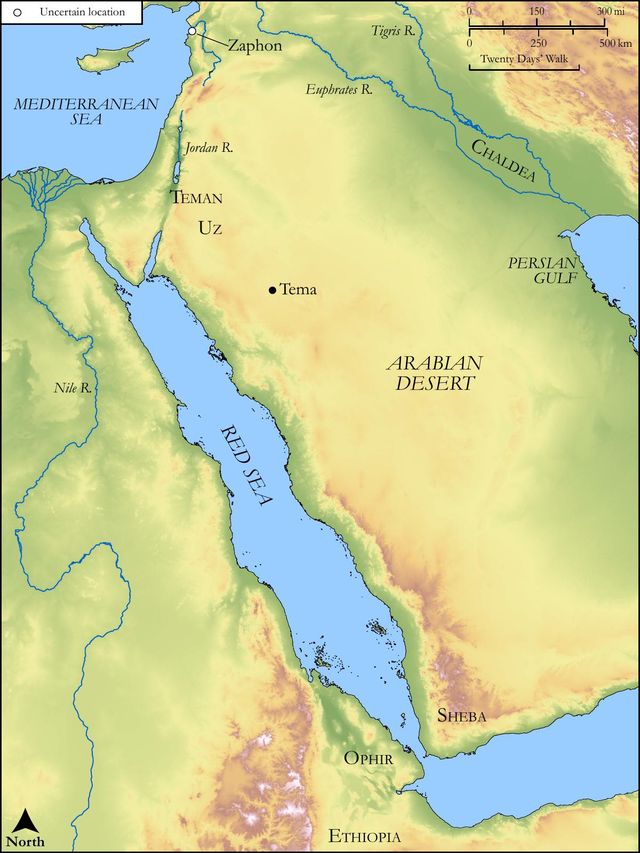
See on the biblical-era map
Study this verse
Public-domain commentary
Matthew Henry
From his Commentary on the Whole Bible. Henry comments on passages, not single verses — this entry covers Job 26:5–14. His three-level outline is real structure in the source text, so it is rendered as structure.
The truth received a great deal of light from the dispute between Job and his friends concerning those points about which they differed; but now they are upon a subject in which they were all agreed, the infinite glory and power of God. How does truth triumph, and how brightly does it shine, when there appears no other strife between the contenders than which shall speak most highly and honourably of God and be most copious in showing forth his praise! It were well if all disputes about matters of religion might end thus, in glorifying God as Lord of all, and our Lord, with one mind and one mouth (Rom 15:6); for to that we have all attained, in that we are all agreed.
I.Many illustrious instances are here given of the wisdom and power of God in the creation and preservation of the world.
1.If we look about us, to the earth and waters here below, we shall see striking instances of omnipotence, which we may gather out of these verses.
(1.)He hangs the earth upon nothing, Job 26:7. The vast terraqueous globe neither rests upon any pillars nor hangs upon any axle-tree, and yet, by the almighty power of God, is firmly fixed in its place, poised with its own weight. The art of man could not hang a feather upon nothing, yet the divine wisdom hangs the whole earth so. It is ponderibus librata suis - poised by its own weight, so says the poet; it is upheld by the word of God's power, so says the apostle. What is hung upon nothing may serve us to set our feet on, and bear the weight of our bodies, but it will never serve us to set our hearts on, nor bear the weight of our souls.
(2.)He sets bounds to the waters of the sea, and compasses them in (Job 26:10), that they may not return to cover the earth; and these bounds shall continue unmoved, unshaken, unworn, till the day and night come to an end, when time shall be no more. Herein appears the dominion which Providence has over the raging waters of the sea, and so it is an instance of his power, Jer 5:22. We see too the care which Providence takes of the poor sinful inhabitants of the earth, who, though obnoxious to his justice and lying at his mercy, are thus preserved from being overwhelmed, as they were once by the waters of a flood, and will continue to be so, because they are reserved unto fire.
(3.)He forms dead things under the waters. Rephaim-giants, are formed under the waters, that is, vast creatures, of prodigious bulk, as whales, giant-like creatures, among the innumerable inhabitants of the water. So bishop Patrick.
(4.)By mighty storms and tempests he shakes the mountains, which are here called the pillars of heaven (Job 26:11), and even divides the sea, and smites through its proud waves, Job 26:12. At the presence of the Lord the sea flies and the mountains skip, Psa 114:3, Psa 114:4. See Hab 3:6, etc. A storm furrows the waters, and does, as it were, divide them; and then a calm smites through the waves, and lays them flat again. See Psa 89:9, Psa 89:10. Those who think Job lived at, or after, the time of Moses, apply this to the dividing of the Red Sea before the children of Israel, and the drowning of the Egyptians in it. By his understanding he smiteth through Rahab; so the word is, and Rahab is often put for Egypt; as Psa 87:4; Isa 51:9.
2.If we consider hell beneath, though it is out of our sight, yet we may conceive the instances of God's power there. By hell and destruction (Job 26:6) we may understand the grave, and those who are buried in it, that they are under the eye of God, though laid out of our sight, which may strengthen our belief of the resurrection of the dead. God knows where to find, and whence to fetch, all the scattered atoms of the consumed body. We may also consider them as referring to the place of the damned, where the separate souls of the wicked are in misery and torment. That is hell and destruction, which are said to be before the Lord (Pro 15:11), and here to be naked before him, to which it is probable there is an allusion, Rev 14:10, where sinners are to be tormented in the presence of the holy angels (who attended the Shechinah) and in the presence of the Lamb. And this may give light to Job 26:5, which some ancient versions read thus (and I think more agreeably to the signification of the word Rephaim): Behold, the giants groan under the waters, and those that dwell with them; and then follows, Hell is naked before him, typified by the drowning of the giants of the old world; so the learned Mr. Joseph Mede understands it, and with it illustrates Pro 21:16, where hell is called the congregation of the dead; and it is the same word which is here used, and which he would there have rendered the congregation of the giants, in allusion to the drowning of the sinners of the old world. And is there any thing in which the majesty of God appears more dreadful than in the eternal ruin of the ungodly and the groans of the inhabitants of the land of darkness? Those that will not with angels fear and worship shall for ever with devils fear and tremble; and God therein will be glorified.
3.If we look up to heaven above, we shall see instances of God's sovereignty and power.
(1.)He stretches out the north over the empty place, Job 26:7. So he did at first, when he stretched out the heavens like a curtain (Psa 104:2); and he still continues to keep them stretched out, and will do so till the general conflagration, when they shall be rolled together as a scroll, Rev 6:14. He mentions the north because his country (as ours) lay in the northern hemisphere; and the air is the empty place over which it is stretched out. See Psa 89:12. What an empty place is this world in comparison with the other!
(2.)He keeps the waters that are said to be above the firmament from pouring down upon the earth, as once they did (Job 26:8): He binds up the waters in his thick clouds, as if they were tied closely in a bag, till there is occasion to use them; and, notwithstanding the vast weight of water so raised and laid up, yet the cloud is not rent under them, for then they would burst and pour out as a spout; but they do, as it were, distil through the cloud, and so come drop by drop, in mercy to the earth, in small rain, or great rain, as he pleases.
(3.)He conceals the glory of the upper world, the dazzling lustre of which we poor mortals could not bear (Job 26:9): He holds back the face of his throne, that light in which he dwells, and spreads a cloud upon it, through which he judges, Job 22:13. God will have us to live by faith, not by sense; for this is agreeable to a state of probation. It were not a fair trial if the face of God's throne were visible now as it will be in the great day.
Lest his high throne, above expression bright,
With deadly glory should oppress our sight,
To break the dazzling force he draws a screen
Of sable shades, and spreads his clouds between.
- Sir R. Blackmore
(4.)The bright ornaments of heaven are the work of his hands (Job 26:13): By his Spirit, the eternal Spirit that moved upon the face of the waters, the breath of his mouth (Psa 33:6), he has garnished the heavens, not only made them, but beautified them, has curiously bespangled them with stars by night and painted them with the light of the sun by day. God, having made man to look upward (Os homini sublime dedit - To man he gave an erect countenance), has therefore garnished the heavens, to invite him to look upward, that, by pleasing his eye with the dazzling light of the sun and the sparkling light of the stars, their number, order, and various magnitudes, which, as so many golden studs, beautify the canopy drawn over our heads, he may be led to admire the great Creator, the Father and fountain of lights, and to say, "If the pavement be so richly inlaid, what must the palace be! If the visible heavens be so glorious, what are those that are out of sight!" From the beauteous garniture of the ante-chamber we may infer the precious furniture of the presence-chamber. If stars be so bright, what are angels! What is meant here by the crooked serpent which his hands have formed is not certain. Some make it part of the garnishing of the heavens, the milky-way, say some; some particular constellation, so called, say others. It is the same word that is used for leviathan (Isa 27:1), and probably may be meant of the whale or crocodile, in which appears much of the power of the Creator; and why may not Job conclude with that inference, when God himself does so? ch. 41.
II.He concludes, at last, with an awful et caetera (Job 26:14):
Lo, these are parts of his ways, the out-goings of his wisdom and power, the ways in which he walks and by which he makes himself known to the children of men. Here,
1.He acknowledges, with adoration, the discoveries that were made of God. These things which he himself had said, and which Bildad had said, are his ways, and this is heard of him; this is something of God. But,
2.He admires the depth of that which is undiscovered. This that we have said is but part of his ways, a small part. What we know of God is nothing in comparison with what is in God and what God is. After all the discoveries which God has made to us, and all the enquiries we have made after God, still we are much in the dark concerning him, and must conclude, Lo, these are but parts of his ways. Something we hear of him by his works and by his word; but, alas! how little a portion is heard of him? heard by us, heard from us! We know but in part; we prophesy but in part. When we have said all we can, concerning God, we must even do as St. Paul does (Rom 11:33); despairing to find the bottom, we must sit down at the brink, and adore the depth: O the depth of the wisdom and knowledge of God! It is but a little portion that we hear and know of God in our present state. He is infinite and incomprehensible; our understandings and capacities are weak and shallow, and the full discoveries of the divine glory are reserved for the future state. Even the thunder of his power (that is, his powerful thunder), one of the lowest of his ways here in our own region, we cannot understand. See Job 37:4, Job 37:5. Much less can we understand the utmost force and extent of his power, the terrible efforts and operations of it, and particularly the power of his anger, Psa 90:11. God is great, and we know him not.
Historical interpretation
Historical reception
2 surviving comments on this verse. Each one is dated, so this reads as a timeline rather than a list.
Select a marker to jump to its quote. Markers stagger vertically where authors wrote within a few decades of each other.
“Behold, giants groan under the waters.” After proposing the division that he made between power and wisdom, Job puts forward his evidence. He distinguishes the deep and the underworld. Both those that live in the deep of the sea, even if they are of tremendous size (and for this reason he calls them “giants,” which we understand as “wild beasts”) and those in the underworld itself (which prevents the sight of viewers as if in a thick fog)—both these realms remain constantly within the realm of God’s power and exposed to his eyes. “Behold, giants groan under the waters.” The Greek text reads, “Will the giants receive the service of the midwife under the waters, and in their neighbor?” This must be interpreted as asking whether the dead will resurrect if they are under the waters on earth. In saying “they will resurrect,” the thought is that “it will be as if they had the service of a midwife.” It is interpreted according to the metaphor of a woman giving birth. The meaning is this, “The art of midwifery takes the child out of the womb.” If so, is it possible to raise the dead from the underworld, when this realm belongs only to God? “The underworld is naked before him.” It is impossible, he says, to hold back the dead when God wants to resurrect them. Only at his command [the earth] is forced to throw up those which it has devoured. “There is no cover to perdition.” Even though [the underworld] is covered by the thickness of darkness, it appears transparently before the eyes of the Almighty.
30. For it was fitting that by rebuking he should first beat down the swelling of earthly wisdom, and by instruction afterwards pass on to words replete with mysteries. Thus by ‘giants,’ either apostate Angels, or all proud men may without objection be understood. For hence it is said by the Prophet, The dead shall not live, the giants shall not rise up again. [Is. 26, 14] For whom does he call ‘the dead’ saving sinners, and whom does he designate ‘giants’ save those, who over and above take pride in sin. Now the former do ‘not live,’ because by sinning they have forfeited the life of righteousness; these latter too ‘cannot rise up again’ after death, because, after their transgression being swoln with pride, they do not have recourse to the remedies of penitence. Hence it is written again, The man that wandereth out of the way of understanding shall remain in the congregation of the dead. [Prov. 21, 16] For whosoever forsakes the way of righteousness, to whose number does he join himself, saving to the number of the proud spirits? Now it is well said in opposition to the high-minded, Lo, the giants groan under the waters. As if it were expressed in plain speech; ‘Wherefore on the score of knowledge should man be proud, when the abyss of ignorance keeps at the bottom the very proudest of the spirits of the Angels?’
31. But if by the name of ‘the giants’ the powerful ones of this world are denoted, in ‘the waters’ we may have the multitudes represented, as John beareth witness, who saith, The waters, which thou seest, are peoples. [Rev. 17, 15] Now against him that is filled with pride it is well spoken; Lo, the giants groan under the waters; because all that are high and lifted up, while in this life they long to attain the highest pitch of honours, groan under the burthens of peoples. For in proportion as a man is the higher lifted up here, he is burthened with so much the heavier cares. And to those very same people in mind and thoughts he is put under, whom in dignity he is put over. And by these words it is well shown in brief that all pride lies prostrate on the ground by the mere act by which it lifts itself up on high, so as to be the more effectually bowed down beneath all things from the same cause, that it would fain be set above all. For man when he is lifted up in high stations, bears so many in number over him, as he rules persons put beneath him. But those, that are associated with such persons, are by fellowship in their labour themselves also weighed to the ground. For together with them they likewise bear the toilsomeness of the burthen, whilst along with them they go after the gloriousness of the honour. Hence whereas he said, Lo, the giants groan under the waters; he directly added;
And they that dwell along with them.
32. As though he said; ‘Equally with them do they groan,’ who by taking delight are associated to their glory. Now the very employment of worldly dignities is borne down with readier vices in proportion as it is charged with heavier cares. For would that the mind of man even at rest might be able to see and eschew sins! And so because he saw that the longed for heights of affairs cannot be administered without sins, and because it is not hidden from the wrath of God, whatsoever is committed of an unlawful kind.
Continue studying Job 26:5 across the web’s major study libraries — every link below opens this exact verse, chapter, or book on the destination site.
Read & Compare
 BibleGatewayThis verse in more than 200 translations and 70 languages.
 Bible.comThe YouVersion reader — hundreds of translations, reading plans, and highlights.
 ESV.orgCrossway's official English Standard Version reader.
 NET BibleThe NET translation with 60,000+ translators' notes on every rendering decision.
 STEP BibleTyndale House's free study tool — original text, vocabulary, and scholarly resources.
 BibliaLogos Bible Software's free web reader.
 USCCBThe New American Bible (Revised Edition) with the U.S. bishops' study notes.
Commentaries
 BibleHub CommentariesDozens of classic commentaries on this verse, gathered on one page.
 StudyLightMore than 100 commentary sets — the largest collection on the web.
 BibleRefPlain-English commentary on what this verse means, verse by verse.
 Enduring WordDavid Guzik's free commentary on this chapter, widely used by Bible teachers.
 Bible Study ToolsVerse commentary alongside Greek and Hebrew study aids.
Original Language & Research
- BibleHub InterlinearThe verse word by word — original language, transliteration, and English.
- BibleHub LexiconEvery word's original-language definition and Strong's entry.
 Blue Letter BibleDeep-study tools — Strong's numbers, concordance, and word studies.
 SefariaThe Hebrew text with Rashi and centuries of Jewish commentary.
Sermons, Hymns & Audio


TrulyRandomVerse is not affiliated with these sites and doesn’t control their content. They’re linked because they’re genuinely useful.
Summary
Job 26:5 stands as a profound declaration of God's absolute omnipotence and sovereign dominion, asserting His control not only over the visible creation but also over the most mysterious, hidden, and often feared realms of existence. In this verse, Job eloquently proclaims that even the "dead things" or "shades" residing "under the waters"—a reference to the deepest parts of the earth or the underworld—are not beyond God's formative power and ultimate authority, underscoring His unmatched and comprehensive rule over all creation, including life and death itself.
Context
ShowHideLiterary Context
Job 26:5 is embedded within Job's magnificent and poetic discourse on God's omnipotence, which serves as a powerful rebuttal to Bildad's brief and somewhat inadequate speech in Job 25. Rather than merely defending his own righteousness, Job elevates the discussion to a grand theological proclamation of God's unmatched power and wisdom. Chapters 26 and 27 showcase Job's profound understanding of God's sovereignty over all things, moving from the heavens (Job 26:6-9) to the earth's foundations (Job 26:7) and, critically, to the deepest, most mysterious parts of creation, including the underworld, as highlighted in this verse. It functions as a powerful affirmation that no realm, no matter how hidden or chaotic, lies outside God's ultimate control, setting the stage for God's direct address to Job in later chapters.
Historical & Cultural Context
The phrase "under the waters" (Hebrew: mi-tachat mayim) alludes to the deep of creation, the "water under the earth" of the second commandment, a region associated with the abyss and the underworld (Sheol). In many ancient myths, these deep waters were the domain of chaotic forces or independent deities. The "dead [things]" (Hebrew: repha'im) were understood either as ancient, powerful inhabitants (giants) or, more commonly, as the "shades" or spirits of the deceased residing in Sheol. By declaring that these repha'im are "formed" from "under the waters," Job asserts Yahweh's unique and absolute sovereignty over realms that other cultures might have considered independent, chaotic, or governed by other powers. This statement profoundly contrasts with pagan beliefs, firmly placing even the dreaded realm of death under the direct, formative power of the one true God.
Key Themes
ShowHideThis verse powerfully contributes to several overarching themes in the book of Job and broader biblical theology. Foremost is the theme of Divine Omnipotence and Sovereignty, emphasizing God's absolute control over all aspects of creation, including those considered deepest, darkest, or most mysterious. It underscores that even the forces of death and the unseen inhabitants of the deep are subject to His power and formation, as seen in Psalm 139:8. Another key theme is God's Transcendent Wisdom, which extends beyond human comprehension, reaching into the hidden depths of existence. The verse also touches upon the Mystery of Creation, acknowledging realms beyond human grasp but still firmly under God's hand, and implicitly, God's Victory over Chaos, as He orders and controls what was often perceived as primeval, untamed forces, demonstrating His power over all that is, was, and is to come.
Exposition and Analysis
ShowHideKey Word Analysis
ShowHideThis term is central to understanding the verse. In the Old Testament, râphâʼ (often appearing as repha'im in the plural) can refer to ancient, mighty inhabitants or giants (e.g., Deuteronomy 2:11). However, more commonly, and almost certainly in this context, it refers to the "shades" or spirits of the dead who reside in Sheol, the underworld (e.g., Psalm 88:10, Isaiah 26:14). Job's use of this term emphasizes God's dominion over the departed, asserting that even the spirits of the dead are subject to His power and are not self-existent entities.
The verb chûwl (here in its passive form, cholalu) is a primitive root carrying connotations of twisting, whirling, or, more specifically, being brought forth, travailed, or made. It suggests a process of creation, birth, or formation. The passive voice implies that these "dead things" are being formed or brought into being by an external agent—God. This signifies that even these shadowy inhabitants of the deep are not autonomous but are continually subject to God's creative or formative power, highlighting His active involvement and comprehensive control over every realm of existence.
This term, appearing in the phrase "from under the waters" (mi-tachat mayim), refers to the deep, subterranean waters. In Scripture, these waters are often associated with the underworld, the abyss, or Sheol, representing the deepest, most hidden, and mysterious parts of creation, realms typically beyond human reach or comprehension. By stating that even from "under the waters" these "dead things are formed," Job powerfully reinforces God's comprehensive and inescapable reach, demonstrating that no part of existence, however remote, terrifying, or chaotic, is outside His sovereign jurisdiction.
Verse Breakdown
ShowHide"Dead [things] are formed"
This opening clause immediately establishes the subject: the repha'im, or the spirits of the dead. The verb "are formed" (passive voice, from chûwl) indicates that these entities are not independent or self-originating but are brought into existence or continually sustained by a higher power. This challenges any notion of an autonomous realm of the dead or spirits, asserting God's ultimate creative and sustaining power over them, even in their disembodied state.
"from under the waters,"
This phrase specifies the origin or location from which these "dead things" are formed. It points to the deepest, most concealed parts of the earth, the abyss, or the underworld (Sheol). This emphasizes the profound extent of God's power, reaching into realms that are typically hidden, mysterious, and often associated with primeval chaos or death in ancient thought. It highlights God's comprehensive sovereignty over all dimensions of existence, from the highest heavens to the deepest abyss.
"and the inhabitants thereof."
This concluding phrase broadens the scope of the assertion. It clarifies that not only the "dead things" themselves but also all other "inhabitants" of these deep, watery, subterranean regions are under God's formative and sovereign hand. This reinforces the comprehensive nature of God's dominion, leaving no part of creation, visible or invisible, known or mysterious, outside of His ultimate control and power, encompassing all beings within these hidden realms.
Literary Devices
ShowHideJob 26:5, within its broader context, employs several powerful literary devices to convey God's immense power. Merism is evident as Job describes God's dominion over the heavens (verse 6), the earth (verse 7), and the depths "under the waters" (verse 5), thereby encompassing the entirety of creation from highest to lowest, visible to invisible. This comprehensive scope underscores God's absolute sovereignty. The verse also utilizes vivid Poetic Language and striking Imagery by referring to "dead things" being "formed" from the mysterious "under the waters," creating a dramatic and awe-inspiring picture of God's control over realms beyond human experience or understanding. Furthermore, there is an element of Allusion as Job engages with the notions the nations held of the underworld and primeval chaos. However, he recontextualizes these ideas not to validate pagan myths but to assert Yahweh's unique and supreme sovereignty over all such realms, effectively debunking any notion of independent powers or forces outside of God's ultimate authority.
Theological and Thematic Connections
ShowHideJob 26:5 offers a profound theological statement on the absolute sovereignty of God over all creation, including the very realms of death and the unseen. This truth is foundational to biblical theology, contrasting sharply with ancient pagan ideas of independent underworld deities or chaotic forces. It asserts that even the repha'im, the shades of the dead, are not beyond God's formative power, implying that death itself is ultimately under His dominion. This concept foreshadows God's ultimate victory over death through resurrection, demonstrating His comprehensive authority over life and death, and His power to bring forth new life even from the depths of the grave, confirming that no aspect of existence is outside His divine reach.
Reflection and Application
ShowHideJob 26:5 serves as a powerful anchor for faith, reminding us that there is no place, no entity, and no circumstance—however mysterious, terrifying, or seemingly uncontrollable—that lies outside of God's ultimate authority and sovereign hand. For the believer, this truth should inspire profound awe and unwavering trust. If God governs the deepest, most hidden, and even the "dead" realms of existence, He certainly has comprehensive control over our known world, our personal circumstances, and the ultimate mystery of death itself. This verse invites us to humble ourselves before such a magnificent Creator, finding comfort in His omnipresence and omnipotence, especially when facing the unknowns of life, the inevitability of loss, or the daunting prospect of death. It calls us to rest in the assurance that our lives, and indeed our very existence, are held securely within the grasp of the One who forms even the "dead things" from "under the waters," ensuring that His purposes will prevail in all things.
Questions for Reflection
ShowHideFAQ
ShowHideWhat are the "dead [things]" mentioned in Job 26:5?
ShowHideThe "dead [things]" refers to the Hebrew word râphâʼ (רָפָא), often appearing in the plural as repha'im. While this term can sometimes refer to ancient giants or powerful beings (as in Deuteronomy 2:11), in the context of Job 26:5 and other poetic books (e.g., Psalm 88:10, Isaiah 26:14), it most commonly refers to the "shades" or spirits of the dead who reside in Sheol, the underworld. Job's point is that even these inhabitants of the realm of the dead are not self-existent or beyond God's control; they are "formed" or brought into being by Him, demonstrating His absolute dominion over all aspects of existence.
How does this verse describe the heavens, the earth, and the deep?
ShowHideThis verse speaks of the whole creation as having an earthly realm, a heavenly realm above, and a subterranean realm "under the waters" or the "deep" (the abyss). This "deep" was often associated with primeval chaos or the underworld (Sheol/Hades). Unlike pagan myths where these realms might be governed by independent, often malevolent deities, Job's declaration asserts that the God of Israel, Yahweh, has absolute and sovereign control over all these realms, including the deepest and most mysterious parts of creation. He is not merely a sky-god or an earth-god, but the supreme ruler over everything, even the forces associated with death and chaos, demonstrating His unique power.
Does this verse imply God creates death?
ShowHideNo, this verse does not imply that God is the author of death in the sense of evil or a curse. Instead, it speaks to God's ultimate dominion and sovereignty over the realm of the dead and its inhabitants. It emphasizes that even death and the spirits of the departed are subject to His power and are not outside of His control. This is a statement about God's comprehensive authority over all existence, including the transition between life and death, and the state of those who have passed on. It foreshadows the biblical truth that God has the power to overcome death itself, as seen in the resurrection of believers.
Christ-Centered Fulfillment
ShowHideJob 26:5, with its profound declaration of God's sovereignty over the "dead things" formed "under the waters," finds its ultimate and most glorious fulfillment in the person and work of Jesus Christ. The "shades" or repha'im of the underworld, once conceived as beyond human reach, are definitively subjected to God's power through Christ's death, descent, and triumphant resurrection. Jesus, as the resurrection and the life, demonstrates God's formative power over death itself, rising from the grave and conquering its dominion (Romans 6:9). He descended into the depths, not to be held captive, but to proclaim victory over spiritual powers (Colossians 2:15) and to destroy the one who holds the power of death (Hebrews 2:14-15). The imagery of God forming "dead things" from "under the waters" is powerfully realized in Christ, who now holds the "keys of death and Hades" (Revelation 1:18), signifying His absolute authority over every realm, including the very one Job describes as being under God's sovereign hand. In Christ, the mysterious depths and the power of death are not only known to God but utterly subdued by Him, offering eternal hope to all who believe.