


Job 41:34
Bible text: King James Version (1769 Blayney text) · Public domain
Bible text: Berean Standard Bible · Public domain
Bible text: American Standard Version (1901) · Public domain
Bible text: World English Bible, Messianic edition · Public domain
Bible text: Geneva Bible (1599) · Public domain
Bible text: Young's Literal Translation · Public domain
- אֵת'et<obj.>H853DirObjMParticle Object Indicator
- כָּלkoleveryH3605N-msNoun Singular Masculine Absolute
- גָּבֹהַּga·Vo·ahexalted [one]H1364Adj-msAdjective Singular Masculine Absolute
- יִרְאֶהyir·'Ehit seesH7200V-Qal-Imperf-3msVerb Qal Imperfect 3rd Singular Masculine
- הוּאHu'itH1931Pro-3msPronoun Personal 3rd Singular Masculine
- מֶלֶךְMe·lekh[is] kingH4428N-msNoun Singular Masculine Absolute
- עַל'aloverH5921PrepPreposition
- כָּלkolallH3605N-mscNoun Singular Masculine Construct
- בְּנֵיbe·nei[the] sons ofH1121N-mpcNoun Plural Masculine Construct
- שָׁחַץSha·chatzprideH7830N-msNoun Singular Masculine Absolute
English is a literal word-by-word gloss of the Hebrew, not the KJV's wording. Why?
This is the original text the KJV's translators worked from — each Hebrew word with its own literal English meaning in this verse, prepared by scholars at Tyndale House, Cambridge. The KJV translates whole sentences, not word by word, so its wording differs: one Hebrew word can become several English words, and the KJV may choose “the LORD” where the gloss reads “Yahweh”. Both are faithful — they answer different questions. For the KJV's own rendering, switch to the KJV text.
Details
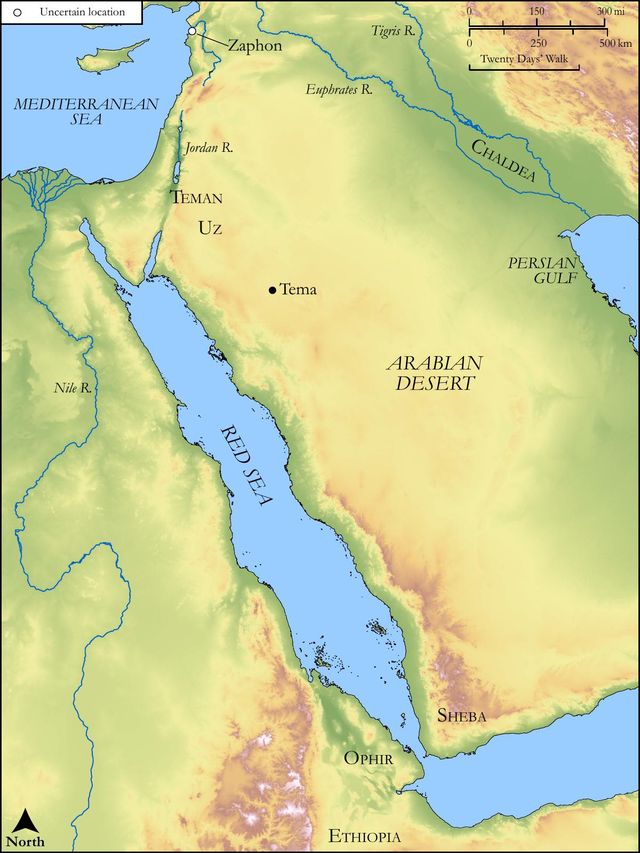
See on the biblical-era map
Study this verse
Public-domain commentary
Matthew Henry
From his Commentary on the Whole Bible. Henry comments on passages, not single verses — this entry covers Job 41:11–34. His three-level outline is real structure in the source text, so it is rendered as structure.
God, having in the foregoing verses shown Job how unable he was to deal with the leviathan, here sets forth his own power in that massy mighty creature. Here is,
I.God's sovereign dominion and independency laid down, Job 41:11.
1.That he is indebted to none of his creatures. If any pretend he is indebted to them, let them make their demand and prove their debt, and they shall receive it in full and not by composition: "Who has prevented me?" that is, "who has laid any obligations upon me by any services he has done me? Who can pretend to be before-hand with me? If any were, I would not long be behind-hand with them; I would soon repay them." The apostle quotes this for the silencing of all flesh in God's presence, Rom 11:35. Who hath first given to him, and it shall be recompensed to him again? As God does not inflict upon us the evils we have deserved, so he does bestow upon us the favours we have not deserved.
2.That he is the rightful Lord and owner of all the creatures: "Whatsoever is under the whole heaven, animate or inanimate, is mine (and particularly this leviathan), at my command and disposal, what I have an incontestable property in and dominion over." All is his; we are his, all we have and do; and therefore we cannot make God our debtor; but of thy own, Lord, have we given thee. All is his, and therefore, if he were indebted to any, he has wherewithal to repay them; the debt is in good hands. All is his, and therefore he needs not our services, nor can he be benefited by them. If I were hungry I would not tell thee, for the world is mind and the fulness thereof, Psa 50:12.
II.The proof and illustration of it, from the wonderful structure of the leviathan, Job 41:12.
1.The parts of his body, the power he exerts, especially when he is set upon, and the comely proportion of the whole of him, are what God will not conceal, and therefore what we must observe and acknowledge the power of God in. Though he is a creature of monstrous bulk, yet there is in him a comely proportion. In our eye beauty lies in that which is small (inest sua gratia parvis - little things have a gracefulness all their own) because we ourselves are so; but in God's eye even the leviathan is comely; and, if he pronounce even the whale, event he crocodile, so, it is not for us to say of any of the works of his hands that they are ugly of ill-favoured; it is enough to say so, as we have cause, of our own works. God here goes about to give us an anatomical view (as it were) of the leviathan; for his works appear most beautiful and excellent, and his wisdom and power appear most in them, when they are taken in pieces and viewed in their several parts and proportions.
(1.)The leviathan, even prima facie - at first sight, appears formidable and inaccessible, Job 41:13, Job 41:14. Who dares come so near him while he is alive as to discover or take a distinct view of the face of the garment, the skin with which he is clothed as with a garment, so near him as to bridle him like a horse and so lead him away, so near him as to be within reach of his jaws, which are like a double bridle? Who will venture to look into his mouth, as we do into a horse's mouth? He that opens the doors of his face will see his teeth terrible round about, strong and sharp, and fitted to devour; it would make a man tremble to think of having a leg or an arm between them.
(2.)His scales are his beauty and strength, and therefore his pride, Job 41:15-17. The crocodile is indeed remarkable for his scales; if we understand it of the whale, we must understand by these shields (for so the word is) the several coats of his skin; or there might be whales in that country with scales. That which is remarkable concerning the scales is that they stick so close together, by which he is not only kept warm, for no air can pierce him, but kept safe, for no sword can pierce him through those scales. Fishes, that live in the water, are fortified accordingly by the wisdom of Providence, which gives clothes as it gives cold.
(3.)He scatters terror with his very breath and looks; if he sneeze or spout up water, it is like a light shining, either with the froth or the light of the sun shining through it, Job 41:18. The eyes of the whale are reported to shine in the night-time like a flame, or, as here, like the eye-lids of the morning; the same they say of the crocodile. The breath of this creature is so hot and fiery, from the great natural heat within, that burning lamps and sparks of fire, smoke and a flame, are said to go out of his mouth, even such as one would think sufficient to set coals on fire, Job 41:19-21. Probably these hyperbolical expressions are used concerning the leviathan to intimate the terror of the wrath of God, for that is it which all this is designed to convince us of. Fire out of his mouth devours, Psa 18:7, Psa 18:8. The breath of the Almighty, like a stream of brimstone, kindles Tophet, and will for ever keep it burning, Isa 30:33. The wicked one shall be consumed with the breath of his mouth, Th2 2:8.
(4.)He is of invincible strength and most terrible fierceness, so that he frightens all that come in his way, but is not himself frightened by any. Take a view of his neck, and there remains strength, Job 41:22. his head and his body are well set together. Sorrow rejoices (or rides in triumph) before him, for he makes terrible work wherever he comes. Or, Those storms which are the sorrow of others are his joys; what is tossing to others is dancing to him. His flesh is well knit, Job 41:23. The flakes of it are joined so closely together, and are so firm, that it is hard to pierce it; he is as if he were all bone. His flesh is of brass, which Job had complained his was not, Job 6:12. His heart is as firm as a stone, Job 41:24. He has spirit equal to his bodily strength, and, though he is bulky, he is sprightly, and not unwieldy. As his flesh and skin cannot be pierced, so his courage cannot be daunted; but, on the contrary, he daunts all he meets and puts them into a consternation (Job 41:25): When he raises up himself like a moving mountain in the great waters even the mighty are afraid lest he should overturn their ships or do them some other mischief. By reason of the breakings he makes in the water, which threaten death, they purify themselves, confess their sins, betake themselves to their prayers, and get ready for death. We read (Job 3:8) of those who, when they raise up a leviathan, are in such a fright that they curse the day. It was a fear which, it seems, used to drive some to their curses and others to their prayers; for, as now, so then there were seafaring men of different characters and on whom the terrors of the sea have contrary effects; but all agree there is a great fright among them when the leviathan raises up himself.
(5.)All the instruments of slaughter that are used against him do him no hurt and therefore are not error to him, Job 41:26-29. The sword and the spear, which wound nigh at hand, are nothing to him; the darts, arrows, and sling-stones, which wound at a distance, do him no damage; nature has so well armed him cap-a-pie - at all points, against them all. The defensive weapons which men use when they engage with the leviathan, as the habergeon, or breast-plate, often serve men no more than their offensive weapons; iron and brass are to him as straw and rotten wood, and he laughs at them. It is the picture of a hard-hearted sinner, that despises the terrors of the Almighty and laughs at all the threatenings of his word. The leviathan so little dreads the weapons that are used against him that, to show how hardy he is, he chooses to lie on the sharp stones, the sharp-pointed things (Job 41:30), and lies as easy there as if he lay on the soft mire. Those that would endure hardness must inure themselves to it.
(6.)His very motion in the water troubles it and puts it into a ferment, Job 41:31, Job 41:32. When he rolls, and tosses, and makes a stir in the water, or is in pursuit of his prey, he makes the deep to boil like a pot, he raises a great froth and foam upon the water, such as is upon a boiling pot, especially a pot of boiling ointment; and he makes a path to shine after him, which even a ship in the midst of the sea does not, Pro 30:19. One may trace the leviathan under water by the bubbles on the surface; and yet who can take that advantage against him in pursuing him? Men track hares in the snow and kill them, but he that tracks the leviathan dares not come near him.
2.Having given this particular account of his parts, and his power, and his comely proportion, he concludes with four things in general concerning this animal: - (1.) That he is a non-such among the inferior creatures: Upon earth there is not his like, Job 41:33. No creature in this world is comparable to him for strength and terror. Or the earth is here distinguished from the sea: His dominion is not upon the earth (so some), but in the waters. None of all the savage creatures upon earth come near him for bulk and strength, and it is well for man that he is confined to the waters and there has a watch set upon him (Job 7:12) by the divine Providence, for, if such a terrible creature were allowed to roam and ravage upon this earth, it would be an unsafe and uncomfortable habitation for the children of men, for whom it is intended. (2.) That he is more bold and daring than any other creature whatsoever: He is made without fear. The creatures are as they are made; the leviathan has courage in his constitution, nothing can frighten him; other creatures, quite contrary, seem as much designed for flying as this for fighting. So, among men, some are in their natural temper bold, others are timorous. (3.) That he is himself very proud; though lodged in the deep, yet he beholds all high things, Job 41:34. The rolling waves, the impending rocks, the hovering clouds, and the ships under sail with top and top-gallant, this mighty animal beholds with contempt, for he does not think they either lessen him or threaten him. Those that are great are apt to be scornful. (4.) That he is a king over all the children of pride, that is, he is the proudest of all proud ones. He has more to be proud of (so Mr. Caryl expounds it) than the proudest people in the world have; and so it is a mortification to the haughtiness and lofty looks of men. Whatever bodily accomplishments men are proud of, and puffed up with, the leviathan excels them and is a king over them. Some read it so as to understand it of God: He that beholds all high things, even he, is King over all the children of pride; he can tame the behemoth (Job 40:19) and the leviathan, big as they are, and stout-hearted as they are. This discourse concerning those two animals was brought in to prove that it is God only who can look upon proud men and abase them, bring them low and tread them down, and hide them in the dust (Job 40:11-13), and so it concludes with a quod erat demonstrandum - which was to be demonstrated; there is one that beholds all high things, and, wherein men deal proudly, is above them; he is King over all the children of pride, whether brutal or rational, and can make them all either bend or break before him, Isa 2:11. The lofty looks of man shall be humbled, and the haughtiness of men shall be bowed down, and thus the Lord alone shall be exalted.
Historical interpretation
Historical reception
2 surviving comments on this verse. Each one is dated, so this reads as a timeline rather than a list.
Select a marker to jump to its quote. Markers stagger vertically where authors wrote within a few decades of each other.
This is the true description of the beast according to the faithful [understanding] of the story. There must be no doubt about their great size because of the power of the Creator. However, [these words] are also addressed to a plane of higher intellect, so that we may believe through them that something else is signified as well, and therefore the strength of spiritual iniquity may be perceived more easily in the image of the bodies. As these [beasts] are deadly for the body, so they are for human morality, and as the sin of pride must be imputed to them, so it must be punished.
42. That is, he looks down as if from above on all, who are, as it were, placed beneath him; because while he strives in his intention against his Maker, he scorns to think any one like himself. And this fitly suits his members also, because all the wicked, elated through swelling of heart, despise with the haughtiness of pride all whom they behold. And if they ever respect them outwardly, yet within, in the secret of their heart, where they are great in their own estimation, they consider the life and the merits of others inferior to themselves. And they look on them as beneath themselves, because, through the lofty thought of their heart, they have placed themselves on a kind of high eminence. To whom it is well said by the Prophet; Woe unto you that are wise in your own eyes, and prudent in your own sight. [Is. 5, 21] Hence also Paul says; Be not wise in your own conceits. [Rom. 12, 16] Hence it is said to Saul by the Divine reproof; When thou wast little in thine own eyes, did I not make thee a head in the tribes of Israel? [1 Sam. 15, 17] For he is little in his own eyes, who in considering himself, regards himself as inferior to the merits of others. For whoever in the loftiness of his thought extends himself above the merits of others, looks, as it were, on himself as great. But the reprobate Saul remained not in the good which he had begun, because he was swollen with pride at the power he had received. But, on the other hand, David, ever thinking humbly of himself, and counting himself inferior, in comparison with the same Saul, after he had met with an opportunity of striking, and spared this same raging adversary, prostrated himself with humble profession, saying; Whom dost thou pursue, O king of Israel? whom dost thou pursue? A dead dog, and a single flea. [l Sam. 24, 15] And he had been already certainly anointed as king, and had already learned by Samuel praying, and pouring the oil upon his head, that Divine Grace, having rejected Saul, was preserving him to hold the helm of the kingdom. And yet with humble mind he was prostrating himself to his persecuting adversary, to whom he knew that he had been preferred in the Divine judgment. He therefore humbly placed himself beneath him, to whom he knew that he was incomparably superior through the grace of election. Let those then, who are still ignorant in what rank they are held by God, learn in what way they should humble themselves to their neighbours, if even His Elect thus humble themselves before those, to whom they know they are already preferred in His secret judgments.
43. But it is a usual mark of the Elect, that they ever think more meanly of themselves than they really are. For hence it is said by the same David; If I did not think humbly, but exalted my soul. [Ps. 131, 1] Hence Solomon invites the little ones to wisdom, saying; If any is a little one, let him come to her. [Prov. 9, 4] But he who as yet despises not himself, does not lay hold of the humble wisdom of God. Hence the Lord says in the Gospel; I thank Thee, O Father, Lord of heaven and earth, because Thou hast hid these things from the wise and prudent, and hast revealed them to little ones. [Matt. 11, 25] Hence again the Psalmist says; The Lord keeping little ones. [Ps. 116, 5] Hence the teacher of the Gentiles says; We became little ones in the midst of you. [1 Thess. 2, 7] Hence advising his disciples, he says; Each esteeming others better than themselves. [Phil. 2, 3] For, because every wicked person considers every one whom he knows, to be inferior to himself, the righteous, on the contrary, endeavours to regard all his neighbours as superior to himself. And lest, when one person humbles himself before another, this humiliation should tend to the pride of the other, he rightly admonished both parties, saying; Each esteeming others better than themselves: in order that in the thoughts of the heart I should prefer him to myself, and he in return should prefer me to himself; so that, when the heart is kept down on either side, no one may be elated by the honour bestowed on him.
44. But the reprobate, because they are members of this Leviathan, scorn either to know or to maintain this form of humility. Because, though they sometimes show themselves outwardly humble, yet they neglect to maintain the power of humility within. And it often happens to them that if they ever perform one single good thing, however trifling, they immediately turn away the thought of their mind from all their faults, and ever look with all their attention at even this last good thing they may have done, and that from this they regard themselves as already holy, forgetting all the wickedness they have committed, keeping in mind only their one good action, which perhaps they were able but imperfectly to execute. As, on the other hand, it is usually the case with the Elect, that though powerful in the grace of many virtues, one sin, however inconsiderable, greatly harasses and assails them, in order that, by considering that they are weakened in one quarter, they may not pride themselves on those virtues in which they are powerful. And while they tremble at their weakness, they also maintain more humbly that point in which they are strong. The wicked, therefore, by thus incautiously looking at their one inconsiderable good quality, discern not the many and grievous sins in which they are plunged. And it is so ordered by a marvellous dispensation, that the Elect from the fear of being weakened by even their most minute sin, lose not the great virtues to which they have advanced.
45. It is so ordered then by the rule of the righteous and secret judgment, that their evils are of service to the one, and that their good things are injurious to the others; when these make use of their slight sins for their advance in virtue, and those avail themselves of their smallest good deeds to add to their sin. For these advance to greater perfection in virtue from the fact that they are tempted to sin. But those fall back into greater sin, from the fact that they boast of then goodness. The reprobate therefore applies what is good to a bad purpose, and the virtuous applies what is had to a good purpose. As it frequently happens that one person falls into the evil of sickness from wholesome food taken improperly, and that another, by taking the poison of a serpent in a medicine of proper composition, gets the better of his troublesome sickness. He therefore who would not use his wholesome food aright, perishes fatally by the very means from which others live in health. But he who took care to use the serpent’s poison cautiously, lives in health by the very means by which others perish fatally. We call then not the wickedness itself, but the suggestion of wickedness, with which we are often tempted against our will and efforts, the poison of the serpent. But this is then turned into a remedy, when the mind which is raised on high by its virtues, is brought low by the temptations it sees ranged against it. Whatever works then the wicked, and those who are rejected from the approval of inward examination, may perform, with whatever virtues they may shine forth, they are utterly ignorant of the sense of humility; doubtless because they are members of this Leviathan, of whom it is said by the voice on high, He beholdeth every high thing. Because not only by himself, but by the hearts of those whom he has possessed, he looks down as from an high place on all beneath him.
46. But it must be observed, that this Leviathan, who is described by a beast which possesses a body, is described as looking on high, because, namely, when pride of heart extends outwardly as far as to the body, it is first indicated by the eyes. For they, being puffed up by the swelling of pride, look, as it were, from on high, and the more they depress, the higher they raise, themselves. For unless pride showed itself through the eyes, as if through certain outlets [‘fenestras’], the Psalmist would never say to God, Thou wilt save the humble people, and wilt bring down the eyes of the proud. [Ps. 18, 27] Unless pride poured forth through the eyes, Solomon would not say also concerning the pride of Judaea; A generation, whose eyes are lofty, and their eyelids lifted up on high. [Prov. 30, 13] Because then this Leviathan is designated by an animal possessing a body, and pride, when it comes forth into the body, more plainly rules over the eyes, the ancient enemy is described as seeing all men, as it were, from on high. But because many points are brought forward to set forth the enemy of the human race, the mind is very desirous, that some one point should be more plainly stated, in the end of the Lord’s speech, by which his members can be pointed out by a brief description. It follows;
He is a king over all the children of pride.
47. This Leviathan, in order to fall in all the points mentioned above, smote himself with pride alone. For he would not wither up, through those many branches of sins, had he not first, through this, become rotten in the root. For it is written, Pride is the beginning of all sin. [Ecclus. 10, 13] For by this he himself fell, by this he overthrew men who followed him. He assaulted the health of our immortality with the same weapon as he destroyed the life of his own blessedness. But God introduced it at the end of His speech, for this reason, that by mentioning the pride of this Leviathan after all his sins, He might point out what was worse than all sins. Although further, from the fact of its being placed at the bottom, it is pointed out to be the root of vices. For as a root is covered over beneath, but yet branches expand outwardly from it, so pride conceals itself within, but open vices immediately shoot forth from it. For no evils would come forth to view, if this did not fetter the mind in secret. This is that which makes the mind of this Leviathan to boil as a pot. And by this he agitates also the minds of men with a kind of glow of madness, but he shows by their outward deeds how he subverts the mind of the person he agitates. For that first boils with pride within, which afterwards foams forth in works without.
48. But because an opportunity has offered itself of speaking about pride, we ought to examine into it with greater minuteness and anxiety, and to point out with what power or in what way it enters the minds of men, and on whom, and in what way, it commits ravages. For other sins assail those virtues only by which they themselves are destroyed; as, namely, anger patience, gluttony abstinence, lust continence. But pride, which we have called the root of vices, far from being satisfied with the extinction of one virtue, raises itself up against all the members of the soul, and as an universal and deadly disease corrupts the whole body. So that whatever is doing when it makes its assaults, even if it appears to be a virtue, vain-glory alone, and not God, is served thereby. For when pride assaults the mind, a kind of tyrant closely invests, as it were, a besieged city: and the wealthier is any one he has seized, the more harshly does he rise up in his authority; because the more largely the business of virtue is transacted without humility, the more widely does pride exercise its sway. But whoever has with enslaved mind admitted its tyranny within, suffers this loss first of all, that from the eye of his heart being closed, he loses the equitableness of judgment. For even all the good doings of others are displeasing to him, and the things which he has done, even amiss, alone please him. He always looks down on the doings of others, he always admires his own doings; because whatever he has done, he believes that he has done with singular skill; and for that which he performs through desire of glory, he favours himself in his thought; and when he thinks that he surpasses others in all things, he walks with himself along the broad spaces of his thought, and silently utters his own praises. But the mind is sometimes brought to such haughtiness, as in his pride to be unrestrained even in boastfulness of speech. But ruin follows the more easily, the more shamelessly a man is puffed up in his own mind. For hence it is written, The heart is exalted before a fall. [Prov. 16, 18] Hence it is said by Daniel, The king was walking in the palace of Babylon, and he answered and said, Is not this great Babylon, that I have built for the house of the kingdom by the might of my power, in the glory of my beauty? [Dan. 4, 29] But how vengeance swiftly aroused repressed this pride, he immediately added, saying, While the word was yet in the king’s mouth, there fell voice from heaven, To thee it is said, O king Nabuchodonosor, the kingdom shall depart from thee, and they shall drive thee out from men, and thy habitation shall be with cattle, and wild beasts: thou shalt eat hay as an ox, and seven times shall be changed over thee. [ib. 31] Behold, because the pride of mind vented itself even in open words, the forbearance of the Judge immediately burst out in his sentence; and smote him the more severely, the more immoderately his pride exalted itself; and because he enumerated and mentioned the goods in which he flattered himself, he heard the evils enumerated with which he was to be smitten.
49. But it should be understood, that this very pride, of which we are speaking, possesses some persons in secular, and others in spiritual concerns. For one prides himself on gold, another on eloquence, one on weak and earthly things, another on the highest and heavenly virtues. And yet one and the same thing is going on before the eyes of God, though, as it comes to the hearts of men, it is clothed in their sight with a different garb. For when he who was at first proud of earthly glory, is afterwards elated at his sanctity, pride has never forsaken his heart, but, coming to him as usual, it has changed its garment, that it may not be recognised.
50. It should be known also, that it attacks rulers in one way, and subjects in another. For it suggests to the thoughts of a ruler, that he has by the sole merit of his life risen above others; and if he has ever done any things well, it suggests them unseasonably to his mind. And when it suggests that he has specially pleased God, in order the more easily to enforce its suggestion, it brings forward in evidence, the recompense of the power entrusted to him; saying, That unless Almighty God perceived thee to be better than these men, He would not have given them all under thy power. And it presently exalts his mind, points out that those who are under his power are vile and worthless, so that he no longer regards any body as fit for him to speak to on equal terms. And hence the calmness of his mind is soon turned into wrath; because when he despises all, when he blames without any moderation the understanding, and the conduct of all, he swells out the more unrestrainedly into anger, the more he considers that those who are committed to his charge, are not worthy of him.
51. But, on the other hand, when pride urges on the heart of subjects, it strives especially to make them neglect entirely the consideration of their own conduct, and in their silent thoughts always to become judges of their ruler. For when they look unseasonably for what they ought to blame in him, they never notice what to correct in themselves. And hence they perish the more dreadfully, the more they avert their eyes from themselves; because they stumble and fall in the journey of this life, while they fix their attention elsewhere. They declare that they are sinners indeed, but not to such a degree that they should be delivered up to the control of so hurtful a person. And while they despise his doings, while they scorn his precepts, they are plunged into such madness, as to think that God does not care for the concerns of men; because they grieve that they have been put under the charge of one, who is, as it were, deservedly blamed. And while they are thus proud against their ruler, they also rise up against the sentence of their Maker. And whilst they pass sentence on the conduct of their pastor, they impugn also the wisdom of Him who orders all things. But they often oppose the commands of their ruler impertinently, and term this haughtiness of language, liberty. For pride frequently thus presents itself, as if it were proper liberty, just as fear frequently puts itself in the place of humility. For, just as many are silent through fear, and yet consider that they are silent from humility, so do some speak from the impatience of pride, and yet think that they are speaking with rightful freedom. But sometimes inferiors utter not the impertinencies which they feel; and they whose loquacity is hardly restrained, are sometimes silent solely from the bitterness of their inward rancour. But, by suppressing through grief of mind their words of impertinence, though they are wont to speak wickedly, they are more wickedly silent. Because when on having sinned they hear any correction, they keep back, through indignation, the words of reply. Whenever they are treated harshly, they frequently break out into words of complaint at this very harshness. But when their teachers prevent them with gentleness, they are more grievously indignant at this very humility, with which they are prevented. And their mind is the more vastly inflamed, the more considerately it is regarded as weak. These doubtless, because they are ignorant of humility, which is the parent of virtues, lose the benefit of their labour, even if there are any good things which they seem to do; because the height of the rising fabric is not strongly fixed, which is not by the strength of its foundation made fast on the rock. That then which they build rises up only to fall, because before they erect the fabric they do not first prepare the foundations of humility. But we thoroughly lay open their inmost character, if we show what they are in a few outward points.
52. For to all who swell within with proud thoughts there is noisiness in their speech, bitterness in their silence, dissoluteness in their mirth, wrath in their sorrow, unseemliness in their conduct, comeliness in their appearance, erectness in their gait, rancour in their reply. Their mind is ever strong in inflicting, weak in enduring, contumely; sluggish in obeying, importunate in provoking others; slothful in those things which it ought, and has power, to do, but ready for those which it neither ought, nor is able, to do. In that which it seeks not of its own accord, it is turned by no exhortation, but it seeks to be compelled to do that which it secretly longs for, because while it fears to become cheap from indulging its desire, it wishes to suffer compulsion even in its own will.
53. Because then we have said that the minds of men are tempted in one way by carnal, and in another by spiritual, concerns, let those hear; All flesh is grass, and the glory thereof as the flower of grass. [Is. 40, 6] And let these hear that which is said to some persons after their miracles; I know you not whence ye are; depart from Me, all ye workers of iniquity. [Luke 13, 27] Let those hear; If riches increase, set not your heart upon them. [Ps. 62, 10] Let these hear that the foolish virgins, who come with empty vessels, are shut out from the marriage within. [Matt. 25, 12] Again, because we have said before, that rulers are tempted in one way, and subjects in another, let those hear that which is said by a certain wise man; Have they made thee a ruler? Be not lifted up, but be among them as one of them. [Ecclus. 32, 1] Let these hear; Obey them that have the rule over you, and be subject to them, for they watch as if about to give an account for your souls. [Heb. 13, 17] Let those, when they boast of the power they have received, hear that which is said by the voice of Abraham to the rich man in flames; Son, remember that thou in thy life time receivedst thy good things. [Luke 16, 25] Let these, when they break into complaints against their rulers, hear that answer which is given to the murmuring people by the voices of Moses and Aaron; Nor is your murmur against us, but against the Lord. For what are we? [Ex. 16, 8] Let those hear; They shall be troubled in the sight of Him Who is the Father of orphans, and the Judge of widows. [Ps. 68, 4] Let these hear what is said against the contumacy of subjects; Whosoever resisteth the power, resisteth the ordinance of God. [Rom. 13, 2] Let all together hear; God resisteth the proud, but giveth grace to the humble. [James 4, 6] Let all hear; Every one that exalteth his heart is unclean before God. [Prov. 16, 5] Let all hear; Why art thou proud, O earth and ashes? [Ecclus. 10, 9] Against the plague of this sickness, let us all hear that, which the Truth our Instructor teaches, saying; Learn of Me, for I am meek, and lowly in heart. [Matt. 11, 29]
54. For for this end the Only Begotten Son of God took on Him the form of our infirmity; for this the Invisible appeared not only visible, but even despised; [Phil. 2, 5-8] for this He endured the jests of contumely, the reproaches of derisions, and the torments of sufferings, that God in His humility might teach man not to be proud. How great then is the virtue of humility, since for the sole purpose of truly teaching it, He Who above estimation is great, became little, even to suffering? For since the pride of the devil caused the origin of our fall, the humility of God was found out as the instrument of our redemption. For our enemy who was created great among all things, wished to appear exalted above all things. But our Redeemer remaining great above all things, deigned to become little among all things.
55. But we both detect more readily the cause of pride, and lay bare the foundations of humility, if we briefly mention and run over what the author of death, and what the Creator of life declare. For the one says; I will ascend into heaven. [Is. 14, 13] But the Other says by the Prophet, My soul is filled with evils, and My life hath drawn nigh unto hell. [Ps. 88, 4] The one says; I will exalt my throne above the stars of heaven. [Is. 14, 13] The Other says to mankind expelled from the abodes of Paradise; Behold, I come quickly, and I will dwell in the midst of thee. [Zech. 2, 10] The one says; I will sit in the mount of the testament, on the sides of the north. [Is. 14, 14] The Other says; I am a worm, and no man, the reproach of men, and the outcast of the people. [Ps. 22, 7] The one says; I will ascend above the height of the clouds; I will be like the Most High. [Is. 14, 14] The Other; When He was in the form of God thought it not robbery to be equal with God, but emptied Himself, taking the form of a servant; [Phil. 2, 6] and He speaks by His members, saying; Who is like unto Thee, O Lord? [Ex. 15, 11] The one speaks by his members, saying; I know not the Lord, neither will I let Israel go. [Ex. 5, 2] The Other says by Himself; If I should say I know Him not, I shall be a liar, like unto you: but I know Him, and keep His saying. [John 8, 55] The one says; The rivers are mine, and I have made them. [Ez. 29, 9] The Other says; I can of Mine own Self do nothing. [John 5, 30] And again; My Father that abideth in Me, He doeth the works. [John 14, 20] The one, when showing all kingdoms, says; All this power will I give Thee, and the glory them, for they are delivered to me, and to whom I will give them. [Luke 4, 6] The Other says; Ye shall drink indeed of My cup, but to sit on My right hand, or on My left, is not Mine to give to you, but to them for whom it is prepared of My Father. [Matt. 20, 23] The one says; Ye shall be as gods, knowing good and evil. [Gen. 3, 5] The Other says; It is not for you to know the times or the moments which the Father hath put in His own power. [Acts 1, 17] The other, in order that the Divine Will might be despised, and his own enforced, says; Why hath God commanded you, that ye should not eat of every tree of Paradise? [Gen. 3, 1] And a little after; For God doth know, that in whatsoever day ye eat thereof, your eyes shall be opened. [ib. 5] The Other says; I seek not Mine own will, but the will of Him Which hath sent Me. [John 5, 30] The one speaks by his members, saying; Let there be no meadow, which our luxury does not pass through, let us crown ourselves with roses before they be withered, let us leave every where tokens of our joy. [Wisd. 2, 2] The Other announces to His members, saying, Ye shall weep and lament, but the world shall rejoice. [John 16, 20] The one teaches the minds who are subject to him nothing else but to aim at the height of loftiness, to transcend all their equals in swelling of mind, to surpass with lofty pride the society of all men, and to exalt themselves even against the might of their Creator: as is said of these very persons by the Psalmist; They have passed into the affection of the heart, they have thought and spoken wickedness, they have spoken iniquity on high. [Ps. 73, 7] The Other when approaching the spitting, the palms of the hands, the buffets, the crown of thorns, the cross, the spear, and death, admonishes His members, saying; If any man serve Me, let him follow Me. [John 12, 26]
56. Because then our Redeemer rules the hearts of the humble, and this Leviathan is called the king of the proud, we know plainly, that pride is a most evident token of the reprobate, but humility, on the contrary, of the Elect. When it is known then which any one possesses, it is found out under what king he is fighting. For every one bears as it were a kind of inscription [‘titulum’] in his work, to show thereby easily under the power of what ruler he is serving. Whence it is also said by the Gospel; Ye shall know them by their fruits. [Matt. 7, 16] Lest then the members of this Leviathan should deceive us by performing even wonders, the Lord has pointed out a plain token by which they can be detected, saying; He is a king over all the children of pride. For though they sometimes assume a pretended appearance of humility, yet they cannot conceal themselves in every point. For since then pride cannot bear to be long concealed, when it is concealed by one action it is exposed by another. But they who war under the king of humility, ever fearful, and circumspect on every side, fight against the darts of pride, and specially guard, as it were, the eye only of their body against the coming blows, when in themselves they principally defend their humility.
Continue studying Job 41:34 across the web’s major study libraries — every link below opens this exact verse, chapter, or book on the destination site.
Read & Compare
 BibleGatewayThis verse in more than 200 translations and 70 languages.
 Bible.comThe YouVersion reader — hundreds of translations, reading plans, and highlights.
 ESV.orgCrossway's official English Standard Version reader.
 NET BibleThe NET translation with 60,000+ translators' notes on every rendering decision.
 STEP BibleTyndale House's free study tool — original text, vocabulary, and scholarly resources.
 BibliaLogos Bible Software's free web reader.
 USCCBThe New American Bible (Revised Edition) with the U.S. bishops' study notes.
Commentaries
 BibleHub CommentariesDozens of classic commentaries on this verse, gathered on one page.
 StudyLightMore than 100 commentary sets — the largest collection on the web.
 BibleRefPlain-English commentary on what this verse means, verse by verse.
 Enduring WordDavid Guzik's free commentary on this chapter, widely used by Bible teachers.
 Bible Study ToolsVerse commentary alongside Greek and Hebrew study aids.
Original Language & Research
- BibleHub InterlinearThe verse word by word — original language, transliteration, and English.
- BibleHub LexiconEvery word's original-language definition and Strong's entry.
 Blue Letter BibleDeep-study tools — Strong's numbers, concordance, and word studies.
 SefariaThe Hebrew text with Rashi and centuries of Jewish commentary.
Sermons, Hymns & Audio


TrulyRandomVerse is not affiliated with these sites and doesn’t control their content. They’re linked because they’re genuinely useful.
Summary
Job 41:34 serves as the climactic declaration of Leviathan's unparalleled dominion and, by extension, God's absolute sovereignty over all creation, including the most formidable and arrogant human powers. This verse encapsulates the creature's untamable nature and its symbolic role as a king over those who embody pride, thereby powerfully illustrating the futility of human self-sufficiency in the face of divine omnipotence and wisdom. It concludes God's detailed description of Leviathan, reinforcing the central message that only the Creator can control such immense power and that true wisdom lies in humble submission to Him.
Context
ShowHideLiterary Context
Job 41:34 provides the powerful conclusion to God's second and final speech to Job, which commenced in Job 38. Following Job's exhaustive and often despairing theological debates with his friends concerning the nature of suffering and divine justice, God intervenes dramatically from a whirlwind. His speeches, spanning Job 38-41, do not directly explain Job's suffering but rather aim to humble him by unveiling the incomprehensible vastness of divine wisdom and power manifest in creation. The detailed descriptions of various creatures, from the wild ass and ostrich to the formidable Behemoth (in Job 40) and culminating in the terrifying Leviathan (in Job 41), serve a singular purpose: to demonstrate that if Job cannot even comprehend or control a fraction of God's creation, how much less can he presume to challenge or fully understand the Creator Himself? Leviathan, presented as the ultimate, untamable creature, stands as the irrefutable, final proof of God's unchallengeable authority and absolute dominion over all things.
Historical & Cultural Context
The vivid descriptions of Behemoth and Leviathan in the book of Job present powerful, often chaotic, creatures that frequently symbolize forces beyond human mastery. While scholarly debate continues regarding whether Leviathan refers to a literal creature (such as a massive crocodile or whale) or primarily functions as a mythical sea monster, its portrayal can be set beside the primeval chaos monsters of the nations' myths (e.g., Tiamat in Babylonian mythology, Yam among the Canaanites). In those myths, the chief deity's ability to subdue such primordial forces was a definitive mark of supreme power and order. Therefore, God's explicit mastery over Leviathan would have been understood by Job and his contemporaries as a profound and unequivocal declaration of His unique ability to order and control all aspects of creation, including those perceived as chaotic, untamable, or even malevolent. The "children of pride" (Hebrew: b'nê šaḥaṣ) could refer to human rulers, powerful empires, or even rebellious individuals whose arrogance led them to challenge divine authority, echoing the pervasive theme of hubris often depicted in ancient narratives and wisdom literature.
Key Themes
ShowHideThis verse powerfully contributes to several overarching themes central to the book of Job and the broader biblical narrative. Firstly, it emphatically underscores God's absolute sovereignty over all creation, encompassing both the natural world and human powers. Leviathan's untamable nature serves as a vivid illustration that only God possesses true, unchallengeable power, a theme consistently affirmed throughout the Scriptures, for instance, in Psalm 104:24-26. Secondly, it directly confronts the folly and futility of human pride and self-sufficiency. If even the most powerful and arrogant humans—the "children of pride"—are ultimately subservient to a creature that only God can master, then their boasting and self-exaltation are utterly vain in the face of God's infinite might. This theme resonates strongly with biblical warnings against pride, such as the proverb that "Pride goes before destruction, and a haughty spirit before a fall" found in Proverbs 16:18. Finally, the entire divine discourse, culminating in this verse, aims to foster profound humility and reverent awe before God. Job's transformative encounter with God's overwhelming majesty leads him to a posture of repentance, acknowledging his limited understanding and God's infinite wisdom, as beautifully expressed in Job 42:5-6.
Exposition and Analysis
ShowHideKey Word Analysis
ShowHideThis verb signifies "to see," "to gaze upon," or "to regard." In the context of Leviathan, "he beholdeth" implies not a casual observation but a steady, unafraid, and even disdainful gaze. It conveys Leviathan's supreme position and its utter lack of fear toward anything else in creation. This word emphasizes its unchallenged dominance and fearlessness, asserting that nothing in the created order can intimidate it.
This term refers to anything "elevated," "exalted," "lofty," or "proud." In this verse, it encompasses all that is considered great or imposing, whether physically (e.g., mountains, tall creatures) or metaphorically (e.g., proud individuals, mighty rulers, or other formidable beasts). Leviathan's ability to "behold all high things" signifies its superiority over every entity that might otherwise be considered powerful or imposing in the natural world, reinforcing its status as the apex of earthly creation.
This idiomatic phrase, combining H1121 ("son") and H7830 ("haughtiness" or "pride"), literally translates to "sons of haughtiness" or "sons of pride." It refers to arrogant, haughty, or self-exalting individuals, particularly those who boast of their own strength, wisdom, or independence from God. This phrase can encompass powerful human rulers, nations, or any person who exhibits defiant self-sufficiency and hubris. By stating that Leviathan is "a king over" them, the text highlights the ultimate limits of human power and the boundless nature of divine authority, as Leviathan, a mere creature, demonstrates the futility of human self-exaltation.
Verse Breakdown
ShowHide"He beholdeth all high [things]:"
This opening clause powerfully establishes Leviathan's unchallenged supremacy within the created order. The creature is depicted as so formidable and awe-inspiring that it looks down upon everything else that might be considered great, lofty, or powerful. This imagery conveys its absolute dominance, its untamed nature, and its complete lack of fear toward any other earthly entity. It reinforces Leviathan's status as the apex predator, a creature beyond the reach or challenge of any other in the physical realm.
"he [is] a king over all the children of pride."
This is the pivotal theological declaration of the verse, shifting from Leviathan's natural dominance to its profound symbolic and spiritual significance. By declaring Leviathan "a king over" the "children of pride" (an idiom for arrogant, self-exalting humans), the text implies that even the most formidable and self-assured human beings are ultimately subservient to a creature that only God can master. This statement serves as a direct and potent challenge to human hubris and self-sufficiency, demonstrating that if humanity cannot subdue Leviathan, how much less can they contend with the God who created and effortlessly controls it? It underscores the ultimate limits of human power and the boundless, unchallengeable nature of divine authority.
Literary Devices
ShowHideJob 41:34 masterfully employs several literary devices to convey its profound theological message regarding God's sovereignty and human humility. Hyperbole is prominently used in the description of Leviathan's absolute dominance, portraying it as a creature so terrifying and powerful that it "beholds all high things" without fear, thereby exaggerating its might to emphasize God's even greater, incomparable power. Symbolism is central to the verse, as Leviathan itself functions as a potent symbol. It represents the untamed, chaotic forces of creation, the inherent limits of human power, and ultimately, God's absolute sovereignty over all things, including that which seems uncontrollable and fearsome. Furthermore, Leviathan serves as a powerful symbol of the ultimate challenge to human pride. The declaration that Leviathan is "a king over all the children of pride" employs Metaphor, equating Leviathan's natural dominion with a symbolic rule over human arrogance and self-exaltation. This also borders on Anthropomorphism, attributing a kingly role and a deliberate, conscious "beholding" to a creature, thereby imbuing it with a sense of conscious superiority that reflects God's design and purpose. The verse also utilizes stark Contrast, setting Leviathan's untamed and unchallengeable power against the futility and ultimate subservience of human pride, thereby highlighting the vast chasm between human limitations and divine omnipotence.
Theological and Thematic Connections
ShowHideJob 41:34 culminates God's majestic display of His creation, serving as a profound theological statement about divine sovereignty and the pervasive nature of human pride. The untamable Leviathan, a creature utterly beyond human control, becomes the ultimate testament to God's unique and absolute power. If humanity cannot conquer or even approach this fearsome creature, then their attempts to challenge, question, or even fully comprehend the Creator are revealed as utterly futile and presumptuous. This verse underscores that true wisdom and peace begin with acknowledging God's unchallengeable authority and humbly submitting to His will, rather than relying on finite human strength, intellect, or self-sufficiency. It is a profound call to humility, reminding humanity of its proper place in creation, under the dominion of a God who effortlessly controls even the most fearsome and chaotic aspects of His creation.
Reflection and Application
ShowHideJob 41:34 challenges us to deeply confront the pervasive human tendency towards pride and self-sufficiency, a tendency that often leads to a false sense of control and an inflated view of our own capabilities. In a world that frequently exalts human achievement, intellectual prowess, and the pursuit of absolute control, this verse serves as a potent and sobering reminder that there is a Creator whose power, wisdom, and dominion infinitely transcend our own. When we encounter circumstances that seem insurmountable, when chaos threatens to overwhelm, or when we are tempted to rely solely on our own strength and understanding, Leviathan stands as a vivid, ancient illustration of God's absolute mastery over all that is fearsome, chaotic, or seemingly uncontrollable. It invites us to cultivate a posture of profound humility, recognizing our inherent limitations and God's boundless might. This humility is not demeaning but profoundly liberating, as it frees us from the exhausting burden of self-reliance and invites us to trust in the One who is truly "king over all the children of pride," capable of handling anything and everything according to His perfect, sovereign plan. Embracing this truth allows us to release our anxieties and find true rest in His all-encompassing power.
Questions for Reflection
ShowHideFAQ
ShowHideWhat is Leviathan, and is it a literal creature?
ShowHideLeviathan, as vividly described in Job 41, is a creature of immense power and terrifying appearance, often depicted as a massive aquatic beast or sea monster. Scholars hold varying views on its literal identity; some suggest it could be a highly exaggerated description of a large crocodile or whale, while others believe it is primarily a symbolic representation of primeval chaos and untamable power, set beside the myths of the nations about monsters that only the gods could subdue. Regardless of its precise literal identity, its function within the book of Job is clear: it embodies the ultimate, unconquerable force in creation from a human perspective, serving as a powerful testament to God's unparalleled power and sovereignty, as only He can control such a creature.
What does "children of pride" mean in this context?
ShowHideThe phrase "children of pride" (Hebrew: b'nê šaḥaṣ) is an idiomatic expression that refers to arrogant, haughty, or self-exalting individuals or groups. This phrase points to those who, in their strength, wisdom, or perceived power, boast of their independence from God and defiantly challenge divine authority. It can encompass powerful human rulers, nations, or any person who exhibits defiant self-sufficiency and hubris, believing themselves to be masters of their own destiny. By stating that Leviathan is "a king over" them, the verse highlights that even the most formidable and proud human beings are ultimately subordinate to a creature that only God can master, thereby underscoring the profound futility of human pride in the face of divine omnipotence and unchallengeable dominion.
Christ-Centered Fulfillment
ShowHideWhile Job 41:34 vividly describes God's sovereignty over a fearsome creature, its ultimate and most profound fulfillment is found in the person and redemptive work of Jesus Christ. Leviathan, as a symbol of untamed power and the "king over all the children of pride," powerfully foreshadows the spiritual forces of evil and the pervasive dominion of sin that hold humanity captive through pride, rebellion, and self-sufficiency. Just as God alone could subdue the physical Leviathan, so too only God, in the person of Jesus Christ, could conquer the ultimate spiritual "Leviathan"—the powers of sin, death, and the devil. The New Testament reveals Jesus as the true King, not merely over physical creatures, but over all principalities and powers, as triumphantly declared in Colossians 2:15. Through His sacrificial death on the cross and His glorious resurrection, Christ disarmed the spiritual forces of darkness and triumphed over them, decisively breaking their dominion. Furthermore, Christ embodies the ultimate humility, standing in stark contrast to the "children of pride." His self-emptying love and obedience, beautifully articulated in Philippians 2:5-8, offer the pathway to true freedom from the bondage of pride, inviting humanity to find their true identity, security, and purpose not in their own strength or achievements, but in His sovereign grace and redemptive power. He is the one who truly has "all authority in heaven and on earth" (Matthew 28:18), demonstrating God's ultimate dominion over all things, visible and invisible, physical and spiritual, for all eternity.