


Mark 9:25
- ἸδὼνIdōnHaving seenG1492V-2AAP-NSMVerb 2nd Aorist Active Participle Nominative Singular Masculine
- δὲdenowG1161CONJConjunction
- ὁho<the>G3588T-NSMDefinite article Nominative Singular Masculine
- ἸησοῦςIēsousJesusG2424N-NSM-PNoun Nominative Singular Masculine Individual
- ὅτιhotithatG3754CONJConjunction
- ἐπισυντρέχειepisuntrecheiwas running togetherG1998V-PAI-3SVerb Present Active Indicative 3rd Singular
- ὄχλοςochlosa crowdG3793N-NSMNoun Nominative Singular Masculine
- ἐπετίμησενepetimēsenHe rebukedG2008V-AAI-3SVerb Aorist Active Indicative 3rd Singular
- τῷtōtheG3588T-DSNDefinite article Dative Singular Neuter
- πνεύματιpneumatispiritG4151N-DSNNoun Dative Singular Neuter
- τῷtō<the>G3588T-DSNDefinite article Dative Singular Neuter
- ἀκαθάρτῳakathartōuncleanG169A-DSNAdjective Dative Singular Neuter
- λέγωνlegōnsayingG3004V-PAP-NSMVerb Present Active Participle Nominative Singular Masculine
- αὐτῷ·autōto itG846P-DSNPersonal pronoun Dative Singular Neuter
- τὸtoOG3588T-VSNDefinite article Vocative Singular Neuter
- ἄλαλονalalonMuteG216A-VSNAdjective Vocative Singular Neuter
- καὶkaiandG2532CONJConjunction
- κωφὸνkōphondeafG2974A-VSNAdjective Vocative Singular Neuter
- τὸtoOG3588T-VSNDefinite article Vocative Singular Neuter
- πνεῦμαpneumaspiritG4151N-VSNNoun Vocative Singular Neuter
- ἐγὼegōI myselfG1473P-1NSPersonal pronoun Nominative 1st Singular
- ἐπιτάσσωepitassōcommandG2004V-PAI-1SVerb Present Active Indicative 1st Singular
- σοι·soiyouG4771P-2DSPersonal pronoun Dative 2nd Singular
- ἔξελθεexelthedo comeG1831V-2AAM-2SVerb 2nd Aorist Active Imperative 2nd Singular
- ἐξexout ofG1537PREPPreposition
- αὐτοῦautouhimG846P-GSMPersonal pronoun Genitive Singular Masculine
- καὶkaiandG2532CONJConjunction
- μηκέτιmēketino moreG3371ADV-NAdverb or adverb and particle combined Negative
- εἰσέλθῃςeiselthēsshall you enterG1525V-2AAS-2SVerb 2nd Aorist Active Subjunctive 2nd Singular
- εἰςeisintoG1519PREPPreposition
- αὐτόνautonhimG846P-ASMPersonal pronoun Accusative Singular Masculine
English is a literal word-by-word gloss of the Greek, not the KJV's wording. Why?
This is the original text the KJV's translators worked from — each Greek word with its own literal English meaning in this verse, prepared by scholars at Tyndale House, Cambridge. The KJV translates whole sentences, not word by word, so its wording differs: one Greek word can become several English words, and the KJV may choose “charity” where the gloss reads “love”. Both are faithful — they answer different questions. For the KJV's own rendering, switch to the KJV text.
Details
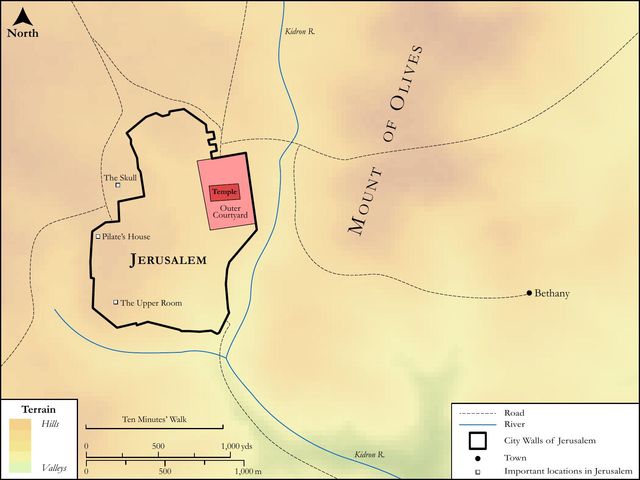
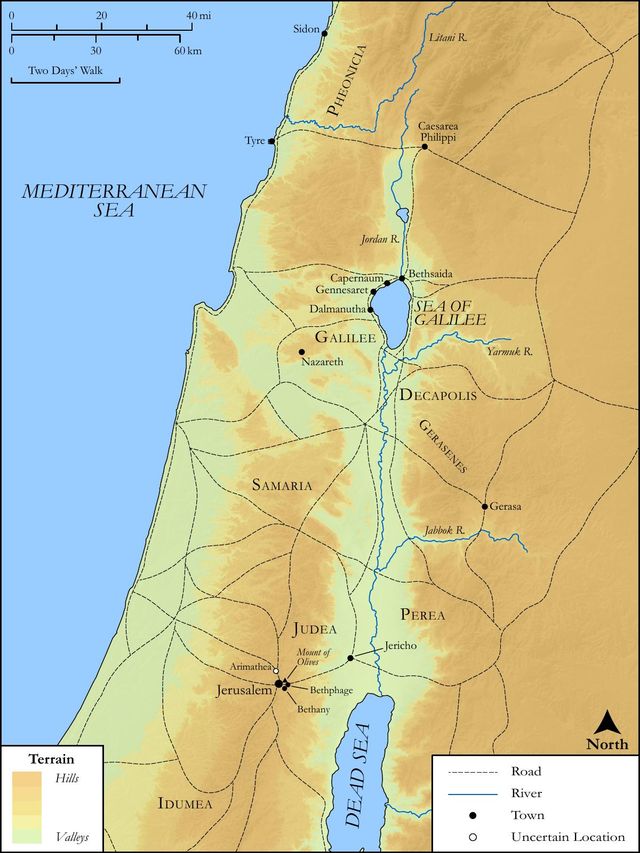
See on the biblical-era map
Study this verse
Public-domain commentary
Matthew Henry
From his Commentary on the Whole Bible. Henry comments on passages, not single verses — this entry covers Mark 9:14–29. His two-level outline is real structure in the source text, so it is rendered as structure.
We have here the story of Christ casting the devil out of a child, somewhat more fully related than it was in Mat 17:14, etc. Observe here,
I.Christ's return to his disciples, and the perplexity he found them in.
He laid aside his robes of glory, and came to look after his family, and to enquire what was become of them. Christ's glory above does not make him forget the concerns of his church below, which he visits in great humility, Mat 17:14. And he came very seasonably, when the disciples were embarrassed and run a-ground; the scribes, who were sworn enemies both to him and them, had gained an advantage against them. A child possessed with a devil was brought to them, and they could not cast out the devil, whereupon the scribes insulted over them, and reflected upon their Master, and triumphed as if the day were their own. He found the scribes questioning with them, in the hearing of the multitude, some of whom perhaps began to be shocked by it. Thus Moses, when he came down from the mount, found the camp of Israel in great disorder; so soon were Christ and Moses missed. Christ's return was very welcome, no doubt, to the disciples, and unwelcome to the scribes. But particular notice is taken of its being very surprising to the people, who perhaps were ready to say, As for this Jesus, we wot not what is become of him; but when they beheld him coming to them again, they were greatly amazed (some copies add, kai exephobēthēsan - and they were afraid); and running to him (some copies for prostrechontes, read proschairontes - congratulating him, or bidding him welcome), they saluted him. It is easy to give a reason why they should be glad to see him; but why where they amazed, greatly amazed, when they beheld him? Probably, there might remain something unusual in his countenance; as Moses's face shone when he came down from the mount, which made the people afraid to come nigh him, Exo 34:30. So perhaps did Christ's face, in some measure; at least, instead of seeming fatigued, there appeared a wonderful briskness and sprightliness in his looks, which amazed them.
II.The case which perplexed the disciples, brought before him.
He asked the scribes, who, he knew, were always vexatious to his disciples, and teasing them upon every occasion, "What question ye with them? What is the quarrel now?" The scribes made no answer, for they were confounded at his presence; the disciples made none, for they were comforted, and now left all to him. But the father of the child opened the case, Mar 9:17, Mar 9:18.
1.His child is possessed with a dumb spirit; he has the falling-sickness, and in his fits is speechless; his case is very sad, for, wheresoever the fit takes him, the spirit tears him, throws him into such violent convulsions as almost pull him to pieces; and, which is very grievous to himself, and frightful to those about him, he foams at his mouth, and gnashes with his teeth, as one in pain and great misery; and though the fits go off presently, yet they leave him so weak, that he pines away, is worn to a skeleton; his flesh is dried away; so the word signifies, Psa 102:3-5. This was a constant affliction to a tender father.
2.The disciples cannot give him any relief; "I desired they would cast him out, as they had done many, and they would willingly have done it, but they could not; and therefore thou couldest never have come in better time; Master, I have brought him to thee."
III.The rebuke he gave to them all (Mar 9:19); O faithless generation, how long shall I be with you? How long shall I suffer you? Dr.
Hammond understands this as spoken to the disciples, reproving them for not exerting the power he had given them, and because they did not fast and pray, as in some cases he had directed them to do. But Dr. Whitby takes it as a rebuke to the scribes, who gloried in this disappointment that the disciples met with, and hoped to run them down with it. Them he calls a faithless generation, and speaks as one weary of being with them, and of bearing with them. We never heard him complaining, "How long shall I be in this low condition, and suffer that?" But, "How long shall I be among these faithless people, and suffer them?"
IV.The deplorable condition that the child was actually in, when he was brought to Christ, and the doleful representation which the father made of it. When the child saw Christ, he fell into a fit; The spirit straightway tore him, boiled within him, troubled him (so Dr. Hammond); as if the devil would set Christ at defiance, and hoped to be too hard for him too, and to keep possession in spite of him. The child fell on the ground, and wallowed foaming. We may put another construction upon it - that the devil raged, and had so much the greater wrath, because he knew that his time was short, Rev 7:12. Christ asked, How long since this came to him? And, it seems, the disease was of long standing; it came to him of a child (Mar 9:21), which made the case the more sad, and the cure more difficult. We are all by nature children of disobedience, and in such the evil spirit works, and has done so from our childhood; for foolishness is bound in the heart of a child, and nothing but the mighty grace of Christ can cast it out.
V.The pressing instances which the father of the child makes with Christ for a cure (Mar 9:22); Ofttimes it hath cast him into the fire, and into the waters, to destroy him. Note, The devil aims at the ruin of those in whom he rules and works, and seeks whom he may devour. But, if thou canst do any thing, have compassion on us, and help us. The leper was confident of Christ's power, but put an if upon his will (Mat 8:2); If thou wilt, thou canst. This poor man referred himself to his good-will, but put an if upon his power, because his disciples, who cast out devils in his name, had been non-plussed in this case. Thus Christ suffers in his honour by the difficulties and follies of his disciples.
VI.The answer Christ gave to his address (Mar 9:23); If thou canst believe, all things are possible to him that believeth. Here,
1.He tacitly checks the weakness of his faith. The sufferer put it upon Christ's power, If thou canst do any thing, and reflected on the want of power in the disciples; but Christ turns it upon him, and puts him upon questioning his own faith, and will have him impute the disappointment to the want of that; If thou canst believe.
2.He graciously encourages the strength of his desire; "All things are possible, will appear possible, to him that believes the almighty power of God, to which all things are possible;" or "That shall be done by the grace of God, for them that believe in the promise of God, which seemed utterly impossible." Note, In dealing with Christ, very much is put upon our believing, and very much promised it. Canst thou believe? Darest thou believe? Art thou willing to venture thy all in the hands of Christ? To venture all thy spiritual concerns with him, and all thy temporal concerns for him? Canst thou find in thy heart to do this? If so, it is not impossible but that, though thou has been a great sinner, thou mayest be reconciled; though thou art very mean and unworthy, thou mayest get to heaven. If thou canst believe, it is possible that thy hard heart may be softened, thy spiritual diseases may be cured; and that, weak as thou art, thou mayest be able to hold out to the end.
VII.The profession of faith which the poor man made hereupon (Mar 9:24); He cried out, "Lord, I believe; I am fully persuaded both of thy power and of thy pity; my cure shall not be prevented by the want of faith; Lord, I believe." He adds a prayer for grace to enable him more firmly to rely upon the assurances he had of the ability and willingness of Christ to save; Help thou my unbelief. Note,
1.Even those who through grace can say, Lord, I believe, have reason to complain of their unbelief; that they cannot so readily apply to themselves, and their own case, the word of Christ as they should, no so cheerfully depend upon it.
2.Those that complain of unbelief, must look up to Christ for grace to help them against it, and his grace shall be sufficient for them. "Help mine unbelief, help me to a pardon for it, help me with power against it; help out what is wanting in my faith with thy grace, the strength of which is perfected in our weakness."
VIII.The cure of the child, and the conquest of this raging devil in the child.
Christ saw the people come running together, expecting to see the issue of this trial of skill, and therefore kept them in suspense no longer, but rebuked the foul spirit; the unclean spirit, so it should be rendered, as in other places. Observe,
1.What the charge was which Christ gave to this unclean spirit; "Thou dumb and deaf spirit, that makest the poor child dumb and deaf, but shalt thyself be made to hear thy doom, and not be able to say any thing against it, come out of him immediately, and enter no more into him. Let him not only be brought out of this fit, but let his fits never return." Note, Whom Christ cures, he cures effectually. Satan may go out himself, and yet recover possession; but if Christ cast him out, he will keep him out.
2.How the unclean spirit took it; he grew yet more outrageous, he cried, and rent him sore, gave him such a twitch at parting, that he was as one dead; so loth was he to quit his hold, so exasperated at the superior power of Christ, so malicious to the child, and so desirous was he to kill him. Many said, He is dead. Thus the toss that a soul is in at the breaking of Satan's power in it may perhaps be frightful for the present, but opens the door to lasting comfort.
3.How the child was perfectly restored (Mar 9:27); Jesus took him by the hand, kratēsas - took fast hold of him, and strongly bore him up, and he arose and recovered, and all was well.
IX.The reason he gave to the disciples why they could not cast out this devil.
They enquired of him privately why they could not, that wherein they were defective might be made up another time, and they might not again be thus publicly shamed; and he told them (Mar 9:29), This kind can come forth by nothing but prayer and fasting. Whatever other difference there really might be, none appears between this and other kinds, but that the unclean spirit had had possession of this poor patient from a child, and that strengthened his interest, and confirmed his hold. When vicious habits are rooted by long usage, and begin to plead prescription, like chronical diseases that are hardly cured. Can the Aethiopian change his skin? The disciples must not think to do their work always with a like ease; some services call them to take more than ordinary pains; but Christ can do that with a word's speaking, which they must prevail for the doing of by prayer and fasting.
Historical interpretation
Nine Centuries of Reception
8 surviving comments on this verse. Each one is dated, so this reads as a timeline rather than a list.
Select a marker to jump to its quote. Markers stagger vertically where authors wrote within a few decades of each other.
But there is no peace for man under the sun; envy is ever slaying the little ones, and lightnings strike the tops of the great mountains. Of all those who run to the Church, some as the multitudes come in faith to learn, others, as the Scribes, with envy and pride. It goes on, And straightway all the people, when they beheld Jesus, were greatly amazed, and feared.
Now it was the people, and not the disciples, who on seeing Him were amazed and feared, for there is no fear in love; fear belongs to servants, amazement to fools. It goes on: And he asked them, What question ye with them. Why does the Lord put this question? That confession may produce salvation, and the murmuring of our hearts may be appeased by religious words.
This saying, If thou canst, is a proof of the freedom of the will. Again, all things are possible to him that believeth, which evidently means all those things which are prayed for with tears in the name of Jesus, that is, of salvation.
By this also we are taught that our faith is tottering, if it lean not on the stay of the help of God. But faith by its tears receives the accomplishment of its wishes; Wherefore it continues, When Jesus saw that the multitude came running together, he rebuked the foul spirit, saying unto him, Thou dumb and deaf spirit, I charge thee come out of him, and enter no more into him.
Again, a sinner foameth forth folly, gnasheth with anger, pineth away in sloth. But the evil spirit tears him, when coming to salvation, and in like manner those whom he would drag into his maw he tears asunder by terrors and losses, as he did Job.
Further, in his being vexed from his infancy, the Gentile people is signified, from the very birth of whom the vain worship of idols arose, so that they in their folly sacrificed their children to devils. And for this reason it is said that it cast him into the fire and into the water; for some of the Gentiles worshipped fire, others water.
Again, the Lord applies to the evil spirit what he had inflicted on the man, calling him deaf and dumb spirit, because he never will hear and speak what the penitent sinner can speak and hear. But the devil, quitting a man, never returns, if the man keep his heart with the keys of humility and charity, and hold possession of the gate of freedom.1 The man who was healed became as one dead, for it is said to those who are healed, Ye are dead, and your life is hid with Christ in God. (Col. 3:3.)
Or else, the folly which is connected with the softness of the flesh, is healed by fasting; anger and laziness are healed by prayer. Each wound has its own medicine, which must be applied to it; that which is used for the heel will not cure the eye; by fasting, the passions of the body, by prayer, the plagues of the soul, are healed.
(ubi sup.) The Scriptures declare that this man was weak in faith, for Christ says, O faithless generation: and He adds, If thou canst believe. But although his want of faith was the cause of their not casting out the devil, he nevertheless accuses the disciples; wherefore it is added, And I spake to thy disciples that they should cast him out; but they could not. Now observe his folly; in praying to Jesus in the midst of the crowd, he accuses the disciples, wherefore the Lord before the multitude so much the more accuses him, and not only aims the accusation at himself, but also extends it to all the Jews; for it is probable that many of those present had been offended, and had held wrong thoughts concerning His disciples. Wherefore there follows, He answereth them and saith, O faithless generation, how long shall I be with you? how long shall I suffer you? By which He showed both that He desired death, and that it was a burden to Him to converse with them.
(ubi sup.) But this the Lord permitted for the sake of the father of the boy, that when he saw the devil vexing his child, he might be brought on to believe that the miracle was to be wrought.
(Vict. Ant. e Cat. in Marc. sed v. Chrys. ubi sup.) His meaning is; such a plenitude of virtue is there in Me, that not only can I do this, but I will make others to have that power; where fore if thou canst believe as thou oughtest to do, thou shalt be able to cure not only him, but many more. In this way then, He endeavoured to bring back to the faith, the man who as yet speaks unfaithfully. There follows, And straightway the father of the child cried out, and said with tears, Lord, I believe; help thou mine unbelief. But if he had already believed, saying, I believe, how is it that he adds, help thou mine unbelief? We must say then that faith is manifold, that one sort of faith is elementary, another perfect; but this man, being but a beginner in believing, prayed the Saviour to add to his virtue what was wanting.
(ubi sup.) They feared that perchance they had lost the grace conferred upon them; for they had already received power over unclean spirits. It goes on: And he said unto them, This kind can come forth by nothing but by prayer and fasting.
(Vict. Ant. e Cat. in Marc.) Or else, the disciples asked Jesus, how it was written that the Son of man must suffer? Now in answer to this, He says, As John came in the likeness of Elias, and they evil intreated him, so according to the Scriptures must the Son of man suffer.
(Vict. Ant. e Cat. in Marc.) And His rebuking him, and saying, I charge thee, is a proof of Divine power. Again, in that He says not only, come out of him, but also enter no more into him, He shows that the evil spirit was ready to enter again, because the man was weak in faith, but was prevented by the command of the Lord. It goes on, And the spirit cried, and rent him sore, and came out of him; and he was as one dead, insomuch that many said, He is dead. For the devil was not able to inflict death upon him, because the true Life was come.
(Mor. x. 30) But he who is freed from the power of the evil spirit is thought to be dead; for whosoever has already subdued earthly desires, puts to death within himself his carnal mode of life, and appears to the world as a dead man, and many look upon him as dead; for they who know not how to live after the Spirit, think that he who does not follow after carnal pleasures is altogether dead.
And when Jesus saw the crowd running together, he rebuked the unclean spirit, saying to it: You deaf and mute spirit, I command you, come out of him, and never enter him again. The rebuke of the Lord is the power of the divine command. But he rebuked not the boy who was suffering harm, but the demon who was inflicting it. For whoever desires to correct a sinner must indeed exterminate the vice by rebuking and cursing it, but nourish the man by loving him. And well did the Lord who drives out the unclean spirit from the man at the same time command it not to enter him again. For he is truly freed from demonic domination, who avoids returning to the sins from which he was once cleansed by repenting by living poorly.
(in Marc. 3, 38) In all cases, the difference between the mind of the Scribes and of the people ought to be observed; for the Scribes arc never said to have shown any devotion, faith, humility, and reverence, but as soon as the Lord was come, the whole multitude was greatly amazed and feared, and ran up to Him, and saluted Him; wherefore there follows, And running to him, saluted him.
(ubi sup.) The question, indeed, which was raised may, if I am not deceived, have been this, wherefore they, who were the disciples of the Saviour, were unable to heal the demoniac, who was placed in the midst, which may be gathered from the following words; And one of the multitude answered and said, Master, I have brought unto thee my son, which hath a dumb spirit; and wheresoever he taketh him, he teareth him: and he foameth, and gnasheth with his teeth, and pineth away.
(ubi sup.) So far, however, is He from being angry with the person, though He reproved the sin, that He immediately added, Bring him unto me; and they brought him unto him. And when he saw him, straightway the spirit fare him, and he fell on the ground, and wallowed foaming.
Let Juliang blush, who dares to say that all men are born in the flesh, without the infection of sin, as though they were innocent in all respects, just as Adam was when he was created. For what was there in the boy, that he should be troubled from infancy with a cruel devil, if he were not held at all by the chain of original sin? since it is evident that he could not yet have had any sin of his own.
(ubi sup.) The answer of the Lord was suited to the petition; for the man said, If thou canst do any thing, help us; and to this the Lord answered, If thou canst believe. On the other hand, the leper who cried out, with faith, Lord, if thou will, thou canst make me clean, (Matt. 8:2. 3) received an answer according to his faith, I will, be thou clean.
(ubi sup.) For no man at once reaches to the highest point, but in holy living a man begins with the least things that he may reach the great; for the beginning of virtue is different, from the progress and the perfection of it. Because then faith mounts up through the secret inspiration of grace, by the steps of its own meritsh, he who had not yet believed perfectly was at once a believer and an unbeliever.
(ubi sup.) But him, whom the unholy spirit made like unto death, the holy Saviour saved by the touch of His holy hand; wherefore it goes on, But Jesus took him by the hand, and lifted him up, and he arose. Thus as the Lord had shown Himself to be very God by the power of healing, so He showed that He had the very nature of our flesh, by the manner of His human touch. The Manichæani indeed madly denies that He was truly clothed in flesh; He Himself, however, by raising, cleansing, enlightening so many afflicted persons by His touch, condemned his heresy before its birth. It goes on: And when he was come into the house, his disciples asked him privately, Why could not we cast him out?
(ubi sup.) Again, in a mystical sense, on high the Lord unfolds the mysteries of the kingdom to His disciples, but below He rebukes the multitude for their sins of unfaithfulness, and expels devils from those, who are vexed by them. Those who are still carnal and foolish, He strengthens, teaches, punishes, whilst He more freely instructs the perfect concerning the things of eternity.
(ubi sup.) For oftentimes when we try to turn to God after sin, our old enemy attacks us with new and greater snares, which he does, either to instil into us a hatred of virtue, or to avenge the injury of his expulsion.
(ubi sup.) Or by this demoniac are signified those, who are bound by the guilt of original sin, and coming into the world as criminals, are to be saved by grace; and by fire is meant the heat of anger, by water, the pleasures of the flesh, which melt the soul by their sweetness. But He did not rebuke the boy, who suffered violence, but the devil, who inflicted it, because he who desires to amend a sinner, ought, whilst he exterminates his vice by rebuking and cursing it, to love and cherish the man.
(ubi sup.) Further, our Lord, while teaching the Apostles how the worst devil is to be expelled, gives all of us rules for our life; that is, He would have us know that all the more grievous attacks of evil spirits or of men are to be overcome by fastings and prayers; and again, that the anger of the Lord, when it is kindled for vengeance on our crimes, can be appeased by this remedy alone. But fasting in general is not only abstinence from food, but also from all carnal delights, yea, from all vicious passions. In like manner prayer taken generally, consists not only in the words by which we call upon the Divine mercy, but also in all those things which we do with the devotedness of faith in obedience to our Maker, as the Apostle testifies, when he says, Pray without ceasing. (1 Thess. 5:17)
After He had shown His glory in the mount to the three disciples, He returns to the other disciples, who had not come up with Him into the mount; wherefore it is said, And when he came to his disciples, he saw a great multitude about them, and the Scribes questioning with them. For the Pharisees, catching the opportunity of the hour when Christ was not present, came up to them, to try to draw them over to themselves.
For the multitude was glad to see Him, so that they saluted Him from afar, as He was coming to them; but some suppose that His countenance had become more beautiful from His transfiguration, and that this induced the crowd to salute Him.
He also permits the child to be vexed, that in this way we might know the devil's wickedness, who would have killed him, had he not been assisted by the Lord. It goes on: And he asked his father, How long is it ago since this came unto him? And he said, Of a child; and offtimes it has cast him into the fire and into the waters to destroy him.
The reason that He rebuked the foul spirit, when He saw the crowd running together, was that he did not wish to cure him before the multitude, that He might give us a lesson to avoid ostentation.
That is, the whole class of lunatics, or simply, of all persons possessed with devils. Both the man to be cured, and he who cures him, should fast; for a real prayer is offered up, when fasting is joined with prayer, when he who prays is sober and not heavy with food.
Again, this devil is deaf and dumb; deaf, because he does not choose to hear the words of God; dumb, because he is unable to teach others their duty.
(ap. Pseudo-Hier.) Again, when Jesus, that is, the word of the Gospel, takes hold of the hand, that is, of our powers of action, then shall we be freed from the devil. And observe that God first helps us, then it is required of us that we do good; for which reason it is said that Jesus raised him, in which is shown the aid of God, and that he arose, in which is declared the zeal of man.
(non occ.) Now he expresses in the words of his petition his want of faith; for that is the reason why he adds, But if thou canst do any thing, have compassion on us, and help us. For in that he says, If thou canst do any thing, he shows that he doubts His power, because he had seen that the disciples of Christ had failed in curing him; but he says, have compassion on us, to show the misery of the son, who suffered, and the father, who suffered with him. It goes on: Jesus said unto him, If thou canst believe, all things are possible to him that believeth.
Continue studying Mark 9:25 across the web’s major study libraries — every link below opens this exact verse, chapter, or book on the destination site.
Read & Compare
 BibleGatewayThis verse in more than 200 translations and 70 languages.
 Bible.comThe YouVersion reader — hundreds of translations, reading plans, and highlights.
 ESV.orgCrossway's official English Standard Version reader.
 NET BibleThe NET translation with 60,000+ translators' notes on every rendering decision.
 STEP BibleTyndale House's free study tool — original text, vocabulary, and scholarly resources.
 BibliaLogos Bible Software's free web reader.
 USCCBThe New American Bible (Revised Edition) with the U.S. bishops' study notes.
Commentaries
 BibleHub CommentariesDozens of classic commentaries on this verse, gathered on one page.
 StudyLightMore than 100 commentary sets — the largest collection on the web.
 BibleRefPlain-English commentary on what this verse means, verse by verse.
 Enduring WordDavid Guzik's free commentary on this chapter, widely used by Bible teachers.
 Bible Study ToolsVerse commentary alongside Greek and Hebrew study aids.
Original Language & Research
- BibleHub InterlinearThe verse word by word — original language, transliteration, and English.
- BibleHub LexiconEvery word's original-language definition and Strong's entry.
 Blue Letter BibleDeep-study tools — Strong's numbers, concordance, and word studies.
 CNTR CollationThe earliest Greek manuscripts of this verse, collated letter by letter.
Sermons, Hymns & Audio


TrulyRandomVerse is not affiliated with these sites and doesn’t control their content. They’re linked because they’re genuinely useful.
Summary
Mark 9:25 vividly portrays Jesus's absolute and immediate authority over demonic forces. In this pivotal moment, as a large crowd gathers and His disciples remain helpless, Jesus directly confronts a malevolent spirit that has rendered a boy mute and deaf. With a singular, powerful command, Jesus rebukes the "foul spirit," ordering it to depart permanently from the afflicted child, thereby demonstrating His unique sovereignty over all spiritual oppression and bringing complete deliverance.
Context
ShowHideLiterary Context
This verse is the climax of a dramatic narrative beginning in Mark 9:14. Jesus has just descended from the Mount of Transfiguration, where His divine glory was revealed to Peter, James, and John. Upon His return, He finds the remaining disciples embroiled in an argument with scribes, unable to cast out a demon from a boy. The father's desperate plea highlights the disciples' failure and the severity of the boy's suffering, which includes violent convulsions and self-harm. Jesus's subsequent lament about the "faithless generation" (Mark 9:19) sets the stage for His decisive intervention, contrasting His omnipotent power with human weakness and unbelief. The gathering crowd, mentioned in this verse, underscores the public nature of the miracle and the immediate impact of Jesus's presence.
Historical & Cultural Context
In 1st-century Jewish society, illnesses and afflictions, particularly those involving speech, hearing, or violent behavior, were often attributed to demonic influence. Exorcism was a recognized practice, though often complex and requiring specific rituals or divine power. The failure of Jesus's disciples would have been a significant public embarrassment, potentially undermining their credibility and, by extension, Jesus's. The description of the spirit as "dumb and deaf" (G216, G2974) reflects the observable symptoms, not necessarily the inherent nature of the demon itself. This specific affliction made the boy unable to hear or respond to religious instruction or the call of God, a profound spiritual implication in a culture centered on the Law and divine revelation. The rapid gathering of the crowd was typical, as word of miraculous events spread quickly, drawing onlookers eager to witness or challenge such displays of power.
Key Themes
ShowHideMark 9:25 powerfully contributes to several overarching themes in Mark's Gospel. Foremost is Jesus's Supreme Authority over all creation, including the spiritual realm. His command is not a plea but an absolute decree, demonstrating His divine power that far surpasses that of His disciples or any human agency. This event also highlights the Nature of Spiritual Warfare, portraying demonic forces as real, malevolent, and debilitating, yet ultimately subservient to Christ. Furthermore, the broader context of the passage emphasizes the theme of Faith and Unbelief, with the father's struggling faith and the disciples' lack of it serving as a backdrop to Jesus's unwavering power. The deliverance of the boy also underscores Jesus's Compassion and Redemptive Mission, as He restores individuals from the most severe forms of bondage, foreshadowing His ultimate victory over the powers of darkness through His death and resurrection, as seen in passages like Colossians 2:15.
Exposition and Analysis
ShowHideKey Word Analysis
ShowHideThis term (G2008) signifies a strong censure, admonition, or, by implication, to forbid. It's not merely a suggestion but a forceful, authoritative command, often used in the New Testament to describe Jesus's dominion over natural elements, diseases, and demons. It underscores Jesus's inherent right and power to confront and silence evil.
Derived from a negative particle and a word meaning "cleansed," akáthartos (G169) means impure, ceremonially, morally, or specifically, demonic. It emphasizes the defiling, unholy nature of the spirit, which stands in stark contrast to the holiness of God and the purity Jesus embodies. The spirit's presence pollutes and corrupts.
This word (G2004) means to arrange upon or order. It conveys a strong, authoritative injunction or command, reinforcing the idea that Jesus is not asking but issuing an absolute directive. It highlights His position of power and His right to impose His will upon the demonic entity.
Verse Breakdown
ShowHide"When Jesus saw that the people came running together"
This clause sets the scene, indicating the immediate public attention drawn to the unfolding event. The Greek word for "came running together" (episyntréchō, G1998) implies a hasty gathering, suggesting a sense of urgency and perhaps morbid curiosity among the crowd, which could have further complicated the situation for the father and the disciples.
"he rebuked the foul spirit"
This is the decisive action. Jesus does not engage in a prolonged battle or a complex ritual. His "rebuke" (epitimáō) is a direct, authoritative confrontation with the demon, asserting His supreme power over it. The spirit is identified as "foul" (akáthartos), emphasizing its inherent impurity and opposition to God's holiness.
"saying unto him, 'Thou dumb and deaf spirit, I charge thee, come out of him, and enter no more into him.'"
This is Jesus's direct command. By addressing the spirit as "dumb and deaf" (álalos G216 and kōphós G2974), Jesus identifies the specific manifestation of its oppression, highlighting the precise nature of the boy's affliction. The phrase "I charge thee" (epitássō) reinforces the absolute authority behind His command. The dual imperative "come out of him, and enter no more into him" (exérchomai G1831, eisérchomai G1525, mēkéti G3371) signifies a complete and permanent expulsion, ensuring that the deliverance is final and the boy will not be re-afflicted by this particular demon.
Literary Devices
ShowHideMark 9:25 is rich in literary devices that amplify its theological message. The most prominent is Direct Address, as Jesus speaks directly to the demon, personifying it and asserting His dominion over it. This is immediately followed by the Imperative Mood ("come out," "enter no more"), which conveys Jesus's absolute authority and the non-negotiable nature of His command. There is a clear Contrast between the disciples' inability to cast out the demon and Jesus's effortless, immediate success, highlighting His unique power. The description of the spirit as "dumb and deaf" serves as Metonymy, where the effect (the boy's muteness and deafness) is used to describe the cause (the spirit itself). This also carries Symbolism, as spiritual "deafness" and "muteness" often represent an inability to hear or proclaim God's truth, suggesting the demon's aim was to spiritually incapacitate the boy.
Theological and Thematic Connections
ShowHideMark 9:25 stands as a powerful testament to the unique and unparalleled authority of Jesus Christ over the forces of evil. It demonstrates that demonic oppression, no matter how entrenched or debilitating, is utterly subject to His divine word. This event is not merely a display of power but a revelation of God's redemptive purpose—to liberate humanity from the dominion of darkness and restore them to wholeness. The "foul spirit" represents the pervasive nature of evil and sin that defiles and binds, while Jesus's authoritative command signifies the purity and power of God's kingdom breaking into the world to reclaim what is lost. This encounter foreshadows Christ's ultimate victory over sin and death on the cross, establishing His reign as the supreme Lord over all powers, visible and invisible.
Reflection and Application
ShowHideMark 9:25 offers profound encouragement and practical insight for believers today. In a world where spiritual oppression, emotional bondage, and various forms of suffering persist, this passage reminds us that Jesus Christ retains all authority. We are called to bring our deepest needs, our most challenging circumstances, and the burdens of those we love to Him, confident in His ability to deliver. Just as Jesus's word was sufficient to cast out the demon, His promises and His presence are sufficient for us. This passage encourages us to cultivate a robust faith that trusts in Jesus's power, even when our own efforts or the efforts of others seem to fail. It also serves as a call to spiritual vigilance, recognizing that while evil spirits are real, their power is limited and ultimately broken by Christ. Our hope is not in our strength, but in His.
Questions for Reflection
ShowHideFAQ
ShowHideWhy did Jesus specifically call the spirit "dumb and deaf"?
ShowHideJesus addressed the spirit as "dumb and deaf" because these were the specific, debilitating symptoms it caused in the boy. The demon's oppression manifested as an inability to speak or hear, which would have profoundly isolated the child and prevented him from engaging in normal life or religious instruction. By naming the affliction, Jesus directly confronted the demon's work and asserted His authority over that specific manifestation of evil, demonstrating His power to restore the boy to full function, as seen in Mark 9:26-27.
Does this passage suggest that all physical ailments like muteness or deafness are caused by demons?
ShowHideNo, this passage does not suggest that all physical ailments are caused by demonic possession. While some biblical accounts, like this one, clearly link physical symptoms to demonic activity, the Bible also records Jesus healing people with similar conditions who were not described as demon-possessed (e.g., Mark 7:31-37). The key is to understand that in this specific case, the symptoms were a direct result of the "foul spirit's" oppression, which Jesus identified and confronted. We must avoid generalizing this particular instance to all cases of physical disability.
Christ-Centered Fulfillment
ShowHideMark 9:25 is a powerful microcosm of Christ's broader mission and ultimate victory. The immediate and absolute authority Jesus displays over the "foul spirit" foreshadows His comprehensive triumph over all the powers of darkness through His death and resurrection. Just as He definitively commanded the demon to "enter no more" into the boy, so too did He, on the cross, disarm the principalities and powers, making a public spectacle of them, triumphing over them in it (Colossians 2:15). This act of deliverance points to the greater liberation from sin and spiritual death that Christ offers to all humanity. He is the true deliverer, who came not merely to alleviate symptoms but to utterly destroy the works of the devil (1 John 3:8). Through His finished work, believers are transferred from the domain of darkness into the kingdom of His beloved Son (Colossians 1:13), receiving permanent freedom and new life in Him. This singular act of exorcism in Mark 9:25 thus serves as a vivid demonstration of the conquering King, Jesus, who establishes His reign by decisively defeating every enemy of God and humanity.