


1 Samuel 27:3
Bible text: King James Version (1769 Blayney text) · Public domain
Bible text: King James Version with Strong's numbers · Public domain
Bible text: Berean Standard Bible · Public domain
Bible text: American Standard Version (1901) · Public domain
Bible text: World English Bible, Messianic edition · Public domain
Bible text: Geneva Bible (1599) · Public domain
Bible text: Young's Literal Translation · Public domain
- וַיֵּשֶׁבvai·ye·Shevand he dweltH3427Conj-w ¦ V-Qal-ConsecImperf-3msVerb Qal Consecutive Imperfect 3rd Singular Masculineוַandיֵּשֶׁבhe dwelt
- דָּוִדda·VidDavidH1732N-proper-mNoun Proper Masculine
- עִם'imwithH5973PrepPreposition
- אָכִישׁ'a·KhishAchishH397N-proper-mNoun Proper Masculine
- בְּגַתbe·Gatin GathH1661Prep-b ¦ N-properNoun Proper LocationבְּinגַתGath
- הוּאhu'heH1931Pro-3msPronoun Personal 3rd Singular Masculine
- וַאֲנָשָׁיוva·'a·na·Shavand his menH582Conj-w ¦ N-mpc ¦ 3msNoun Plural Masculine Constructוַandאֲנָשָׁיmenוhis
- אִישׁ'isheach oneH376N-msNoun Singular Masculine Absolute
- וּבֵיתוֹu·vei·Toand his householdH1004Conj-w ¦ N-msc ¦ 3msNoun Singular Masculine Constructוּandבֵיתhouseholdוֹhis
- דָּוִדda·VidDavidH1732N-proper-mNoun Proper Masculine
- וּשְׁתֵּיu·she·Teiand [the] twoH8147Conj-w ¦ N-fdcNoun Dual Feminine Constructוּandשְׁתֵּי[the] two
- נָשָׁיוna·Shavhis wivesH802N-mpc ¦ 3msNoun Plural Masculine Constructנָשָׁיwivesוhis
- אֲחִינֹעַם'a·chi·No·'amAhinoamH293N-proper-fNoun Proper Feminine
- הַיִּזְרְעֵאלִיתhai·yiz·re·'e·Litthe Jezreelite [woman]H3158Art ¦ N-fsNoun Gentilic Singular Feminine AbsoluteהַtheיִּזְרְעֵאלִיתJezreelite [woman]
- וַאֲבִיגַיִלva·'a·vi·Ga·yiland AbigailH26Conj-w ¦ N-proper-fNoun Proper FeminineוַandאֲבִיגַיִלAbigail
- אֵשֶׁת'e·shet[the] wife ofH802N-fscNoun Singular Feminine Construct
- נָבָלna·ValNabalH5037N-proper-mNoun Proper Masculine
- הַכַּרְמְלִיתHa·kar·me·Litthe Carmelite [woman]H3761Art ¦ N-fsNoun Gentilic Singular Feminine AbsoluteהַtheכַּרְמְלִיתCarmelite [woman]
English is a literal word-by-word gloss of the Hebrew, not the KJV's wording. Why?
This is the original text the KJV's translators worked from — each Hebrew word with its own literal English meaning in this verse, prepared by scholars at Tyndale House, Cambridge. The KJV translates whole sentences, not word by word, so its wording differs: one Hebrew word can become several English words, and the KJV may choose “the LORD” where the gloss reads “Yahweh”. Both are faithful — they answer different questions. For the KJV's own rendering, switch to the KJV text.
Details
See on the biblical-era map
Study this verse
Public-domain commentary
Matthew Henry
From his Commentary on the Whole Bible. Henry comments on passages, not single verses — this entry covers 1 Samuel 27:1–7. His three-level outline is real structure in the source text, so it is rendered as structure.
Here is, I. The prevalency of David's fear, which was the effect of the weakness of his faith (Sa1 27:1): He said to his heart (so it may be read), in his communings with it concerning his present condition, I shall now perish one day by the hand of Saul. He represented to himself the restless rage and malice of Saul (who could not be wrought into a reconciliation) and the treachery of his own countrymen, witness that of the Ziphites, once and again; he looked upon his own forces, and observed how few they were, and that no recruits had come in to him for a great while, nor could he perceive that he got any ground; and hence, in a melancholy mood, he draws this dark conclusion: I shall one day perish by the hand of Saul. But, O thou of little faith! wherefore dost thou doubt? Was he not anointed to be king? Did not that imply an assurance that he should be preserved to the kingdom? Though he had no reason to trust Saul's promises, had he not all the reason in the world to trust the promises of God? His experience of the particular care Providence took of him ought to have encouraged him. He that has delivered does and will. But unbelief is a sin that easily besets even good men. When without are fightings, within are fears, and it is a hard matter to get over them. Lord, increase our faith!
II.The resolution he came to hereupon.
Now that Saul had, for this time, returned to his place, he determined to take this opportunity of retiring into the Philistines' country. Consulting his own heart only, and not the ephod or the prophet, he concludes, There is nothing better for me than that I should speedily escape into the land of the Philistines. Long trials are in danger of tiring the faith and patience even of very good men. Now,
1.Saul was an enemy to himself and his kingdom in driving David to this extremity. He weakened his own interest when he expelled from his service, and forced into the service of his enemies, so great a general as David was, and so brave a regiment as he had the command of.
2.David was no friend to himself in taking this course. God had appointed him to set up his standard in the land of Judah, Sa1 22:5. There God had wonderfully preserved him, and employed him sometimes for the good of his country; why then should he think of deserting his post? How could he expect the protection of the God of Israel if he went out of the borders of the land of Israel? Could he expect to be safe among the Philistines, out of whose hands he had lately escaped so narrowly by feigning himself mad? Would he receive obligations from those now whom he knew he must not return kindness to when he should come to be king, but be under an obligation to make war upon? Hereby he would gratify his enemies, who bade him go and serve other gods that they might have wherewith to reproach him, and very much weaken the hands of his friends, who would not have wherewith to answer that reproach. See what need we have to pray, Lord, lead us not into temptation.
III.The kind reception he had at Gath.
Achish bade him welcome, partly out of generosity, being proud of entertaining so brave a man, partly out of policy, hoping to engage him for ever to his service, and that his example would invite many more to desert and come over to him. No doubt he gave David a solemn promise of protection, which he could rely upon when he could not trust Saul's promises. We may blush to think that the word of a Philistine should go further than the word of an Israelite, who, if an Israelite indeed, would be without guile, and that the city of Gath should be a place of refuge for a good man when the cities of Israel refuse him a safe abode. David,
1.Brought his men with him (Sa1 27:2) that they might guard him, and might themselves be safe where he was, and to recommend himself the more to Achish, who hoped to have service out of him.
2.He brought his family with him, his wives and his household, so did all his men, Sa1 27:2, Sa1 27:3. Masters of families ought to take care of those that are committed to them, to protect and provide for those of their own house, and to dwell with them as men of knowledge.
IV.Saul's desisting from the further prosecution of him (Sa1 27:4):
He sought no more again for him; this intimates that notwithstanding the professions of repentance he had lately made, if he had had David in his reach, he would have aimed another blow. But, because he dares not come where he is, he resolves to let him alone. Thus many seem to leave their sins, but really their sins leave them; they would persist in them if they could. Saul sought no more for him, contenting himself with his banishment, since he could not have his blood, and hoping, it may be (as he had done, Sa1 18:25), that he would, some time or other, fall by the hand of the Philistines; and, though he would rather have the pleasure of destroying him himself, yet, if they do it, he will be satisfied, so that it be done effectually.
V.David's removal from Gath to Ziklag.
1.David's request for leave to remove was prudent and very modest, Sa1 27:5.
(1.)It was really prudent. David knew what it was to be envied in the court of Saul, and had much more reason to fear in the court of Achish, and therefore declines preferment there, and wishes for a settlement in the country, where he might be private, more within himself, and less in other people's way. In a town of his own he might have the more free exercise of his religion, and keep his men better to it, and not have his righteous soul vexed, as it was at Gath, with the idolatries of the Philistines.
(2.)As it was presented to Achish it was very modest. He does not prescribe to him what place he should assign him, only begs it may be in some town in the country, where he pleased (beggars must not be choosers); but he gives this for a reason, "Why should thy servant dwell in the royal city, to crowd thee, and disoblige those about thee?" Note, Those that would stand fast must not covet to stand high; and humble souls aim not to dwell in royal cities.
2.The grant which Achish made to him, upon that request, was very generous and kind (Sa1 27:6, Sa1 27:7): Achish gave him Ziklag. Hereby,
(1.)Israel recovered their ancient right; for Ziklag was in the lot of the tribe of Judah (Jos 15:31), and afterwards, out of that lot, was assigned, with some other cities, to Simeon, Jos 19:5. But either it was never subdued, or the Philistines had, in some struggle with Israel, made themselves masters of it. Perhaps they had got it unjustly, and Achish, being a man of sense and honour, took this occasion to restore it. The righteous God judgeth righteously.
(2.)David gained a commodious settlement, not only at a distance from Gath, but bordering upon Israel, where he might keep up a correspondence with his own countrymen, and whither they might resort to him at the revolution that was now approaching. Though we do not find that he augmented his forces at all while Saul lived (for, Sa1 30:10, he had but his six hundred men), yet, immediately after Saul's death, that was the rendezvous of his friends. Nay, it should seem, while he kept himself close because of Saul, multitudes resorted to him, at least to assure him of their sincere intentions, 1 Chr. 12:1-22. And this further advantage David gained, that Ziklag was annexed to the crown, at least the royalty of it pertained to the kings of Judah, ever after, Sa1 27:6. Note, There is nothing lost by humility and modesty, and a willingness to retire. Real advantages follow those that flee from imaginary honours. Here David continued for some days, even four months, as it may very well be read (Sa1 27:7), or some days above four months: the Septuagint reads it, some months; so long he waited for the set time of his accession to the throne; for he that believeth shall not make haste.
Historical interpretation
Two Centuries of Reception
3 surviving comments on this verse. Each one is dated, so this reads as a timeline rather than a list.
Select a marker to jump to its quote. Markers stagger vertically where authors wrote within a few decades of each other.
“When the Philistines held him in Gath”; this is recounted in the text of the book of Kings [Samuel]. David was terrorized by attacks of Saul and thought that he would be hidden in the city of Gath among the Philistines. But we have said that all this is to be explained as mystical allegory. Gath denotes “winepress,” the squeezing which every Christian endures, but then he makes the harvest most abundant when he has been pressed by the rods of afflictions. So the church reasonably and appropriately speaks in this heading. Though weighed down by the persecutions of the Philistines, that is, by outsiders, [the church] pours forth the deserving merits of its saints with abundant freedom as though they were liquid nectar.
He was from the tribe of Caleb. The teachers of the synagogue were from the disciples of the lawgiver. For the scribes and Pharisees sat on Moses' seat (Matthew XXIII); who, since they then led other mortals by the grace of both human and divine wisdom, can, not unjustly, be called Caleb, that is, the whole heart; or because we read that patriarch Caleb was powerful in faith and virtue, we can say that the faithfulness of the faithful is the increase of damnation for the faithless, who have degenerated from the life of their parents.
And David dwelt with Achish in Gath, etc. Gath, which is translated as winepress, signifies the pressures and tribulations by which the faith of the Church is tested in this life; as also the Psalms, which are titled for the winepresses, declare. Achish, who is called Brother of man, signifies the people of the nations who, by believing in Christ, rejoice to be his brother through grace, and to act manfully. For Maoch, his father, who is translated into emasculation, that is, deprived of manly action, mind, and virtue, demonstrates the Gentiles of earlier times, who, serving idols, remained void both of the work and reward of virtue. Therefore, the Lord dwelt among the nations first in persecutions and very great pressures, until they themselves could know to accept his faith; he and his apostles: every shepherd, with the Church subjected to him which he governs and educates; Christ himself as the one shepherd of twin flocks, namely those he brought from the Gentiles, and those from the Jews dispersed in the day of gloom and cloud, whom he does not cease to preserve and feed among the nations. David’s two wives can also be understood as the chaste souls of the faithful, adhering to Christ in the lifestyle of two ways of life, namely active and contemplative. Ahinoam the Jezreelite, that is, my brother’s beauty, deriving origin from the seed of God, may be she whose eyes of an enlightened mind burn with all their strength to see the King in his beauty. Abigail, on the other hand, that is, my Father’s exultation; the wife of Nabal the Carmelite, that is, the foolish and soft one, can be understood as she who, recently saved by repentance from the blandishments of a foolish teacher, brings such joy in the Father in heaven along with the angels, more than over the ninety-nine righteous who do not need repentance.
Continue studying 1 Samuel 27:3 across the web’s major study libraries — every link below opens this exact verse, chapter, or book on the destination site.
Read & Compare
 BibleGatewayThis verse in more than 200 translations and 70 languages.
 Bible.comThe YouVersion reader — hundreds of translations, reading plans, and highlights.
 ESV.orgCrossway's official English Standard Version reader.
 NET BibleThe NET translation with 60,000+ translators' notes on every rendering decision.
 STEP BibleTyndale House's free study tool — original text, vocabulary, and scholarly resources.
 BibliaLogos Bible Software's free web reader.
 USCCBThe New American Bible (Revised Edition) with the U.S. bishops' study notes.
Commentaries
 BibleHub CommentariesDozens of classic commentaries on this verse, gathered on one page.
 StudyLightMore than 100 commentary sets — the largest collection on the web.
 BibleRefPlain-English commentary on what this verse means, verse by verse.
 Enduring WordDavid Guzik's free commentary on this chapter, widely used by Bible teachers.
 Bible Study ToolsVerse commentary alongside Greek and Hebrew study aids.
Original Language & Research
- BibleHub InterlinearThe verse word by word — original language, transliteration, and English.
- BibleHub LexiconEvery word's original-language definition and Strong's entry.
 Blue Letter BibleDeep-study tools — Strong's numbers, concordance, and word studies.
 SefariaThe Hebrew text with Rashi and centuries of Jewish commentary.
Sermons, Hymns & Audio


TrulyRandomVerse is not affiliated with these sites and doesn’t control their content. They’re linked because they’re genuinely useful.
Summary
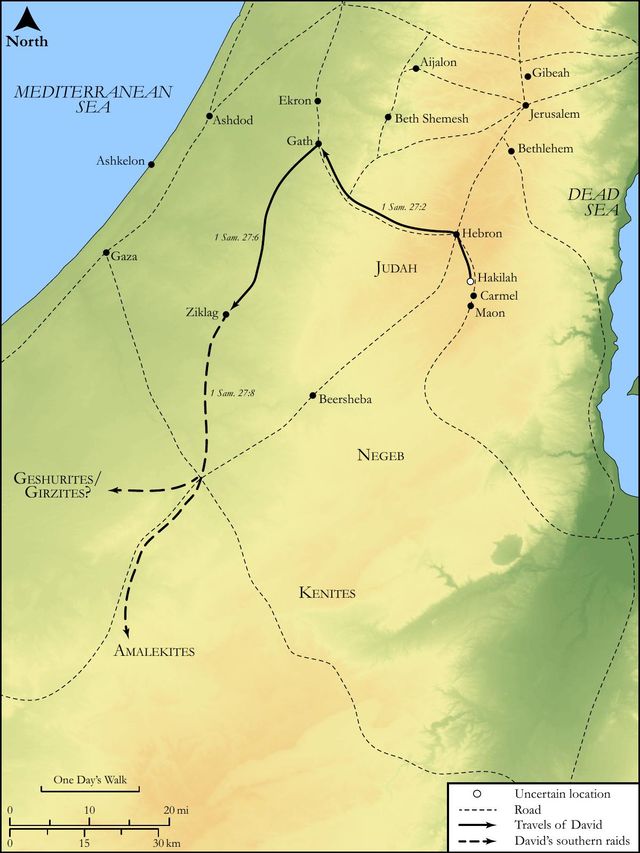
1 Samuel 27:3 vividly portrays David's desperate flight from King Saul, compelling him to seek asylum in the Philistine city of Gath under the protection of King Achish. This verse underscores the extreme circumstances David faced, detailing his relocation with his entire retinue, including his two wives, Ahinoam and Abigail, and their households. It marks a significant and morally complex turning point in David's journey, revealing the lengths to which he was driven to ensure the survival and security of those under his care, even if it meant dwelling among Israel's traditional adversaries.
Context
ShowHideLiterary Context
This verse immediately follows David's somber realization in 1 Samuel 27:1 that he would "perish one day by the hand of Saul" and his subsequent resolve to escape to the land of the Philistines. 1 Samuel 27:2 then describes David's departure with his 600 loyal men. The detailed mention of his wives and their households in verse 3 emphasizes the comprehensive and long-term nature of this relocation, signaling a profound break from his life in Israel. This pivotal move sets the stage for the morally ambiguous period of David's life in Philistine territory, where he engages in deceptive military campaigns against other nations, as further elaborated in the subsequent narratives of 1 Samuel 27 and 1 Samuel 28.
Historical & Cultural Context
David's decision to seek asylum in Gath was an extraordinary and perilous act, given that the Philistines were Israel's most formidable and persistent enemies. Gath itself held deep significance as the hometown of Goliath, the very giant David had famously slain in 1 Samuel 17:4. This was not David's first encounter with King Achish; he had previously feigned madness in Gath to escape capture (1 Samuel 21:10-15). His return, this time with a substantial retinue, suggests a calculated and desperate risk, likely predicated on the hope that Achish might perceive value in harboring a skilled warrior who was an enemy of Saul. The explicit mention of David's "two wives" reflects the polygamous practices common among powerful men and leaders of that day, a societal norm that, while prevalent, stood in tension with God's original design for a monogamous union as established in Genesis 2:24.
Key Themes
ShowHideThis verse powerfully illustrates the theme of exile and desperation in David's life. Driven from his homeland by Saul's relentless pursuit, he is forced to seek refuge among his people's historical enemies, highlighting the intense pressure and danger that defined this period. It also underscores the complex interplay between human pragmatism and divine providence. While David's strategic move to Gath appears rational from a human perspective, it raises profound questions about his complete reliance on God's protection within the promised land, especially in light of the moral compromises that would follow. Furthermore, the verse subtly touches upon David's developing leadership and the formation of his household. It portrays him not merely as a warrior but as a responsible leader, providing protection and care not only for his 600 men but also for their families, including his own. The specific inclusion of Abigail, identified as "Nabal's wife," serves as a literary reminder of the events in 1 Samuel 25, emphasizing David's expanding influence and the intricate ways in which his personal and domestic life were interwoven with his public destiny.
Exposition and Analysis
ShowHideKey Word Analysis
ShowHideThis primitive root signifies "to sit down, remain, settle, inhabit, or abide." In this context, it implies a more permanent and established residence rather than a fleeting visit. David did not merely pass through Gath; he "dwelt" there, indicating a deliberate intention to establish a prolonged stay and, to some extent, integrate into the Philistine community. This choice underscores the depth of his desperation and his perceived finality of his break with Saul's kingdom, highlighting a settled, albeit precarious, existence.
The Philistine king of Gath. His name, of uncertain derivation, possibly carries connotations of "serpent" or "venomous," subtly adding a layer of symbolic danger and moral ambiguity to David's choice of refuge. The profound irony of David, the slayer of Goliath, finding protection under the king of Gath—the very city of his most infamous enemy—underscores the paradoxical nature of David's predicament. Achish represents the unlikely, yet essential and precarious, ally in David's desperate flight.
Derived from a root possibly meaning "to build," this term broadly refers to a "house" but extends to encompass an entire "family" or "household" in its widest sense. Here, it signifies not just David's immediate family but the collective families of his men, including wives and children. The use of "household" highlights David's comprehensive responsibility as a leader, emphasizing that his relocation was a communal act, involving the complete transplantation of a significant community that had formed around him during his fugitive period.
Verse Breakdown
ShowHide"And David dwelt with Achish at Gath"
This opening clause establishes the central action and setting of the verse. It starkly presents David, the anointed future king of Israel, in a position of dependence, residing in the capital city of Israel's long-standing and formidable enemy. This act is a direct consequence of King Saul's unrelenting persecution, forcing David into an alliance that would have been utterly unthinkable under normal circumstances, revealing the profound depths of his desperation.
"he and his men, every man with his household"
This phrase powerfully emphasizes the comprehensive nature of David's migration. It was not merely David alone, but his entire retinue of 600 fighting men, accompanied by their wives and children. This crucial detail highlights David's profound responsibility as a leader for the welfare and security of his followers and their families, indicating the formation of a significant, self-contained community that had coalesced around him during his fugitive years.
"[even] David with his two wives, Ahinoam the Jezreelitess, and Abigail the Carmelitess, Nabal's wife"
The specific mention of David's wives underscores his personal circumstances and the growing complexity of his domestic life. Ahinoam was David's first recorded wife after Michal was taken from him (1 Samuel 25:43). Abigail, the widow of Nabal, was taken by David after God's judgment upon Nabal (1 Samuel 25:39-42). Their presence signifies the establishment of David's own burgeoning household within this foreign land, a microcosm of the future royal court. The geographical descriptors ("Jezreelitess," "Carmelitess") serve to ground the narrative in specific Israelite regions, subtly reminding the reader of David's origins and the land he has been compelled to abandon.
Literary Devices
ShowHideThe verse employs several significant literary devices that enrich its meaning and impact. Irony is profoundly evident, as David, the celebrated hero who famously slew Goliath of Gath, now finds himself seeking asylum in Goliath's very hometown, under the protection of the king he had previously deceived. This dramatic reversal of fortunes powerfully underscores David's desperate plight and the unexpected, often paradoxical, turns of divine providence. There is also a subtle foreshadowing of David's subsequent moral compromises and the profound challenges of leading a people caught between conflicting loyalties, as his prolonged stay in Philistine territory would involve deceptive military campaigns. The detailed characterization of David is skillfully achieved, portraying him not merely as a formidable warrior but as a responsible and compassionate leader, diligently caring for his entire extended "household." Furthermore, the specific naming of his wives, particularly Abigail with her past association with Nabal, functions as a powerful form of allusion, drawing the reader's attention back to previous narratives and highlighting the intricate and complex tapestry of David's personal history.
Theological and Thematic Connections
ShowHideDavid's dwelling in Gath represents a profound theological tension point in his journey. On one hand, it showcases David's remarkable human ingenuity and pragmatism in seeking survival amidst extreme duress. On the other hand, it inevitably raises questions about the completeness of his trust in God's protection within the promised land of Israel, the very land God had sovereignly given to His people. Yet, even in this seemingly unideal and morally ambiguous situation, the pervasive hand of God's sovereignty is undeniably evident. David's period in Gath, despite its inherent moral compromises and the difficult choices it necessitated, served as an unexpected "training ground" for his future kingship. It allowed him to hone his leadership skills, refine his military strategies, and develop his ability to manage a diverse community, all without direct interference from Saul. This episode powerfully illustrates that God, in His infinite wisdom and patience, can work through and even redeem human choices—even those born of fear, desperation, or imperfection—to further His ultimate purposes, meticulously preparing His chosen instrument for the throne of Israel.
Reflection and Application
ShowHideDavid's flight to Gath serves as a profound and sobering reminder that even the most devout figures of faith, those chosen and anointed by God, are not immune to the crushing weight of fear, the pangs of desperation, and the necessity of making morally complex choices under intense duress. His story encourages us to look with honesty and humility at our own lives, recognizing that extreme pressure and seemingly insurmountable circumstances can lead us to seek unconventional or even questionable solutions for security and survival. While David's pragmatism in this instance ensured his physical preservation, his subsequent actions in Philistine territory reveal the profound spiritual dangers and moral compromises that can arise when security is prioritized over unwavering conviction. For us today, this passage challenges us to critically examine where we place our ultimate trust when all human options appear exhausted. Do we, like David, seek refuge in our own "Gath"—in worldly solutions, expedient compromises, or alliances that might offer temporary relief but ultimately pull us away from God's ideal path and perfect will? Or do we, even in the midst of the most terrifying storms, cling steadfastly to the conviction that God's protection, provision, and faithfulness are always sufficient, even if it means enduring hardship or uncertainty within the confines of His sovereign plan? David's journey, with all its imperfections, ultimately teaches us about God's boundless patience and unwavering faithfulness, demonstrating His ability to work through flawed people in imperfect situations to accomplish His perfect and redemptive purposes.
Questions for Reflection
ShowHideFAQ
ShowHideWhy did David go to Gath, of all places, given his history with Goliath?
ShowHideDavid's decision to flee to Gath, the very hometown of Goliath whom he had famously slain, was a desperate and extraordinarily risky strategic move. He had seemingly exhausted all viable options within Israel, concluding that he would inevitably "perish one day by the hand of Saul" (1 Samuel 27:1). His previous, brief encounter with Achish (where he feigned madness to escape capture in 1 Samuel 21:10-15) might have provided him with some insight into Achish's character or a perceived vulnerability. Achish, in turn, likely saw a unique opportunity to gain a powerful warrior and strategically disrupt Saul's kingdom by harboring David, an enemy of his own enemy. It was a calculated risk born of extreme desperation, highlighting David's resourcefulness, but also his profound sense of having no other viable alternatives.
What does the mention of his two wives tell us about David's household and the culture of the time?
ShowHideThe explicit mention of David's two wives, Ahinoam and Abigail, clearly indicates his polygamous status, a practice that was common and socially accepted among kings and powerful men of that day, though it stood in tension with God's original design for marriage (Genesis 2:24). Ahinoam was David's first recorded wife after Michal was taken from him (1 Samuel 25:43). Abigail, notably identified as "Nabal's wife," was married by David after Nabal's death, highlighting David's rapidly growing influence and the intricate ways in which his domestic life was intertwined with his public and political trajectory (1 Samuel 25:39-42). This detail not only provides a glimpse into the complex social norms of the era but also shows David as a leader responsible for a developing household, even in the precarious circumstances of exile.
Was David's decision to go to Gath an act of faith or fear?
ShowHideDavid's decision to go to Gath appears to be a complex and intertwined blend of both profound fear and a pragmatic, albeit imperfect, faith. His statement in 1 Samuel 27:1 clearly articulates a deep-seated fear of Saul's relentless and murderous pursuit. However, his actions also reflect an underlying belief that God would still preserve him, even if it necessitated taking unconventional, morally ambiguous, and highly risky measures. While this was certainly not an ideal act of faith, as it subsequently led to moral compromises and deceptive actions later in 1 Samuel 27, God's divine providence continued to work through David's choices, meticulously preparing him for the throne. This episode highlights that even great figures of faith can act out of mixed motives and human weakness, yet God remains sovereign and can still accomplish His ultimate purposes through them.
Christ-Centered Fulfillment
ShowHideDavid's exile in Gath, a place of both profound danger and unexpected refuge, serves as a poignant and multifaceted foreshadowing of Christ's own redemptive journey. David, the anointed king-elect, is unjustly forced to flee his own land and people, seeking asylum among enemies due to the relentless rejection and persecution by the reigning, yet illegitimate, king Saul. In a parallel yet infinitely superior manner, Jesus, the true and eternal King of Israel, experienced a profound form of "exile" and ultimate rejection by His own people, which culminated in His suffering and sacrificial death outside the city gates of Jerusalem (Hebrews 13:12). David's reliance on an imperfect, worldly king like Achish for temporary protection starkly contrasts with Christ, who is Himself the perfect, ultimate, and eternal refuge for all who are persecuted, oppressed, or in desperate need of salvation (Psalm 46:1). While David's time in Gath was marked by moral ambiguities, human cunning, and a reliance on deceptive strategies, Jesus perfectly trusted His Heavenly Father, even when that trust led Him directly to the agony of the cross, thereby becoming the true "Lamb of God who takes away the sin of the world!" (John 1:29). David's period of "hiding" and providential preparation in a foreign land ultimately led to his rightful enthronement as king, just as Christ's suffering, death, and resurrection led to His glorious ascension and ultimate enthronement as Lord over all creation, offering eternal refuge, perfect peace, and complete salvation to all who believe in His name (Philippians 2:9-11).