


1 Samuel 19:1
Bible text: King James Version (1769 Blayney text) · Public domain
Bible text: Berean Standard Bible · Public domain
Bible text: American Standard Version (1901) · Public domain
Bible text: World English Bible, Messianic edition · Public domain
Bible text: Geneva Bible (1599) · Public domain
Bible text: Young's Literal Translation · Public domain
- וַיְדַבֵּרvay·da·Berand he spokeH1696Conj-w ¦ V-Piel-ConsecImperf-3msVerb Piel Consecutive Imperfect 3rd Singular Masculineוַandיְדַבֵּרhe spoke
- שָׁאוּלsha·'UlSaulH7586N-proper-mNoun Proper Masculine
- אֶל'eltoH413PrepPreposition
- יוֹנָתָןyo·na·TanJonathanH3129N-proper-mNoun Proper Masculine
- בְּנוֹbe·Nohis sonH1121N-msc ¦ 3msNoun Singular Masculine Constructבְּנsonוֹhis
- וְאֶלve·'eland toH413Conj-w ¦ PrepPrepositionוְandאֶלto
- כָּלkolallH3605N-mscNoun Singular Masculine Construct
- עֲבָדָיו'a·va·Davhis servantsH5650N-mpc ¦ 3msNoun Plural Masculine Constructעֲבָדָיservantsוhis
- לְהָמִיתle·ha·Mitto killH4191Prep-l ¦ V-Hiphil-InfVerb Hiphil Infinitive Constructלְtoהָמִיתkill
- אֶת'et<obj.>H853DirObjMParticle Object Indicator
- דָּוִדda·VidDavidH1732N-proper-mNoun Proper Masculine
- וִיהוֹנָתָןvi·ho·na·Tanand JonathanH3083Conj-w ¦ N-proper-mNoun Proper MasculineוִandיהוֹנָתָןJonathan
- בֶּןben[the] son ofH1121N-mscNoun Singular Masculine Construct
- שָׁאוּלsha·'UlSaulH7586N-proper-mNoun Proper Masculine
- חָפֵץcha·Fetzhe delightedH2654V-Qal-Perf-3msVerb Qal Perfect 3rd Singular Masculine
- בְּדָוִדbe·da·Vidin DavidH1732Prep-b ¦ N-proper-mNoun Proper MasculineבְּinדָוִדDavid
- מְאֹדme·'OdexceedinglyH3966Adj-msAdjective Numerical Singular Masculine Absolute
English is a literal word-by-word gloss of the Hebrew, not the KJV's wording. Why?
This is the original text the KJV's translators worked from — each Hebrew word with its own literal English meaning in this verse, prepared by scholars at Tyndale House, Cambridge. The KJV translates whole sentences, not word by word, so its wording differs: one Hebrew word can become several English words, and the KJV may choose “the LORD” where the gloss reads “Yahweh”. Both are faithful — they answer different questions. For the KJV's own rendering, switch to the KJV text.
Details
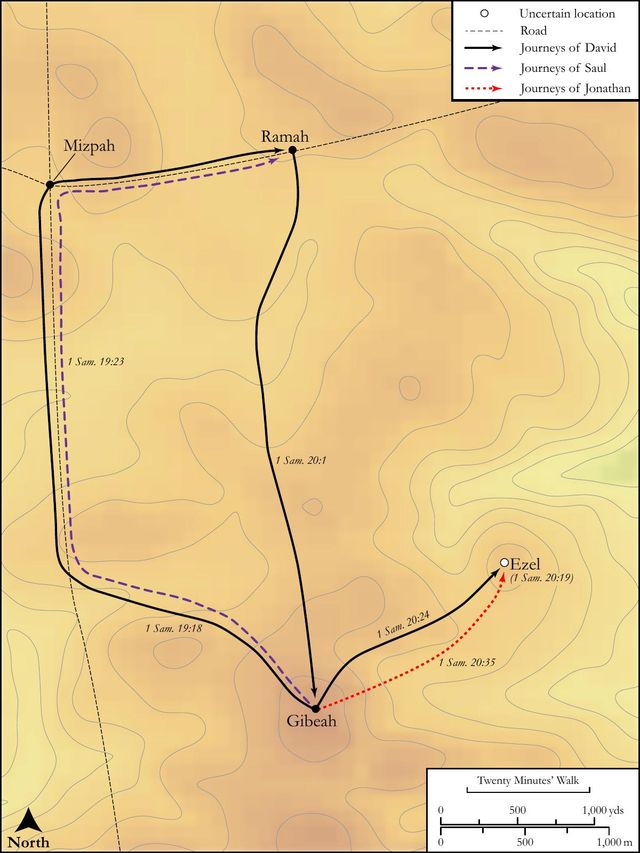
See on the biblical-era map
Study this verse
Public-domain commentary
Matthew Henry
From his Commentary on the Whole Bible. Henry comments on passages, not single verses — this entry covers 1 Samuel 19:1–7. His four-level outline is real structure in the source text, so it is rendered as structure.
Saul and Jonathan appear here in their different characters, with reference to David.
I.Never was enemy so unreasonably cruel as Saul.
He spoke to his son and all his servants that they should kill David, Sa1 19:1. His projects to take him off had failed, and therefore he proclaims him an out-law, and charges all about him, upon their allegiance, to take the first opportunity to kill David. It is strange that he was not ashamed thus to avow his malice when he could give no reason for it, and that knowing all his servants loved David (for so he had said himself, Sa1 18:22), he was not afraid of provoking them to rebel by this bloody order. Either malice was not then so politic, or justice was not so corrupted as it has been since, or else Saul would have had him indicted, and have suborned witnesses to swear treason against him, and so have had him taken off, as Naboth was, by colour of law. But there is least danger from this undisguised malice. It was strange that he who knew how well Jonathan loved him should expect him to kill him; but he thought that because he was heir to the crown he must needs be as envious at David as himself was. And Providence ordered it thus that he might befriend David's safety.
II.Never was friend so surprisingly kind as Jonathan.
A friend in need is a friend indeed. Such a one Jonathan was to David. He not only continued to delight much in him, though David's glory eclipsed his, but bravely appeared for him now that the stream ran so strongly against him.
1.He took care for his present security by letting him know his danger (Sa1 19:2): "Take heed to thyself, and keep out of harm's way." Jonathan knew not but that some of the servants might be either so obsequious to Saul or so envious at David as to put the orders in execution which Saul had given, if they could light on David.
2.He took pains to pacify his father and reconcile him to David. The next morning he ventured to commune with him concerning David (Sa1 19:3), not that night, perhaps because he observed Saul to be drunk and not fit to be spoken to, or because he hoped that, when he had slept upon it, he would himself revoke the order, or because he could not have an opportunity of speaking to him till morning.
(1.)His intercession for David was very prudent. It was managed with a great deal of the meekness of wisdom; and he showed himself faithful to his friends by speaking good of him, though he was in danger of incurring his father's displeasure by it - a rare instance of valuable friendship! He pleads,
[1.]The good services David had done to the public, and particularly to Saul: His work has been to thee-ward very good, Sa1 19:4. Witness the relief he had given him against his distemper with his harp, and his bold encounter with Goliath, that memorable action, which did, in effect, save Saul's life and kingdom. He appeals to himself concerning his: Thou thyself sawest it, and didst rejoice. In that and other instances it appeared that David was a favourite of heaven and a friend to Israel, as well as a good servant to Saul, for by him the Lord wrought a great salvation for all Israel; so that to order him to be slain was not only base ingratitude to so good a servant, but a great affront to God and a great injury to the public.
[2.]He pleads his innocency. Though he had formerly done many good offices, yet, if he had now been chargeable with any crimes, it would have been another matter; but he has not sinned against thee (Sa1 19:1), his blood is innocent (Sa1 19:5), and, if he be slain, it is without cause. And Jonathan had therefore reason to protest against it because he could not entail any thing upon his family more pernicious than the guilt of innocent blood.
(2.)His intercession, being thus prudent, was prevalent. God inclined the heart of Saul to hearken to the voice of Jonathan. Note, We must be willing to hear reason, and to take all reproofs and good advice even from our inferiors, parents from their own children. How forcible are right words! Saul was, for the present, so far convinced of the unreasonableness of his enmity to David that,
[1.]He recalled the bloody warrant for his execution (Sa1 19:6): As the Lord liveth, he shall not be slain. Whether Saul swore here with due solemnity or no does not appear; perhaps he did, and the matter was of such moment as to deserve it and of such uncertainty as to need it. But at other times Saul swore rashly and profanely, which made the sincerity of this oath justly questionable; for it may be feared that those who can so far jest with an oath as to make a by-word of it, and prostitute it to a trifle, have not such a due sense of the obligation of it but that, to serve a turn, they will prostitute it to a lie. Some suspect that Saul said and swore this with a malicious design to bring David within his reach again, intending to take the first opportunity to slay him. But, as bad as Saul was, we can scarcely think so ill of him; and therefore we suppose that he spoke as he thought for the present, but the convictions soon wore off and his corruptions prevailed and triumphed over them.
[2.]He renewed the grant of his place at court. Jonathan brought him to Saul, and he was in his presence as in times past (Sa1 19:7), hoping that now the storm was over, and that his friend Jonathan would be instrumental to keep his father always in this good mind.
Historical interpretation
Three Centuries of Reception
3 surviving comments on this verse. Each one is dated, so this reads as a timeline rather than a list.
Select a marker to jump to its quote. Markers stagger vertically where authors wrote within a few decades of each other.
But true martyrs are such as those of whom the Lord says, “Blessed are those who are persecuted for righteousness’ sake.” It is not, therefore, those who suffer persecution for their unrighteousness and for the divisions which they impiously introduce into Christian unity, but those who suffer for righteousness’ sake, that are truly martyrs. For Hagar also suffered persecution at the hands of Sarah; and in that case she who persecuted was righteous, and she who suffered persecution was unrighteous. Are we to compare with this persecution which Hagar suffered to the case of holy David, who was persecuted by unrighteous Saul? Surely there is an essential difference, not in respect of his suffering but because he suffered for righteousness’ sake.
Moreover, Jonathan, the son of Saul, loved David greatly, etc. Likewise, the apostles loved Christ greatly, and, recounting the accusations of the faithless, they beseeched Him to defend His Church, to preserve the faith in His name within the Church; remaining secretly in the hearts of the believers, yet hidden from the disturbance of men. We, however, they say, you dwelling fruitfully in the minds of the pious (Genesis 27). For this is truly the field full of fragrance and grace, which the Lord has blessed; we will speak and teach this people in Your name, and those who prefer to believe rather than disbelieve from among them, we will announce to Your holy Church, so that, knowing the state of each, it may learn to join the faithful and to protect itself from the unbelievers.
(1 Samuel 19) "But Saul spoke to Jonathan his son," etc. The princes of the Jews, together with the elders and scribes, spoke to the apostles, strictly commanding them not to speak at all nor teach in the name of Jesus.
Continue studying 1 Samuel 19:1 across the web’s major study libraries — every link below opens this exact verse, chapter, or book on the destination site.
Read & Compare
 BibleGatewayThis verse in more than 200 translations and 70 languages.
 Bible.comThe YouVersion reader — hundreds of translations, reading plans, and highlights.
 ESV.orgCrossway's official English Standard Version reader.
 NET BibleThe NET translation with 60,000+ translators' notes on every rendering decision.
 STEP BibleTyndale House's free study tool — original text, vocabulary, and scholarly resources.
 BibliaLogos Bible Software's free web reader.
 USCCBThe New American Bible (Revised Edition) with the U.S. bishops' study notes.
Commentaries
 BibleHub CommentariesDozens of classic commentaries on this verse, gathered on one page.
 StudyLightMore than 100 commentary sets — the largest collection on the web.
 BibleRefPlain-English commentary on what this verse means, verse by verse.
 Enduring WordDavid Guzik's free commentary on this chapter, widely used by Bible teachers.
 Bible Study ToolsVerse commentary alongside Greek and Hebrew study aids.
Original Language & Research
- BibleHub InterlinearThe verse word by word — original language, transliteration, and English.
- BibleHub LexiconEvery word's original-language definition and Strong's entry.
 Blue Letter BibleDeep-study tools — Strong's numbers, concordance, and word studies.
 SefariaThe Hebrew text with Rashi and centuries of Jewish commentary.
Sermons, Hymns & Audio


TrulyRandomVerse is not affiliated with these sites and doesn’t control their content. They’re linked because they’re genuinely useful.
Summary
1 Samuel 19:1 marks a perilous and public escalation in King Saul's relentless animosity towards David, as he abandons covert plots and personal attacks to issue a direct, murderous command to his own son Jonathan and all his servants: that they should assassinate David. This verse signifies a dark turning point, revealing the destructive depths of Saul's jealousy, paranoia, and spiritual decline, while simultaneously setting the stage for Jonathan's profound moral dilemma and God's continued sovereign protection over His chosen servant.
Context
ShowHideLiterary Context
This verse immediately follows a period of escalating tension and attempted violence from King Saul towards David. In 1 Samuel 18, David's military successes and soaring popularity, particularly after his victory over Goliath (1 Samuel 17:50), ignited Saul's profound envy and insecurity. The women's song, "Saul hath slain his thousands, and David his ten thousands" (1 Samuel 18:7), inflamed Saul's wrath, leading to repeated attempts to kill David with a javelin (1 Samuel 18:10-11). Despite these personal attacks and Saul's attempts to have David killed by the Philistines through impossible dowry demands (1 Samuel 18:25), David continued to prosper because "the Lord was with him" (1 Samuel 18:12). Chapter 19 opens with Saul abandoning these more subtle or personal methods for an open, public decree of murder, dramatically escalating the conflict and forcing a crisis of loyalty within his own court.
Historical & Cultural Context
The monarchies of that day often involved intense power struggles, with kings viewing popular rivals or potential successors as direct threats to their throne. Saul's actions, while extreme and morally reprehensible, reflect a paranoid ruler's desperate attempt to eliminate perceived competition and secure his dynasty. The concept of a king's command being absolute was prevalent, making Saul's decree particularly dangerous for David, as it carried the full weight of royal authority. However, the command to "kill" an innocent, loyal servant was a profound violation of justice, hospitality, and the covenantal principles that were meant to govern the Israelite kingdom. The narrative unfolds in Israel, where God's covenant with His people and His anointing of leaders were meant to establish a righteous kingdom, making Saul's unrighteous command a stark contrast to divine principles. This command would have been issued within Saul's court, likely in Gibeah, to his closest advisors and military leaders.
Key Themes
ShowHideThis verse powerfully illustrates the destructive nature of unchecked jealousy and paranoia, as Saul's envy morphs into a murderous intent that consumes him, leading him to disregard all moral boundaries. It highlights the profound tension between divine sovereignty and human rebellion, demonstrating that despite Saul's malicious efforts, God's plan for David's kingship will ultimately prevail. The verse also introduces the critical theme of loyalty and betrayal, as Jonathan, Saul's own son and heir, is placed in an agonizing moral dilemma between allegiance to his father and his deep, covenantal friendship with David, established in 1 Samuel 18:1-4. Finally, it underscores the theme of divine protection, foreshadowing how God will continually safeguard David from Saul's relentless pursuit, even when the king's own household is commanded to turn against him.
Exposition and Analysis
ShowHideKey Word Analysis
ShowHideThis verb (דָּבַר, dâbar), derived from the primitive root H1696, signifies more than casual conversation; it denotes a deliberate, authoritative utterance, often implying a command, decree, or formal declaration. In this context, it emphasizes the intentionality and force behind Saul's instruction. It is a public and official pronouncement, not a private whisper, indicating Saul's open commitment to David's demise and his desire to legitimize the act through royal decree.
The Hebrew word מוּת (mûwth), H4191, is a strong, unambiguous term meaning "to die" or, in its causative form, "to kill," "to slay," or "to put to death." Its use here leaves no doubt about Saul's intent: he desires David's assassination. This is not a request for imprisonment or exile, but a direct order for lethal violence, underscoring the extreme nature of Saul's hatred and his complete disregard for David's life, even in the face of David's loyalty and service.
Verse Breakdown
ShowHide"¶ And Saul spake to Jonathan his son, and to all his servants,"
The pilcrow (¶) in the KJV signifies a new paragraph or a significant thematic shift in the narrative, here marking the dangerous escalation of Saul's campaign against David. Saul's decision to "speak" to Jonathan, his heir and David's closest friend, and "to all his servants" indicates a public, official decree rather than a covert plot. By involving his own son, Saul creates an immediate moral crisis and tests the loyalty of his inner circle. This public declaration reveals the extent of Saul's desperation, his abandonment of any pretense of justice, and his willingness to corrupt his own household to achieve his murderous aims.
"that they should kill David."
This is the chilling command at the heart of the verse. It is a direct order for assassination, revealing the depth of Saul's jealousy, paranoia, and spiritual depravity. David, who had served Saul faithfully, defeated Israel's enemies, and brought honor to the kingdom, is now targeted for murder by the very king he served. This command is a heinous act, violating both human and divine law (specifically the sixth commandment, "You shall not murder"), and it sets the stage for a prolonged period of persecution for David, highlighting the profound moral decay of King Saul.
Literary Devices
ShowHideThe verse employs several potent literary devices. Escalation is profoundly evident as Saul moves from personal javelin attacks and indirect plots to a public, direct command for murder, signifying a dangerous new phase in his animosity. There is profound Irony in Saul commanding his own son, Jonathan, to kill David, given Jonathan's deep covenantal friendship and unwavering loyalty to David, which is well-established in the preceding chapter. This sets up a powerful moral dilemma for Jonathan, forcing a choice between filial obedience to a corrupt king and righteous loyalty to an innocent friend and God's anointed. The explicit command to "kill" also functions as foreshadowing, indicating the relentless and violent pursuit David will endure throughout the subsequent chapters of 1 Samuel, yet simultaneously highlighting God's unwavering protection over His anointed one. The stark contrast between Saul's destructive hatred and David's innocent faithfulness also serves as a form of character foil, emphasizing the spiritual and moral decline of the king.
Theological and Thematic Connections
ShowHideThis verse serves as a stark theological commentary on the destructive power of unchecked sin, particularly jealousy, pride, and an unyielding grip on power, when it takes root in a leader's heart. Saul's descent from a divinely appointed king to a murderous tyrant demonstrates the tragic consequences of rejecting God's Spirit and pursuing one's own agenda above divine will. His command to kill David is a direct affront to God's anointing and plan, highlighting the ongoing tension between human will and divine sovereignty. Yet, even in this dark moment of human treachery and the king's open rebellion against God's purposes, God's faithfulness to His promises and His chosen servant is implicitly affirmed, as Saul's command ultimately fails to thwart God's purpose for David.
Reflection and Application
ShowHide1 Samuel 19:1 is a chilling reminder of how quickly unchecked sin can escalate from internal resentment to outward, destructive actions. Saul's jealousy, fueled by his insecurity and an evil spirit, led him to abandon all moral and ethical boundaries, even commanding murder against an innocent and loyal servant. This narrative compels us to examine our own hearts, recognizing the insidious nature of envy and pride and the importance of addressing them through confession, repentance, and reliance on God's grace before they consume us and harm others. It also highlights the profound courage and integrity required to stand for what is right, even when it means opposing powerful figures or family members, as Jonathan's subsequent actions demonstrate. Ultimately, the verse encourages us to place our trust not in human power or protection, but in the sovereign hand of God, who faithfully guards those He has chosen and fulfills His purposes despite human opposition and the most malicious of schemes. We are reminded that true security and purpose are found in aligning ourselves with God's will, not in clinging to earthly positions or possessions.
Questions for Reflection
ShowHideFAQ
ShowHideWhy did Saul command Jonathan and all his servants to kill David, instead of doing it himself or just one person?
ShowHideSaul's command to Jonathan and "all his servants" was a strategic and desperate move born out of his escalating paranoia and a desire to legitimize his murderous intent. By involving Jonathan, his own son and heir, Saul aimed to test his loyalty and perhaps implicate him in the plot, making it harder for Jonathan to side with David. By including "all his servants," Saul was attempting to make David's assassination a public, sanctioned act of the court, rather than a private, illicit murder. This also served to spread the responsibility, making it more likely that someone would carry out the deed. However, this broad command also created a wider circle of potential dissenters and informants, ultimately working against Saul's goal, as Jonathan immediately warned David (1 Samuel 19:2).
What does the "¶" (pilcrow) at the beginning of the KJV verse signify?
ShowHideIn older English translations like the King James Version, the pilcrow (¶) is a typesetting mark used to indicate a new paragraph or a significant thematic break in the text. It doesn't imply a textual variant or a special meaning of the verse itself, but rather signals to the reader that the following sentence or passage begins a new thought or section within the narrative flow. In 1 Samuel 19:1, it highlights the beginning of a new and intensified phase in Saul's persecution of David, moving from individual, impulsive attempts to an open, public command for assassination.
How did David respond to this direct threat on his life?
ShowHideDavid did not directly respond to Saul's command in this verse, as he was not present when it was issued. However, David was immediately warned by Jonathan, who had heard his father's decree and remained loyal to his friend (1 Samuel 19:2). Jonathan then interceded with Saul on David's behalf, temporarily pacifying the king and bringing David back to court (1 Samuel 19:4-7). Despite this temporary reprieve, Saul's murderous intent soon returned, leading David to flee and become a fugitive for many years, relying on God's miraculous protection and guidance (1 Samuel 19:9-10).
Christ-Centered Fulfillment
ShowHide1 Samuel 19:1, with its raw depiction of a divinely appointed leader seeking to murder an innocent, God-anointed servant, powerfully foreshadows the ultimate rejection and persecution of God's true Anointed One, Jesus Christ. Just as Saul, driven by jealousy, insecurity, and a desperate desire to retain earthly power, sought to eliminate David, so too did the religious and political authorities of Jesus' day conspire to put Him to death, viewing Him as a threat to their established order and earthly authority (John 11:47-50). David, though innocent, was hunted and betrayed by the very king he served, much like the Lamb of God who was "led as a sheep to the slaughter" (Isaiah 53:7). Yet, just as God supernaturally protected David through various means and ultimately established him on the throne of Israel, so too did God raise Jesus from the dead, vindicating Him and establishing His eternal kingdom, a kingdom that cannot be shaken (Acts 2:23-24). Saul's futile attempt to thwart God's plan for David underscores the unshakeable sovereignty of God in bringing about His redemptive purposes through Christ, ensuring that no human malice or conspiracy can ultimately prevent the triumph of His Messiah and the establishment of His everlasting reign (Philippians 2:9-11).