


1 Thessalonians 2:17
Bible text: King James Version (1769 Blayney text) · Public domain
Bible text: King James Version with Strong's numbers · Public domain
Bible text: Berean Standard Bible · Public domain
Bible text: American Standard Version (1901) · Public domain
Bible text: World English Bible, Messianic edition · Public domain
Bible text: Geneva Bible (1599) · Public domain
Bible text: Young's Literal Translation · Public domain
- ἩμεῖςHēmeisWe ourselvesG3165P-1NPPersonal pronoun Nominative 1st Plural
- δέdehoweverG1161CONJConjunction
- ἀδελφοίadelphoibrothersG80N-VPMNoun Vocative Plural Masculine
- ἀπορφανισθέντεςaporphanisthenteshaving been bereavedG642V-APP-NPMVerb Aorist Passive Participle Nominative Plural Masculine
- ἀφ᾽aph᾽ofG575PREPPreposition
- ὑμῶνhumōnyouG4771P-2GPPersonal pronoun Genitive 2nd Plural
- πρὸςprosforG4314PREPPreposition
- καιρὸνkairon[the] timeG2540N-ASMNoun Accusative Singular Masculine
- ὥραςhōrasof an hourG5610N-GSFNoun Genitive Singular Feminine
- προσώπῳprosōpōin faceG4383N-DSNNoun Dative Singular Neuter
- οὐounotG3756PRT-NNegative Particle Negative
- καρδίᾳkardiain heartG2588N-DSFNoun Dative Singular Feminine
- περισσοτέρωςperissoterōsmore abundantlyG4056ADV-CAdverb Comparative
- ἐσπουδάσαμενespoudasamenwere eagerG4704V-AAI-1PVerb Aorist Active Indicative 1st Plural
- τὸtotheG3588T-ASNDefinite article Accusative Singular Neuter
- πρόσωπονprosōponfaceG4383N-ASNNoun Accusative Singular Neuter
- ὑμῶνhumōnof youG4771P-2GPPersonal pronoun Genitive 2nd Plural
- ἰδεῖνideinto seeG1492V-2AANVerb 2nd Aorist Active Infinitive
- ἐνenwithG1722PREPPreposition
- πολλῇpollēagreatG4183A-DSFAdjective Dative Singular Feminine
- ἐπιθυμίᾳepithumiadesireG1939N-DSFNoun Dative Singular Feminine
English is a literal word-by-word gloss of the Greek, not the KJV's wording. Why?
This is the original text the KJV's translators worked from — each Greek word with its own literal English meaning in this verse, prepared by scholars at Tyndale House, Cambridge. The KJV translates whole sentences, not word by word, so its wording differs: one Greek word can become several English words, and the KJV may choose “charity” where the gloss reads “love”. Both are faithful — they answer different questions. For the KJV's own rendering, switch to the KJV text.
Details
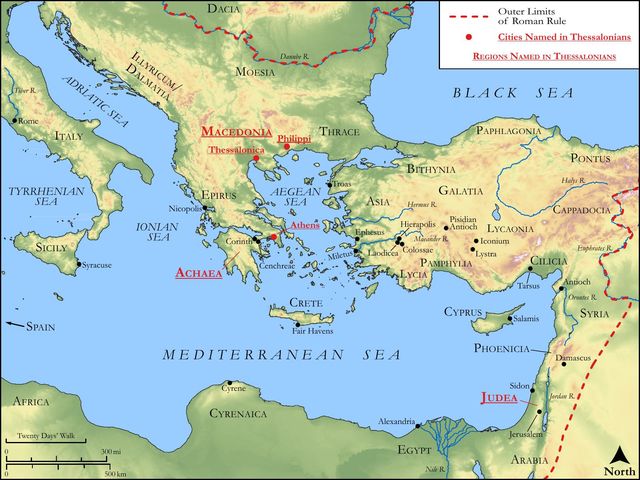
See on the biblical-era maps

Study this verse
Public-domain commentary
Matthew Henry
From his Commentary on the Whole Bible. Henry comments on passages, not single verses — this entry covers 1 Thessalonians 2:17–20.
In these words the apostle apologizes for his absence. Here observe, 1. He tells them they were involuntarily forced from them: We, brethren, were taken from you, Th1 2:17. Such was the rage of his persecutors. He was unwillingly sent away by night to Berea, Act 17:10. 2. Though he was absent in body, yet he was present in heart. He had still a remembrance of them, and great care for them. 3. Even his bodily absence was but for a short time, the time of an hour. Time is short, all our time on earth is short and uncertain, whether we are present with our friends or absent from them. This world is not a place where we are always, or long, to be together. It is in heaven that holy souls shall meet, and never part more. 4. He earnestly desired and endeavoured to see them again: We endeavoured more abundantly to see your face with great desire, Th1 2:17. So that the apostle at least intended his absence should be but for a short time. His desire and endeavour were to return again very soon to Thessalonica. But men of business are not masters of their own time. Paul did his endeavour, and he could do no more, Th1 2:18. 5. He tells them that Satan hindered his return (Th1 2:18), that is, either some enemy or enemies, or the great enemy of mankind, who stirred up opposition to Paul, either in his return to Thessalonica, when he intended to return thither, or stirred up such contentions or dissensions in those places whether he went as made his presence necessary. Note, Satan is a constant enemy to the work of God, and does all he can to obstruct it. 6. He assures them of his affection and high esteem for them, though he was not able, as yet, to be present with them according to his desire. They were his hope, and joy, and crown of rejoicing; his glory and joy. These are expressions of great and endeared affection, and high estimation. And it is happy when ministers and people have such mutual affection and esteem of each other, and especially if they shall thus rejoice, if those that sow and those that reap shall rejoice together, in the presence of our Lord Jesus Christ at his coming.
The apostle here puts the Thessalonians in mind that though he could not come to them as yet, and though he should never be able to come to them, yet our Lord Jesus Christ will come, nothing shall hinder this. And further, when he shall come, all must appear in his presence, or before him. Ministers and people must all appear before him, and faithful people will be the glory and joy of faithful ministers in that great and glorious day.
Historical interpretation
Historical reception
1 surviving comment on this verse from the historical church.
"But we, being taken from you for a short time in presence, not in heart, endeavored the more abundantly to see your face with great desire."
He has not said "separated," but what was much more. He had spoken above of flattery, showing that he did not flatter, that he did not seek glory. He speaks here concerning love. Because he had said above, "as a father his children," "as a nurse," here he uses another expression, "being made orphans," which is said of children who have lost their fathers. And yet they were made orphans. "No"-he says-"but we. For if any one should examine our longing, even as little children without a protector, having sustained an untimely bereavement, long for their parents, not only from the feelings of nature itself, but also on account of their deserted state, so truly do we too feel." From this also he shows his own despondency on account of their separation. And this we cannot say, he says, that we have waited a long period, but "for a short time," and that "in presence, not in heart." For we always have you in our mind. See how great is his love Although having them always in his heart, he sought also their presence face to face. Tell me not of your superlative philosophy This is truly fervent love; both to see, and to hear, and speak; and this may be of much advantage. "We endeavored the more exceedingly." What is "more exceedingly"? He either means to say, "we are vehemently attached to you," or, "as was likely, being bereaved for a season, we endeavored to see your face." Observe the blessed Paul. When of himself he cannot satisfy his longing, he does it through others, as when he sends Timothy to the Philippians, and the same person again to the Corinthians, holding intercourse with them through others, when he cannot of himself. For in loving them, he was like some mad person, not to be restrained, nor to command himself in his affection.
Continue studying 1 Thessalonians 2:17 across the web’s major study libraries — every link below opens this exact verse, chapter, or book on the destination site.
Read & Compare
 BibleGatewayThis verse in more than 200 translations and 70 languages.
 Bible.comThe YouVersion reader — hundreds of translations, reading plans, and highlights.
 ESV.orgCrossway's official English Standard Version reader.
 NET BibleThe NET translation with 60,000+ translators' notes on every rendering decision.
 STEP BibleTyndale House's free study tool — original text, vocabulary, and scholarly resources.
 BibliaLogos Bible Software's free web reader.
 USCCBThe New American Bible (Revised Edition) with the U.S. bishops' study notes.
Commentaries
 BibleHub CommentariesDozens of classic commentaries on this verse, gathered on one page.
 StudyLightMore than 100 commentary sets — the largest collection on the web.
 BibleRefPlain-English commentary on what this verse means, verse by verse.
 Enduring WordDavid Guzik's free commentary on this chapter, widely used by Bible teachers.
 Bible Study ToolsVerse commentary alongside Greek and Hebrew study aids.
Original Language & Research
- BibleHub InterlinearThe verse word by word — original language, transliteration, and English.
- BibleHub LexiconEvery word's original-language definition and Strong's entry.
 Blue Letter BibleDeep-study tools — Strong's numbers, concordance, and word studies.
 CNTR CollationThe earliest Greek manuscripts of this verse, collated letter by letter.
Sermons, Hymns & Audio


TrulyRandomVerse is not affiliated with these sites and doesn’t control their content. They’re linked because they’re genuinely useful.
Summary
In 1 Thessalonians 2:17, the Apostle Paul, along with Silvanus and Timothy, articulates a profound and tender longing for the Thessalonian believers, from whom they had been forcibly separated. Despite their physical absence, Paul assures them that their hearts remained intimately connected, expressing an earnest and intense desire to reunite with them, underscoring the deep, familial bond that characterized their apostolic ministry.
Context
ShowHideLiterary Context
This verse immediately follows Paul's detailed defense of his ministry and conduct among the Thessalonians in 1 Thessalonians 2:1-12. He meticulously refutes any accusations of selfish motives, flattery, or financial exploitation, asserting that his ministry was pure, gentle, and sacrificial, akin to a nursing mother and an exhorting father. Having established the integrity and loving nature of their work, Paul transitions in 1 Thessalonians 2:13-16 to commend the Thessalonians for receiving the gospel not as a human word, but as the very word of God, which was actively at work in them. Their suffering for the faith, mirroring the experiences of the churches in Judea, further confirmed their genuine conversion. Against this backdrop of commendation and shared suffering, verse 17 then expresses the apostles' deep personal anguish over their forced separation and their fervent desire to return, solidifying the genuine affection that undergirded their ministry.
Historical & Cultural Context
Paul, Silvanus, and Timothy had experienced a tumultuous and abrupt departure from Thessalonica. As recorded in Acts 17:1-10, after only a few weeks of successful ministry, jealous Jews incited a mob, accusing Paul and his companions of sedition against Caesar by proclaiming another king, Jesus. This led to a violent uproar, forcing Paul and Silas to flee under the cover of night, leaving Timothy behind for a time. This sudden and involuntary separation was deeply painful for the apostles, especially given the nascent stage of the Thessalonian church. The cultural context of the Roman Empire, with its emphasis on civic order and emperor worship, meant that the proclamation of "another king" was perceived as a direct threat, leading to swift and often brutal suppression. This historical reality explains the "short time in presence" (referring to their brief stay and abrupt departure) and the intense longing for reconnection, as the apostles genuinely feared for the spiritual well-being of these new believers left in the midst of hostility.
Key Themes
ShowHideThe verse significantly contributes to several overarching themes in 1 Thessalonians. Firstly, it powerfully illustrates the theme of Authentic Pastoral Care and Affection. Paul's language here, particularly the imagery of being "taken from you" (like being orphaned), transcends mere professional duty, revealing a deep, parental love for his spiritual children. This complements his earlier descriptions of their ministry as gentle and nurturing in 1 Thessalonians 2:7-8. Secondly, the verse highlights Spiritual Unity Amidst Physical Separation. Paul's assertion that they were "not in heart" despite being physically absent underscores the profound spiritual bond that united them in Christ, a bond that physical distance or persecution could not sever. This theme resonates with Paul's broader theological understanding of the church as one body, as seen in Ephesians 4:4. Finally, the "great desire" to see their face emphasizes the theme of Persistent Missionary and Pastoral Commitment. Despite the dangers and forced departure, the apostles' fervent longing to return demonstrates their unwavering dedication to the spiritual growth and well-being of the Thessalonian church, a commitment that led Paul to send Timothy back to strengthen and encourage them, as detailed in 1 Thessalonians 3:1-5.
Exposition and Analysis
ShowHideKey Word Analysis
ShowHideThis word (G642) literally means "to bereave wholly," or "to be orphaned from." Paul's use of this term is profoundly evocative, conveying a sense of deep loss and separation akin to a child being orphaned or parents losing their children. It powerfully communicates the emotional pain and sorrow Paul and his companions felt at being forcibly separated from the Thessalonian believers, emphasizing the intimate, familial nature of their spiritual bond.
Derived from spoudē (haste, earnestness), this verb (G4704) means "to use speed, to make effort, to be prompt or earnest." It signifies a diligent, zealous, and determined effort. Paul is not merely expressing a passive wish but an active, persistent, and energetic pursuit to achieve their goal of reuniting with the Thessalonians, reflecting the intensity of their pastoral concern.
While this word (G1939) can sometimes denote a longing for what is forbidden (lust or concupiscence), in this context, when combined with "great" (polýs, G4183), it signifies an intense, fervent, and legitimate longing or yearning. It speaks to the depth of Paul's affection and the strength of his emotional connection to the Thessalonian believers, emphasizing a heartfelt and pure eagerness to see them again.
Verse Breakdown
ShowHide"But we, brethren, being taken from you for a short time in presence,"
This clause introduces a contrast ("But") to the preceding discussion of their ministry and the Thessalonians' reception of the gospel. Paul identifies himself and his companions as "brethren," reinforcing the familial bond. The phrase "being taken from you" (from aporphanízō) powerfully conveys the involuntary and painful nature of their separation, likening it to being orphaned or bereaved. The separation was "for a short time" (referring to the brevity of their initial stay and the abruptness of their departure) and only "in presence," highlighting that the physical distance did not equate to emotional or spiritual detachment.
"not in heart,"
This crucial phrase clarifies the nature of their separation. While physically absent, their hearts, minds, and affections remained fully engaged with the Thessalonian church. This emphasizes the enduring spiritual unity and deep emotional connection that transcended geographical barriers, affirming their unwavering love and concern for the believers.
"endeavoured the more abundantly to see your face"
This part reveals the apostles' active response to their separation. "Endeavoured" (from spoudázō) signifies their diligent and earnest efforts to return. The adverb "the more abundantly" (from perissotérōs) intensifies this effort, indicating an overflowing and zealous desire to achieve their goal. "To see your face" is an idiom for personal presence and intimate fellowship, expressing a yearning for direct, face-to-face interaction and mutual encouragement.
"with great desire."
This concluding phrase reinforces the profound intensity of their longing. The "great desire" (combining polýs and epithymía) underscores the depth of their affection and the fervent nature of their yearning for reunion. It encapsulates the emotional weight of their pastoral heart, demonstrating that their ministry was driven by genuine love and not merely obligation.
Literary Devices
ShowHidePaul masterfully employs several literary devices to convey the depth of his feelings. The most striking is the Metaphor of being "taken from you" (ἀπορφανισθέντες), which literally means "orphaned." This powerful imagery likens the separation of the apostles from the Thessalonians to the painful bereavement of a child from its parents, or vice-versa. It evokes a profound sense of loss and vulnerability, highlighting the intimate, familial bond that existed. Secondly, Paul uses Contrast effectively with the phrase "in presence, not in heart." This juxtaposition emphasizes that while physical separation was a reality, their spiritual and emotional connection remained unbroken, underscoring the enduring nature of their bond in Christ. Finally, the use of Intensification through phrases like "the more abundantly" and "with great desire" conveys the overflowing and fervent nature of their longing. These adverbs amplify the emotional weight, assuring the Thessalonians of the apostles' unwavering commitment and deep affection despite the challenging circumstances.
Theological and Thematic Connections
ShowHideThis verse beautifully illustrates the nature of authentic pastoral ministry, rooted in genuine affection and spiritual unity rather than mere obligation or professional duty. It underscores the profound bond that forms between spiritual leaders and their flock, a bond that transcends physical distance and persecution. Paul's "great desire" to see the Thessalonians reflects a core theological truth: Christian fellowship is not merely transactional but deeply relational, mirroring the relational nature of God Himself. It speaks to the importance of presence, even when hindered, and the persistent pursuit of mutual encouragement and spiritual edification within the body of Christ. This passage serves as a timeless model for those in ministry, demonstrating that true leadership flows from a heart of love and a fervent desire for the spiritual flourishing of others, even in the face of adversity.
Reflection and Application
ShowHidePaul's heartfelt longing for the Thessalonians offers a profound model for our own relationships within the Christian community and beyond. It challenges us to examine the depth of our spiritual connections, asking whether our care for fellow believers extends beyond mere acquaintance to a genuine, empathetic desire for their well-being and spiritual growth. In a world often characterized by superficial interactions and digital detachment, Paul's emphasis on "not in heart" reminds us that true connection transcends physical presence. It calls us to cultivate bonds of love and commitment that endure through separation, difficulty, and distance, actively seeking ways to encourage, support, and pray for one another. Furthermore, this passage encourages perseverance in ministry and relationships, reminding us that obstacles should not diminish our love or our "great desire" to foster deep, Christ-centered fellowship.
Questions for Reflection
ShowHideFAQ
ShowHideWhat does Paul mean by "taken from you for a short time in presence, not in heart"?
ShowHidePaul is explaining the nature of his separation from the Thessalonian believers. "Taken from you" (Greek: aporphanízō) implies a forced and painful separation, like being orphaned or bereaved. It wasn't a voluntary departure. "For a short time in presence" refers to the brevity of his initial stay in Thessalonica and the abrupt, forced nature of his departure due to persecution, as detailed in Acts 17:5-10. The crucial phrase "not in heart" clarifies that while he was physically absent, his affection, concern, and spiritual connection to them remained unbroken and strong. His heart was still fully with them, demonstrating a deep, enduring pastoral love that transcended physical distance.
Why was Paul so eager to see the Thessalonians again?
ShowHidePaul's eagerness stemmed from several factors. Firstly, his ministry to them was cut short by intense persecution, leaving the young church vulnerable and untaught in many areas. He had a deep pastoral concern for their spiritual well-being and growth, wanting to strengthen their faith and provide further instruction (as seen in 1 Thessalonians 3:10). Secondly, he had a profound personal affection for them, viewing them as his spiritual children (see 1 Thessalonians 2:7-8). His desire was not merely a professional obligation but a heartfelt longing for fellowship and mutual encouragement, reflecting the genuine love that characterized his apostolic ministry.
Christ-Centered Fulfillment
ShowHideThe profound longing expressed by Paul in 1 Thessalonians 2:17 finds its ultimate and perfect fulfillment in the person and work of Jesus Christ. Just as Paul yearned for the physical presence of his spiritual children, so too does Christ, the Great Shepherd, deeply desire intimate fellowship with His flock. His earthly ministry was characterized by a relentless pursuit of the lost and a tender care for those who believed, culminating in His ultimate sacrifice to reconcile humanity to God (see 2 Corinthians 5:18-19). Though physically ascended, Christ is "not in heart" absent from His church; rather, He promised His abiding spiritual presence until the end of the age (see Matthew 28:20). His intercessory prayer in John 17 reveals His fervent "great desire" for the unity and sanctification of His disciples, and His longing for them to be with Him where He is. Ultimately, the "endeavour" to see their face points forward to Christ's promised return, when He will gather His elect and consummate His kingdom, bringing about the glorious, unending, face-to-face reunion with His beloved bride, the Church (see 1 Thessalonians 4:17 and Revelation 22:4).