


1 Corinthians 5:3
Bible text: King James Version (1769 Blayney text) · Public domain
Bible text: King James Version with Strong's numbers · Public domain
Bible text: Berean Standard Bible · Public domain
Bible text: American Standard Version (1901) · Public domain
Bible text: World English Bible, Messianic edition · Public domain
Bible text: Geneva Bible (1599) · Public domain
Bible text: Young's Literal Translation · Public domain
- ἐγὼegōI myselfG1473P-1NSPersonal pronoun Nominative 1st Singular
- μὲνmenindeedG3303PRTParticle or Disjunctive
- γὰρgarthoughG1063CONJConjunction
- ὡςhōsasG5613PRTParticle or Disjunctive
- ἀπὼνapōnbeing absentG548V-PAP-NSMVerb Present Active Participle Nominative Singular Masculine
- τῷtō<the>G3588T-DSNDefinite article Dative Singular Neuter
- σώματιsōmatiin bodyG4983N-DSNNoun Dative Singular Neuter
- παρὼνparōnbeing presentG3918V-PAP-NSMVerb Present Active Participle Nominative Singular Masculine
- δὲdehoweverG1161CONJConjunction
- τῷtō<the>G3588T-DSNDefinite article Dative Singular Neuter
- πνεύματιpneumatiin spiritG4151N-DSNNoun Dative Singular Neuter
- ἤδηēdēalreadyG2235ADVAdverb
- κέκρικαkekrikahave judgedG2919V-RAI-1SVerb Perfect Active Indicative 1st Singular
- ὡςhōsasG5613PRTParticle or Disjunctive
- παρὼνparōnbeing presentG3918V-PAP-NSMVerb Present Active Participle Nominative Singular Masculine
- τὸνtonthe [one]G3588T-ASMDefinite article Accusative Singular Masculine
- οὕτωςhoutōssoG3779ADVAdverb
- τοῦτοtoutothisG3778D-ASNDemonstrative pronoun Accusative Singular Neuter
- κατεργασάμενονkatergasamenonhaving producedG2716V-ADP-ASMVerb Aorist Middle Deponent Participle Accusative Singular Masculine
English is a literal word-by-word gloss of the Greek, not the KJV's wording. Why?
This is the original text the KJV's translators worked from — each Greek word with its own literal English meaning in this verse, prepared by scholars at Tyndale House, Cambridge. The KJV translates whole sentences, not word by word, so its wording differs: one Greek word can become several English words, and the KJV may choose “charity” where the gloss reads “love”. Both are faithful — they answer different questions. For the KJV's own rendering, switch to the KJV text.
Details
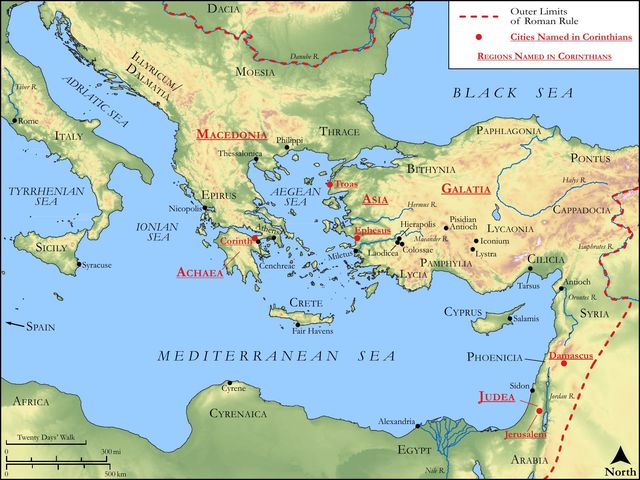
See on the biblical-era maps

Study this verse
Public-domain commentary
Matthew Henry
From his Commentary on the Whole Bible. Henry comments on passages, not single verses — this entry covers 1 Corinthians 5:1–6. His two-level outline is real structure in the source text, so it is rendered as structure.
Here the apostle states the case; and,
I.Lets them know what was the common or general report concerning them, that one of their community was guilty of fornication, Co1 5:1.
It was told in all places, to their dishonour, and the reproach of Christians. And it was the more reproachful because it could not be denied. Note, The heinous sins of professed Christians are quickly noted and noised abroad. We should walk circumspectly, for many eyes are upon us, and many mouths will be opened against us if we fall into any scandalous practice. This was not a common instance of fornication, but such as was not so much as named among the Gentiles, that a man should have his father's wife - either marry her while his father was alive, or keep her as his concubine, either when he was dead or while he was alive. In either of these cases, his criminal conversation with her might be called fornication; but had his father been dead, and he, after his decease, married to her, it had been incest still, but neither fornication nor adultery in the strictest sense. But to marry her, or keep her as a concubine, while his father was alive, though he had repudiated her, or she had deserted him, whether she were his own mother or not, was incestuous fornication: Scelus incredibile (as Cicero calls it), et prater unum in omni vit inauditum (Orat. pro Cluent.), when a woman had caused her daughter to be put away, and was married to her husband. Incredible wickedness! says the orator; such I never heard of in all my life besides. Not that there were no such instances of incestuous marriages among the heathens; but, whenever they happened, they gave a shock to every man of virtue and probity among them. They could not think of them without horror, nor mention them without dislike and detestation. Yet such a horrible wickedness was committed by one in the church of Corinth, and, as is probable, a leader of one of the factions among them, a principal man. Note, The best churches are, in this state of imperfection, liable to very great corruptions. Is it any wonder when so horrible a practice was tolerated in an apostolical church, a church planted by the great apostle of the Gentiles?
II.He greatly blames them for their own conduct hereupon: They were puffed up (Co1 5:2), they gloried,
1.Perhaps on account of this very scandalous person. He might be a man of great eloquence, of deep science, and for this reason very greatly esteemed, and followed, and cried up, by many among them. They were proud that they had such a leader. Instead of mourning for his fall, and their own reproach upon his account, and renouncing him and removing him from the society, they continued to applaud him and pride themselves in him. Note, Pride or self-esteem often lies at the bottom of our immoderate esteem of others, and this makes us as blind to their faults as to our own. It is true humility that will bring a man to a sight and acknowledgement of his errors. The proud man either wholly overlooks or artfully disguises his faults, or endeavours to transform his blemishes into beauties. Those of the Corinthians that were admirers of the incestuous person's gifts could overlook or extenuate his horrid practices. Or else,
2.It may intimate to us that some of the opposite party were puffed up. They were proud of their own standing, and trampled upon him that fell. Note, It is a very wicked thing to glory over the miscarriages and sins of others. We should lay them to heart, and mourn for them, not be puffed up with them. Probably this was one effect of the divisions among them. The opposite party made their advantage of this scandalous lapse, and were glad of the opportunity. Note, It is a sad consequence of divisions among Christians that it makes them apt to rejoice in iniquity. The sins of others should be our sorrow. Nay, churches should mourn for the scandalous behaviour of particular members, and, if they be incorrigible, should remove them. He that had done this wicked deed should have been taken away from among them.
III.We have the apostle's direction to them how they should now proceed with this scandalous sinner.
He would have him excommunicated and delivered to Satan (Co1 5:3-5); as absent in body, yet present in spirit, he had judged already as if he had been present; that is, he had, by revelation and the miraculous gift of discerning vouchsafed him by the Spirit, as perfect a knowledge of the case, and had hereupon come to the following determination, not without special authority from the Holy Spirit. He says this to let them know that, though he was at a distance, he did not pass an unrighteous sentence, nor judge without having as full cognizance of the case as if he had been on the spot. Note, Those who would appear righteous judges to the world will take care to inform them that they do not pass sentence without full proof and evidence. The apostle adds, him who hath so done this deed. The fact was not only heinously evil in itself, and horrible to the heathens, but there were some particular circumstances that greatly aggravated the offence. He had so committed the evil as to heighten the guilt by the manner of doing it. Perhaps he was a minister, a teacher, or a principal man among them. By this means the church and their profession were more reproached. Note, In dealing with scandalous sinners, not only are they to be charged with the fact, but the aggravating circumstances of it. Paul had judged that he should be delivered to Satan (Co1 5:5), and this was to be done in the name of Christ, with the power of Christ, and in a full assembly, where the apostle would be also present in spirit, or by his spiritual gift of discerning at a distance. Some think that this is to be understood of a mere ordinary excommunication, and that delivering him to Satan for the destruction of the flesh is only meant of disowning him, and casting him out of the church, that by this means he might be brought to repentance, and his flesh might be mortified. Christ and Satan divide the world: and those that live in sin, when they profess relation to Christ, belong to another master, and by excommunication should be delivered up to him; and this in the name of Christ. Note, Church-censures are Christ's ordinances, and should be dispensed in his name. It was to be done also when they were gathered together, in full assembly. The more public the more solemn, and the more solemn the more likely to have a good effect on the offender. Note, Church-censures on notorious and incorrigible sinners should be passed with great solemnity. Those who sin in this manner are to be rebuked before all, that all may fear, Ti1 5:20. Others think the apostle is not to be understood of mere excommunication, but of a miraculous power or authority they had of delivering a scandalous sinner into the power of Satan, to have bodily diseases inflicted, and to be tormented by him with bodily pains, which is the meaning of the destruction of the flesh. In this sense the destruction of the flesh has been a happy occasion of the salvation of the spirit. It is probable that this was a mixed case. It was an extraordinary instance: and the church was to proceed against him by just censure; the apostle, when they did so, put forth an act of extraordinary power, and gave him up to Satan, nor for his destruction, but for his deliverance, at least for the destruction of the flesh, that the soul might be saved. Note, The great end of church-censures is the good of those who fall under them, their spiritual and eternal good. It is that their spirit may be saved in the day of the Lord Jesus, Co1 5:5. Yet it is not merely a regard to their benefit that is to be had in proceeding against them. For,
IV.He hints the danger of contagion from this example:
Your glorying is not good. Know you not that a little leaven leaveneth the whole lump? The bad example of a man in rank and reputation is very mischievous, spreads the contagion far and wide. It did so, probably, in this very church and case: see Co2 12:21. They could not be ignorant of this. The experience of the whole world was for it; one scabbed sheep infects a whole flock. A little heaven will quickly spread the ferment through a great lump. Note, Concern for their purity and preservation should engage Christian churches to remove gross and scandalous sinners.
Historical interpretation
Two Centuries of Reception
5 surviving comments on this verse. Each one is dated, so this reads as a timeline rather than a list.
Select a marker to jump to its quote. Markers stagger vertically where authors wrote within a few decades of each other.
Come, now, if he had not "wholly saddened" so many persons in the first Epistle; if he had "rebuked" none, had "terrified" none; if he had "smitten" the incestuous man alone; if, for his cause, he had sent none into panic, had struck (no) "inflated" one with consternation,-would it not be better for you to suspect, and more believing for you to argue, that rather some one far different had been in the same predicament at that time among the Corinthians; so that, rebuked, and terrified, and already wounded with mourning, he therefore-the moderate nature of his fault permitting it-subsequently received pardon, than that you should interpret that (pardon as granted) to an incestuous fornicator? For this you had been bound to read, even if not in an Epistle, yet impressed upon the very character of the apostle, by (his) modesty more clearly than by the instrumentality of a pen: not to steep, to wit, Paul, the "apostle of Christ," the "teacher of the nations in faith and verity," the "vessel of election," the founder of Churches, the censor of discipline, (in the guilt of) levity so great as that he should either have condemned rashly one whom he was presently to absolve, or else rashly absolved one whom he had not rashly condemned, albeit on the ground of that fornication which is the result of simple immodesty, not to say on the ground of incestuous nuptials and impious voluptuousness and parricidal lust,-(lust) which he had refused to compare even with (the lusts of) the nations, for fear it should be set down to the account of custom; (lust) on which he would sit in judgment though absent, for fear the culprit should "gain the time; " (lust) which he had condemned after calling to his aid even "the Lord's power," for fear the sentence should seem human. Therefore he has trifled both with his own "spirit," and with "the angel of the Church," and with "the power of the Lord," if he rescinded what by their counsel he had formally pronounced.
If we also, in our diverse provinces, (but) present mutually in spirit, observe those very solemnities, whose then celebration our present discourse has been defending, that is the sacramental law.
Moreover, we did not withdraw from the visible assembling of ourselves together, with the Lord's presence. But those in the city I tried to gather together with all the greater zeal, as if I were present with them; for I was absent indeed in the body, as I said, but present in the spirit. And in Cephro indeed a considerable church sojourned with us, composed partly of the brethren who followed us from the city, and partly of those who joined us from Egypt. There, too, did God open to us a door for the word. And at first we were persecuted, we were stoned; but after a period some few of the heathen forsook their idols, and turned to God. For by our means the word was then sown among them for the first time, and before that they had never received it. And as if to show that this had been the very purpose of God in conducting us to them, when we had fulfilled this ministry, He led us away again.
"For I verily being absent in body, but present in spirit."
Mark his energy. He suffers them not even to wait for his presence, nor to receive him first and then pass the sentence of binding: but as if on the point of expelling some contagion before that it have spread itself into the rest of the body, he hastens to restrain it. And therefore he subjoins the clause, "I have judged already, as though I were present." These things moreover he said, not only to urge them unto the declaration of their sentence and to give them no opportunity of contriving something else, but also to frighten them, as one who knew what was to be done and determined there. For this is the meaning of being "present in spirit:" as Elisha was present with Gehazi, and said, "Went not my heart with thee?" Wonderful! How great is the power of the gift, in that it makes all to be together and as one; and qualifies them to know the things which are far off. "I have judged already as though I were present."
He permits them not to have any other device. "Now I have uttered my decision as if I were present: let there be no delays and puttings off: for nothing else must be done."
None would expect anything else, implies Paul, once again showing how important the matter was.
Continue studying 1 Corinthians 5:3 across the web’s major study libraries — every link below opens this exact verse, chapter, or book on the destination site.
Read & Compare
 BibleGatewayThis verse in more than 200 translations and 70 languages.
 Bible.comThe YouVersion reader — hundreds of translations, reading plans, and highlights.
 ESV.orgCrossway's official English Standard Version reader.
 NET BibleThe NET translation with 60,000+ translators' notes on every rendering decision.
 STEP BibleTyndale House's free study tool — original text, vocabulary, and scholarly resources.
 BibliaLogos Bible Software's free web reader.
 USCCBThe New American Bible (Revised Edition) with the U.S. bishops' study notes.
Commentaries
 BibleHub CommentariesDozens of classic commentaries on this verse, gathered on one page.
 StudyLightMore than 100 commentary sets — the largest collection on the web.
 BibleRefPlain-English commentary on what this verse means, verse by verse.
 Enduring WordDavid Guzik's free commentary on this chapter, widely used by Bible teachers.
 Bible Study ToolsVerse commentary alongside Greek and Hebrew study aids.
Original Language & Research
- BibleHub InterlinearThe verse word by word — original language, transliteration, and English.
- BibleHub LexiconEvery word's original-language definition and Strong's entry.
 Blue Letter BibleDeep-study tools — Strong's numbers, concordance, and word studies.
 CNTR CollationThe earliest Greek manuscripts of this verse, collated letter by letter.
Sermons, Hymns & Audio


TrulyRandomVerse is not affiliated with these sites and doesn’t control their content. They’re linked because they’re genuinely useful.
Summary
In 1 Corinthians 5:3, the Apostle Paul emphatically asserts his spiritual authority and decisive judgment over a grievous moral transgression within the Corinthian church. Though physically absent from them, Paul declares his profound spiritual presence and the definitive nature of his ruling concerning the man involved in the scandalous incestuous relationship, thereby setting the imperative for the Corinthian believers to execute the necessary church discipline.
Context
ShowHideLiterary Context
This verse is a pivotal statement within Paul's impassioned rebuke to the Corinthian church, found in 1 Corinthians 5. It immediately follows Paul's expression of astonishment and dismay in 1 Corinthians 5:1-2 that they have tolerated a man living in an incestuous relationship—a sin so egregious it was unheard of even among pagans—and have even become arrogant rather than sorrowful. Paul's declaration of judgment in 1 Corinthians 5:3 serves as the authoritative basis for the specific instructions on church discipline that follow in 1 Corinthians 5:4-5, highlighting the urgency and necessity of dealing with unrepentant sin to maintain the purity and witness of the Christian community.
Historical & Cultural Context
The city of Corinth was a bustling, cosmopolitan port city renowned for its wealth, trade, and unfortunately, its moral laxity. The term "Corinthianize" was synonymous with sexual immorality. While Roman law prohibited certain forms of incest, the specific act of a man living with his stepmother (his father's wife) after his father's death was considered particularly scandalous, even by pagan standards. The Corinthian church, composed of both Jewish and Gentile converts, was struggling to shed its pagan influences and adopt Christian ethical standards. Paul's strong condemnation and immediate judgment underscore the stark contrast between the prevailing Corinthian culture and the high moral standards expected of believers, emphasizing that the church must not conform to the world's depravity but rather embody God's holiness.
Key Themes
ShowHidePaul's declaration in this verse contributes significantly to several major themes in 1 Corinthians. Foremost is Apostolic Authority, as Paul asserts his God-given right to make definitive judgments for the churches he founded, even from a distance, demonstrating a spiritual connection and discernment that transcends physical presence. This is akin to his spiritual oversight mentioned in Colossians 2:5. Closely related is the theme of Church Discipline, as Paul initiates the process by which the church must act against persistent, unrepentant sin to preserve its integrity. This judgment is not merely a personal opinion but a divine directive for the congregation to implement, highlighting the church's responsibility to uphold Holiness and Purity. Finally, Paul's claim to be "present in spirit" points to the theme of Spiritual Discernment, suggesting a profound spiritual perception of the situation and a clear understanding of God's will regarding it, allowing him to judge "as though I were present."
Exposition and Analysis
ShowHideKey Word Analysis
ShowHideThis verb signifies "to distinguish, i.e., decide (mentally or judicially); by implication, to try, condemn, punish." Paul's use of the perfect tense ("have judged already") indicates a completed action with ongoing results. His judgment is not a tentative or future consideration but a settled, definitive decision that stands as a binding verdict, requiring immediate and decisive action from the Corinthian church. It carries the weight of a judicial decree.
Referring to "a current of air, i.e., breath; figuratively, a spirit, i.e., (human) the rational soul, (by implication) vital principle, mental disposition, etc." When Paul says he is "present in spirit," he is not suggesting a mystical out-of-body experience but rather a profound spiritual empathy, discernment, and authoritative connection to the church. It implies a spiritual perception and understanding of the situation, guided by the Holy Spirit, enabling him to exercise his apostolic authority as if he were physically present.
This adverb means "even now, by this time." Its inclusion emphasizes the immediacy and finality of Paul's judgment. It underscores that the decision has been made, the verdict rendered, and there is no need for further deliberation on his part. This "already" serves to prod the Corinthians to swift action, as the matter is settled in Paul's mind and in God's sight.
Verse Breakdown
ShowHide"For I verily, as absent in body, but present in spirit"
Paul establishes the paradoxical nature of his involvement. Though physically distant from Corinth, he asserts a profound spiritual connection and presence. This "presence in spirit" is not merely empathy but a spiritual discernment and authoritative engagement with the church's situation, implying that his spiritual authority transcends geographical limitations. The phrase highlights his deep concern and active participation in the spiritual well-being of the Corinthians, even from afar.
"have judged already, as though I were present"
This clause reveals the decisive and complete nature of Paul's verdict. The perfect tense of "have judged" (Greek: kekrika) signifies a settled, irrevocable decision. Paul has not merely formed an opinion; he has rendered a definitive judgment, just as he would have done if he were physically standing among them. This underscores the gravity of the situation and the unassailable authority behind his pronouncement.
"concerning him that hath so done this deed"
Paul clearly identifies the subject of his judgment: the man who has committed the specific, egregious act of immorality detailed in 1 Corinthians 5:1. The phrase "so done this deed" refers to the incestuous relationship, emphasizing the shocking and unacceptable nature of the sin. Paul's judgment is precise and directed at the specific individual and his unrepentant behavior.
Literary Devices
ShowHidePaul employs several literary devices in this verse to convey the weight of his message. The primary device is Contrast, seen in the antithetical pairing of "absent in body" versus "present in spirit." This highlights the spiritual reality of Paul's apostolic connection to the church, asserting that his authority and discernment are not bound by physical proximity. There is also a strong element of Apostolic Assertion, where Paul unequivocally declares his judgment, using the first-person pronoun "I verily" to emphasize his personal, authoritative involvement. This assertion functions almost as a Legal Pronouncement, setting a precedent for the church's subsequent actions and underscoring the divine backing of his verdict.
Theological and Thematic Connections
ShowHideThis verse powerfully articulates the spiritual reality of the church as a unified body under apostolic authority, even across physical distances. Paul's "presence in spirit" signifies not only his deep pastoral care but also the spiritual discernment granted to apostles for the health and purity of the church. It underscores the profound truth that sin within the community affects the entire body, necessitating decisive action. The theological implication is that the church, as God's redeemed people, is called to reflect His holiness, and therefore, cannot tolerate unrepentant sin in its midst. Paul's judgment serves as a divine mandate for the local assembly to act, demonstrating that church discipline is a necessary, God-ordained function for maintaining the integrity of the Christian witness and for the restoration of the erring individual.
Reflection and Application
ShowHide1 Corinthians 5:3 challenges contemporary believers and church leaders to grapple with the serious responsibility of addressing unrepentant sin within the Christian community. It reminds us that true spiritual leadership involves not only teaching and nurturing but also making difficult, biblically-grounded judgments when necessary for the health, integrity, and witness of the body of Christ. While physical presence is often ideal, this verse illustrates that spiritual unity and discernment can transcend distance, enabling leaders to act decisively on behalf of biblical truth and holiness. It calls the church to maintain a high standard of conduct, reflecting God's character to the world, and to understand that tolerating egregious sin compromises its identity and mission. Our commitment to holiness must be visible, both individually and corporately, for the glory of God and the good of the community.
Questions for Reflection
ShowHideFAQ
ShowHideHow could Paul be "present in spirit" when he was physically absent from Corinth?
ShowHidePaul's declaration of being "present in spirit" (G3918 páreimi in G4151 pneûma) does not imply an out-of-body experience or mystical omnipresence. Rather, it signifies a profound spiritual connection, authoritative discernment, and pastoral engagement with the Corinthian church's situation. As an apostle, Paul possessed a unique spiritual authority and insight, guided by the Holy Spirit, which allowed him to perceive and judge the matter as if he were physically there. It emphasizes the reality of the spiritual bond within the body of Christ and Paul's God-given role as an overseer, whose authority and judgment were valid regardless of physical distance. His spiritual presence meant his mind, will, and apostolic authority were fully engaged with the issue, enabling him to render a definitive verdict.
What does "have judged already" imply for the Corinthian church's responsibility?
ShowHideThe phrase "have judged already" (Greek: kekrika, perfect tense of G2919 krínō) signifies that Paul's decision was definitive, completed, and stood as a settled verdict. This implies that the Corinthian church was not being asked to deliberate on the validity of the judgment, but rather to implement it. Paul had made the authoritative decision, and their responsibility was to carry out the necessary disciplinary action. This highlights the hierarchical nature of apostolic authority in the early church and the expectation that local congregations would submit to such divinely-inspired directives for the sake of purity and order within the body of Christ.
Christ-Centered Fulfillment
ShowHide1 Corinthians 5:3 finds its ultimate fulfillment and meaning in the person and work of Jesus Christ. Paul's apostolic authority to judge, even from a distance, flows directly from Christ, who is the supreme Head of the Church (Colossians 1:18) and the ultimate Judge of all humanity (John 5:22). The call for the Corinthian church to purge the immoral person from their midst reflects Christ's own desire for His bride, the Church, to be "holy and blameless" (Ephesians 5:27). Just as Paul's spiritual presence enabled him to discern and judge, Christ is truly present with His church by His Spirit (Matthew 28:20) and continually works to purify it. The discipline Paul commands, though severe, is ultimately for the restoration of the individual and the preservation of the church's witness, mirroring Christ's redemptive purpose to save sinners and conform them to His image (Romans 8:29). Thus, Paul's judgment in this verse is a temporal manifestation of Christ's ongoing work of sanctification and governance over His people, ensuring that His body remains a pure reflection of His glory.