


Romans 1:13
Bible text: King James Version (1769 Blayney text) · Public domain
Bible text: King James Version with Strong's numbers · Public domain
Bible text: Berean Standard Bible · Public domain
Bible text: American Standard Version (1901) · Public domain
Bible text: World English Bible, Messianic edition · Public domain
Bible text: Geneva Bible (1599) · Public domain
Bible text: Young's Literal Translation · Public domain
- ΟὐOuNotG3756PRT-NNegative Particle Negative
- θέλωthelōI do wantG2309V-PAI-1SVerb Present Active Indicative 1st Singular
- δὲdenowG1161CONJConjunction
- ὑμᾶςhumasyouG4771P-2APPersonal pronoun Accusative 2nd Plural
- ἀγνοεῖνagnoeinto be ignorantG50V-PANVerb Present Active Infinitive
- ἀδελφοίadelphoibrothersG80N-VPMNoun Vocative Plural Masculine
- ὅτιhotithatG3754CONJConjunction
- πολλάκιςpollakismany timesG4178ADVAdverb
- προεθέμηνproethemēnI purposedG4388V-2AMI-1SVerb 2nd Aorist Middle Indicative 1st Singular
- ἐλθεῖνeltheinto comeG2064V-2AANVerb 2nd Aorist Active Infinitive
- πρὸςprostoG4314PREPPreposition
- ὑμᾶςhumasyouG4771P-2APPersonal pronoun Accusative 2nd Plural
- καὶkaiandG2532CONJConjunction
- ἐκωλύθηνekōluthēnwas hinderedG2967V-API-1SVerb Aorist Passive Indicative 1st Singular
- ἄχριachriuntilG891PREPPreposition
- τοῦtoutheG3588T-GSMDefinite article Genitive Singular Masculine
- δεῦροdeuropresentG1204INJInterjection
- ἵναinathatG2443CONJConjunction
- τινὰtinasomeG5100X-ASMIndefinite pronoun Accusative Singular Masculine
- καρπὸνkarponfruitG2590N-ASMNoun Accusative Singular Masculine
- σχῶschōI may haveG2192V-2AAS-1SVerb 2nd Aorist Active Subjunctive 1st Singular
- καὶkaialsoG2532CONJConjunction
- ἐνenamongG1722PREPPreposition
- ὑμῖνhuminyouG4771P-2DPPersonal pronoun Dative 2nd Plural
- καθὼςkathōseven asG2531CONJConjunction
- καὶkaievenG2532CONJConjunction
- ἐνenamongG1722PREPPreposition
- τοῖςtoistheG3588T-DPNDefinite article Dative Plural Neuter
- λοιποῖςloipoisotherG3062A-DPNAdjective Dative Plural Neuter
- ἔθνεσινethnesinGentilesG1484N-DPNNoun Dative Plural Neuter
English is a literal word-by-word gloss of the Greek, not the KJV's wording. Why?
This is the original text the KJV's translators worked from — each Greek word with its own literal English meaning in this verse, prepared by scholars at Tyndale House, Cambridge. The KJV translates whole sentences, not word by word, so its wording differs: one Greek word can become several English words, and the KJV may choose “charity” where the gloss reads “love”. Both are faithful — they answer different questions. For the KJV's own rendering, switch to the KJV text.
Details
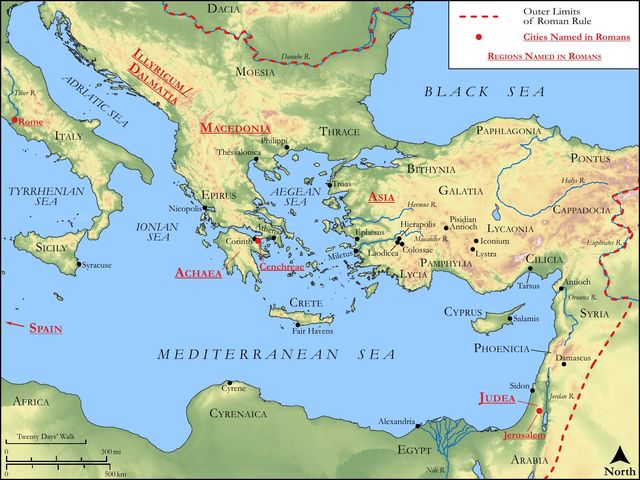
See on the biblical-era maps

Study this verse
Public-domain commentary
Matthew Henry
From his Commentary on the Whole Bible. Henry comments on passages, not single verses — this entry covers Romans 1:8–15. His three-level outline is real structure in the source text, so it is rendered as structure.
We may here observe,
I.His thanksgivings for them (Rom 1:8):
First, I thank my God. It is good to begin every thing with blessing God, to make that the alpha and omega of every song, in every thing to give thanks. - My God. He speaks this with delight and triumph. In all our thanksgivings, it is good for us to eye God as our God; this makes every mercy sweet, when we can say of God, "He is mine in covenant." - Through Jesus Christ. All our duties and performances are pleasing to God only through Jesus Christ, praises as well as prayers. - For you all. We must express our love to our friends, not only by praying for them, but by praising God for them. God must have the glory of all the comfort we have in our friends; for every creature is that to us, and no more, which God makes it to be. Many of these Romans Paul had no personal acquaintance with, and yet he could heartily rejoice in their gifts and graces. When some of the Roman Christians met him (Act 28:15), he thanked God for them, and took courage; but here his true catholic love extends itself further, and he thanks God for them all; not only for those among them that were his helpers in Christ, and that bestowed much labour upon him (of whom he speaks Rom 16:3, Rom 16:6), but for them all. - That your faith is spoken of. Paul travelled up and down from place to place, and, wherever he came, he heard great commendations of the Christians at Rome, which he mentions, not to make them proud, but to quicken them to answer the general character people gave of them, and the general expectation people had from them. The greater reputation a man hath for religion, the more careful he should be to preserve it, because a little folly spoils him that is in reputation, Ecc 10:1. - Throughout the whole world, that is, the Roman empire, into which the Roman Christians, upon Claudius's edict to banish all the Jews from Rome, were scattered abroad, but had now returned, and, it seems, left a very good report behind them, wherever they had been, in all the churches. There was this good effect of their sufferings: if they had not been persecuted, they had not been famous. This was indeed a good name, a name for good things with God and good people. As the elders of old, so these Romans, obtained a good report through faith, Heb 11:2. It is a desirable thing to be famous for faith. The faith of the Roman Christians came to be thus talked of, not only because it was excelling in itself, but because it was eminent and observable in its circumstances. Rome was a city upon a hill, every one took notice of what was done there. Thus those who have many eyes upon them have need to walk circumspectly, for what they do, good or bad, will be spoken of. The church of Rome was then a flourishing church; but since that time how is the gold become dim! How is the most fine gold changed! Rome is not what it was. She was then espoused a chaste virgin to Christ, and excelled in beauty; but she has since degenerated, dealt treacherously, and embraced the bosom of a stranger; so that (as that good old book, the Practice of Piety, makes appear in no less than twenty-six instances) even the epistle to the Romans is now an epistle against the Romans; little reason has she therefore to boast of her former credit.
II.His prayer for them, Rom 1:9.
Though a famous flourishing church, yet they had need to be prayed for; they had not yet attained. Paul mentions this as an instance of his love to them. One of the greatest kindnesses we can do our friends, and sometimes the only kindness that is in the power of our hands, is, by prayer to recommend them to the loving-kindness of God. From Paul's example here we may learn,
1.Constancy in prayer: Always without ceasing. He did himself observe the same rules he gave to others, Eph 6:18; Th1 5:17. Not that Paul did nothing else but pray, but he kept up stated times for the solemn performance of that duty, and those very frequent, and observed without fail.
2.Charity in prayer: I make mention of you. Though he had not particular acquaintance with them, nor interest in them, yet he prayed for them; not only for all saints in general, but he made express mention of them. It is not unfit sometimes to be express in our prayers for particular churches and places; not to inform God, but to affect ourselves. We are likely to have the most comfort in those friends that we pray most for. Concerning this he makes a solemn appeal to the searcher of hearts: For God is my witness. It was in a weighty matter, and in a thing known only to God and his own heart, that he used this asseveration. It is very comfortable to be able to call God to witness to our sincerity and constancy in the discharge of a duty. God is particularly a witness to our secret prayers, the matter of them, the manner of the performance; then our Father sees in secret, Mat 6:6. God, whom I serve with my spirit. Those that serve God with their spirits may, with a humble confidence, appeal to him; hypocrites who rest in bodily exercise cannot. His particular prayer, among many other petitions he put up for them, was that he might have an opportunity of paying them a visit (Rom 1:10): Making request, if by any means, etc. Whatever comfort we desire to find in any creature, we must have recourse to God for it by prayer; for our times are in his hand, and all our ways at his disposal. The expressions here used intimate that he was very desirous of such an opportunity: if by any means; that he had long and often been disappointed: now at length; and yet that he submitted it to the divine Providence: a prosperous journey by the will of God. As in our purposes, so in our desires, we must still remember to insert this, if the Lord will, Jam 4:15. Our journeys are prosperous or otherwise according to the will of God, comfortable or not as he pleases.
III.His great desire to see them, with the reasons of it, Rom 1:11-15.
He had heard so much of them that he had a great desire to be better acquainted with them. Fruitful Christians are as much the joy as barren professors are the grief of faithful ministers. Accordingly, he often purposed to come, but was let hitherto (Rom 1:13), for man purposeth, but God disposeth. He was hindered by other business that took him off, by his care of other churches, whose affairs were pressing; and Paul was for doing that first, not which was most pleasant (then he would have gone to Rome), but which was most needful - a good example to ministers, who must not consult their own inclinations so much as the necessity of their people's souls. Paul desired to visit these Romans,
1.That they might be edified (Rom 1:11): That I may impart unto you. He received, that he might communicate. Never were full breasts so desirous to be drawn out to the sucking infant as Paul's head and heart were to be imparting spiritual gifts, that is, preaching to them. A good sermon is a good gift, so much the better for being a spiritual gift. - To the end you may be established. Having commended their flourishing he here expresses his desire of their establishment, that as they grew upward in the branches they might grow downward in the root. The best saints, while they are in such a shaking world as this, have need to be more and more established; and spiritual gifts are of special use for our establishment.
2.That he might be comforted, Rom 1:12. What he heard of their flourishing in grace was so much a joy to him that it must needs be much more so to behold it. Paul could take comfort in the fruit of the labours of other ministers. - By the mutual faith both of you and me, that is, our mutual faithfulness and fidelity. It is very comfortable when there is a mutual confidence between minister and people, they confiding in him as a faithful minister, and he in them as a faithful people. Or, the mutual work of faith, which is love; they rejoiced in the expressions of one another's love, or communicating their faith one to another. It is very refreshing to Christians to compare notes about their spiritual concerns; thus are they sharpened, as iron sharpens iron. - That I might have some fruit, Rom 1:13. Their edification would be his advantage, it would be fruit abounding to a good account. Paul minded his work, as one that believed the more good he did the greater would his reward be.
3.That he might discharge his trust as the apostle of the Gentiles (Rom 1:14): I am a debtor.
(1.)His receivings made him a debtor; for they were talents he was entrusted with to trade for his Master's honour. We should think of this when we covet great things, that all our receivings put us in debt; we are but stewards of our Lord's goods.
(2.)His office made him a debtor. He was a debtor as he was an apostle; he was called and sent to work, and had engaged to mind it. Paul had improved his talent, and laboured in his work, and done as much good as ever any man did, and yet, in reflection upon it, he still writes himself debtor; for, when we have done all, we are but unprofitable servants. - Debtor to the Greeks, and to the barbarians, that is, as the following words explain it, to the wise and to the unwise. The Greeks fancied themselves to have the monopoly of wisdom, and looked upon all the rest of the world as barbarians, comparatively so; not cultivated with learning and arts as they were. Now Paul was a debtor to both, looked upon himself as obliged to do all the good he could both to the one and to the other. Accordingly, we find him paying his debt, both in his preaching and in his writing, doing good both to Greeks and barbarians, and suiting his discourse to the capacity of each. You may observe a difference between his sermon at Lystra among the plain Lycaonians (Act 14:15, etc.) and his sermon at Athens among the polite philosophers, Act 17:22, etc. He delivered both as debtor to each, giving to each their portion. Though a plain preacher, yet, as debtor to the wise, he speaks wisdom among those that are perfect, Co1 2:6. For these reasons he was ready, if he had an opportunity, to preach the gospel at Rome, Rom 1:15. Though a public place, though a perilous place, where Christianity met with a great deal of opposition, yet Paul was ready to run the risk at Rome, if called to it: I am ready - prothumon. It denotes a great readiness of mind, and that he was very forward to it. What he did was not for filthy lucre, but of a ready mind. It is an excellent thing to be ready to meet every opportunity of doing or getting good.
Historical interpretation
Two Centuries of Reception
9 surviving comments on this verse. Each one is dated, so this reads as a timeline rather than a list.
Select a marker to jump to its quote. Markers stagger vertically where authors wrote within a few decades of each other.
This sentence contains a rhetorical aside (hyperbaton), and the construction is defective.… It ought to be joined to the next verse by the words “to whom,” so that the phrase reads: “the rest of the Gentiles, Greeks and barbarians, to whom I am under obligation.” … The whole thing would then read as follows: “Just as I have fruit among the other Gentiles, Greeks and barbarians, wise and foolish, to whom I am under obligation, so also, as much as in me lies, am I eager to preach the gospel also to you who are at Rome, for I am not ashamed to preach the gospel among any people, for the power of God is in it for salvation to all who believe, for the Jew first and for the Greek, for in the gospel the righteousness of God is revealed, which was previously covered by a veil in the law. Now it is revealed in those who come from the faith of the Old Testament to the faith of the new gospel.”So much for the order of the words; now we must examine the apostle’s meaning. When Paul says: “I have often intended to come to you,” he demonstrates the love which he had for the Romans. But when he adds: “but thus far have been prevented,” though indeed it may be thought that he was prevented by God, it is shown by this that it is God’s business where each of the apostles ought or ought not to go. It is by a particular dispensation that he appoints some to preach the Word of God and others not, as Paul himself says elsewhere: “When we tried to go into Bithynia, the Spirit of Christ prevented us.” … But if this phrase refers to the passage where he says that: “Satan hindered us,” he shows clearly that he is constantly struggling in prayer, so that by overcoming the hindrances of Satan he may be given a successful journey in the will of God, to see those who are at Rome.
For he desires and does not cease to pray that he may obtain some fruit from them as he has from the other Gentiles. Thus like one who is acquisitive for many riches, Paul wants to amass some return from his many spiritual investments. He gathers fruit from the Greeks, fruit from the barbarians, fruit from the wise, fruit even from the foolish. For while to some he speaks wisdom as to those who are perfect, to others he says, as if speaking to foolish people, that he wants to know nothing among them except Jesus Christ and him crucified. Some he teaches from the law and the prophets; others he persuades with signs and wonders.
For the fruit of those who have believed the Word is the benefit to those who hear it. And the Lord says that he has sent the apostles in order to bear much fruit. Indeed, a few gleaners have harvested the entire church.
Paul here indicates his plan and intention, which he does not doubt that they already know from those brothers who had come to Rome from Jerusalem or the neighboring cities for some reason, perhaps because of their religion, or from Aquila and Priscilla, who would have told the Romans of Paul’s intention. As he had often wanted to come but had been prevented, it came about that he wrote them a letter, lest they continue in their unwholesome habits for too long to be easily corrected. He calls them brothers not only because they had been born again but also because there were among them some who believed rightly, however few they may have been. Incidentally, this is why he says that they are “called to be saints.” What does it mean to be called to be saints? If they are already saints, how can they be called to be sanctified? This belongs to the foreknowledge of God, because God knows those who will be saints, for those who are already with him are saints and remain called forever. Yet Paul says that he has been prevented up to the time the epistle was written. He was being prevented by God, who could foresee that the Romans were still unprepared. So God sent the apostle to other cities more prepared to receive the truth.While acting in the name of the Savior, they were still prevented by their negligence from being as yet worthy to learn spiritual things.
Paul did not say that he was prevented for no reason. He wanted them to know why he was delayed. He urged them to get ready, so that when they heard that a spiritual grace was to be given to them they would make themselves ready to receive it.
Paul declares that he wants to come to them for their common good, so that they might receive the saving grace of the Spirit, having a reasoned profession of their faith, and that he might have some fruit of his ministry from God, having provoked them to the right faith by the example of the other Gentiles. For one who sees others responding in faith will be more eager to receive it.
Here is a compliance great as that of slaves, and a plain exhibition of his excellent temper! For, that he was let, he says, but why, he does not go on to say. For he does not pry into the command of his Master, but only obeys. And yet one might expect a person to start questions, as to why God hindered a city so conspicuous and great, and towards which the whole world was looking, from enjoying such a teacher, and that for so long a time. For he that had overcome the governing city, could easily go on to the subjects of it. But he that let alone the more royal one, and lay in wait about the dependents, had the main point left neglected. But none of these things does he busy himself with, but yields to the incomprehensibleness of Providence, thereby both showing the right tone of his soul, and instructing us all never to call God to account for what happens, even though what is done seem to trouble the minds of many. For the Master's part it is alone to enjoin, the servants' to obey. And this is why he says, that he was let, but not for what cause; for he means, even I do not know; ask not then of me the counsel or mind of God. For why, tell me, do you even seek to learn it? do you not know that all things are under His care, that He is wise, that He doeth nothing at a mere hazard, that He loveth thee more than they who begat thee, and goes exceeding far beyond a father's yearnings of affection to thee, and a mother's anxiousness. Seek then no more, and go not a step further; for this is sufficient consolation for thee: since even then it was well ordered for the Romans. And if thou knowest not the manner, take it not to heart: for this is a main feature of faith, even when in ignorance of the manner of the dispensation, to receive what is told us of His Providence.
Paul then having succeeded in what he was earnest about (and what was this? to show that it was not as slighting them that he did not come to them, but because, though greatly desiring it, he was hindered), and having divested himself of the accusation of remissness, and having persuaded them that he was not less desirous to see them than themselves, further shows his love to them by other things. For even when I was hindered he means, I did not stand aloof from the attempt, but I kept attempting always yet was always hindered, yet never did I stand aloof thus, without falling out with the will of God, still keeping my love. For by his purposing it to himself and not standing aloof from it, he showed his affection; but through his being hindered and yet not struggling against it, all his love to God. "That I might have some fruit among you also." Yet he had told them the cause of his longing before, and shown that it was becoming him; but still here also, he states it, clearing away all their suspicion. For since the city was conspicuous, and in the whole extent of sea and land had no equal to many even the mere desire of becoming acquainted with it became a reason for a journey to it; that they might not think anything of the sort about Paul, or suspect that, merely with a view to glory in claiming them to himself he desired to be present there, he repeatedly lays down the ground of his desire, and before he says, it was that "I may impart to you some spiritual gift," that I desired to see you; but here more clearly, "that I might have some fruit among you also even as among other Gentiles." The rulers he puts with the subjects, and after the countless triumphs and victories and the glory of the consuls, he puts them with the barbarians, and with good reason too. For where the nobility of faith is, there is none barbarian, none Grecian, none stranger, none citizen, but all mount up to one height of dignity.
The Romans would have learned of Paul’s plans through the brothers who were constantly coming and going. Prevented here means “busy,” because he was preaching in other provinces.
There were many who sped to Rome for human reasons. Paul reveals his own chaste desire to go there and that his motive was a godly one. It appears that he longed after the Romans, perhaps because their faith had become an encouragement to all their subject peoples.
Paul here shows quite clearly that he wanted to go to Rome but that he had often been prevented. At the same time he wants to put them in fear, lest perhaps it was because of their unworthiness that he had been prevented from going to them.
Paul declares both his own plan and God’s overruling. For God’s grace was fully in control of his life.
Paul tells the Romans that it will benefit him to come to them, saying that the nations which received the gospel through him had clearly added to his own riches.
Continue studying Romans 1:13 across the web’s major study libraries — every link below opens this exact verse, chapter, or book on the destination site.
Read & Compare
 BibleGatewayThis verse in more than 200 translations and 70 languages.
 Bible.comThe YouVersion reader — hundreds of translations, reading plans, and highlights.
 ESV.orgCrossway's official English Standard Version reader.
 NET BibleThe NET translation with 60,000+ translators' notes on every rendering decision.
 STEP BibleTyndale House's free study tool — original text, vocabulary, and scholarly resources.
 BibliaLogos Bible Software's free web reader.
 USCCBThe New American Bible (Revised Edition) with the U.S. bishops' study notes.
Commentaries
 BibleHub CommentariesDozens of classic commentaries on this verse, gathered on one page.
 StudyLightMore than 100 commentary sets — the largest collection on the web.
 BibleRefPlain-English commentary on what this verse means, verse by verse.
 Enduring WordDavid Guzik's free commentary on this chapter, widely used by Bible teachers.
 Bible Study ToolsVerse commentary alongside Greek and Hebrew study aids.
Original Language & Research
- BibleHub InterlinearThe verse word by word — original language, transliteration, and English.
- BibleHub LexiconEvery word's original-language definition and Strong's entry.
 Blue Letter BibleDeep-study tools — Strong's numbers, concordance, and word studies.
 CNTR CollationThe earliest Greek manuscripts of this verse, collated letter by letter.
Sermons, Hymns & Audio


TrulyRandomVerse is not affiliated with these sites and doesn’t control their content. They’re linked because they’re genuinely useful.
Summary
In Romans 1:13, the Apostle Paul articulates his long-standing, yet previously hindered, intention to visit the believers in Rome. He expresses a profound pastoral desire to impart spiritual blessing and witness genuine spiritual fruit among them, mirroring the transformative impact of the Gospel he had experienced in his ministry among other Gentile communities. This verse underscores Paul's apostolic commitment to the spread of the Gospel and the spiritual edification of all believers, regardless of their background.
Context
ShowHideLiterary Context
Romans 1:13 is nestled within the opening salutation and introduction of Paul's letter to the church in Rome, specifically within the section where he expresses his deep longing to visit them (Romans 1:8-15). Having introduced himself as a "servant of Jesus Christ, called to be an apostle" (Romans 1:1), and having declared his eagerness to "impart unto you some spiritual gift" (Romans 1:11), Paul here provides a direct explanation for his delayed arrival. This explanation serves to build rapport and transparency with a church he has not yet met, setting the stage for the profound theological treatise that follows concerning the righteousness of God revealed in the Gospel (Romans 1:16-17).
Historical & Cultural Context
The city of Rome was the heart of the Roman Empire, a melting pot of cultures, religions, and philosophical schools. The church in Rome, though not founded by Paul, was significant due to its strategic location and diverse composition, likely comprising both Jewish and Gentile converts to Christianity. Paul, as the "apostle to the Gentiles" (Romans 11:13), felt a particular burden to minister in such a pivotal center. His repeated attempts to visit were likely thwarted by a combination of providential hindrances, demanding missionary journeys elsewhere, or perhaps even opposition. The cultural expectation would have been for an apostle of his stature to visit the capital, making his explanation for the delay both courteous and necessary to maintain his credibility and the integrity of his mission.
Key Themes
ShowHideThis verse powerfully contributes to several overarching themes in Romans and Paul's broader theology. It highlights Paul's unwavering missionary zeal and his sense of obligation to preach the Gospel to all, including those in Rome (Romans 1:14). The concept of "fruit" introduces the theme of spiritual transformation and productivity, a recurring motif in Paul's writings, signifying genuine conversion, righteous living, and the expansion of God's kingdom. Furthermore, the phrase "among other Gentiles" reinforces Paul's specific apostolic calling to the Gentile world, emphasizing the universal scope of the Gospel and God's redemptive plan for all nations, a truth foundational to the entire book of Romans.
Exposition and Analysis
ShowHideKey Word Analysis
ShowHideMeaning "not to know (through lack of information or intelligence); by implication, to ignore (through disinclination)." Paul uses this phrase, "I would not have you ignorant," as a common rhetorical device (e.g., 1 Corinthians 10:1) to ensure the recipients understand his true intentions and the reasons behind his actions, preventing misunderstanding or misinterpretation of his prolonged absence.
Meaning "to estop, i.e. prevent (by word or act):--forbid, hinder, keep from, let, not suffer, withstand." In KJV English, "let" here means "hindered" or "prevented," not "allowed." This word highlights the external obstacles Paul faced that thwarted his previous attempts to reach Rome, demonstrating that even divine purposes can encounter temporal impediments without negating the ultimate will of God.
Meaning "fruit (as plucked), literally or figuratively." In this context, "fruit" is used metaphorically to represent the spiritual results of Paul's ministry—conversions, spiritual growth, righteous living, and the establishment of mature Christian communities. It signifies the tangible evidence of God's work through the Gospel.
Verse Breakdown
ShowHide"Now I would not have you ignorant, brethren"
Paul addresses the Roman believers directly as "brethren," establishing a familial and intimate tone. His opening phrase, "I would not have you ignorant," serves as a polite yet firm way to introduce an important clarification, ensuring they are fully informed about his intentions and past circumstances.
"that oftentimes I purposed to come unto you, (but was let hitherto,)"
Paul reveals his repeated and consistent intention ("oftentimes I purposed") to visit Rome. The parenthetical clause "but was let hitherto" explains why these purposes had not yet materialized. The word "let" (hindered) indicates that external circumstances or divine providence, rather than a lack of desire on his part, had prevented his journey until that point.
"that I might have some fruit among you also, even as among other Gentiles"
This clause states the ultimate purpose of his desired visit. Paul's goal was not merely a social call but to see spiritual "fruit" (i.e., conversions, spiritual growth, and the flourishing of the church) among the Roman believers. The phrase "among you also, even as among other Gentiles" underscores his consistent missionary pattern and his expectation that God would work powerfully in Rome, just as He had in other Gentile regions where Paul had ministered (e.g., Acts 14:27).
Literary Devices
ShowHidePaul employs several rhetorical devices in this verse to communicate his message effectively. The phrase "I would not have you ignorant" is a classic Pauline idiom or formulaic expression (found also in 1 Corinthians 12:1 and 1 Thessalonians 4:13), serving as a polite yet direct way to convey crucial information and ensure the audience's understanding. The use of "brethren" (Greek, adelphós) is an example of apostolic appeal and familial language, fostering a sense of community and shared identity with his readers. Furthermore, the concept of "fruit" is a powerful metaphor for the spiritual results of ministry and the evidence of genuine faith and transformation, a common biblical image (e.g., Matthew 7:16).
Theological and Thematic Connections
ShowHideRomans 1:13 reveals Paul's deep commitment to the Great Commission, demonstrating that true apostolic ministry is driven by a desire for spiritual transformation and the expansion of God's kingdom, not personal gain or recognition. His perseverance despite hindrances highlights the reality that God's plans often unfold through challenges, yet His ultimate purpose for spiritual fruit remains steadfast. This verse also underscores the universal scope of the Gospel, affirming that God's saving power is available to all, Jew and Gentile alike, and that the same spiritual fruit evident elsewhere can and should be expected in every community of believers.
Reflection and Application
ShowHidePaul's transparency about his hindered plans in Romans 1:13 offers a profound lesson for believers today. It reminds us that even the most fervent desires and divinely appointed missions can face obstacles. Yet, Paul's unwavering purpose to "have some fruit" among the Romans, despite past delays, serves as a powerful example of perseverance in ministry and personal calling. Our focus should always be on the spiritual outcomes—seeing lives transformed by the Gospel, believers maturing in their faith, and communities reflecting Christ's character. When we encounter hindrances, whether in our personal spiritual growth, our efforts to share the Gospel, or our service within the church, we are called to maintain our focus on God's purposes and trust in His timing, knowing that He works all things for His glory and the good of those who love Him.
Questions for Reflection
ShowHideFAQ
ShowHideWhy was Paul "let hitherto" from coming to Rome?
ShowHideThe phrase "was let hitherto" means Paul was "hindered" or "prevented" from coming to Rome until that point. The Bible does not explicitly state the specific nature of these hindrances. They could have been providential (God redirecting his steps for other urgent missionary work, as seen in Acts 16:6-10), or they might have been practical obstacles such as demanding ministry responsibilities, financial constraints, or even opposition from adversaries. Regardless of the exact cause, Paul understood these as external forces that had temporarily thwarted his long-standing desire to visit the Roman church, without diminishing his ultimate purpose.
Christ-Centered Fulfillment
ShowHideRomans 1:13, with Paul's desire to bear "fruit" among the Gentiles, finds its ultimate fulfillment in Christ, who is the source and embodiment of all spiritual fruit. Jesus Himself declared, "I am the vine; you are the branches. If you remain in me and I in you, you will bear much fruit; apart from me you can do nothing" (John 15:5). Paul's longing to see spiritual fruit in Rome is a reflection of Christ's own mission to gather a people for Himself from every nation, tribe, and tongue (Revelation 7:9). The "fruit" Paul sought was the outcome of the Gospel, which is the power of God for salvation to everyone who believes (Romans 1:16). This spiritual fruit, manifested in transformed lives and growing faith, is ultimately the work of the Holy Spirit, whom Christ sent to empower believers (Galatians 5:22-23). Thus, Paul's apostolic ambition to see fruit among the Gentiles is a direct extension of Christ's redemptive work, bringing all peoples into His glorious kingdom.