


1 Thessalonians 3:9
Bible text: King James Version (1769 Blayney text) · Public domain
Bible text: King James Version with Strong's numbers · Public domain
Bible text: Berean Standard Bible · Public domain
Bible text: American Standard Version (1901) · Public domain
Bible text: World English Bible, Messianic edition · Public domain
Bible text: Geneva Bible (1599) · Public domain
Bible text: Young's Literal Translation · Public domain
- τίναtinaWhatG5101I-ASFInterrogative pronoun Accusative Singular Feminine
- γὰρgarforG1063CONJConjunction
- εὐχαριστίανeucharistianthanksgivingG2169N-ASFNoun Accusative Singular Feminine
- δυνάμεθαdunamethaare we ableG1410V-PNI-1PVerb Present Middle Or Passive Deponent Indicative 1st Plural
- τῷtō<the>G3588T-DSMDefinite article Dative Singular Masculine
- θεῷtheōto GodG2316N-DSM-TNoun Dative Singular Masculine Title
- ἀνταποδοῦναιantapodounaito giveG467V-2AANVerb 2nd Aorist Active Infinitive
- περὶpericoncerningG4012PREPPreposition
- ὑμῶνhumōnyouG4771P-2GPPersonal pronoun Genitive 2nd Plural
- ἐπὶepiin return forG1909PREPPreposition
- πάσῃpasēallG3956A-DSFAdjective Dative Singular Feminine
- τῇtēatheG3588T-DSFDefinite article Dative Singular Feminine
- χαρᾷcharajoyG5479N-DSFNoun Dative Singular Feminine
- ᾗhēthatG3739R-DSFRelative pronoun Dative Singular Feminine
- χαίρομενchairomenwe rejoiceG5463V-PAI-1PVerb Present Active Indicative 1st Plural
- δι᾽di᾽because ofG1223PREPPreposition
- ὑμᾶςhumasyouG4771P-2APPersonal pronoun Accusative 2nd Plural
- ἔμπροσθενemprosthenbeforeG1715PREPPreposition
- τοῦtoutheG3588T-GSMDefinite article Genitive Singular Masculine
- θεοῦtheouGodG2316N-GSM-TNoun Genitive Singular Masculine Title
- ἡμῶνhēmōnof usG3165P-1GPPersonal pronoun Genitive 1st Plural
English is a literal word-by-word gloss of the Greek, not the KJV's wording. Why?
This is the original text the KJV's translators worked from — each Greek word with its own literal English meaning in this verse, prepared by scholars at Tyndale House, Cambridge. The KJV translates whole sentences, not word by word, so its wording differs: one Greek word can become several English words, and the KJV may choose “charity” where the gloss reads “love”. Both are faithful — they answer different questions. For the KJV's own rendering, switch to the KJV text.
Details
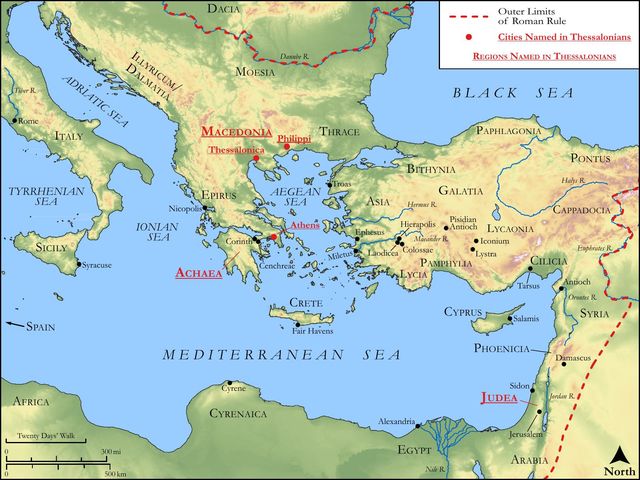
See on the biblical-era maps

Study this verse
Public-domain commentary
Matthew Henry
From his Commentary on the Whole Bible. Henry comments on passages, not single verses — this entry covers 1 Thessalonians 3:6–10. His three-level outline is real structure in the source text, so it is rendered as structure.
Here we have Paul's great satisfaction upon the return of Timothy with good tidings from the Thessalonians, in which we may observe,
I.The good report Timothy made concerning them, Th1 3:6.
Without question, he was a willing messenger of these good tidings. Concerning their faith, that is, concerning their stedfastness in the faith, that they were not shaken in mind, nor turned aside form the profession of the gospel. Their love also continued; their love to the gospel, and the ministers of the gospel. For they had a good and a kind remembrance of the apostles, and that constantly, or always. The names of the apostles were very dear to them, and the thoughts of them, and what they themselves had received from them, were very precious, insomuch that they desired greatly to see them again, and receive some spiritual gift from them; and there was no love lost, for the apostle was as desirous to see them. It is happy where there is such mutual love between minister and people. This tends to promote religion, and the success of the gospel. The world hates them, and therefore they should love one another.
II.The great comfort and satisfaction the apostle had in this good report concerning them (Th1 3:7, Th1 3:8):
Therefore, brethren, we were comforted in all our affliction and distress. The apostle thought this good news of them was sufficient to balance all the troubles he met with. It was easy to him to bear affliction, or persecution, or fightings from without, when he found the good success of his ministry and the constancy of the converts he had made to Christianity; and his distress of mind on account of his fears within, lest he had laboured in vain, was now in a good measure over, when he understood their faith and the perseverance of it. This put new life and spirit into the apostle and made him vigorous and active in the work of the Lord. Thus he was not only comforted, but greatly rejoiced also: Now we live, if you stand fast in the Lord, Th1 3:8. It would have been a killing thing to the apostles if the professors of religion had been unsteady, or proved apostates; whereas nothing was more encouraging than their constancy.
III.The effects of this were thankfulness and prayer to God on their behalf. Observe,
1.How thankful the apostle was, Th1 3:9. He was full of joy, and full of praise and thanksgiving. When we are most cheerful we should be most thankful. What we rejoice in we should give thanks for. This is to rejoice before our God, to spiritualize our joy. Paul speaks as if he could not tell how to express his thankfulness to God, or his joy and rejoicing for their sakes. But he was careful God should not lose the glory of the comfort he received in the welfare of his friends. His heart was enlarged with love to them and with thanksgiving to God. He was willing to express the one and the other as well as he could. As to thankfulness to God, this especially is very imperfect in the present state; but, when we come to heaven, we shall do this work better than now we can.
2.He prayed for them night and day (Th1 3:10), evening and morning, or very frequently, in the midst of the business of the day or slumber of the night lifting up his heart to God in prayer. Thus we should pray always. And Paul's prayer was fervent prayer. He prayed exceedingly, and was earnest in his supplication. Note, When we are most thankful we should always give ourselves to prayer; and those we give thanks for have yet need to be prayed for. Those whom we most rejoice in, and who are our greatest comforts, must be our constant care, while in this world of temptation and imperfection. There was something still lacking in their faith; Paul desired that this might be perfected, and to see their face in order thereunto. Note,
(1.)The best of men have something wanting in their faith, if not as to the matter of it, there being some mysteries or doctrines not sufficiently known or believed by them, yet as to the clearness and certainty of their faith, there being some remaining darkness and doubtings, or at least as to the effects and operations of it, these being not so conspicuous and perfect as they should be. And,
(2.)The ministry of the word and ordinances is helpful, and to be desired and used for the perfecting of that which is lacking in our faith.
Historical interpretation
Historical reception
1 surviving comment on this verse from the historical church.
"For what thanksgiving can we render again unto God for you, for all the joy wherewith we joy for your sakes before our God; night and day praying exceedingly that we may see your face, and may perfect that which is lacking in your faith?"
Not only, he says, are ye the causes of life to us, but also of much joy, and so much that we cannot worthily give thanks to God. Your good behavior, he says, we consider to be the gift of God. Such kindnesses have you shown to us, that we think it to be of God; yea, rather, and it is of God. For such a disposition of mind comes not of a human soul or carefulness.
"Night and day," he says, "praying exceedingly." This too is a sign of joy. For as any husbandman, hearing concerning his land that has been tilled by himself, that it is burdened with ears of grain, longs with his own eyes to see so pleasant a sight, so Paul to see Macedonia. "Praying exceedingly." Observe the excess; "that we may see your face, and may perfect that which is lacking in your faith."
Here there is a great question. For if now thou livest, because they stand fast, and Timothy brought thee "glad tidings of their faith and love," and thou art full of so much joy as not to be able worthily to give thanks to God, how sayest thou here that there are deficiencies in their faith? Were those then the words of flattery? By no means, far be it. For previously he testified that they endured many conflicts, and were no worse affected than the Churches in Judaea. What then is it? They had not enjoyed the full benefit of his teaching, nor learned all that it behoved them to learn. And this he shows toward the end. Perhaps there had been questionings among them concerning the Resurrection, and there were many who troubled them, not by temptations, nor by dangers, but by acting the part of teachers. This is what he says is lacking in their faith, and for this reason, he has so explained himself, and has not said, that you should be confirmed, where indeed he feared concerning the faith itself, "I have sent," he says, "Timothy to confirm you," but here, "to perfect that which is lacking," which is rather a matter of teaching than of confirming.
Continue studying 1 Thessalonians 3:9 across the web’s major study libraries — every link below opens this exact verse, chapter, or book on the destination site.
Read & Compare
 BibleGatewayThis verse in more than 200 translations and 70 languages.
 Bible.comThe YouVersion reader — hundreds of translations, reading plans, and highlights.
 ESV.orgCrossway's official English Standard Version reader.
 NET BibleThe NET translation with 60,000+ translators' notes on every rendering decision.
 STEP BibleTyndale House's free study tool — original text, vocabulary, and scholarly resources.
 BibliaLogos Bible Software's free web reader.
 USCCBThe New American Bible (Revised Edition) with the U.S. bishops' study notes.
Commentaries
 BibleHub CommentariesDozens of classic commentaries on this verse, gathered on one page.
 StudyLightMore than 100 commentary sets — the largest collection on the web.
 BibleRefPlain-English commentary on what this verse means, verse by verse.
 Enduring WordDavid Guzik's free commentary on this chapter, widely used by Bible teachers.
 Bible Study ToolsVerse commentary alongside Greek and Hebrew study aids.
Original Language & Research
- BibleHub InterlinearThe verse word by word — original language, transliteration, and English.
- BibleHub LexiconEvery word's original-language definition and Strong's entry.
 Blue Letter BibleDeep-study tools — Strong's numbers, concordance, and word studies.
 CNTR CollationThe earliest Greek manuscripts of this verse, collated letter by letter.
Sermons, Hymns & Audio


TrulyRandomVerse is not affiliated with these sites and doesn’t control their content. They’re linked because they’re genuinely useful.
Summary
First Thessalonians 3:9 encapsulates the apostle Paul's profound and inexpressible gratitude to God for the steadfast faith and love of the Thessalonian believers. Having sent Timothy to ascertain their spiritual well-being amidst severe persecution, Paul receives a report confirming their perseverance, which fills him and his companions with overwhelming joy. This verse serves as a rhetorical question, highlighting that no amount of thanksgiving could adequately express the spiritual delight they experienced in God's presence, knowing the Thessalonians remained firm in their commitment to Christ.
Context
ShowHideLiterary Context
This verse is the climactic expression of Paul's relief and joy following Timothy's return from Thessalonica. Paul had been deeply anxious about the young church, fearing that the intense persecution they faced might have undermined their faith (1 Thessalonians 3:5). Timothy's positive report, detailed in 1 Thessalonians 3:6, confirmed their steadfastness in faith and love, bringing immense comfort to Paul and his companions in their own afflictions. This overflow of gratitude in 1 Thessalonians 3:9 naturally leads into Paul's fervent prayer for them in the subsequent verses (1 Thessalonians 3:10-13), where he expresses his longing to see them again and to perfect what is lacking in their faith. The entire chapter 3 of 1 Thessalonians beautifully illustrates the deep pastoral bond between Paul and the churches he founded.
Historical & Cultural Context
The church in Thessalonica was established during Paul's second missionary journey, as recorded in Acts 17:1-9. His ministry there was brief but impactful, marked by significant conversions among both Jews and Gentiles, but also by intense opposition from hostile Jewish leaders who incited a mob against him. This forced Paul and his companions, Silas and Timothy, to leave the city hastily. The persecution did not cease for the new believers, who continued to face tribulation (1 Thessalonians 1:6). Paul's concern was heightened by the fact that he had left them relatively quickly, potentially without fully grounding them in the faith. In that day, communication was slow and perilous, making the receipt of a direct, positive report from Timothy an extraordinary relief and cause for genuine celebration for Paul, Silas, and Timothy, who were then in Corinth.
Key Themes
ShowHide1 Thessalonians 3:9 contributes significantly to several overarching themes within the epistle and Paul's broader theology. Firstly, it highlights the overwhelming gratitude of the apostle, demonstrating that spiritual blessings in the lives of others are a profound cause for thanksgiving to God. Secondly, it underscores the communal nature of Christian joy, revealing that Paul's deepest gladness was not for personal gain but for the spiritual flourishing and perseverance of the church, even amidst suffering (2 Corinthians 7:4). Thirdly, the phrase "before our God" emphasizes the God-centeredness of this emotion and thanksgiving, indicating that true spiritual joy is experienced in God's presence and ultimately directed towards Him as the source of all grace and steadfastness. Finally, the verse beautifully illustrates Paul's deep pastoral heart and his genuine affection for the believers, serving as a model for spiritual leadership that prioritizes the spiritual health and growth of the flock above all else (Philippians 1:3-4).
Exposition and Analysis
ShowHideKey Word Analysis
ShowHideThis term denotes gratitude or grateful language, especially to God as an act of worship. It signifies a profound sense of appreciation and acknowledgment of divine favor. In this context, it emphasizes that Paul's response to the Thessalonians' faithfulness is not merely a human emotion but a spiritual act of worship directed towards God, who is the ultimate enabler of their perseverance.
This verb means "to requite," "to recompense," or "to repay." Paul's rhetorical question, "For what thanks can we render...?" implies that no amount of human thanksgiving could possibly be an adequate "repayment" or "requital" to God for the immense joy and comfort He has provided through the Thessalonians' steadfastness. It highlights the vastness of the divine blessing and the inadequacy of human response.
This word describes a deep, abiding gladness or calm delight, often spiritual in nature. It is distinct from fleeting happiness and is frequently associated with the work of the Holy Spirit (Galatians 5:22). The repetition of the root word ("joy wherewith we joy") intensifies this meaning, emphasizing the overflowing, abundant, and profound spiritual delight Paul experienced.
Verse Breakdown
ShowHide"For what thanks can we render to God again for you,"
Paul opens with a rhetorical question, immediately setting a tone of overwhelming, almost inexpressible gratitude. The "For" (G1063, gár) introduces the reason for his preceding statements of comfort and life. The phrase "what thanks can we render" implies that no human expression of gratitude, no matter how fervent, could possibly be sufficient to repay God for the blessing the Thessalonians represent. This highlights the magnitude of the spiritual gift Paul perceives in their faithfulness.
"for all the joy wherewith we joy for your sakes"
This clause explains the specific reason for Paul's inability to render sufficient thanks: the immense joy he experiences because of the Thessalonians. The repetition of the root word for "joy" (G5479, chará and G5463, chaírō) emphasizes the intensity and abundance of this spiritual delight. It is a joy directly tied to their spiritual well-being and perseverance, demonstrating the deep interconnectedness and mutual encouragement within the early Christian community. Paul's joy is not selfish but springs from observing God's work in others.
"before our God;"
This concluding phrase is crucial, elevating the entire sentiment to a divine plane. It signifies that this joy and thanksgiving are not merely human sentiments exchanged between individuals, but are experienced and expressed in God's very presence, with Him as the ultimate witness and recipient. It underscores that the source of the Thessalonians' steadfastness is God, and therefore, all credit and gratitude are due to Him. This makes Paul's emotion a form of worship, acknowledging God's active involvement in the lives of His people.
Literary Devices
ShowHidePaul masterfully employs several literary devices in this verse to convey the depth of his emotion. The most prominent is the Rhetorical Question: "For what thanks can we render to God again for you...?" This question is not meant to be answered but serves to emphasize the inexpressible nature of Paul's gratitude. By posing it, he implies that no amount of thanksgiving would be adequate, thereby magnifying the blessing he perceives in the Thessalonians' faith. Another significant device is Repetition, specifically of the root word for "joy" ("joy wherewith we joy"). This intensifying repetition, known as polyptoton, underscores the overwhelming and abundant nature of the spiritual delight Paul experiences. It conveys a sense of overflowing emotion that cannot be contained by a single expression of joy. Finally, there is an element of Hyperbole in the implied inadequacy of any thanks. Paul's language suggests that his joy is so profound that it transcends normal human expressions of gratitude, further highlighting the magnitude of God's work in the Thessalonians and the comfort it brings to the apostle.
Theological and Thematic Connections
ShowHideThis verse profoundly illustrates the interconnectedness of the body of Christ and the divine source of true spiritual joy. Paul's joy is not derived from personal gain or worldly success, but from observing the perseverance and growth of fellow believers in their faith, even amidst severe trials. This points to a theology where the spiritual health of one part of the body brings genuine rejoicing to another, fostering a communal and selfless love that reflects the very heart of God. It also highlights that all true spiritual fruit, including steadfast faith and love in the face of adversity, is ultimately God's work, prompting an outpouring of worship and thanksgiving directed solely to Him. The verse serves as a powerful reminder that our deepest gratitude should be for God's transformative work in the lives of His people, recognizing Him as the sustainer of faith and the wellspring of all comfort and joy.
Reflection and Application
ShowHidePaul's overflowing joy and gratitude in 1 Thessalonians 3:9 offer a timeless and profound model for believers today. In a world often characterized by self-focus and individualistic pursuits, this verse calls us to cultivate a radical other-centeredness, finding our deepest spiritual satisfaction not in what we gain, but in what God is doing in the lives of others. It challenges us to actively seek out and celebrate the spiritual growth, perseverance, and faithfulness of our brothers and sisters in Christ, especially when they navigate difficult circumstances. This requires intentional awareness, genuine care, and a heart quick to give thanks to God for His work in His people. Furthermore, Paul's example reminds us that our thanksgiving should be directed "before our God," acknowledging Him as the ultimate source of all spiritual strength and the one who sustains faith. This transforms our gratitude into an act of worship, reinforcing our dependence on Him and deepening our trust in His ongoing work within the body of Christ. Such a perspective fosters a vibrant, mutually encouraging, and God-glorifying Christian community.
Questions for Reflection
ShowHideFAQ
ShowHideWhy was Paul so joyful about the Thessalonians' faith?
ShowHidePaul's joy stemmed from a deep pastoral love and concern for the Thessalonian believers, whom he had left somewhat abruptly due to persecution. He had sent Timothy specifically to check on their spiritual condition, fearing that the intense trials they faced might have caused them to waver in their faith (1 Thessalonians 3:5). When Timothy returned with a positive report—confirming their steadfastness in faith and love despite ongoing tribulation (1 Thessalonians 3:6)—it brought immense comfort and relief to Paul, who was also experiencing his own afflictions. His joy was therefore a profound spiritual gladness rooted in seeing God's sustaining grace at work in their lives, validating his ministry and confirming their genuine conversion.
Is it appropriate for our joy to be so dependent on others' spiritual state?
ShowHideYes, in a healthy Christian community, our joy is intrinsically linked to the spiritual well-being of others. The New Testament frequently portrays believers as members of "one body" (1 Corinthians 12:26), where "if one member suffers, all suffer together; if one member is honored, all rejoice together." Paul's joy in the Thessalonians' faith is not a sign of unhealthy dependence but rather a beautiful expression of genuine spiritual love and the communal nature of the church. It reflects a selfless concern for the spiritual flourishing of others, which is a hallmark of Christ-like love (Philippians 2:4). This joy is ultimately directed to God, who is the source of all spiritual growth and perseverance.
How does this verse relate to the practice of thanksgiving in prayer?
ShowHideThis verse powerfully illustrates the vital role of thanksgiving in prayer, particularly for other believers. Paul's rhetorical question, "For what thanks can we render to God again for you," is not a lament but an expression of overwhelming gratitude that spills over into worship. It models for us that our prayers should not solely consist of petitions for our needs or the needs of others, but also fervent thanksgiving for what God is already doing in the lives of His people. Paul consistently begins his epistles with expressions of thanksgiving for the churches, demonstrating that acknowledging God's work in others is a fundamental aspect of a healthy spiritual life and a powerful act of worship "before our God" (Philippians 1:3-4).
Christ-Centered Fulfillment
ShowHideWhile 1 Thessalonians 3:9 directly expresses Paul's joy in the Thessalonians' faith, it finds its ultimate Christ-centered fulfillment in the profound truth that such faith and perseverance are themselves gifts secured and sustained by Jesus Christ. Paul's joy is not merely in human steadfastness, but in the evidence of Christ's transformative and preserving work within His church. It is the resurrected Christ who builds His church, against which "the gates of hell shall not prevail" (Matthew 16:18). The Thessalonians' ability to stand firm amidst persecution is a testament to the power of the Holy Spirit, whom Christ poured out on His people (Acts 2:33), enabling them to bear the fruit of faith, love, and joy (Galatians 5:22). Paul's "joy wherewith we joy" mirrors the joy of Christ Himself over His redeemed people, a joy that led Him to endure the cross (Hebrews 12:2). Ultimately, our ability to give thanks to God for the faith of others is a direct result of Christ's intercession for His saints (Romans 8:34) and His ongoing work as the Good Shepherd who keeps His sheep safe in His hand (John 10:28). Thus, Paul's overflowing gratitude is, in essence, a thanksgiving to God for the victorious and sustaining work of Christ in the lives of His beloved.