


Colossians 2:13
Bible text: King James Version (1769 Blayney text) · Public domain
Bible text: King James Version with Strong's numbers · Public domain
Bible text: Berean Standard Bible · Public domain
Bible text: American Standard Version (1901) · Public domain
Bible text: World English Bible, Messianic edition · Public domain
Bible text: Geneva Bible (1599) · Public domain
Bible text: Young's Literal Translation · Public domain
- ΚαὶKaiAndG2532CONJConjunction
- ὑμᾶςhumasyouG4771P-2APPersonal pronoun Accusative 2nd Plural
- νεκροὺςnekrousdeadG3498A-APMAdjective Accusative Plural Masculine
- ὄνταςontasbeingG1510V-PAP-APMVerb Present Active Participle Accusative Plural Masculine
- ἐνeninG1722PREPPreposition
- τοῖςtoistheG3588T-DPNDefinite article Dative Plural Neuter
- παραπτώμασινparaptōmasintrespassesG3900N-DPNNoun Dative Plural Neuter
- καὶkaiandG2532CONJConjunction
- τῇtēain theG3588T-DSFDefinite article Dative Singular Feminine
- ἀκροβυστίᾳakrobustiauncircumcisionG203N-DSFNoun Dative Singular Feminine
- τῆςtēsof theG3588T-GSFDefinite article Genitive Singular Feminine
- σαρκὸςsarkosfleshG4561N-GSFNoun Genitive Singular Feminine
- ὑμῶνhumōnof youG4771P-2GPPersonal pronoun Genitive 2nd Plural
- συνεζωοποίησενsunezōopoiēsenHe made alive togetherG4806V-AAI-3SVerb Aorist Active Indicative 3rd Singular
- σὺνsunwithG4862PREPPreposition
- αὐτῷautōHimG846P-DSMPersonal pronoun Dative Singular Masculine
- χαρισάμενοςcharisamenoshaving forgivenG5483V-ADP-NSMVerb Aorist Middle Deponent Participle Nominative Singular Masculine
- ἡμῖνhēminusG3165P-1DPPersonal pronoun Dative 1st Plural
- πάνταpantaallG3956A-APNAdjective Accusative Plural Neuter
- τὰtatheG3588T-APNDefinite article Accusative Plural Neuter
- παραπτώματα·paraptōmatatransgressionsG3900N-APNNoun Accusative Plural Neuter
English is a literal word-by-word gloss of the Greek, not the KJV's wording. Why?
This is the original text the KJV's translators worked from — each Greek word with its own literal English meaning in this verse, prepared by scholars at Tyndale House, Cambridge. The KJV translates whole sentences, not word by word, so its wording differs: one Greek word can become several English words, and the KJV may choose “charity” where the gloss reads “love”. Both are faithful — they answer different questions. For the KJV's own rendering, switch to the KJV text.
Details
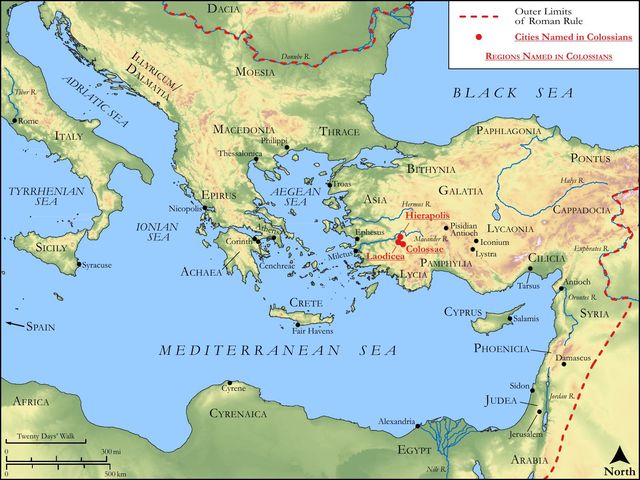
See on the biblical-era maps

Study this verse
Public-domain commentary
Matthew Henry
From his Commentary on the Whole Bible. Henry comments on passages, not single verses — this entry covers Colossians 2:13–15. His two-level outline is real structure in the source text, so it is rendered as structure.
The apostle here represents the privileges we Christians have above the Jews, which are very great.
I.Christ's death is our life:
And you, being dead in your sins and the uncircumcision of your flesh, hath he quickened together with him, Col 2:13. A state of sin is a state of spiritual death. Those who are in sin are dead in sin. As the death of the body consists in its separation from the soul, so the death of the soul consists in its separation from God and the divine favour. As the death of the body is the corruption and putrefaction of it, so sin is the corruption or depravation of the soul. As a man who is dead is unable to help himself by any power of his own, so an habitual sinner is morally impotent: though he has a natural power, or the power of a reasonable creature, he has not a spiritual power, till he has the divine life or a renewed nature. It is principally to be understood of the Gentile world, who lay in wickedness. They were dead in the uncircumcision of their flesh, being aliens to the covenant of promise, and without God in the world, Eph 2:11, Eph 2:12. By reason of their uncircumcision they were dead in their sins. It may be understood of the spiritual uncircumcision or corruption of nature; and so it shows that we are dead in law, and dead in state. Dead in law, as a condemned malefactor is called a dead man because he is under a sentence of death; so sinners by the guilt of sin are under the sentence of the law and condemned already, Joh 3:18. And dead in state, by reason of the uncircumcision of our flesh. An unsanctified heart is called an uncircumcised heart: this is our state. Now through Christ we, who were dead in sins, are quickened; that is, effectual provision is made for taking away the guilt of sin, and breaking the power and dominion of it. Quickened together with him - by virtue of our union to him, and in conformity to him. Christ's death was the death of our sins; Christ's resurrection is the quickening of our souls.
II.Through him we have the remission of sin:
Having forgiven you all trespasses. This is our quickening. The pardon of the crime is the life of the criminal: and this is owing to the resurrection of Christ, as well as his death; for, as he died for our sins, so he rose again for our justification, Rom 4:25.
III.Whatever was in force against us is taken out of the way.
He has obtained for us a legal discharge from the hand-writing of ordinances, which was against us (Col 2:14), which may be understood,
1.Of that obligation to punishment in which consists the guilt of sin. The curse of the law is the hand-writing against us, like the hand-writing on Belshazzar's wall. Cursed is every one who continues not in every thing. This was a hand-writing which was against us, and contrary to us; for it threatened our eternal ruin. This was removed when he redeemed us from the curse of the law, being made a curse for us, Gal 3:13. He cancelled the obligation for all who repent and believe. "Upon me be the curse, my father." He vacated and disannulled the judgment which was against us. When he was nailed to the cross, the curse was as it were nailed to the cross. And our indwelling corruption is crucified with Christ, and by virtue of his cross. When we remember the dying of the Lord Jesus, and see him nailed to the cross, we should see the hand-writing against us taken out of the way. Or rather,
2.It must be understood of the ceremonial law, the hand-writing of ordinances, the ceremonial institutions or the law of commandments contained in ordinances (Eph 2:15), which was a yoke to the Jews and a partition-wall to the Gentiles. The Lord Jesus took it out of the way, nailed it to his cross; that is, disannulled the obligation of it, that all might see and be satisfied that it was no more binding. When the substance came, the shadows fled away. It is abolished (Co2 3:13), and that which decayeth and waxeth old is ready to vanish away, Heb 8:13. The expressions are in allusion to the ancient methods of cancelling a bond, either by crossing the writing or striking it through with a nail.
IV.He has obtained a glorious victory for us over the powers of darkness:
And, having spoiled principalities and powers, he made a show of them openly, triumphing over them in it, Col 2:15. As the curse of the law was against us, so the power of Satan was against us. He treated with God as the Judge, and redeemed us out of the hands of his justice by a price; but out of the hands of Satan the executioner he redeemed us by power and with a high hand. He led captivity captive. The devil and all the powers of hell were conquered and disarmed by the dying Redeemer. The first promise pointed at this; the bruising of the heel of Christ in his sufferings was the breaking of the serpent's head, Gen 3:15. The expressions are lofty and magnificent: let us turn aside and see this great sight. The Redeemer conquered by dying. See his crown of thorns turned into a crown of laurels. He spoiled them, broke the devil's power, and conquered and disabled him, and made a show of them openly - exposed them to public shame, and made a show of them to angels and men. Never had the devil's kingdom such a mortal blow given to it as was given by the Lord Jesus. He tied them to his chariot-wheels, and rode forth conquering and to conquer - alluding to the custom of a general's triumph, who returned victorious. - Triumphing over them in it; that is, either in his cross and by his death; or, as some read it, in himself, by his own power; for he trod the wine-press alone, and of the people there was none with him.
Historical interpretation
Two Centuries of Reception
4 surviving comments on this verse. Each one is dated, so this reads as a timeline rather than a list.
Select a marker to jump to its quote. Markers stagger vertically where authors wrote within a few decades of each other.
Thanks to this simplicity of truth, so opposed to the subtlety and vain deceit of philosophy, we cannot possibly have any relish for such perverse opinions. Then, if God "quickens us together with Christ, forgiving us our trespasses," we cannot suppose that sins are forgiven by Him against whom, as having been all along unknown, they could not have been committed.
For unto this end was manifested the Son of God, to undo the works of the devil: "for He has "undone" them withal, by setting man free through baptism, the "handwriting of death" having been "made a gift of" to him: and accordingly, "he who is being born of God doeth not sin, because the seed of God abideth in him; and he cannot sin, because he hath been born of God.
And redeem them from the snare of the devil, and the ill-usage of the demons, and free them from every unlawful word, and every absurd practice and wicked thought; forgive them all their offences, both voluntary and involuntary, and blot out that handwriting which is against them,
"Having forgiven us," he saith, "all our trespasses," those which produced that deadness. What then? Did He allow them to remain? No, He even wiped them out; He did not scratch them out merely; so that they could not be seen. "In doctrines" [ordinances], he saith. What doctrines? The Faith. It is enough to believe. He hath not set works against works, but works against faith. And what next? Blotting out is an advance upon remission; again he saith, "And hath taken it out of the way." Nor yet even so did He preserve it, but rent it even in sunder, "by nailing it to His Cross." "Having put off from himself the principalities and the powers, He made a show of them openly, triumphing over them in it." Nowhere has he spoken in so lofty a strain.
Seest thou how great His earnestness that the bond should be done away? To wit, we all were under sin and punishment. He Himself, through suffering punishment, did away with both the sin and the punishment, and He was punished on the Cross. To the Cross then He affixed it; as having power, He tore it asunder. What bond? He means either that which they said to Moses, namely, "All that God hath said will we do, and be obedient" (Ex. xxiv. 3), or, if not that, this, that we owe to God obedience; or if not this, he means that the devil held possession of it, the bond which God made for Adam, saying, "In the day thou eatest of the tree, thou shalt die." (Gen. ii. 17.) This bond then the devil held in his possession. And Christ did not give it to us, but Himself tore it in two, the action of one who remits joyfully.
"Having put off from himself the principalities and the powers." He means the diabolical powers; because human nature had arrayed itself in these, or because they had, as it were, a hold, when He became Man He put away from Himself that hold. What is the meaning of "He made a show of them"? And well said he so; never yet was the devil in so shameful a plight. For whilst expecting to have Him, he lost even those he had; and when That Body was nailed to the Cross, the dead arose. There death received his wound, having met his death-stroke from a dead body. And as an athlete, when he thinks he has hit his adversary, himself is caught in a fatal grasp; so truly doth Christ also show, that to die with confidence is the devil's shame.
For he would have done everything to persuade men that He did not die, had he had the power. For seeing that of His Resurrection indeed all succeeding time was proof demonstrative; whilst of His death, no other time save that whereat it happened could ever furnish proof; therefore it was, that He died publicly in the sight of all men, but He arose not publicly, knowing that the aftertime would bear witness to the truth. For, that whilst the world was looking on, the serpent should be slain on high upon the Cross, herein is the marvel. For what did not the devil do, that He might die in secret? Hear Pilate saying, "Take ye Him away, and crucify Him, for I find no fault in Him" (John xix. 6), and withstanding them in a thousand ways. And again the Jews said unto Him, "If Thou art the Son of God, come down from the Cross." (Matt. xxvii. 40.) Then further, when He had received a mortal wound, and He came not down, for this reason He was also committed to burial; for it was in His power to have risen immediately: but He did not, that the fact might be believed. And yet in cases of private death indeed, it is possible to impute them to a swoon, but here, it is not possible to do this either. For even the soldiers brake not His legs, like those of the others, that it might be made manifest that He was dead. And those who buried The Body are known; and therefore too the Jews themselves seal the stone along with the soldiers. For, what was most of all attended to, was this very thing, that it should not be in obscurity. And the witnesses to it are from enemies, from the Jews. Hear them saying to Pilate, "That deceiver said, while he was yet alive, After three days I rise again. Command therefore that the sepulchre" (Matt. xxvi. 63, 64) be guarded by the soldiers. This was accordingly done, themselves also sealing it. Hear them further saying even afterwards to the Apostles, "Ye intend to bring this Man's blood upon us." (Acts v. 28.) He suffered not the very fashion of His Cross to be put to shame. For since the Angels have suffered nothing like it, He therefore doth everything for this, showing that His death achieved a mighty work. There was, as it were, a single combat. Death wounded Christ: but Christ, being wounded, did afterwards kill death. He that seemed to be immortal, was destroyed by a mortal body; and this the whole world saw. And what is truly wonderful is, that He committed not this thing to another. But there was made again a second bond of another kind than the former.
Continue studying Colossians 2:13 across the web’s major study libraries — every link below opens this exact verse, chapter, or book on the destination site.
Read & Compare
 BibleGatewayThis verse in more than 200 translations and 70 languages.
 Bible.comThe YouVersion reader — hundreds of translations, reading plans, and highlights.
 ESV.orgCrossway's official English Standard Version reader.
 NET BibleThe NET translation with 60,000+ translators' notes on every rendering decision.
 STEP BibleTyndale House's free study tool — original text, vocabulary, and scholarly resources.
 BibliaLogos Bible Software's free web reader.
 USCCBThe New American Bible (Revised Edition) with the U.S. bishops' study notes.
Commentaries
 BibleHub CommentariesDozens of classic commentaries on this verse, gathered on one page.
 StudyLightMore than 100 commentary sets — the largest collection on the web.
 BibleRefPlain-English commentary on what this verse means, verse by verse.
 Enduring WordDavid Guzik's free commentary on this chapter, widely used by Bible teachers.
 Bible Study ToolsVerse commentary alongside Greek and Hebrew study aids.
Original Language & Research
- BibleHub InterlinearThe verse word by word — original language, transliteration, and English.
- BibleHub LexiconEvery word's original-language definition and Strong's entry.
 Blue Letter BibleDeep-study tools — Strong's numbers, concordance, and word studies.
 CNTR CollationThe earliest Greek manuscripts of this verse, collated letter by letter.
Sermons, Hymns & Audio


TrulyRandomVerse is not affiliated with these sites and doesn’t control their content. They’re linked because they’re genuinely useful.
Summary
Colossians 2:13 powerfully declares the profound spiritual transformation experienced by believers in Christ. It portrays humanity's former state as spiritually dead and alienated from God, marked by both personal transgressions and a Gentile identity apart from the covenant. However, through God's gracious intervention, believers are supernaturally "quickened" or made alive together with Christ, simultaneously receiving complete and comprehensive forgiveness for all their sins, thereby establishing a new, vibrant spiritual reality rooted in His resurrection power.
Context
ShowHideLiterary Context
Colossians 2:13 is situated within Paul's broader theological argument in the letter, particularly his fervent defense of the sufficiency and supremacy of Christ against various false teachings infiltrating the Colossian church. Following warnings against deceptive philosophies and human traditions in Colossians 2:8, Paul grounds the believer's completeness and freedom in Christ alone. Verses Colossians 2:9-10 establish Christ's divine fullness and the believer's spiritual completeness in Him. This verse, Colossians 2:13, then elaborates on the mechanism of this completeness: through spiritual resurrection and forgiveness, directly linking it to Christ's work on the cross and resurrection, which is further expounded in Colossians 2:14-15. The "uncircumcision of your flesh" specifically addresses the Gentile believers, emphasizing that the new covenant's spiritual circumcision in Christ transcends the old covenant's physical rite.
Historical & Cultural Context
The church in Colossae faced a unique blend of syncretistic teachings, often referred to as the "Colossian heresy." This heresy likely combined elements of Jewish legalism (emphasizing rituals like circumcision, dietary laws, and festivals), philosophical asceticism (self-denial, mystical experiences), and possibly early Gnostic ideas (special knowledge, angelic worship, disdain for the material world). Paul's emphasis on "the uncircumcision of your flesh" directly counters the legalistic insistence on physical circumcision as a prerequisite for full inclusion or spiritual maturity, which was a significant issue for Gentile converts. The cultural context also included a Roman imperial presence, but the immediate threat to the church's purity came from within, through false teachers who diminished Christ's unique role and introduced human-made requirements for salvation or spiritual advancement. Paul's letter, therefore, served as a crucial corrective, re-centering the Colossians' faith on Christ alone.
Key Themes
ShowHideThis verse contributes significantly to several major themes found throughout the book of Colossians. Firstly, it underscores the theme of Christ's Supremacy and Sufficiency, asserting that all that is needed for salvation, spiritual life, and forgiveness is found in Him, countering any notion of additional requirements or mediators (as seen in Colossians 1:15-20). Secondly, it highlights the radical Transformation from Spiritual Death to New Life in Christ, a concept also powerfully articulated in Ephesians 2:1-5. This transformation is not merely an improvement but a complete spiritual resurrection, a participation in Christ's own life. Thirdly, the verse emphasizes Complete Forgiveness and Redemption, showcasing God's gracious act of removing the burden of sin and guilt, which is foundational to the believer's new identity and freedom (Colossians 1:14). Finally, by addressing the "uncircumcision of your flesh," it strongly reinforces the theme of Inclusion of Gentiles into God's covenant blessings through faith in Christ, breaking down barriers that once separated Jews and Gentiles (as further developed in Ephesians 2:11-22).
Exposition and Analysis
ShowHideKey Word Analysis
ShowHideFrom an apparently primary root meaning "a corpse," this term denotes a state of being "dead" literally or figuratively. In Colossians 2:13, it is used figuratively to describe the spiritual condition of humanity apart from Christ: a state of spiritual separation from God, characterized by an inability to respond to divine life or produce righteousness. It signifies a lack of spiritual vitality and responsiveness, not merely moral weakness but a fundamental incapacity.
Derived from words referring to the prepuce, this term literally means "the prepuce" or "uncircumcised." By implication, it refers to an uncircumcised (i.e., Gentile) state or person, and figuratively, an unregenerate state. In this context, it specifically addresses the Gentile background of the Colossian believers, highlighting that their physical status outside the Jewish covenant of circumcision was no barrier to God's saving grace or their inclusion in the new covenant community. It underscores that true spiritual circumcision is of the heart, not merely of the flesh.
This compound verb comes from sýn (with, together) and zōopoiéō (to make alive). It means "to reanimate conjointly with" or "to make alive together with." The prefix syn- is crucial, emphasizing a profound union and co-participation with Christ. It signifies that believers are not merely revived but are made alive with Christ, sharing in His resurrection life and power. This is a divine act of imparting spiritual life, transforming the dead into the living.
From a root meaning "to fall beside" or "to slip aside," this noun signifies a "side-slip (lapse or deviation)," meaning an (unintentional) error or (wilful) transgression. It refers to specific acts of sin, a deviation from God's righteous standard. The use of "all trespasses" emphasizes the comprehensive nature of the forgiveness extended by God through Christ, covering every single offense.
Verse Breakdown
ShowHide"And you, being dead in your sins"
This clause describes the former spiritual condition of the Colossian believers (and all humanity apart from Christ). "Dead" here is not physical death but a spiritual state of alienation and separation from God, characterized by an inability to respond to His call or live righteously. This spiritual death is "in" or "because of" their "sins" (plural), referring to their specific acts of transgression and rebellion against God's holy standard.
"and the uncircumcision of your flesh"
This phrase further defines their former state, particularly for the Gentile believers in Colossae. "Uncircumcision of your flesh" refers to their physical status as Gentiles, who were outside the covenant community of Israel and its sign of circumcision. Theologically, it represents their unregenerate state, their natural human condition apart from God's covenant grace, emphasizing their spiritual alienation and the inadequacy of human efforts or external rituals for salvation.
"hath he quickened together with him"
This is the pivotal turning point, highlighting God's miraculous intervention. The subject "he" refers to God the Father, who, through Christ, has "quickened" or "made alive" believers. The crucial addition "together with him" (Christ) signifies a profound spiritual union. Believers are not merely revived but are raised to new life with Christ, participating in His resurrection power and sharing in His victory over death and sin. This is a divine act of spiritual regeneration.
"having forgiven you all trespasses"
This final clause explains the basis and consequence of being quickened. Concurrent with being made alive, God has "forgiven" (graciously pardoned) believers for "all trespasses." The word "all" emphasizes the comprehensive and complete nature of this forgiveness, covering every single sin committed. This radical act of pardon removes the guilt, penalty, and power of sin, making reconciliation with God possible and forming the foundation for the new life received.
Literary Devices
ShowHidePaul employs several powerful literary devices in Colossians 2:13 to convey his profound theological message. Metaphor is central, as he describes the unregenerate state as "dead in your sins." This isn't literal death but a vivid comparison illustrating spiritual lifelessness, an inability to respond to God or produce spiritual fruit. This metaphor sets up a stark Contrast with the subsequent phrase, "hath he quickened together with him," highlighting the radical transformation from spiritual death to vibrant spiritual life. The phrase "uncircumcision of your flesh" uses Metonymy, where the physical state of being uncircumcised stands for the entire Gentile identity and their spiritual alienation from God's covenant people. Finally, the declaration "having forgiven you all trespasses" uses Hyperbole to emphasize the absolute and comprehensive nature of God's forgiveness, leaving no sin unforgiven, thereby assuring believers of their complete pardon.
Theological and Thematic Connections
ShowHideColossians 2:13 is a foundational declaration of the believer's new identity and standing in Christ, rooted in God's sovereign grace. It underscores the profound theological truth that salvation is entirely a work of God, transforming individuals from a state of spiritual death and alienation into vibrant new life. This passage beautifully articulates the concept of "union with Christ," where believers are not merely recipients of His benefits but are intimately joined with Him in His death, burial, and resurrection. This union means that Christ's victory over sin and death becomes their victory, and His life becomes their life. The complete forgiveness of "all trespasses" highlights the thoroughness of Christ's atoning work, removing the barrier of sin and establishing a righteous standing before God, not based on human merit or ritual, but solely on divine grace. This truth liberates believers from the burden of guilt and the futility of self-effort, empowering them to live in the freedom and power of their new spiritual reality.
Reflection and Application
ShowHideColossians 2:13 offers profound comfort and a powerful foundation for the believer's identity and walk. To truly grasp its implications is to be liberated from the weight of past failures and the futility of striving for acceptance. We are reminded that our spiritual life is not dependent on our performance, our background, or any human ritual, but entirely on God's gracious act in Christ. This truth should cultivate deep gratitude for the radical transformation from spiritual death to vibrant life, fostering a secure assurance of our standing with God. Knowing that "all trespasses" have been forgiven empowers us to live without the condemnation of sin, freeing us to pursue holiness not out of fear or obligation, but out of love and joyful response to the One who gave us new life. It calls us to live from our new identity in Christ, recognizing that the power that raised Him from the dead is now at work within us, enabling us to overcome sin and live a life that honors Him.
Questions for Reflection
ShowHideFAQ
ShowHideWhat does it mean to be "dead in your sins and the uncircumcision of your flesh"?
ShowHideTo be "dead in your sins" (Greek, nekrós en tois hamartíais) means to be spiritually separated from God, unable to respond to His call or produce spiritual life. It's not a physical death, but a state of spiritual lifelessness and alienation from the source of all life. The "uncircumcision of your flesh" (Greek, akrobystía tēs sarkós) specifically refers to the Gentile background of many believers, who were physically uncircumcised and therefore outside the covenant community of Israel. Theologically, it signifies humanity's natural, unregenerate state apart from God's grace, emphasizing that neither one's ethnic background nor adherence to external rituals could bridge the gap created by sin. Both phrases describe a condition of profound spiritual inability and alienation from God, highlighting the desperate need for divine intervention. This condition is universally true for all humanity apart from Christ, as described in Ephesians 2:1.
How does God "quicken" us, and what does it mean to be "quickened together with him"?
ShowHideGod "quickens" (Greek, syzōopoiéō) us by imparting spiritual life where there was once only spiritual death. This is a supernatural act of regeneration, a spiritual resurrection. To be "quickened together with him" means that this new life is intimately linked to and shared with Christ. It signifies a profound spiritual union with Jesus, where believers participate in His resurrection life. Just as Christ was raised from the dead, believers are spiritually raised with Him, sharing in His victory over sin and death. This is not merely a revival of old life but the impartation of a completely new, divine life that flows from our union with Christ. This concept is further elaborated in Romans 6:4 and Ephesians 2:5.
Christ-Centered Fulfillment
ShowHideColossians 2:13 finds its ultimate fulfillment in the person and work of Jesus Christ, who is the sole source of the spiritual life and complete forgiveness it proclaims. Humanity's state of being "dead in sins" and marked by "the uncircumcision of your flesh" (representing spiritual alienation) is directly addressed by Christ's atoning sacrifice on the cross. He became sin for us, dying our death so that we might live His life (2 Corinthians 5:21). The "quickening together with him" is the glorious result of Christ's resurrection; His triumph over death and the grave is the power by which we are spiritually regenerated and raised to new life (Romans 6:4). Furthermore, the complete forgiveness of "all trespasses" is made possible only through the shedding of Christ's blood, which cleanses us from all sin (Hebrews 9:22 and 1 John 1:7). In Christ, the old covenant's physical mark of circumcision is superseded by a spiritual circumcision of the heart, performed by Christ Himself, signifying a complete cutting away of the sinful nature (Colossians 2:11). Thus, Colossians 2:13 is a powerful testament to Christ's all-sufficient work, through which God reconciles alienated humanity to Himself, grants new life, and provides comprehensive pardon, fulfilling the deepest needs of the human heart.