


Matthew 20:26
Bible text: King James Version (1769 Blayney text) · Public domain
Bible text: Berean Standard Bible · Public domain
Bible text: American Standard Version (1901) · Public domain
Bible text: World English Bible, Messianic edition · Public domain
Bible text: Geneva Bible (1599) · Public domain
Bible text: Young's Literal Translation · Public domain
- οὐχouchNotG3756PRT-NNegative Particle Negative
- οὕτωςhoutōsthusG3779ADVAdverb
- δέdenowG1161CONJConjunction
- ἔσταιestaiwill it beG1510V-FDI-3SVerb Future Middle Deponent Indicative 3rd Singular
- ἐνenamongG1722PREPPreposition
- ὑμῖνhuminyouG4771P-2DPPersonal pronoun Dative 2nd Plural
- ἀλλ᾽all᾽butG235CONJConjunction
- ὃςhoswho[ever]G3739R-NSMRelative pronoun Nominative Singular Masculine
- ἐὰνeanifG1437CONDConjunction
- θέλῃthelēshall wishG2309V-PAS-3SVerb Present Active Subjunctive 3rd Singular
- ἐνenamongG1722PREPPreposition
- ὑμῖνhuminyouG4771P-2DPPersonal pronoun Dative 2nd Plural
- μέγαςmegasgreatG3173A-NSMAdjective Nominative Singular Masculine
- γενέσθαιgenesthaito becomeG1096V-2ADNVerb 2nd Aorist Middle Deponent Infinitive
- ἔσταιestaihe will beG1510V-FDI-3SVerb Future Middle Deponent Indicative 3rd Singular
- ὑμῶνhumōnyourG4771P-2GPPersonal pronoun Genitive 2nd Plural
- διάκονος·diakonosservantG1249N-NSMNoun Nominative Singular Masculine
English is a literal word-by-word gloss of the Greek, not the KJV's wording. Why?
This is the original text the KJV's translators worked from — each Greek word with its own literal English meaning in this verse, prepared by scholars at Tyndale House, Cambridge. The KJV translates whole sentences, not word by word, so its wording differs: one Greek word can become several English words, and the KJV may choose “charity” where the gloss reads “love”. Both are faithful — they answer different questions. For the KJV's own rendering, switch to the KJV text.
Details
See on the biblical-era maps
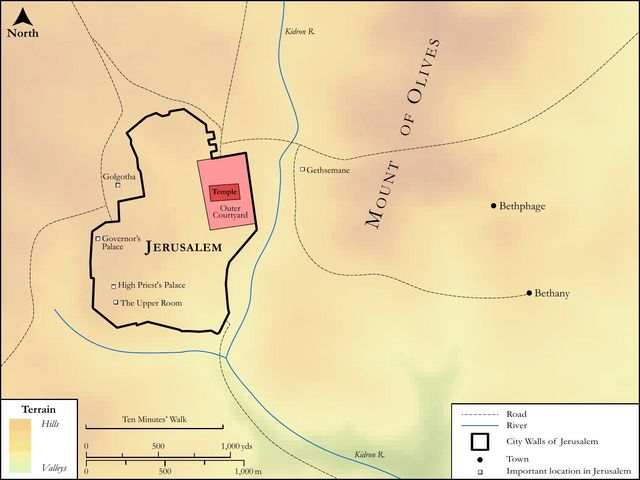
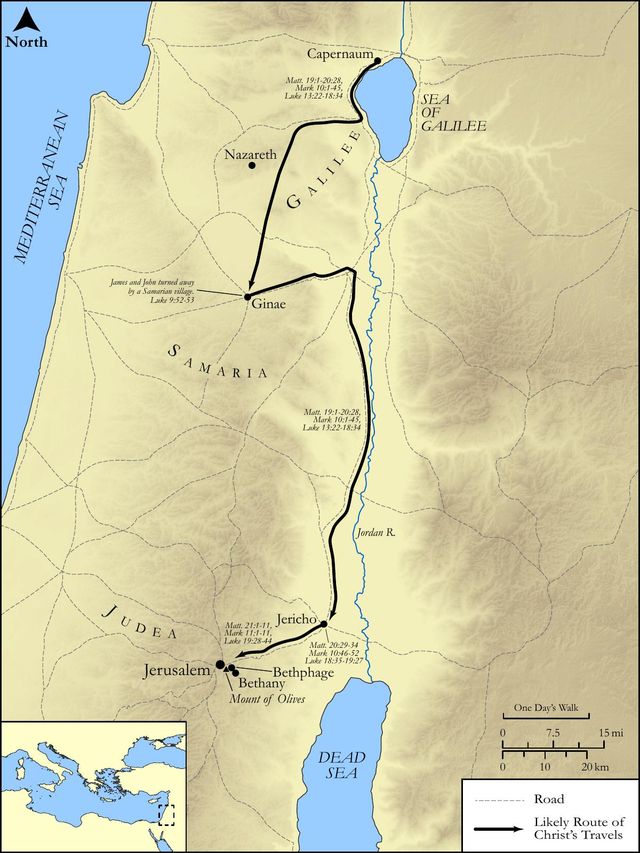
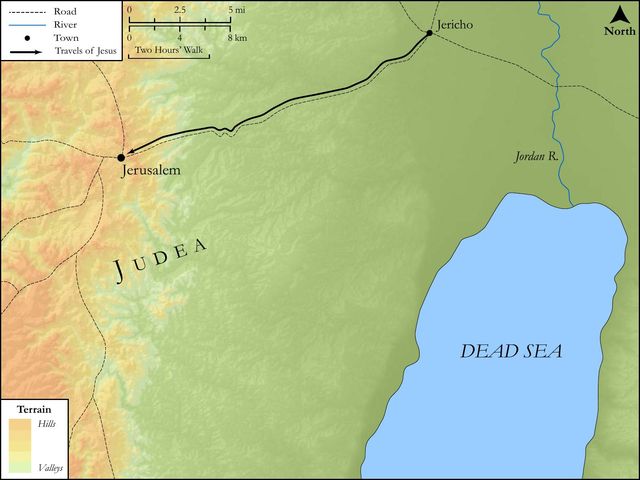
Study this verse
Historical interpretation
Two Centuries of Reception
9 surviving comments on this verse. Each one is dated, so this reads as a timeline rather than a list.
Select a marker to jump to its quote. Markers stagger vertically where authors wrote within a few decades of each other.
That is, not content merely to rule over their subjects, they are severe and oppressive. But among you who are Mine these things shall not be so; for as all carnal things are done by compulsion, but spiritual things by free-will, so those rulers who are spiritual ought to rest their power in the love of their subjects, not in their fears.
"Then were the ten moved with indignation with respect to the two." Then. When? When He had reproved them. So long as the judgment was Christ's, they were not moved with indignation; but seeing them preferred, they were contented, and held their peace, out of reverence and honor to their Master.
And if they were vexed in mind, yet they dared not utter this. And when they had some feeling of human weakness towards Peter, at the time that He gave the didrachmas, they did not give way to anger, but asked only, "Who then is greatest?" But since here the request was the disciples', they are moved with indignation. And not even here are they straightway moved with indignation, when they asked, but when Christ had reproved them, and had said they should not enjoy the first honors, unless they showed themselves worthy of these.
Seest thou how they were all in an imperfect state, when both these were lifting themselves up above the ten, and those envying the two? But, as I said, show me them after these things, and thou wilt see them delivered from all these passions. Hear at least how this same John, he who now came to Him for these things, everywhere gives up the first place to Peter, both in addressing the people, and in working miracles, in the Acts of the Apostles.
And he conceals not Peter's good deeds, but relates both the confession, which he openly made when all were silent, and his entering into the tomb, and puts the apostle before himself. For, because both continued with Him at His crucifixion, taking away the ground of his own commendation, he saith, "That disciple was known unto the high priest."
But James survived not a long time, but from the beginning he was so greatly filled with warmth, and so forsook all the things of men, and mounted up to an height unutterable, as straightway to be slain. Thus, in all respects, they after these things became excellent.
But then, "they were moved with indignation." What then saith Christ? "He called them unto Him, and said, The princes of the Gentiles exercise dominion over them." For, as they were disturbed and troubled, He soothes them by His call before His word, and by drawing them near Him. For the two having separated themselves from the company of the ten, had stood nearer Him, pleading their own interests. Therefore He brings near Him these also, by this very act, and by exposing and revealing it before the rest, soothing the passion both of the one and of the other.
And not as before, so now also doth He check them. For whereas before He brings little children into the midst, and commands to imitate their simplicity and lowliness; here He reproves them in a sharper way from the contrary side, saying, "The princes of the Gentiles exercise dominion over them, and their great ones exercise authority upon them, but it shall not be so among you; but he that will be great among you, let this man be minister to all; and he that will be first, let him be last of all;" showing that such a feeling as this is that of heathens, I mean, to love the first place. For the passion is tyrannical, and is continually hindering even great men; therefore also it needs a severer stripe. Whence He too strikes deeper into them, by comparison with the Gentiles shaming their inflamed soul, and removes the envy of the one and the arrogance of the other, all but saying, "Be not moved with indignation, as insulted. For they harm and disgrace themselves most, who on this wise seek the first places, for they are amongst the last. For matters with us are not like matters without. 'For the princes of the Gentiles exercise dominion over them,' but with me the last, even he is first."
"And in proof that I say not these things without cause, by the things which I do and suffer, receive the proof of my sayings. For I have myself done something even more. For being King of the powers above, I was willing to become man, and I submitted to be despised, and despitefully entreated. And not even with these things was I satisfied, but even unto death did I come. Therefore," He saith,
"Even as the Son of Man came not to be ministered unto, but to minister, and to give His life a ransom for many." "For not even at this did I stop," saith He, "but even my life did I give a ransom; and for whom? For enemies. But thou if thou art abused, it is for thyself, but I for thee."
Be not then afraid, as though thine honor were plucked down. For how much soever thou humblest thyself, thou canst not descend so much as thy Lord. And yet His descent hath become the ascent of all, and hath made His own glory shine forth. For before He was made man, He was known amongst angels only; but after He was made man and was crucified, so far from lessening that glory, He acquired other besides, even that from the knowledge of the world.
Fear not then, as though thine honor were put down, if thou shouldest abase thyself, for in this way is thy glory more exalted, in this way it becomes greater. This is the door of the kingdom. Let us not then go the opposite way, neither let us war against ourselves. For if we desire to appear great, we shall not be great, but even the most dishonored of all.
Seest thou how everywhere He urges them by the opposite things, giving them what they desire? For in the preceding parts also we have shown this in many instances, and in the cases of the covetous, and of the vain-glorious, He did thus. For wherefore, He saith, dost thou give alms before men? That thou mayest enjoy glory? Thou must then not do so, and thou shall surely enjoy it. Wherefore dost thou lay up treasures? That thou mayest be rich? Thou must then not lay up treasures, and thou shalt be rich. Even so here too, wherefore dost thou set thy heart on the first places? That thou mayest be before others? Choose then the last place, and then thou wilt enjoy the first. So that if it be thy will to become great, seek not to become great, and then thou wilt be great. For the other is to be little.
Seest thou how He drew them off from the disease, by showing them both from thence failing of their object, and from hence gaining, that they might flee the one, and follow after the other.
And of the Gentiles, too, He for this cause reminded them, that in this way again He might show the thing to be disgraceful and to be abhorred.
For the arrogant is of necessity base, and, on the contrary, the lowly-minded is high. For this is the height that is true and genuine, and exists not in name only, nor in manner of address. And that which is from without is of necessity and fear, but this is like to God's. Such a one, though he be admired by no one, continues high; even as again the other, though he be courted by all, is of all men the basest. And the one is an honor rendered of necessity, whence also it easily passes away; but the other is of principle, whence also it continues steadfast. Since for this we admire the saints also, that being greater than all, they humbled themselves more than all. Wherefore even to this day they continue to be high, and not even death hath brought down that height.
So long as the judgment of Christ upon this request was in suspense, the other disciples were not indignant; but when they heard Him rebuke them, they were sorrowful; whence it is said, And when the ten heard it, they had indignation against the two brethren.
For when the Lord rebuked them, then they perceived that this request was from the disciples. For though they were grieved in their hearts when they saw them so especially honoured in the transfiguration, they yet dared not so express themselves, out of respect to their teacher.
By thus calling them to Him, and speaking to them face to face, he sooths them in their discomposure; for the two had been speaking with the Lord apart by themselves. But not now as before does He it by bringing forward a child, but He proves it to them by reasoning from contraries; Ye know that the princes of the Gentiles exercise dominion over them.
He shows here that it is of the Gentiles to desire preeminence; and by this comparison of the Gentiles He calms their troubled souls.
How much soever you humble yourself, you cannot descend so far as did your Lord.
(Verses 25 and following) But Jesus called them to Himself and said, 'You know that the rulers of the Gentiles lord it over them, and their great men exercise authority over them. It is not this way among you, but whoever wishes to become great among you shall be your servant, and whoever wishes to be first among you shall be your slave. Just as the Son of Man did not come to be served, but to serve, and to give His life a ransom for many.' Therefore, it is in vain that some have sought excessive things, or that others grieve over the longing for their ancestors, since the summit of virtues is reached not through power, but through humility. Finally, he presents his own example, so that if his words were disregarded, they would be ashamed of their actions, and he says:
(Verse 19 onwards) And as they were departing from Jericho, a great crowd followed him. And behold, two blind men sitting by the roadside, heard that Jesus was passing by, and they cried out, saying: Lord, have mercy on us, Son of David. But the crowd rebuked them, telling them to be silent. Yet they cried out even more, saying: Lord, have mercy on us, Son of David. There were many robbers in Jericho who used to attack and harm those who were coming in and going out of Jerusalem; therefore the Lord came to Jericho with his disciples, to heal the wounded and to bring a large crowd with him. Finally, after they want to leave from Jericho, a large crowd followed him. If he had stayed in Jerusalem and never descended to the lowly things, the crowd would still be sitting in darkness and in the shadow of death until today. But there were also two blind men by the road. He calls blind those who could not yet speak: In your light we will see light (Ps. XXXV, 10). Along the road, because they seemed to have knowledge of the Law: but they were ignorant of the way, which is Christ: whom most understand as the Pharisees and Sadducees, and others as both the people, the old Testament and the New: because one, following the written Law, was blind without Christ. Because they could not see by themselves, they heard the proclamations of the Savior, and confessed him as the son of David. But if both blind men are referred to the Jewish people, what follows, 'The crowd rebuked them,' should be understood in relation to the Gentiles: whom the Apostle warns not to boast and be arrogant against their own root (Rom. 11); but since they themselves were grafted in by the error of those before them from the wild olive tree into the good olive tree, they should by no means envy the salvation of those before them. Have mercy on us, O son of David. They are reproached by the crowds, and yet they do not remain silent: but rather they repeat the same thing more frequently, so that they may show the desire for the fullness of true light.
They do not lay it upon the forwardness of the mother who spoke the request, but upon her sons, who, not knowing their measure, burned with so immoderate desires.
But the meek and lowly Master neither charges the two with ambition, nor rebukes the ten for their spleen and jealousy; but, Jesus called them unto him.
Lastly, He sets before them His own example, that so should they little weigh His words, His deeds might shame them, whence He adds, As also the Son of Man cometh not to be ministered unto, but to minister.
(de Trin i. 12.) Or otherwise; The Lord makes answer to His disciples in His character of servant; though whatever is prepared by the Father is also prepared by the Son, for He and the Father are one.
A hermit was asked, ‘What is humility?’ He answered, ‘Humility is a great work, and a work of God. The way of humility is to undertake bodily labour, and believe yourself a sinner, and make yourself the servant of all.’ A brother said, ‘What does it mean, to be the servant of all?’ He answered, ‘To be the servant of all is not to look at the sins of others, always to look at your own sins, and to pray to God without ceasing.’
But as the two had asked carnally, so now the ten are grieved carnally. For as to seek to be above all is blame-worthy, so to have another above us is mortifying to our vanity.
Indeed, to desire a good work is good, for it is within our will, and ours is the reward; but to desire a primacy of honour is vanity. For when we attain this we are judged of God, because we know not whether in our precedence of honour we deserve the reward of righteousness. For not even an Apostle will have praise with God, because he is an Apostle, but if he has well fulfilled the duties of his Apostleship; nor was an Apostle placed in honour as an Apostle, for any previous merit of his; but was judged meet for that ministry, on account of the disposition of his mind. For high place courts him who flies from it, and shuns him who courts it. A better life then, and not a more worthy degree, should be our object. The Lord therefore, willing to check the ambition of the two sons of Zebedee, and the indignation of the others, points out this distinction between the chief men of the world, and those of the Church, showing that the primacy in Christ is neither to be sought by him who has it not, nor envied by him who has it. For men become masters in this world that they may exercise domination over their inferiors, and reduce them to slavery, and rob them, and employ them even to death for their own profit and glory. But men become governors in the Church, that they may serve those who are under them, and minister to them whatever they have received of Christ, that they may postpone their own convenience, and mind that of others, and not refuse even to die for the sake of those beneath them. To seek therefore a command in the Church is neither righteous, nor profitable. No prudent man will voluntarily subject himself to slavery, nor to stand in such peril wherein he will have to render account for the whole Church; unless it be one perchance who fears not God's judgment, who abuses His ecclesiastical primacy to a secular end, so that He converts it into a secular primacy.
Continue studying Matthew 20:26 across the web’s major study libraries — every link below opens this exact verse, chapter, or book on the destination site.
Read & Compare
 BibleGatewayThis verse in more than 200 translations and 70 languages.
 Bible.comThe YouVersion reader — hundreds of translations, reading plans, and highlights.
 ESV.orgCrossway's official English Standard Version reader.
 NET BibleThe NET translation with 60,000+ translators' notes on every rendering decision.
 STEP BibleTyndale House's free study tool — original text, vocabulary, and scholarly resources.
 BibliaLogos Bible Software's free web reader.
 USCCBThe New American Bible (Revised Edition) with the U.S. bishops' study notes.
Commentaries
 BibleHub CommentariesDozens of classic commentaries on this verse, gathered on one page.
 StudyLightMore than 100 commentary sets — the largest collection on the web.
 BibleRefPlain-English commentary on what this verse means, verse by verse.
 Enduring WordDavid Guzik's free commentary on this chapter, widely used by Bible teachers.
 Bible Study ToolsVerse commentary alongside Greek and Hebrew study aids.
Original Language & Research
- BibleHub InterlinearThe verse word by word — original language, transliteration, and English.
- BibleHub LexiconEvery word's original-language definition and Strong's entry.
 Blue Letter BibleDeep-study tools — Strong's numbers, concordance, and word studies.
 CNTR CollationThe earliest Greek manuscripts of this verse, collated letter by letter.
Sermons, Hymns & Audio


TrulyRandomVerse is not affiliated with these sites and doesn’t control their content. They’re linked because they’re genuinely useful.
Summary
Matthew 20:26 presents a radical redefinition of greatness within the Kingdom of God, contrasting sharply with the worldly pursuit of power and dominance. Following the ambitious request of James and John's mother, Jesus teaches His disciples that true leadership among His followers is not found in exercising authority over others, as Gentile rulers do, but rather in humble, self-sacrificial service. This verse establishes a foundational principle for Christian community and leadership: genuine influence and spiritual authority are attained through ministering to others, reflecting Christ's own example of servanthood.
Context
ShowHideLiterary Context
This verse is deeply embedded within a crucial teaching moment in Jesus's ministry, specifically following the third prediction of His passion and resurrection in Matthew 20:17-19. Immediately preceding Matthew 20:26, the mother of James and John approaches Jesus with an audacious request for her sons to sit at His right and left hand in His kingdom (Matthew 20:20-21). This request sparks indignation among the other ten disciples (Matthew 20:24), revealing their own lingering worldly ambitions and misunderstanding of Jesus's kingdom. Jesus seizes this opportunity to correct their misconceptions, first by describing the oppressive nature of Gentile authority (Matthew 20:25), and then by presenting His counter-cultural model of servant leadership, culminating in His own example in Matthew 20:28.
Historical & Cultural Context
Under Rome in Jesus's time, leadership was synonymous with power, prestige, and the exercise of authority. Rulers, governors, and even religious leaders often sought to dominate and be served, extracting tribute and homage from their subjects. The concept of a leader humbling themselves to serve those under them was largely alien and counter-intuitive. Roman society, in particular, valued status and honor, with a clear hierarchy where the powerful ruled over the weak. Jesus's teaching directly challenges this pervasive cultural norm, presenting a revolutionary paradigm for leadership that would have been shocking to His disciples, who were themselves steeped in these societal expectations and still harbored hopes of earthly power and recognition within His anticipated kingdom.
Key Themes
ShowHideMatthew 20:26 contributes significantly to several overarching themes in the Gospel of Matthew. It is central to Jesus's redefinition of greatness, shifting the focus from worldly power and status to humble service. This teaching underscores the theme of discipleship, emphasizing that true followers of Christ are called to embody a different kind of life, one marked by self-denial and service, rather than self-exaltation. It also highlights the theme of kingdom values, demonstrating that the principles governing God's kingdom are fundamentally inverted compared to those of the world. The passage foreshadows Jesus's ultimate act of self-sacrifice (Matthew 20:28), presenting His life as the supreme example of the servant leadership He calls His disciples to embrace. This radical ethic of service is a recurring motif throughout Jesus's ministry, from the Sermon on the Mount to His final instructions to His disciples.
Exposition and Analysis
ShowHideKey Word Analysis
ShowHideThis word, often translated as "big" or "large," refers to something or someone of significant size, importance, or influence. In the context of the disciples' request and the worldly understanding of leadership, it signifies a person of high status, power, and authority—one who commands respect and is served by others. Jesus uses this common understanding of "greatness" only to subvert it entirely, redefining it in terms of service rather than dominion.
This versatile verb means "to come into being," "to become," or "to happen." In this verse, it speaks to the process of transformation or the state of existence. When Jesus says "whosoever will be great," He is addressing the very aspiration of the disciples to become something significant. The subsequent command, "let him be your minister," indicates the new state or identity that true greatness entails—a shift from a desire for status to an embodiment of service.
This term literally means "an attendant," "a waiter at table," or "one who runs on errands." It denotes someone who serves others in a practical, often humble capacity. It is the root of the English word "deacon." Its use here is profoundly significant: Jesus directly equates "greatness" not with ruling or being served, but with active, humble service. It emphasizes a posture of self-giving and meeting the needs of others, rather than asserting authority or demanding honor.
Verse Breakdown
ShowHide"But it shall not be so among you:"
Jesus immediately establishes a stark contrast between the worldly model of leadership, which He has just described (Gentile rulers lording over their subjects), and the principles that must govern His community. The "you" refers specifically to His disciples, indicating that the kingdom ethic is fundamentally different and counter-cultural. This phrase serves as a direct repudiation of the disciples' (and the world's) understanding of power.
"but whosoever will be great among you,"
This clause acknowledges the inherent human desire for significance and influence. Jesus does not condemn the aspiration to "be great" outright, but rather redirects it. The "whosoever" implies that this new path to greatness is open to anyone among His followers, regardless of their current status or background, provided they adopt the prescribed method.
"let him be your minister;"
This is the core command and the radical redefinition. The path to true greatness in God's kingdom is through humble service. The term "minister" (diákonos) signifies active, practical service to others, often in a lowly capacity. This command turns the world's power structure upside down: instead of being served, the one who desires to be great must become a servant of all, prioritizing the needs and well-being of others.
Literary Devices
ShowHideMatthew 20:26 employs several significant literary devices. The most prominent is Antithesis, where Jesus directly contrasts the worldly model of leadership ("it shall not be so among you") with the kingdom model ("whosoever will be great... let him be your minister"). This sharp opposition highlights the radical nature of His teaching. There is also clear Irony, as Jesus declares that the path to "greatness" (a concept typically associated with power and being served) is through "ministry" (a concept associated with humility and serving). This ironic reversal challenges conventional wisdom. Furthermore, the passage uses Didactic Instruction, as Jesus is explicitly teaching His disciples a foundational principle for their conduct and leadership within His nascent community. The use of the imperative "let him be" underscores the authoritative and prescriptive nature of this teaching.
Theological and Thematic Connections
ShowHideMatthew 20:26 is a pivotal statement that encapsulates the inverted values of the Kingdom of God, where humility precedes honor and service defines true leadership. It stands in direct opposition to the fallen human tendency towards self-exaltation and the pursuit of power for personal gain. Theologically, it reveals the nature of God's reign as one of love, sacrifice, and humble care for humanity, rather than oppressive dominion. This principle of servant leadership is not merely a suggestion but a divine mandate for all who claim to follow Christ, mirroring God's own condescension in Christ to serve and redeem humanity. It underscores that spiritual authority is derived from a posture of self-giving, reflecting the very character of God.
Reflection and Application
ShowHideMatthew 20:26 serves as an enduring challenge to every believer, calling us to fundamentally re-evaluate our understanding of success, influence, and leadership. In a world that constantly pressures us to assert ourselves, climb the ladder, and seek personal recognition, Jesus's words offer a liberating counter-narrative. This verse is not just for those in formal leadership positions but for every disciple, inviting us to cultivate a servant's heart in all our relationships and spheres of influence—in our families, workplaces, churches, and communities. It compels us to ask whether our ambitions are rooted in self-exaltation or in a genuine desire to uplift and benefit others. Embracing this principle means actively seeking opportunities to serve, to put the needs of others before our own, and to find our true significance not in being served, but in serving, just as Christ Himself did. It is a call to humble, practical action that transforms lives and reflects the very nature of God's love.
Questions for Reflection
ShowHideFAQ
ShowHideWhat is the "worldly" view of greatness that Jesus is contrasting in Matthew 20:26?
ShowHideThe "worldly" view of greatness, as described by Jesus in Matthew 20:25, is characterized by rulers who "lord it over" their subjects and "exercise authority" over them. This implies a system where power is used for personal gain, dominance, and self-exaltation, often at the expense of others. It's a hierarchical structure where those at the top are served and control those beneath them, seeking prestige, honor, and obedience. This was the prevailing model in the Roman Empire and among the princes of the Gentiles.
Christ-Centered Fulfillment
ShowHideMatthew 20:26 finds its ultimate fulfillment and most profound expression in the person and work of Jesus Christ Himself. While the verse commands His followers to be ministers, Jesus perfectly embodies this principle, not merely as a teacher but as the supreme example. He came "not to be ministered unto, but to minister, and to give his life a ransom for many" (Matthew 20:28). His entire earthly ministry, from His incarnation to His crucifixion, was a demonstration of humble servanthood. He, who was God, "made himself of no reputation, and took upon him the form of a servant" (Philippians 2:7), washing His disciples' feet (John 13:1-17) and ultimately offering His life as the perfect sacrifice for the sins of humanity. Thus, the call to be a "minister" in Matthew 20:26 is not just a moral imperative but an invitation to participate in the very nature and mission of Christ, who achieved ultimate greatness and glory through the path of ultimate humility and service. His resurrection and exaltation (Philippians 2:9-11) demonstrate that God honors and exalts those who humble themselves and serve.