


Genesis 31:4
Bible text: King James Version (1769 Blayney text) · Public domain
Bible text: Berean Standard Bible · Public domain
Bible text: American Standard Version (1901) · Public domain
Bible text: World English Bible, Messianic edition · Public domain
Bible text: Geneva Bible (1599) · Public domain
Bible text: Young's Literal Translation · Public domain
- וַיִּשְׁלַחvai·yish·Lachand he sentH7971Conj-w ¦ V-Qal-ConsecImperf-3msVerb Qal Consecutive Imperfect 3rd Singular Masculineוַandיִּשְׁלַחhe sent
- יַעֲקֹבya·'a·KoJacobH3290N-proper-mNoun Proper Masculine
- וַיִּקְרָאvai·yik·Ra'and he summonedH7121Conj-w ¦ V-Qal-ConsecImperf-3msVerb Qal Consecutive Imperfect 3rd Singular Masculineוַandיִּקְרָאhe summoned
- לְרָחֵלle·ra·Chel<to> RachelH7354Prep-l ¦ N-proper-fNoun Proper Feminineלְ<to>רָחֵלRachel
- וּלְלֵאָהu·le·le·'Ahand <to> LeahH3812Conj-w ¦ Prep-l ¦ N-proper-fNoun Proper Feminineוּandלְ<to>לֵאָהLeah
- הַשָּׂדֶהha·sa·Dehthe fieldH7704Art ¦ N-msNoun Singular Masculine Absoluteהַtheשָּׂדֶהfield
- אֶל'eltoH413PrepPreposition
- צֹאנוֹtzo·Nohis flockH6629N-csc ¦ 3msNoun Singular common gender Constructצֹאנflockוֹhis
English is a literal word-by-word gloss of the Hebrew, not the KJV's wording. Why?
This is the original text the KJV's translators worked from — each Hebrew word with its own literal English meaning in this verse, prepared by scholars at Tyndale House, Cambridge. The KJV translates whole sentences, not word by word, so its wording differs: one Hebrew word can become several English words, and the KJV may choose “the LORD” where the gloss reads “Yahweh”. Both are faithful — they answer different questions. For the KJV's own rendering, switch to the KJV text.
Details
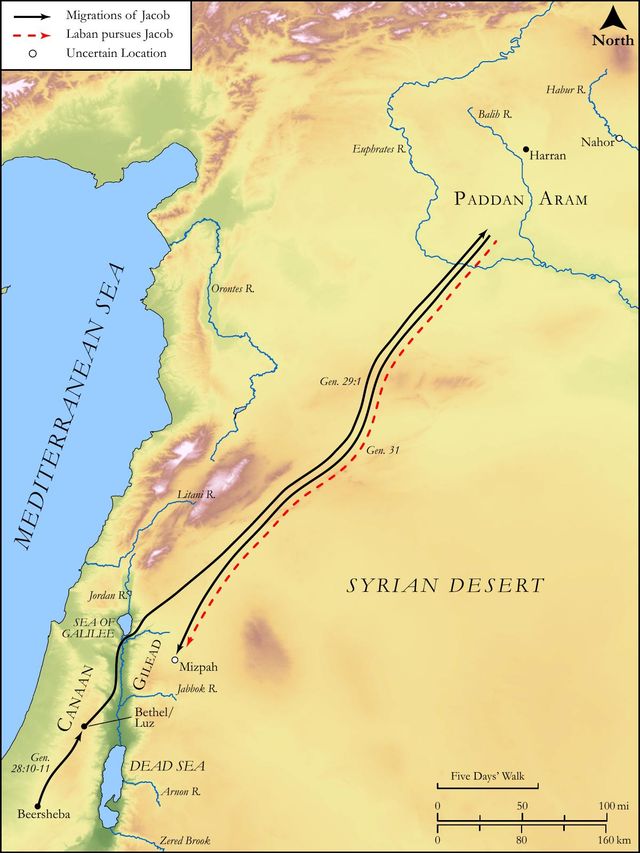
See on the biblical-era maps


Study this verse
Public-domain commentary
Matthew Henry
From his Commentary on the Whole Bible. Henry comments on passages, not single verses — this entry covers Genesis 31:1–16. His four-level outline is real structure in the source text, so it is rendered as structure.
Jacob is here taking up a resolution immediately to quit his uncle's service, to take what he had and go back to Canaan. This resolution he took up upon a just provocation, by divine direction, and with the advice and consent of his wives.
I.Upon a just provocation; for Laban and his sons had become very cross and ill-natured towards him, so that he could not stay among them with safety or satisfaction.
1.Laban's sons showed their ill-will in what they said, Gen 31:1. It should seem they said it in Jacob's hearing, with a design to vex him. The last chapter began with Rachel's envying Leah; this begins with Laban's sons envying Jacob. Observe,
(1.)How greatly they magnify Jacob's prosperity: He has gotten all this glory. And what was this glory that they made so much ado about? It was a parcel of brown sheep and speckled goats (and perhaps the fine colours made them seem more glorious), and some camels and asses, and such like trading; and this was all this glory. Note, Riches are glorious things in the eyes of carnal people, while to all those that are conversant with heavenly things they have no glory in comparison with the glory which excelleth. Men's over-valuing worldly wealth is that fundamental error which is the root of covetousness, envy, and all evil.
(2.)How basely they reflect upon Jacob's fidelity, as if what he had he had not gotten honestly: Jacob has taken away all that was our father's. Not all, surely. What had become of those cattle which were committed to the custody of Laban's sons, and sent three days' journey off? Gen 30:35, Gen 30:36. They mean all that was committed to him; but, speaking invidiously, they express themselves thus generally. Note,
[1.]Those that are ever so careful to keep a good conscience cannot always be sure of a good name.
[2.]This is one of the vanities and vexations which attend outward prosperity, that it makes a man to be envied of his neighbors (Ecc 4:4), and who can stand before envy? Pro 27:4. Whom Heaven blesses hell curses, and all its children on earth.
2.Laban himself said little, but his countenance was not towards Jacob as it used to be; and Jacob could not but take notice of it, Gen 31:2, Gen 31:5. He was but a churl at the best, but now he was more churlish than formerly. Note, Envy is a sin that often appears in the countenance; hence we read of an evil eye, Pro 23:6. Sour looks may do a great deal towards the ruin of peace and love in a family, and the making of those uneasy of whose comfort we ought to be tender. Laban's angry countenance lost him the greatest blessing his family ever had, and justly.
II.By divine direction and under the convoy of a promise:
The Lord said unto Jacob, Return, and I will be with thee, Gen 31:3. Though Jacob had met with very hard usage here, yet he would not quit his place till God bade him. He came thither by orders from Heaven, and there he would stay till he was ordered back. Note, It is our duty to set ourselves, and it will be our comfort to see ourselves, under God's guidance, both in our going out and in our coming in. The direction he had from Heaven is more fully related in the account he gives of it to his wives (Gen 31:10-13), where he tells them of a dream he had about the cattle, and the wonderful increase of those of his colour; and how the angel of God, in that dream (for I suppose the dream spoken of Gen 31:10 and that Gen 31:11 to be the same), took notice of the workings of his fancy in his sleep, and instructed him, so that it was not by chance, or by his own policy, that he obtained that great advantage; but, 1. by the providence of God, who had taken notice of the hardships Laban had put upon him, and took this way to recompense him: "For I have seen all the Laban doeth unto thee, and herein I have an eye to that." Note, There is more of equity in the distributions of the divine providence than we are aware of, and by them the injured are recompensed really, though perhaps insensibly. Nor was it only by the justice of providence that Jacob was thus enriched, but, 2. In performance of the promise intimated in what is said Gen 31:13, I am the God of Beth-el, This was the place where the covenant was renewed with him. Note, Worldly prosperity and success are doubly sweet and comfortable when we see them flowing, not from common providence, but from covenant-love, to perform the mercy promised - when we have them from God as the God of Beth-el, from those promises of the life which now is that belong to godliness. Jacob, even when he had this hopeful prospect of growing rich with Laban, must think of returning. When the world begins to smile upon us we must remember it is not our home. Now arise (Gen 31:13) and return, (1.) To thy devotions in Canaan, the solemnities of which had perhaps been much intermitted while he was with Laban. The times of this servitude God had winked at; but now, "Return to the place where thou anointedst the pillar and vowedst the vow. Now that thou beginnest to grow rich it is time to think of an altar and sacrifices again." (2.) To thy comforts in Canaan: Return to the land of thy kindred. He was here among his near kindred; but those only he must look upon as his kindred in the best sense, the kindred he must live and die with, to whom pertained the covenant. Note, The heirs of Canaan must never reckon themselves at home till they come thither, however they may seem to take root here.
III.With the knowledge and consent of his wives. Observe,
1.He sent for Rachel and Leah to him to the field (Gen 31:4), that he might confer with them more privately, or because one would not come to the other's apartment and he would willingly talk with them together, or because he had work to do in the field which he would not leave. Note, Husbands that love their wives will communicate their purposes and intentions to them. Where there is a mutual affection there will be a mutual confidence. And the prudence of the wife should engage the heart of her husband to trust in her, Pro 31:11. Jacob told his wives,
(1.)How faithfully he had served their father, Gen 31:6. Note, If others do not do their duty to us, yet we shall have the comfort of having done ours to them.
(2.)How unfaithfully their father had dealt with him Gen 31:7. He would never keep to any bargain that he made with him, but, after the first year, still as he saw Providence favour Jacob with the colour agreed on, every half year of the remaining five he changed it for some other colour, which made it ten times; as if he thought not only to deceive Jacob, but the divine Providence, which manifestly smiled upon him. Note, Those that deal honestly are not always honestly dealt with.
(3.)How God had owned him notwithstanding. He had protected him from Laban's ill-will: God suffered him not to hurt me. Note, Those that keep close to God shall be kept safely by him. He had also provided plentifully for him, notwithstanding Laban's design to ruin him: God has taken away the cattle of your father, and given them to me, Gen 31:9. Thus the righteous God paid Jacob for his hard service out of Laban's estate; as afterwards he paid the seed of Jacob for their serving the Egyptians, with their spoils. Note, God is not unrighteous to forget his people's work and labour of love, though men be so, Heb 6:10. Providence has ways of making those honest in the event that are not so in their design. Note, further, The wealth of the sinner is laid up for the just, Pro 13:22.
(4.)He told them of the command God had given him, in a dream, to return to his own country (Gen 31:13), that they might not suspect his resolution to arise from inconstancy, or any disaffection to their country or family, but might see it to proceed from a principle of obedience to his God, and dependence on him.
2.His wives cheerfully consented to his resolution. They also brought forward their grievances, complaining that their father had been not only unkind, but unjust, to them (Gen 31:14-16), that he looked upon them as strangers, and was without natural affection towards them; and, whereas Jacob had looked upon the wealth which God had transferred from Laban to him as his wages, they looked upon it as their portions; so that, both ways, God forced Laban to pay his debts, both to his servant and to his daughters. So then it seemed,
(1.)They were weary of their own people and their father's house, and could easily forget them. Note, This good use we should make of the unkind usage we meet with from the world, we should sit the more loose to it, and be willing to leave it and desirous to be at home.
(2.)They were willing to go along with their husband, and put themselves with him under the divine direction: Whatsoever God hath said unto thee do. Note, Those wives that ar their husband's meet helps will never be their hindrances in doing that to which God calls them.
Continue studying Genesis 31:4 across the web’s major study libraries — every link below opens this exact verse, chapter, or book on the destination site.
Read & Compare
 BibleGatewayThis verse in more than 200 translations and 70 languages.
 Bible.comThe YouVersion reader — hundreds of translations, reading plans, and highlights.
 ESV.orgCrossway's official English Standard Version reader.
 NET BibleThe NET translation with 60,000+ translators' notes on every rendering decision.
 STEP BibleTyndale House's free study tool — original text, vocabulary, and scholarly resources.
 BibliaLogos Bible Software's free web reader.
 USCCBThe New American Bible (Revised Edition) with the U.S. bishops' study notes.
Commentaries
 BibleHub CommentariesDozens of classic commentaries on this verse, gathered on one page.
 StudyLightMore than 100 commentary sets — the largest collection on the web.
 BibleRefPlain-English commentary on what this verse means, verse by verse.
 Enduring WordDavid Guzik's free commentary on this chapter, widely used by Bible teachers.
 Bible Study ToolsVerse commentary alongside Greek and Hebrew study aids.
Original Language & Research
- BibleHub InterlinearThe verse word by word — original language, transliteration, and English.
- BibleHub LexiconEvery word's original-language definition and Strong's entry.
 Blue Letter BibleDeep-study tools — Strong's numbers, concordance, and word studies.
 SefariaThe Hebrew text with Rashi and centuries of Jewish commentary.
Sermons, Hymns & Audio


TrulyRandomVerse is not affiliated with these sites and doesn’t control their content. They’re linked because they’re genuinely useful.
Summary
Genesis 31:4 records Jacob's decisive action to summon his wives, Rachel and Leah, for a private meeting in the secluded setting of the field where his flock grazed. This strategic consultation was a crucial preparatory step, prompted by God's explicit command for Jacob to return to Canaan and the escalating tension with Laban, signaling Jacob's imminent departure from Mesopotamia after twenty years of service.
Context
ShowHideLiterary Context
Genesis 31:4 is a pivotal moment, immediately following God's direct command to Jacob in Genesis 31:3 to "return unto the land of thy fathers, and to thy kindred." This divine instruction comes after a period of increasing animosity from Laban and his sons, as described in Genesis 31:1-2. Jacob's response in verse 4 is an act of immediate obedience and strategic planning, setting the stage for the dramatic confrontation with his wives in Genesis 31:5-16 and the subsequent clandestine departure from Laban's household in Genesis 31:17-21. The verse transitions the narrative from Jacob's internal struggles and external pressures to his decisive action, initiating the long-awaited return to the promised land.
Historical & Cultural Context
In that day, patriarchal households were the norm, with the patriarch holding significant authority. However, major family decisions, especially those involving relocation or significant changes in status, often involved consultation with key family members, particularly wives who held considerable influence over household affairs and the raising of children. The "field" (sadeh) was typically an open area for pasturing livestock, providing a natural setting for privacy away from the immediate domestic sphere of the tent or household, where conversations could easily be overheard. Laban's household, as depicted in Genesis 29-31, was characterized by cunning, deception, and rivalry, making a private meeting away from his influence absolutely essential for Jacob to discuss his plans without interference or premature discovery.
Key Themes
ShowHideThis verse contributes to several overarching themes in the book of Genesis and Jacob's narrative. Firstly, it highlights the theme of Divine Guidance and Human Obedience, as Jacob acts directly in response to God's command to return to Canaan, demonstrating his growing reliance on the Lord despite his past deceptions. Secondly, it underscores God's Faithfulness to His Covenant Promises, as Jacob's return is a crucial step towards the fulfillment of the land and progeny promises made to Abraham, Isaac, and Jacob himself (e.g., Genesis 28:15). Thirdly, the strategic choice of location emphasizes Prudence and Strategic Leadership in the face of adversity, as Jacob navigates a hostile environment with wisdom. Finally, the act of calling his wives, rather than simply dictating, introduces the theme of Family Consultation and Unity, acknowledging the vital role and agency of Rachel and Leah in the family's momentous decision to leave Laban.
Exposition and Analysis
ShowHideKey Word Analysis
ShowHideA primitive root meaning "to send away, for, or out (in a great variety of applications)." In this context, it signifies Jacob's deliberate and active initiation of the meeting. He didn't passively wait for an opportunity but purposefully dispatched a messenger or himself went to summon his wives, indicating a decisive and urgent action.
A primitive root meaning "to call out to (i.e. properly, address by name, but used in a wide variety of applications)." This word emphasizes the direct and personal nature of Jacob's summons. He specifically named Rachel and Leah, indicating that this was a targeted and intentional gathering of the two women most central to his family's future.
A collective name for "a flock (of sheep or goats)." The mention of the flock is crucial as it defines the "field" as a place of work and solitude, away from the domestic compound. It signifies the primary occupation and wealth of Jacob, and importantly, provides a natural, inconspicuous setting for a private and sensitive discussion, away from Laban's prying eyes and ears.
Verse Breakdown
ShowHide"And Jacob sent and called Rachel and Leah"
This initial clause highlights Jacob's agency and intentionality. The Hebrew verbs "sent" (וַיִּשְׁלַח, vayyishlach) and "called" (וַיִּקְרָא, vayyiqra) indicate a deliberate, two-part action: first, the dispatching of a summons, and second, the act of calling them by name. This shows Jacob taking the initiative and actively orchestrating a crucial family meeting. The specific mention of Rachel and Leah underscores their central importance to Jacob's family and the gravity of the discussion he was about to have with them.
"to the field unto his flock"
This phrase specifies the location of the summoned meeting, which is highly significant. The "field" (sadeh) implies an open, rural area, distinct from Laban's immediate household. The addition "unto his flock" further clarifies that this was a place where Jacob spent his working hours, a place of relative solitude and privacy. This strategic choice of location emphasizes Jacob's need for a secure, undisturbed environment to discuss his momentous decision to leave Laban without fear of being overheard or interrupted, showcasing his foresight and prudence.
Literary Devices
ShowHideThe verse employs several literary devices. Setting is crucial, as the choice of "the field unto his flock" is not merely descriptive but Symbolic of privacy, security, and a place removed from Laban's oppressive influence. This setting Foreshadows the clandestine nature of Jacob's eventual departure. The concise yet active verbs "sent" and "called" demonstrate Direct Narration that emphasizes Jacob's decisive Agency and leadership. The specific naming of "Rachel and Leah" uses Synecdoche, representing not just the two wives but the entirety of Jacob's immediate family unit and their collective future, underscoring their vital role in the impending migration.
Theological and Thematic Connections
ShowHideGenesis 31:4 serves as a powerful illustration of how divine guidance often necessitates human action, even strategic and potentially risky ones. Jacob's immediate and calculated response to God's command to return to Canaan demonstrates a maturing faith and a growing willingness to obey the Lord, even when it means confronting difficult family dynamics and making a perilous journey. This act of gathering his wives for consultation, though seemingly a simple logistical step, underscores the importance of communal decision-making within the covenant family, reflecting a leadership that values input and seeks unity in purpose, even under patriarchal authority. It sets the stage for God's continued faithfulness in protecting and prospering Jacob's family as they embark on the next phase of their journey towards the fulfillment of the Abrahamic covenant.
Reflection and Application
ShowHideGenesis 31:4, though brief, offers profound insights into effective leadership, communication, and obedience in the face of significant life transitions. Jacob's example teaches us the critical importance of choosing the right time and place for sensitive discussions, ensuring privacy and minimizing external interference when addressing momentous decisions that impact others. His decision to consult with Rachel and Leah, even after receiving a direct divine command, models a form of leadership that values the input and understanding of those affected, fostering unity and shared ownership of the outcome. This is further elaborated in Genesis 31:5-16, where he thoroughly explains the situation and God's directive, seeking their consent and cooperation. For us today, this verse underscores the need for prompt and decisive action when God provides clear direction, coupled with taking counsel with those it will affect, as Jacob did with Rachel and Leah. It reminds us that even when our path is divinely ordained, the journey often requires careful planning, courageous steps, and the cultivation of strong, unified relationships to navigate challenges successfully.
Questions for Reflection
ShowHideFAQ
ShowHideWhy did Jacob call Rachel and Leah to the field instead of discussing it in the house?
ShowHideJacob called Rachel and Leah to the field to ensure absolute privacy and secrecy for their crucial discussion. Given the strained and increasingly hostile relationship with Laban, as well as the envy of Laban's sons (mentioned in Genesis 31:1), discussing their imminent departure within the confines of Laban's household would have risked eavesdropping and immediate confrontation. The open "field unto his flock" provided a secure, secluded environment, allowing Jacob to speak freely and gather his wives' consent without jeopardizing their plans or provoking Laban prematurely. This strategic choice highlights Jacob's prudence and foresight in a precarious situation.
Does Jacob's act of consulting his wives diminish his patriarchal authority?
ShowHideNo, Jacob's consultation with Rachel and Leah does not diminish his patriarchal authority; rather, it demonstrates wise leadership that takes counsel with those it will affect. While God had given him the direct command to return to Canaan (as seen in Genesis 31:3), Jacob understood the profound impact this decision would have on his wives and children. By involving them in the discussion, explaining the situation and God's will (as he does in Genesis 31:5-16), he showed respect for their roles, fostered unity, and secured their cooperation for the challenging journey ahead. This approach strengthened his leadership by ensuring buy-in and shared commitment, rather than simply dictating terms. It reflects a mature understanding that true leadership often involves collaboration and clear communication, even within a hierarchical structure.
Christ-Centered Fulfillment
ShowHideJacob's strategic leadership in gathering his family to embark on a divinely commanded journey back to the promised land subtly prefigures Christ's perfect leadership of His church, the new Israel. Just as Jacob, guided by God, led his household out of a place of servitude, tension, and impending conflict towards their inheritance, so too does Christ, the Good Shepherd, gather His people—the redeemed family of God—and lead them out of spiritual bondage and the "land of Laban" (symbolic of the world's systems) into their true eternal inheritance. This verse, therefore, points to the broader biblical narrative of God's faithful guidance of His chosen people through their earthly pilgrimage, culminating in Christ, who perfectly fulfills God's promises and leads His flock to the ultimate promised land—the new heavens and new earth where righteousness dwells, a place of perfect peace and communion with God, far removed from the strife and deception of this present age.