


Genesis 31:1
Bible text: King James Version (1769 Blayney text) · Public domain
Bible text: King James Version with Strong's numbers · Public domain
Bible text: Berean Standard Bible · Public domain
Bible text: American Standard Version (1901) · Public domain
Bible text: World English Bible, Messianic edition · Public domain
Bible text: Geneva Bible (1599) · Public domain
Bible text: Young's Literal Translation · Public domain
- וַיִּשְׁמַעvai·yish·Ma'and he heardH8085Conj-w ¦ V-Qal-ConsecImperf-3msVerb Qal Consecutive Imperfect 3rd Singular Masculineוַandיִּשְׁמַעhe heard
- אֶת'et<obj.>H853DirObjMParticle Object Indicator
- דִּבְרֵיdiv·Rei[the] words ofH1697N-mpcNoun Plural Masculine Construct
- בְנֵיve·nei[the] sons ofH1121N-mpcNoun Plural Masculine Construct
- לָבָןla·VanLabanH3837N-proper-mNoun Proper Masculine
- לֵאמֹרle·Mor<to> sayingH559Prep-l ¦ V-Qal-InfVerb Qal Infinitive Constructלֵ<to>אמֹרsaying
- לָקַחla·Kachhe has takenH3947V-Qal-Perf-3msVerb Qal Perfect 3rd Singular Masculine
- יַעֲקֹבya·'a·KoJacobH3290N-proper-mNoun Proper Masculine
- אֵת'et<obj.>H853DirObjMParticle Object Indicator
- כָּלkolallH3605N-msNoun Singular Masculine Absolute
- אֲשֶׁר'a·SherthatH834RelParticle Relative
- לְאָבִינוּle·'a·Vi·nu[belonged] to our fatherH1Prep-l ¦ N-msc ¦ 1cpNoun Singular Masculine Constructלְ[belonged] toאָבִיfatherנוּour
- וּמֵאֲשֶׁרu·me·'a·Sherand from [that] whichH834Conj-w ¦ Prep-m ¦ RelParticle Relativeוּandמֵfromאֲשֶׁר[that] which
- לְאָבִינוּle·'a·Vi·nu[belonged] to our fatherH1Prep-l ¦ N-msc ¦ 1cpNoun Singular Masculine Constructלְ[belonged] toאָבִיfatherנוּour
- עָשָׂה'a·Sahhe has acquiredH6213V-Qal-Perf-3msVerb Qal Perfect 3rd Singular Masculine
- אֵת'et<obj.>H853DirObjMParticle Object Indicator
- כָּלkolallH3605N-mscNoun Singular Masculine Construct
- הַכָּבֹדha·ka·Vodthe abundanceH3519Art ¦ N-msNoun Singular Masculine Absoluteהַtheכָּבֹדabundance
- הַזֶּהha·Zeh<the> thisH2088Art ¦ PrtParticle Demonstrativeהַ<the>זֶּהthis
English is a literal word-by-word gloss of the Hebrew, not the KJV's wording. Why?
This is the original text the KJV's translators worked from — each Hebrew word with its own literal English meaning in this verse, prepared by scholars at Tyndale House, Cambridge. The KJV translates whole sentences, not word by word, so its wording differs: one Hebrew word can become several English words, and the KJV may choose “the LORD” where the gloss reads “Yahweh”. Both are faithful — they answer different questions. For the KJV's own rendering, switch to the KJV text.
Details
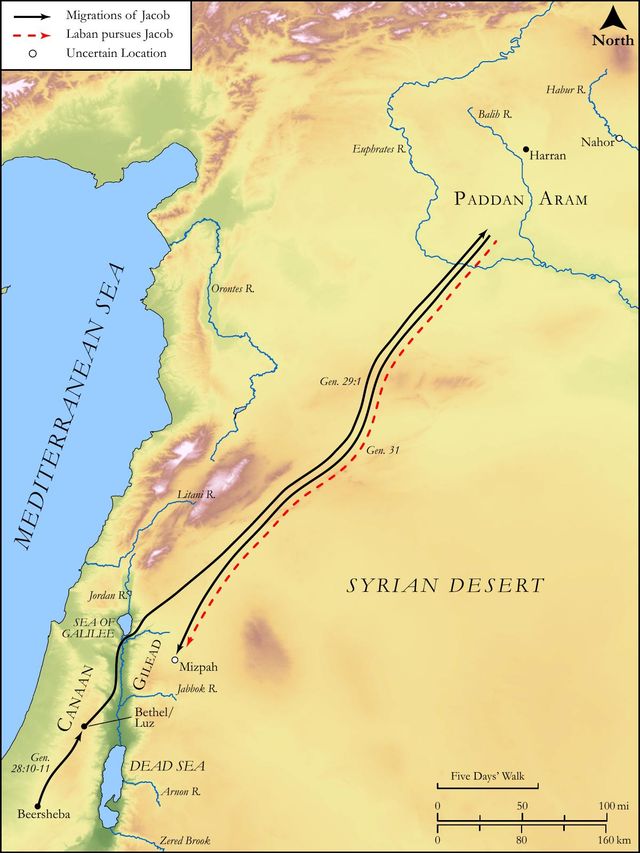
See on the biblical-era maps


Study this verse
Public-domain commentary
Matthew Henry
From his Commentary on the Whole Bible. Henry comments on passages, not single verses — this entry covers Genesis 31:1–16. His four-level outline is real structure in the source text, so it is rendered as structure.
Jacob is here taking up a resolution immediately to quit his uncle's service, to take what he had and go back to Canaan. This resolution he took up upon a just provocation, by divine direction, and with the advice and consent of his wives.
I.Upon a just provocation; for Laban and his sons had become very cross and ill-natured towards him, so that he could not stay among them with safety or satisfaction.
1.Laban's sons showed their ill-will in what they said, Gen 31:1. It should seem they said it in Jacob's hearing, with a design to vex him. The last chapter began with Rachel's envying Leah; this begins with Laban's sons envying Jacob. Observe,
(1.)How greatly they magnify Jacob's prosperity: He has gotten all this glory. And what was this glory that they made so much ado about? It was a parcel of brown sheep and speckled goats (and perhaps the fine colours made them seem more glorious), and some camels and asses, and such like trading; and this was all this glory. Note, Riches are glorious things in the eyes of carnal people, while to all those that are conversant with heavenly things they have no glory in comparison with the glory which excelleth. Men's over-valuing worldly wealth is that fundamental error which is the root of covetousness, envy, and all evil.
(2.)How basely they reflect upon Jacob's fidelity, as if what he had he had not gotten honestly: Jacob has taken away all that was our father's. Not all, surely. What had become of those cattle which were committed to the custody of Laban's sons, and sent three days' journey off? Gen 30:35, Gen 30:36. They mean all that was committed to him; but, speaking invidiously, they express themselves thus generally. Note,
[1.]Those that are ever so careful to keep a good conscience cannot always be sure of a good name.
[2.]This is one of the vanities and vexations which attend outward prosperity, that it makes a man to be envied of his neighbors (Ecc 4:4), and who can stand before envy? Pro 27:4. Whom Heaven blesses hell curses, and all its children on earth.
2.Laban himself said little, but his countenance was not towards Jacob as it used to be; and Jacob could not but take notice of it, Gen 31:2, Gen 31:5. He was but a churl at the best, but now he was more churlish than formerly. Note, Envy is a sin that often appears in the countenance; hence we read of an evil eye, Pro 23:6. Sour looks may do a great deal towards the ruin of peace and love in a family, and the making of those uneasy of whose comfort we ought to be tender. Laban's angry countenance lost him the greatest blessing his family ever had, and justly.
II.By divine direction and under the convoy of a promise:
The Lord said unto Jacob, Return, and I will be with thee, Gen 31:3. Though Jacob had met with very hard usage here, yet he would not quit his place till God bade him. He came thither by orders from Heaven, and there he would stay till he was ordered back. Note, It is our duty to set ourselves, and it will be our comfort to see ourselves, under God's guidance, both in our going out and in our coming in. The direction he had from Heaven is more fully related in the account he gives of it to his wives (Gen 31:10-13), where he tells them of a dream he had about the cattle, and the wonderful increase of those of his colour; and how the angel of God, in that dream (for I suppose the dream spoken of Gen 31:10 and that Gen 31:11 to be the same), took notice of the workings of his fancy in his sleep, and instructed him, so that it was not by chance, or by his own policy, that he obtained that great advantage; but, 1. by the providence of God, who had taken notice of the hardships Laban had put upon him, and took this way to recompense him: "For I have seen all the Laban doeth unto thee, and herein I have an eye to that." Note, There is more of equity in the distributions of the divine providence than we are aware of, and by them the injured are recompensed really, though perhaps insensibly. Nor was it only by the justice of providence that Jacob was thus enriched, but, 2. In performance of the promise intimated in what is said Gen 31:13, I am the God of Beth-el, This was the place where the covenant was renewed with him. Note, Worldly prosperity and success are doubly sweet and comfortable when we see them flowing, not from common providence, but from covenant-love, to perform the mercy promised - when we have them from God as the God of Beth-el, from those promises of the life which now is that belong to godliness. Jacob, even when he had this hopeful prospect of growing rich with Laban, must think of returning. When the world begins to smile upon us we must remember it is not our home. Now arise (Gen 31:13) and return, (1.) To thy devotions in Canaan, the solemnities of which had perhaps been much intermitted while he was with Laban. The times of this servitude God had winked at; but now, "Return to the place where thou anointedst the pillar and vowedst the vow. Now that thou beginnest to grow rich it is time to think of an altar and sacrifices again." (2.) To thy comforts in Canaan: Return to the land of thy kindred. He was here among his near kindred; but those only he must look upon as his kindred in the best sense, the kindred he must live and die with, to whom pertained the covenant. Note, The heirs of Canaan must never reckon themselves at home till they come thither, however they may seem to take root here.
III.With the knowledge and consent of his wives. Observe,
1.He sent for Rachel and Leah to him to the field (Gen 31:4), that he might confer with them more privately, or because one would not come to the other's apartment and he would willingly talk with them together, or because he had work to do in the field which he would not leave. Note, Husbands that love their wives will communicate their purposes and intentions to them. Where there is a mutual affection there will be a mutual confidence. And the prudence of the wife should engage the heart of her husband to trust in her, Pro 31:11. Jacob told his wives,
(1.)How faithfully he had served their father, Gen 31:6. Note, If others do not do their duty to us, yet we shall have the comfort of having done ours to them.
(2.)How unfaithfully their father had dealt with him Gen 31:7. He would never keep to any bargain that he made with him, but, after the first year, still as he saw Providence favour Jacob with the colour agreed on, every half year of the remaining five he changed it for some other colour, which made it ten times; as if he thought not only to deceive Jacob, but the divine Providence, which manifestly smiled upon him. Note, Those that deal honestly are not always honestly dealt with.
(3.)How God had owned him notwithstanding. He had protected him from Laban's ill-will: God suffered him not to hurt me. Note, Those that keep close to God shall be kept safely by him. He had also provided plentifully for him, notwithstanding Laban's design to ruin him: God has taken away the cattle of your father, and given them to me, Gen 31:9. Thus the righteous God paid Jacob for his hard service out of Laban's estate; as afterwards he paid the seed of Jacob for their serving the Egyptians, with their spoils. Note, God is not unrighteous to forget his people's work and labour of love, though men be so, Heb 6:10. Providence has ways of making those honest in the event that are not so in their design. Note, further, The wealth of the sinner is laid up for the just, Pro 13:22.
(4.)He told them of the command God had given him, in a dream, to return to his own country (Gen 31:13), that they might not suspect his resolution to arise from inconstancy, or any disaffection to their country or family, but might see it to proceed from a principle of obedience to his God, and dependence on him.
2.His wives cheerfully consented to his resolution. They also brought forward their grievances, complaining that their father had been not only unkind, but unjust, to them (Gen 31:14-16), that he looked upon them as strangers, and was without natural affection towards them; and, whereas Jacob had looked upon the wealth which God had transferred from Laban to him as his wages, they looked upon it as their portions; so that, both ways, God forced Laban to pay his debts, both to his servant and to his daughters. So then it seemed,
(1.)They were weary of their own people and their father's house, and could easily forget them. Note, This good use we should make of the unkind usage we meet with from the world, we should sit the more loose to it, and be willing to leave it and desirous to be at home.
(2.)They were willing to go along with their husband, and put themselves with him under the divine direction: Whatsoever God hath said unto thee do. Note, Those wives that ar their husband's meet helps will never be their hindrances in doing that to which God calls them.
Historical interpretation
Historical reception
1 surviving comment on this verse from the historical church.
See how envy drove them to ingratitude, and not only them but also Laban himself. “Jacob saw Laban’s attitude to him,” the text goes on, remember, “and, lo, it was not as it had previously been.” You see, his sons’ words deranged his mind and made him forget what he had said some time before in conversation with Jacob, “God has blessed me in your coming.” After thanking the Lord for making his wealth increase through the arrival of the good man, he was now disturbed in mind under the influence of his sons and inflamed with envy, perhaps because he saw the good man’s fortunate circumstances, and so he was not prepared to behave toward him in the same way.
Continue studying Genesis 31:1 across the web’s major study libraries — every link below opens this exact verse, chapter, or book on the destination site.
Read & Compare
 BibleGatewayThis verse in more than 200 translations and 70 languages.
 Bible.comThe YouVersion reader — hundreds of translations, reading plans, and highlights.
 ESV.orgCrossway's official English Standard Version reader.
 NET BibleThe NET translation with 60,000+ translators' notes on every rendering decision.
 STEP BibleTyndale House's free study tool — original text, vocabulary, and scholarly resources.
 BibliaLogos Bible Software's free web reader.
 USCCBThe New American Bible (Revised Edition) with the U.S. bishops' study notes.
Commentaries
 BibleHub CommentariesDozens of classic commentaries on this verse, gathered on one page.
 StudyLightMore than 100 commentary sets — the largest collection on the web.
 BibleRefPlain-English commentary on what this verse means, verse by verse.
 Enduring WordDavid Guzik's free commentary on this chapter, widely used by Bible teachers.
 Bible Study ToolsVerse commentary alongside Greek and Hebrew study aids.
Original Language & Research
- BibleHub InterlinearThe verse word by word — original language, transliteration, and English.
- BibleHub LexiconEvery word's original-language definition and Strong's entry.
 Blue Letter BibleDeep-study tools — Strong's numbers, concordance, and word studies.
 SefariaThe Hebrew text with Rashi and centuries of Jewish commentary.
Sermons, Hymns & Audio


TrulyRandomVerse is not affiliated with these sites and doesn’t control their content. They’re linked because they’re genuinely useful.
Summary
Genesis 31:1 marks a pivotal moment in Jacob's life, signaling the imminent conclusion of his two-decade sojourn with Laban. This verse captures Jacob overhearing the bitter accusations of Laban's sons, who perceive his significant prosperity—acquired through diligent labor and divine blessing—as ill-gotten gains stolen from their father's inheritance, thereby confirming the escalating and untenable animosity within the household.
Context
ShowHideLiterary Context
Genesis 31:1 immediately follows a period of intense rivalry and manipulation between Jacob and Laban concerning their flocks and wealth. In Genesis 30, Jacob's shrewd breeding practices, divinely blessed, led to a dramatic increase in his own possessions, often at Laban's expense, despite Laban's repeated attempts to change Jacob's wages and defraud him. This verse serves as the narrative catalyst, confirming Jacob's suspicions about Laban's changing disposition (implied in Genesis 31:2) and setting the stage for God's direct command for Jacob to return to his homeland, as revealed in Genesis 31:3. It marks the final straw in a long, complex, and often deceitful relationship, preparing the reader for Jacob's strategic departure.
Historical & Cultural Context
In the patriarchal society of Jacob's day, wealth was primarily measured in livestock, servants, and land. Inheritance was a crucial aspect of family continuity and economic security, typically passing from father to sons. Laban's sons' accusations reflect a deep concern for their patrimony (H1 - 'âb), fearing that Jacob's accumulation of wealth diminished their own future inheritance. The relationship between Jacob and Laban, initially a familial one, had evolved into a quasi-master-servant dynamic, where Jacob, as a dependent, was expected to enrich his patron. However, Jacob's success, divinely ordained, inverted this expectation, leading to resentment. Such disputes over property and inheritance were common and often led to bitter family feuds, making Jacob's departure a necessary, if difficult, decision for his safety and the well-being of his family.
Key Themes
ShowHideThis verse powerfully contributes to several overarching themes in Genesis. It highlights the theme of Divine Providence Amidst Human Deception, showing how God orchestrates events and blesses His chosen, even when surrounded by human greed and manipulation. Jacob's prosperity, though perceived as theft by Laban's sons, was a direct fulfillment of God's covenant promise to bless him and make him fruitful, echoing the promises made to Abraham and Isaac. The verse also underscores the theme of Envy and Resentment, demonstrating the destructive power of jealousy when one's success is attributed to malicious means rather than divine favor or diligent effort. Furthermore, it advances the theme of Jacob's Journey and God's Guidance, as this overheard conversation becomes a critical signpost, prompting Jacob to seek divine direction for his long-awaited return to the Promised Land, a journey that began with God's promise in Genesis 28:15.
Exposition and Analysis
ShowHideKey Word Analysis
ShowHideThis term refers to "a word; by implication, a matter (as spoken of) or thing." In this context, it signifies not just casual speech but a significant, weighty pronouncement—an accusation that carries serious implications and reveals a deep-seated grievance. It's the "matter" or "affair" that Jacob needed to hear.
This word denotes "father, in a literal and immediate, or figurative and remote application; chief, (fore-) father(-less), [idiom] patrimony, principal." Here, it specifically refers to Laban's possessions and inheritance, the "patrimony" that his sons believed Jacob had unjustly acquired, diminishing their own rightful share.
This word typically means "weight, but only figuratively in a good sense, splendor or copiousness; glorious(-ly), glory, honour(-able)." In Genesis 31:1, "glory" refers to Jacob's substantial material wealth—his flocks, servants, and accumulated possessions—which Laban's sons viewed as ill-gotten "honor" or "splendor" that rightfully belonged to their family. They saw his prosperity as a form of "stolen glory."
Verse Breakdown
ShowHide"And he heard the words of Laban's sons, saying,"
This opening clause immediately establishes Jacob's passive reception of crucial information. The verb "heard" (H8085, shâmaʻ) implies not just auditory perception but also intelligent comprehension and attention, indicating Jacob fully grasped the weight and implication of what was being said. The source of the words—Laban's sons—is significant, as they represent the next generation of Laban's household, whose animosity signals a fundamental shift in the family dynamic.
"Jacob hath taken away all that [was] our father's;"
This is the core accusation. The phrase "taken away" (H3947, lâqach) implies an act of appropriation, suggesting theft or unjust acquisition. The sons' claim that Jacob had taken "all" their father's possessions is likely hyperbole, but it vividly conveys their perception that Jacob's prosperity came directly at their family's expense, threatening their inheritance. This reveals their deep-seated resentment and belief that Jacob's gains were not legitimate.
"and of [that] which [was] our father's hath he gotten all this glory."
This second part of the accusation reinforces the first, emphasizing the source of Jacob's wealth. The verb "gotten" (H6213, ʻâsâh) can mean "to do or make," implying that Jacob "made" or "acquired" his "glory" (H3519, kâbôwd) from their father's resources. The term "glory" here refers to Jacob's substantial material prosperity and elevated status. The sons interpret Jacob's success not as a blessing from God or a result of his labor, but as a direct transfer of their family's wealth and honor to himself, fueling their indignation.
Literary Devices
ShowHideGenesis 31:1 employs several literary devices to convey its significance. Foreshadowing is prominent, as the overheard words explicitly signal the impending conflict and Jacob's necessary departure from Laban's household, setting the stage for the dramatic events that follow. The accusation itself contains Hyperbole, with Laban's sons claiming Jacob took "all" their father's possessions; this exaggeration underscores the depth of their resentment and their skewed perception of Jacob's prosperity. There is also a subtle Irony at play: Jacob, whose name means "supplanter" and who gained his birthright and blessing through cunning, is now himself accused of "taking away" and "getting" what rightfully belongs to others, albeit in this instance, his prosperity is divinely blessed.
Theological and Thematic Connections
ShowHideGenesis 31:1 offers profound theological insights into the nature of divine providence amidst human conflict and the destructive power of envy. It reveals that God's blessings, though often manifesting in material prosperity, can provoke intense jealousy and false accusations from those who lack spiritual discernment. Laban's sons, unable to see God's hand in Jacob's success, attributed his "glory" to theft, highlighting the human tendency to resent God's favor on others. This passage underscores that God works through complex, often strained, human relationships to fulfill His promises, using even the animosity of others as a catalyst to guide His chosen servants into their next season of obedience and blessing.
Reflection and Application
ShowHideGenesis 31:1 serves as a poignant reminder that even when we are faithfully pursuing God's call and experiencing His blessing, we may encounter envy, resentment, and false accusations from others. Jacob's experience teaches us the importance of discerning the spiritual climate around us and recognizing when God may be using difficult circumstances, even hostility, as a sign to move us into a new season or direction. It challenges us to respond not with bitterness or retaliation, but with wisdom, seeking God's guidance and trusting in His unfailing provision. Our true security and "glory" are found not in earthly accumulation, but in our relationship with God, who is our ultimate source of blessing and protection, enabling us to navigate strained relationships and transitions with integrity and faith.
Questions for Reflection
ShowHideFAQ
ShowHideWhat does "all this glory" mean in this context?
ShowHideIn Genesis 31:1, the KJV word "glory" translates the Hebrew term kâbôwd (H3519). While kâbôwd often refers to honor, majesty, or divine splendor, here it specifically denotes Jacob's substantial material wealth, possessions, and elevated status. Laban's sons perceived his accumulated assets—his burgeoning flocks, servants, and other possessions—as "stolen glory" or ill-gotten gain, highlighting their deep resentment over his material success rather than acknowledging God's blessing or Jacob's diligent labor (as described in Genesis 30:27-43).
Why were Laban's sons so resentful of Jacob?
ShowHideLaban's sons were resentful because they believed Jacob had unjustly acquired their father's wealth and resources, thereby diminishing their own future inheritance. They saw Jacob's significant prosperity, which had dramatically increased during his service to Laban, as a direct loss to their patrimony. Their accusations of Jacob "taking away all that was our father's" reflect deep-seated envy and a perception of theft, despite Jacob's diligent work and God's clear blessing upon him. This resentment was exacerbated by Laban's own changing attitude towards Jacob, as noted in Genesis 31:2).
How did Jacob's prosperity come about?
ShowHideJacob's prosperity was a result of both his diligent and strategic labor and, more significantly, divine intervention. Despite Laban's repeated attempts to change Jacob's wages and defraud him (documented in Genesis 31:7), God consistently blessed Jacob's efforts, causing his flocks and wealth to increase dramatically. As Jacob later recounts to his wives in Genesis 31:9, God "has taken away the livestock of your father and given them to me." This divine favor was a direct fulfillment of God's covenant promises to Jacob, ensuring his fruitfulness and blessing as he prepared to return to the land of Canaan.
Christ-Centered Fulfillment
ShowHideGenesis 31:1, with its narrative of Jacob being unjustly accused and envied for his divinely-given prosperity, finds a profound Christ-centered fulfillment. Jacob, though imperfect, foreshadows Christ as one who, through God's favor, accumulates "glory" (in Jacob's case, material wealth; in Christ's, spiritual authority and redemptive power), only to be met with the bitter envy and false accusations of those who reject Him. Just as Laban's sons resented Jacob's "glory" as something "taken away" from their father, so too was Jesus, the true Son and heir of all things, accused by the religious leaders of blasphemy and undermining their authority (John 10:33). His divine "glory" was not something He "gotten" by taking from humanity, but rather by giving Himself entirely (Philippians 2:6-8). The accusations against Jacob led to his divinely orchestrated "departure" from Laban's household; similarly, the hostility and false accusations against Christ culminated in His crucifixion and ascension—a divinely ordained "departure" from this world (John 16:7). Through His sacrifice, Christ did not "take away" from us but rather "took away" our sin (John 1:29) and secured for His spiritual household, the Church, an eternal inheritance of true, imperishable "glory" that surpasses all earthly wealth (1 Peter 1:3-4).