


Mark 9:43
Bible text: King James Version (1769 Blayney text) · Public domain
Bible text: King James Version with Strong's numbers · Public domain
Bible text: Berean Standard Bible · Public domain
Bible text: American Standard Version (1901) · Public domain
Bible text: World English Bible, Messianic edition · Public domain
Bible text: Geneva Bible (1599) · Public domain
Bible text: Young's Literal Translation · Public domain
- καὶkaiAndG2532CONJConjunction
- ἐὰνeanifG1437CONDConjunction
- σκανδαλίζῃskandalizēshall cause to stumbleG4624V-PAS-3SVerb Present Active Subjunctive 3rd Singular
- σεseyouG4771P-2ASPersonal pronoun Accusative 2nd Singular
- ἡhētheG3588T-NSFDefinite article Nominative Singular Feminine
- χείρcheirhandG5495N-NSFNoun Nominative Singular Feminine
- σουsouof youG4771P-2GSPersonal pronoun Genitive 2nd Singular
- ἀπόκοψονapokopsondo cut offG609V-AAM-2SVerb Aorist Active Imperative 2nd Singular
- αὐτήν·autēnitG846P-ASFPersonal pronoun Accusative Singular Feminine
- καλόνkalonbetterG2570A-NSNAdjective Nominative Singular Neuter
- ἐστίνestinit isG1510V-PAI-3SVerb Present Active Indicative 3rd Singular
- σεsefor youG4771P-2ASPersonal pronoun Accusative 2nd Singular
- κυλλὸνkulloncrippledG2948A-ASMAdjective Accusative Singular Masculine
- εἰσελθεῖνeiseltheinto enterG1525V-2AANVerb 2nd Aorist Active Infinitive
- εἰςeisintoG1519PREPPreposition
- τὴνtēn<the>G3588T-ASFDefinite article Accusative Singular Feminine
- ζωὴνzōēnlifeG2222N-ASFNoun Accusative Singular Feminine
- ἢēthanG2228CONJConjunction
- τὰςtas<the>G3588T-APFDefinite article Accusative Plural Feminine
- δύοduotwoG1417A-NUIAdjective
- χεῖραςcheirashandsG5495N-APFNoun Accusative Plural Feminine
- ἔχονταechontahavingG2192V-PAP-ASMVerb Present Active Participle Accusative Singular Masculine
- ἀπελθεῖνapeltheinto go awayG565V-2AANVerb 2nd Aorist Active Infinitive
- εἰςeisintoG1519PREPPreposition
- τὴνtēn<the>G3588T-ASFDefinite article Accusative Singular Feminine
- γέεννανgeennanhellG1067N-ASF-TNoun Accusative Singular Feminine
- εἰςeisintoG1519PREPPreposition
- τὸtotheG3588T-ASNDefinite article Accusative Singular Neuter
- πῦρpurfireG4442N-ASNNoun Accusative Singular Neuter
- τὸto<the>G3588T-ASNDefinite article Accusative Singular Neuter
- ἄσβεστονasbestonunquenchableG762A-ASNAdjective Accusative Singular Neuter
English is a literal word-by-word gloss of the Greek, not the KJV's wording. Why?
This is the original text the KJV's translators worked from — each Greek word with its own literal English meaning in this verse, prepared by scholars at Tyndale House, Cambridge. The KJV translates whole sentences, not word by word, so its wording differs: one Greek word can become several English words, and the KJV may choose “charity” where the gloss reads “love”. Both are faithful — they answer different questions. For the KJV's own rendering, switch to the KJV text.
Details
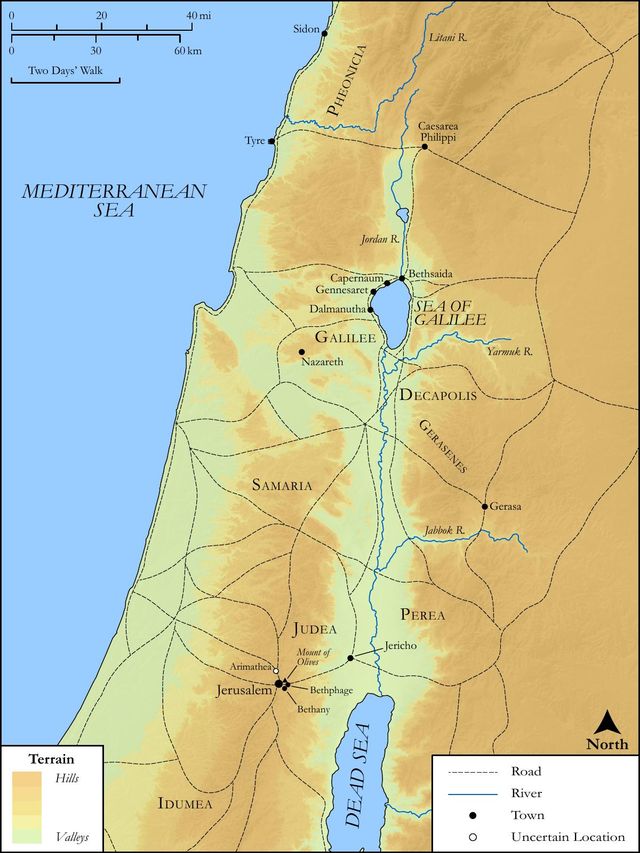
See on the biblical-era maps

Study this verse
Public-domain commentary
Matthew Henry
From his Commentary on the Whole Bible. Henry comments on passages, not single verses — this entry covers Mark 9:41–50. His three-level outline is real structure in the source text, so it is rendered as structure.
Here, I. Christ promiseth a reward to all those that are any way kind to his disciples (Mar 9:41); "Whosoever shall give you a cup of water, when you need it, and will be a refreshment to you, because ye belong to Christ, and are of his family, he shall not lose his reward." Note, 1. It is the honour and happiness of Christians, that they belong to Christ, they have joined themselves to him, and are owned by him; they wear his livery and retainers to his family; nay, they are more nearly related, they are members of his body. 2. They who belong to Christ, may sometimes be reduced to such straits as to be glad of a cup of cold water. 3. The relieving of Christ's poor in their distresses, is a good deed, and will turn a good account; he accepts it, and will reward it. 4. What kindness is done to Christ's poor, must be done them for his sake, and because they belong to him; for that is it that sanctifies the kindness, and puts a value upon it in the sight of God. 5. This is a reason why we must not discountenance and discourage those who are serving the interests of Christ's kingdom, though they are not in every thing of our mind and way. It comes in here as a reason why those must not be hindered, that cast out devils in Christ's name, though they did not follow him; for (as Dr. Hammond paraphrases it) "It is not only the great eminent performances which are done by you my constant attendants and disciples, that are accepted by me, but every the least degree of sincere faith and Christian performance, proportionable but to the expressing the least kindness, as giving a cup of water to a disciple of mine for being such, shall be accepted and rewarded." If Christ reckons kindness to us services to him, we ought to reckon services to him kindnesses to us, and to encourage them, though done by those that follow not with us.
II.He threatens those that offend his little ones, that wilfully are the occasion of sin or trouble to them, Mar 9:42.
Whosoever shall grieve any true Christians, though they be of the weakest, shall oppose their entrance into the ways of God, or discourage and obstruct their progress in those ways, shall either restrain them from doing good, or draw them in to commit sin, it were better for him that a millstone were hanged about his neck, and he were cast into the sea: his punishment will be very great, and the death and ruin of his soul more terrible than such a death and ruin of his body would be. See Mat 18:6.
III.He warns all his followers to take heed of ruining their own souls.
This charity must begin at home; if we must take heed of doing any thing to hinder others from good, and to occasion their sin, much more careful must we be to avoid every thing that will take us off from our duty, or lead us to sin; and that which doth so we must part with, though it be ever so dear to us. This we had twice in Matthew, Mat 5:29, Mat 5:30, and Mat 18:8, Mat 18:9. It is here urged somewhat more largely and pressingly; certainly this requires our serious regard, which is so much insisted upon. Observe,
1.The case supposed, that our own hand, or eye, or foot, offend us; that the impure corruption we indulge is as dear to us as an eye or a hand, or that that which is to us as an eye or a hand, is become an invisible temptation to sin, or occasion of it. Suppose the beloved is become a sin, or the sin a beloved. Suppose we cannot keep that which is dear to us, but it will be a snare and a stumbling-block; suppose we must part with it, or part with Christ and a good conscience.
2.The duty prescribed in that case; Pluck out the eye, cut off the hand and foot, mortify the darling lust, kill it, crucify it, starve it, make no provision for it. Let the idols that have been delectable things, be cast away as detestable things; keep at a distance from that which is a temptation, though ever so pleasing. It is necessary that the part which is gangrened, should be taken off for the preservation of the whole. Immedicabile vulnus ense recidendum est, ne pars sincera trahatur - The part that is incurably wounded must be cut off, lest the parts that are sound be corrupted. We must put ourselves to pain, that we may not bring ourselves to ruin; self must be denied, that it may not be destroyed.
3.The necessity of doing this. The flesh must be mortified, that we may enter into life (Mar 9:43, Mar 9:45), into the kingdom of God, Mar 9:47. Though, by abandoning sin, we may, for the present, feel ourselves as if we were halt and maimed (it may seem to be a force put upon ourselves, and may create us some uneasiness), yet it is for life; and all that men have, they will give for their lives: it is for a kingdom, the kingdom of God, which we cannot otherwise obtain; these halts and maims will be the marks of the Lord Jesus, will be in that kingdom scars of honour.
4.The danger of not doing this. The matter is brought to this issue, that either sin must die, or we must die. If we will lay this Delilah in our bosom, it will betray us; if we be ruled by sin, we shall inevitably be ruined by it; if we must keep our two hands, and two eyes, and two feet, we must with them be cast into hell. Our Saviour often pressed our duty upon us, from the consideration of the torments of hell, which we run ourselves into if we continue in sin. With what an emphasis of terror are those words repeated three times here, Where their worm dieth not, and the fire is not quenched! The words are quoted from Isa 66:24.
(1.)The reflections and reproaches of the sinner's own conscience are the worm that dieth not; which will cleave to the damned soul as the worms do to the dead body, and prey upon it, and never leave it till it is quite devoured. Son, remember, will set this worm gnawing; and how terrible will it bite that word (Pro 5:12, Pro 5:23), How have I hated instruction! The soul that is food to this worm, dies not; and the worm is bred in it, and one with it, and therefore neither doth that die. Damned sinners will be to eternity accusing, condemning, and upbraiding, themselves with their own follies, which, how much soever they are now in love with them, will at the last bite like a serpent, and sting like an adder.
(2.)The wrath of God fastening upon a guilty and polluted conscience, is the fire that is not quenched; for it is the wrath of the living God, the eternal God, into whose hands it is a fearful thing to fall. There are no operations of the Spirit of grace upon the souls of the damned sinners, and therefore there is nothing to alter the nature of the fuel, which must remain for ever combustible; nor is there any application of the merit of Christ to them, and therefore there is nothing to appease or quench the violence of the fire. Dr. Whitby shows that the eternity of the torments of hell was not only the constant faith of the Christian church, but had been so of the Jewish church. Josephus saith, The Pharisees held that the souls of the wicked were to be punished with perpetual punishment; and that there was appointed for them a perpetual prison. And Philo saith, The punishment of the wicked is to live for ever dying, and to be for ever in pains and griefs that never cease.
The two last verses are somewhat difficult, and interpreters agree not in the sense of them; for every one in general, or rather every one of them that are cast into hell, shall be salted with fire, and every sacrifice shall be salted with salt. Therefore have salt in yourselves. [1.] It was appointed by the law of Moses, that every sacrifice should be salted with salt, not to preserve it (for it was to be immediately consumed), but because it was the food of God's table, and no flesh is eaten without salt; it was therefore particularly required in the meat-offerings, Lev 2:13. [2.] The nature of man, being corrupt, and as such being called flesh (Gen 6:3; Psa 78:39), some way or other must be salted, in order to its being a sacrifice to God. The salting of fish (and I think of other things) they call the curing of it. [3.] Our chief concern is, to present ourselves living sacrifices to the grace of God (Rom 12:1), and, in order to our acceptableness, we must be salted with salt, our corrupt affections must be subdued and mortified, and we must have in our souls a savour of grace. Thus the offering up or sacrificing of the Gentiles is said to be acceptable, being sanctified by the Holy Ghost, as the sacrifices were salted, Rom 15:16. [4.] Those that have the salt of grace, must make it appear that they have it; that they have salt in themselves, a living principle of grace in their hearts, which works out all corrupt dispositions, and every thing in the soul that tends to putrefaction, and would offend our God, or our own consciences, as unsavoury meat doth. Our speech must be always with grace seasoned with this salt, that no corrupt communication may proceed out of our mouth, but we may loathe it as much as we would to put putrid meat into our mouths. [5.] As this gracious salt will keep our own consciences void of offence, so it will keep our conversation with others so, that we may not offend any of Christ's little ones, but may be at peace one with another. [6.] We must not only have this salt of grace, but we must always retain the relish and savour of it; for if this salt lose its saltiness, if a Christian revolt from his Christianity, if he loses the savour of it, and be no longer under the power and influence of it, what can recover him, or wherewith will ye season him? This was said Mat 5:13. [7.] Those that present not themselves living sacrifices to God's grace, shall be made for ever dying sacrifices to his justice, and since they would not give honour to him, he will get him honour upon them; they would not be salted with the salt of divine grace, would not admit that to subdue their corrupt affections, no, they would not submit to the operation, could not bear the corrosives that were necessary to eat out the proud flesh, it was to them like cutting off a hand, or plucking out an eye; and therefore in hell they shall be salted with fire; coals of fire shall be scattered upon them (Eze 10:2), as salt upon the meat, and brimstone (Job 18:15), as fire and brimstone were rained on Sodom; the pleasures they have lived in, shall eat their flesh, as it were with fire, Jam 5:3. The pain of mortifying the flesh now is no more to be compared with the punishment for not mortifying it, than salting with burning. And since he had said, that the fire of hell shall not be quenched, but it might be objected, that the fuel will not last always, he here intimates, that by the power of God it shall be made to last always; for those that are cast into hell, will find the fire to have not only the corroding quality of salt, but its preserving quality; whence it is used to signify that which is lasting: a covenant of salt is a perpetual covenant, and Lot's wife being turned into a pillar of salt, made her a remaining monument of divine vengeance. Now since this will certainly be the doom of those that do not crucify the flesh with its affections and lusts, let us, knowing this terror of the Lord, be persuaded to do it.
Historical interpretation
Nine Centuries of Reception
12 surviving comments on this verse. Each one is dated, so this reads as a timeline rather than a list.
Select a marker to jump to its quote. Markers stagger vertically where authors wrote within a few decades of each other.
Or else, It is better for thee to enter into life maimed, that is, without the chief place, for which you have wished, than having two hands to go into eternal fire. The two hands for high station are humility and pride; cut off pride, keeping to the estate of lowliness.
The oblation of the Lord is the race of man, which is here salted by means of wisdom, whilst the corruption of blood, the nurse of rottenness, and the mother of worms, is being consumed, which there also shall he tried by the purgatorial firem.
Or otherwise; That salt is saltless which loves the chief place, and dares not rebuke others. Wherefore there follows, Have salt in yourselves, and have peace one with another. That is, let the love of your neighbour temper the saltness of rebuke, and the salt of justice season the love of your neighbour.
But let none of you think, brethren, that the Lord commended the cutting off of the members. His meaning is, that the purpose should be cut off, not the members, and the causes which allure to sin, in order that our thought, borne up on the chariot of sight, may push towards the love of God, supported by the bodily senses; and not give loose reins to the eyes of the flesh as to wanton horses, eager to turn their running outside the way of the commandments, but may subject the bodily sight to the judgment of the mind, and not suffer those eyes of ours, which God intended to be viewers and witnesses of His work, to become panders of evil desire. And therefore let the bodily senses as well as the internal thought be subject to the law of God, and let them serve His will, whose work they acknowledge themselves to be.
(Hom. in Matt. 59) He says not this of our limbs, but of our intimate friends, whom as being necessary to us we look upon as our limbs; for nothing is so hurtful as mischievous society.
Here truly it appears that they who do acts of devotedness in the name of Christ, even before they have joined themselves to the company of Christians, and have been washed in the Christian Sacraments, are more useful than those who though already bearing the name of Christians, by their doctrine drag their followers with themselves into everlasting punishment; whom also under the name of members of the body, He orders, as an offending eye or hand, to be torn from the body, that is, from the fellowship itself of unity, that we may rather come to everlasting life without them, than with them go into hell. But the separation of those who separate themselves from them consists in the very circumstance of their not yielding to them, when they would persuade them to evil, that is, offend them. If indeed their wickedness becomes known to all the good men, with whom they are connected, they are altogether cut off from all fellowship, and even from partaking in the heavenly Sacraments. If however they are thus known only to the smaller number, whilst their wickedness is unknown to the generality, they are to he tolerated in such a way that we should not consent to join in their iniquity, and that the communion of the good should not be deserted on their account.
But those who hold that both of these, namely, the fire and the worm, belong to the pains of the soul, and not of the body, say also that those who are separated from the kingdom of God are tortured, as with fire, by the pangs of a soul, repenting too late, and hopelessly; and they not unfitly contend that fire may be put for that burning grief, as says the Apostle, Who is offended, and I burn not? (2 Cor. 11:29) They also think that by the worm must be understood the same grief, as is said: As a moth destroys a garment, and a worm wood, so grief tortures the heart of man. (Prov. 25:20. vulg.) All those who hesitate not to affirm that there will be pain both of body and soul in that punishment, affirm that the body is burnt by the fire. But although this is more credible, because it is absurd that there either the pains of body or of soul should be wanting, still I think that it is easier to say that both belong to the body than that neither; and therefore it seems to me that Holy Scripture in this place is silent about the pains of the soul, because it follows that the soul also is tortured in the pains of the body. Let each man therefore choose which he will, either to refer the fire to the body, the worm to the soul, the one properly, the other in a figure, or else both properly to the body; for living things may exist even in fire, in burnings without being wasted, in pain without death, by the wondrous power of the Almighty Creator. It goes on: And if thy foot offend thee, cut it off: it is better for thee to enter halt into life, than having two feel to be cast into hell, into the fire that never shall be quenched; where their worm, dieth not, and the fire is not quenched.
Mark relates that the Lord said these things consecutively, and has put down some things omitted by every other Evangelist, some which Matthew has also related, others which both Matthew and Luke relate, but on other occasions, and in a different series of events. Wherefore it seems to me that our Lord repeated in this place discourses which He had used in other places, because they were pertinent enough to this saying of His, by which He prevented their forbidding miracles to be wrought in His name, even by him who followed Him not together with His disciples.
(Vict. Ant. e Cat. in Marc.) Then He introduces the witness of prophecy from the prophet Isaiah, saying, Where their worm dieth not, and the fire is not quenched. (Isa. 66:24) He says not this of a visible worm, but He calls conscience, a worm, gnawing the soul for not having done any good thing; for each of us shall be made his own accuser, by calling to mind what he has done in this mortal life, and so their worm remains for ever.
(Vict. Ant. e Cat. in Marc.) Similar to this is that which the Apostle says, And the fire shall try every man's work of what sort it is. (1 Cor. 3:13.) Afterwards he brings in a witness from Leviticus: which says, And every oblation of thy meat offering shall thou season with salt. (Lev. 2:13.)
(v. Vict. Ant. in Cat.) Or else it is meant, that every gift of our victim, which is accompanied by prayer and the assisting of our neighbour, is salted with that divine fire, of which it is said, I am come to send fire on earth. (Luke 12:49.) Concerning which it is added: Salt is good; that is, the fire of love. But if the salt have lost his saltness, that is, is deprived of itself, and that peculiar quality, by which it is called good, where with will ye season it? For there is salt, which has saltness, that is, which has the fulness of grace; and there is salt, which has no saltness, for that which is not peaceful is salt unseasoned.
(v. Vict. Ant. in Cat.) Or, according to Matthew, the disciples of Christ are the salt, which preserves the whole world, resisting the rottenness which proceeds from idolatry and sinful fornication. For it may also be meant, that each of us has salt, in as far as he contains in himself the graces of God. Wherefore also the Apostle joins together grace and salt, saying, Let your speech be always with grace, seasoned with salt. (Col. 4:6) For salt is the Lord Jesus Christ, Who was able to preserve the whole earth, and made many to be salt in the earth: and if any of these be corrupted, (for it is possible for even the good to be changed into corruption,) they are worthy to be cast out.
(de cura past. p. i. c. 2) Mystically by a millstone is expressed the tedious round and toil of a secular life, and by the depths of the sea, the worst damnation is pointed out. He who therefore, after having been brought to a profession of sanctity, destroys others, either by word or example, it had been indeed better for him that his worldly deeds should render him liable to death, under a secular garb, than that his holy office should hold him out as an example for others in his faults, because doubtless if he had fallen alone, his pain in hell would have been of a more endurable kind.
(De cura past. iii. c. 22) Or this is said against those whom greater knowledge, while it raises above their neighbours, cuts off from the fellowship of others; thus the more their learning increases, the more they unlearn the virtue of concord.
(Ibid. ii. 4) He also who strives to speak with wisdom should be greatly afraid, lest by his eloquence the unity of his hearers be thrown into confusion, lest, while he would appear wise, he unwisely cut asunder the bonds of unity.
(ubi sup.) Because the Lord had taught us not to offend those who believe on Him, He now as next in order warns us how much we should beware of those who offend us, that is, who by their words or conduct strive to drag us into the perdition of sin; wherefore He says, And if thy hand offend thee, cut it off.
(ubi sup.) That is, He calls by the name of hand, our intimate friend, of whose aid we daily stand in need; but if such an one should wish to do us a hurt in what concerns our soul, he is to be driven away from our society, lest by choosing a portion in this life with one who is lost, we should perish together with him in that which is to come. Where fore there follows, It is better for thee to enter into life maimed, than having two hands to enter into hell.
(ubi sup.) And as the worm is the pain which inwardly accuses, so the fire is a punishment which rages without us; or by the worm is meant the rottenness of hell, by the fire, its heat.
(ubi sup.) A friend is called a foot, on account of its service in going about for us, since he is as it were ready for our use. It goes on: And if thine eye offend thee, pluck it out: it is better for thee to enter into the kingdom of God with one eye, than having two eyes to be cast into hell fire; where their worm dieth not, and the fire is not quenched. A friend who is useful, and anxious, and sharp in perception, is called an eye.
(ubi sup.) But because the Lord had three times made mention of the worm and the fire, that we might be able to avoid this torment, He subjoins, For every one shall be salted with fire. For the stink of worms always arises from the corruption of flesh and blood, and therefore fresh meat is seasoned with salt, that the moisture of the blood may be dried off, and so it may not breed worms. And if, indeed, that which is salted with salt, keeps off the putrefying worm, that which is salted with fire, that is, seasoned again with flames, on which salt is sprinkled, not only casts off worms, but also consumes the flesh itself. Flesh and blood therefore breed worms, that is, carnal pleasure, if unopposed by the seasoning of continence, produces everlasting punishment for the luxurious; the stink of which if any man would avoid, let him take care to chasten his body with the salt of continence, and his mind with the seasoning of wisdom, from the stain of error and vice. For salt means the sweetness of wisdom, and fire, the grace of the Holy Spirit. He says therefore, Every one shall be salted with fire, because all the elect ought to be purged by spiritual wisdom, from the corruption of carnal concupiscence. Or else, the fire is the fire of tribulation, by which the patience of the faithful is proved, that it may have its perfect work.
(ubi sup.) We may also understand the altar to be the heart of the elect, and the victims and sacrifices to be offered on the altar are good works. But in all sacrifices salt ought to be offered, for that is not a good work which is not purged by the salt of wisdom from all corruption of vain glory, and other evil and superfluous thoughts.
(ubi sup.) Or the good salt is the frequent hearing of God's word, and the seasoning the hidden parts of the heart with the salt of spiritual wisdom.
And if your hand causes you to sin, cut it off. It is better for you to enter life maimed than with two hands to go into hell, into the unquenchable fire. Because he had previously taught not to cause those who believe in him to stumble, he now consequently admonishes us how much we should avoid those who cause us to stumble, that is, who strive by word or example to drive us to the ruin of sin. Indeed, he calls our necessary friend our hand, whose work and daily assistance we need. But if such a one wishes to harm us concerning our soul, he is to be excluded from our company, lest if we wish to share a part with the lost in this life, we perish with him in the future life. Which is also added:
For as salt preserves flesh, and suffers it not to breed worms, so also the discourse of the teacher, if it can dry up what is evil, constrains carnal men, and suffers not the undying worm to grow up in them. But if it be without saltness, that is, if its virtue of drying up and preserving be gone, with what shall it be salted?
Or else, he who binds himself to his neighbour by the tie of love, has salt, and in this way peace with his neighbour.
(non occ.) By maimed He means, deprived of the help of some friend, for it is better to enter into life without a friend, than to go with him into hell.
Continue studying Mark 9:43 across the web’s major study libraries — every link below opens this exact verse, chapter, or book on the destination site.
Read & Compare
 BibleGatewayThis verse in more than 200 translations and 70 languages.
 Bible.comThe YouVersion reader — hundreds of translations, reading plans, and highlights.
 ESV.orgCrossway's official English Standard Version reader.
 NET BibleThe NET translation with 60,000+ translators' notes on every rendering decision.
 STEP BibleTyndale House's free study tool — original text, vocabulary, and scholarly resources.
 BibliaLogos Bible Software's free web reader.
 USCCBThe New American Bible (Revised Edition) with the U.S. bishops' study notes.
Commentaries
 BibleHub CommentariesDozens of classic commentaries on this verse, gathered on one page.
 StudyLightMore than 100 commentary sets — the largest collection on the web.
 BibleRefPlain-English commentary on what this verse means, verse by verse.
 Enduring WordDavid Guzik's free commentary on this chapter, widely used by Bible teachers.
 Bible Study ToolsVerse commentary alongside Greek and Hebrew study aids.
Original Language & Research
- BibleHub InterlinearThe verse word by word — original language, transliteration, and English.
- BibleHub LexiconEvery word's original-language definition and Strong's entry.
 Blue Letter BibleDeep-study tools — Strong's numbers, concordance, and word studies.
 CNTR CollationThe earliest Greek manuscripts of this verse, collated letter by letter.
Sermons, Hymns & Audio


TrulyRandomVerse is not affiliated with these sites and doesn’t control their content. They’re linked because they’re genuinely useful.
Summary
Mark 9:43 delivers a profoundly challenging teaching from Jesus, employing vivid hyperbole to underscore the radical measures required to avoid sin and secure eternal life. This verse, part of a larger discourse on stumbling blocks and the nature of true discipleship, asserts that it is infinitely preferable to sacrifice anything—even something as vital as a hand—that causes one to sin, rather than to cling to it and face the eternal, unquenchable judgment of hell. It is a stark call to uncompromising spiritual integrity and a recognition of the immense stakes involved in one's moral choices.
Context
ShowHideLiterary Context
Mark 9:43 is situated within a crucial section of Jesus' ministry where He is teaching His disciples about the true nature of the Kingdom of God and the demands of discipleship. Immediately preceding this verse, Jesus issues a severe warning against causing "one of these little ones who believe in Me to stumble" (Mark 9:42). He then shifts the focus from causing others to stumble to preventing oneself from stumbling, using the shocking imagery of self-mutilation. This teaching is not isolated but is part of a triadic warning, repeated for the hand, foot, and eye in Mark 9:43-48, emphasizing the pervasive nature of sin and the radical commitment required to overcome it. The passage culminates with a chilling description of Gehenna, reinforcing the eternal consequences of unrepentant sin.
Historical & Cultural Context
The imagery Jesus uses, particularly "Gehenna" (hell), would have resonated powerfully with His Jewish audience. Gehenna, or the Valley of Hinnom, was a literal valley just southwest of Jerusalem, infamous in Israel's history as a place where child sacrifices to the pagan god Molech had occurred (2 Kings 23:10). By Jesus' time, it had become a perpetually burning rubbish dump where fires consumed refuse and the bodies of criminals, often accompanied by maggots. This made it a potent symbol of defilement, destruction, and divine judgment. The concept of "offending" (skandalizō) also carries significant weight, referring to a "stumbling block" or "snare" that causes one to fall morally or spiritually. In a society where physical wholeness was often associated with spiritual purity, Jesus' shocking call to "maim" oneself would have been even more jarring, highlighting the paramount importance of spiritual integrity over physical perfection.
Key Themes
ShowHideThis verse contributes significantly to several overarching themes in Mark's Gospel and Jesus' teaching. It profoundly emphasizes Radical Discipleship, illustrating that following Jesus demands an uncompromising commitment, even to the point of "cutting off" anything, no matter how cherished or seemingly essential, that hinders one's spiritual journey. The passage also highlights the Severity of Sin, portraying it not as a minor transgression but as a grave spiritual threat with eternal consequences. The stark contrast between "life" and "hell" underscores the theme of Eternal Consequences and Divine Judgment, a recurring motif in Jesus' teachings about the Kingdom of God and the ultimate destiny of humanity (Matthew 25:46). Finally, it reinforces the theme of Personal Accountability, shifting from the previous verse's warning about causing others to stumble to an intense focus on individual responsibility for one's own spiritual purity and destiny.
Exposition and Analysis
ShowHideKey Word Analysis
ShowHideMeaning to entrap, trip up, or entice to sin, apostasy, or displeasure. It signifies more than merely annoying someone; it implies actively causing spiritual ruin or leading someone into a moral fall. In this context, it refers to anything that acts as a "stumbling block" to one's own spiritual walk, leading to sin.
Meaning crippled or rocking about, specifically in feet or hands. Jesus uses this term to describe the physical state of someone who has undergone the radical "cutting off" He metaphorically commands, contrasting it with spiritual wholeness in eternal life. It emphasizes the physical sacrifice for spiritual gain.
Of Hebrew origin (Ge Hinnom), referring to the Valley of Hinnom. Figuratively, it is used as a name for the place or state of everlasting punishment. Jesus employs this term to denote the ultimate, terrifying destination for those who refuse to deal decisively with sin.
Meaning not extinguished or, by implication, perpetual. When applied to fire, it signifies an unceasing, eternal flame. This word underscores the permanent and unending nature of the judgment awaiting those who enter "hell," emphasizing its finality and horror.
Verse Breakdown
ShowHide"And if thy hand offend thee, cut it off:"
Jesus begins with a conditional statement, using the "hand" as a symbol of one's actions, work, or means of interaction with the world. The phrase "offend thee" (skandalizō) means if it causes you to stumble into sin. The command "cut it off" is hyperbole, a deliberate exaggeration to shock the listener and emphasize the extreme, decisive action required. It calls for a ruthless severing of anything—habit, relationship, desire, activity—that consistently leads one into sin.
"it is better for thee to enter into life maimed,"
This clause presents the first part of a stark contrast. "Life" (zōḗ) here refers to eternal life, a state of blessed existence with God. To "enter into life maimed" implies that even with significant personal sacrifice, loss, or pain in this earthly existence, the spiritual outcome of eternal life is infinitely superior to any alternative. The physical "maiming" is a metaphor for the cost of spiritual purity.
"than having two hands to go into hell, into the fire that never shall be quenched:"
This is the second, terrifying part of the contrast. "Having two hands" symbolizes clinging to those things that cause one to sin, refusing to make the necessary sacrifices. "Hell" (Gehenna) signifies a place of ultimate, eternal punishment and destruction. The phrase "into the fire that never shall be quenched" (ásbestos) emphasizes the unceasing, unending nature of this judgment, highlighting its finality and the utter horror of eternal separation from God.
Literary Devices
ShowHideJesus employs several powerful Literary Devices in this verse to convey His urgent message. The most prominent is Hyperbole, the intentional exaggeration for emphasis, seen in the command to "cut it off." This is not meant to be taken literally as self-mutilation, but rather to impress upon the listener the radical and uncompromising nature of the spiritual surgery required to deal with sin. The "hand" itself functions as Symbolism, representing one's actions, deeds, or even a cherished aspect of one's life that leads to sin. The entire verse is structured as a powerful Contrast or Antithesis, juxtaposing the desirability of "entering into life maimed" with the horror of "going into hell with two hands." This sharp opposition highlights the immense value of eternal life and the dire consequences of unaddressed sin. Finally, the vivid imagery of "the fire that never shall be quenched" uses Metaphor to describe the eternal judgment, drawing on the familiar and terrifying image of Gehenna to evoke a sense of unceasing torment and destruction.
Theological and Thematic Connections
ShowHideMark 9:43 profoundly underscores the New Testament's teaching on the gravity of sin and the necessity of radical commitment to God. It aligns with the broader biblical principle that true discipleship often demands painful separation from anything that competes with God's sovereignty in one's life or leads to spiritual compromise. The passage reveals Jesus' deep concern for the eternal destiny of individuals, emphasizing that the temporary pain of self-denial is utterly insignificant compared to the eternal suffering of Gehenna. This teaching is not about earning salvation through works, but about demonstrating the fruit of a transformed heart that values God and eternal life above all else, ruthlessly purging anything that hinders that relationship. It serves as a stark reminder of the reality of divine judgment and the urgent call to repentance and holiness.
Reflection and Application
ShowHideJesus' words in Mark 9:43 are not a call to physical self-harm, but a profound spiritual challenge. They demand a ruthless self-examination, compelling us to identify and decisively "cut off" anything in our lives—whether it be a habit, a relationship, an attitude, a desire, or even a seemingly innocent pleasure—that consistently causes us to stumble into sin and jeopardize our relationship with God. This "cutting off" will often be painful, requiring sacrifice, discipline, and a willingness to forgo what might feel comfortable or natural. It means prioritizing spiritual health and eternal destiny above all earthly comforts or attachments. The immeasurable value of eternal life with God far outweighs any temporary discomfort or loss experienced in the pursuit of holiness. This verse calls us to radical obedience, reminding us that lukewarm discipleship is insufficient and that true devotion to Christ requires a decisive break with anything that hinders our walk with Him.
Questions for Reflection
ShowHideFAQ
ShowHideDoes Jesus literally mean we should cut off our hands or pluck out our eyes?
ShowHideNo, Jesus is using hyperbole, a literary device involving extreme exaggeration for emphasis. His intention is not to advocate for physical self-mutilation, but to underscore the absolute seriousness of sin and the radical, uncompromising measures required to deal with anything that causes one to stumble spiritually. The physical imagery serves as a powerful metaphor for the spiritual "surgery" necessary to remove sin from one's life, no matter how painful or costly that process may be. The point is the internal transformation and decisive action against sin, not external injury.
What does "hell" refer to in this verse?
ShowHideThe Greek word translated "hell" in Mark 9:43 is géenna (Gehenna). This term refers to the Valley of Hinnom, a literal valley outside Jerusalem that historically served as a place of pagan child sacrifice and later became a burning rubbish dump. Jesus used this well-known, abhorrent location as a metaphor for the place or state of eternal punishment and destruction for the wicked. It symbolizes a place of unceasing torment and separation from God, characterized by "unquenchable fire" and "a worm that does not die" (Mark 9:48).
Christ-Centered Fulfillment
ShowHideWhile Mark 9:43 presents a stark warning about the consequences of sin, it ultimately points to Christ as the only means of escape from Gehenna and the pathway to eternal life. Jesus, through His own radical obedience and ultimate sacrifice, perfectly fulfilled the demand for a life utterly devoted to God, free from the "stumbling blocks" of sin. He did not merely teach about cutting off sin; He became the perfect Lamb of God who takes away the sin of the world (John 1:29). The "life" Jesus speaks of entering is found exclusively in Him, for He declares, "I am the way, the truth, and the life. No one comes to the Father except through Me" (John 14:6). Our ability to "cut off" sin is not by our own strength but by the power of the Holy Spirit, made available through our union with Christ, who conquered sin and death on the cross (Romans 6:6-7). Thus, this verse, while a call to personal holiness, finds its ultimate hope and empowerment in the finished work of Jesus Christ, who delivers us from the "unquenchable fire" and grants us eternal life.