


Mark 9:41
Bible text: King James Version (1769 Blayney text) · Public domain
Bible text: King James Version with Strong's numbers · Public domain
Bible text: Berean Standard Bible · Public domain
Bible text: American Standard Version (1901) · Public domain
Bible text: World English Bible, Messianic edition · Public domain
Bible text: Geneva Bible (1599) · Public domain
Bible text: Young's Literal Translation · Public domain
- ὃςhosWho[ever]G3739R-NSMRelative pronoun Nominative Singular Masculine
- γὰρgarforG1063CONJConjunction
- ἂνanmaybeG302PRTParticle or Disjunctive
- ποτίσῃpotisēmay give to drinkG4222V-AAS-3SVerb Aorist Active Subjunctive 3rd Singular
- ὑμᾶςhumasyouG4771P-2APPersonal pronoun Accusative 2nd Plural
- ποτήριονpotēriona cupG4221N-ASNNoun Accusative Singular Neuter
- ὕδατοςhudatosof waterG5204N-GSNNoun Genitive Singular Neuter
- ἐνeninG1722PREPPreposition
- τῷtōtheG3588T-DSNDefinite article Dative Singular Neuter
- ὀνόματιonomatinameG3686N-DSNNoun Dative Singular Neuter
- μουmouof meG3165P-1GSPersonal pronoun Genitive 1st Singular
- ὅτιhotibecauseG3754CONJConjunction
- ΧριστοῦChristouof Christ’sG5547N-GSM-TNoun Genitive Singular Masculine Title
- ἐστεesteyou areG1510V-PAI-2PVerb Present Active Indicative 2nd Plural
- ἀμὴνamēnAmenG281INJ-HEBInterjection
- λέγωlegōI sayG3004V-PAI-1SVerb Present Active Indicative 1st Singular
- ὑμῖνhuminto youG4771P-2DPPersonal pronoun Dative 2nd Plural
- οὐoucertainlyG3756PRT-NNegative Particle Negative
- μὴmēnotG3361PRT-NNegative Particle Negative
- ἀπολέσῃapolesēmay loseG622V-AAS-3SVerb Aorist Active Subjunctive 3rd Singular
- τὸνtontheG3588T-ASMDefinite article Accusative Singular Masculine
- μισθὸνmisthonrewardG3408N-ASMNoun Accusative Singular Masculine
- αὐτοῦautouof himG846P-GSMPersonal pronoun Genitive Singular Masculine
English is a literal word-by-word gloss of the Greek, not the KJV's wording. Why?
This is the original text the KJV's translators worked from — each Greek word with its own literal English meaning in this verse, prepared by scholars at Tyndale House, Cambridge. The KJV translates whole sentences, not word by word, so its wording differs: one Greek word can become several English words, and the KJV may choose “charity” where the gloss reads “love”. Both are faithful — they answer different questions. For the KJV's own rendering, switch to the KJV text.
Details
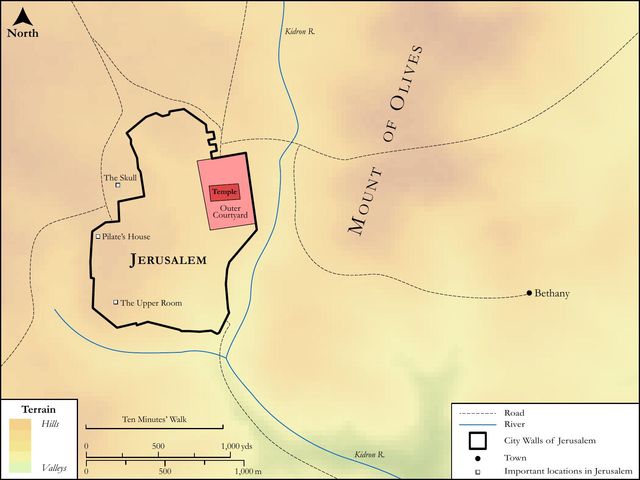
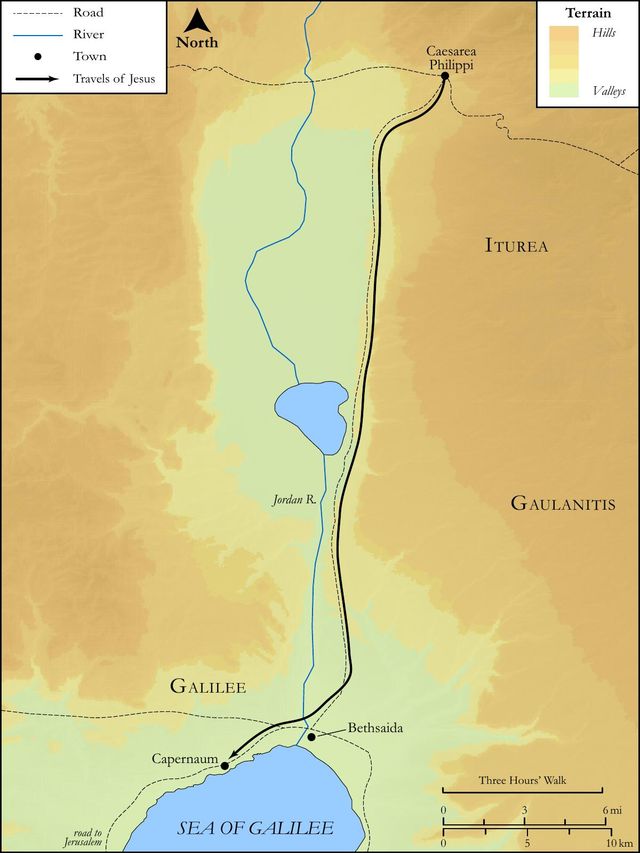
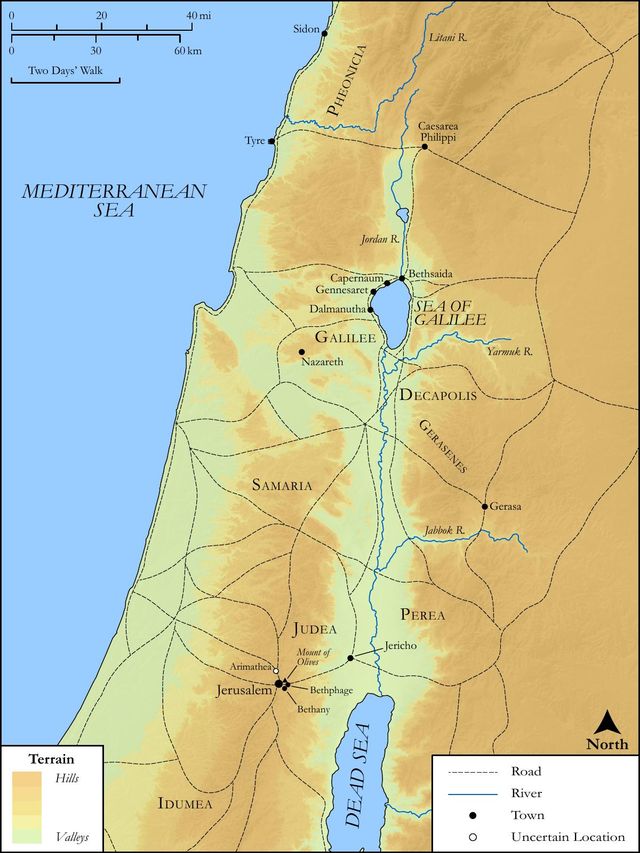
See on the biblical-era maps
Study this verse
Public-domain commentary
Matthew Henry
From his Commentary on the Whole Bible. Henry comments on passages, not single verses — this entry covers Mark 9:41–50. His three-level outline is real structure in the source text, so it is rendered as structure.
Here, I. Christ promiseth a reward to all those that are any way kind to his disciples (Mar 9:41); "Whosoever shall give you a cup of water, when you need it, and will be a refreshment to you, because ye belong to Christ, and are of his family, he shall not lose his reward." Note, 1. It is the honour and happiness of Christians, that they belong to Christ, they have joined themselves to him, and are owned by him; they wear his livery and retainers to his family; nay, they are more nearly related, they are members of his body. 2. They who belong to Christ, may sometimes be reduced to such straits as to be glad of a cup of cold water. 3. The relieving of Christ's poor in their distresses, is a good deed, and will turn a good account; he accepts it, and will reward it. 4. What kindness is done to Christ's poor, must be done them for his sake, and because they belong to him; for that is it that sanctifies the kindness, and puts a value upon it in the sight of God. 5. This is a reason why we must not discountenance and discourage those who are serving the interests of Christ's kingdom, though they are not in every thing of our mind and way. It comes in here as a reason why those must not be hindered, that cast out devils in Christ's name, though they did not follow him; for (as Dr. Hammond paraphrases it) "It is not only the great eminent performances which are done by you my constant attendants and disciples, that are accepted by me, but every the least degree of sincere faith and Christian performance, proportionable but to the expressing the least kindness, as giving a cup of water to a disciple of mine for being such, shall be accepted and rewarded." If Christ reckons kindness to us services to him, we ought to reckon services to him kindnesses to us, and to encourage them, though done by those that follow not with us.
II.He threatens those that offend his little ones, that wilfully are the occasion of sin or trouble to them, Mar 9:42.
Whosoever shall grieve any true Christians, though they be of the weakest, shall oppose their entrance into the ways of God, or discourage and obstruct their progress in those ways, shall either restrain them from doing good, or draw them in to commit sin, it were better for him that a millstone were hanged about his neck, and he were cast into the sea: his punishment will be very great, and the death and ruin of his soul more terrible than such a death and ruin of his body would be. See Mat 18:6.
III.He warns all his followers to take heed of ruining their own souls.
This charity must begin at home; if we must take heed of doing any thing to hinder others from good, and to occasion their sin, much more careful must we be to avoid every thing that will take us off from our duty, or lead us to sin; and that which doth so we must part with, though it be ever so dear to us. This we had twice in Matthew, Mat 5:29, Mat 5:30, and Mat 18:8, Mat 18:9. It is here urged somewhat more largely and pressingly; certainly this requires our serious regard, which is so much insisted upon. Observe,
1.The case supposed, that our own hand, or eye, or foot, offend us; that the impure corruption we indulge is as dear to us as an eye or a hand, or that that which is to us as an eye or a hand, is become an invisible temptation to sin, or occasion of it. Suppose the beloved is become a sin, or the sin a beloved. Suppose we cannot keep that which is dear to us, but it will be a snare and a stumbling-block; suppose we must part with it, or part with Christ and a good conscience.
2.The duty prescribed in that case; Pluck out the eye, cut off the hand and foot, mortify the darling lust, kill it, crucify it, starve it, make no provision for it. Let the idols that have been delectable things, be cast away as detestable things; keep at a distance from that which is a temptation, though ever so pleasing. It is necessary that the part which is gangrened, should be taken off for the preservation of the whole. Immedicabile vulnus ense recidendum est, ne pars sincera trahatur - The part that is incurably wounded must be cut off, lest the parts that are sound be corrupted. We must put ourselves to pain, that we may not bring ourselves to ruin; self must be denied, that it may not be destroyed.
3.The necessity of doing this. The flesh must be mortified, that we may enter into life (Mar 9:43, Mar 9:45), into the kingdom of God, Mar 9:47. Though, by abandoning sin, we may, for the present, feel ourselves as if we were halt and maimed (it may seem to be a force put upon ourselves, and may create us some uneasiness), yet it is for life; and all that men have, they will give for their lives: it is for a kingdom, the kingdom of God, which we cannot otherwise obtain; these halts and maims will be the marks of the Lord Jesus, will be in that kingdom scars of honour.
4.The danger of not doing this. The matter is brought to this issue, that either sin must die, or we must die. If we will lay this Delilah in our bosom, it will betray us; if we be ruled by sin, we shall inevitably be ruined by it; if we must keep our two hands, and two eyes, and two feet, we must with them be cast into hell. Our Saviour often pressed our duty upon us, from the consideration of the torments of hell, which we run ourselves into if we continue in sin. With what an emphasis of terror are those words repeated three times here, Where their worm dieth not, and the fire is not quenched! The words are quoted from Isa 66:24.
(1.)The reflections and reproaches of the sinner's own conscience are the worm that dieth not; which will cleave to the damned soul as the worms do to the dead body, and prey upon it, and never leave it till it is quite devoured. Son, remember, will set this worm gnawing; and how terrible will it bite that word (Pro 5:12, Pro 5:23), How have I hated instruction! The soul that is food to this worm, dies not; and the worm is bred in it, and one with it, and therefore neither doth that die. Damned sinners will be to eternity accusing, condemning, and upbraiding, themselves with their own follies, which, how much soever they are now in love with them, will at the last bite like a serpent, and sting like an adder.
(2.)The wrath of God fastening upon a guilty and polluted conscience, is the fire that is not quenched; for it is the wrath of the living God, the eternal God, into whose hands it is a fearful thing to fall. There are no operations of the Spirit of grace upon the souls of the damned sinners, and therefore there is nothing to alter the nature of the fuel, which must remain for ever combustible; nor is there any application of the merit of Christ to them, and therefore there is nothing to appease or quench the violence of the fire. Dr. Whitby shows that the eternity of the torments of hell was not only the constant faith of the Christian church, but had been so of the Jewish church. Josephus saith, The Pharisees held that the souls of the wicked were to be punished with perpetual punishment; and that there was appointed for them a perpetual prison. And Philo saith, The punishment of the wicked is to live for ever dying, and to be for ever in pains and griefs that never cease.
The two last verses are somewhat difficult, and interpreters agree not in the sense of them; for every one in general, or rather every one of them that are cast into hell, shall be salted with fire, and every sacrifice shall be salted with salt. Therefore have salt in yourselves. [1.] It was appointed by the law of Moses, that every sacrifice should be salted with salt, not to preserve it (for it was to be immediately consumed), but because it was the food of God's table, and no flesh is eaten without salt; it was therefore particularly required in the meat-offerings, Lev 2:13. [2.] The nature of man, being corrupt, and as such being called flesh (Gen 6:3; Psa 78:39), some way or other must be salted, in order to its being a sacrifice to God. The salting of fish (and I think of other things) they call the curing of it. [3.] Our chief concern is, to present ourselves living sacrifices to the grace of God (Rom 12:1), and, in order to our acceptableness, we must be salted with salt, our corrupt affections must be subdued and mortified, and we must have in our souls a savour of grace. Thus the offering up or sacrificing of the Gentiles is said to be acceptable, being sanctified by the Holy Ghost, as the sacrifices were salted, Rom 15:16. [4.] Those that have the salt of grace, must make it appear that they have it; that they have salt in themselves, a living principle of grace in their hearts, which works out all corrupt dispositions, and every thing in the soul that tends to putrefaction, and would offend our God, or our own consciences, as unsavoury meat doth. Our speech must be always with grace seasoned with this salt, that no corrupt communication may proceed out of our mouth, but we may loathe it as much as we would to put putrid meat into our mouths. [5.] As this gracious salt will keep our own consciences void of offence, so it will keep our conversation with others so, that we may not offend any of Christ's little ones, but may be at peace one with another. [6.] We must not only have this salt of grace, but we must always retain the relish and savour of it; for if this salt lose its saltiness, if a Christian revolt from his Christianity, if he loses the savour of it, and be no longer under the power and influence of it, what can recover him, or wherewith will ye season him? This was said Mat 5:13. [7.] Those that present not themselves living sacrifices to God's grace, shall be made for ever dying sacrifices to his justice, and since they would not give honour to him, he will get him honour upon them; they would not be salted with the salt of divine grace, would not admit that to subdue their corrupt affections, no, they would not submit to the operation, could not bear the corrosives that were necessary to eat out the proud flesh, it was to them like cutting off a hand, or plucking out an eye; and therefore in hell they shall be salted with fire; coals of fire shall be scattered upon them (Eze 10:2), as salt upon the meat, and brimstone (Job 18:15), as fire and brimstone were rained on Sodom; the pleasures they have lived in, shall eat their flesh, as it were with fire, Jam 5:3. The pain of mortifying the flesh now is no more to be compared with the punishment for not mortifying it, than salting with burning. And since he had said, that the fire of hell shall not be quenched, but it might be objected, that the fuel will not last always, he here intimates, that by the power of God it shall be made to last always; for those that are cast into hell, will find the fire to have not only the corroding quality of salt, but its preserving quality; whence it is used to signify that which is lasting: a covenant of salt is a perpetual covenant, and Lot's wife being turned into a pillar of salt, made her a remaining monument of divine vengeance. Now since this will certainly be the doom of those that do not crucify the flesh with its affections and lusts, let us, knowing this terror of the Lord, be persuaded to do it.
Historical interpretation
Seven Centuries of Reception
7 surviving comments on this verse. Each one is dated, so this reads as a timeline rather than a list.
Select a marker to jump to its quote. Markers stagger vertically where authors wrote within a few decades of each other.
God never asks his servants to do what is impossible. The love and goodness of his Godhead is revealed as richly available. It is poured out like water upon all. God furnishes to each person according to his will the ability to do something good. None of those seeking to be saved will be lacking in this ability, given by the one who said: “whoever gives you a cup of water to drink because you bear the name of Christ, will by no means lose his reward.”
By which He shows, that he of whom John had spoken was not so far separated from the fellowship of the disciples, as to reject it, as a heretic, but as men are wont to hang back from receiving the Sacraments of Christ, and yet favour the Christian name, so as even to succour Christians, and do them service only because they are Christians. Of these He says they shall not lose their reward; not that they ought already to think themselves secure on account of this good will which they have towards Christians, without being washed with His baptism, and incorporated in His unity, but that they are already so guided by the mercy of God, as also to attain to these, and thus to go away from this life in security.
(Vict. Ant. e Cat. in Marc.) For many believers received gifts, and yet were, not with Christ, such was this man who cast out devils; for there were many of them deficient in some way; some were pure in life, but were not so perfect in faith; others again, contrariwise.
(Vict. Ant. e Cat. in Marc.) It was not from jealousy or envy, however, that John wished to forbid him who cast out devils, but because he wished that all, who called on the name of the Lord, should follow Christ, and be one body with His disciples. But the Lord, however unworthy they who perform the miracles may be, incites others by their means to believe on Him, and induces themselves by this unspeakable grace to become better. Wherefore there follows: But Jesus said, Forbid him not.
(Vict. Ant. e Cat. in Marc.) In conformity to this, He shows that he is not to be forbidden, adding immediately after, For there is no man which shall do a miracle in my name, that can lightly speak evil of me. He says lightly, to meet the case of those who fell into heresy, such as were Simon and Menander, and Cerinthusk; not that they did miracles in the name of Christ, but by their deceptions had the appearance of doing them. But these others, though they do not follow us, cannot however set themselves to say any thing against us, because they honour My name by working miracles.
(Vict. Ant. e Cat. in Marc.) Or else, this is said of those who believe on Him, but nevertheless do not follow Him from the looseness of their lives. Again, it is said of devils, who try to separate all from God, and to disperse His congregation. There follows, For whosoever shall give you a cup of cold water to drink in my name, because ye belong to Christ, verily I say unto you, he shall not lose his reward.
(Vict. Ant. e Cat. in Marc.) And that no man may allege poverty, He mentions that, of which none can be destitute, that is, a cup of cold water, for which also he will obtain a reward; for it is not the value of the gift, but the dignity of those who receive it, and the feelings of the giver, which makes a work worthy of reward. His words show that His disciples are to be received, not only on account of the reward, which he who receives them obtains, but also, because he thus saves himself from punishment. There follows: And whosoever shall offend one of these little ones that believe in me, it is better for him that a millstone were hanged about his neck, and he were cast into the sea: as though He would say,1 All who honour you for My sake have their reward, so also those who dishonour you, that is, offend you, shall receive the worst of vengeance. Further, from things which are palpable to us, He describes an intolerable torment, making mention of a millstone, and of being drowned; and He says not, let a millstone be hanged about his neck, but, it is better for him to suffer this, showing by this that some more heavy evil awaits him. But He means by little ones that believe on Me, not only those who follow Him, but those who call upon His name, those also who offer a cup of cold water, though they do not any greater works. Now He will have none of these offended or plucked away; for this is what is meant by forbidding them to call upon His name.
(in Ezech. 1. Hom. 7) We must observe, however, that in our good works we must sometimes avoid the offence of our neighbour, sometimes look down upon it as of no moment. For in as far as we can do it without sin, we ought to avoid the offence of our neighbour; but if a stumblingblock is laid before men in what concerns the truth, it is better to allow the offence to arise, than that the truth should be abandoned.
(de cura past. p. i. c. 2) Mystically by a millstone is expressed the tedious round and toil of a secular life, and by the depths of the sea, the worst damnation is pointed out. He who therefore, after having been brought to a profession of sanctity, destroys others, either by word or example, it had been indeed better for him that his worldly deeds should render him liable to death, under a secular garb, than that his holy office should hold him out as an example for others in his faults, because doubtless if he had fallen alone, his pain in hell would have been of a more endurable kind.
(ubi sup.) John, loving the Lord with eminent devotion, thought that He who performed an office to which He had no right was to be excluded from the benefit of it. Wherefore it is said, And John answered him, saying, Master, we saw one casting out devils in thy name, and he followeth not us: and we forbad him, because he followeth not us.
(ubi sup.) By which He shows that no one is to be driven away from that partial goodness which he possesses already, but rather to be stirred up to that which he has not as yet obtained.
(ubi sup.) And fitly the man who is offended is called a little one, for he who is great, whatever he may suffer, departs not from the faith; but he who is little and weak in mind looks out for occasions of stumbling. For this reason we must most of all look to those who are little ones in the faith, lest by our fault they should be offended, and go back from the faith, and fall away from salvation.
For whoever gives you a cup of cold water to drink because you belong to Christ, truly I tell you, he will not lose his reward (Psalm 140). We read in the prophet David: To excuse excuses in sins, that many presented quasi-just excuses for their sins, so that they seem to sin out of necessity what they willfully commit. The Lord, the searcher of hearts and minds, who foresees future thoughts in each individual, had said: Whoever receives one such child in my name receives me. Someone could argue and say: I am hindered by poverty, my meager state restrains me so that I cannot practice hospitality. And He dispels this excuse by the simplest precept, that we should wholeheartedly offer a cup of water, and this cold, according to Matthew. He says cold water, not hot, so that the opportunity of poverty and shortage of firewood in heating would not be sought as an excuse. The Apostle instructs similarly to the Galatians: Let him who is taught the word share all good things with him who teaches (Gal. 6). And he encourages disciples towards the refreshment of their teachers. And because anyone could plead poverty and evade the command, he solves the imminent question before proposing it by saying: Do not be deceived; God is not mocked. For whatever a man sows, that he will also reap (Ibid.).
Or again, some unbelievers, seeing that the name of Jesus was full of virtue, themselves used it, and performed signs, though they were unworthy of Divine grace; for the Lord wished to extend His name even by the unworthy.
For how can he speak evil of Me, who draws glory from My name, and works miracles by the invocation of this very name. There follows, For he that is not against you is on your part.
Not only will I not forbid him who works miracles in My name, but also whosoever shall give you the smallest thing for My name's sake, and shall receive you, not on account of human and worldly favour, but from love to Me, shall not lose his reward.
Continue studying Mark 9:41 across the web’s major study libraries — every link below opens this exact verse, chapter, or book on the destination site.
Read & Compare
 BibleGatewayThis verse in more than 200 translations and 70 languages.
 Bible.comThe YouVersion reader — hundreds of translations, reading plans, and highlights.
 ESV.orgCrossway's official English Standard Version reader.
 NET BibleThe NET translation with 60,000+ translators' notes on every rendering decision.
 STEP BibleTyndale House's free study tool — original text, vocabulary, and scholarly resources.
 BibliaLogos Bible Software's free web reader.
 USCCBThe New American Bible (Revised Edition) with the U.S. bishops' study notes.
Commentaries
 BibleHub CommentariesDozens of classic commentaries on this verse, gathered on one page.
 StudyLightMore than 100 commentary sets — the largest collection on the web.
 BibleRefPlain-English commentary on what this verse means, verse by verse.
 Enduring WordDavid Guzik's free commentary on this chapter, widely used by Bible teachers.
 Bible Study ToolsVerse commentary alongside Greek and Hebrew study aids.
Original Language & Research
- BibleHub InterlinearThe verse word by word — original language, transliteration, and English.
- BibleHub LexiconEvery word's original-language definition and Strong's entry.
 Blue Letter BibleDeep-study tools — Strong's numbers, concordance, and word studies.
 CNTR CollationThe earliest Greek manuscripts of this verse, collated letter by letter.
Sermons, Hymns & Audio


TrulyRandomVerse is not affiliated with these sites and doesn’t control their content. They’re linked because they’re genuinely useful.
Summary
Mark 9:41 offers a profound assurance from Jesus, declaring that even the smallest act of kindness—giving a cup of water—performed for His followers "in my name" and "because ye belong to Christ," will certainly receive an eternal reward. This verse encapsulates the divine recognition of sincere, Christ-motivated service, emphasizing that no genuine expression of love and support for those identified with Him goes unnoticed or uncompensated by God. It serves as a powerful encouragement for disciples to extend hospitality and care, knowing their efforts are eternally significant.
Context
ShowHideLiterary Context
This verse concludes a significant teaching segment in Mark's Gospel where Jesus has been instructing His disciples on the true nature of greatness and discipleship, often contrasting worldly values with kingdom principles. Immediately preceding Mark 9:41, Jesus addresses the disciples' dispute about who is the greatest (Mark 9:33-34), teaching them humility and the importance of receiving others, especially children, in His name (Mark 9:35-37). He then warns against causing "little ones" to stumble and speaks graphically about the severity of sin and the necessity of radical commitment to Him, even to the point of self-sacrifice (Mark 9:42-50). In this flow, Mark 9:41 acts as a positive counterpoint, assuring those who support His disciples, even in the most humble ways, that their efforts will not go unrewarded, thus balancing the stern warnings with a promise of divine recompense for faithful service.
Historical & Cultural Context
In the ancient Near East, and particularly in first-century Jewish society, hospitality was not merely a social custom but a moral and religious imperative. Providing water, especially in the arid climate of Palestine, was a fundamental act of care and a life-sustaining gesture. Travelers often relied on the kindness of strangers for basic provisions. To offer a "cup of water" was the simplest, most accessible, and yet profoundly meaningful act of hospitality, available even to the poorest. The phrase "in my name" (G1722 en G3686 ónoma G3450 moû) carried significant weight, implying an act done by the authority of Christ, with His character, and for His sake. It was not merely a general act of charity but one specifically motivated by identification with Jesus and His mission, recognizing that those receiving the water "belong to Christ" (G2075 esté G5547 Christós). This context elevates a simple physical act to a profound spiritual one, demonstrating allegiance and love for the Lord.
Key Themes
ShowHideMark 9:41 contributes to several overarching themes in Mark's Gospel and broader biblical theology. It highlights the value of seemingly small acts when performed with the right motivation, demonstrating that God sees and rewards even the most humble expressions of love and service. This underscores the theme of discipleship as practical service, moving beyond mere intellectual assent to active, compassionate engagement. The phrase "because ye belong to Christ" emphasizes the identification of believers with Jesus, implying that service rendered to His followers is service rendered to Him, a theme powerfully echoed in Matthew 25:40. Furthermore, the promise "he shall not lose his reward" speaks to the certainty of divine recompense for faithful service, assuring believers that their labor in the Lord is never in vain and points to an eternal perspective on earthly deeds.
Exposition and Analysis
ShowHideKey Word Analysis
ShowHideThis preposition, translated "in," denotes a fixed position (in place, time, or state) or instrumentality. In the phrase "in my name," it signifies acting by means of or in the sphere of Christ's authority, character, and purpose. It's not just a verbal invocation but an alignment of one's actions with Christ's identity and mission.
Translated "name," this word refers to more than just a label; it encompasses one's authority, character, reputation, and very essence. To do something "in my name" means to do it as Christ's representative, embodying His nature, and for the advancement of His kingdom.
This word means "pay for service," "hire," "wages," or "reward." It can be positive or negative. Here, it refers to the positive recompense or remuneration for service rendered. The promise is that this "reward" will certainly not be lost, indicating a guaranteed, divinely appointed return for acts of faithful service.
Verse Breakdown
ShowHide"For whosoever shall give you a cup of water to drink"
This clause introduces the specific act of kindness. The "cup of water" is a hyperbole for the smallest, most basic, and universally accessible act of hospitality. It emphasizes that no act of genuine care, however simple or inexpensive, is too insignificant to be noticed by God. The "you" refers to Jesus' disciples, those who are His followers.
"in my name, because ye belong to Christ"
This is the crucial qualifier, defining the motivation and identity behind the act. "In my name" means acting by Christ's authority and embodying His character, for His sake. "Because ye belong to Christ" (literally, "because you are of Christ") clarifies that the recipients are identified with Jesus, emphasizing a spiritual kinship and ownership. The act is rewarded not as general philanthropy, but as an expression of love and allegiance to Christ through His people.
"verily I say unto you"
This is Jesus' solemn affirmation, introduced by the Greek word amēn (amen). It underscores the absolute truth and certainty of the promise that follows. It's a divine guarantee, lending weighty authority to His words.
"he shall not lose his reward"
This is the divine promise. The double negative ("shall not lose") emphasizes the absolute certainty of the reward. It assures that any act of service, however small, performed with the specified motivation, will be acknowledged and compensated by God, implying an eternal and spiritual recompense that cannot be forfeited.
Literary Devices
ShowHideMark 9:41 employs several powerful literary devices. Hyperbole is evident in "a cup of water," which represents the smallest, most common, and least costly act of hospitality, yet it is elevated to a deed worthy of eternal reward. This emphasizes that God values the heart and motivation more than the magnitude of the deed. Emphasis is achieved through Jesus' solemn declaration, "verily I say unto you" (Greek: amḗn legō hymin), which serves as an authoritative pronouncement, drawing the listener's attention to the absolute truth and certainty of the promise. Furthermore, there is a clear Contrast between the humility and simplicity of the act (a cup of water) and the profound, eternal significance of the promised reward. This highlights God's disproportionate grace and generosity in valuing even the most humble service.
Theological and Thematic Connections
ShowHideMark 9:41 deeply connects to the biblical theology of divine justice and recompense, illustrating that God is a rewarder of those who diligently seek and serve Him, particularly through acts of love towards His people. It underscores the profound truth that genuine service, motivated by love for Christ and extended to those who bear His name, is never in vain. This verse affirms the principle of identification: when we serve a follower of Christ, we are, in essence, serving Christ Himself, making every act of kindness a direct expression of devotion to the Lord. It also speaks to the nature of the Kingdom of God, where humility and service are elevated above worldly notions of power and status, and where even the smallest acts of faith-filled love yield eternal dividends.
Reflection and Application
ShowHideMark 9:41 serves as a profound encouragement for every believer, reminding us that our acts of service, no matter how seemingly insignificant, are deeply valued by God when performed with a heart aligned with Christ. It challenges us to look for opportunities to extend kindness, hospitality, and support to others, especially those within the body of Christ, recognizing that in doing so, we are ministering directly to Jesus. This verse liberates us from the pressure of needing to perform grand gestures to gain divine favor, instead focusing on the sincerity of our motives and the love that fuels our actions. It fosters a spirit of selfless generosity and mutual care within the Christian community, assuring us that our labor of love will yield an eternal reward, far surpassing any earthly recognition or material gain.
Questions for Reflection
ShowHideFAQ
ShowHideWhat does "in my name" truly mean in this verse?
ShowHide"In my name" (Greek: en tō onomati mou) signifies more than just uttering Jesus' name. It means acting by His authority, embodying His character, and doing something for His sake or because of a personal relationship with Him. It implies that the deed is performed out of allegiance to Christ, reflecting His values and furthering His purposes. It's an act of identification with Jesus, done as His representative or out of love for Him.
Does this verse imply that we earn our salvation through good deeds?
ShowHideNo, this verse does not teach salvation by works. Christian theology consistently affirms that salvation is by grace through faith in Jesus Christ alone, as articulated in passages like Ephesians 2:8-9. Mark 9:41 speaks to the rewards for faithful service after one has already become a follower of Christ ("because ye belong to Christ"). It highlights God's gracious recognition and recompense for acts of love and obedience performed by those who are already His, demonstrating that our labor in the Lord is never in vain (1 Corinthians 15:58).
Christ-Centered Fulfillment
ShowHideMark 9:41 finds its ultimate Christ-centered fulfillment in the person and work of Jesus Himself, who perfectly exemplified the principle of humble service and the promise of divine reward. Jesus, though God, "made himself of no reputation, and took upon him the form of a servant" (Philippians 2:7), culminating in His ultimate act of service on the cross, where He gave His life as a ransom for many (Mark 10:45). His entire earthly ministry was an embodiment of giving a "cup of water" in the most profound sense, offering spiritual life and refreshment to a thirsty world. The promise of "he shall not lose his reward" is perfectly fulfilled in Christ's resurrection and exaltation "far above all principality, and power, and might, and dominion, and every name that is named" (Ephesians 1:21). Furthermore, Jesus identifies so closely with His followers that service to them is service to Him, as seen in His teaching about serving "the least of these my brethren" (Matthew 25:40). Thus, Mark 9:41 not only encourages Christ-like service but also points to Christ as both the perfect Servant and the ultimate Rewarder, ensuring that all who are "in Him" and serve "in His name" will share in His eternal glory.