


Ezekiel 16:3
Bible text: King James Version (1769 Blayney text) · Public domain
Bible text: King James Version with Strong's numbers · Public domain
Bible text: Berean Standard Bible · Public domain
Bible text: American Standard Version (1901) · Public domain
Bible text: World English Bible, Messianic edition · Public domain
Bible text: Geneva Bible (1599) · Public domain
Bible text: Young's Literal Translation · Public domain
- וְאָמַרְתָּve·'a·mar·Taand you will sayH559Conj-w ¦ V-Qal-ConsecPerf-2msVerb Qal Consecutive Perfect 2nd Singular Masculineוְandאָמַרְתָּyou will say
- כֹּהkohthusH3541AdvAdverb
- אָמַר'a·Marhe saysH559V-Qal-Perf-3msVerb Qal Perfect 3rd Singular Masculine
- אֲדֹנָי'a·do·Nai[the] LordH136N-properNoun Proper Title
- יְהוִהYah·wehYahwehH3069N-properNoun Proper Title
- לִירוּשָׁלִַםli·Ru·sha·Limto JerusalemH3389Prep-l ¦ N-properNoun Proper LocationלִtoירוּשָׁלִַםJerusalem
- מְכֹרֹתַיִךְme·kho·ro·Ta·yikhyour originsH4351N-fpc ¦ 2fsNoun Plural Feminine Constructמְכֹרֹתַיִoriginsךְyour
- וּמֹלְדֹתַיִךְu·Mo·le·do·Ta·yikhand your birth<s>H4138Conj-w ¦ N-fpc ¦ 2fsNoun Plural Feminine Constructוּandמֹלְדֹתַיִbirth<s>ךְyour
- מֵאֶרֶץme·'E·retz[were] from [the] land ofH776Prep-m ¦ N-fscNoun Singular Feminine Constructמֵ[were] fromאֶרֶץ[the] land of
- הַכְּנַעֲנִיha·ke·na·'a·Nithe Canaanite[s]H3669Art ¦ N-msNoun Gentilic Singular Masculine AbsoluteהַtheכְּנַעֲנִיCanaanite[s]
- אָבִיךְ'a·Vikhyour fatherH1N-msc ¦ 2fsNoun Singular Masculine Constructאָבִיfatherךְyour
- הָאֱמֹרִיha·'e·mo·Ri[was] <the> AmoriteH567Art ¦ N-msNoun Gentilic Singular Masculine Absoluteהָ[was] <the>אֱמֹרִיAmorite
- וְאִמֵּךְve·'i·Mekhand your motherH517Conj-w ¦ N-fsc ¦ 2fsNoun Singular Feminine Constructוְandאִמֵּmotherךְyour
- חִתִּיתchi·Tit[was] a HittiteH2850N-fsNoun Gentilic Singular Feminine Absolute
English is a literal word-by-word gloss of the Hebrew, not the KJV's wording. Why?
This is the original text the KJV's translators worked from — each Hebrew word with its own literal English meaning in this verse, prepared by scholars at Tyndale House, Cambridge. The KJV translates whole sentences, not word by word, so its wording differs: one Hebrew word can become several English words, and the KJV may choose “the LORD” where the gloss reads “Yahweh”. Both are faithful — they answer different questions. For the KJV's own rendering, switch to the KJV text.
Details
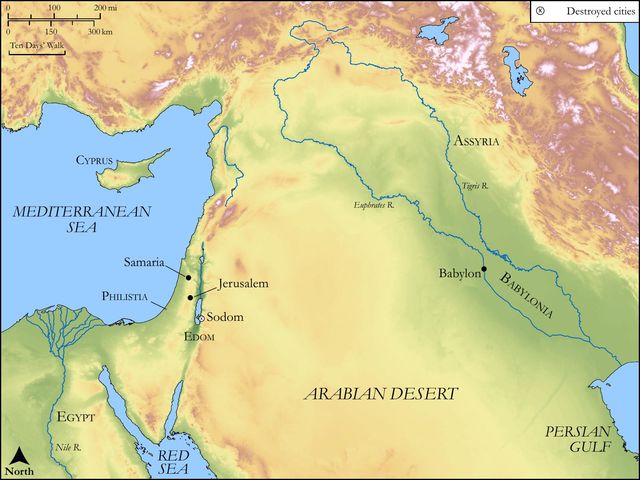
See on the biblical-era map
Study this verse
Public-domain commentary
Matthew Henry
From his Commentary on the Whole Bible. Henry comments on passages, not single verses — this entry covers Ezekiel 16:1–5. His two-level outline is real structure in the source text, so it is rendered as structure.
Ezekiel is now among the captives in Babylon; but, as Jeremiah at Jerusalem wrote for the use of the captives though they had Ezekiel upon the spot with them (ch. 29), so Ezekiel wrote for the use of Jerusalem, though Jeremiah himself was resident there; and yet they were far from looking upon it as an affront to one another's help both by preaching and writing. Jeremiah wrote to the captives for their consolation, which was the thing they needed; Ezekiel here is directed to write to the inhabitants of Jerusalem for their conviction and humiliation, which was the thing they needed.
I.This is his commission (Eze 16:2):
"Cause Jerusalem to know her abominations (that is, her sins); set them in order before her." Note,
1.Sins are not only provocations which God is angry at, but abominations which he hates, as contrary to his nature, and which we ought to hate, Jer 44:4.
2.The sins of Jerusalem are in a special manner so. The practice of profaneness appears most odious in those that make a profession of religion.
3.Though Jerusalem is a place of great knowledge, yet she is loth to know her abominations; so partial are men in their own favour that they are hardly made to see and own their own badness, but deny it, palliate or extenuate it.
4.It is requisite that we should know our sins, that we may confess them, and may justify God in what he brings upon us for them.
5.It is the work of ministers to cause sinners, sinners in Jerusalem, to know their abominations, to set before them the glass of the law, that in it they may see their own deformities and defilements, to tell them plainly of their faults. Thou art the man.
II.That Jerusalem may be made to know her abominations, and particularly the abominable ingratitude she had been guilty of, it was requisite that she should be put in mind of the great things God had done for her, as the aggravations of her bad conduct towards him; and, to magnify those favours, she is in these verses made to know the meanness and baseness of her original, from what poor beginnings God raised her, and how unworthy she was of his favour and of the honour he had put upon her. Jerusalem is here put for the Jewish church and nation, which is here compared to an outcast child, base-born and abandoned, which the mother herself has no affection nor concern for.
1.The extraction of the Jewish nation was mean: "Thy birth is of the land of Canaan (Eze 16:3); thou hadst from the very first the spirit and disposition of a Canaanite." The patriarchs dwelt in Canaan, and they were there but strangers and sojourners, had no possession, no power, not one foot of ground of their own but a burying-place. Abraham and Sarah were indeed their father and mother, but they were only inmates with the Amorites and Hittites, who, having the dominion, seemed to be as parents to the seed of Abraham, witness the court Abraham made to the children of Seth (Gen 23:4, Gen 23:8), the dependence they had upon their neighbours the Canaanites, and the fear they were in of them, Gen 13:7; Gen 34:30. If the patriarchs, at their first coming to Canaan, had conquered it, and made themselves masters of it, this would have put an honour upon their family and would have looked great in history; but, instead of that, they went from one nation to another (Psa 105:13), as tenants from one farm to another, almost as beggars from one door to another, when they were but few in number, yea, very few. And yet this was not the worst; their fathers had served other gods in Ur of the Chaldees (Jos 24:2); even in Jacob's family there were strange gods, Gen 35:2. Thus early had they a genius leading them to idolatry; and upon this account their ancestors were Amorites and Hittites.
2.When they first began to multiply their condition was really very deplorable, like that of a new-born child, which must of necessity die from the womb if the knees prevent it not, Job 3:11, Job 3:12. The children of Israel, when they began to increase into a people and became considerable, were thrown out from the country that was intended for them; a famine drove them thence. Egypt was the open field into which they were cast; there they had no protection or countenance from the government they were under, but, on the contrary, were ruled with rigour, and their lives embittered; they had no encouragement given them to build up their families, no help to build up their estates, no friends or allies to strengthen their interests. Joseph, who had been the shepherd and stone of Israel, was dead; the king of Egypt, who should have been kind to them for Joseph's sake, set himself to destroy this man-child as soon as it was born (Rev 12:4), ordered all the males to be slain, which, it is likely, occasioned the exposing of many as well as Moses, to which perhaps the similitude here has reference. The founders of nations and cities had occasion for all the arts and arms they were masters of, set their heads on work, by policies and stratagems, to preserve and nurse up their infant states. Tantae molis erat Romanam condere gentem - So vast were the efforts requisite to the establishment of the Roman name. Virgil. But the nation of Israel had no such care taken of it, no such pains taken with it, as Athens, Sparta, Rome, and other commonwealths had when they were first founded, but, on the contrary, was doomed to destruction, like an infant new-born, exposed to wind and weather, the navel-string not cut, the poor babe not washed, not clothed, no swaddled, because not pitied, Eze 16:4, Eze 16:5. Note, We owe the preservation of our infant lives to the natural pity and compassion which the God of nature has put into the hearts of parents and nurses towards new-born children. This infant is said to be cast out, to the loathing of her person; it was a sign that she was loathed by those that bore her, and she appeared loathsome to all that looked upon her. The Israelites were an abomination to the Egyptians, as we find Gen 43:32; Gen 46:34. Some think that this refers to the corrupt and vicious disposition of that people from their beginning: they were not only the weakest and fewest of all people (Deu 7:7), but the worst and most ill-humoured of all people. God giveth thee this good land, not for thy righteousness, for thou art a stiff-necked people, Deu 9:6. And Moses tells them there (Eze 16:24), You have been rebellious against the Lord from the day that I knew you. They were not suppled, nor washed, nor swaddled; they were not at all tractable or manageable, nor cast into any good shape. God took them to be his people, not because he saw any thing in them inviting or promising, but so it seemed good in his sight. And it is a very apt illustration of the miserable condition of all the children of men by nature. As for our nativity, in the day that we were born we were shapen in iniquity and conceived in sin, our understandings darkened, our minds alienated from the life of God, polluted with sin, which rendered us loathsome in the eyes of God. Marvel not then that we are told, You must be born again.
Historical interpretation
Two Centuries of Reception
4 surviving comments on this verse. Each one is dated, so this reads as a timeline rather than a list.
Select a marker to jump to its quote. Markers stagger vertically where authors wrote within a few decades of each other.
Which of the cities in the world were so elevated and so deep in knowledge as the city of God?
If so many things are said in Jerusalem about which such great and wonderful things are written that have been promised to her, what future is there for unhappy me, if I sin? Who will I have for a father, who will I have for a mother?
If we are on the alert, these evils that came into life as a result of the sins of our forebears will in no way be able to harm us, because in fact they go no further than the level of terminology. It was the first formed human being who through the fall brought on the punishment of death and was responsible for spending his life in pain and distress, and it was he who was the cause of servitude. But Christ the Lord came and permitted all these evils to occur only at the level of terminology, provided we are of the right mind. You see, death is now not death but only carries the name of death—or, rather, even the very name has been abolished.
(Verse 3) Your ancestors and your lineage are from the land of Canaan (Vulgate: Canaan). Your father is Amorite, and your mother is Hittite. Great faith and immense boldness of the prophets, to accuse one man and the whole city of ignobility. Marvelous is Daniel, who dared to say to the delinquent elder, committing adultery and murder: The seed of Canaan, not Judah, has deceived you (Dan. 13:56). Great is also Isaiah, who cries out to the princes and the people of Judah: Hear the word of the Lord, you princes of Sodom, listen with your ears to the words of the Lord, people of Gomorrah (Isa. 1:10). But not less so Ezechiel, who speaks confidently to the whole city: Your root, and your generation from the land of Chanaan: Your father Amorrhite, and your mother Chethite, Although even Stephen, the first martyr of the Gospel, spoke to the insane people (Acts 7:51): You have always resisted the Holy Spirit with stubborn necks and uncircumcised hearts (Al. you resist). And although we may understand that Jerusalem is the root and its generation the land of Chanaan, according to what is said, that the people was called in Egypt and dwelled there for a long time (for Cham, father of Chanaan, was the head of the Egyptian nation), nevertheless, according to the similarity of their crimes, we will say that the root of Jerusalem is the land of Egypt: Hence its father is also called Amorrhite, which means 'being talked about,' that is, being much celebrated in speech. And your mother Chethaea, that is, one who is possessed; who either herself is insane, or who sends others into madness. For everyone who commits sin is born of the devil (John 8:54). Therefore, in the whole world, the famous name of this ancient father is, and he turns many into madness. And it is commanded to Jerusalem, either according to the letter or according to the spirit, to leave the ancient father; and it is said to her: Hear, daughter, and see, and incline your ear; and forget your people, and your father's house: and the king will desire your beauty (Psalm 45:11). And it is promised to him that if he desires to return to the true father after sin: I will restore you as you were when you were born. What great nobility, that the city of Jerusalem, which descended from the lineage of Abraham, Isaac, and Jacob, had God as its father? And yet because he sinned and abandoned the true parent, he deserves to hear: Your root and your generation are from the land of Canaan: Your father is Amorite, and your mother is Hittite. If she heard this: what will happen to us who were called from the filth of the nations, who have lost every stain in the baptism of the Savior, if we defile the garment of Christ and do not have the wedding garment at the banquet? Certainly, it is necessary that we are handed over with bound hands and feet to eternal flames, in which there is weeping of eyes and gnashing of teeth (Matthew 22).
Continue studying Ezekiel 16:3 across the web’s major study libraries — every link below opens this exact verse, chapter, or book on the destination site.
Read & Compare
 BibleGatewayThis verse in more than 200 translations and 70 languages.
 Bible.comThe YouVersion reader — hundreds of translations, reading plans, and highlights.
 ESV.orgCrossway's official English Standard Version reader.
 NET BibleThe NET translation with 60,000+ translators' notes on every rendering decision.
 STEP BibleTyndale House's free study tool — original text, vocabulary, and scholarly resources.
 BibliaLogos Bible Software's free web reader.
 USCCBThe New American Bible (Revised Edition) with the U.S. bishops' study notes.
Commentaries
 BibleHub CommentariesDozens of classic commentaries on this verse, gathered on one page.
 StudyLightMore than 100 commentary sets — the largest collection on the web.
 BibleRefPlain-English commentary on what this verse means, verse by verse.
 Enduring WordDavid Guzik's free commentary on this chapter, widely used by Bible teachers.
 Bible Study ToolsVerse commentary alongside Greek and Hebrew study aids.
Original Language & Research
- BibleHub InterlinearThe verse word by word — original language, transliteration, and English.
- BibleHub LexiconEvery word's original-language definition and Strong's entry.
 Blue Letter BibleDeep-study tools — Strong's numbers, concordance, and word studies.
 SefariaThe Hebrew text with Rashi and centuries of Jewish commentary.
Sermons, Hymns & Audio


TrulyRandomVerse is not affiliated with these sites and doesn’t control their content. They’re linked because they’re genuinely useful.
Summary
Ezekiel 16:3 initiates a profound and extended allegory in which the prophet, speaking for the Lord GOD, confronts Jerusalem directly, personifying the city as a foundling child with deeply pagan origins. This verse immediately establishes the city's spiritual heritage not as pure Israelite, but as rooted in the idolatrous and immoral practices of the surrounding Canaanite nations, specifically identifying its "father" as an Amorite and its "mother" as a Hittite. This stark declaration sets the stage for the chapter's scathing indictment of Jerusalem's profound unfaithfulness and spiritual adultery, highlighting that its very existence and subsequent blessings were solely due to God's unmerited grace, rather than any inherent worth or pure lineage.
Context
ShowHideLiterary Context
Ezekiel 16 is a remarkable and graphic allegory, arguably one of the most vivid in the prophetic literature. Following chapters 1-11, which detail God's glory departing the temple and Jerusalem's impending judgment, and chapters 12-15, which deliver various pronouncements of doom, chapter 16 shifts to a deeply personal and historical indictment. The Lord GOD addresses Jerusalem as a female child, abandoned and defiled at birth, whom He lovingly rescued, nourished, adorned, and married. Verse 3 serves as the foundational premise for this entire narrative, establishing Jerusalem's ignoble, pagan origins to underscore the magnitude of God's unmerited favor and, consequently, the heinousness of the city's subsequent betrayal. It sets up the dramatic contrast between God's lavish grace and Jerusalem's profound spiritual harlotry, which unfolds in graphic detail throughout the rest of the chapter, culminating in her judgment and eventual restoration.
Historical & Cultural Context
The historical context for Ezekiel's prophecy is the Babylonian exile, specifically around 593-571 BC. Jerusalem, though not yet fully destroyed, was under Babylonian dominion, and many of its inhabitants, including Ezekiel, had already been deported. The "land of Canaan" refers to the geographical region into which Israel migrated, a land populated by various indigenous groups. The Amorites and Hittites were prominent Canaanite tribes, known for their polytheistic religions, fertility cults, and often abhorrent practices, including child sacrifice. These groups represented the very antithesis of Yahweh worship and the Mosaic Law. By attributing Jerusalem's "parentage" to these specific tribes, God is not suggesting a literal ethnic lineage for the Jewish people, but rather a spiritual and moral one. It powerfully conveys that Jerusalem, the supposed holy city, had fully absorbed the idolatry and immorality of the Amorites and Hittites, becoming indistinguishable from them in its spiritual corruption, a stark contrast to God's original command for Israel to remain separate from the nations of Canaan, as outlined in Deuteronomy 7:1-6.
Key Themes
ShowHideThis verse introduces several crucial themes that permeate Ezekiel 16 and the broader prophetic message. Firstly, it highlights Divine Grace versus Human Unfaithfulness. Jerusalem had no inherent claim to God's favor; its spiritual roots were in paganism, emphasizing that its chosen status was solely due to God's unmerited grace, not its own worth or pure lineage. This sets up the stark contrast with its later profound unfaithfulness. Secondly, it addresses Spiritual Identity and Origins. God challenges Jerusalem's self-perception, reminding it of its true spiritual beginnings. The "Amorite" and "Hittite" represent the dominant pagan cultures of Canaan, known for their abominable practices. This imagery powerfully conveys that Jerusalem, despite being God's holy city, had fully assimilated the spiritual corruption of the surrounding nations, becoming indistinguishable from them in its idolatry, a theme elaborated upon in Ezekiel 16:32. Thirdly, it underscores the pervasive issue of Idolatry and Moral Corruption. By linking Jerusalem's "parents" to these specific Canaanite groups, the verse implicitly condemns the city's adoption of their idolatrous worship and immoral customs, which were explicitly forbidden by God to Israel, as seen in passages like Deuteronomy 12:29-31.
Exposition and Analysis
ShowHideKey Word Analysis
ShowHideA word suggesting "origin" or "source," as if from a mine. This term emphasizes the deep-seated foundation or intrinsic beginning of Jerusalem's spiritual identity. It points to something fundamental to its "birth" or "habitation" in the land, reflecting its inherent pagan roots.
Derived from the verb "to beget" or "to bear." This term specifically refers to one's birthplace, lineage, or family origin. Its pairing with mᵉkûwrâh creates a powerful rhetorical emphasis on Jerusalem's complete and undeniable connection to its pagan roots, highlighting both its geographical and ancestral ties to Canaanite practices.
A patronymic term referring to a descendant of the Amorites, one of the prominent Canaanite tribes. The name possibly means "mountaineer" or "prominent." Historically, the Amorites were known for their strength and widespread presence in Canaan before the Israelite conquest. Theologically, they represent the epitome of pagan idolatry and moral depravity against which Israel was repeatedly warned, as seen in Genesis 15:16. Attributing Jerusalem's father to an Amorite powerfully symbolizes its deep assimilation of the very evils God commanded Israel to eradicate.
Verse Breakdown
ShowHide"And say, Thus saith the Lord GOD unto Jerusalem;"
This opening establishes the divine authority of the message. The phrase "Thus saith the Lord GOD" (Hebrew: ʼĂdônây Yᵉhôvih, H136 H3069) is a powerful prophetic formula, emphasizing that the words are not Ezekiel's own but a direct revelation from the sovereign God of Israel. The direct address "unto Jerusalem" (H3389) personifies the city, setting the stage for the extended allegory of the chapter, treating it as a moral agent capable of hearing and responding to divine indictment.
"Thy birth and thy nativity [is] of the land of Canaan;"
This clause immediately confronts Jerusalem's presumed holy identity by asserting its deep-seated origins in the pagan land of Canaan (H776 H3669). The repetition of "birth" (mᵉkûwrâh, H4351) and "nativity" (môwledeth, H4138) forcefully underscores that Jerusalem's spiritual "DNA" was fundamentally intertwined with the idolatry and immorality prevalent in the region before God's intervention. It implies a spiritual, not necessarily ethnic, heritage, highlighting its default state of corruption apart from divine grace.
"thy father [was] an Amorite, and thy mother an Hittite."
This graphic imagery further specifies Jerusalem's pagan heritage. The Amorites (H567) and Hittites (H2850) were prominent, powerful, and notoriously idolatrous Canaanite tribes. By assigning them as Jerusalem's "parents" (H1, H517), God vividly portrays the city's spiritual assimilation of their abominable practices, highlighting its deep-seated corruption and its departure from the covenant purity expected of God's chosen people. This is a metaphorical statement about Jerusalem's spiritual identity and practices, not a literal genealogical claim, underscoring the extent of its spiritual harlotry.
Literary Devices
ShowHideEzekiel 16:3 employs several powerful literary devices to convey its scathing indictment. The most prominent is Personification, where Jerusalem is addressed directly as a female child, setting up the extended Allegory that unfolds throughout the entire chapter. This allows God to narrate Jerusalem's history as a personal drama of rescue, covenant, and profound betrayal. The description of Jerusalem's "father" as an Amorite and "mother" as a Hittite is a potent Metaphor and Symbolism. These specific Canaanite tribes symbolize the deep-seated paganism, idolatry, and moral corruption that characterized the land from which Jerusalem arose and which it later embraced. This metaphorical parentage is a form of Hyperbole, exaggerating Jerusalem's pagan origins to emphasize the depth of its spiritual assimilation and the stark contrast with God's gracious election. The repetition of "birth" and "nativity" also serves as a form of Emphasis, underscoring the undeniable and intrinsic connection Jerusalem had to the land's pagan practices.
Theological and Thematic Connections
ShowHideEzekiel 16:3 serves as a stark theological declaration, reminding Jerusalem, and by extension, Israel, of their true spiritual origins and the profound nature of God's unmerited grace. The verse challenges any notion of inherent righteousness or claim to divine favor based on lineage, firmly establishing that Jerusalem's very existence as God's city was an act of sovereign election and redemptive love, rescuing it from a state of utter spiritual depravity. This sets the theological stage for understanding Jerusalem's subsequent unfaithfulness not merely as disobedience, but as a heinous act of spiritual adultery against a God who had lavished immeasurable grace upon a people who, by their "birth," were no different from the pagan nations around them. This foundational truth underscores the theme of God's unilateral covenant love in the face of human depravity.
Reflection and Application
ShowHideEzekiel 16:3 offers profound insights for believers today, serving as a powerful reminder of our own spiritual origins and the magnitude of God's grace. Just as Jerusalem had no inherent claim to God's favor, but was "born" into a state of spiritual corruption, so too humanity is born into sin, separated from God and steeped in the ways of the world. This verse compels us to remember that any spiritual standing, salvation, or blessing we possess is purely by God's unmerited grace, not by our own merit, background, or good works. It fosters humility and gratitude, prompting us to continually acknowledge that "it is by grace you have been saved" (Ephesians 2:8). Furthermore, the warning implicit in Jerusalem's assimilation of pagan practices serves as a potent caution against spiritual compromise in our own lives. We are called to be in the world but not of the world, vigilant against adopting values, practices, or ideologies that contradict God's truth. This verse challenges us to examine our own "spiritual DNA" and ensure that our identity is rooted firmly in Christ, not in the prevailing culture.
Questions for Reflection
ShowHideFAQ
ShowHideWas Jerusalem literally founded by Amorites and Hittites?
ShowHideNo, Ezekiel 16:3 is not a literal historical or ethnic statement about the founding of Jerusalem or the lineage of the Jewish people. The Jewish people traced their ancestry back to Abraham, Isaac, and Jacob. Instead, this verse uses powerful allegory and metaphor to convey a spiritual truth. By declaring Jerusalem's "father" an Amorite and "mother" a Hittite, God is highlighting the city's deep spiritual and moral corruption, indicating that it had fully assimilated the idolatrous and immoral practices of the surrounding Canaanite nations from which God had called Israel to be separate. It emphasizes that Jerusalem's spiritual "DNA" was, by default, pagan, and its existence as God's city was solely due to His unmerited grace and transformative power.
Why does God use such harsh language to describe Jerusalem?
ShowHideGod uses such graphic and unflinching language in Ezekiel 16, including verse 3, to convey the profound depth of Jerusalem's spiritual unfaithfulness and the heinousness of its sin. The allegory of a foundling child rescued and adorned by God, only to become a harlot, is designed to shock and expose the severity of their spiritual adultery. This harshness is not gratuitous; it reflects the intensity of God's grief over their betrayal and the seriousness of breaking covenant with Him. It underscores that despite God's immense grace and blessings, Jerusalem had chosen to become indistinguishable from the very pagan nations whose practices God abhorred. The language serves to emphasize the gravity of their rebellion and to justify the impending judgment, while also setting the stage for the eventual hope of restoration rooted in God's steadfast love, as seen later in Ezekiel 16:60-63.
Christ-Centered Fulfillment
ShowHideEzekiel 16:3, with its stark portrayal of Jerusalem's pagan origins and spiritual depravity, finds profound Christ-centered fulfillment in several ways. Firstly, it powerfully underscores the universal human condition. Just as Jerusalem was "born" into a land of Canaanite idolatry, so too all humanity is born into a world steeped in sin, alienated from God by nature and choice, as described in Romans 3:23 and Ephesians 2:1-3. We, like Jerusalem, have no inherent righteousness or claim to God's favor. Secondly, the verse highlights the absolute necessity and glory of God's sovereign grace. What God did for Jerusalem—rescuing, cleansing, and adorning her—He supremely does for humanity through Jesus Christ. Christ is the ultimate expression of God's unmerited love, taking us from our "birth" in sin and making us new creations, adopted into His family (2 Corinthians 5:17). He is the true Israel, perfectly obedient where Jerusalem failed, fulfilling the covenant promises. Through His atoning sacrifice, Christ cleanses us from our "Amorite" and "Hittite" spiritual heritage of sin and idolatry, transforming us into His own pure bride (Ephesians 5:25-27). Thus, Ezekiel 16:3 ultimately points to the radical, transformative power of the Gospel, where God's grace in Christ overcomes our deepest spiritual depravity, offering new birth and a pure identity in Him (John 3:3).